Artículos de Investigación
Digital twin integration and sustainability outcomes: evidence from Huawei’s transformation journey (2008–2024)
Integración del gemelo digital y resultados de sostenibilidad: evidencia del proceso de transformación de Huawei (2008–2024)
 Mohamed Boulesnam boulesnam.mohamed@univ-medea.dz
Abdelghani Kahela kahela.abdelghani@univ-medea.dz
Ouissam Hocini hocini.ouissam@univ-medea.dz
Noha Mohamed Helal El-Shobary dr_nohahelal@dsw.bsu.edu.eg
Mohamed Boulesnam boulesnam.mohamed@univ-medea.dz
Abdelghani Kahela kahela.abdelghani@univ-medea.dz
Ouissam Hocini hocini.ouissam@univ-medea.dz
Noha Mohamed Helal El-Shobary dr_nohahelal@dsw.bsu.edu.eg
Digital twin integration and sustainability outcomes: evidence from Huawei’s transformation journey (2008–2024)
Uniandes Episteme. Revista digital de Ciencia, Tecnología e Innovación, vol. 12, núm. 4, pp. 554-571, 2025
Universidad Regional Autónoma de los Andes

Esta obra está bajo una Licencia Creative Commons Atribución-NoComercial-CompartirIgual 4.0 Internacional.
Recepción: 06/09/2025
Revisado: 21/09/2025
Aprobación: 23/09/2025
Publicación: 01/10/2025
Abstract: This study aimed to determine how the transition to the Digital Twin (DT) model has significantly affected sustainability from 2008 to 2024 at Huawei Technologies. The measurable impact of DT systems on green packaging, waste to landfill, and water consumption was thoroughly assessed through statistical evaluation using dummy-variable regression and independent samples T-test in a comprehensive mixed-methods approach. Significant observable changes in the efficacy of eco-friendly packaging and waste reduction associated with DT were evident after 2015, when real-time monitoring, simulation, and predictive analytics were applied. Water consumption also noticeably increased after the advent of DT, although increased transparency and scale may have also contributed. The findings are in line with relevant literature on ecological innovation through DT and support digital technology's role in advancing corporate environmental performance. The contributions further widen the scope of discussions on digital sustainability while highlighting DTs as strategic tools toward measurable and impactful environmental gains.
Keywords: Digital Twin, sustainability, environmental performance, Huawei, digital transformation.
Resumen: Este estudio tuvo como objetivo determinar cómo la transición al modelo Gemelo Digital (GD) ha afectado significativamente la sostenibilidad de 2008 a 2024 en Huawei Technologies. El impacto medible de los sistemas GD en los envases ecológicos, los residuos a vertedero y el consumo de agua se evaluó exhaustivamente mediante una evaluación estadística utilizando regresión de variable ficticia y prueba T de muestras independientes en un enfoque integral de métodos mixtos. Cambios observables significativos en la eficacia de los envases ecológicos y la reducción de residuos asociados con GD fueron evidentes después de 2015, cuando se aplicó la monitorización en tiempo real, la simulación y el análisis predictivo. El consumo de agua también aumentó notablemente después de la llegada del GD, aunque una mayor transparencia y escala también pueden haber contribuido. Los hallazgos están en línea con la literatura relevante sobre innovación ecológica a través del GD y respaldan el papel de la tecnología digital en el avance del desempeño ambiental corporativo. Las contribuciones amplían aún más el alcance de las discusiones sobre la sostenibilidad digital al tiempo que destacan los GD como herramientas estratégicas para obtener ganancias ambientales medibles e impactantes.
Palabras clave: Gemelo Digital, sostenibilidad, desempeño ambiental, Huawei, transformación digital.
INTRODUCTION
Digital Twin (DT) technology has recently evolved as one of the main revolutionary forces that drives environmental innovation to allow an organization to simulate, command, monitor, and optimize their operation sustainability in real time. Due to the growing pressure from both the regulatory bodies and society to minimize footprints on the earth and achieve high climate targets, DT systems provide dynamic connections between the physical infrastructure and digital intelligence. They permit predictive modeling, real-time monitoring, and system-wide optimization that can be better allocated for cleaner production processes across complex industrial ecosystems.
Sustainability is no longer a peripheral concern but has become a central pillar of long-term corporate strategy, competitiveness, and responsibility. Environmental metrics such as water usage, eco-friendly packaging deployment, and industrial waste management have evolved into key performance indicators for organizations aiming to align with global sustainability frameworks. Companies that proactively work toward dealing with these dimensions make their contributions toward environmental protection; additionally, they make their activities more resilient to future changes, less costly in the long run, and more trustworthy in the eyes of stakeholders.
This research assesses the role of DT adoption in promoting sustainability in Huawei Technologies, being the world leader in information and communication technology (ICT) innovation. It has been noted that most researchers have emphasized operational efficiency and financial performance gains associated with DT systems. The present study changes the setting to environmental outcomes instead. This study is about whether the integration of DT at Huawei, which was officially started in 2015, has improved its environmental footprint over time.
It also relies on longitudinal analysis covering 2008 to 2024, determining the empirical impact of DT adoption on three key indicators: green packaging consumption, percentage of waste sent to landfills, and consumption of water. The outcomes contribute to the emerging discourse on digital sustainability and position DT technology as a strategic lever for environmental progress in large-scale corporate operations.
The study presents three research hypotheses that bear on the potential environment-level benefits of DT adoption. The first holds that integration of DT has led to a statistically significant increase in green packaging use, reflecting improved practices in sustainable materials. The second states that the extent of adopting DT is associated with a tremendous decline in the percentage of waste sent to landfills, indicating enhanced waste management efficiency. The third examines whether the implementation of DT has had a measurable impact on water consumption, acknowledging both the prospects of greater efficiency and claims to increase resource demand due to operational scale. These hypotheses frame the analytical focus of the study and form the basis for the statistical tests that follow.
METHODS
To measure the environmental effects of DT adoption at Huawei Technologies, this study employed a quantitative longitudinal approach from 2008 to 2024. The period was divided into two phases: Before-DT Period (2008-2014), representing the years prior to the introduction of DT, and After-DT Period (2015-2024), representing the years following the integration of DT into everyday operations at Huawei Technologies. Three environmental performance indicators are sourced from the sustainability reports of Huawei: green packaging, waste to landfill, and water consumption. These variables represented different facets of the company's environmental strategy: green packaging, which indicates the volume of eco-friendly materials used; landfill percentage, which measures waste disposal efficiency; and water consumption, which reflects the intensity of resource usage.
To determine the possible impact of DT adoption on these indicators, two supplementary statistical techniques were applied using SPSS software. First, a dummy variable regression model was examined. A binary variable was created to correspond to the adoption of DT (0 for the pre-DT period and 1 for the post-DT period), with each environmental indicator regressed independently on this dummy variable. Thus, the model estimated whether a structural shift occurred after the adoption of DT, quantifying the direction and magnitude of that change.
In addition to regression analysis, the study conducted independent samples T-tests to compare the average values of each indicator before and after DT adoption. This served as a robust check for regression results to ensure that the observed change was not due to random variation. The T-tests provide a further comparative statistical perspective on whether the observed shifts in green packaging, landfill waste, and water consumption are statistically significant across the two periods.
All analysis was done with SPSS software to maintain methodological consistency, transparency, and reproducibility. Both regression and hypothesis testing techniques applied contribute to the assessment of environmental transformation, whilst triangulation of these methods aims at establishing whether indeed measurable and meaningful improvements in the environmental performance of Huawei Technologies have taken place through the integration of DT technology.
RESULTS
1. Literature review
The digital twin technology was venturing more into the international arena to be the connecting factor of the countries, driving efforts towards their sustainability. Digital twins are actual virtual copies of real assets that facilitate real-time data acquisition, simulation, and predictive analytics for industries by being able to make them more efficient, consume less resources, reduce wastage, and support better decision making (Gerstlberger & Prause, 2024; Trienens et al., 2024). Now, integrating DTs with Industry 4.0 and digitalization enables them to address newer environmental and operational issues (Meng et al., 2023; Kineber et al., 2023).
More literature supports that DTs facilitate the transition to sustainable production systems. Ünal et al. (2023) and Maheshwari et al. (2023) findings noted that DTs allowed better control over energy and material consumption, contributing to reduced carbon emissions and operating costs. Bassey et al. (2024) considered them applicable to improvements in renewable energy forecasting, particularly in the accuracy and reliability of prediction results. Indeed, for buildings, DTs support optimal energy use and carbon emission reduction, while justifying in the domains of water and food, predictive maintenance enabled through DTs reduces the volume of waste and unplanned downtimes (Saini et al., 2022(.
In manufacturing and logistics, DT provides dynamic views into supply chains with improved sustainability using scenario modeling, traceability, and resource planning (Singh et al., 2023; Enyejo et al., 2024). According to Malik (2024), the inclusion of DT with circular economy frameworks improves the recycling process, reduces dependence on raw materials, and enhances long-term viability.
The construction and built environment sectors have also been transformed by the digitalization of twin technology. Research shows that DTs integrated with Building Information Modeling (BIM) improve lifecycle assessment and facilitate green building certification )Figueiredo et al., 2024(. They explore DTs with blockchain-enhancement for support on transparency and the integrity of data in sustainable construction.
Meanwhile, DTs extend to smart cities and urban sustainability; they are being used in traffic management and waste optimization. In addition, energy systems such as smart grids can significantly decrease carbon emissions through better demand prediction and grid balancing (Al-Shetwi et al., 2025).
Strategically enabling sustainability through DTs is more than just an operational aspect. Pires et al. (2021) and Bányai and Kovács (2023) discussed how DTs will provide real-time feedback loops that improve decision-making under uncertainty. Yakovenko and Shaptala (2024) mentioned that their focus is on using DTs for environmental, social, and governance reporting and compliance. Garske et al. (2024) and Diodato et al. (2023) talk about how digital governance frameworks will allow achieving the full sustainability promise of DTs, particularly in green transitions in Europe.
Potential reinforcement of this sustainability promise is through applications that are state-specific. For oil and gas, it is said that such narrow-scope use of digital twinning will serve to minimize risk, prolong the life span of pieces of equipment, and reduce environmental footprint (Zhang et al., 2024; Svadkovsky, 2023).
Yet, despite holding promises, many hurdles remain in DT deployment. The challenges of initial high investment cost, a lack of standardized frameworks, and voids in technical skills are reported by Eslahi et al. (2024) and Al Maawali and Al Fahdi (2022). More empirical evidence is noted by Piras et al. (2024) to take place in validating the sustainability claims. The efforts should be directed toward generating unified sustainability metrics within DT architectures. These concerns are relevant for developing nations, where digital infrastructures and policy alignment are still not well developed.
Other studies in the current decade have increasingly focused on the interaction network of DTs with other enabling technologies needed to derive the full potential of DTs. For example, Khajavi et al. (2019) and Zhang and Jiang (2024) discussed using AI synergies, and Pomè and Signorini (2023) evaluated blockchain integration. These combinations not only add value but also create a solid setup for real-time, data-driven environmental control. Lifecycle sustainability assessments are also another realm where DTs are superior. Dynamic life-cycle modeling with resultant emissions, water usage, and energy flows over time was demonstrated by Edrisi and Azari (2023) to facilitate ex ante redesign of processes, resource reallocation, and reduction of adverse environmental externalities. In addition, renovation strategies for aging infrastructure have been investigated using system dynamics models supported by DT.
While the existing literature has extensively highlighted the potential of DT technologies in enhancing sustainability across various sectors, ranging from manufacturing and construction to smart cities and agriculture, most studies remain fragmented in scope, domain-specific, or focused on theoretical promises and sectoral applications. Unlike these studies, the current research offers a comprehensive, empirical assessment of DT adoption within a single corporate context over time, using measurable environmental performance indicators. By focusing on Huawei Technologies and analyzing post-adoption trends in water consumption, green packaging, waste generation, and greenhouse gas emissions, this study contributes a longitudinal, data-driven perspective on DTs' real-world impact on sustainability. Moreover, by integrating environmental metrics with organizational strategy, this work bridges the gap between technological deployment and tangible ecological outcomes, offering a replicable model for evidence-based sustainability assessment in other industries and regions.
2. Evaluating the environmental impact of DT adoption: evidence from Huawei Technologies (2008–2024)
DT technology has been introduced as a significant moment for Huawei Technologies as it transitions into a digitalized and sustainable solution. From 2015 onwards, adopting DT systems within Huawei was about improving efficiencies and laying down a foundation for developing ecological wisdom through intelligent automation and real-time optimization. By virtualizing physical assets and environmental systems, DT platforms allowed Huawei to simulate, monitor, and predict environmental impacts with unprecedented precision in industrial operations and supply chains. This environmental modeling capability can contribute to more enlightened decision-making regarding the use of resources, reduction of emissions, and disposal of waste. Therefore, this study delved into two time periods concerning how Huawei's environmental performance has changed before and after adopting DT (which refers to the changes that took place from 2008 to 2014 and from 2015 to 2024, respectively). Comparisons of longitudinal trends before and after deploying DT provided insights into whether DT deployment has had a significant impact on green packaging adoption, reduced landfill waste, and freshwater consumption. All this will be done while providing a data-driven assessment of how DT has influenced corporate environmental dynamics.
2.1 The Evolution of DT Integration at Huawei Technologies
It is necessary to set the timeframe and veracity of Huawei's investment in the adoption of DT technologies before evaluating the effects of this adoption on sustainability. According to its annual reports, this study notes a strategic inflection point around 2015 when Huawei's initiatives started to become oriented towards DT. Although the term “digital twin” was not explicitly used in the early stages, substantial investments in cloud computing, ICT infrastructure, and data systems laid the groundwork for future DT integration. This foundational period forms the empirical basis for the sustainability-focused regression models and comparative analyses employed in the current study.
Huawei’s progression toward DT maturity followed a deliberate, phased approach spanning nearly a decade. From 2015 to 2018, the company focused on developing enabling technologies—such as artificial intelligence, the Internet of Things (IoT), 5G, and edge computing—that are core components of DT architecture. Between 2019 and 2020, Huawei began piloting domain-specific applications and introduced the conceptual model of “Intelligent Twins,” signaling a shift toward dynamic digital-physical integration. These efforts supported early applications in smart manufacturing, automotive systems, and cloud orchestration, paving the way for targeted sustainability improvements through real-time monitoring and virtual modeling.
From 2021, Huawei started mentioning, in conjunction with its strategic and sustainability reports, DT technologies. During that period and up to 2024, DT systems transitioned from conceptual frameworks to becoming integrated tools in core environmental solutions. By 2023, the combination of DT with advanced AI models —such as the Pangu series— collected information from various sources for a unified simulation and optimization of sustainable energy systems, campus management, and industrial automation. DT ecosystems such as Pangu 5.0 featured heavily in Huawei's environmental strategy in 2024. These digital twins facilitate grid-forming energy storage, real-time emissions tracking, and resource optimization. The above timeline indicates that DT adoption at Huawei is closely linked with the longer-term sustainability vision and part of the core layer within the green transformation agenda (Huawei, 2015-2024).
3. Environmental performance gains from DT adoption
DT technology has revolutionized the way companies’ model and manage their environmental performance in real-time. At Huawei Technologies, DT adoption has impacted green packaging, waste to landfill, and water consumption as three major sustainability measures. Increased amounts of eco-friendly packaging and reduced landfill waste have been aided greatly by this technology, reflecting better resource efficiency. Water consumption is up, most likely due to operational expansion and improved accuracy of measurement. These results illustrate the environmental implications arising from the integration of DT and the functioning of DT within Huawei's sustainability identity.
3.1 The impact of DT on green packaging
Green packaging has been an integral part of Huawei's sustainability indicators pertaining to environmental efficiency in logistics and supply chain functions. This started in 2015, when Huawei began using DT technology to simulate and monitor in real-time for environmental mitigation. This section will look at the trend of green packaging units from 2008 to 2023 and analyze the statistical impacts of DT through a dummy regression model.
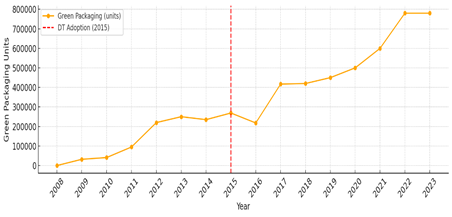
Figure 1
Green packaging units in Huawei (2008–2023).
Figure 1 above illustrates the evolution of green packaging units, with a clear visual shift occurring after the adoption of DT in 2015. Prior to this date, the number of eco-friendly packaging units remained relatively modest, averaging 96,180 units per year. After 2015, a substantial increase is observed, reaching up to 780,000 units in 2023. This visible jump suggests a significant structural change in Huawei’s packaging strategy.
| Statistical Test | Result |
| Dummy Variable Regression Coefficient | 96180 |
| Regression P-Value | 0,0061 |
| Regression R-Squared | 0,426 |
To quantify this change, a dummy variable regression was performed using DT adoption (0 before 2015, 1 after) as the independent variable (Table 1). The regression coefficient was estimated at +96180, indicating an average increase of nearly 96180 green packages post-adoption. The result was statistically significant (p = 0.0061) with an R-squared value of 0.426, showing that DT adoption alone explains over 42% of the variance in green packaging.
3.2 The impact of DT on waste landfill percentage
The percentage of waste sent to landfills (Land to Fill %) is a direct reflection of a company’s environmental efficiency and waste management practices. As DT technologies enhance predictive modeling and process optimization, one anticipated outcome is a significant reduction in waste disposal rates. This section explores how this environmental metric evolved before and after 2015 and tests whether the observed changes are statistically significant.
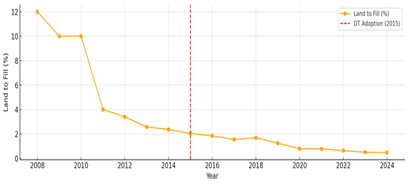
Figure 2
Waste landfill percentage in Huawei (2008–2024).
Figure 2 shows the decline in landfill waste percentage from 12% in 2008 to just 0.47% in 2024. A noticeable drop begins around the year of DT adoption, supporting the notion that digital transformation contributed to improved waste management.
| Statistical Test | Result |
| Dummy Variable Regression Coefficient | -5.18 |
| Regression P-Value | 0.0013 |
| Regression R-Squared | 0.510 |
A regression model was developed using the same dummy variable approach. The DT coefficient was estimated at –5.18, indicating that, on average, landfill waste decreased by 5.18 percentage points following DT adoption (Table 2). The model yielded a highly significant p-value of 0.0013 and an R-squared of 0.510, meaning that over 51% of the variance in landfill rates can be attributed to the DT initiative.
3.3 The impact of DT on water consumption
Water consumption is a critical environmental metric that reflects how efficiently an organization utilizes natural resources in its operations. As manufacturing scales and industrial processes become increasingly complex, monitoring and optimizing water usage becomes essential for sustainable development. With the integration of DT technology, Huawei has gained the capability to simulate water-intensive processes, track real-time usage patterns, and identify inefficiencies across its production systems. This article investigated changes that take place in Huawei's water consumption before and after the year 2015, which is when the idea of digital transformation (DT) was developed, in line with applying statistical methods to find out if those changes are associated with digital transformation. Through regression, the assessments are meant to judge whether digital change has improved water management or whether other operational dynamics have contributed to creating larger effects.
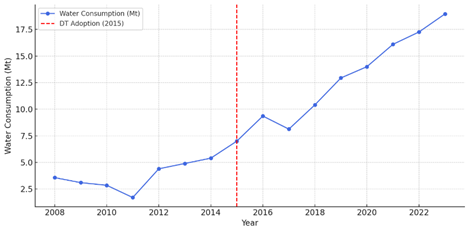
Figure 3
Water consumption in Huawei (2008–2024).
The trend of water consumption in Huawei from 2008 to 2023 is illustrated with a vertical red dashed line representing the year 2015, which is the year DT technology was introduced. (Figure 3) Water consumption exhibited relatively less and stable levels with minor annual increases before 2015. However, from 2015 onwards, it was clearly witnessed to have an upward trend in consumption.
During the post-DT period, water use has had a consistent and sharp increase, reaching its latest recording level in 2023. Various interpretations are plausible: the increase is the result of Huawei's operational expansion, greater manufacturing complexity, or more involved environmental reporting made possible by means of DT systems. Probably, however, DT integration enabled companies to measure and report up-to-date resource use more accurately, along with increased amounts that had not been internalized in the measurement of resource use. Increased consumption may seem challenging, especially when it comes to environmental concerns; however, it indicates a shift towards transparency and data-driven environments.
| Statistical Test | Result |
| Dummy Variable Regression Coefficient | 8935 |
| Regression P-Value | 0,001 |
| Regression R-Squared | 0,71 |
The regression analysis on water consumption evaluates the structural change concerning the conception of DT technology adopted by Huawei (Table 3), while using a dummy variable approach. From the coding of dummy variable 0 in pre-adoption of DT periods (2008-2014) and 1 in post-adoption of DT periods (2015-2023), it models the impact of DT on water use.
Regression results indicate a coefficient of 8935, which shows that there was an increase in annual average water consumption by roughly 8.9 million metric tons after the introduction of DT technology. This increase is statistically significant with a p-value of 0.001, which is lower than the normal level of significance of 0.05. The change in water consumption cannot be considered random but rather as strongly associated with the structural shift introduced through the implementation of DT.
Furthermore, the R-squared value of 0.71 indicates that the model explains 71% of the variance in water consumption over the study period. This high explanatory power reinforces the reliability of the regression results and suggests that DT adoption, along with associated operational changes, played a central role in altering Huawei’s water usage profile.
In summary, this increase in water consumption seems to have resulted from the expansion of operational activities following the installation of DT technology. DT allows increased efficiency, automation, and optimization in processes, along with increased production capacity or more effective facility utilization. Thus, higher returns could be an operational consequence of growth in the organization rather than an inefficiency. Hence, with improved DT capacities, this increase in water consumption allows scaled-up operations, which may even be a by-product of their effectiveness through DT adoption.
4. Pre- and post-DT environmental dynamics
While the regression model provides a directional estimate of impact, this section deepens the analysis through a comparative statistical test across three key environmental metrics: green packaging, waste to landfill, and water consumption. By splitting the time frame into pre- and post-digital twin periods, we apply an independent samples t-test to assess whether the observed environmental performance differences are statistically significant. This enables a clearer understanding of the sustainability shift surrounding the year 2015, offering stronger empirical support for the role of DT adoption in driving ecological improvements.
4.1 Green packaging T test results
This section applies an independent samples T-test on the green packaging parameter to judge the environmental significance of DT technology adoption at Huawei. The testing was carried out to compare averages of green packaging units before and after 2015, when DT integration started, testing for the statistical significance of an observed change to gain perspective on the digital transformation's impact on the environment. Table 04 presents comparative results.
| Statistical Test | Result |
| T-Test Mean (Before) | 185086, 66 |
| T-Test Mean (After) | 432111, 11 |
| T-Test P-Value | 0,01 |
An independent samples T-test was then conducted to evaluate the effects of DT adoption on Huawei's green packaging practices, with the temporal framework divided into two periods: the pre-DT period (2008-2014) and the post-DT period (2015-2024) (Table 4). On average, there were about 185087 green packages on the market. After the adoption of DT, the number of average green packages increased significantly to approximately 432,111. The T-test results yielded a p-value of 0.011, meaning that at the 5% significance level, the increase is statistically significant.
In these cases, evidence shows that adoption of DT technology does affect Huawei's sustainability strategies regarding green packaging practices in a positive manner. The capability to conduct virtual simulations of packaging processes, optimize material consumption, and monitor supply chains in real time could contribute to more efficient and sustainable production cycles. Such improvements are critical not only for reducing the ecological footprint of Huawei but also in the alignment of production with global sustainability standards; thus, demonstrating a practical case of DT transformation in manufacturing and logistics.
4.2 Waste to landfill T Test results
Waste sent to landfill constitutes one of the most distinguishing elements in the environmental responsibility and resource efficiency of a company. Changes in landfill percentages can offer valuable insights into the ecological contributions of digital transformation programs using DT, especially when examined across pre- and post-adoption periods. An independent samples T-test was carried out to examine whether the reduction of waste sent to landfill by Huawei became statistically significant after the launch of DT in 2015. Thus, the analysis also complemented the previous regression results with a statistical comparison of the environmental performance of the company between pre- and post-DT adoption periods.
| Statistical Test | Result |
| T-Test Mean (Before) | 2,78 |
| T-Test Mean (After) | 1,22 |
| T-Test P-Value | 0,017 |
The second metric used in the evaluation was the portion of waste, which was routed to landfills, as it serves as a critical indicator of resource efficiency and waste management (Table 5). Before the implementation of DT technology, Huawei had an average landfill percentage of 2.78%. This figure dropped qualitatively to 1.23% when considered as a post-DT percentage. The independent T-test indicated a p-value of 0.017, thus indicating that this drop is statistically significant.
This decrease also strengthens the case for the environmental benefits associated with DT integration. These are supported through improved accuracy in material flow tracking, predictive analytics for waste generation, and digital optimization of recycling processes, where DT systems likely play a very crucial role in minimizing waste. A reduction in the requirement for landfill corresponds with better operational control and reinforces the impact of digital technologies on advancing sustainable industry practices.
4.3 Water consumption T Test results
Water consumption is a crucial dimension in environmental sustainability, best reflecting how resources are efficiently utilized within industrial operations. To check how Huawei's water use changed before and after the DT implementation, this analysis is of interest in capturing the wider environmental implications of this digital shift. An independent samples T-test was carried out to find out if post-DT years can be associated with significant changes in water consumption levels. This analysis also complements the previous regression findings with a comparative statistical lens to assess the impact of DT integration on Huawei's water resource management in the pre- and post-2015 periods.
| Statistical Test | Result |
| T-Test Mean (Before) | 4,9 |
| T-Test Mean (After) | 12,68 |
| T-Test P-Value | 0,0005 |
An independent T-test analysis was also conducted regarding water use, a critical sustainability indicator, especially in manufacturing contexts. The consumption of water before 2015 averaged 4.90 million tons, whereas after the adoption of DT, it surged to 12.68 million tons. With a p-value of 0.0005, this difference demonstrates a high level of statistical significance.
At first, it may seem that this increase in water consumption goes against the spirit of sustainability, whereas actually, it might be the result of increased production capacity and the diversification of goods.
DISCUSSION
The study findings imply that implementing DT technology in Huawei had favorable effects on different aspects of environmental sustainability. The performances of all three indicators (green packaging, landfill waste, and water consumption) demonstrate marked changes after 2015, following the adoption of DT systems.
Improvement in green packaging was consistent with previous studies on the role of DTs in supply chain optimization and material waste reduction. According to Ünal et al. (2023) and Singh et al. (2023), DT facilitates real-time tracking and simulation of logistics, enabling companies to transition toward sustainable packaging solutions. Huawei's journey in this area suggests that DTs and predictive analytics can indeed generate tangible, ecologically sustainable improvements in manufacturing and distribution processes.
According to the study, landfill waste reduction has shown an increased rate of resource efficiency and waste diversion after adopting DT. These findings echo the arguments made by Malik (2024), who argue that DT-enabled monitoring, recycling coordination, and optimization of systems play a major role in minimizing landfill incidence. By allowing increased analysis of material flow together with waste forecasting, DT systems appear to be advancing within a circular and sustainable industrial model.
Post-DT observations indicate an increase in water consumption, which Edrisi and Azari (2023) caution may represent increased operational scales and improved accuracy of monitoring. Increased resource consumption in agriculture and smart manufacturing does not contradict sustainability, particularly when tied to digital oversight, transparency, and expanding capability. Therefore, from an analytical point of view, this indicator should be understood as physical growth linked to improved measurement and digital governance.
In summary, the results of this study support the building consensus in the literature that DT technologies serve not only as tools for operational optimization but also as strategic tools for delivering environmental performance. The case of Huawei Technologies exemplifies that DTs, when situated in a wider sustainability vision, can deliver meaningful and multidimensional ecological benefits, a view supported by the works of Bassey et al. (2024), Garske et al. (2024). It further strengthens the argument for the DTs as potential key components in the corporate sustainability transition in the digital age.
CONCLUSION
The findings of this study provide strong empirical evidence that the adoption of Digital Twin (DT) technologies at Huawei in 2015 marked a turning point in the company’s environmental performance. Notable improvements were observed in green packaging and reductions in waste sent to landfills, outcomes that can be directly associated with the enhanced predictive modeling, real-time simulation, and resource management capacities afforded by DT systems. These results confirm that DTs are not only technological innovations but also an effective tool for sustainable production practices.
Water consumption, by contrast, exhibited an upward trend after DT implementation. This increase, however, should be interpreted within the context of organizational expansion and the greater transparency enabled by DT platforms in tracking resource use. Rather than signaling reduced sustainability, the trend reflects the scaling of operations supported by advanced digital infrastructure. The results suggest that DTs enhance the traceability of environmental indicators, thereby equipping firms with new tools for proactive resource governance.
Huawei’s trajectory aligns with a growing international body of research that emphasizes the transformative potential of DTs in promoting circular economy models and advancing sustainable strategies across diverse industries, including energy, manufacturing, and urban infrastructure. Importantly, the case of Huawei illustrates that the success of DT adoption is contingent upon its integration into long-term organizational strategies and values. Investments in ICT infrastructure, coupled with a clear alignment between digital innovation and environmental objectives, are shown to be essential for realizing the full potential of DT systems.
In conclusion, Digital Twin technology emerges as a credible driver of corporate sustainability transformation. By enabling data-driven decision-making and reinforcing ecological responsibility, DTs offer industries a viable pathway to address environmental and regulatory challenges. This research contributes to the broader academic debate on digital sustainability by demonstrating how DT adoption can generate measurable environmental benefits, while simultaneously reshaping organizational approaches toward more resilient, efficient, and sustainable digital ecosystems.
REFERENCES
Al Maawali, K. M., & Al Fahdi, K. K. (2022). How to Build a Digital Twin with Strong Justification & Return of Investment: Case Study from OQ Oman (SPE Paper 210991-MS). Proceedings of the 22nd ADIPEC Conference. Abu Dhabi, UAE. https://doi.org/10.2118/210991-ms
Al-Shetwi, A. Q., Atawi, I. E., El-Hameed, M. A., & Abuelrub, A. (2025). Digital twin technology for renewable energy, smart grids, energy storage and vehicle-to-grid integration: Advancements, applications, key players, challenges and future perspectives in modernising sustainable grids. IET Smart Grid, 8(1), e70026. https://doi.org/10.1049/stg2.70026
Bányai, K., & Kovács, L. (2023). Identification of influence of digital twin technologies on production systems: a return on investment-based approach. Eastern-European Journal of Enterprise Technologies, 4(13), 66–78. https://doi.org/10.15587/1729-4061.2023.283876
Bassey, K. E., Opoku-Boateng, J., Antwi, B. O., & Ntiakoh, A. (2024). Economic impact of digital twins on renewable energy investments. Engineering Science & Technology Journal, 5(7), 2232–2247. https://doi.org/10.51594/estj.v5i7.1318
Diodato, D., Huergo, E., Moncada-Paternò-Castello, P., Rentocchini, F., & Timmermans, B. (2023). Introduction to the special issue on “the twin (digital and green) transition: handling the economic and social challenges.” Industry and Innovation, 30(7), 755–765. https://doi.org/10.1080/13662716.2023.2254272
Edrisi, F., & Azari, M. S. (2023). Digital Twin for Sustainability Assessment and Policy Evaluation: A Systematic Literature Review. 2023 IEEE/ACM 7th International Workshop on Green and Sustainable Software (GREENS), Melbourne, Australia. https://doi.org/10.1109/greens59328.2023.00007
Enyejo, J. O., Fajana, O. P., Jok, I. S., Ihejirika, C. J., Awotiwon, B. O., & Olola, T. M. (2024). Digital Twin Technology, Predictive Analytics, and Sustainable Project Management in Global Supply Chains for Risk Mitigation, Optimization, and Carbon Footprint Reduction through Green Initiatives. International Journal of Innovative Science and Research Technology, 9(11), 609-630. https://doi.org/10.38124/ijisrt/ijisrt24nov1344
Eslahi, M., Farazdaghi, E., Meouche, R.E. (2024). Towards Digital Twins in Sustainable Construction: Feasibility and Challenges. In: Ben Ahmed, M., Boudhir, A.A., El Meouche, R., Karaș, İ.R. (eds) Innovations in Smart Cities Applications Volume 7. SCA 2023. Lecture Notes in Networks and Systems. (Vol 938). Springer, Cham. https://doi.org/10.1007/978-3-031-54376-0_18
Figueiredo, K., Hammad, A. W. A., Pierott, R., Tam, V. W. Y., & Haddad, A. (2024). Integrating Digital Twin and Blockchain for dynamic building Life Cycle Sustainability Assessment. Journal of Building Engineering, 97(111018). https://doi.org/10.1016/j.jobe.2024.111018
Garske, B., Holz, W., & Ekardt, F. (2024). Digital twins in sustainable transition: exploring the role of EU data governance. Frontiers in Research Metrics and Analytics, 9.https://doi.org/10.3389/frma.2024.1303024
Gerstlberger, W., & Prause, G. (2024). The twin challenge of sustainability and digital transformation. Scientific Papers, 32(2), 2137. https://doi.org/10.46585/sp32022137
Huawei Technologies Co., Ltd. (2015–2024). Sustainability reports 2015–2024. https://www.huawei.com/en/sustainability/sustainability-report
Khajavi, S. H., Motlagh, N. H., Jaribion, A., Werner, L. C. & Holmström, J. (2019). Digital twin: Vision, benefits, boundaries, and creation for buildings. IEEE Access, 7, 147406-147419. https://doi.org/10.1016/j.compind.2020.103293
Kineber, A. F., Singh, A. K., Fazeli, A., Mohandes, S. R., Cheung, C., Arashpour, M., Ejohwomu, O., Zayed, T. (2023). Modelling the Relationship Between Digital Twins Implementation Barriers and Sustainability Pillars. Insights from building and construction sector. Sustainable Cities and Society, 99, 104930. https://doi.org/10.1016/j.scs.2023.104930
Maheshwari, P., Kamble, S., Belhadi, A., Mani, V., & Pundir, A. (2023). Digital twin implementation for performance improvement in process industries- A case study of food processing company. International Journal of Production Research, 61(23), 8343–8365. https://doi.org/10.1080/00207543.2022.2104181
Malik, A. A. (2024). The Economic Impact of Digital Twin Technology on Manufacturing Systems. Proceedings of the 2024 Winter Simulation Conference (WSC). Orlando, USA. https://doi.org/10.1109/wsc63780.2024.10838771
Meng, X., Das, S., & Meng, J. (2023). Integration of Digital Twin and Circular Economy in the Construction Industry. Sustaintability, 15(17), 13186.https://doi.org/10.3390/su151713186
Piras, G., Muzi, F., & Tiburcio, V. A. (2024). Digital Management Methodology for Building Production Optimization through Digital Twin and Artificial Intelligence Integration. Buildings, 14(7), 2110. https://doi.org/10.3390/buildings14072110
Pires, F., Souza, M., Ahmad, B., & Leitão, P. (2021). Decision Support Based on Digital Twin Simulation: A Case Study. Service Oriented, Holonic and Multi-Agent Manufacturing Systems for Industry of the Future. Springer Cham. https://doi.org/10.1007/978-3-030-69373-2_6
Pomè, A. P., & Signorini, M. (2023). Real time facility management: Assessing the effectiveness of Digital Twin in the Operation and Maintenance phase of building life cycle. IOP Conference Series: Earth and Environmental Science, 1176(1), 012003. https://doi.org/10.1088/1755-1315/1176/1/012003
Saini, K. K., Sharma, P., Mathur, H. D., & Siguerdidjane, H. (2022). Digital Twin of a Commercial Building Microgrid: Economic & Environmental Sustainability Analysis. Proceedings of the 2023 IEEE International Conference on Industrial Engineering and Engineering Management (IEEM), New Delhi, India. https://doi.org/10.1109/PIICON56320.2022.10045142
Singh, G. P., Singh, S., Daultani, Y., Daultani, Y., & Chouhan, M. (2023). Measuring the influence of digital twins on the sustainability of manufacturing supply chain: A mediating role of supply chain resilience and performance. Computers & Industrial Engineering, 186, 109711.https://doi.org/10.1016/j.cie.2023.109711
Svadkovsky, V. A. (2023). The use of digital twins to improve the operational efficiency in the extractive industries. Strategic decisions and risk management, 14(3), 292-311. https://doi.org/10.17747/2618-947x-2023-3-292-311
Trienens, M., Rasor, R., Kharatyan, A., Dumitrescu, R., & Anacker, H. (2024). Digital twins to increase sustainability throughout the system life cycle: a systematic literature review, 4, 2277-2286.https://doi.org/10.1017/pds.2024.230
Ünal, A., Albayrak, Ö., & Ünal, P. (2023). Impact of Digital Twin Technology Utilization in Manufacturing on Sustainability: An Industrial Case Study. Portland International Conference on Management of Engineering and Technology (PICMET), Monterrey, Mexico. https://doi.org/10.23919/picmet59654.2023.10216885
Xu, B., Wang, J., Wang, X., Liang, Z., Cui, L., Liu, X., & Ku, A. Y. (2019). A case study of digital-twin-modelling analysis on power-plant-performance optimizations. Clean Energy, 3(3), 227-234. https://doi.org/10.1093/CE/ZKZ025
Yakovenko, Y., & Shaptala, R. (2024). Study of digital twins as the driving force of digital transformation and achieving the goals of sustainable development. Technology Audit and Production Reserves, 2(4(76)), 11–20. https://doi.org/10.15587/2706-5448.2024.301423
Zhang, J., & Jiang, S. (2024). Digital twin for sustainable development in building automation. Engineering, Construction and Architectural Management.https://doi.org/10.1108/ecam-08-2024-1024
Zhang, Y., Lau, L., Yanchus, P., Forootan, Z., & Marfatia, Z. (2024). Enhancing Efficiency and Sustainability in Offshore Oil and Gas Operations through Digital Twin and AI Technology: A Practitioner’s View. ADIPEC, Abu Dhabi, UAE. https://doi.org/10.2118/221957-ms
Información adicional
redalyc-journal-id: 5646