
Esta obra está bajo una Licencia Creative Commons Atribución 4.0 Internacional.
Recepción: 02 Junio 2020
Aprobación: 14 Enero 2021
DOI: https://doi.org/10.17058/reci.v1i1.15133
Abstract: Background and Objectives: Nutrition, in addition to its physiological function, plays an important role in the recovery of individuals with malaria, a disease that still represents a serious public health problem in the world. The objective of this study was to assess nutritional determinants in the frequency of food intake and the occurrence of anemia in children and adolescents with P. vivax malaria. Methods: A cross-sectional analytical study was carried out between 2014 and 2015 in the Marajo Island. The hemoglobin level was measured by the colorimetric enzymatic reaction and a questionnaire of food intake frequency was used to assess the consumption of different types of food. Results: A total of 67 patients met the inclusion criteria, from which 62.7% were children and 37.3% were adolescents. There was a high consumption of ultra-processed foods in both age groups. Anemia occurred in 52.2% of patients, and in most of them it was moderate. There was no significant association between anemia and sex, age group or parasitemia at admission. However a significant association was found between anemia and the ingestion of ultra-processed foods. Conclusion: The ingestion of ultra-processed foods contributes to anemia in children and adolescent with malaria by P. vivax.
Keywords: Plasmodium vivax, Anemia, Nutritional Status, Food Consumption.
Resumo: Justificativa e Objetivos: A nutrição, além de sua função fisiológica, desempenha um papel importante na recuperação de indivíduos com malária, uma doença que ainda representa um grave problema de saúde pública no mundo. O objetivo deste estudo é avaliar os determinantes nutricionais na frequência da ingestão alimentar e a ocorrência de anemia em crianças e adolescentes com malária por P. vivax. Métodos: Estudo transversal analítico, realizado entre 2014 e 2015 na ilha do Marajó. O nível de hemoglobina foi medido pela reação enzimática colorimétrica e um questionário de frequência de ingestão alimentar foi utilizado para avaliar o consumo de alimentos. Resultados: Um total de 67 pacientes atendeu aos critérios de inclusão do estudo, dos quais 62,7% eram crianças e 37,3% adolescentes. Houve alto consumo de alimentos ultraprocessados em ambas as faixas etárias. A anemia foi detectada em 52,2% dos pacientes e, na maioria deles, foi moderada. Não houve associação significativa entre anemia e sexo, faixa etária ou parasitemia na admissão. No entanto, encontramos uma associação significativa entre presença de anemia e ingestão de alimentos ultraprocessados. Conclusão: A ingestão de alimentos ultraprocessados contribui para a anemia em crianças e adolescentes com malária por P. vivax.
Palavras-chave: Plasmodium vivax, Anemia, Estado nutricional, Consumo alimentar.
Resumen: Justificación y objetivos: La nutrición, además de su función fisiológica, juega un papel importante en la recuperación de las personas con malaria, una enfermedad que todavía representa un importante problema de salud pública en el mundo. El objetivo de este estudio es evaluar los determinantes nutricionales en la frecuencia del consumo de alimentos y la ocurrencia de anemia en niños y adolescentes con malaria por P. vivax. Métodos: se realizó un estudio analítico transversal entre 2014 y 2015, en la Isla de Marajó. El nivel de hemoglobina fue evaluado por ensayos enzimáticos colorimétricos y se utilizó un cuestionario de frecuencia de consumo de alimentos para evaluar el consumo. Resultados: Un total de 67 pacientes cumplió los criterios de inclusión en el estudio, de los cuales el 62,7% eran niños y el 37,3% adolescentes. Se registró un alto consumo de alimentos ultraprocesados en niños y adolescentes. La anemia se detectó en el 52,2% de los pacientes, de carácter moderada principalmente. No se encontró una asociación significativa entre anemia y sexo, grupo de edad o parasitemia al ingreso. Sin embargo, se encontró una asociación significativa entre la anemia y la ingestión de alimentos ultraprocesados. Conclusión: La ingesta de alimentos ultraprocesados se asocia con la presencia de anemia en niños y adolescentes con malaria por P. vivax.
Palabras clave: Plasmodium vivax, Anemia, Estado Nutricional, Consumo Alimentario.
INTRODUCTION
Malaria is still one of the major health public problems in the Brazilian Amazon with approximately 145,000 cases reported every year. Plasmodium vivax is the most prevalent species in the Region of the Americas, representing 82% of the cases notified to the health surveillance system in the Amazon Region1,2. As a rule, the parasite density in P. vivax malaria is lower than in P. falciparum. However, it is worth mentioning that P. vivax infection can range from asymptomatic cases to serious complications that can lead to death. Groups at risk for severe disease are children, pregnant women, and primary infected patients3-5.
Anemia is common in vivax malaria, and the exact mechanisms are still unclear. Several host-related factors contribute to anemia in these patients. These include genetic and environmental factors as intestinal helminthes, comorbidities, and inadequate alimentary habits6. The latter is relevant because it can lead to the deficiency of essential nutrients including vitamin A, zinc, iron, and folate, which contribute to the increase in the rate and intensity of anemia in patients with malaria. Moreover, the adequate intake of nutrients is important for an adequate immune response of the human host against infections7. In malaria, the deficit of essential nutrients can be due to either the inadequate alimentary habits related to low levels of education and low economic status of most of the people who live in endemic areas or to the anorexia, nausea, and vomiting caused by the disease, which lead to an inadequate food intake and contribute to the negative nitrogen balance8.
The objective of this study was to evaluate nutritional determinants in the frequency of food intake and the occurrence of anemia in children and adolescents with malaria by P. vivax.
METHODS
Study site and participants
This was a cross-sectional descriptive study of cases carried out from January 2014 to December 2015 in the municipality of Anajas in the Marajo Island (00º 59′ 21″S e 49º 56′ 24″W). The municipality has an area of about 6,913,068 km2 and a population estimated at 24,759 inhabitants, most of them (61.6%) living in rural areas. Anajas has a very low human development index of 0.484. The municipality concentrates most of the cases of malaria in the State of Para, and 3,004 cases were notified in 2013. Plasmodium vivax accounted for 90% of the cases9,10.
The criteria for inclusion were children and adolescents with slide-confirmed infection by P. vivax who spontaneously searched for assistance in the malaria health facility of the municipality and displayed signals and symptoms of the disease. The criteria for exclusion were children and adolescents with other infectious or chronic-degenerative diseases, signals and symptoms of severe malaria (parasitemia above 5%, jaundice, pulmonary impairment, altered levels of consciousness), G6PD deficiency, congenital diseases and/or antimalarial use three to six months prior to the inclusion in the study.
Data collection
A semi-structured questionnaire was applied to the guardian of the children and adolescents included in the study. Data regarding sex, age range, history of malaria, parasitemia at admission, economic status of family, and education level of the mother were registered in an appropriated database.
Laboratory analysis
Blood samples were collected at enrollment from patients in the study for parasite count and hemoglobin measurement. Parasite count was performed according to the Walker technique. The number of parasites was recorded in 200 white blood cells, considering a total count of 8,000/mL of white blood cells11. The measurement of hemoglobin was based on photometric detection of cyanmethemoglobin which is a stable compound derived from hemoglobin, using Labtest diagnostic Kits, following good laboratory practices. The diagnosis of anemia and its severity followed the criteria of the World Health Organization, which consider anemia in children from 6 to 59 months when hemoglobin < 11 g/dl, for children from 5 to 11 years when hemoglobin < 12.5g/dl, for children from 12 to 14 years and non-pregnant adolescents when hemoglobin < 12g/dl and for adolescent males when hemoglobin < 13g/dl12.
Frequency of food intake
A food frequency questionnaire (FFQ) previously validated for the Brazilian population was used to estimate the frequency of foods intake. The questionnaire was applied to the guardians of the children and adolescents at their enrollment in the study. The instrument is composed of 100 different foods, which are classified in two categories: a) in natura or minimally processed, including fresh fruits, milk and eggs, beef, vegetables and cereals and flours; b) ultra-processed foods such as fast foods and savory snacks, canned foods, treats and sweets, and sweet drinks. The intake of these foods was considered regular if ingested 5 or more times in a week. The categories and the classification of weekly ingestion were based on the guidelines of adequate and healthy food intake for the Brazilian population13.
Data analysis
Data was presented as frequency of occurrence for categorical variables. The Chi-square test and the Fisher’s exact test were performed for comparisons of these quantitative variables. Continuous variables are presented as median (interquartile range), and were compared using the Mann-Whitney test. Data was analyzed in WHO programs AnthroPlus and SPSS software v.21.0 (IBMinc, Chicago, IL, USA), and a p-value <0.05 was considered significant.
Ethical aspects
The present study was revised and approved by the ethical committee of Institute of Health Sciences of the Federal University of Pará, under the number 261.593/2013 and CAAE 207199612.0.0000.0018. The parents or guardians of the patients provided consent for their inclusion in the study.
RESULTS
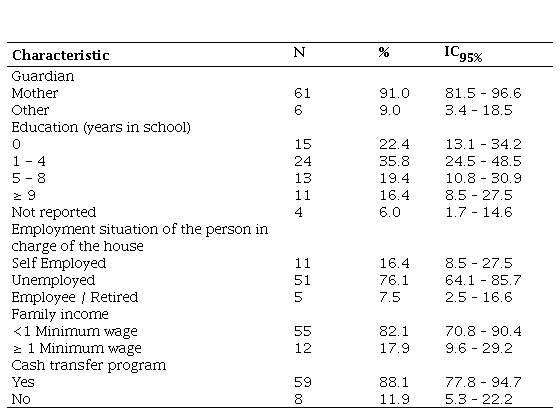
A total of 67 patients met the criteria for the inclusion in the study. The mean age was 9.5 (8.0-12.8) years and children represented 62.7% of the casuistic (. > 0.05). In most cases, the mother was the guardian of the children and adolescents (91%), they have a low education level, live with a monthly stipend below $100.00 and they were included in social programs of cash transfer (Table 1).
Socioeconomic characteristics of the families of patients included in the study, Anajás-Pará, 2015.
The frequency of anemia was 52.2% and in most cases moderate (74.3%), with classification of microcytic (51.4%). The sex, age group, and parasitemia at admission were similar between patients with and without anemia (Table 2).
Baseline characteristics of patients AnajasPará 2015
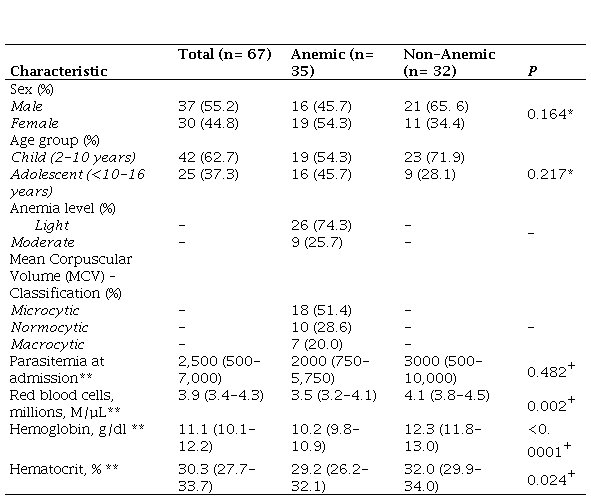
*Chisquare test; ** median interquartile range; + MannWhitney test
The frequency of ingestion of in natura or minimally processed foods was similar in both anemic and non-anemic patients, with a low ingestion of fresh fruits (64.2%), vegetables (53.7%), and a regular intake of beans (77.6%), beef (86.6%), milk and eggs (74.6%) and cassava root (89.5%). The frequency of processed foods ingestion was higher in anemic patients compared to non-anemic ones. Patients reported a low frequency of ingestion of canned foods (95.5%) and treats and sweet (74.6%), but a regular ingestion of fast food (52.2%) and sweet drinks (52.2%). Data is presented in Table 3.
Distribution of food consumption of patients and the presence of anemia AnajasPará 2015
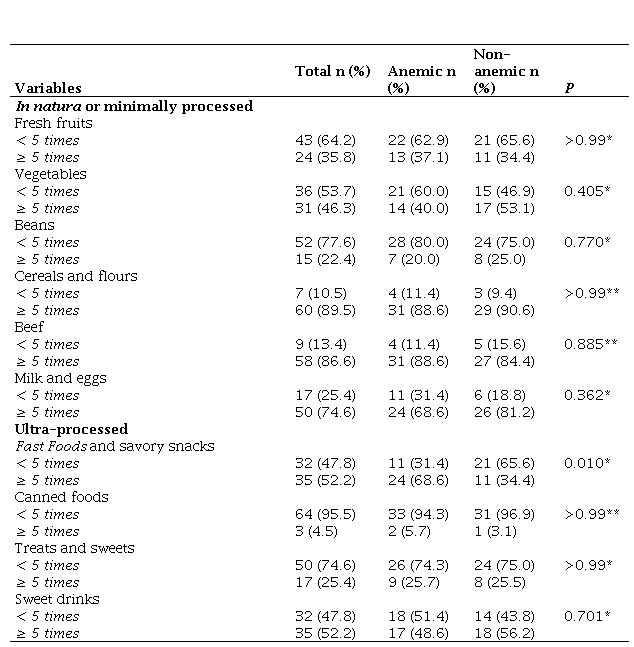
* Chisquare test; ** Fisher’s Exact test
DISCUSSION
The study was designed to assess the frequency of ingestion of different types of foods and the occurrence of anemia in children and adolescents with vivax malaria from the Brazilian Amazon. The evaluation of the alimentary habits of the population that lives in endemic areas could provide relevant information about determining factors of anemia in subjects with malaria. In the area of the study, most of the inhabitants live below the poverty line and have a low level of education, and this could contribute to an inadequate intake of essential nutrients. In fact, the social and economic profile of children and adolescents enrolled in the study are in agreement with other reports about the epidemiology of malaria in the Brazilian Amazon. Moreover, the repeated episodes of the disease in children and adolescents with a low parasite count when compared to P. falciparum cases is common in this endemic area.
The analysis of the food frequency questionnaire showed an ingestion of fruits and vegetables below that recommended by the WHO14. A similar result was found by a study that included children and adolescents from an endemic area in the state of Amazonas15. Moreover, there is a high ingestion of ultra-processed foods by both children and adolescents. This scenario reflects a potential change in the nutritional standard of Brazilian population, which might promote negative consequences for the health of those individuals, especially in areas of food insecurity, as in natura foods are important sources of essential macronutrients and micronutrients that are required to an adequate immune response to environmental stressors. In addition, the intake of fruits and vegetables by the native population of the Amazon is lower than in other regions of the country16-18.
Anemia is an important complication of vivax malaria and the exact mechanism underlying is still unclear. In the present study, around half of the patients experienced moderate anemia which is in accordance with previous studies of the same endemic scenario that reported a high prevalence of anemia19.
In children from the Brazilian Amazon, anemia has been associated with the deficiency of iron and of other micronutrients, including folate, vitamin A, and vitamin B12. This is a result from genetic or environmental factors such as intestinal and other parasitic infections as well as chronic infection or non-infectious diseases, and the inadequate ingestion of essential nutrients13,20-22. In the present study, we could not find association between anemia and sex, age, or parasite count at admission. However, the presence of anemia was associated with high frequency of weekly intake of ultra-processed foods, which have high levels of free sugars and total, saturated, and trans-fat, and low levels of proteins, dietary fibers and, especially micronutrients (vitamins and minerals)23, demonstrating the low nutritional quality of the population studied.
Overall, population groups with low socioeconomic status and low educational levels have a lower prevalence of healthy food consumption. Therefore with a low content of essential nutrients, they are more vulnerable to micronutrient deficiencies23,24, such as iron, which is an important cause of anemia. The association between iron deficiency and malaria incidence by P. vivax was observed in a study carried out with children in the Amazon Region. Thus, the deficiency of this micronutrient, besides being a marker of a serious socioeconomic problem, represents a greater risk for malaria25.
On the other hand, there was no significant association between the frequency of ingestion of in natura foods with the occurrence of anemia in children and adolescents included in the study. These results could be due to the low ingestion of foods from this group by the patients included in the study.
The results of the current study are relevant to understand the factors underlying anemia in patients with malaria by P. vivax from the Brazilian Amazon. Surprisingly, people living in this forest area have a low ingestion of fruits, vegetables and usually have meals with a high content of ultra-processed foods. Finally, there is a significant association between anemia and the consumption of foods with low content of essential nutrients.
Acknowledgments
The authors thank Fundação de Amparo à Pesquisa do Estado do Pará (FAPESPA) for the financial support of the research project “Nutritional, cognitive and adhesion to the treatment of children with vivax malaria in the municipality of Anajás”.
REFERENCES
1. World Health Organization. (WHO). World malaria report 2019. Geneva: WHO; 2019.
2. Ministry of Health. (BR). Health Surveillance. Epidemiological situation of malaria in Brazil, 2012 and 2013. Brasília: Ministry of Health; 2015. Available at: https://www.saude.gov.br/images/pdf/2015/dezembro/16/2015-003---Mal--ria.pdf
3. Aggarwal V, Aggarwal V, Patel H, Pathak J. Study Of Clinical Spectrum And Complications Of Plasmodium Vivax Malaria. Natl J Integr Res Med [Internet]. 2018Jan.31; 8(1):120-5. Available at: http://nicpd.ac.in/ojs-/index.php/njirm/article/view/1183
4. Center of Disease Control and Prevetion. (CDC). Malária. 2020). [cited 2020 May 20] Available at: https://www.cdc.gov/malaria/about/
5. Howes RE, Battle KE, Mendis KN, Smith DL, Cibulskis RE, Baird JK, et al. Global epidemiology of Plasmodium vivax. Am J Trop Med Hyg. 2016; 95:15–34. https://doi.org/10.4269/ajtmh.16-0141
6. Ehrhardt S, Burchard GD, Mantel C, Cramer JP, Kaiser S, Kubo M, et al. Malaria, anemia, and malnutrition in African children–defining intervention priorities. J Infect Dis. 2006; 194(1): 108-114. https://doi.org/10.1086/504688
7. Krawinkel MB. Interaction of Nutrition and Infections Globally: An Overview. Institute of Nutritional. Ann Nutr Metab. 2012; 61(suppl 1): 39–45. https://doi.org/10.1159/000345162
8. Caulfield LE, Onis M, Blössner M, Black RE. Undernutrition as an underlying cause of malaria morbidity and mortality in children less than five years old. Am J Trop Med Hyg. 2004; 71(2 Suppl): 55-67.
9. Brazilian Institute of Geography and Statistics. Censo Demográfico 2010: Características da População-Amostra. Cidades. Anajás-PA. 2010. Available at: http://www.cidades.ibge.gov.br/xtras/perfil.php?lang=&codmun=150070&search=para|anajas|infograficos:-informacoes-completas
10. Ministry of Health. (BR). Health Surveillance Secretariat 2005/2015. Malaria epidemiological surveillance information system. SIVEP-Malária [computer program]. Brasília: Ministry of Health; 2016 [cited 2018 Ago 23]. Available at: www.saude.gov.br/sivep_malaria
11. Ministry of Health. (BR). Health Surveillance Secretariat. Malaria Laboratory Diagnostic Manual: Standards and Technical Manuals. 2 ed. Brasília: Ministry of Health; 2009. Available from: https://www.saude.gov.br/images/pdf/2014/maio/27/Manual-de-diagn--stico-laboratorial-da-mal--ria-2-ed..pdf
12. World Health Organization. (WHO). The Global Prevalence of Anaemia in 2011. Geneva: WHO; 2015. Available at: https://www.who.int/nutrition/publications/micronutrients/global_prevalence_anaemia_2011/en
13. Ministry of Health. (BR). Health Care Secretariat. Food guide for the Brazilian population. 2 ed. Brasília: Ministry of Health; 2014. Available at: http://189.28.128.100/dab/docs/portaldab/publicacoes/guia_alimentar_populacao_brasileira.pdf
14. World Health Organization. (WHO). Diet, nutrition and the prevention of chronic diseases: report of a Joint WHO/FAO Expert Consultation. Geneva: WHO; 2003. Technical Report Series, No. 916. Available at: http://apps.who.int/iris/bitstream/handle/10665/42665/WHO_TRS_916.pdf;jsessionid=CA96064204317EB2DF97DB13DA04E165?sequence=1
15. Macedo RS, Araújo LGB, Estrázulas JA, Liberali R, Benzecry SG, Lacerda MVG. Avaliação de consumo alimentar e nutricional de escolares de 5 a 15 anos de uma área endêmica de malária do Amazonas. Revista Digital - Buenos Aires. 2010; 14(142):1-11. Available at: https://www.efdeportes.com/efd142/consumo-alimentar-de-uma-area-de-malaria-do-amazonas.htm
16. Chandra RK. Nutrition and the immune system from birth to old age. Eur J Clin Nutr, 2002; 56(Suppl 3): S73–76. https://dx.doi.org/10.1038/sj.ejcn.1601492
17. Ohnishi M, Leshabari S, Ambikile JS, Oishi K, Nakao Y, Nishihara M. Associations among anthropometric measures, food consumption, and quality of life in school-age children in Tanzania [published correction appears in J Rural Med. 2017 Nov; 12 (2):153]. J Rural Med. 2017;12(1):38‐45. https://doi.org/10.2185/jrm.2924
18. Ministry of Health. (BR). Health Surveillance Secretariat. Vigitel Brasil 2018: vigilância de fatores de risco e proteção para doenças crônicas por inquérito telefônico. Brasília: Ministério da Saúde; 2019. Available at: https://www.saude.gov.br/images/pdf/2019/julho/25/vigitel-brasil-2018.pdf
19. Guimarães MGS, Martins AC, Schlosser AR, Cardoso DS, Menezes CCR, Silva AL, et al. Prevalence of Anemia in Non-Severe Malaria Cases In Mâncio Lima, Acre. Rev Patol Trop. 2016; 45(1):77-86. https://doi.org/10.5216/rpt.v45i1.40196
20. Baird JK, Valecha N, Duparc S, White NJ, Price RN. Diagnosis and Treatment of Plasmodium vivax Malaria. Am. J. Trop. Med. Hyg. 2016; 95(Suppl 6):35–51. https://dx.doi.org/10.4269/ajtmh.16-0171
21. Kotepui M, Piwkham D, Phunphuech B, Phiwklam N, Chupeerach C, Duangmano S. Effects of Malaria Parasite Density on Blood Cell Parameters. PLoS One. 2015; 10(3):e0121057. https://dx.doi.org/10.1371/journal.pone.0121057
22. Arruda EF, Araújo FM, Guimarães MGS, Nogueira R, Ramalho AA, Silva-Nunes M. Associação entre malária e anemia em área urbana de transmissão do Plasmodium: Mâncio Lima, Acre, Brasil. Cad. Saúde Pública. 2016; 32(9):1-10. http://dx.doi.org/10.1590/0102-311X00115514
23. Louzada MLDC, Ricardo CZ, Steele EM, Levy RB, Cannon G, Monteiro CA. The share of ultra-processed foods determines the overall nutritional quality of diets in Brazil. Public Health Nutr. 2018; 21(1):94‐102. https://doi.org/10.1017/S1368980017001434
24. Medina LPB, Barros MBA, Sousa NFDS, Bastos TF, Lima MG, Szwarcwald CL. Social inequalities in the food consumption profile of the Brazilian population: National Health Survey, 2013. Desigualdades sociais no perfil de consumo de alimentos da população brasileira: Pesquisa Nacional de Saúde, 2013. Rev Bras Epidemiol. 2019; 22Suppl 02(Suppl 02):E190011.SUPL.2. Published 2019 Oct 7. https://doi.org/10.1590/1980-549720190011.supl.2
25. Benzecry SG, Alexandre MA, Vítor-Silva S, Salinas JL, de Melo GC, Marinho HA, et al. Micronutrient Deficiencies and Plasmodium vivax Malaria among Children in the Brazilian Amazon. PLoS ONE. 2016; 11(3): e0151019. https://doi.org/10.1371/journal.pone.0151019
