Artigos Revisão
Infection in ICU patients treated in the intensive care unit based on nursing and medical measures
Infecção em pacientes internados em UTI em unidade de terapia intensiva com base em medidas de enfermagem e médicas
Infección en pacientes de UCI tratados en la unidad de cuidados intensivos según medidas médicas y de enfermería

Infection in ICU patients treated in the intensive care unit based on nursing and medical measures
Revista de Epidemiologia e Controle de Infecção, vol. 15, núm. 2, pp. 87-91, 2025
Universidade de Santa Cruz do Sul

Esta obra está bajo una Licencia Creative Commons Atribución 4.0 Internacional.
Recepción: 01 Noviembre 2024
Aprobación: 23 Abril 2025
Abstract: Background and Objectives: Irritable bowel syndrome (IBS) is a common gastrointestinal disorder characterized by symptoms such as diarrhea, constipation, abdominal pain, stress, chronic fatigue, and bloating. This study investigates the prevalence of infection in patients treated in the intensive care unit (ICU), focusing on nursing and medical measures. Methods: The present study conducted a systematic review of 40 articles published between 2012 and 2024, utilizing keywords such as “ICU,” “Nursing,” “Medical Staff,” “Health Care” and “Hospital Infection” in databases including PubMed, Web of Science, Scopus, Science Direct, EBSCO, Wiley, Elsevier, Embase, and Google Scholar. Results: The findings indicate that urinary tract infections are the most common, while pneumonia is the deadliest hospital-acquired infection. In some centers, however, nosocomial infections of the circulatory system are the main cause of patient mortality. The meta-analysis revealed a prevalence of infection among ICU patients of 82%. Conclusion: Given the high prevalence of hospital-acquired infections, effective nursing and medical care are essential for reducing these infections.
Keywords: Infection, Delivery of Health Care, Treatment Staff, Nurses, Intensive Care Units.
Resumo: Justificativa e Objetivos: A síndrome do intestino irritável (SII) é um distúrbio gastrointestinal comum, caracterizado por sintomas como diarreia, constipação, dor abdominal, estresse, fadiga crônica e distensão abdominal. Este estudo investiga a prevalência de infecção em pacientes tratados em unidade de terapia intensiva (UTI), com foco em medidas de enfermagem e médicas. Métodos: O presente estudo realizou uma revisão sistemática de 40 artigos publicados entre 2012 e 2024, utilizando palavras-chave como “UTI”, “Enfermagem”, “Equipe Médica”, “Assistência Médica” e “Infecção Hospitalar” em bases de dados como PubMed, Web of Science, Scopus, Science Direct, EBSCO, Wiley, Elsevier, Embase e Google Acadêmico. Resultados: Os achados indicam que as infecções do trato urinário são as mais comuns, enquanto a pneumonia é a infecção hospitalar mais letal. Em alguns centros, no entanto, as infecções nosocomiais do sistema circulatório são a principal causa de mortalidade dos pacientes. A meta-análise revelou uma prevalência de infecção entre pacientes de UTI de 82%. Conclusão: Dada a alta prevalência de infecções hospitalares, cuidados médicos e de enfermagem eficazes são essenciais para reduzir essas infecções.
Palavras-chave: Infecção, Prestação de Cuidados de Saúde, Equipe de Tratamento, Enfermeiros, Unidades de Terapia Intensiva.
Resumen: Justificatión y Objetivos: El síndrome del intestino irritable (SII) es un trastorno gastrointestinal común que se caracteriza por síntomas como diarrea, estreñimiento, dolor abdominal, estrés, fatiga crónica y distensión abdominal. Este estudio investiga la prevalencia de infecciones en pacientes tratados en la unidad de cuidados intensivos (UCI), centrándose en las medidas médicas y de enfermería. Métodos: El presente estudio realizó una revisión sistemática de 40 artículos publicados entre 2012 y 2024, utilizando palabras clave como "UCI", "Enfermería", "Personal médico", "Atención sanitaria" e "Infección hospitalaria" en bases de datos como PubMed, Web of Science, Scopus, Science Direct, EBSCO, Wiley, Elsevier, Embase y Google Scholar. Resultados: Los hallazgos indican que las infecciones del tracto urinario son las más comunes, mientras que la neumonía es la infección intrahospitalaria más mortal. Sin embargo, en algunos centros, las infecciones nosocomiales del sistema circulatorio son la principal causa de mortalidad. El metanálisis reveló una prevalencia de infección del 82% entre los pacientes de la UCI. Conclusión: Dada la alta prevalencia de infecciones intrahospitalarias, la atención médica y de enfermería eficaz es esencial para reducirlas.
Palabras clave: Infección, Atención Sanitaria, Personal de Tratamiento, Enfermería, Unidades de Cuidados Intensivos.
INTRODUCTION
Patients in the intensive care unit (ICU) are frequently at risk for infections, which can lead to sepsis.1 Despite numerous studies providing national and international epidemiological data on sepsis since 2009, fewer studies have focused exclusively on the underlying infections.1 Detailed data on infection types, including causative microorganisms and the availability of diagnostic and treatment options, is crucial for raising awareness among clinicians, patients, and caregivers regarding the consequences of infections.2–3 Understanding infection risk factors can assist in developing targeted policies for diagnosis and treatment, facilitate appropriate resource allocation, support the design of interventional studies, and provide a benchmark for evaluating advancements in patient outcomes and the effectiveness of novel therapies over time.4–6
Research indicates that 45% of patients have suspected or confirmed infections, with 62% receiving antibiotics.7–8Additionally, studies report that 71% of patients received prophylactic or therapeutic antibiotics, and 51% had a suspected or confirmed infection.8–9
Considering the significance of infection spread, the global rate of hospital mortality, and the roles of nurses and doctors, the current study investigates the percentage of infections in patients treated in the ICU, focusing on nursing and medical measures.
METHODS
This systematic review and meta-analysis examined 40 articles published between 2012 and 2024. Keywords such as “ICU,” “Nursing,” “Medical Staff”, “Health Care,” and “Hospital Infection” were used to search international databases including PubMed, Web of Science, Scopus, Science Direct, EBSCO, Wiley, Elsevier, Embase, and Google Scholar, following the PRISMA 2020 27-item checklist. Two researchers independently collected data using a standardized data collection form designed to minimize reporting errors and omissions. The form included the following information: author name, year of publication, infection status in patients, number of participants, age range, irrigation technique, etiology, and medications.
Inclusion Criteria
Studies were selected based on the PICO framework. The population (P) included patients treated in the ICU; the intervention (I) involved nursing interventions; comparators (C) included no specific interventions or routine care; and outcomes (O) focused on infection prevalence. Eligible studies included randomized controlled trials (RCTs), cohort studies, case-control studies, and comparative studies published between January 2012 and December 2024.
Exclusion Criteria
Studies were excluded if they were non-research articles, such as editorials, commentaries, letters to the editor, or case reports. Research not directly related to accelerating recovery in ICU patients, such as studies focused on unrelated surgical interventions or non-clinical outcomes, was also excluded. Additionally, studies that did not report specific clinical outcomes related to recovery in ICU patients or those published in languages other than English were excluded.
The prevalence of infection in patients based on nursing and medical measures was calculated using a fixed-effect model and the inverse-variance method, with p<0.05 considered significant.
RESULTS
The present study utilized the PRISMA 2020 flow diagram for study selection, which is reported as a standard in PRISMA 2020.
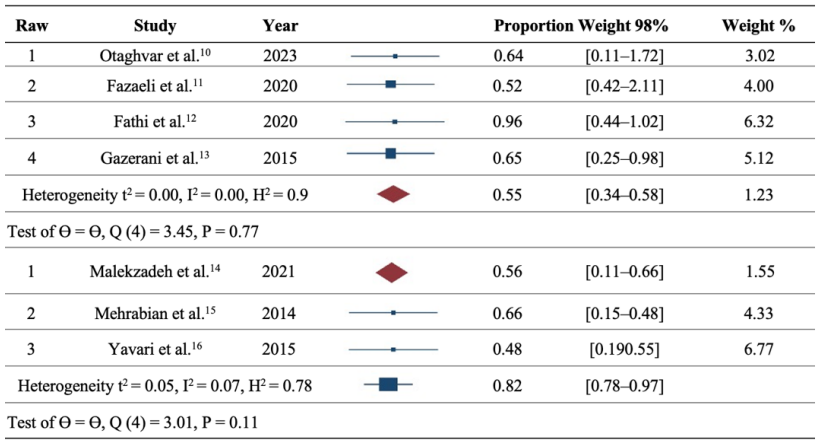
The initial search identified 40 articles. In the first phase, one article was eliminated due to duplicate records based on article titles. In the second step, studies that did not meet the inclusion criteria were excluded by reviewing the abstracts of 39 articles (n = 6). In the third step, four articles with incomplete data or non-compliance with the inclusion and exclusion criteria were eliminated after examining the full texts of 35 articles. Ultimately, seven articles were included in the present study (Figure 1 and Table 1).
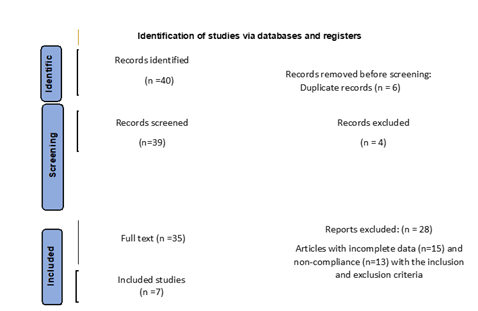
Figure 1
PRISMA 2020 flow diagram.
The prevalence of infection among ICU patients was found to be 82% [ES: 0.82, 95% CI; 0.78–0.97]. The proportion of patients with suspected or confirmed infections ranged from 78% to 97% (Table 1).
DISCUSSION
Research indicates that the elderly are more likely to acquire hospital infections due to immune system deficiencies, diabetes, and vitamin deficiencies. Typically, elderly patients and those with urinary catheters exhibit symptoms of urinary infections, including behavioral changes such as agitation, uncontrollable urination, fever and chills, and intense burning sensation and redness at the catheter site.17 Children are also at increased risk for hospital infection due to their immature immune system.18Patients in the ICU are particularly vulnerable to nosocomial infections; the use of artificial ventilation devices and the presence of various intravenous and urinary catheters contribute to the number of both resistant and sensitive microorganisms, necessitating vigilant nursing and medical measures. Furthermore, prolonged antibiotic use increases the risk of infections.19
Despite the implementation of numerous nursing and medical protocols to prevent surgical site infections, reports indicate a 1% to 3% chance of acquiring a hospital-acquired infection.20 Findings from one study demonstrated that after nursing care, the overall rate of surgical site infections decreased from 3.3% to 1.8%.21
Statistics show that women are 50% more susceptible to urinary tract infections (UTIs) than men, attributed to anatomical differences in urinary tracts. UTIs can be painful and, if left untreated, may lead to serious complications, including kidney infections and sepsis. Common symptoms include a strong urge to urinate and pain or burning during urination. Most UTIs are caused by bacteria, though in some cases, they may result from fungal proliferation or, rarely, viral infections. While antibiotics are commonly prescribed to treat various types of UTIs, individuals can also take preventive measures to reduce their risk. If left untreated, the infection may spread to the bloodstream and lead to sepsis—a life-threatening condition, particularly when the upper urinary tract is involved.22 With regard to ciprofloxacin, it is generally not recommended for uncomplicated UTIs, as the potential risks often outweigh the benefits in such cases. However, in instances of complicated UTIs or kidney infections where alternative treatment options are unavailable, a doctor may consider prescribing ciprofloxacin.23–24,27
Infection following breast prosthesis surgery is a significant complication.25–27,28 If symptoms of infection are not promptly addressed, the infection may enter the bloodstream, leading to complex treatment processes and potentially fatal outcomes. Therefore, it is crucial to take infections following breast prosthesis surgery seriously.29
It is believed that implementing a safety management system can help care department managers identify failures in the service delivery before they occur, in collaboration with human resources and utilizing active tools such as failure mode and effects analysis.30Adhering to functional area standards in the ICU can reduce infection rates.31
ICUs in low-income countries face substantial challenges, including a shortage of healthcare workers and inadequate infrastructure.32–34 Studies also show that the nurse-to-patient ratio in Brazilian hospitals is suboptimal, and the number of nurses in ICUs significantly impacts patient clinical outcomes. Therefore, it is recommended to develop specialized care units with a focus on strengthening human resources.35
The performance of ICUs in controlling hospital infections requires increased attention and effort. To enhance ICU quality, it is essential to further improve intensive care units, requires proper documentation of actions taken by nurses and doctors. Hospitals can improve service quality by accurately recording patient information, medications used, and length of stay through software systems.36
Infections in cancer patients can be caused by bacteria, viruses, fungi, or protozoa and may become more severe, posing life-threatening risks. Patients should seek medical attention if they experience fever, redness, swelling, weakness, or other signs of infection, as early treatment is crucial for effective management. Some infections can be prevented through vaccination. Recent advancements in cancer treatment have significantly improved outcomes for many patients. Maintaining a healthy diet, engaging in recommended exercise, and practicing good hygiene may help reduce the risk of infection. Limitations of the present study include the small sample sizes and variability in methodologies and instruments used in the reviewed studies. Future clinical trials are recommended to evaluate the outcomes of nursing and medical interventions over extended follow-up periods to control infections.
REFERENCES
1. McSparron JI, Ricotta DN, Moskowitz A, Volpicelli FM, Roberts DH, Schwartzstein RM, et al. The PrOSTE: identifying key components of effective procedural teaching. Annals of the American Thoracic Society. 2015;12(2):230-4. https://doi.org/10.1513/annalsats.201406-237bc
2. Vincent J-L, Rello J, Marshall J, Silva E, Anzueto A, Martin CD, et al. International study of the prevalence and outcomes of infection in intensive care units. Jama. 2009;302(21):2323-9. https://doi.org/10.1001/jama.2009.1754
3. Baker RE, Mahmud AS, Miller IF, Rajeev M, Rasambainarivo F, Rice BL, et al. Infectious disease in an era of global change. Nature reviews microbiology. 2022;20(4):193-205. https://doi.org/10.1038/s41579-021-00639-z
4. Raoofi S, Pashazadeh-Kan F, Rafiei S, Hosseinipalangi Z, Noorani-Mejareh Z, Khani S, et al. Global prevalence of nosocomial infection: A systematic review and meta-analysis. PloS one. 2023;18(1):e0274248. https://doi.org/10.1371/journal.pone.0274248
5. Yuan C, Adeloye D, Luk TT, Huang L, He Y, Xu Y, et al. The global prevalence of and factors associated with Helicobacter pylori infection in children: a systematic review and meta-analysis. The Lancet Child & Adolescent Health. 2022;6(3):185-94. https://doi.org/10.1016/s2352-4642(21)00400-4
6. Naghavi M, Vollset SE, Ikuta KS, Swetschinski LR, Gray AP, Wool EE, et al. Global burden of bacterial antimicrobial resistance 1990–2021: a systematic analysis with forecasts to 2050. The Lancet. 2024;404(10459):1199-226. https://doi.org/10.1016/s0140-6736(24)01867-1
7. Hansen E, Belden K, Silibovsky R, Vogt M, Arnold WV, Bicanic G, et al. Perioperative antibiotics. The Journal of arthroplasty. 2014;29(2):29-48. https://doi.org/10.1016/j.arth.2013.09.030
8. Vincent J-L, Sakr Y, Singer M, Martin-Loeches I, Machado FR, Marshall JC, et al. Prevalence and outcomes of infection among patients in intensive care units in 2017. Jama. 2020;323(15):1478-87. https://doi.org/10.1001/jama.2020.2717
9. Grant J, Saux NL, Stewardship A, Microbiology RCotAoM, Canada ID. Duration of antibiotic therapy for common infections. Official Journal of the Association of Medical Microbiology and Infectious Disease Canada. 2022;6(3):181-97. https://doi.org/10.3138/jammi-2021-04-29
10. Otaghvar HA, Mahdigholizad S, Kalkhoran MK, Motamedi T, Jafarian AA, Salehi R, et al. Investigating the Results of Amniocentesis in the Operating Room on Children's Acute Second Degree Burn Wounds in Patients Referred to Shahid Motahari Hospital in Tehran in 2021-2022. Eurasian Journal of Chemical, Medicinal and Petroleum Research. 2023;2(5):32-44. https://doi.org/10.5281/zenodo.8047614
11. Malekzadeh R, Assadi T, Mahmoudi E, Montazeriun F. Performance evaluation of the intensive care units in hospitals affiliated to Mazandaran University of Medical Sciences during the COVID-19 pandemic. Journal of Modern Medical Information Sciences. 2023;8(4):312-23. http://jmis.hums.ac.ir/article-1-377-en.html
12. Fathi E, Malekshahi-Beiranvand F, Hatami-Varzaneh A, Nobahari A. Health Care Workers Challenges during Coronavirus Outbreak: The Qualitative Study. Journal of Research in Behavioural Sciences. 2020;18(2):237-48. http://dx.doi.org/10.52547/rbs.18.2.237
13. Gazerani A, Aliakbari R, Habibzadeh M, Haresabadi M. Assessment of safety status in operating room by the World Health Organization standards for safety-friendly hospital. Journal of North Khorasan University of Medical Sciences. 2015;6(4):895-903. http://dx.doi.org/10.29252/jnkums.6.4.895
14. Malekzadeh R, Heydari K, Moosazadeh M, Assadi T. Incidence and severity of COVID-19 in hospital staff and their relationship with influenza vaccination in Mazandaran Province, 2020. Journal of Mazandaran University of Medical Sciences. 2021;31(199):12-9. http://jmums.mazums.ac.ir/article-1-16304-en.html
15. Mehrabian F. Quality of services in training and medical emergency centers. Journal of Guilan University of Medical Sciences. 2014;22(89). http://journal.gums.ac.ir/article-1-564-en.html
16. Masoud Y, Hossein AS, Mahshid M. Evaluation of Intensive Care Unit in terms of standards of care in selected hospitals in Tehran. 2015. https://www.magiran.com/p1491496
17. Shaw C, Wagg A. Urinary and faecal incontinence in older adults. Medicine (Baltimore). 2021;49(1):44-50. https://www.clinicalkey.es/#!/content/journal/1-s2.0-S135730392030270X
18. Isigi SS, Parsa AD, Alasqah I, Mahmud I, Kabir R. Predisposing factors of nosocomial infections in hospitalized patients in the United Kingdom: systematic review. JMIR public health and surveillance. 2023;9:e43743. https://doi.org/10.2196/43743
19. Prescott JF, Sykes JE, Daniels JB. Streptococcal and enterococcal infections. Greene's Infectious Diseases of the Dog and Cat: Elsevier; 2021. p. 597-610. https://doi.org/10.1016/b978-0-323-50934-3.00050-1
20. Mikus E, Fiorentino M, Sangiorgi D, Fiaschini C, Tenti E, Tremoli E, et al. Surgical treatment of active endocarditis pre-and post-COVID-19 pandemic onset. Biomedicines. 2024;12(1):233. https://doi.org/10.3390/biomedicines12010233
21. Hoertel N, Sánchez‐Rico M, Gulbins E, Kornhuber J, Carpinteiro A, Lenze EJ, et al. Association between FIASMAs and Reduced Risk of Intubation or Death in Individuals Hospitalized for Severe COVID‐19: an observational multicenter study. Clinical Pharmacology & Therapeutics. 2021;110(6):1498-511. https://doi.org/10.1002/cpt.2317
22. Dobrek Ł. Drug-related urinary tract infections. Wiad Lek. 2021;74:1728-36. https://wiadlek.pl/wp-content/uploads/archive/2021/WLek202107130.pdf
23. Kaur R, Kaur R. Symptoms, risk factors, diagnosis and treatment of urinary tract infections. Postgraduate medical journal. 2021;97(1154):803-12. https://doi.org/10.1136/postgradmedj-2020-139090
24. Kwok M, McGeorge S, Mayer‐Coverdale J, Graves B, Paterson DL, Harris PN, et al. Guideline of guidelines: management of recurrent urinary tract infections in women. BJU international. 2022;130:11-22. https://doi.org/10.1111/bju.15756
25. Higgins T, Arastu AS, Auerbach PS. Medicine for the Outdoors E-Book: The Essential Guide to First Aid and Medical Emergencies: Elsevier Health Sciences; 2022. https://www.amazon.com/Medicine-Outdoors-Essential-Medical-Emergencies/dp/0323680569
26. Rafailova L. Features of nurse care and providing emergency care for patients with bleeding in the emergency department: Ternopil; 2021. https://repository.tdmu.edu.ua//handle/123456789/17604
27. Sekhar-Reddy NV. Medical Emergencies in Oral and Maxillofacial Surgical Practice. Oral and Maxillofacial Surgery for the Clinician. 2021:49-58. https://doi.org/10.1007/978-981-15-1346-6_4
28. Steligo K. The Complete Guide to Breast Reconstruction: Choosing the Best Options After Your Mastectomy: JHU Press; 2023. https://www.amazon.com/Complete-Guide-Breast-Reconstruction-Mastectomy/dp/1421447592
29. Lieffering AS, Hommes JE, Ramerman L, Rakhorst HA, Mureau MA, Verheij RA, et al. Prevalence of local postoperative complications and breast implant illness in women with breast implants. JAMA Network Open. 2022;5(10):e2236519-e. https://doi.org/10.1001/jamanetworkopen.2022.36519
30. Heydari M, Lai KK, Fan Y, Li X. A review of emergency and disaster management in the process of healthcare operation management for improving hospital surgical intake capacity. Mathematics. 2022;10(15):2784. https://doi.org/10.3390/math10152784
31. Di-Laura D, D'Angiolella L, Mantovani L, Squassabia G, Clemente F, Santalucia I, et al. Efficiency measures of emergency departments: an Italian systematic literature review. BMJ open quality. 2021;10(3):e001058. https://doi.org/10.1136/bmjoq-2020-001058
32. Tetteh LA, Agyenim‐Boateng C, Simpson SNY. Institutional pressures and accountability processes in pursuit of sustainable development goals: Insights from Ghanaian indigenous oil companies. Corporate Social Responsibility and Environmental Management. 2024;31(1):89-107. https://doi.org/10.1002/csr.2554
33. Elnahas M, Hübner J, Lang PM, Ahmadi E, editors. Job Satisfaction Among First-Generation Migrant Physicians in Anesthesiology and Intensive Care Medicine in Germany. Healthcare; 2024: MDPI. https://doi.org/10.3390/healthcare12212107
34. Jalal A, Iwamoto K, Gedik G, Ravaghi H, Kodama C. Health workforce capacity of intensive care units in the Eastern Mediterranean Region. Plos one. 2023;18(6):e0286980. https://doi.org/10.1371/journal.pone.0286980
35. Ngoc NM, Tien NH. Solutions for Development of High-Quality Human Resource in Binh Duong Industrial Province of Vietnam. International journal of business and globalisation. 2023;4(1):28-39. https://www.researchgate.net/publication/364994952_Solutions_for_development_of_high_quality_human_resource_in_Binh_Duong_Industrial_Province_of_Vietnam
36. Yarahmadi S, Soleimani M, Gholami M, Fakhr‐Movahedi A, Madani SMS. Health disparities in service delivery in the intensive care unit: A critical ethnographic study. Nursing in critical care. 2024. https://doi.org/10.1111/nicc.13170
Información adicional
redalyc-journal-id: 5704