Influencing elements of technological adoption: Case study about management in an educational institution
Elementos influenciadores da adoção tecnológica: Estudo de caso sobre a gestão em uma instituição de ensino
Elementos influyentes de la adopción tecnológica: Estudio de caso sobre gestión en una institución de eseñanza
 Caroline Oliveira Melo caroline.oliveiramelo@gmail.com
Maria Conceição Melo Silva Luft ceicamelo.ufs@gmail.com
Ronalty Oliveira Rocha ronaltyrocha@gmail.com
Caroline Oliveira Melo caroline.oliveiramelo@gmail.com
Maria Conceição Melo Silva Luft ceicamelo.ufs@gmail.com
Ronalty Oliveira Rocha ronaltyrocha@gmail.com
Influencing elements of technological adoption: Case study about management in an educational institution
Contextus – Revista Contemporânea de Economia e Gestão, vol. 19, pp. 124-145, 2021
Universidade Federal do Ceará

Esta obra está bajo una Licencia Creative Commons Atribución-NoComercial 4.0 Internacional.
Recepción: 03 Diciembre 2020
Aprobación: 26 Marzo 2021
Publicación: 03 Mayo 2021
Abstract: This study sought to analyze, from the point of view of educational managers, and based on the TOE framework, the determinants, boosters, and creators of barriers to the adoption and implementation of information and communication technologies within an educational institution. A qualitative, descriptive, and exploratory study was conducted, adopting the single case study as the research strategy. The data were collected through interviews, documentary research, and direct observations, later submitted to content analysis. Considering the TOE framework, the results demonstrate that the main determinants of technological adoption are linked to the environmental context; that the boosting elements are arranged in the organizational context; and that the elements that create barriers involve the organizational and environmental contexts.
Keywords: information and communication technology, technological adoption, educational management, TOE framework, case study.
Resumo: Esse estudo buscou analisar, sob o ponto de vista dos gestores educacionais, e tendo como base o framework TOE, os fatores determinantes, impulsionadores e criadores de barreiras à adoção e implementação de tecnologias da informação e comunicação no âmbito de uma instituição de ensino. Foi realizado um estudo qualitativo, descritivo e exploratório, adotando-se o estudo de caso único como estratégia de pesquisa. Os dados foram coletados em entrevistas, pesquisa documental e observações diretas, posteriormente submetidos à análise de conteúdo. Considerando o framework TOE, os resultados demonstram que os principais determinantes à adoção tecnológica estão vinculados ao contexto ambiental; que os elementos impulsionadores estão dispostos no contexto organizacional; e que os elementos criadores de barreira envolvem os contextos organizacional e ambiental.
Palavras-chave: tecnologia da informação e comunicação, adoção tecnológica, gestão educacional, modelo TOE, estudo de caso.
Resumen: Este estudio buscó analizar, desde el punto de vista de los gestores educativos, y con base en el marco TOE, los determinantes, impulsores y creadores de barreras para la adopción e implementación de las tecnologías de la información y la comunicación en el ámbito de una institución educativa. Se realizó un estudio cualitativo, descriptivo y exploratorio, adoptando el estudio de caso único como estrategia de investigación. Los datos fueron recolectados a través de entrevistas, investigación documental y observaciones directas, que posteriormente fueron sometidas a análisis de contenido. Considerando el marco TOE, los resultados demuestran que los principales determinantes de la adopción tecnológica están vinculados al contexto ambiental; que los elementos impulsores estén dispuestos en el contexto organizativo; y que los elementos que crean barreras involucran los contextos organizacional y ambiental.
Palabras clave: tecnología de la información y la comunicación, adopción tecnológica, gestión educativa, marco TOE, estúdio de caso.
1 INTRODUCTION
Information technologies (ITs) are already part of several aspects of people's daily lives. The importance of such technologies is evident, since they establish new forms of organization of society, to the point that Castells (2003) states that the revolution of information technology represents, at least, a historical event as important as the Industrial Revolution of the 18th century, because it discontinues the standards of economy, society and culture practiced so far. In this context, the use of the computer and the Internet as tools for access, processing, and transmission of information, further expanded the changes caused by the ITs, giving rise to the term Information and Communication Technologies (ICTs).
Within educational institutions, the adoption and use of ICTs, putting them at the service of the formation of a critical, productive, and inclusive society, has been one of the requirements for improving educational quality and consequent social and economic development of a nation (Albino, 2015).
In addition, in educational institutions, information technology affects not only teaching and learning practices and processes but also radically transforms management processes into education by providing support for management, planning, project development, and decision-making (Tan, 2016). This new direction given to educational management has been conceptualized as leadership or technology-oriented management.
In the educational sphere, technological leadership involves an integrated process, where managers must motivate the academic community in general for learning, using, and integrating technologies in the environment in which they are working or developing their activities (Yorulmaz & Can, 2016).
It is perceived, then, that educational management can no longer be conceived without technological leadership, in which the ICT is understood as an indispensable element to the transformation of the institution, not only in the ways of teaching and learning, but also in the administrative actions that subsidize the main activity of educating, so that it is also relevant to understand the processes of adoption and technological management in educational institutions (Melo, Luft & Rocha, 2019).
In this context, it is worth mentioning the role of the Federal Institutes of Education, Science and Technology (IF's), teaching and research entities that give professional education a strategic role in the development of locally productive and cultural arrangements and that also foster socio-economic development of the brazilian regions, contributing to the definition of local development policies in line with the planning of national policies (Anjos & Rôças, 2017). Thus, considering the social, educational, and economic relevance of educational institutions of the IF's type, it is necessary to reflect on the elements that influence the process of technological adoption in these educational entities.
In this perspective, the important role played by educational management is highlighted by Barroso and Silva (2014), stating that the variables that interfere in the use of IT in institutions permeate, among other things, the domain of managers in managing technologies in the institutional. However, several factors can influence this process, impacting the adoption and dissemination of technology in multiple spheres.
On this subject, Montealegre, Iyengar, and Sweeney (2014) point out that technology adoption is not a one-off action, where the process is finalized after the decision. On the contrary, it is a continuous and dynamic process, having as its central point the action of managers is constantly seeking technology to meet organizational needs and objectives.
Corroborating the importance of studying the aspects that involve the relationship between the ICT and the management of an educational institution, Silva, França, and Almeida (2016) point out that although the debate related to management is consolidated in the scientific community, the continuous advance of technologies provokes new perspectives on the dimensions that configure education, making this an important field to be investigated.
It should be noted that, in the educational environment, some of the latest studies on technological adoption, published in Brazil, investigated the process of adoption of technological innovation through a model of factors that influence the behavior of teachers in a virtual learning environment (Machado, Bellini & Leite, 2011); evaluated the perceptions of university professors about m-learning, identifying what can favor or inhibit the adoption of this technological tool (Pina et al., 2016); and identified variables that can contribute to the adoption of technological innovation in the virtual learning environment (Caliari, Zilber & Perez, 2017).
In the international context, it is pertinent to explain that studies on technological adoption have: explored the psychological factors that influence the adoption of new media production technologies by mass communication students (Hopp & Gangadharbatla, 2016); investigated the factors that affect the adoption of electronic government information systems (Thanh, Yoon &, Hwang, 2018); developed models to investigate the main drivers of the adoption of the smart classroom (Selim, Eid & Agag, 2020); investigated, with Kuwait high school teachers, readiness for changes in smartphone technology (Al-Furaih & Al-Awidi, 2020); and discussed the processes of adoption and implementation of technological innovations observed in criminal justice, correctional literature and other disciplines (Link & Reece, 2021).
Specifically to technological adoption in an educational context and from the perspective of management, the identified studies investigated the factors that determine the adoption of cloud computing by colleges and universities in the United States of America and Canada (Klug & Bai, 2015), examined the determinants of ICT adoption in Nigerian universities (Eze, Awa, Okoye, Emecheta & Anazodo, 2015), as well as discussed the elements that influence technological adoption in higher-level institutions in Saudi Arabia (Tashkandi & Al-Jabri, 2015); and analyzed the influence of organizational factors in the adoption of an information system at a university (Silva, Correia, Machado & Oliveira, 2020).
It is noticed that the researches on technological adoption have directed attention to the verification of factors that influence adoption, especially by teachers and students (Machado, Bellini & Leite, 2011; Pina et al., 2016; Caliari, Zilber & Perez, 2017; Hopp & Gangadharbatla, 2016), with limited analysis of the managerial aspect of this process in educational institutions (Klug & Bai, 2015; Eze, Awa, Okoye, Emecheta & Anazodo, 2015; Tashkandi & Al-Jabri, 2015; Silva et al., 2020), making this discussion relevant in the context of a Brazilian educational institution. Therefore, the present study addressed the following research question: How are the factors that influence the adoption and implementation of information and communication technologies in an educational institution configured?
Addressing this problem, the work aims to analyze, from the point of view of educational managers, the determining elements, boosters, and creators of barriers to the process of adoption and implementation of information and communication technologies within the scope of an educational institution.
To this end, the research is based on the Framework Technology, Organization, and Environment (TOE) (Tornatzky & Fleischer, 1990) that deals with contexts that influence the process by which an organization adopts and implements a technological innovation. Moreover, in the field of information systems, the TOE framework has gained empirical and theoretical validations much more robust than other technological adoption structures (Yoon & George, 2013; Awa, Ukoha & Igwe, 2017), which is why this framework is applied in this study.
Considering the TOE framework, it is observed that some of the latest published studies dealt with contextual influences on the adoption of RFID (Cao, Jones & Sheng, 2014); investigated the relationships between the application of the TOE framework, the co-production of services, the availability of digital resources and the performance of companies (Tsou & Hsu, 2015); evaluated factors to explain the adoption of mobile hotel reservation systems (Wang, Li & Zang 2016); examined the determinants of post-adoption of enterprise 2.0 systems (Jia, Guo & Barnes, 2017); deepened research in assessing the reach of ITCs in small and medium-sized enterprises (Souza, Siqueira & Reinhard, 2017); proposed and tested a structure with factors from the TOE and UTAUT theory to provide insights that complement and extend existing research on technology adoption (Awa, Ojiabo & Orokor, 2017); examined how companies are prepared for green innovation in terms of technological, organizational and environmental readiness (Zhang, Sun, Yang & Wang, 2020).
The observation of the objectives and results of the mentioned studies reinforce the research gap on the analysis of the TOE framework, especially due to the scope of its technological, organizational, and environmental contexts, for technological adoption, in its managerial aspect, in an educational institution.
2 THEORETICAL FRAMEWORK
A range of technologies has been acquired by educational institutions to automate old practices, replacing handwriting to produce text; for immediate access to information; or even for storing information or data (Weston & Bain, 2010).
Setubal (2015) states that the impact of technologies in the educational context is only possible if the necessary conditions for their use are sufficiently consolidated in the educational institution, and this implies the availability of equipment; in the adequate training of the actors involved in the educational context; and in the organization of administrative and pedagogical management that favors the use of ICT.
Although the simple insertion of new resources in old practices does not cause significant changes, considering that technology alone cannot carry out social transformations (Silva, França & Almeida, 2016), it is undeniable that technological infrastructure is one of the aspects that make up this transformational movement.
Thus, it is essential that, as non-educational organizations, educational institutions are also managed to consider technology as an essential element to its functioning. In this context, Tan (2016) explains that information technology affects not only teaching and learning practices and processes but also radically transforms management processes into education. This author also adds that the use of information technologies by educational institutions provides support for management, planning, project development, and the decision-making process.
In this context, Fu (2013) adds that the use of information technology tools in school management activities promotes positive impacts on the management of educational institutions, including better accessibility to information, more efficient administration, greater use of financial and intellectual resources, reduced workload, better time management, and improved reporting quality.
This new direction given to educational management has been conceptualized as leadership or technology-oriented management. For Yorulmaz and Can (2016), technological leadership is an attribute of the leader who takes the initiative in the effective and efficient use of technology, influencing, guiding, and managing the organization in this direction. In the educational scope, the authors explain that this action involves an integrated process, where managers must motivate the academic community in general for learning, using, and integrating technologies in the environment in which they are working or developing their activities.
The decisive role of educational leadership in the implementation of technologies is also recognized among the agencies and associations that promote and encourage improvements in the field of education. An internationally known association is the International Society for Technology in Education (ISTE), which has developed a series of standards that "aim to provide a framework for rethinking education, adapting to a constantly changing technological reality" (ISTE, 2009).
ISTE's standard for the leadership of educational institutions is known as ISTE Standards for Administrators, which addresses several guidelines of conduct for educational managers, subdivided into five themes. The main objectives of each group of guidelines are presented below (ISTE, 2009):
-
• Visionary leadership: involves inspiring and leading the development and implementation of a shared vision for comprehensive technology integration to promote excellence and support transformation across the organization.
• Culture and learning in the digital age: seek the creation of a culture of learning with and through technologies.
• Excellence in professional practice supports and promotes the training of professionals to work with technological resources.
• Systemic improvement: enables the technological infusion of the institution through the acquisition of infrastructure, preparation of planning, and projects.
• Digital citizenship: implements policies for the safe, legal, and ethical use of digital and communication technologies.
It is perceived, therefore, that educational management can no longer be conceived without technological leadership, in which the ICT is understood as an indispensable element to the transformation of the institution, not only in the ways of teaching and learning but also in the administrative actions that subsidize the main activity of educating. Thus, the decision-making process of adoption and the appropriate planning for the implementation of ITCs become strategic actions for technology-oriented management. Due to its relevance and importance to organizational performance and technological leadership, technological adoption can be implemented through several models, such as the TOE framework, which will be discussed in the next topic.
2.1 Models and/or Theories of Technology Adoptio
The adoption of information technology has been studied for at least three decades, with research being developed in the most diverse segments, with the objective of understanding, predicting, and explaining variables that influence the adoption behavior of both individuals and organizations (Sahin, 2006; Gangwar, Date & Raoot, 2013).
On this subject, Taherdoost (2018) indicates different models and/or theories as instruments for technology adoption analysis, while Oliveira and Martins (2011) highlight the Theory of Planned Behavior (TPB), Technology Model Acceptance (TAM), Unified Theory of Acceptance and Use of Technology (UTAUT), Diffusion of Innovations (DOI) and Technology, Organization, and Environment (TOE) models as the most used in research related to technology adoption.
The theory of planned behavior (TPB), proposed by Ajzen (1985), is a theory designed to predict and explain human behavior in specific contexts, for example, in information systems. Taherdoost (2018) explains that in the TPB model, three main factors affect technological adoption: behavioral attitude, subjective norm, and perceived behavioral control.
The attitude characterizes the user's evaluations regarding the expected results and benefits in the performance of the new behavior (Ajzen, 1991), while the subjective norm comprises the influence imposed by the culture of which the user is a participant (Ajzen & Fishbein, 2005). Additionally, Sharma and Mishra (2014) explain that behavioral control refers to people's perception of the ease or difficulty of performing the behavior of interest. Thus, Yi, Jackson, Park, and Probst (2006) summarized that in the TPB model, human and social aspects play an important role in the adoption of technologies.
Another relevant model for technological adoption is the technology acceptance model (TAM), developed by Davis (1989) to determine factors that influence the acceptance of the technology. According to Portz et al., (2019), TAM is an information technology framework for understanding the adoption and use of emerging technologies by users, particularly in the workplace, since people tend to use a certain technology or not to improve their performance in the work environment (Davis, 1989). Moreover, Lai (2017) complements that the TAM model was developed to understand the causal relationship between external variables of user acceptance and actual use of the computer, trying to understand the behavior of this user through perceived knowledge of utility and ease.
Thus, the TAM model describes that two individual beliefs are the most important to explain the individual's intention on the use of information technology: perceived utility and perceived ease of use (Davis, 1989). In this context, the perceived utility is characterized by how much individuals trust that the use of a specific tool can improve the execution of their tasks, while perceived ease emphatically influences users' convictions and expectations in using innovation (Hoong, Thi & Lin, 2017). It is also added that the perceived utility, according to Davis (1989), is the strongest predictor of the intention to use technology.
Furthermore, the TAM also suggests that perceptions of usefulness and ease of use are mediated by external variables, including individual differences, system characteristics, social influences, and facilitation conditions (Portz et al., 2019). In summary, the objective of TAM is to explain the behavior of users and identify why a particular system or technology is not accepted and, consequently, to implement the appropriate corrective steps (Davis, 1989).
The unified theory of acceptance and use of technology (UTAUT), in turn, is a model constructed by Venkatesh, Morris, and Davis (2003) from a systematic review with consolidation and description of different models of technological adoption. In this context, Sharma, and Mishra (2014) explain that UTAUT is intended to serve as a comprehensive model that can be applied in a wide range of situations and has four main constructions: performance expectation, the expectation of effort, social influence, and facilitating conditions, as well as important moderators, such as gender, age, willingness, and experience.
At this juncture, Sila (2015) explains that the expectation of performance understands the degree to which the use of technology will bring benefits in the performance of certain activities; the expectation of effort is the degree of ease associated with the use of technology, and social influence involves the degree to which an individual realizes that other influential people believe that he should use the system. Finally, the facilitating conditions reflect the degree to which a user perceives the existence of organizational and technical infrastructure to sustain the use of the technological system (Venkatesh et al., 2003).
Another relevant theory for technological adoption is Everet Rogers' Diffusion of Innovations Theory (DOI), first published in 1962. Through this theory, Rogers (2003) proposes that adoption is the result of the diffusion process, in which an innovation is communicated among members of a social system, through certain channels, over time. It is important to highlight that, for the author, the terms innovation and technology are used as synonyms, considering that virtually all innovations are technological in nature.
Taherdoost (2018), based on Rogers (2003), adds that the DOI model integrates three main components: adopter characteristics, characteristics, and/or perceived attributes of innovation, and innovation decision-making process.
Concerning the characteristics of the adopter, Sila (2015) explains that these can be: Innovators (Pioneer Adopters) - those who first adopt innovation; Early Adopters – opinion-makers who facilitate the diffusion process; Early Majority - users who adopt innovation only when the benefits of technology are demonstrated and risks are bearable; Late Majority – formed by more conservative participants who adopt an innovation after most users already use the new technology and; Laggards - a group of users that adopts the technology long after the launch of innovation and when technology is sedimented in the social system.
Still related to DOI, and according to Rogers (2003), the rate of adoption of an innovation can be explained largely by the so-called perceived attributes of innovation. These are five characteristics inherent to the product, namely: relative advantage, compatibility, complexity, stability, and observability. These attributes were tested and validated in the research conducted by Moore and Benbasat (1991), who added three more variables or constructs to this relationship: willingness, image, and demonstrability of the results. Table 1 lists all these attributes and their concepts.
| Dimension | Concept |
| Relative Advantage | How much innovation is perceived as being better than its precursor. |
| Compatibility | How much innovation is perceived as being consistent with the existing values, needs, and experience of potential users. |
| Complexity | How much innovation is perceived as being difficult to use. |
| Testability | How much it is possible to experience innovation before its adoption. |
| Observability | How observable the results of an innovation are for others. |
| Willingness | How much the use of innovation is perceived as motivated by its own will. |
| Image | How much the use of innovation is perceived as positive for the image or status of someone in your social system. |
| Demonstrability of results | How tangible and easy the results of the use of innovation are. |
On this subject, Melo (2018) explains that such attributes are not concrete characteristics but may vary depending on the adopter's point of view (be it an individual or an organization), since several factors can alter this judgment, such as the individual's familiarity with technological artifacts, or the awareness of real organizational needs; the fact is that the more these attributes are perceptible, the more likely the evaluated technology will be acquired.
Regarding the decision-making component on innovation, five steps are undertaken: confirmation, implementation knowledge, decision, and persuasion (Rogers, 2003). The decision-making process begins with knowledge when the individual or organization becomes aware of the existence of innovation and acquires some knowledge about it. The second stage of the process, persuasion, deals with the creation of an opinion or attitude towards innovation, which may be favorable or unfavorable.
Next comes the decision, when the decision-making unit participates in activities that lead to the choice to adopt or reject the technology. The next step, called implementation, is effective when the innovation adopted is used; it is here, as Rogers (2003) points out, that the process is no longer strictly mental, and also practical application. Finally, the last phase is confirmation, where the decision-maker seeks support on his decision among the members of the social system in which he is inserted.
On the characteristics of this technology adoption model, Taherdoost (2018) summarizes that the DOI focuses more on system characteristics, organizational attributes, and environmental aspects, has less power of explanation and is less practical for predicting results compared to other models.
Finally, the TOE framework was developed by Tornatzky and Fleischer (1990) and identifies three contexts that influence the process by which an organization adopts and implements a technological innovation: technological, organizational, and environmental (Angeles, 2014).
The technological context encompasses the technologies relevant to the company, both those that are already in use and those that are available in the market but have not yet been adopted by the organization. Thus, the technological context describes that adoption depends on the set of technologies inside and outside the company (Alone, 2017).
According to Baker (2012), internal technologies are of great importance, because they constitute the basis or reference of the organization for the adoption of new technologies and will allow knowledge of the type of change that will occur. For example, based on the analysis of the internal technological context, the management of an organization can identify whether the adoption of a particular technology will allow a gradual change or establish a rupture, making the forms of work carried out so far completely obsolete.
The organizational context refers to the characteristics and resources of the firm, including structure, communication, company size, and amount of available resources. Wisdom, Chor, Hoagwood, and Horwitz (2013) point out that organizational characteristics present an intersection between the very structure of an organization and its workers, thus becoming an area of contradictory findings. This is because, while an organization with a well-defined research infrastructure can facilitate technological adoption, if this structure is centralized and very formal, adoption is less likely to succeed.
Finally, the environmental context includes aspects related to the industry in which the organization is inserted, competitors, and the government itself (Tornatzky & Fleischer, 1990).
The analysis of empirical research using the TOE framework brings out the most used constructs in each context:
-
• Technological context (technology): ease of use (assimilation) of a system; perceived relative advantage (gains) of innovation; compatibility (technical and organizational); traceability; perceived direct and indirect benefits; standardization; complexity (learning curve), experimentation (pilot test / experimentation) and observability (visibility /imagination) (Gangwar, Date & Raoot, 2013; Awa, Ojiabo & Emecheta, 2015).
• Organizational context (organization): financial resources, company structure; innovation capacity; ability to know; operational capacity; strategic use of technology; trust; technological resources; support for innovation; quality of human capital; accumulated organizational knowledge; expertise and infrastructure; organizational readiness; the scope of the company's business; senior management support; organizational culture; and management structure (Tornatzky & Fleischer, 1990; Gangwar, Date & Raoot, 2013; Sabherwal, Jeyaraj & Chowa, 2006).
• Environmental context (external environment): competitiveness; external and internal pressures; pressure and readiness of trading partners; supplier support; commercial dependence; the uncertainty of the environment; the intensity of work; competitive pressure, socio-cultural issues, government incentives, and technical support infrastructure, as well as access to quality ICT consulting services (Scupola, 2009; Gangwar, Date & Raoot, 2013; Awa, Ojiabo & Emecheta, 2015).
Figure 1 illustrates the three contexts and their influence on the decision-making process.
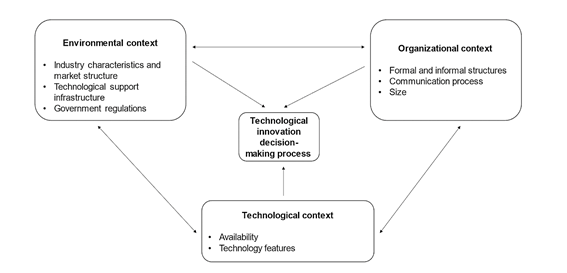
Figure 1.
Framework TOE
Source: Tornatzky and Fleischer (1990)
Thus, the TOE framework can be defined as a generalized theoretical perspective on IT adoption and is free from restrictions related to the size of the firm and the industry. The application of the model can enable the prediction of challenges, the impact of activities in the value chain, the factors that influence the adoption decisions of business innovations, and better development of organizational capabilities through technology (Gangwar, Date & Ramaswamy, 2015).
To resolve conflicts about the characteristics and peculiarities of each model, Table 2 was elaborated.
| Authors consulted | Model | Determinants of adoption | Model focus |
| Ajzen (1985, 1991); Ajzen and Fishbein (2005); Yi et al., (2006); Sharma and Mishra (2014); Taherdoost (2018). | Theory of planned behavior (TPB) | Behavioral attitude, subjective norm, and perceived behavioral control. | Individual and social issues in the user's environment. |
| Davis (1989); Venkatesh and Davis, (2000); Lai (2017); Hoong, Thi, and Lin (2017); Portz et al., (2019). | Technology acceptance model (TAM) | Perceived usefulness and ease | Individual issues in the organizational environment. |
| Venkatesh et al., (2003); Sharma and Mishra (2014); Sila (2015). | The unified theory of acceptance and use of technology (UTAUT) | Performance expectation, effort expectation, social influence, and facilitating conditions | Individual and social issues in the organizational environment. |
| Rogers (2003); Moore and Benbasat (1991); Sila (2015); Taherdoost (2018); Melo (2018). | Diffusion of Innovations Theory (DOI) | Characteristics of the adopter, characteristics, and/or perceived attributes of innovation and decision-making process on innovation. | Individual and organizational issues in the personal and organizational environment of users. |
| Tornatzky and Fleischer (1990); Scupola, (2009); Baker (2012); Gangwar, Date and Raoot (2013); Sabherwal, Jeyaraj and Chowa (2006); Wisdom et al., (2013) Angeles (2014); Alone (2017); Awa, Ojiabo and Emecheta (2015) | Technology Organization and Environment (TOE) | Technological, organizational, and environmental contexts | Organizational issues in the organizational environment. |
As can be perceived, each technological adoption model uses specific determinants ranging from personal characteristics, performance expectations to the evaluation of business contexts. It is also important to highlight that, although indirectly, all models involve personal and social issues applied to the organizational environment, a space in which technological adoption is evaluated for its benefits and potentialities.
However, in the organizational issues of investigation, the DOI and TOE models stand out. Specifically, to the TOE model, it is worth reinforcing that this framework has a solid theoretical basis and consistent empirical support, having been tested in the adoption of different technologies, in diverse organizational and cultural contexts. The criticisms directed to the model state that some variables, such as those related to individual issues, cannot be contemplated, and that there is a lack of variables and clear constructs for each context in the original framework. Even in the face of criticism, the TOE remains among the most prominent and widely used models and theories for the adoption of technologies in the organizational context (Oliveira & Martins, 2011; Baker, 2012; Gangwar, Date & Raoot, 2013).
Moreover, although the framework structure is like the DOI theory proposed by Rogers (2003), the TOE proposed by Tornatzky and Fleischer (1990) includes the environmental and organizational component, being able to explain the external pressures and opportunities that influence the organization being, for this reason, used as a reference for empirical research (Gangwar, Date & Raoot, 2013).
Furthermore, Rahayu and Day (2015) state that THE TOE is recognized as a model that covers many dimensions, having greater explanatory power than other models, since this framework has an interactive perspective, assuming that changes in an organization are influenced by several factors and their interactions in a dynamic structure, which may explain the adoption of IT innovations more comprehensively (Awa, Ukoha & Igwe, 2017), reasons why this model is applied in the empirical stage of this study.
3 METHODOLOGY
The research was characterized as qualitative because it sought to establish the meaning of a phenomenon from the point of view of the participants, where the researcher seeks to listen to them and build an understanding based on what is said. In addition, this form of research allows the interpretation of complex situations (Creswell, 2009). Regarding its purpose, this research was considered descriptive. Newman (2013) reports that descriptive research presents a detailed picture of a situation, social scenario, or relationship, in the case of this research, a description of the elements influencing technology adoption in an educational institution.
The research strategy adopted was a single case study. To assist the researcher in deciding between the use of the single or multiple case study, Yin (2015) considers that, in choosing the single case, the particularity of the case and its potential contribution to the body of knowledge being studied are important criteria that justify the selection of the research strategy.
As exposed by Stake (2000) when adopting a single case study, the researcher's intention is not to represent the world but to represent the case under study. The adoption of the single case study in this research is also justified, according to Platt (2007), which argues that the possibilities of generalization resulting from case studies should not be associated with the number of cases studied, but with the adequacy between the analyzed phenomenon and the theory in development.
Given the characteristics of the single case, this study addresses this research strategy, because it understands that the selected institution, the Federal Institute of Education, Science and Technology of Sergipe - Federal Institute of Sergipe (IFS), has particularities that cannot be found in other institutions of the State in which it is inserted, for example, the IFS has actions in the area of IT and innovation firming at least 20 educational partnerships with world-renowned companies in the area of information technology such as Google, IBM, Oracle, Unity, and Apple Store for Education. These partnerships have been implemented to increase the consumption of refreshers courses free of charge to students and teachers; encourage certification for that audience; and ensure unrestricted access to the latest software for academic use. Among the perceived benefits of IFS educational partnerships are academic e-mail with unlimited storage; unlimited cloud storage; free office apps; and training and download of exclusive programs (Lima, 2017).
Additionally, IFS has stood out in national and regional competitions on robotics, computing, and informatics (Melo, Luft & Rocha, 2020). Moreover, the selected institution was ranked among the top ten educational organizations in the Federal Court of Auditors Survey (TCU) on Information Technology Governance (Santos, 2018).
It is believed that such peculiarities of the selected institution make the adoption and implementation of information and communication technologies a challenge for its managers. Therefore, the selected case has the potential to contribute to the areas of research related to the adoption of IT, in the educational scope. Such peculiarities of the institution motivated its selection. Furthermore, although it was not a determining factor, the ease of access to the institution by one of the researchers is an accessory element in the choice of the IFS.
The research was evaluated by the Research Ethics Committee of the Federal Institute of Sergipe, which after analysis issued an opinion in favor of carrying out the investigations.
The sources of evidence followed the dimension influencing contexts of the TOE framework: environmental context, organizational context, and technological context. The interviews were used as the main source of evidence in this study. The target audience of the semi-structured interviews were the institutional deans, strategic managers, and IT managers. All five strategic managers in the final areas were interviewed; strategic or final areas in the institution are considered: teaching, research and extension, people management, administration, and institutional development. As for IT managers, the two managers who participate more actively in decision-making for the adoption of information and communication technology (ICT) at the organizational level were interviewed.
Table 3 presents the identification and position of the managers interviewed.
Table 3
Characteristics of the interviewees
| Interviewee | Position |
| GTI 1 | Director of Information Technology |
| GTI 2 | IT Governance Coordinator and the internal ICT Planning Committee |
| GE 1 | Dean of institutional development |
| GE 2 | Dean of research and extension |
| GE 3 | Dean of administration |
| GE 4 | Dean of people management |
| GE 5 | Dean of teaching |
In addition to the interviews, the non-participant direct observation was made in two moments, the first, in an ICT planning workshop, and the second, in a meeting of the Information and Communication Technology Steering Committee, of which six of the seven interviewees are members. In addition, document analysis was carried out through access to the following institutional documents: IFS Statute, mission, institutional vision and values, IT Portfolio Management Methodology, Draft of the Information and Communication Technology Master Plan 2014-2019, and ICT Solutions Contracting Plan.
The data analysis technique used in this study was the content analysis proposed by Bardin (2006), composed of the stages of pre-analysis, exploration of the material, and treatment of the results, inference, and interpretation. Initially, the pre-analysis was performed, which consists of the organization phase of the material, when the first contact with the collected data is made. In this phase, the interviews were transcribed, the documents for analysis were selected and the field notes collected in the direct observations were organized. It was then set out to the floating (initial) reading of the entire material and, finally, to the creation of indexes or codes for data classification.
Posteriorly, to assist in the exploration of the material, the organization, and analysis of the data, the NVivo software was used, in version 11. To do this, a project file was created, bringing together all the documents that make up the search database. After storing the sources of evidence, it was possible to insert all the codes into the software, and thus perform the exploration of the material, which was then indexed according to the established codes (analysis elements), and the codes, in turn, were grouped into categories. The system or grid of categories was established, a priori, according to the theoretical framework raised, and thus included the influencing contexts of the TOE framework, that is, the environmental, technological, and organizational contexts.
However, during the content analysis, more precisely in the stages of pre-analysis and exploration of the material, it was admitted the inclusion or modification of categories, this is because, after the detailed examination of the content of the interviews, in association with the documentary analysis and direct observation, it was noticed that the interviewees' arguments and reports about the elements influencing adoption were presented in categories with different levels of relevance, making it possible to categorize them as “determinants”, “boosters” and “barriers” to technological adoption, inserted in the environmental, organizational and technological contexts of the TOE Framework. Thus, the category system was rearranged, and the grid used in the research became a mixed type, according to Vergara (2015).
Table 4 presents the initial analysis categories, the adjusted categories, and the summary of the guiding questions in the interview script.
| Analysis categories (initial) | Rearrangement of analysis categories(Mixed grid) | Summary of the questions that guide the interview script |
| Influencing elements of the TOE Framework - Environmental context; Organizational context; Technological context. | Determinants, boosters, and barriers to technological adoption. | How do you learn about new ICTs? |
| In your opinion, considering the institution, the technology itself, and the environment in which the IFS is inserted, what factors influence the adoption or rejection of an ICT? Comment on each of them. | ||
| What are the main criteria you use to choose an ICT? | ||
| In general, how do you describe the steps of the decision-making process for the adoption of ICT? | ||
| What improvements do you identify in your industry with the use of IT? | ||
| What difficulties do you identify when using a new ICT? | ||
| How are actions carried out to encourage or disseminate the use of technologies? | ||
| What types of follow-up are performed to verify that the implemented technology is being used and whether it meets the needs of users? | ||
| Are servers stimulated and sent for training related to the use of technological resources that involve their activities? | ||
| Are training, courses, and recycling for IT professionals a recurring practice? Report the difficulties in this area. (Question targeted specifically at IT managers). | ||
| Is your sector well equipped with the equipment and resources needed to meet the demands? Are there disabled areas? | ||
| Do the services made by the IT support area meet the needs of your industry? Comment on the reasons for yes and no. (Question specifically directed to administrative managers). | ||
| What are the main criteria and sources used by the IT departament to authorize the adoption of ICT? (Question targeted specifically at IT managers). | ||
| Through ICT resources can you get information and indicators to improve management? Comment what is stopping you and what could be improved? | ||
| Do you think there are sufficient infrastructure and personnel to deal with IT? Comment on what needs to be improved. |
Thus, for better analysis and understanding, the dimension "influencing contexts" had its categories reorganized, resulting in the following nomenclatures: "determinants", "boosters" and "barriers", which were presented as elements belonging to the contexts of the environmental context, organizational environment, and technological environment, according to TOE framework.
In the last phase, treatment of results, inference, and interpretation, the data received treatment and analysis, becoming significant, or according to the author, "speakers". The technique used was the thematic category analysis. The exploration phase of the material allowed the dismemberment of the text into units, and its regrouping into categories, thus allowing the performance of the category analysis, started at the previous stage of content analysis.
As for the criteria of validity and reliability of this study, the postulates of Yin (2015) that dismember the validity in three types of tests were used: construct validity, external validity, and internal validity, the latter being used only for studies with explanatory characteristics, which is not the condition of this research. To ensure construct validity, multiple sources of evidence and triangulation of data were used.
The external validity in the single case study is expressed through analytical generalization. As Yin (2015) explains, although they cannot be generalized, the results obtained in case studies should enable the dissemination of knowledge, through possible generalizations, because the objective is to expand and generalize theories (analytical generalization) from results obtained with the analysis of the case that is, casting an empirical light on theoretical concepts or principles.
Reliability, on the other hand, is related to the production of consistent results due to the data collection techniques and analysis procedures employed (Saunders, Lewis & Thornill, 2009). Thus, a case study protocol was used, and a database was created in the NVivo software, which organized and documented all data collected for the case study.
3.1 Characterization of the institution
The Federal Institute of Education, Science, and Technology of Sergipe (Federal Institute of Sergipe/IFS) was created with the promulgation of Law No. 11,892 of December 29, 2008, which created the Federal Institutes of Education, Science, and Technology. The multicampus institution was composed of the integration of two Brazilian federal autarchies, the Federal Center for Technological Education of Sergipe (CEFET-SE) and the Federal Agrotechnical School of São Cristóvão (EAFSC) (IFS, 2019).
Considering the regional relevance of this institution, corroborated by its expressiveness in offering free education, it stands out that IFS maintains 9372 regular students enrolled in 21 integrated courses (high school and technical together), 29 subsequent courses (technical education only), 18 undergraduate courses, two stricto sensu graduate courses and ten campuses (Cruz, 2019), being the institution that has, in Sergipe, the greatest diversity of levels of education under the command of the same administrative structure (Data for the year 2019).
It is also pertinent to highlight the social performance of the institution analyzed since most of the more than 9,000 students come from low-income families. Another relevant aspect is the significant productivity of the academic community since 715 students and 333 employees participate in applied research, extension, and innovation projects. Additionally, there are more than 60 sustainable projects and dozens of social projects aimed at community actions in needy areas, projects that contribute not only to scientific and technological knowledge but also to the improvement of the living conditions of the local population (Cruz, 2019).
It should also be noted that the IFS has for years stood out among the main federal institutes in the Northeast, having reached the first position of the general index of courses (IGC) of the Ministry of Education in the triennium 2014-2016 (Bittencourt, 2019) and was positioned among the five best institutions of the federal education network of the Northeast in 2017 (Inep, 2018), besides being among the best educational institutions in Sergipe (Bittencourt, 2019).
4 ANALYSIS AND DISCUSSION OF RESULTS
Based on the TOE framework, developed by Tornatzky and Fleischer (1990), we sought to verify elements that influence the managers interviewed in the process of adoption and implementation of new technologies, and that are present in the environmental context, in the internal institutional context, or even those inherent to the technology itself. Thus, for better analysis and understanding, the dimension "influencing contexts" had its categories reorganized, resulting in the following nomenclatures: "determinants", "boosters" and "barriers".
4.1 Determinants of Adoption
The elements that decisively influence the adoption are those that define or direct the adoption of specific technologies in the institution. The first element identified is the existing technology in the institution, belonging to the technological context. In the speech of the interviewee GTI 1, it is perceived that the internal technologies direct future projects related to ITCs. This statement is evident when the interviewee comments on the Integrated Management System, which is currently used in most administrative activities.
You already have this corporate system that is an ERP, that is, a system that integrates all the final areas, and our idea is to offer the same services in a smaller format, in mobile [...] we want the manager to need the data and be in the palm of his hand (Entrevistado GTI 1).
Similarly, during the analysis of the documents "ICT Solutions Contracting Plan" of the years 2017 and 2018, the influence of existing technologies in the institution was also evidenced. This document lists the main acquisitions and contracts that will be made in the ICT area during the year. Thus, it could be verified that, in the 2017 plan, of the 25 related items, 10 are linked to existing equipment and services, this means that 40% of the total of the ICT to be adopted are referred to or are an improvement of internal technology. In the plan planned for 2018, this percentage rose to 57%, with 8 of the 14 contracts being based on internal technologies.
This result ratifies the findings of Awa, Ojiabo, and Emecheta (2015), since for the adoption of new technological tools has been considered technical compatibility with current tools, as well as organizational compatibility with the operation of the institution.
The findings also corroborate the statement of baker (2012) that the technologies present in the institution serve as a reference for the adoption of the new tools because they allow evaluating and planning the change that will occur in the institution. In addition, adjusting the configuration of existing technology with the intended technological innovation is one of the determining factors in the decision to adopt (Fuller, Hardin & Scott, 2007; Salleh, Janczewski & Beltran, 2015).
Another determining element, identified in the interviewees' speech, and found in the environment external to the institution (and in the environmental context of the TOE framework), is the influence of external government institutions. With data analysis, it was possible to identify that such institutions can determine the adoption of technologies in two ways: first, regulating or governing the acquisitions of IT, and secondly, imposing their technologies for use in the institution.
The government regulatory institutions cited by the interviewees and mentioned in the institutional documents are the Information Technology Resources Administration System (SISP), and control bodies such as the Comptant General of the Union (CGU) and the Federal Court of Auditors (TCU). The interviewees' speech reflects this influence, like interviewee GTI 2, who said: "we are tied to rules. It has guidelines for IT hiring that we have to follow, both defined by the TCU, and defined by SISP, what you can buy, what you can not buy". Furthermore, one interviewee said:
I remember an audit that the CGU did in 2014 or 2015 where he pointed out the suggestion of various computerizations, automation in the end area, both the teaching part, as in the research part, greater publicity, greater transparency, and this has been worked, not only to meet the control bodies but also to serve the society in general (Interviewee GE 3).
It is noticed that organs that do not have specific performance in the educational environment are one of the main regulators in the adoption of new ITCs. It is not intended here to belittle the actions of such institutions, which are, even of great importance for supervision and control in the case of public institutions. However, the concern to meet the demands imposed can make other factors, more specific to the reality of educational institutions, with much more discreet participation in the adoption and implementation of IT. The market itself in which educational institutions are inserted could exert greater influence, demanding improvements, and acquisitions more aligned with the end-activity of the institution.
The external agencies that impose their technology for use in the institution, through documents, ordinances, and regulations, in general, belong to the federal government, such as the Ministry of Education (MEC), in the area of education, the Ministry of Finance, in financial administration, and the Ministry of Planning in the area of people management, the latter two currently merged into the Ministry of Economy (ME). When talking especially about the systems imposed by the MEC, the interviewees expressed their dissatisfaction, as in the speech of the interviewee GE 1:
IFS needs to register all its students in a system called SISTEC. It is a tool, a program instituted in law, by MEC, for the use and control of these academic issues. So, what happens, SISTEC it is very, very flawed. Then when you realize you are wrong, you cannot change because it is a very big bureaucracy to make any adjustment, then it's demotivating, you already think that there doesn't fit (Interviewee GE 1).
Although it can discourage users, the imposition of specific technologies is a difficult reality to change because, as Scupola (2009) and Baker (2012) point out, government regulations have the power both to provide incentives, creating opportunities, and to impose requirements, restricting the adoption of technologies.
Table 5 summarizes the description of elements determining the technological adoption in the researched sources in which this element was identified (interviews, documentation). It is observed that the code "external organs" occurred much more often, compared to the code "existing technologies", demonstrating that the influence of external organs is more recognized institutionally.
Table 5
| Code | Code description | |
| Interview | Documentary Analysis | |
| ICT Solutions Contracting Plan | ||
| Existing technologies | Integrated Management System (ERP) | In 2017 and 2018, 40% and 57% of acquired ICT were based on existing technologies. |
| Governmental institutions | Regulation of IT acquisitions Determination of the technologies adopted. | ------------------------------- |
It is perceived that, when the influence of determining elements aims at internal standardization and optimization of existing resources, it is better accepted among the decision-makers interviewed. However, when coming from external organs, especially in cases where specific technologies are imposed, their receptivity decreases considerably. Thus, it is understood that the determination itself is not considered bad, as long as it does not fully restrict the power of choice of institutional managers and that the justification of the action is supported by internal improvement.
4.2 Adoption Boosters
Among the boosters of adoption, we identified the creation of the Information and Communication Technology Steering Committee (CGTIC), composed of strategic managers and campus directors, and chaired by the Rector. It is the maximum decision-making body of matters related to IT, and its creation, according to the interviewees, brought benefits such as agility in decision-making, increased IT actions in the institution, and an approximation of the IT area to the business area. The speech of one of the interviewees reflects this thought:
I think this committee is of paramount importance, first because we as a manager must have science, knowledge, even to help the dissemination too, and know the tools and applications that the institute has been acquiring. Because it is no use for you to acquire and no one has knowledge or know how to use it, so I think it is very important (Interviewee GE 2).
Observing one of the CGTIC meetings, it was noticed that the creation of the committee, with technical and administrative members, stimulated the participation and support of senior management in the discussion of aspects about adoption, limitations, and needs for technological adjustments. Furthermore, the analysis of the document IT Portfolio Management Methodology allows the identification of procedures for IT management in the institution, which directs part of the discussions at CGTIC.
Thus, the creation of the committee demonstrates the effort for the participation and support of senior management in decisions related to ICTs, so, this element resembles the construct "support of senior management", included in the organizational context of the TOE framework, which, according to Gangwar, Date, and Raoot (2013) is one of the most used in the analysis of the contexts influencing the adoption of the TOE framework.
In addition, the creation of the committee demonstrates, according to Balaid, Rozan, and Abdullah (2014), that senior management provides a favorable climate, communicates, and reinforces corporate values through an articulated vision, and therefore serves as one of the most critical boosters for the adoption of new technologies. Moreover, Chuang, Luor, and Lu (2014) found that senior management's knowledge of the benefits of technology and the organization's expectations, as well as concomitant support, are critical predictors of technological adoption, as found in the institution analyzed.
Thus, the involvement of senior management can be considered one of the main gains for the management of the educational institution, enabling the digital inclusion of educational managers, presenting them with the benefits of IT, and motivating them to use the tools.
The expertise of the IT team, also belonging to the context of the organizational environment, is another boosting element of adoption since it has allowed the institution that more projects, involving acquisitions and implementation of new tools, can be conducted. In addition, the arrival of new qualified servers generated a team renewal, and consequently the emergence of more ideas for improving the institution's ICT infrastructure. IT managers recognize this advance:
We have a renewed team, that is, 40% of the servers are recent, and there consequently it is natural that the server that just entered it has a greater dedication, a
greater concern with the result [...] this allows us to perform more things in less time and more at the same time. Today we have around 20-something projects at the same time (Interviewee GTI 1).
This quality of the IT team is also felt by strategic managers:
We migrated almost all the modules of the old academic system to the new one in a year, and if I compare with other institutes, they are five- or six-years old migrating and have not yet reached even where we are today (Interviewee GE 5).
The IT team's expertise was also observed in IFS institutional documents, such as the ICT Solutions Hiring Plan and Draft of the Information and Communication Technology Master Plan 2014-2019, that mention actions and policies for training personnel, more precisely the situations that generate the need for training. In addition, it was noticed in the observation of the ICT planning workshop and of the ICT management committee meeting, the competence and involvement of IT professionals in relation to planning the adoption of ICTs.
The importance of the qualification of the IT team is ratified by Barbosa and Faria (2008) who found that the participation of qualified employees has a significant positive impact on the probability of adoption, providing an additional and interesting view on the understanding of technological adoption.
Finally, another influencing element that boosts the adoption of IT is the improvement in the business or perceived utility, evidence also included in the context of organizational environment, which, according to Lunardi, Dolci, and Wendland (2013) occurs when the organization adopts technology because it realized that it would be useful in its daily activities, improving the performance of tasks and increasing security, for example. Questions such as agility in the development of activities and security in the storage of information are pointed out by several interviewees as relevant points: "speed, efficiency, response, security, because everything is recorded" (Interviewee GE 2) and "we save time, we keep the information more safely, we issue a report, we do not have to produce a report" (Interviewee GE 3).
The evidence obtained from the interviewees' reports reinforces that technological adoption optimizes the performance of daily activities, improves the performance of tasks, and increases safety (Lunardi, Dolci & Wendland, 2013). Going further, the results achieved ratify the postulates of Awa, Ukoha, and Igwe (2017) which explain that technological adoption allows achieving synergy and overlap between new technologies and improved ways of executing organizational processes.
The description of the boosting elements, according to the sources of evidence, is shown in Table 6. In this category, it was possible to observe that the involvement of senior management and the quality of the team responsible for the ICT are two elements that complement each other, and, if found in isolation, lose much of their power of influence. This relationship occurs, therefore, management involved with the ICT needs a solid and qualified base of professionals to make the projects about the integration of the in the organizational context a reality.
| Code | Code description | ||
| Interview | Documentary Analysis | Observation | |
| IT Portfolio Management MethodologyICT Solutions Contracting PlanDraft of the Information and Communication Technology Master Plan 2014-2019 | ICT planning workshopMeeting of the ICT Steering Committee | ||
| Creation of CGTIC (senior management support) | Agility in decision making. Increase in IT actions. | Indication of procedures for IT management in the institution. | Participation and support of senior management in the discussion of aspects about adoption, limitations, and needs of technological adaptations. |
| IT team expertise | New servers Trainings, workshops, and distance learning courses. Migration of academic modules. | Situations of training needs. | Perception of the competence and involvement of IT professionals concerning planning for the adoption of IT. |
| Business improvement (perceived utility) | Approach of the IT area with the business area. Time gain. More secure information storage. Agility for issuing reports. | ---------------------------------- | ------------------------------------------------------------- |
4.3 Barriers to Adoption
Several difficulties inherent to the organizational context and a specific one inherent to the environmental context, create barriers or difficulties to the decision-making process of adoption and implementation of ITCs. These barriers are grouped into the following codes: high demand, communication, lack of integration and turnover, inserted in the organizational context, and budget, linked to the environment context (external environment) of the TOE framework.
The high demand is the burden that the institution's IT team faces and makes actions for adoption and implementation slower. The Information Technology Board (DTI) is the second decision instance, shortly after the initial decision made by the strategic manager. The routine practiced in the institution, that all adoptions related to ICT need an opinion of DTI, makes the demand of this sector extremely high, generating a slower process for the business area. The speech of strategic managers reflects the dissatisfaction in this question: "the demand for work that IT team has, sometimes influences, you need a faster solution, in a faster time, only there are so many other priorities, and they have to support the whole institution" (Interviewee GE 1); "what has is a gap very large for a response, takes a long time, understood and finally, maybe it's a matter of prioritization, the IT here today is very focused on new projects then we are a little neglected" (Interviewee GE 4).
In this sense, in the observation of the ICT planning workshop, discussions about the criteria and priorities for meeting the demands were perceived, as well as directions for the CGTIC meeting.
Another barrier identified in the sources of evidence is communication. The difficulty of communication between the business area and IT area is not something exclusive to educational institutions, much less to the institution researched, on the contrary, it is a barrier in several organizations and institutions.
Luftman, Lyytinen, and Zvi (2017) discuss the importance of communication between IT business managers so that both parties clearly understand their respective strategies, plans, risks, priorities, and how to achieve them. The authors also point out that effective communication between the areas influences the positive alignment and the consequent achievement of coordinated activities; in addition, executives learn to listen, understand, and respect each other. All this facilitates collaborative leverage of resources and results in trust relationships, which is important as organizations grow and the need for integration increases.
The lack or failure of communication, on the other hand, results in a lack of investment in IT and missed opportunities (Luftman, Lyytinen & Zvi, 2017). One of the strategic managers, because he has training in the IT area, admits the difficulty that IT professionals encounter in the relationship with other areas:
We, in the IT area, we have a more technical language, so we speak a lot of English mixed with Portuguese, speak many acronyms, and so this approximation of IT staff to users is a big challenge [...] I think you need to put the IT guy to get out of his box and sit at the user's desk, do his job to understand, put him to work closely because sometimes it is locked in a room viewing the computer and not is in the day by day. This modus operandi makes it difficult (Interviewee GE 5).
On the other hand, during the documentary analysis of the Information and Communication Technology Master Plan (PDTIC) and the ICT Solutions Contracting Plan, it was found that these documents generally use more technical language when describing procedures specific to the IT area.
During the direct observation held at the event, I Workshop of Planning in IT, which brought together servers from the IT area of the institution, several problems related to the ICT was pointed out by the servers themselves, having as a cause, according to them, the failure of communication between the areas. Some of the problems mentioned were maintenance of solutions that no longer meet the needs of the institution; use of only one market solution as a basis for defining requirements; contracting of incomplete solutions, often leading to overspending for further correction; unavailability of essential services.
Communication between business areas and IT is a critical success factor in the organization and should be treated as an intangible asset. Communication-related problems increasingly distance the two areas, affecting the positive perception about IT (Velloso, Yanase & Oliveira, 2015), and, consequently, generating negative impacts at the time of adoption and implementation of new technologies (Awa, Ukoha & Igwe, 2017).
The third barrier identified in the institution is the lack of integration. Managers still work, often, in isolation, even between business areas, and do not realize that ICT solutions adopted by one area can be of great value to others. This factor generates rework and may incur additional costs when a given solution is no longer purchased jointly by two or more business areas. The IT manager addressed the difficulty of implementing the new academic system, precisely due to the lack of integration of the institution:
We are deploying the integrated solution for an organization that is not integrated. The public service in general, not only the teaching structure not usually very coordinated in its actions. You have islands of knowledge, so the HR area does not communicate with the financial, which does not communicate with bidding and contracts. You have an entire ecosystem, from the point of view of legislation, but the areas do not communicate, do not care about the indicator of the other (Interviewee GTI 1).
During the observation of the ICT planning workshop, issues arising from communication that prevented integration were reported, such as the maintenance of ineffective solutions, the adoption of only one market solution to define requirements; acquisition of partial solutions, and the non-availability of essential services, as previously mentioned.
In this context, Silva, Torres, and Nicolini (2016) emphasize the importance of an integrated and mature administration, stating that among the competencies necessary for managers of educational institutions, is the ability to manage it in its total complexity, having the vision of the context in which it is inserted, the knowledge of its processes and internal departments, and what are its educational demands.
In the wake of these facts, these issues need to be addressed among strategic managers in a coordinated way, because they realize that when integration is restricted to the sharing of a database in a system, sufficient gains are not generated for educational management, as reported by one of the interviewees:
Concerning systems, there is an integration in the database, so if the teacher needs to use the people management system, he does not need to make a new registration, it is already there, that is all. But in usability we do not feel so, it does not happen for a pro-rectory to implement a solution that will favor another sector [...] this is even a problem here in the institution, many "small software", "small system" (Interviewee GE 4).
The budget, also cited by several managers as one of the barriers to adoption and implementation, is the only element of the group that belongs to the environmental context (external environment) since the institution depends on the budget transfers of the federal government. The budget limitation affects both the acquisition of equipment and resources, as well as implementation actions, such as trainings. The interviewee GTI 2 addressed the difficulty of training managers in the ICT area due to budgetary limitations:
We put some things in our training plan, already signaling to the area of training of ICT managers, only that has that budget impact, so we can not always do [...] some things we try to apply workshops, distance courses, but these tools are also limited (Interviewee GTI 2).
The document Information and Communication Technology Master Plan (PDTIC) signaled budget cuts as a threat to ICT planning. The institution's spending limit in 2017 was 31% lower than the amount committed in 2016. It is a barrier that does not depend entirely on the institution to be overcome, however, two specifics actions in IT were carried out to reduce institutional spending. They were:
-
· The implementation of a new telephony project, which reduced IFS spending with calls by R$ 250,000; and
· Rentals of printing machines, reducing expenses by R$ 62,000.00 monthly.
The evidence obtained in the organization studied reinforces that federal laws and policies, as well as economic and budgetary mechanisms, influence the adoption of innovations (Landsbergen & Wolken, 2001). However, it is noticed that resource limitation, despite being a barrier to many acquisitions, can also become an opportunity to plan workarounds and review current resource allocations.
The turnover of managers is another major problem that also affects the adoption and implementation of ITCs. This is because there is a breakdown in the process, especially in the transition from the decision-making step to the implementation step. As all adoption of IT is carried out by the business unit in conjunction with the Information Technology Directorate (DTI), this sector perceives the problem and its consequences:
You will plan, then you plan with a manager, you build with another manager, and deliver to a third party, [...] this for IT is horrible, because it is a requirement that was thought by a person when you will execute what was idealized, already have another manager supervising and when you implement, is another manager who did not understand what was executed and much less because it was planned (Interviewee GTI 1).
Turnover does not include only senior management. Other smaller managements and coordinations, subordinated to them, also suffer from this problem, which is so expressive that the SWOT analysis presented in the Information and Communication Technology Master Plan (PDTIC), points to turnover as one of the institution's weaknesses regarding the adoption, implementation, and management of ICTs.
In this context, Silva, Aguiar, Binotto, Siqueira, and Corona (2014) discuss the issue, stating that in the academic environment, this transience of the servers in management positions is a strongly present aspect, and does not always occur without major trauma sprees for the occupant of the position and the group that surrounds it. The authors also state that this turnover of managers seems to be more complex in the academic environment than in the business context.
Table 7 summarizes the occurrence of the five codes belonging to the Barriers category.
| Code | Code description | ||
| Interview | Documentary Analysis | Observation | |
| Information and Communication Technology Master Plan (PDTIC)ICT Solutions Contracting Plan. | ICT planning workshop | ||
| High demand | IT needs to meet requests from across the institution. | ----------------------------------------- | Observation of the ICT planning workshop with the discussion about the criteria and priorities to meet the demands. Directions at the CGTIC meeting. |
| Communication | Technical language of IT professionals. | Documents generally use a more technical language when describing IT procedures. | Perception that IT professionals often use foreign expressions and acronyms. During the ICT planning workshop, participants related problems generated by failures in communication about maintenance actions, hiring requirements and availability of essential services. |
| Integration | Isolated work between the areas of the institution. Areas with different software for similar activities. | ----------------------------------------- | During the ICT planning workshop, issues derived from communication that prevented integration were reported. |
| Budget | Limitation for the acquisition of equipment and contracting of | The PDTIC indicated cuts of 31% compared to 2017 and 2016. Description of the implementation of telephony projects and rental of printing machines. | ------------------------------------------------------------------ |
| Turnover | Interruptions in the decision-making and technological implementation process. | Indicated as a weakness in the institution's PDTIC. | ------------------------------------------------------------------ |
It is perceived that the most strongly mentioned problems are the lack of integration of the institution and the budgetary limitation, remembering that the first may aggravate the second, because the lack of integration can generate, also, to rework, the non-acquisition of joint solutions, capable of reducing the costs resulting from the adoption.
4.4 Influencers of Adoption: Determinants, Boosters and Barriers Makers to Technological Adoption in an Educational Institution
Considering the variety of results explored in this study, Figure 2 was elaborated, which illustrates an analytical structure with all the elements identified in the research, classified according to the type of influence they exert in the institution surveyed.
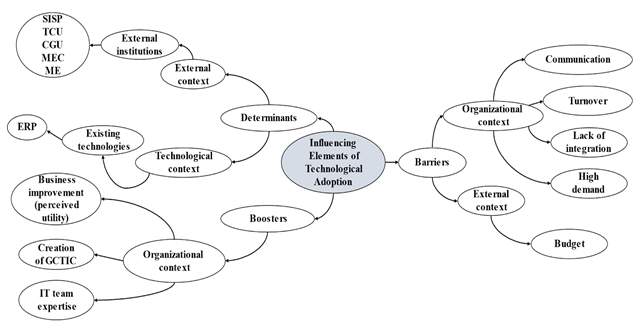
Figure 2
Elements influencing the adoption of information and communication technology
Source: Developed by the authors.
Taking into account the analytical structure, what is found is that educational institutions such as the Federal Institute of Sergipe, which have a similar structure, operating rules, and public management, deal with different determining influence, boosters and creating barriers, which act on the process of adopting and implementing information and communication technologies.
What is perceived, then, is that for this type of institution, the elements that determine adoption are not totally under the control of the institution, but rather arranged, primarily, in the environmental context of the TOE framework, represented by governmental control and management bodies, such as the Information Technology Resources Administration System (SISP), the Federal Comptroller General (CGU), the Federal Audit Court (TCU), the Ministry of Education, and the Ministry of Economy. Demonstrating that the interaction with these government institutions is what defines, in fact, the technological adoption and implementation in the IFS.
This finding increases the literature on the topic and seems to reflect a characteristic of the Brazilian educational context, considering educational entities such as the Federal Institutes of Education, Science, and Technology, since Tashkandi and Al-Jabri (2015), in a study on the adoption technology of cloud computing in the Arab context of higher education institutions, as well as Klug and Bai (2015) when studying adoption in North American and Canadian institutions detected that there is no effective government pressure for technological adoption in educational institutions those countries. On the other hand, while in the Brazilian institution government entities are preponderant to technological adoption, in the Arab context (Tashkandi & Al-Jabri, 2015) and from North American and Canadian institutions (Klug & Bai, 2015), technological readiness, institutional size and complexity assume this role.
On the other hand, the determining elements also include technologies existing in the institution, included in the technological context of the TOE framework. This finding reflects that, within the scope of the researched institution, it is the identification of the technical compatibility of the new technological tools with the integrated management system (ERP) that determines the adoption in the technological context. This perception differentiates the findings of this study in comparison with similar studies, presenting a result that differs from that achieved by Klug and Bai (2015) who found that relative advantage, compatibility, regulatory policy, and support are insignificant factors for technological adoption in universities in the USA and Canada.
The results obtained in the evaluated organization also allow us to infer that Brazilian educational institutions have better physical, and technological infrastructures than those found in countries like Nigeria, in which Eze et al., (2015) realized that electricity, internet connectivity, and technology support are the most significant determinants of ICT adoption in public universities.
These elements seem to have been overcome in the researched institution, in which the adoption boosters, although associated with the organizational context of the TOE framework, are not represented by technical elements, but portrayed by the improvement in the business, the creation of the technology management committee of information (GCTIC) and the expertise of the IT team, aspects little discussed in other studies in the area (Tashkandi & Al-Jabri, 2015; Klug & Bai, 2015; Eze et al., 2015).
In addition, the results of this research expand the findings of Silva et al., (2020), by demonstrating that although the creation of ICT management committees encourages the participation and support of top management, educational institutions can implement trainings, workshops, and distance courses to reinforce the IT team's expertise and success in technology adoption processes. On the other hand, this study advances the findings of Silva et al., (2020) for promoting an analysis of the adoption of technology considering all contexts of the TOE framework - environmental, technological, and organizational - as well as for categorizing them as determinants, boosters, and barrier makers.
From another perspective, the TOE organizational context also adds almost all barriers to technological adoption, characterized by communication failures, high server turnover, little integration between business areas, and high demand for IT services (support). These elements are expressive in the creation of barriers to the adoption and implementation of information and communication technologies, and because they are inserted in the organizational context and under the administrative jurisdiction of educational managers, they must be the object of studies and management strategies that minimize their impact.
Finally, the analytical structure also demonstrates that a strong barrier to adoption is inserted in the environmental context of the TOE framework, specifically due to budget limitations. In the case analyzed, the determining influence of external government institutions and the budgetary barrier are clear examples of what authors Tornatzky and Fleischer (1990) showed as elements that do not depend, in any aspect, on factors related to decision-makers. Indeed, the determinations of external government institutions and the budget constraint were among the most cited influencing elements, demonstrating the active action of these factors in the process of technological adoption in an educational institution.
5 CONCLUSIONS
The main contribution of this research is in the identification and organizational analysis of the influencing contexts of the TOE framework - environmental context, organizational context, and technological context - categorized into determining factors, boosters, and barrier makers for technological adoption in an educational institution, a theme with limited academic discussion, under the management perspective, in educational entities in Brazil.
Through this lens, it was found that in the educational institution analyzed, the environmental context involves, through control bodies, the main determinants of technological adoption, specifically, Information Technology Resources Administration System (SISP), Comptant General of the Union (CGU), and the Federal Court of Auditors (TCU), in addition to the Ministry of Education and Ministry of Economy.
Moreover, it was also noticed that, in the organizational context, the adjustment and integration between current and future technologies are determinant to technological adoption in the educational institution studied, mainly because the ERP has undergone updates and improvements to adjust to the needs of this educational entity.
It was also noticed that when the influence of determining elements aims at internal standardization and optimization of existing resources, it is better accepted among decision-makers. However, when coming from external organs, especially in cases where specific technologies are imposed, receptivity decreases. Thus, it is understood that the determination itself is not considered bad, as long as it does not restrict the power of choice of institutional managers and that the justification of the action is supported by internal improvement.
Thus, it was inferred that in the organizational context, the boosters of technological adoption encompass the involvement of senior management and the quality of the team responsible for IT. These elements complement each other, and, if found in isolation, lose some of their power of influence. This relationship occurs, therefore, management involved with the ICT needs a solid and qualified base of professionals to make the projects about the integration in the organizational context a reality.
These findings reinforce the potential for successful technological adoption in the IFS since the case did not reveal difficulties with limitation in a learning capacity, professional qualification, management support, institutional support, and size of the institution as inhibitors to technological adoption, as perceived by Eze et al., (2015) in Nigerian universities.
It is worth mentioning that the organizational context comprises elements that act simultaneously as boosters and barrier makers to technological adoption, mainly in aspects related to communication, lack of integration, turnover, and high demand, elements not detected in similar studies on technological adoption, from the management point of view, in educational institutions, such as Tashkandi and Al-Jabri (2015), Klug and Bai (2015) and Eze et al., (2015).
These findings allow us to infer that in educational institutions, like IFS, several elements act to impose, boost, or create difficulties for technological adoption. Some of them are out of control of management, notably those belonging to the environmental context, and others can be administered by it, especially those that fit into the categories of boosters and barriers, as they are elements, mostly, found in the internal organizational environment.
Different from what was observed in similar studies on the factors that influence technology adoption in educational institutions (Tashkandi & Al-Jabri, 2015; Klug & Bai, 2015; Eze et al.,2015), this work detected that elements present in the environmental and technological contexts – external institutions and existing technologies – decisively influence the decision-making process of technological adoption to direct or even impose on the institution the need to acquire and/or use certain technologies. On the other hand, the elements of the internal organizational environment – communication, turnover, integration, and high demand – and a specific element of the environment context– budget – exert influences that can boost or create barriers to adoption, but are not decisive, as in the first case.
Additional finding perceived in the educational institution is that the organizational context is the environment that stands out from the others mentioned in the TOE framework because it houses both the boosting elements of adoption, as well as the barriers that arise to the process. Therefore, the organizational context has significant participation in the adoption decision and in the success of implementation and ratifies the strategic role played by managers, because it is in the internal environment that they have greater power to act and can perform to mitigate barriers and strengthen boosters.
Consequently, if administrative managers are integrated and with IT managers, they will be able to plan and promote joint actions to adopt and implement the best ICT solutions, so it is necessary to avoid the communication barriers found in the case.
Thus, it is perceived that the inclusion of ICT in the educational environment involves much broader dimensions, highlighting, in addition to an infrastructure that opportunities the dissemination of these technologies, a management team that leads the processes of adoption and implementation, to contribute significantly to the transformation of the institution.
Regarding the limitations of this study, the interviewees' indisposition to report problems and difficulties stands out. Because all interviewees belonged to senior management, the reporting of aspects considered negative was often avoided by some of them.
This study does not end the possibilities of debate on technological adoption in educational institutions, for this reason, it is recommended to new studies: to analyze the role of current technologies as determinants and barriers makers to technological adoption, especially about internal users of organizations; evaluate, from the perspective of educational managers, teachers and students, the results in academic performance and internal improvement from the adoption of technological tools; identify and evaluate components of the environmental context that, simultaneously, impose barriers and boost technological adoption in educational institutions, as well as evaluate the strategic performance of educational managers as drivers of the adoption process; and to investigate how technological adoption has been planned and implemented in the face of budgetary limitations.
In addition, it is possible to analyze the adoption of specific technologies within educational institutions, such as social media. Finally, the expansion of this study with other educational institutions in Sergipe or even other regions of the country is also relevant since it will allow comparison of results and construction of analytical generalizations.
Considering the understanding that administrative management is the starting point and central element for the dissemination of IT in all institutional spaces, it is emphasized that this study achieved its purpose since it was able to analyze the influencing elements in the adoption and implementation of IT by educational managers of the Federal Institute of Sergipe, besides contributing to the exploration of the TOE framework in an analysis unit that can infer new or similar findings in other units of the same segment, allowing to understand how these factors can guide managers of educational institutions and IT managers in their technology adoption decisions.
REFERENCES
Ajzen, I. (1985). From intentions to actions: A theory of planned behavior. In J. E. Kuhl & J. Beckmann (Orgs.), Action control: From cognition to behavior. Berlim: Springer-Verlag.
Ajzen, I. (1991). The theory of planned behavior. Organizational Behavior and Human Decisions Processes, 50(2), 179-211. https://doi.org/10.1016/0749-5978(91)90020-T
Ajzen, I., & Fishbein, M. (2005). The influence of attitudes on behaviour. In D. Albarracin, B. T. Johnson & M. P. Zanna (Eds.), The Handbook of Attitudes. Lawrence Erlbaum Associates.
Albino, R. D. (2015). Uma visão integrada sobre o nível de uso das tecnologias da informação e comunicação em escolas brasileiras. (Dissertação de Mestrado). Universidade de São Paulo, São Paulo, Brasil. https://www.teses.usp.br/teses/disponiveis/12/12139/tde-10082015-141546/publico/RaphaelDonaireAlbino_Corrigida.pdf
Al-Furaih, S. A. A., & Al-Awidi, H. M. (2020). Teachers’ change readiness for the adoption of smartphone technology: Personal concerns and technological competency. Technology, Knowledge and Learning, 25, 409-432. https://doi.org/10.1007/s10758-018-9396-6
Alone, K. (2017). Adoption of e-learning technologies in education institutions/organizations: a literature review. Asian Journal of Educational Research, 5(4), 63-71. http://www.multidisciplinaryjournals.com/wp-content/uploads/2017/07/Full-Paper-ADOPTION-OF-E-LEARNING-TECHNOLOGIES-IN-EDUCATION.pdf
Angeles, R. (2014). Using the technology-organization-environment framework for analyzing Nike’s considered Index Green Initiative: A decision support system-driven system. Journal of Management and Sustainability, 4(1), 96-113. https://doi.org/10.5539/jms.v4n1p96
Anjos, M. B., & Rôças, G. (2017) As políticas públicas e o papel social dos institutos federais de educação, ciência e tecnologia. Natal: Editora IFRN.
Awa, H. A., Ukoha, O., & Igwe, S. R. (2017). Revisiting technology-organization-environment (T-O-E) theory for enriched applicability. The Bottom Line, 30(1), 2-22. https://doi.org/10.1108/BL-12-2016-0044
Awa, H. O., Ojiabo, O. U., & Orokor, L. E. (2017). Integrated technology-organization-environment (T-O-E) taxonomies for technology adoption. Journal of Enterprise Information Management, 30(6), 893-921. https://doi.org/10.1108/JEIM-03-2016-0079
Awa, H. O., Ojiabo, U. O., & Emecheta, B. C. (2015). Integrating TAM, TPB and TOE frameworks and expanding their characteristic constructs for e-commerce adoption by SMEs. Journal of Science and Technology Policy Management, 6(1), 76-94. https://doi.org/10.1108/JSTPM-04-2014-0012
Baker, J. (2012). The technology–organization–environment framework. In Y. K. Dwivedi, M. R. Wade & S. L. Schneberger (Eds). Information systems theory: Explaining and predicting our digital society. New York: Springer
Balaid, A., Rozan, M. Z. A., & Abdullah, S. N. (2014). Conceptual model for examining knowledge maps adoption in software development organizations. Asian Social Science, 10(15), 118-132. https://doi.org/10.5539/ass.v10n15p118
Barbosa, N., & Faria, A. P. (2008). Technology adoption: Does labour skill matter? Evidence from Portuguese firm-level data. Empirica, 35, 179-194. https://doi.org/10.1007/s10663-007-9056-x
Bardin, L. (2006). Análise de Conteúdo (4 ed.). São Paulo: Edições 70.
Barroso, R. C. A., & Silva, J. A. B. (2014). Política de uso das tecnologias da informação, comunicação e mídias em Sergipe: Uma história a ser contada. Revista do Instituto Histórico e Geográfico de Sergipe, 2(44), 293-310. https://seer.ufs.br/index.php/rihgse/article/view/11957
Quatro campi do IFS estão entre os dez primeiros colocados em ranking com as melhores instituições
Brasil (2017). IFS: Melhor instituto federal do norte e nordeste. Instituto Federal de Sergipe. http://ifs.edu.br/ultimas-noticias/279-destaque/6191-ifs-melhor-instituto-federal-do-norte-e-nordeste
Caliari, K. V. Z., Zilber, M. A., & Perez, G. (2017). Tecnologias da informação e comunicação como inovação no ensino superior presencial: uma análise das variáveis que influenciam na sua adoção. REGE - Revista de Gestão, 24(3), 247-255. https://doi.org/10.1016/j.rege.2017.05.003
Cao, Q., Jones, D. R., & Sheng, H. (2014). Contained nomadic information environments: Technology, organization, and environment influences on adoption of hospital RFID patient tracking. Information & Management, 51(2), 225-239. https://doi.org/10.1016/j.im.2013.11.007
Castells, M. (2003). A sociedade em rede (7 ed.) São Paulo: Paz & Terra.
Chuang, S., Luor, T., & Lu, H. (2014). Assessment of institutions, scholars, and contributions on agile software development (2001-2012). Journal of Systems and Software, 93(7), 84-101. https://doi.org/10.1016/j.jss.2014.03.006
Creswell, J. W. (2009). Research design: Qualitative, quantitative and mixed methods approaches (3 ed.) Thousand Oaks: Sage Publications.
Cruz, C. F. (2019). IFS transforma vidas e promove desenvolvimento. Instituto Federal de Educação, Ciência e Tecnologia de Sergipe. http://www.ifs.edu.br/ultimas-noticias/7731-ifs-transforma-a-vida-de-pessoas-e-promove-o-desenvolvimento
Davis, F. D. (1989). Perceived usefulness, perceived ease of use, and user acceptance of information technology. MIS Quarterly, 13(3), 319‐340. https://doi.org/10.2307/249008
Eze, S. C., Awa, H. O., Okoye, J. C., Emecheta, B. C. & Anazodo, R. O. (2013). Determinant factors of information communication technology (ICT) adoption by government‐owned universities in Nigeria: A qualitative approach. Journal of Enterprise Information Management, 26(4), 427-443. https://doi.org/10.1108/JEIM-05-2013-0024
Fu, J. S. (2013). ICT in education: A critical literature review and its implications. International Journal of Education and Development using Information and Communication Technology (IJEDICT), 9(1), 112-125. http://files.eric.ed.gov/fulltext/EJ1182651.pdf
Fuller, M., Hardin, A., & Scott, C. (2007). Diffusion of virtual innovation. The Data Base for Advances in Information Systems, 38(4), 40-44. https://doi.org/10.1145/1314234.1314243
Gangwar, H., Date, H., & Ramaswamy, R. (2015). Understanding determinants of cloud computing adoption using an integrated TAM-TOE model. Journal of Enterprise Information Management, 28(1), 107-130. https://doi.org/10.1108/JEIM-08-2013-0065
Gangwar, H., Date, H., & Raoot, A. D. (2013). Review on IT adoption: insights from recent technologies. Journal of Enterprise Information Management, 27(4), 488-502. https://doi.org/10.1108/JEIM-08-2012-0047
Hoong, A. L. S., Thi, L. S., & Lin, M. (2017). Affective technology acceptance model: Extending technology acceptance model with positive and negative affect. In M. Mohiuddin, N. Halilem, S. M. A. Kobir & C. Yuliang (Eds.), Knowledge Management Strategies and Applications. IntechOpen. https://doi.org/10.5772/intechopen.70351
Hopp, T., & Gangadharbatla, H. (2016). Examination of the factors that influence the technological adoption intentions of tomorrow’s new media producers: A longitudinal exploration. Computers in Human Behavior, 55(b) 1117-1124. https://doi.org/10.1016/j.chb.2014.09.040
IFS (2018). Instituto Federal de Sergipe http://www.ifs.edu.br/institucional
INEP (2018). IGC - Resultados. Instituto Nacional de Estudos e Pesquisas Educacionais Anísio Teixeira. http://download.inep.gov.br/educacao_superior/igc_cpc/2018/resultado_igc_2017.xlsx
ISTE (2009). ISTE Standards Administrators. International Society For Technology in Education. https://bityli.com/ULvNb
Jia, Q., Guo, Y., & Barnes, S. J. (2017). Enterprise 2.0 post-adoption: Extending the information system continuance model based on the technology-organization-environment framework. Computers in Human Behavior, 67, 95-105. https://doi.org/10.1016/j.chb.2016.10.022
Klug, W., Bai, X. (2015). Factors affecting cloud computing adoption among universities and colleges in the United States and Canada. Issues in Information Systems, 16(3), 1-10. https://doi.org/10.48009/3_iis_2015_1-10
Lai, P. C. (2017). The literature review of technology adoption models and theories for the novelty technology. Journal of Information Systems and Technology Management, 14(1), 21-38. http://doi.org/10.4301/S1807-17752017000100002
Landsbergen, D., Jr., & Wolken, G, Jr. (2002). Realizing the promise: Government information systems and the fourth generation of information technology. Public Administration Review. 61(2), 206-220. https://doi.org/10.1111/0033-3352.00023
Lima, N. (2017). Parcerias com empresas de tecnologia prometem elevar qualidade do ensino. Instituto Federal de Educação, Ciência e Tecnologia de Sergipe, 2017. http://www.ifs.edu.br/ultimas-noticias/195-inovacao/5648-parcerias-educacionais-2
Link, T. C., & Reece, B. (2020). Barriers to the adoption of technological innovations in corrections: A review and case study. International Journal of Offender Therapy and Comparative Criminology, 65(2-3), 262-281. https://doi.org/10.1177/0306624X20952396
Luftman, J., Lyytinen, K., & Zvi, T. B. (2017). Enhancing the measurement of information technology (IT) business alignment and its influence on company performance. Journal of Information Technology, 32(1), 26-46. https://doi.org/10.1057/jit.2015.23
Lunardi, G. L., Dolci, B. D., & Wendland, J. (2013). Internet móvel nas organizações: fatores de adoção e impactos sobre o desempenho. RAC - Revista de Administração Contemporânea, 17(6). https://doi.org/10.1590/S1415-65552013000600004
Machado, P. A., Bellini, C. G. P., & Leite, J. C. L. (2011, September). Adoção e uso de inovação tecnológica em educação a distância: Estudo sobre integração de TAM e IDT. Anais do Encontro da Associação Nacional de Pós-Graduação e Pesquisa em Administração, Rio de Janeiro, Brasil, 33. http://www.anpad.org.br/admin/pdf/ADI1671.pdf
Melo, C. O. M. (2018). Adoção e implementação das tecnologias da informação e comunicação: um estudo de caso sobre maturidade eletrônica. (Dissertação de Mestrado). Universidade Federal de Sergipe, São Cristóvão, Brasil.
Melo, C. O. M., Luft, M. C. M. S., & Rocha, R. O. R. (2019) elementos influenciadores da adoção tecnológica: Estudo de caso sobre a gestão em uma instituição de ensino. Anais do Encontro da Associação Nacional de Pós-Graduação e Pesquisa em Administração, São Paulo, Brasil, 43. http://www.anpad.org.br/abrir_pdf.php?e=MjY3OTE=
Montealegre, R., Iyengar, K., & Sweeney, J. (2014). Toward a process model of IT adoption ambidexterity: A revelatory case-study. International Conference on Information Systems, Auckland, New Zealand. https://bit.ly/2KcFLQo
Moore, G. C., & Benbasat, I. (1991). Development of an Instrument to measure the perceptions of adopting and information technology innovation. Information Systems Research, 2(3), 173-239. https://doi.org/10.1287/isre.2.3.192
Newman, W. L. (2013). Social Research Methods: .ualitative and quantitative approaches (7 ed.) Harlow: Pearson Education.
Oliveira, T., & Martins, M. F. (2011). Literature review of information technology adoption models at firm level. The Electronic Journal Information Systems Evaluation, 14(1), 110-121. https://academic-publishing.org/index.php/ejise/article/view/389
Pina, F., Kurtz, R., Ferreira, J. B., Freitas, A., Silva, J. F., & Giovannini, C. J. (2016). M-learning adoption in higher education: the professor's point of view. Revista eletrônica de administração. 22(2), 279-306. https://doi.org/10.1590/1413-2311.0262015.54352
Platt, J. (2007). Case study. In W. Outhwaite & S. Turner. The Sage Handbook of Social Science Methodology (pp. 100-118). London: Sage.
Portz J. D., Bayliss, E. A., Bull, S., Boxer, R. S., Bekelman, D. B., Gleason, K., & Czaja, S. (2019). Using the technology acceptance model to explore user experience, intent to use, and use behavior of a patient portal among older adults with multiple chronic conditions: Descriptive qualitative study. Journal of Medical Internet Research, 21(4). https://doi.org/10.2196/11604
Rahayu, R., & Day, J. (2015). Determinant factors of e-commerce adoption by SMEs in developing country: evidence from Indonesia. Procedia - Social and Behavioral Sciences, 195, 142-150. https://doi.org/10.1016/j.sbspro.2015.06.423
Rogers, E. M. (2003). Diffusion of Innovations (5 ed). New York: Simon & Schuster.
Sabherwal, R., Jeyaraj, A., & Chowa, C. (2006). Information system success: individual and organizational determinants. Management Science, 52(12), 1849-1864. https://doi.org/10.1287/mnsc.1060.0583
Sahin, I. (2006). Detailed review of Rogers' diffusion of innovations theory and educational technology-related studies based on Rogers' theory. The Turkish Online Journal of Educational Technology, 5(2), 14-23. https://files.eric.ed.gov/fulltext/EJ1102473.pdf
Salleh, K. A., Janczewski, L. J., & Beltran, F. (2015). SEC-TOE framework: Exploring security determinants in big data solutions adoption. Pacific Asia Conference on Information Systems, 19. http://aisel.aisnet.org/pacis2015/203?utm_source=aisel.aisnet.org%2Fpacis2015%2F203&utm_medium=PDF&utm_campaign=PDFCoverPages
Santos, M. I. (2018). Instituto Federal de Sergipe. http://www.ifs.edu.br/noticias-dti/6842-pesquisa-do-tcu-sobre-governanca-de-ti-coloca-ifs-na-8-colocacao-entre-106-instituicoes
Saunders, M. Lewis, P., & Thornhill, A. (2009). Research methods for business students (5 ed.). England: Pearson Education Limited.
Scupola, A. (2009). SMEs’ e-commerce adoption: perspectives from Denmark and Australia. Journal of Enterprise Information Management, 22(1/2), 152-166. https://doi.org/10.1108/17410390910932803
Selim, H. M., Eid, R., & Agag, G. (2020). Understanding the role of technological factors and external pressures in smart classroom adoption. Education + Training, 62(6), 631-644. https://doi.org/10.1108/ET-03-2020-0049
Setubal, M. A. (2015). Educação e sustentabilidade: Princípios e valores para a formação de educadores. São Paulo: Peirópolis.
Shah, M. (2014). Impact of management information systems (MIS) on school administration: What the literature says. Procedia - Social and Behavioral Sciences, 116, 2799-2804. https://doi.org/10.1016/j.sbspro.2014.01.659
Sharma, R., & Mishra R. (2014). A review of evolution of theories and models of technology adoption. Indore Management Journal, 6(2), 17-29. https://bit.ly/3pIvCv1
Sila, I. (2015). The state of empirical research on the adoption and diffusion of business-to-business e-commerce. International Journal of Electronic Business, 12(3), 258-301. https://pdfs.semanticscholar.org/bdbc/b8c3acbfb56677aaf8f258764e322fd0036e.pdf
Silva, E. T., Torres, A. A. G., & Nicolini, A. M. (2016). Competências contempladas pelos cursos de pós-graduação lato e stricto sensu para gestores de IES: similaridades e divergências. In Anais do Colóquio Internacional de Gestión Universitária (CIGU), Arequipá, Peru, 16. https://bit.ly/2UDBAiz
Silva, F. M., Aguiar, T. L., Binotto, E., Siqueira, E. S., & Corona, F. P. (2014). Tornar-se e deixar de ser diretor: a experiência de professores em uma universidade federal do centro-oeste. Revista de Administração, Contabilidade e Economia, 13(1), 123-151. https://portalperiodicos.unoesc.edu.br/race/article/view/3755
Silva, I. C. O., França, M. L. C., & Almeida, G. M. (2016). Gestão com TIC no espaço escolar: Um recorte sobre o município de Delmiro Gouveia - AL. In Revista do Encontro Internacional de Formação de Professores e Fórum Permanente de Inovação Educacional, 9(1). https://eventos.set.edu.br/enfope/article/view/1912/685
Silva, M. S. T., Correia, S. N., Machado, P. A., & Oliveira, V. M. (2020). Adoption of information technology in public administration: A focus on the organizational factors of a Brazilian federal university. Teoria e Prática em Administração, 10(2), 138-153. https://doi.org/10.21714/2238-104X2020v10i2-51923
Souza, C. A., Siqueira, S., & Reinhard, N. (2017). Digital divide of small and medium-sized enterprises: An analysis of influencing factors using the TOE Theory. Revista de Administração Mackenzie, 18(2), 15-48. https://doi.org/10.1590/1678-69712017/administracao.v18n2p15-48
Stake, R. E. (2000). Case Studies. In N. K. Denzin & Y. Lincoln (Eds.), Handbook of Qualitative Research (2 ed.). Thousand Oaks, Sage.
Taherdoost, H. (2018). A review of technology acceptance and adoption models and theories. Procedia Manufacturing, 22, 960-967. https://doi.org/10.1016/j.promfg.2018.03.137
Tan, Ç. (2016). Technology usage in school management: Electronic school. International Journal of Learning and Teaching, 2(1), 53-57. https://doi.org/10.18178/ijlt.2.1.53-57
Tashkandi, A., & Al-Jabri, I. (2015). Cloud computing adoption by higher education institutions in Saudi Arabia analysis based on TOE. International Conference on Cloud Computing, 1-8. https://doi.org/10.1109/CLOUDCOMP.2015.7149634
Thanh, N. V., Yoon, H., & Hwang, J. (2018). A study on the factors affect to technological adoption of e-Government Information System interoperability in Vietnam. The International Technology Management Review, 7(2), 125-143. https://doi.org/10.2991/itmr.2018.7.2.2
Tornatzky, L., & Fleischer, M. (1990). The Process of Technology Innovation. MA: Lexington Books.
Tsou, H., & Hsu, S. H. (2015). Performance effects of technology-organization-environment openness, service co-production, and digital-resource readiness: The case of the IT industry. International Journal of Information Management, 35(1), 1-14. https://doi.org/10.1016/j.ijinfomgt.2014.09.001
Velloso, V. F., Yanaze, M. H., & Oliveira, E. A. A. Q. (2015). A sistemática da comunicação em TI: Uma contribuição dos profissionais de tecnologias de informação do vale do paraíba. Revista Brasileira de Gestão e Desenvolvimento Regional, 11(2), 379-402. https://www.rbgdr.net/revista/index.php/rbgdr/article/view/1783/460
Venkatesh, V., & Davis, F. D. (2000). A theoretical extension of the technology acceptance model: Four longitudinal field studies. Management Science, 46(2), 186-204. https://doi.org/10.1287/mnsc.46.2.186.11926
Venkatesh, V., Morris, M. G., Davis, G. B, & Davis, F. D. (2003). User acceptance of information technology: Toward a unified view. MIS Quarterly, 27(3), 425-478. https://doi.org/10.2307/30036540
Vergara, S. C. (2015). Métodos de Pesquisa em Administração (6 ed.). São Paulo: Atlas.
Wang, Y., Li, H., Li, C., & Zhang, D. (2016). Factors affecting hotels' adoption of mobile reservation systems: A technology-organization-environment framework. Tourism Management, 53, 163-172. https://doi.org/10.1016/j.tourman.2015.09.021
Weston, M. E., & Bain, A. (2010). The end of Techno-Critique: The naked truth about 1:1 laptop initiatives and educational change. The Journal of Technology, Learning, and Assessment, 9(6), 5-24. https://ejournals.bc.edu/index.php/jtla/article/view/1611
Wisdom, J. P., Chor, K. H. B., Hoagwood, K. E., & Horwitz, S. M. (2014). Innovation adoption: A review of theories and constructs. Administration and Policy in Mental Health, 41(4), 480-502. https://doi.org/10.1007%2Fs10488-013-0486-4
Yi, M. Y., Jackson, J. D., Park, J. S., & Probst, J. C. (2006). Understanding information technology acceptance by individual professionals: Toward an integrative view. Information & Management, 43(3), 350-363. https://doi.org/10.1016/j.im.2005.08.006
Yin, R. K. (2015). Estudo de caso: Planejamento e métodos (5 ed.). Porto Alegre: Bookman.
Yoon, T., & George, J. (2013). Why aren’t organizations adopting virtual worlds? Computers in Human Behaviour, 29(3), 772-790. https://doi.org/10.1016/j.chb.2012.12.003
Yorulmaz, A., & Can, S. (2016). The technology leadership competencies of elementary and secondary school directors. Educational Policy Analysis and Strategic Research, 11(1), 47-61. https://files.eric.ed.gov/fulltext/EJ1127620.pdf
Zhang, Y., Sun, J., Yang, Z., & Wang, Y. (2020). Critical success factors of green innovation: Technology, organization and environment readiness. Journal of Cleaner Production, 264. https://doi.org/10.1016/j.jclepro.2020.121701