Indicators of the behavior of social entrepreneurs at the individual level
Indicadores do comportamento dos empreendedores sociais em nível individual
Indicadores del comportamiento de los emprendedores sociales a nivel individual
 Tárcila Bezerra Vasconcelos tarcilabezerravasconcelos@gmail.com
Verônica Macário de Oliveira veronica.macario@uaac.ufcg.edu.br
Suzanne Érica Nóbrega Correia suzanne.enc@gmail.com
Tárcila Bezerra Vasconcelos tarcilabezerravasconcelos@gmail.com
Verônica Macário de Oliveira veronica.macario@uaac.ufcg.edu.br
Suzanne Érica Nóbrega Correia suzanne.enc@gmail.com
Indicators of the behavior of social entrepreneurs at the individual level
Contextus – Revista Contemporânea de Economia e Gestão, vol. 20, pp. 168-181, 2022
Universidade Federal do Ceará

Esta obra está bajo una Licencia Creative Commons Atribución-NoComercial 4.0 Internacional.
Recepción: 15 Febrero 2022
Aprobación: 11 Abril 2022
Publicación: 28 Junio 2022
Abstract: This research aims to identify the indicators of the behavior of social entrepreneurs at an individual level to propose a conceptual framework associated with the subject. It adopted a descriptive and exploratory qualitative-quantitative approach, consulting databases used were the Web of Science (WoS) and Scopus. The research sample consisted of articles published between the years 2000 to 2020. It found three main research lines: entrepreneurial social intention, behavioral characteristics, and entrepreneurial social orientation. Among the indicators, the most prominent are: entrepreneurial self-efficacy, social support, previous experience, moral obligation and empathy.
Keywords: social entrepreneurship, indicators, behavior, entrepreneurial self-efficacy, social support.
Resumo: Esta pesquisa tem como objetivo identificar os indicadores do comportamento dos empreendedores sociais em nível individual que estão sendo explorados nas pesquisas sobre o tema e a estrutura conceitual associada a esta mensuração. Adotou-se uma abordagem quali-quantitativa de natureza descritiva e exploratória. As bases de dados utilizadas foram a Web of Science (WoS) e o Scopus. A amostra da pesquisa foi composta por artigos publicados entre os anos de 2000 à 2020. Foi constatada a existência de três tipos principais de linhas de pesquisa, são elas: a intenção social empreendedora, características comportamentais, e orientação social empreendedora. Entre os indicadores, os de maior destaque são: a autoeficácia empreendedora, suporte social, experiência anterior, obrigação moral e empatia.
Palavras-chave: empreendedorismo social, indicadores, comportamento, autoeficácia empreendedora, suporte social.
Resumen: Esta investigación tiene como objetivo identificar los indicadores del comportamiento de los emprendedores sociales a nivel individual que están siendo explorados en investigaciones sobre el tema y el marco conceptual asociado a esta medición. Se adoptó un enfoque cualitativo-cuantitativo de carácter descriptivo y exploratorio. Las bases de datos utilizadas fueron Web of Science (WoS) y Scopus. La muestra de investigación estuvo conformada por artículos publicados entre los años 2000 a 2020. Se encontró la existencia de tres tipos principales de líneas de investigación, estas son: intención social emprendedora, características conductuales y orientación social emprendedora. Entre los indicadores, los más destacados son: autoeficacia emprendedora, apoyo social, experiencia previa, obligación moral y empatía.
Palabras clave: el emprendimiento social, indicadores, conducta, autoeficacia emprendedora, apoyo social.
1 INTRODUCTION
The literature on entrepreneurship includes scholars of various nationalities with numerous perspectives. Several fields of knowledge focus on studying the subject (Chandra, 2018), and the attention received in economies around the world is notorious (Chandra, 2018; Ferreira, Pinto & Miranda, 2015). Most public managers currently seek to encourage and develop it as an essential political objective (Block et al., 2017; Global Entrepreneurship Monitor [GEM], 2020). This scenario emerged from the historical and social transformations when decisive state intervention gave way to a discourse that made individuals responsible for their employability and boosted competition between economic agents (Tavares & Rodrigues, 2015). As a result, entrepreneurship has become a powerful change mechanism for economic and social development (GEM, 2020).
Since the 1940s, Schumpeter (1943) mentioned the relevance of this type of activity. In his studies, the author states that the entrepreneur identifies the needs of society and creates solutions through new production patterns or processes, even through the introduction of new products on the market. Entrepreneurs' actions influence environmental changes within the system through imaginary combinations of offerings, markets, and means of bringing those offerings into existence (Davidsson, 2015). The entrepreneur is considered a revolutionary agent through individuals who discover, evaluate, and explore innovative opportunities to transform society (Schumpeter, 1943). The vision of the innovative entrepreneur and a knowledge-intensive actor involved in a learning process using and transforming existing knowledge and generating new knowledge (Malerba & McKelvey, 2020) was associated with it.
From another perspective, some studies point to low income as both the cause and the effect of high levels of entrepreneurial activity. The impact of entrepreneurial activity depends on the type of entrepreneurship and the context in which it is found (GEM, 2020). Furthermore, the logic of traditional companies is supported by a mentality whereby each strategic objective must respond to the aim of profitability. Such ideologies are impregnated in social relationships and have been negatively affecting society. As Dey and Steyaert (2016) have pointed out, neoliberal governance strongly emphasizes proactive individuals seeking to improve their well-being, conceiving selfish and opportunistic individuals.
This scenario favors inequalities in modern society. The absolute majority of the poor live in situations of socio-environmental risk in developing countries (Moura et al., 2015). For the first time in two decades, the quest to end poverty suffered its worst setback (World Bank, 2020b). Extreme poverty is expected to affect between 9.1% and 9.4% of the world's population in 2020 (World Bank, 2020a). In this sense, society suffers from various social needs that have not been fully met by public authorities or traditional companies (Singh & Inbanathan, 2018). Business models can create or potentiate problems that harm societies. In this context, initiatives that balance economic wealth, social benefits (Zahra & Wright, 2016), and environmental preservation are essential.
In this scenario, Social Entrepreneurship emerged and gained ground in world economies, integrating sustainable business models influenced by society's needs arising from governmental gaps (Barki et al., 2015) or from the conventional market itself. In this way, social entrepreneurs are defined as individuals who provide ideas that cause changes at a systemic level by generating innovative solutions to society's challenges (Ashoka, 2021; Barki et al., 2019; Jia & Desa, 2020; Nga & Shamuganathan, 2010; Waddock & Post, 1991). Furthermore, many authors conceptualize Social Entrepreneurship based on its dual mission – generating economic and social value – or as an entrepreneurial activity that creates social value (Saebi et al., 2018).
Due to the relevance that social entrepreneurship has assumed in solving society's problems, it becomes a vital issue to analyze its measurement elements at an individual level. However, there is a gap in studies aimed at understanding the characteristics inherent to the social entrepreneur (Dionisio, 2019). There is an inconsistency prevailing about the traits, attitudes, and skills found (Satar & Natasha, 2019), reinforcing the need to further studies on the elements of measurement at the individual level.
This research aims to identify the indicators of the behavior of Social Entrepreneurs at an individual level. That is being tested and exploited in research on the topic and the conceptual framework of this measurement. The study is justified by the need to know in more detail the behavior at an individual level of social entrepreneurs and contribute to the literature in the field, seeking to identify and systematize the conceptual structure adopted in these studies.
This article is structured in five sections. This introduction is followed by the theoretical framework that addresses the indicators of entrepreneurial behavior at an individual level. In the third section, the methodological procedures are detailed. The results are presented and discussed in the fourth section. Finally, there are the authors' final considerations.
2 INDICATORS OF INDIVIDUAL BEHAVIOR OF SOCIAL ENTREPRENEURS
Social entrepreneurship has emerged as a complex organizational form that uses market-based methods in promising ways to solve challenging social issues (Miller et al., 2012). It is noteworthy that interest in the topic has increased substantially (Carmona et al., 2018). As an emerging field, there is a dispersion in the literature, disfavoring the construction of a consolidated and universally accepted concept (Carmona et al., 2018).
However, the basic foundation that supports the concepts presented in the literature offers social issues at the heart of their discussions (Carmona et al., 2018; Mair & Martí, 2006; Peredo & McLean, 2006; Sassmannshausen & Volkmann, 2018). The creation of social value is understood to be measures that imply solving and satisfying the basic needs of society, such as food, shelter, essential health, education, etc. (Muralidharan & Pathak, 2018; Ruysscher et al., 2017). It is closely related to adjusting social balance through the generation of social values (Singh & Inbanathan, 2018).
Most definitions emphasize the hybrid nature of combining a social mission with business activities (Pache & Santos, 2013; Saebi et al., 2018; Smith et al., 2013; Muñoz & Kimmitt, 2019). In this way, such entrepreneurs strive to balance social impact and financial sustainability, seeking innovation as an answer to organizational survival and, finally, to achieve social objectives by addressing existing social problems (Dwivedi & Weerawardena, 2018; Bergamini et al. al., 2017). Thus, identifying opportunities in social enterprises arises through a social problem.
Providing goods and services to social entrepreneurs is not an end but an integral part of an intervention to achieve social goals, thus contributing to social change (Grieco, 2018). A social mission is central to social entrepreneurs, as it affects the way these individuals perceive and evaluate opportunities in society through the development of value offerings based on a vision oriented to the collective interest associated with the demands of society that are not met conventionally (Muralidharan & Pathak, 2018).
The differences between traditional and social entrepreneurs start with identifying the opportunity since market gaps create different perceptions of business opportunities for the social and commercial entrepreneurs (Austin et al., 2006). Social entrepreneurs tend to look for new ways to make value for target communities. In this effort, they must actively examine the external environment and use existing resources economically (Dwivedi & Weerawardena, 2018). And be primarily driven by their mission of creating social value for target communities (Dwivedi & Weerawardena, 2018; Kannampuzha & Hockerts, 2019; Macke et al., 2018; Mair & Martí, 2006).
Since social problems drive the social entrepreneur, unfavorable contextual factors for the commercial entrepreneur, based on market indicators, can be seen as an opportunity (Austin et al., 2006). This is due to the objective of meeting social needs arising from a failure or absence of market supply. Thus, many social enterprises spring up to meet emerging needs during difficult economic times despite an unfavorable funding environment (Austin et al., 2006). They differ in motivation and purpose (Sulphey & Alkahtani, 2017).
Studies examining the behavior of the social entrepreneur place the individual in a central role in the process of social entrepreneurship (Satar & Natasha, 2019). The initial work on social entrepreneurship focused on the individual level of analysis. However, not many papers have been published on the topic (Persaud & Bayon, 2019). The objective of these works was not to develop a scale or conceptual model but to point out the virtues and main characteristics of this type of entrepreneur. Studies investigating entrepreneurial characteristics at an individual level originated in the work of Robinson and Huefner (1991). The authors developed a consistent model to assess entrepreneurial attitudes (Satar & Natasha, 2019). Subsequently, there were several attempts to study social entrepreneurship at an individual level with different perspectives and theoretical lenses. Diversity around the definition of social entrepreneurship is also found in the scales that measure orientation towards social entrepreneurship (Sulphey & Salim, 2020). With this, Table 1 exposes the aspects of studies that address social entrepreneurship at an individual level.
As shown in Table 1, the antecedents and determinants are related to external and intrinsic sources of the social entrepreneur, analyzing the influence factors and biases of social entrepreneurs. The intrinsic factors are the social self-efficacy, moral obligation, and empathy of the social entrepreneur. Moral responsibility is related to self-efficacy. The first indicator is a feeling of obligation to solve social issues related to adherence to ethical standards (Hockerts, 2015). The second is the belief that imminent social difficulties can occur be solved by social entrepreneurs (Akhter et al., 2020; Hockerts, 2015, 2017; Lacap et al., 2018). Thus, the first relates to the feeling of duty and the second to the sense of achieving. These indicators emerge from the perception of putting oneself in the other's shoes, which comes from the feeling of empathy. External factors include perceived social support, previous experience working with social problems, and educational support. Furthermore, the indicators atomization and extirpation, restrictive perspective, and uniformity of explanation were found in the work of Chipeta et al. (2020) and used to assess the reductive tendencies of the social entrepreneur due to the unrealistic perception of the probabilities of success.
This typology is closely intertwined with social entrepreneurial intent. Among nominees, the self-efficacy of the social entrepreneur stood out, being present in almost all the articles that fit this category and being exposed in the works that approached the entrepreneurial social intention. However, the intention is not only determined by an individual's self-efficacy but also by the perceived presence of support networks that can help them achieve the intended outcome and familiarity with social issues due to previous experience (Hockerts, 2017). Thus, the results found in the articles that are included in the “Determinants and antecedents” typology reported the importance of social entrepreneur self-efficacy and perceived social support as determinants and antecedents of social entrepreneurial intention (for example, Akhter et al., 2020; Hockerts, 2015 Lacap et al., 2018). However, as portrayed by Akhter et al. (2020), in some cases, previous experience with social problems cannot be considered an antecedent or determinant in the final construct.
| Typologies | Dimensions addressed | Authors |
| Determinants and antecedents | Self-efficacy, Social support, Previous experience, Educational support, Atomization and extirpation, Restrictive perspective, Uniformity of explanation, Empathy, Moral obligation. | (Akhter et al., 2020; Chipeta et al., 2020; Hockerts, 2015; Lacap et al., 2018) |
| Personality traits and behavioral characteristics | Agreeableness, Extraversion, Neuroticism, Openness, Conscientiousness, Social Capital, Creativity, Proactivity, Compassionate Love, Social and Personal Traits of the Social Entrepreneur, Innovative Traits of the Social Entrepreneur, Executing Traits of the Social Entrepreneur, etc. | (Capella Peris et al., 2016; Kedmeneć et al., 2015; Nga & Shamuganathan, 2010; Ryzin et al., 2009; Sulphey & Alkahtani, 2017) |
| Social entrepreneurial intention | Social capital, Perceived desirability, Self-efficacy, Outcome expectations, Attitude towards behavior, Subjective norms, Perceived behavioral control, Attitude to becoming a social entrepreneur, Emotional intelligence, Creativity, Moral obligation. | (Ha et al., 2020; Luc, 2020; Tiwari et al., 2017a, 2017b) |
| Social entrepreneurial orientation | Innovation, Social Innovation, Proactivity, Risk Management, Effective Guidance, Social Mission Orientation, Social Risk Taking, Sociality, Leader Opening Behaviors, Leader Closing Behaviors, Social Passion, Social Vision. | (Dwivedi & Weerawardena, 2018; Kraus et al., 2017; Martínez-Climent et al., 2019; Satar & Natasha, 2019; Sulphey & Salim, 2020) |
| Motivations | Self-interest, alternative business model, and prosocial motivation. | (Humbert & Roomi, 2018) |
Sequentially, personality traits and behavioral characteristics seek their psychological sources to analyze their relationship with social entrepreneurs. Personality aspects are stable over time and are associated with a wide range of individual behaviors that help explain differences in individual actions in similar situations (Llewellyn & Wilson, 2003). Thus, the unique personality of social entrepreneurs provides the impetus for strong willpower that drives their passions, innovation, and social interactions (Nga & Shamuganathan, 2010). 2010). In this context, the five major personality dimensions have become the most widely used and researched model: agreeableness, extroversion, neuroticism, openness to experiences, and conscientiousness (Gosling et al., 2003). The study by Nga & Shamuganathan (2010) found that personality traits likeability, openness, and conscientiousness generally positively influence the dimensions of social entrepreneurship. It was found that agreeableness positively affects all dimensions of social entrepreneurship investigated. Furthermore, entrepreneurs show high levels of creativity to create entirely new businesses or replace old methods with new ones (Luc, 2020). Because of this, they have greater creativity than traditional entrepreneurs because they face problems and situations. less common (Kedmeneć, et al., 2015). They are also proactive as they see opportunities where others only see social issues to make the world a better place by proactively acting to achieve their social mission (Kraus et al., 2017).
Social entrepreneurial intention is seen as a dependent variable in studies that address social entrepreneurship at an individual level. It is found both in research that addresses the antecedents and some articles that address social entrepreneurial orientation. Some dimensions in this typology come from the literature on conventional entrepreneurship, such as perceived desirability and creativity. Ha et al. (2020) analyze the effects of social capital on social entrepreneurial intention and conclude that social entrepreneurial self-efficacy and perceived desirability not only directly affect social entrepreneurial intention but also play mediating roles in the link between social capital and social entrepreneurial intention. Furthermore, Luc (2020) builds on the work of Schwartz (1992) to analyze outcome expectations and social entrepreneurial intention by integrating social cognitive career theory and planned behavior. Regarding the intrinsic dimensions of the social entrepreneur, Tiwari et al. (2017a) support a strong link between creativity and social entrepreneurial intentions. Furthermore, the emotional intelligence dimension is perceived, which was not found in the other typologies and some dimensions specific to the Theory of Planned Behavior (area of psychology).
In sequence, individual social entrepreneurial orientation is an evolving concept (Sulphey & Salim, 2020). The current literature does not contain a consolidated scale measuring individual orientation towards social entrepreneurship (Satar & Natasha, 2019; Sulphey & Salim, 2020). Its concept represents a behavioral orientation (Dwivedi & Weerawardena, 2018), and because of this, it has some dimensions in common with research that addresses personality traits and behavioral characteristics. The works listed in this typology propose to present a social entrepreneurial orientation scale. However, there is great diversity in the number of items and factors that constitute the measurement scales (Sulphey & Salim, 2020). The most recurrent dimensions in the frameworks are also standard in the measurement scales of conventional entrepreneurship. These are innovation, proactiveness, and risk-taking (for example, Gali et al., 2020; Kraus et al., 2017; Martínez-Climent et al., 2019; Satar & Natasha, 2019). However, some dimensions of social entrepreneurship are also observed, such as social innovation, social mission orientation, social risk-taking, social passion, and social vision. Thus, this typology is formed by dimensions in two categories - a part focused on behavioral characteristics in common with conventional entrepreneurs and another type-specific to social entrepreneurs.
Finally, there is not much research that focuses on analyzing the motivators of social entrepreneurs, specifically at the individual level. However, Humbert and Roomi (2018) investigated the relationship between motivations and social and economic performance among female social entrepreneurs. The results demonstrate that the social mission is central and that the search for alternative business models is the fundamental motivation.
Thus, it becomes relevant to investigate how these aspects are being explored in the literature that involves the elements of measuring social entrepreneurship at an individual level.
3 METHODOLOGY
This research aimed to identify the indicators of the behavior of Social Entrepreneurs at an individual level. This study investigated the literature on the subject and the conceptual framework. For this purpose, a qualitative-quantitative, descriptive and exploratory approach.
The data source was secondary, and the databases used were Web of Science (WoS) and Scopus. The search was carried out in January 2021. The research sample consisted of articles published between the years 2000 to 2020 that had the term "social entrepreneur*" in the research title and the topics (title, abstract, or keywords) the term "measure." An essential character (*) was used to locate plurals and variants of the word "social entrepreneur." The selected Web of Science collections was Science Citation Index Expanded (SCI-EXPANDED), Social Sciences Citation Index (SSCI), and Emerging Sources Citation Index (ESCI).
Fifty-seven articles were found on the Web of Science and 58 in Scopus. However, with the refinement of the research, it was found that some papers were present in both databases. As a result, 79 articles remained, which were again subjected to refinement based on the analysis of their texts, and only those that presented indicators of social entrepreneurship at the individual level made up the sample. Thus, the final sample consisted of 23 articles.
The textual corpus analyzed was composed of the abstracts of the articles and the keywords. Data from abstracts and keywords were processed with the support of the software Interface de R pour Analyses Multidimensionnelles de Textes et de Questionnaires (IRAMUTEQ). This allows the performance of textual data analysis or linguistic analysis, that is, the analysis of transcribed verbal material—arising from texts produced in different situations, which are data sources traditionally used in research in Human and Social Sciences (Camargo & Justo, 2013). With this type of analysis, we seek to overcome the classic dichotomy between quantitative and qualitative data analysis by making it possible to "quantify and employ statistical calculations on essentially qualitative variables – the texts" (Camargo & Justo, 2013). Furthermore, Ang et al. (2016) emphasize that software in research generates more rigor and reliability in research.
Thus, lexical analyzes were performed, in which the software identified and reformatted the analyzed text units, transforming Initial Context Units (ICU) into Elementary Context Units (ECU) to determine the number of words, the average frequency, and hapax number (words with frequency one); in addition, he researched the vocabulary and reduced terms based on their roots (lemmatization) and created the dictionary of reduced forms, identifying active and supplementary forms (Camargo & Justo, 2013)
Finally, the following data analysis techniques were used: 1) The Descending Hierarchical Classification (DHC) method to obtain an organized classification into classes of text segments and the relationship between the classes according to their respective words; 2) Correspondence Factor Analysis (CFA) that retrieves the frequencies and correlation values based on the chi-square test (x2 > 3.8) of each word in the analyzed corpus and its significance for the cluster (p-value < 0.05); 3); Similarity analysis to identify co-occurrences between words, indicating the connection between them to identify the structure of a textual corpus.
4 ANALYSIS AND DISCUSSION OF RESULTS
This section presents the results of the bibliometric analysis associated with the literature review on indicators of social entrepreneurship at the individual level. The general corpus consisted of 23 texts, separated into 128 text segments (STs), with the use of 91 STs (71.09%). The textual corpus achieved good results and ensured reliability for performing the DHC, considering that 70% is the minimum rate of Elementary Context Units (ECU) acceptable for data processing in the software (Camargo & Justo, 2013). Furthermore, 4,533 occurrences (words, forms, or words) with 1,233 different words and 724 with a single event.
4.1 Descending Hierarchical Classification (DHC)
An analysis of Descending Hierarchical Classification (DHC) was carried out to analyze a textual set centered on a theme, helping to identify connections and categorization based on linguistic analysis through proximity, frequency, percentage, and strength of the relationship between the words of the textual corpus. The analyzed content was categorized into five classes: Class 1, with 16 STs (17.58%); Class 2, with 18 STs (19.78%); Class 3, with 20 STs (21.98%); Class 4, with 21 STs (23.08%); and Class 5, with 16 STs (17.58%). The five classes are segmented into two main branches (A and B) of the total corpus under analysis. Subcorpus A is formed only by Class 1, and subcorpus B is formed by the other classes and has two branches (B1 and B2). Figure 1 presents the result of the DHC with the words that obtained X² > 3.8 (p < 0.05).
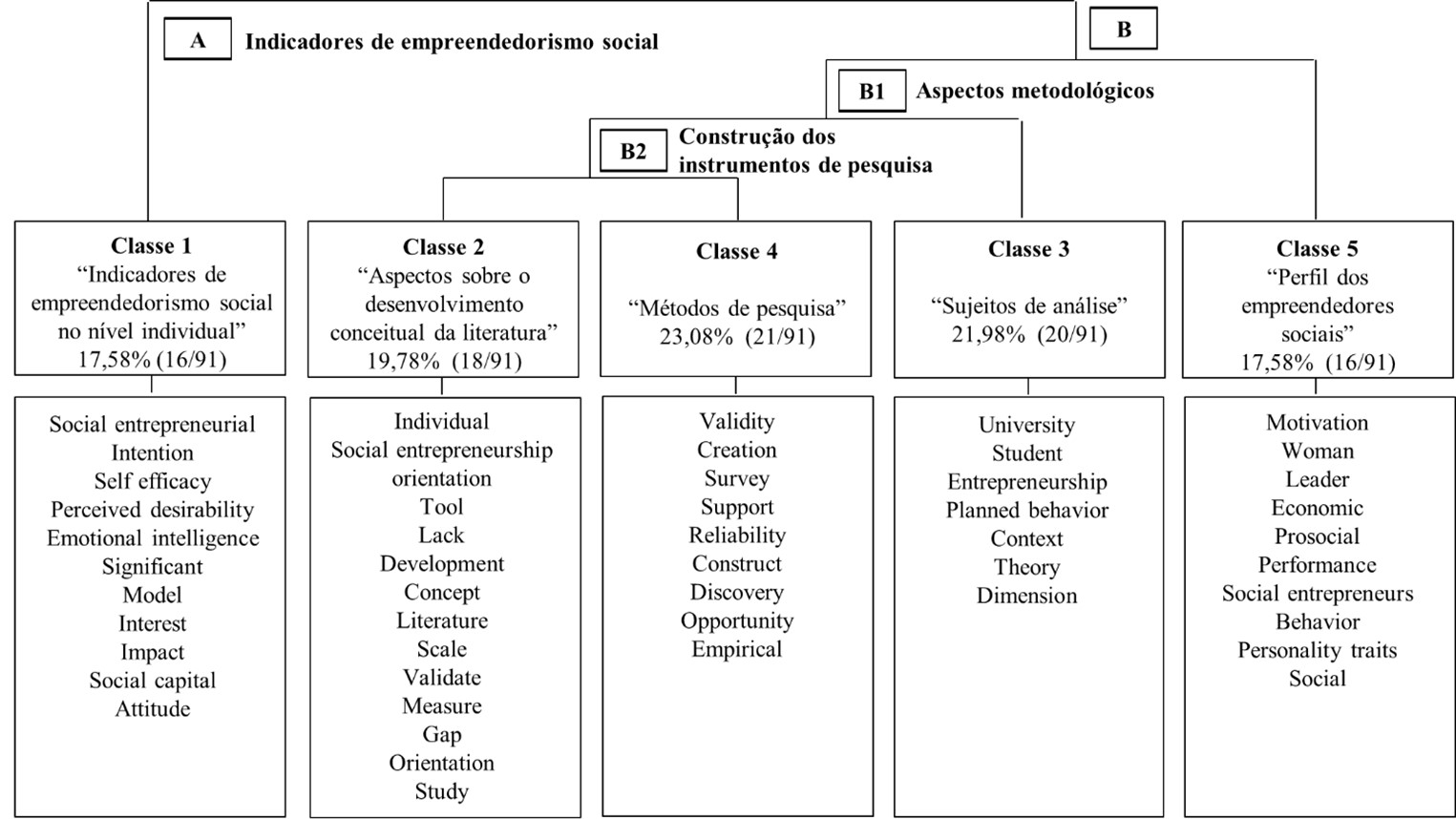
Figure 1
Descending Hierarchical Classification
Source: Survey data adapted and stratified by IRAMUTEQ software.
Subcorpus A was titled "Indicators of Social Entrepreneurship" and was composed only of Class 1. This class was titled "Indicators of Social Entrepreneurial Intent at the Individual Level" and consisted of words and radicals in the range between X² = 6.57 (Attitude) and X² = 42.47 (social entrepreneurial). It is characterized by words that present the antecedents and characteristics that influence the social entrepreneurial intention (self-efficacy, perceived desirability, emotional intelligence, social capital). Influence social entrepreneurial intention that may emerge from the external environment or are intrinsic to the entrepreneur. Examples of external forces that influence social entrepreneurs are previous experience (Akhter et al., 2020; Lacap et al., 2018) and social support (Akhter et al., 2020; Hockerts, 2015; Lacap et al., 2018). Furthermore, they are types of characteristics inherent to the social entrepreneur that influence social entrepreneurial intention: self-efficacy (Akhter et al., 2020; Ha et al., 2020; Hockerts, 2015; Lacap et al., 2018; Tiwari et al., 2017b), empathy (Hockerts, 2015; Lacap et al., 2018; Petrovskaya & Mirakyan, 2018), emotional intelligence (Tiwari et al., 2017a), moral obligation (Hockerts, 2015; Lacap et al., 2018; Tiwari et al., 2017a), and creativity (Kedmeneć et al., 2015; Capella Peris et al., 2016; Sulphey & Alkahtani, 2017; Tiwari et al., 2017a; Ryzin et al., 2009).
This class is mainly formed by dimensions that measure social entrepreneurial intention. It is important to note that creativity was cited both as a dimension for entrepreneurial intention as well as an indicator or variable of research that sought to measure social entrepreneurship or indicate the characteristics of the social entrepreneur. Furthermore, among the indicators, Hockerts (2015) suggested that entrepreneurial self-efficacy and perceived social support significantly impact social entrepreneurial intentions. As research on indicators has a quantitative profile, the presence of words such as "model," "significant," "impact," and "attitude" can be noticed in the class.
Subcorpus B was entitled "Research Characteristics" and was formed by branches B1 (methodological aspects) and B2 (construction of research instruments) and by Classes 2, 3, 4, and 5. It addresses the main characteristics of research on the measurement of social entrepreneurship at an individual level, both in the methodological scope and the key concepts addressed about the social entrepreneur. Class 2 was called "Aspects on the conceptual development of literature" and formed by words and radicals in the range between X² = 4.09 (study) and X² = 30.06 (individual). Words such as "gap", "literature", "study", and "orientation" portray the emphasis in defining studies on social entrepreneurship. Some articles point out a gap in studies that measure social entrepreneurial orientation (Dwivedi & Weerawardena, 2018; Kraus et al., 2017; Satar & Natasha, 2019; Sulphey & Salim, 2020), so their studies seek to remedy such gaps.
Social entrepreneurial orientation has similarities with research addressing social entrepreneurial intention. However, it can be seen that the researches that address the guidance are recent, and all address the dimensions of proactivity and risk management/assumption in their measurement scales. In addition to these, the part of the literature on individual-level indicators addresses innovation (Dwivedi & Weerawardena, 2018; Kraus et al., 2017; Martínez-Climent et al., 2019), social mission orientation (Dwivedi & Weerawardena, 2018) and social vision (Sulphey & Salim, 2020) as dimensions. All these dimensions are connected with the concepts addressed in the American Approach School, as highlighted by Machado et al. (2017).
Class 4 was named “Research Methods” and formed by words and radicals in the range between X² = 6.35 (empirical) and X² = 20.51 (validity). The analyzed studies use quantitative or quali-quantitative methods to model conceptual frameworks relating independent and dependent variables based on statistical tests, such as the study by Ha et al. (2020). It is noteworthy that the approach in this class points to the empirical nature of research, involving a comparison between the hypotheses deduced from the literature and the results of empirical tests (Provdanov & Freitas, 2013).
Class 3 was entitled “Subjects of analysis” and formed by words and radicals in the range between X² = 5.14 (dimension) and X² = 18.78 (university). It is characterized by words that express methodological aspects related to the subjects of analysis. A large part of the studies that make up the sample used the survey as a research method and applied questionnaires to the sample (Akhter et al., 2020; Capella Peris et al., 2016; Ha et al., 2020; Petrovskaya & Mirakyan, 2018; Sulphey & Salim, 2020; Tiwari et al., 2017b, 2017a). Most of the research was directed toward students. Some research was directed toward university students in different cities of the world, such as, for example, Saudi Arabia (Sulphey & Salim, 2020), Bangladesh (Akhter et al., 2020), Vietnam (Ha et al., 2020), and cities located in India (Tiwari et al., 2017a, 2017b). Furthermore, others were also aimed at professors and experts in social entrepreneurship (Capella Peris et al., 2016; Ebrashi, 2013; Kraus et al., 2017) and members of non-profit organizations (Dwivedi & Weerawardena, 2018). Some studies of the investigated sample were directed to social entrepreneurs, addressing their characteristics (Carraher et al., 2016; Petrovskaya & Mirakyan, 2018; Sulphey & Alkahtani, 2017) and their motivations (Humbert & Roomi, 2018).
Finally, Class 5 was entitled "Profile of social entrepreneurs" and was formed by words and radicals in the range between X² = 5.53 (social) and X² = 46.82 (motivation). Social entrepreneurs are individuals who can balance social and economic aspects (Dacin et al., 2011), motivated by the social mission (Dwivedi & Weerawardena, 2018; Humbert & Roomi, 2018; Kannampuzha & Hockerts, 2019; Macke et al., 2018). However, studies point out that profit is not the end in itself but is conceived to enable or boost social impact. Even the creation of positive social and economic value has been the subject of considerable discourse in recent years (Persaud & Bayon, 2019), mainly due to the difficulty of balancing social wealth with the need for profits and economic efficiency (Barki et al., 2015; Zahra et al., 2009).
Furthermore, this class has some aspects that address individual behavior (motivation, behavior, personality traits). Although some works point to motivation as an indicator in their analyzes (for example, Nga & Shamuganathan, 2010; Capella Peris et al., 2016; Tiwari et al., 2017a; Tiwari et al., 2017b), the article by Humbert and Roomi (2018) was the only one that focused exclusively on the motivators of entrepreneurial activity. The study provides an understanding of the motivations of women social entrepreneurs, and the results demonstrate the centrality of the social mission and the quest to develop alternative business models. Thus, it can be considered that entrepreneurial motivation influences entrepreneurial intention (Malhotra & Kiran, 2020), and expectations of individual results can evolve into social entrepreneur motivation when facing favorable conditions, such as family support, government support, etc. (Luc, 2020).
4.2 Correspondence Factor Analysis (CFA)
The Correspondence Factor Analysis (CFA) analyzes the association of the corpus considering the incidence frequencies, the chi-square correlation values of each word in the textual corpus, and the classes that emerged representing them in a Cartesian plane. According to Figure 2, it is essential to note that there are three large clusters. Cluster 1 is formed only by Class 5, "Profile of social entrepreneurs," and there is a difference about the other clusters. Furthermore, cluster 2 is located in the upper quadrant and is composed of Classes 2 (Aspects about the conceptual development of literature) and 4 (Research methods) that form the subcorpus "Construction of research instruments". Finally, cluster 3, located in the lower right corner, comprises Classes 1 (Indicators of social entrepreneurship at the individual level) and 3 (Subjects of analysis).
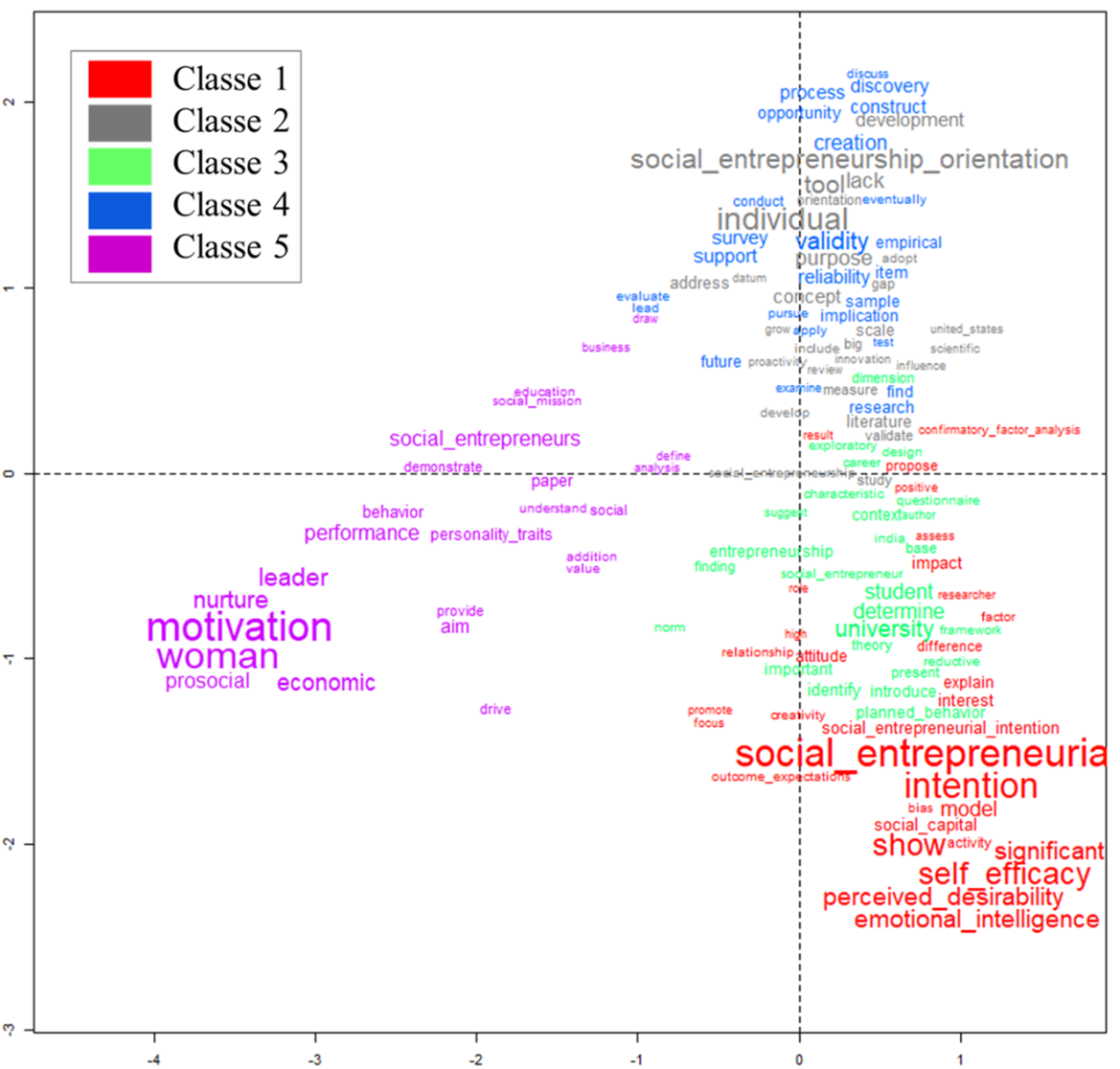
Figure 2
Factor Analysis by Correspondence
Source: Survey data adapted and stratified by IRAMUTEQ software.
Cluster 1 refers to a part of the studies that address motivations, personality traits, and behavioral characteristics (See Table 1), relating them in the same quadrant. Its core is the behavior of the individual social entrepreneur, and its conceptual basis is rescued from the field of psychology (Luc, 2020; Martínez-Climent et al., 2019; Nga & Shamuganathan, 2010). As the cluster is formed by Class 5, which it deals with aspects related to the definition of the social entrepreneur, words such as "economic", "prosocial", and "social mission" is noted. Furthermore, the study of social entrepreneurial motivations in the sample is linked to the work of Humbert and Roomi (2018), who carried out their research with women social entrepreneurs. Because of this, the word "woman" appears in this cluster. Cluster 2 portrays the research gaps that the literary field has and how the gaps will be filled through the dimensions, scales and frameworks developed. This cluster is linked to works that study entrepreneurial social orientation. This branch of studies at the individual level has literary gaps, and this fact explains the linking of words like "gap", "lack", "development", "test", and "validate" to this typology. Furthermore, since the orientation toward social entrepreneurship at the individual level represents a behavioral trend (Dwivedi & Weerawardena, 2018), the words "opportunity", "discovery", and "creation" connect with the work of González et al. (2017). They proposed a conceptual framework for the process of identifying opportunities in social entrepreneurship that includes both discovery and creation of opportunities. Cluster 3, as can be seen in the CFA, highlights some dimensions used in research, such as self-efficacy, perceived desirability, social capital, and emotional intelligence. Such indicators are closely related to the articles that seek to identify the social entrepreneurial intention.
From the distribution of classes and words on the Cartesian plane, it can be inferred that three main types of research study the indicators of entrepreneurship at an individual level: entrepreneurial social intention, motivating aspects and behavioral characteristics, and entrepreneurial social orientation. The first relates to intention bias related to determinants and antecedents of social entrepreneurship. Entrepreneurial social intention refers to an individual's behavior that induces him to become a social entrepreneur, a future orientation of an individual to start a new social enterprise and become an entrepreneur (Akhter et al., 2020).
Another essential aspect that can be observed in CFA is derived from the Theory of Planned Behavior, which highlights that an individual's intention is a determinant of a person's future course of action (Ajzen, 1991). The stronger the intention, the more likely it is behavior to follow (Ajzen, 2020). It is noteworthy that the motivating aspects and behavioral characteristics seek their sources in the literature on entrepreneurship and social entrepreneurship. Furthermore, the study of the motivations of social entrepreneurs is associated with the study of women entrepreneurs. Finally, social entrepreneurial orientation at the individual level is an evolving concept (Sulphey & Salim, 2020), and the scales adopted, for the most part, were developed consisting of the dimensions: of innovation, risk-taking, and proactivity (Satar & Natasha, 2019).
It is important to note that the three main types of surveys were separated into different clusters. Thus, although all articles analyzed studying the behavior of the social entrepreneur, the perspectives have some distinct peculiarities, as explained above.
4.3 Similarity Analysis
Similitude Analysis is based on Graph Theory and aims to identify occurrences and indications of a connection between words, helping to determine the structure of the content of the textual corpus. Figure 3 presents the similarity tree with the words with eight or more co-occurrences, accounting for 47 words. As can be seen, the words that stood out the most are highlighted in the tree. Thus, it is observed that three words stand out in the text, they are: "social entrepreneurship" (95 co-occurrences), "study" (52 co-occurrences), and "measure" (39 co-occurrences).
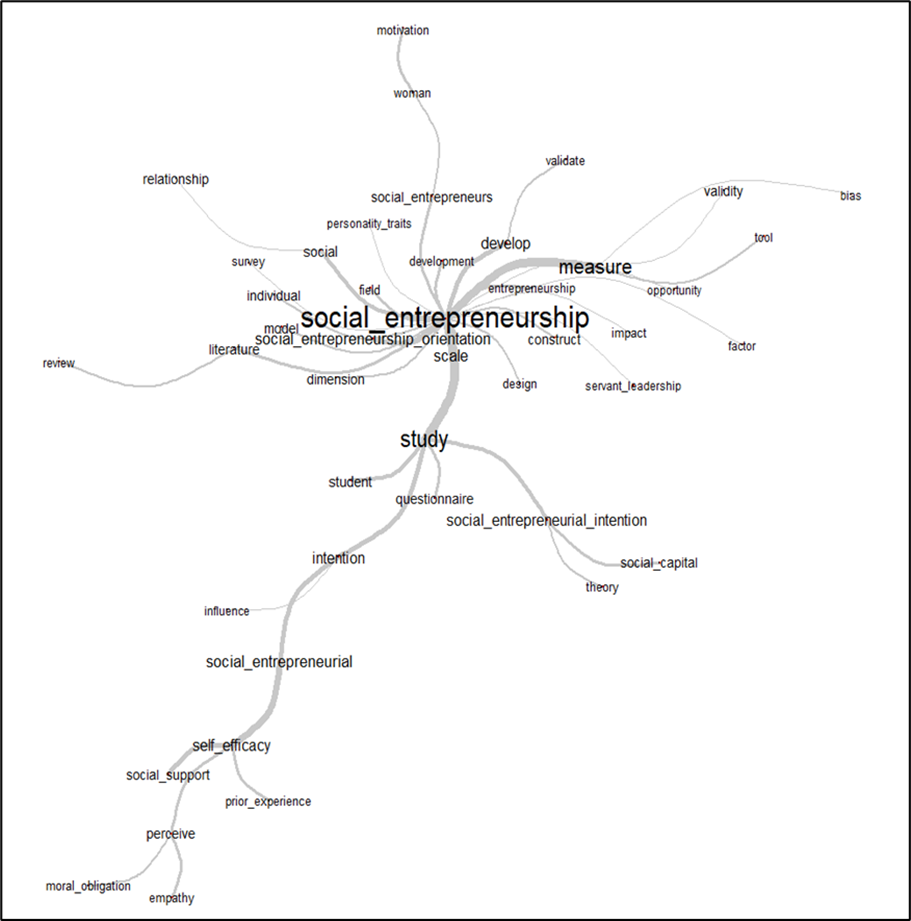
Figure 3
Similarity Analysis
Source: Research data adapted and stratified by the IRAMUTEQ software.
The central axis articulating with the other words in the similarity tree is the word "social entrepreneurship". The two words that stand out in terms of the number of co-occurrences emerge from this central axis. The "study" branch is the most prevalent and is linked to 15 words, which makes sense considering the purpose of this research. A considerable part of the sample is related to studies that examine social entrepreneurial intention and use questionnaires as data collection. Furthermore, entrepreneurial self-efficacy is a dimension used in several studies to analyze the intentions of the social entrepreneur. It is linked to the dimensions: of moral obligation, empathy and previous experience.
In sequence, the “measure” branch is articulated with the words “tool”, “validity”, and “bias”. Most studies propose to statically validate a tool for measurement through indicators (for example, Akhter et al., 2020; Carraher et al., 2016; Chipeta et al., 2020; Dwivedi & Weerawardenab, 2018; Gali et al., 2020; Dwivedi & Weerawardenab, 2018; Gali et al. al., 2020; etc.) using quantitative or mixed research methods. The development of scales was validated through dimensions and items at the individual level. However, there were two exceptions. Ebrashi (2013) work focused on an exploratory, inductive qualitative analysis, and the article by Martínez-Climent et al. (2019) performed a rigorous review of the literature.
In summary, the similarity tree indicates the main points of the studies. Most of the studies applied questionnaires with students looking for the leading indicators at the individual level. Among the indicators, the most prominent are: entrepreneurial self-efficacy, social support, previous experience, moral obligation, and empathy.
5 CONCLUSIONS
The present study proposed to analyze the indicators of the behavior of social entrepreneurs at an individual level. When analyzing the conceptual structure of the indicators as a field of knowledge, it was found that there are three main types of research lines, namely: entrepreneurial social intention, behavioral characteristics, and entrepreneurial social orientation. Although the analytical focus is the same (the social entrepreneur), and they all focus on behavior, these lines of research have different perspectives. The social entrepreneurial intention has a stronger connection with psychology, especially with the Theory of Planned Behavior. Behavioral characteristics address individual characteristics inherent to the literature on social entrepreneurship, personality traits from psychology, and motivational aspects. On the other hand, the social entrepreneurial orientation is supported more certainly in the literature on entrepreneurship and social entrepreneurship.
Several factors involve and influence an individual to become a social entrepreneur. However, it is still unclear how these factors, which affect the three lines of research found in the present research, are related. The study of indicators at an individual level can be regarded as emerging due to the number of articles published in the last five years. This conceptual gap in the typologies of studies at an individual level is explained. Thus, this gap in the literature can be considered a significant research gap.
In general, the studies propose to statically validate a tool for measurement through indicators using quantitative and mixed research methods. Most studies examine social entrepreneurial intent and use questionnaires as data collection. According to the articles in the database, some antecedents influence social entrepreneurial intention that may emerge from the external environment or are intrinsic to the entrepreneur.
Finally, there is a distinction between some lines of research that involve entrepreneurship at the individual level. However, their differences and origins have not yet been explored in depth. Future studies could look for how these aspects relate to influencing a person to become a social entrepreneur.
The contribution of social entrepreneurs to society has been highlighted in various spheres of society. In this way, understanding their behavior is essential to identify who in society could develop social businesses and foster social entrepreneurial behavior. Thus, this article provides a panoramic view of what the literature has pointed out in relation to indicators at an individual level.
Acknowledgments
We thank the CAPES Foundation, Ministry of Education of Brazil, for the funding under the Scholarship Agreement nº 88887.610529/2021-00.
REFERENCES
Ajzen, I. (1991). The Theory of Planned Behavior. Organizational Behavior and Human Decision Processes, 50(2).
Ajzen, I. (2020). The theory of planned behavior: Frequently asked questions. Human Behavior and Emerging Technologies, 2(4). https://doi.org/10.1002/hbe2.195
Akhter, A., Hossain, M. U., & Al Asheq, A. (2020). Influential factors of social entrepreneurial intention in Bangladesh. Journal of Asian Finance, Economics and Business, 7(8). https://doi.org/10.13106/JAFEB.2020.VOL7.NO8.645
Ang, C. K.; Embi, M. A.; Yunus, M. (2016). Enhancing the quality of the findings of a longitudinal case study: Reviewing trustworthiness via ATLAS.ti. The Qualitative Report, 21(10), 1855-1867. https://doi.org/10.46743/2160-3715/2016.2480
Ashoka. (2021). Empreendedorismo Social. Ashoka Brazil. https://www.ashoka.org/pt-br/focus/empreendedorismo-social
Austin, J., Stevenson, H., & Wei-Skillern, J. (2006). Social and commercial entrepreneurship: Same, different, or both? Entrepreneurship: Theory and Practice, 30(1). https://doi.org/10.1111/j.1540-6520.2006.00107.x
Barki, E., Comini, G. M., & Torres, H. G. (2019). Negócios de impacto socioambiental no Brasil: Como empreender, financiar e apoiar (1st ed.). FGV Editora.
Barki, E., Comini, G., Cunliffe, A., Hart, S., & Rai, S. (2015). Social entrepreneurship and social business: Retrospective and prospective research. RAE Revista de Administracao de Empresas, 55(4). https://doi.org/10.1590/S0034-759020150402
Bergamini, T. P., Navarro, C. L. C., & Hilliard, I. (2017). Is crowdfunding an appropriate financial model for social entrepreneurship? Academy of Entrepreneurship Journal, 23(1).
Block, J. H., Fisch, C. O., & Van Praag, M. (2017). The Schumpeterian entrepreneur: A review of the empirical evidence on the antecedents, behaviour and consequences of innovative entrepreneurship. Industry and Innovation, 24(1). https://doi.org/10.1080/13662716.2016.1216397
Camargo, B. V., & Justo, A. M. (2013). IRAMUTEQ: Um software gratuito para análise de dados textuais. Temas Em Psicologia, 21(2). https://doi.org/10.9788/tp2013.2-16
Capella Peris, C., Gil Gómez, J., Martí Puig, M., & Ruiz-Bernardo, P. (2016). Construcción de un cuestionario para medir el emprendimiento social en educación física. Pedagogia Social Revista Interuniversitaria, 28. https://doi.org/10.7179//psri_2016.28.13
Carmona, V. C., Martens, C. D. P., Leão, A. L. D. B. C., Nassif, V. M. J., & Freitas, H. M. R. (2018). Empreendedorismo social: Uma perspectiva bibliométrica na área de administração e negócios. Estudios Gerenciales, 34(149), 399-410. https://doi.org/10.18046/j.estger.2018.149.2912
Carraher, S. M., Welsh, D. H. B., & Svilokos, A. (2016). Validation of a measure of social entrepreneurship. European Journal of International Management, 10(4). https://doi.org/10.1504/EJIM.2016.077421
Chandra, Y. (2018). Mapping the evolution of entrepreneurship as a field of research (1990-2013): A scientometric analysis. PLoS ONE, 13(1). https://doi.org/10.1371/journal.pone.0190228
Chipeta, E. M., Venter, R., & Kruse, P. (2020). Measuring the Role of Reductive Bias in Social Enterprise Formation: Development and Validation of a Social Entrepreneurial Intention Bias Scale. Journal of Social Entrepreneurship. https://doi.org/10.1080/19420676.2020.1758196
Dacin, M. T., Dacin, P. A., & Tracey, P. (2011). Social entrepreneurship: A critique and future directions. Organization Science, 22(5). https://doi.org/10.1287/orsc.1100.0620
Davidsson, P. (2015). Entrepreneurial opportunities and the entrepreneurship nexus: A re-conceptualization. Journal of Business Venturing, 30(5). https://doi.org/10.1016/j.jbusvent.2015.01.002.
Dey, P., & Steyaert, C. (2016). Rethinking the Space of Ethics in Social Entrepreneurship: Power, Subjectivity, and Practices of Freedom. Journal of Business Ethics, 133(4). https://doi.org/10.1007/s10551-014-2450-y
Dionisio, M. (2019). The evolution of social entrepreneurship research: A bibliometric analysis. Social Enterprise Journal, 15(1), 22-45. https://doi.org/10.1108/SEJ-05-2018-0042
Dwivedi, A., & Weerawardena, J. (2018). Conceptualizing and operationalizing the social entrepreneurship construct. Journal of Business Research, 86. https://doi.org/10.1016/j.jbusres.2018.01.053
Ebrashi, R. El. (2013). Social entrepreneurship theory and sustainable social impact. Social Responsibility Journal, 9(2). https://doi.org/10.1108/SRJ-07-2011-0013
Ferreira, M. P. V., Pinto, C. F., & Miranda, R. M. (2015). Três décadas de pesquisa em empreendedorismo: Uma revisão dos principais periódicos internacionais de empreendedorismo. REAd. Revista Eletrônica de Administração, 21(2), 406-436. https://doi.org/10.1590/1413-2311.0342014.52536
Gali, N., Niemand, T., Shaw, E., Hughes, M., Kraus, S., & Brem, A. (2020). Social entrepreneurship orientation and company success: The mediating role of social performance. Technological Forecasting and Social Change, 160. https://doi.org/10.1016/j.techfore.2020.120230
Global Entrepreneurship Monitor (GEM). (2020). GEM 2019/2020 Global Report. 2020. https://www.gemconsortium.org/report/gem-2019-2020-global-report
González, M. F., Husted, B. W., & Aigner, D. J. (2017). Opportunity discovery and creation in social entrepreneurship: An exploratory study in Mexico. Journal of Business Research, 81. https://doi.org/10.1016/j.jbusres.2016.10.032
Gosling, S. D., Rentfrow, P. J., & Swann, W. B. (2003). A very brief measure of the Big-Five personality domains. Journal of Research in Personality, 37(6), 504-528. https://doi.org/10.1016/s0092-6566(03)00046-1
Grieco, C. (2018). What do social entrepreneurs need to walk their talk? Understanding the attitude–behavior gap in social impact assessment practice. Nonprofit Management and Leadership, 29(1). https://doi.org/10.1002/nml.21310
Ha, N. T., Doan, X. H., Vu, T. N., Linh Nguyen, T. P., Phan, T. H., & Duong, C. D. (2020). The effect of social capital on social entrepreneurial intention among Vietnamese students. Journal of Asian Finance, Economics and Business, 7(8). https://doi.org/10.13106/JAFEB.2020.VOL7.NO8.671
Hockerts, K. (2015). The Social Entrepreneurial Antecedents Scale (SEAS): A validation study. Social Enterprise Journal, 11(3). https://doi.org/10.1108/sej-05-2014-0026
Hockerts, K. (2017). Determinants of Social Entrepreneurial Intentions. Entrepreneurship: Theory and Practice, 41(1). https://doi.org/10.1111/etap.12171
Humbert, A. L., & Roomi, M. A. (2018). Prone to “care”? Relating motivations to economic and social performance among women social entrepreneurs in Europe. Social Enterprise Journal, 14(3). https://doi.org/10.1108/SEJ-11-2017-0058
Jia, X., & Desa, G. (2020). Social entrepreneurship and impact investment in rural–urban transformation: An orientation to systemic social innovation and symposium findings. Agriculture and Human Values, 37(4). https://doi.org/10.1007/s10460-020-10133-6
Kannampuzha, M., & Hockerts, K. (2019). Organizational social entrepreneurship: Scale development and validation. Social Enterprise Journal, 15(3). https://doi.org/10.1108/SEJ-06-2018-0047
Kedmeneć, I., Rebernik, M., & Eric, J. P. (2015). The impact of individual characteristics on intentions to pursue social entrepreneurship. Ekonomski Pregled, 66(2).
Kraus, S., Niemand, T., Halberstadt, J., Shaw, E., & Syrjä, P. (2017). Social entrepreneurship orientation: Development of a measurement scale. International Journal of Entrepreneurial Behaviour and Research, 23(6). https://doi.org/10.1108/IJEBR-07-2016-0206
Lacap, J. P. G., Mulyaningsih, H. D., & Ramadani, V. (2018). The mediating effects of social entrepreneurial antecedents on the relationship between prior experience and social entrepreneurial intent: The case of Filipino and Indonesian university students. Journal of Science and Technology Policy Management, 9(3). https://doi.org/10.1108/JSTPM-03-2018-0028
Llewellyn, D. J., & Wilson, K. M. (2003). The controversial role of personality traits in entrepreneurial psychology. Education + Training, 45(6). https://doi.org/10.1108/00400910310495996
Luc, P. T. (2020). Outcome expectations and social entrepreneurial intention: Integration of planned behavior and social cognitive career theory. Journal of Asian Finance, Economics and Business, 7(6). https://doi.org/10.13106/JAFEB.2020.VOL7.NO6.399
Machado, M. C. R., Lenzi, F. C., & Verdu, C. P. (2017). Empreendedorismo social: Fronteiras teóricas das escolas. XX SemeAd. São Paulo, Brasil, 22. https://login.semead.com.br/20semead/anais/arquivos/1205.pdf
Macke, J., Sarate, J. A. R., Domeneghini, J., & Silva, K. A. da. (2018). Where do we go from now? Research framework for social entrepreneurship. Journal of Cleaner Production, 183. https://doi.org/10.1016/j.jclepro.2018.02.017
Mair, J., & Martí, I. (2006). Social entrepreneurship research: A source of explanation, prediction, and delight. Journal of World Business, 41(1). https://doi.org/10.1016/j.jwb.2005.09.002
Malerba, F., & McKelvey, M. (2020). Knowledge-intensive innovative entrepreneurship integrating Schumpeter, evolutionary economics, and innovation systems. Small Business Economics, 54(2). https://doi.org/10.1007/s11187-018-0060-2
Malhotra, S., & Kiran, R. (2020). Entrepreneurial motivation, entrepreneurial intention and entrepreneurial training: an empirical study of higher educational technical institutes in north India. 8th International Conference on Innovation Management, Entrepreneurship and Sustainability (IMES), 349-363.
Martínez-Climent, C., Rodríguez-García, M., & Zeng, J. (2019). Ambidextrous leadership, social entrepreneurial orientation, and operational performance. Sustainability (Switzerland), 11(3). https://doi.org/10.3390/su11030890
Miller, T. L., Grimes, M. G., Mcmullen, J. S., & Vogus, T. J. (2012). Venturing for others with heart and head: How compassion encourages social entrepreneurship. Academy of Management Review, 37(4), 616-640. https://doi.org/10.5465/amr.2010.0456
Moura, A. M., Comini, G., & Teodósio, A. S. S. (2015). The international growth of a social business: A case study. RAE Revista de Administração de Empresas, 55(4). https://doi.org/10.1590/S0034-759020150408
Muñoz, P., & Kimmitt, J. (2019). Social mission as competitive advantage: A configurational analysis of the strategic conditions of social entrepreneurship. Journal of Business Research, 101. https://doi.org/10.1016/j.jbusres.2018.11.044
Muralidharan, E., & Pathak, S. (2018). Sustainability, transformational leadership, and social entrepreneurship. Sustainability (Switzerland), 10(2). https://doi.org/10.3390/su10020567
Nga, J. K. H., & Shamuganathan, G. (2010). The influence of personality traits and demographic factors on social entrepreneurship start up intentions. Journal of Business Ethics, 95(2). https://doi.org/10.1007/s10551-009-0358-8
Pache, A. C., & Santos, F. (2013). Inside the hybrid organization: Selective coupling as a response to competing institutional logics. Academy of Management Journal, 56(4). https://doi.org/10.5465/amj.2011.0405
Peredo, A. M., & McLean, M. (2006). Social entrepreneurship: A critical geography of the concept. Journal of World Business, 41(1). https://doi.org/10.1016/j.jwb.2005.10.007
Persaud, A., & Bayon, M. C. (2019). A Review and Analysis of the Thematic Structure of Social Entrepreneurship Research: 1990-2018. International Review of Entrepreneurship, 17(4).
Petrovskaya, I., & Mirakyan, A. (2018). A mission of service: social entrepreneur as a servant leader. International Journal of Entrepreneurial Behaviour and Research, 24(3). https://doi.org/10.1108/IJEBR-02-2016-0057
Provdanov, C. C., & Freitas, E. C. (2013). Metodologia do trabalho científico: Métodos e técnicas da pesquisa e do trabalho acadêmico. Novo Hamburgo: Feevale.
Robinson, P., & Huefner, J. (1991). Entrepreneurial research on student subjects does not generalize to real world entrepreneurs. Journal of Small Business Management, 29(2).
Ruysscher, C., Claes, C., Lee, T., Cui, F., Van Loon, J., De Maeyer, J., & Schalock, R. (2017). A systems approach to social entrepreneurship. Voluntas, 28(6). https://doi.org/10.1007/s11266-016-9704-5
Ryzin, G. G., Grossman, S., DiPadova-Stocks, L., & Bergrud, E. (2009). Portrait of the social entrepreneur: Statistical evidence from a US panel. Voluntas, 20(2). https://doi.org/10.1007/s11266-009-9081-4
Saebi, T., Foss, N. J., & Linder, S. (2018). Social entrepreneurship research: Past achievements and future promises. Journal of Management, 45(1). https://doi.org/10.1177/0149206318793196
Sassmannshausen, S. P., & Volkmann, C. (2018). The scientometrics of social entrepreneurship and its establishment as an academic field. Journal of Small Business Management, 56(2). https://doi.org/10.1111/jsbm.12254
Satar, M. S., & Natasha, S. (2019). Individual social entrepreneurship orientation: Towards development of a measurement scale. Asia Pacific Journal of Innovation and Entrepreneurship, 13(1). https://doi.org/10.1108/apjie-09-2018-0052
Schumpeter, J. A. (1943). Capitalism, Socialism and Democracy. In Modern Economic Classics-Evaluations Through Time. Routledge. https://doi.org/10.4324/9781315270548-17
Schwartz, S. H. (1992). Universals in the content and structure of values: Theoretical advances and empirical tests in 20 countries. Advances in Experimental Social Psychology, 25(C). https://doi.org/10.1016/S0065-2601(08)60281-6
Singh, N., & Inbanathan, A. (2018). Social entrepreneurship for development: A business model for sustainable development. Working Papers 426, Institute for Social and Economic Change, Bangalore, 1-21. https://doi.org/10.4324/9781315646763
Smith, W. K., Gonin, M., & Besharov, M. L. (2013). Managing social-business tensions: A review and research agenda for social enterprise. Business Ethics Quarterly, 23(3). https://doi.org/10.5840/beq201323327
Sulphey, M. M., & Alkahtani, N. S. (2017). Economic security and sustainability through social entrepreneurship: The current saudi scenario. Journal of Security and Sustainability Issues, 6(3). https://doi.org/10.9770/jssi.2017.6.3(12)
Sulphey, M. M., & Salim, A. (2020). Development of a tool to measure social entrepreneurial orientation. Journal of Entrepreneurship in Emerging Economies, 13(2). https://doi.org/10.1108/JEEE-07-2019-0099
Tavares, L. F., & Rodrigues, M. S. (2015). O SEBRAE e o fortalecimento do discurso do empreendedorismo no Brasil: uma análise a partir do relatório Global Entrepreneurship Monitor (GEM). Sinergia: Revista Do Instituto de Ciências Econômicas, 19(1).
Tiwari, P., Bhat, A. K., & Tikoria, J. (2017a). An empirical analysis of the factors affecting social entrepreneurial intentions. Journal of Global Entrepreneurship Research, 7(1). https://doi.org/10.1186/s40497-017-0067-1
Tiwari, P., Bhat, A. K., & Tikoria, J. (2017b). The role of emotional intelligence and self-efficacy on social entrepreneurial attitudes and social entrepreneurial intentions. Journal of Social Entrepreneurship, 8(2). https://doi.org/10.1080/19420676.2017.1371628
Waddock, S. A., & Post, J. E. (1991). Social entrepreneurs and catalytic change. Public Administration Review, 51(5). https://doi.org/10.2307/976408
World Bank. (2020a). COVID-19 pode levar mais 150 milhões de pessoas para a extrema pobreza até 2021. The World Bank. https://www.worldbank.org/pt/news/press-release/2020/10/07/covid-19-to-add-as-many-as-150-million-extreme-poor-by-2021#:~:text=A pobreza extrema%2C definida como,bienal Pobreza e Prosperidade Compartilhada
World Bank. (2020b). Poverty and Shared Prosperity: Overview Reversals of fortune. World Bank Group. https://doi.org/10.2307/j.ctv14npk3p.9
Zahra, S. A., & Wright, M. (2016). Understanding the Social Role of Entrepreneurship. Journal of Management Studies, 53(4). https://doi.org/10.1111/joms.12149
Zahra, S. A., Gedajlovic, E., Neubaum, D. O., & Shulman, J. M. (2009). A typology of social entrepreneurs: Motives, search processes and ethical challenges. Journal of Business Venturing, 24(5). https://doi.org/10.1016/j.jbusvent.2008.04.007