Work intensification: Towards mapping the study field and defining a research agenda
Intensificação do trabalho: Rumo ao mapeamento do campo de estudos e definição de agenda de pesquisa
Intensificación del trabajo: Hacia el mapeo del campo de estudio y la definición de una agenda de investigación
 Ana Heloísa da Costa Lemos aheloisa@iag.puc-rio.br
Waleska Yone Yamakawa Zavatti Campos waleskazavatti@alumni.usp.br
Marcelo Jucá Quintão marcelojucaquintao@gmail.com
Luciana Aparecida Barbieri da Rosa lucianaaparecidabarbieri@yahoo.com.br
Ana Heloísa da Costa Lemos aheloisa@iag.puc-rio.br
Waleska Yone Yamakawa Zavatti Campos waleskazavatti@alumni.usp.br
Marcelo Jucá Quintão marcelojucaquintao@gmail.com
Luciana Aparecida Barbieri da Rosa lucianaaparecidabarbieri@yahoo.com.br
Work intensification: Towards mapping the study field and defining a research agenda
Contextus – Revista Contemporânea de Economia e Gestão, vol. 20, pp. 182-200, 2022
Universidade Federal do Ceará

Esta obra está bajo una Licencia Creative Commons Atribución-NoComercial 4.0 Internacional.
Recepción: 30 Noviembre 2021
Aprobación: 18 Abril 2022
Publicación: 12 Julio 2022
Abstract: Work intensification can be defined as the increase in energy expenditure by the worker in the exercise of his current occupations. Given the complexity of the phenomenon, this study aimed to analyze the scientific literature on work intensification to map the field and propose a research agenda. Three approaches were developed from 98 articles extracted from the Web of Science, namely bibliometric, scientometric, and content analyses. The findings reveal that the scientific production on the subject had a significant increase between 2010 and 2019; predominant themes are work-family conflict, repetitive strain, and teleworking, among others. Furthermore, the research agenda reveals rich possibilities for gaps and future studies.
Keywords: work intensification, bibliometrics, scientometric, citespace, content analysis.
Resumo: A intensificação do trabalho pode ser definida como o aumento do gasto de energia por parte do trabalhador no exercício de suas correntes ocupações. Diante da complexidade do fenômeno, este trabalho objetivou analisar a literatura científica sobre intensificação do trabalho com vistas a mapear o campo e propor uma agenda de pesquisa. A partir de 98 artigos extraídos da Web of Science foram desenvolvidas três abordagens, a saber: análises bibliométrica, cientométrica e de conteúdo. Os achados revelam que a produção científica sobre o tema teve um aumento significativo entre 2010 e 2019; que temas predominantes são conflito trabalho-família, esforço repetitivo, teletrabalho, entre outros. A agenda de pesquisa descortina ricas possibilidades de lacunas e estudos futuros para a área.
Palavras-chave: intensificação do trabalho, bibliometria, cientometria, citespace, análise de conteúdo.
Resumen: La intensificación del trabajo puede definirse como el aumento del gasto energético por parte del trabajador en el ejercicio de sus ocupaciones actuales. Dada la complejidad del fenómeno, este estudio tuvo como objetivo analizar la literatura científica sobre la intensificación del trabajo con el fin de mapear el campo y proponer una agenda de investigación. A partir de 98 artículos extraídos de la Web of Science, se desarrollaron tres enfoques, a saber: análisis bibliométrico, cienciométrico y de contenido. Los hallazgos revelan que la producción científica sobre el tema tuvo un aumento significativo entre 2010 y 2019; los temas predominantes son el conflicto trabajo-familia, el esfuerzo repetitivo, el teletrabajo, entre otros. La agenda de investigación revela ricas posibilidades de lagunas y estudios futuros para el área.
Palabras clave: intensificación del trabajo, bibliometría, cientometría, citespace, análisis de contenido.
1 INTRODUCTION
The recent and rapid technological and economic changes have brought about a fertile ground for increased work pace and hours, conditions described as work intensifiers (Huo, Boxall & Cheung, 2019; Korunka, Kubicek, Paškvan & Ulferts, 2015). Furthermore, technological transformations have intensified in the context of combating the spread of the SARS-CoV-2 coronavirus pandemic (COVID-19), which has led many workers to rely on intense and constant interaction through information communication technology (ICT) (Venz & Boettcher, 2021). The acceleration of technological change and the impact caused by COVID-19 on the contemporary reality characterized by a “digital workforce” has accentuated work intensification, particularly at managerial levels (Afshari, Hayat, Ramachandran, Bartram & Balakrishnan, 2022; Venz & Boettcher, 2021). For Venz & Boettcher (2021), the current social conjuncture sheds light on the substantial relevance of the debate about work intensification, highlighted by the influence of COVID-19, which has led to overload, exhaustion, and psychological strain among workers as a result of the increased demand for handling ICT tools.
Moreover, work intensification has significantly affected professionals in the public and private sectors, on-site and remote workers, full- and part-time workers, health professionals, domestic workers, teachers, and industry and lean production workers as a result of the overload of work demands hours extension. This phenomenon leads to emotional exhaustion, demotivation, burnout, physical illness, decreased well-being and job satisfaction, family-work conflict, and other negative consequences (Felstead & Henseke, 2017; Korunka et al., 2015; Le Fevre, Boxall & Macky, 2015; Teeple Hopkins, 2017; Willis, Harvey, Thompson, Pearson & Meyer, 2018). The growing levels of work intensification in the productive context (Green, 2004; Kelliher & Anderson, 2010) reinforces the interest in understanding how the research field on the subject has been configured in recent years. The mapping of this field helps to identify its development, its key researchers, related themes, and research trends. To contribute to this mapping, this article aimed to identify the recent behavior of the research field on work intensification. To this end, we sought to achieve the following specific objectives: (1) identify the characteristics of the literature on work intensification, such as the number of articles and citations, research areas, and journals; (2) verify the scope of research in terms of countries, institutions and representative authors; (3) uncover the field’s research topics of interest by studying the relationships between keywords and detecting citation bursts; (4) identify the primary themes addressed in the studies; (5) suggest a research agenda on the topic. Therefore, bibliometric, scientometric, and content analyses were performed on the scientific production of work intensification.
Bibliometrics employs quantitative analysis of publications in databases using statistical tools to measure the performance of various fields of knowledge (Araújo, 2006). In turn, scientometrics creates maps and networks that combine visualization technology through traditional scientometric analysis capable of visually displaying the knowledge obtained through data mining and information processing, allowing the exploration of different relationships (Huang, Zhou, Lv & Chen, 2020). In turn, scientometrics enables researchers to focus on missing information and determine future directions for research when analyzing a field of knowledge (Mingers & Leydesdorff, 2015). In this sense, one of the most influential scientometric software is CiteSpace, developed by Chen (2006). Finally, conventional, inductive content analysis (Elo & Kyngäs, 2008) was employed to consolidate the research agenda.
To achieve these objectives, articles, and reviews published between 2010 and 2019 were collected from the Web of Science (WoS) database, followed by bibliometric, scientometric, and content analysis.
This paper was organized into five sections. After this introduction, the next section addresses the theoretical framework; the third section explains the methodology and research tools used; the fourth section discusses the results; and the fifth section outlines the final remarks and the research agenda.
2 THEORETICAL FRAMEWORK
This study maps the theoretical field of work intensification to point out research directions. To this end, this section presents concepts and contexts on the topic at hand.
2.1 Definition of work intensification
For Rosso (2008), in the contemporary capitalist scenario, work intensification is characterized by the search for maximized results, which can be measured quantitatively or qualitatively. Therefore, work intensification can be defined as the increase of energy expenditure by workers in the performance of their duties, and can be accompanied by the expansion of the working day, accelerated pace, and multi-functionality requirements (Rosso, 2008).
As Druck (2013) points out, work intensification results from multiple factors that have been imposed in different work contexts, such as the increase in work pace and cadence, improvement of control tools, the establishment of unattainable goals, time pressure, longer working hours, demand for functional versatility, higher employee turnover, intense exposure to physical, (Bhattacharya & Tang, 2013) chemical and ergonomic agents (Neumann & Medbo, 2010). Therefore, work intensification can be perceived as an indicator of the precarization of working conditions. The extension of the working day, which is an important indicator of work intensification, can occur both in the corporate environment and at home through telework (Bathini & Kandathil, 2019; Druck, 2013; Felstead & Henseke, 2017). Indeed, in this modality, the time invested has no limits, and pressures are mediated by the surveillance of electronic devices (Druck, 2013; P. Moore & Piwek, 2017).
The theme of work intensification gains notoriety in a scenario marked by the restructuring of capitalism (Boltanski & Chiapello, 2009) that includes, among its main manifestations, the valorization of a management doctrine aimed at maximizing profits by increasing production (Green, 2004; Ramsay, Scholarios & Harley, 2000). To a large extent, the phenomenon of work intensification is tied to systems defined as high performance and cost reduction (Mariappanadar, 2016), instituted by organizations under the auspices of corporate discourses that aim to increase performance continuously (Green, 2004; Heffernan & Dundon, 2016; Kelliher & Anderson, 2010; Mariappanadar, 2016; Ramsay et al., 2000; Tregaskis, Daniels, Glover, Butler & Meyer, 2013).
Growing impoverishment and social vulnerability (Castel, 1998; Le Fevre et al., 2015) sets a precedent for companies to offer flexible working conditions to meet the market’s demands. Despite providing a certain degree of autonomy to employees, the deleterious effects of flexibility may include the loss of social protection from the State (Cunningham, 2016) and work intensification (Kelliher & Anderson, 2010). Kelliher & Anderson (2010) point out that the promise of flexibility makes workers put forth eager efforts in an attempt to meet the employer’s expectations and secure the “benefit” of remote work.
Consequently, such behavior can reinforce the structures of work intensification (Ehrnrooth & Björkman, 2012) since workers help to perpetuate the stereotype of the “ideal worker” by adhering unrestrictedly to the new practices (Kossek, Lewis & Hammer, 2010). Thus, even though they experience an intensified work routine, many individuals end up subjecting themselves to the new rules in the hope of obtaining professional advantages and benefits (Ehrnrooth & Björkman, 2012; Lemos, Gottlieb & Costa, 2016).
Lemos et al. (2016) point out that companies that define themselves as high performing seek professionals who will accept intensified working conditions in exchange for prestige, high salaries, and benefits. In this sense, the organizational culture becomes governed by its employees’ high degree of involvement, who, in turn, systematically reproduce competitiveness among peers (Green, 2004; Kelliher & Anderson, 2010; Tregaskis et al., 2013).
The competition among peers in organizations enables domination strategies as many managers take advantage of the instability and insecurity in the labor market (Cushen, 2013; Druck, 2013) to put yet more pressure on employees and have more control over them (Ehrnrooth & Björkman, 2012; P. Moore & Piwek, 2017). Therefore, work intensification encompasses a related field in which diverse interests are at stake, especially organizational and managerial ones, aiming to obtain more engagement from their workforce (Lemos et al., 2016).
It is also worth mentioning that technological evolution has fostered a working modality that breaks boundaries and becomes ubiquitous (Green, 2004). Equipped with corporate cell phones (Cavazotte, Heloisa Lemos & Villadsen, 2014), notebook computers (Chesley, 2014), and other equipment provided to them free of charge by companies, employees are required to work longer hours than the legal working day to ensure that the demands of the company are prioritized (Kelliher & Anderson, 2010).
Ehrnrooth & Björkman (2012) argue that human resource management areas have the power to influence and enhance employees’ dedication to work through policies and practices that lead them to increase their commitment while expecting future returns. Moreover, when implementing “high performance” work systems, Human Resources departments (Heffernan & Dundon, 2016; Mariappanadar, 2016) can lead to work intensification that, in many cases, ends up sparking dissatisfaction among workers (Tregaskis et al., 2013).
2.2 Studies and contexts of work intensification
Studies with migrant (Teeple Hopkins, 2017) and sugarcane workers in Brazil (McGrath, 2013) have reported the existence of unfree, degrading, and intensified working conditions subject to penalties. In the Brazilian context, McGrath (2013) it is noteworthy that individuals who seek this type of work typically come from very poor regions of the country and that the demands and the fatigue resulting from this activity can have serious health consequences (Neumann & Medbo, 2010) and even lead to the worker’s death (McGrath, 2013).
In the educational field, Loh & Hu (2014) argue that work intensification can arise in the context of competition among academic institutions searching for better results that attract higher profits. Consequently, many professionals are exposed to work systems that foster high individual accountability, competence control, and competition among faculty members (Loh & Hu, 2014; Wilson & Holligan, 2013). Psychosocial risks in the workplace stemming from work intensification include emotional exhaustion, bullying, fatigue, and Burnout syndrome (Evenstad, 2018; Lawrence, Loi & Gudex, 2019; Mariappanadar, 2016; Silla & Gamero, 2018).
Studies of healthcare management have reported an increase in workload due to new technologies (P. Moore & Piwek, 2017) and processes aimed at reducing costs and increasing efficiency to meet the high demand in hospitals and clinics (Kubicek, Paškvan & Korunka, 2015; Willis et al., 2018). Due to work intensification, healthcare workers are constantly forced to manage their physical and mental efforts and the fatigue caused by technological acceleration (Korunka et al., 2015).
According to Currie & Eveline (2011), in the late 1980s, new technologies began to accompany globalization and tightened the bonds between the home and the work environment. This, in turn, made it easier for many workers to perform their professional duties at home (home-based telework) (Bathini & Kandathil, 2019; Boxall & Macky, 2014). However, both the advance in technology and the emergence of teleworking have brought tensions to the balance between work and family (Mrčela & Sadar, 2011), as many professionals have become subjected to demands via technological devices, leading to much more intense and extensive working hours (Cavazotte et al., 2014; Chesley, 2014; Currie & Eveline, 2011; Green, 2004). In the contemporary context, work has infiltrated the family environment in several ways, either by prolonging the working day or by the constant pressures on the balance between “work and family,” “work/quality of life,” thus causing the so-called “work/life collision (Currie & Eveline, 2011; Green, 2004; Mrčela & Sadar, 2011).” In the case of the female workforce, the impacts of intensification on work and social life balance, especially family life (Brown, 2012), are even more intense, which in turn aggravates psychological distress (Boxall & Macky, 2014; Brown, 2012).
Still regarding intensification and its interface with gender issues, Briskin (2012) it is worth mentioning that patriarchy has produced an organizational culture in the professional sphere that points to men’s behavior and perspectives as standards to be followed (Briskin, 2012) and, therefore, privileges long working hours, which tends to be more unfavorable for mothers. Even reaching senior positions, female workers are generally unable to disengage from domestic and family care responsibilities. Thus, work intensification has more deleterious effects on women’s careers than men’s (Gascoigne, Parry & Buchanan, 2015). For these reasons, studies on work intensification must be known and fostered, as they can reflect in the improvement of workers’ health, quality of life, and well-being.
3 METHOD
Bibliometric survey and analysis can be divided into three stages: the definition of the survey strategy for the research, the eligibility criteria for data collection, and the analysis of the results. The database used in the survey was the Web of Science (WoS) Core Collection, by applying the terms “work intensification” and “intensification of work” interposed with the Boolean operator “or.” The WoS database was chosen because of its broad grouping of scientific journals from different publishers and its multidisciplinary character. Furthermore, this study adopted two technological tools compatible with the mentioned base: InCites and CiteSpace.
The chosen approach combined the terms to encompass, in a single survey, the studies that had the main topic phrased in the two forms present in the literature. This process resulted in an initial sample of 305 papers. The eligibility criteria used to identify the appropriate papers for this study were: being an article or review related to work intensification (287 papers). To assimilate the most recent evolution of studies in the field, the period chosen was 2010-2019 (192 papers). Articles published in journals with an impact factor greater than 1.4 or rated as “A” by the 2013-2016 Qualis/Capes score system were chosen; finally, the article’s suitability to the topic was verified through content analysis, resulting in the final sample of 98 papers.
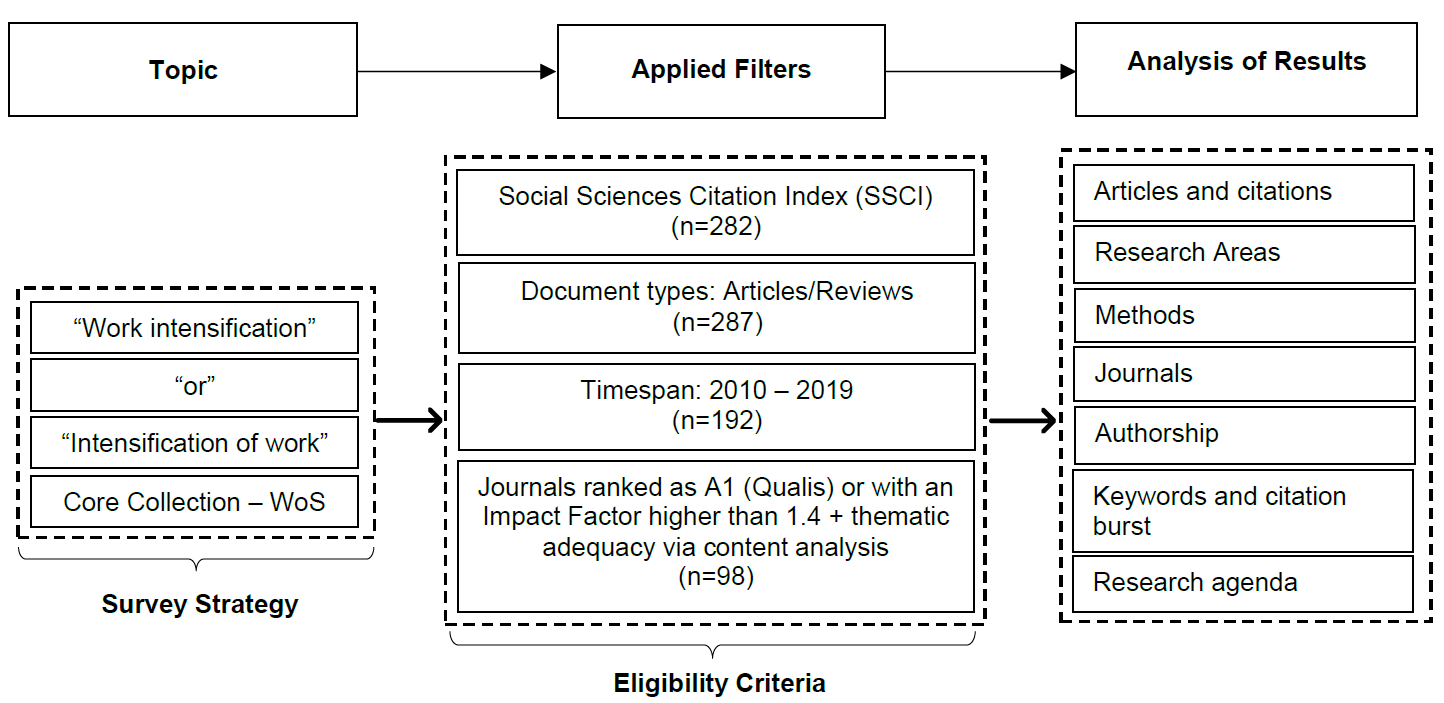
Figure 1
Research method
Source: Prepared by the authors.
In the analysis of the results, bibliometrics and scientometrics were used in conjunction with content analysis. The object of study of bibliometrics is articles published in scientific journals, whereas scientometrics seeks to understand the dynamics of science as a social activity from the analysis of the articles dealing with a given subject (Santos & Kobashi, 2009). Therefore, it is not only a matter of quantifying but giving meaning to the data so that they can be used later by researchers in their work and guide the formulation of public policies (Zhou, Chen & Huang, 2019). The data collected from the WoS database were treated, organized, and visualized according to Figure 2.
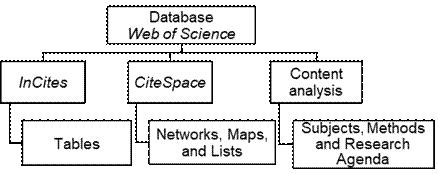
Figure 2.
Tools and methods for organizing and visualizing data
Source: Prepared by the authors
The InCites (Clarivate Analytics) tool evaluates research through various productivity, impact, and collaboration indicators, in the scope of researchers, articles, institutions, countries, journals, research areas, and funding agencies (Bornmann & Leydesdorff, 2013). The module offers citation metrics from the WoS base to evaluate research results, such as those found in this study. The InCites results were fundamental to the bibliometric analysis.
Scientometric analyses relied on CteSpace (version 5.6.R5), one of the most influential tools for analyzing academic literature information. The software allows the generation of different graphs and visual networks, favoring understanding the complex relationships established in the various fields of knowledge (Chen, 2006; Chen & Leydesdorff, 2014). This software was used to generate networks of research areas, journals, countries and institutions, authors, and keywords. The parameters in CiteSpace were defined as: (1) Timespan (2010-2019); (2) Node type: country and institution, category, keyword, references; (3) Selection criterion: Be among the first 50 articles published in a given year. Networks are formed by nodes (authors, journals, institutions, countries, topics) whose size is proportional to their contribution to the literature. The edges are links that portray the intensity and frequency of relationships. The colors of the rings refer to the years. The purple rings point to high intermediation centrality; that is, the items are important in linking to other nodes (Chen & Song, 2019).
Finally, content analysis was applied to grasp professional themes and contexts in work intensification and suggest a research agenda. The abstract, methodology, and final remarks sections were read, and this stage covered all 98 papers to perform open coding, create categories, and abstraction (Elo & Kyngäs, 2008). At the open coding stage, categories were generated spontaneously; after that, the class formation stage involved creating lists of areas grouped under broader headings to reduce the number of clusters; finally, abstraction was performed by assigning names to the categories aligned to the content, as suggested by Elo & Kyngäs (2008).
4 PRESENTATION AND DISCUSSION OF RESULTS
To compose this research, bibliometric, scientometric, and content analyses were performed to collect information about the subject and therefore achieve the proposed objective. This section presents and discusses aspects related to the characteristics of the literature and journals, the scope of research, and the topics of interest of the studies in question.
4.1 Characteristics of the literature
4.1.1 Number of articles and citations
The interest of researchers in a given subject is denoted to a large extent by the growth in the number of studies dedicated to it (Huang et al., 2020). In this sense,
the distribution of publications and citations over time can show growth trends or decline in a given field of study. Figure 3 shows the trends in the number of publications and citations about work intensification over the last ten years.
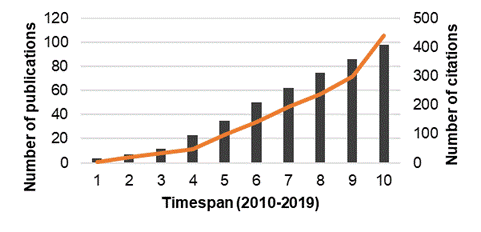
Figure 3
Trends in the number of publications
Source: Prepared by the authors.
From the point of view of the number of publications, we can see that 98 papers published in the decade from 2010 to 2019 appear in an increasing manner, with a significant surge in the last few years. This, in turn, may indicate that the subject has occupied a role of progressive prominence in organizational studies. Indeed, 2013 was a pivotal year for publications, and the number of papers published exceeded 20 for the first time in the period and almost doubled the following year.
In the first years of the survey (2010-2014), 35 papers were published, or an average of 16.2 articles per year. In the following period (2015-2019), 63 papers were published, with an average volume of 74.2 papers and an average growth rate of 18% per year.
The average annual growth rate of publications over the entire period totaled 45%. This may indicate that research on work intensification is in a “growth stage” and has a high potential for development. The total number of citations was 1,515 for the period under review, and the average number of citations per publication was 15.5. The average annual volume of citations was 40.6 citations per year from 2010 to 2014 and 262.4 citations per year from 2015 to 2019. This trend also reflects the increasing attention devoted to this area, especially in the last five years.
Kelliher & Anderson (2010) is the oldest study surveyed in the sample and the most cited in the analyzed period (185 citations). In this paper, the authors show that flexible workers (working under short-time or remote work regimes) experience elevated levels of work intensification. The most recent study, in turn, is Huo et al. (2019), which examined how workers’ well-being is impacted by work intensification as a result of emotional exhaustion. It also discusses the role of managers in mitigating this fatigue and improving the quality of life at work.
4.1.2 Research methods
The methods adopted in the research on work intensification were identified through content analysis of the 98 papers in the sample. It is worth emphasizing that qualitative research is widely adopted in studies on work intensification (51%), which points to an interpretative characteristic of studies on the subject. However, quantitative research (37%) and mixed methods (12%) also add up to a representative percentage, which shows a balance between the methodological approaches in the field.
This analysis is relevant because research methods communicate the choices researchers make about the tools and techniques employed to achieve the research objectives, often expressing the ontology, epistemology, and paradigm predominant in certain fields of study (Morgan, 2005). Thus, the higher incidence of research supported by qualitative methodologies points to the adherence of these strategies to the subject in question and opportunities for developing studies grounded on quantitative methods.
4.2 Journals characterization
The selected articles on work intensification were published in 58 journals. Table 1 lists the top ten journals in the field, considering the total number of citations.
| Periódicos | TC | N | %/98 | FI | Qualis | MV |
| Human Relations | 308 | 4 | 4,1 | 3,37 | A1 | 10,2 |
| Work Employment and Society | 131 | 6 | 6,1 | 2,36 | A1 | 8,2 |
| Internat.Journal of Human Resource Management | 59 | 5 | 5,1 | 3,15 | A1 | 7,8 |
| Work and Occupations | 58 | 1 | 1 | 2,66 | A1 | 10,2 |
| Journal of Management Studies | 56 | 1 | 1 | 5,84 | A1 | 10,1 |
| New Technology Work and Employment | 48 | 5 | 5,1 | 1,22 | A1 | 7,5 |
| European Journal of Work and Organizational Psychology | 44 | 3 | 3,1 | 2,6 | A1 | 8,4 |
| Human Resource Management Journal | 44 | 2 | 2 | 2,84 | A1 | 5,7 |
| Geoforum | 42 | 1 | 1 | 2,93 | A1 | 6,6 |
| Organization | 39 | 5 | 5,1 | 2,7 | A1 | 9,8 |
The total number of citations reflects the level of influence of an article published in a particular journal (Zhou et al., 2019). Even though it varies among fields of knowledge, the journal impact and Qualis score reflect the average citation rate per item, measuring its participation in scientific communication (Huang et al., 2020). Finally, citation half-life is a metric that shows the age of the most cited articles in years (Martín-Martín, Orduna-Malea, Ayllón & Delgado López-Cózar, 2016). Analyzing journals is vital because identifying those most devoted to a given topic or subject represents a valuable research resource for researchers interested in the theme in question (Huang et al., 2020).
As Table 1 shows, the top ten journals generally encompass publications related to the fields of Organizational and Management Studies. According to the journal performance metrics, there was a considerable centralization of citations in Human Relations, which published four (4) papers on the topic and cited 308 times. This is the journal with the second-highest impact factor among the journals in the sample. Its citation half-life totals 10.2 years, which means that half of the citations refer to articles published approximately ten years ago.
The top ten journals (17.24% of 58) published 33% of the total number of articles and received 829 (54.7%) of 1,515 citations. The cited half-life for the top ten journals is greater than five (5), implying that most cited articles on the topic stem from well-developed research published five years or more ago. This means that studies perceived as advanced are prominent in the field, unlike the areas of hard sciences or technology, which are marked by the greater prominence of recent studies.
To proceed with the journal analysis, a dual-map overlay, shown in Figure 4, was developed to describe the citing and cited journals on the same view mode.
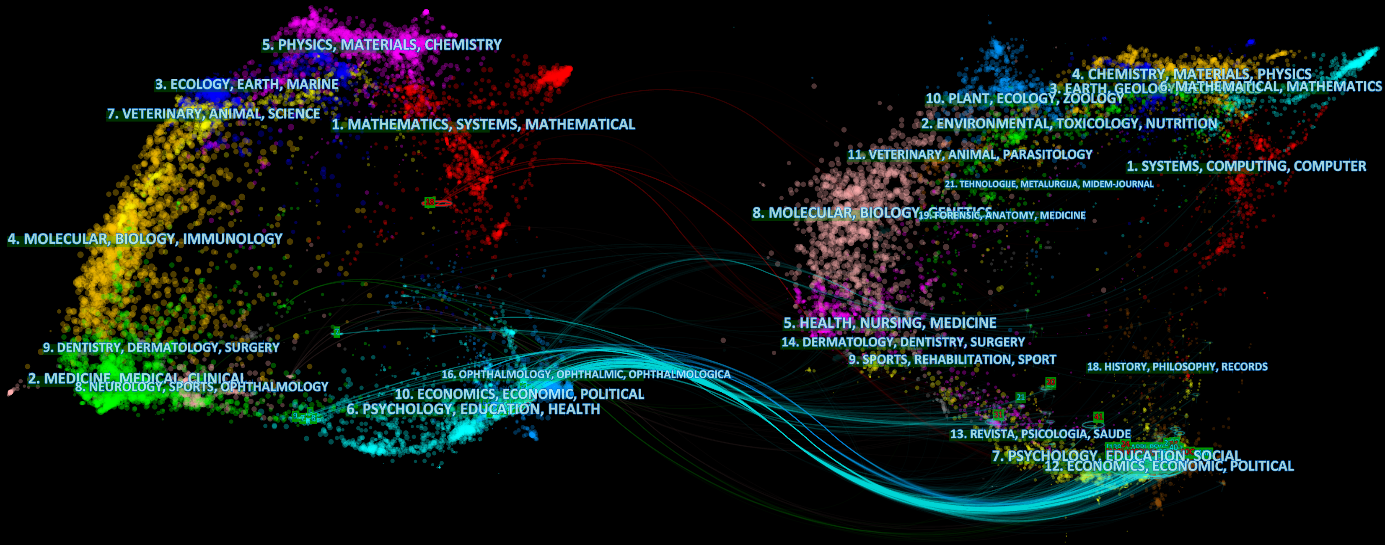
Figure 4
Dualmap overlay
Source: Prepared by the authors.
The map shows where a citation originates and where it points from an uninterrupted and interdisciplinary view (Chen & Leydesdorff, 2014). The citing journal (base map on the left) is the one in which a published article contains references to other journals; the cited journal (base map on the right) is the one in which an article cited by others has been published. The clusters' names were standardized based on the journal titles through CiteSpace algorithms (Chen & Leydesdorff, 2014; Chen & Song, 2019).
The articles present in the 58 citing journals cited 2,667 in the analyzed period. The citing journals (on the left) are mostly related to the field of Economics, which includes the subfields of Management, Psychology, Politics, Education, and Health (labels 10 and 6). In turn, the cited journals (on the right) belong to similar fields (labels 7 and 12). This shows a certain degree of homogeneity among the knowledge areas of citing and cited journals.
We must highlight label 5 of the base map of cited journals (right), whose label points to the existence of some relationship between the studies with nursing, health, and medical journals. This can be explained by the existence of research on work intensification for health professionals, such as Willis et al. (2018) and Briskin (2012).
4.3 Scope of the studies
4.3.1 Authorship analysis and referenced authors
The analysis of the most-cited authors in the references sections of the papers considered the authors with high citation frequency, resulting in the co-citation network in Figure 5. The network consists of 203 authors (nodes) and 660 edges. The network uncovers various participants and a wide range of cooperation in research on work intensification.
The authors and their relationships are crucial elements for advancing the field. Indeed, by analyzing networks, it is possible to uncover which researchers cooperate to a greater degree and the impacts of networks on research fields (Huang et al., 2020). The results show that the author with more citations in the references of the analyzed papers is Francis Green (30 citations). This assigns him greater centrality of intermediation in the network, followed by Brendan Burchell (12), Eillen Appelbaum (11), Keith Macky (9), and Philip M. Podsakoff (8).
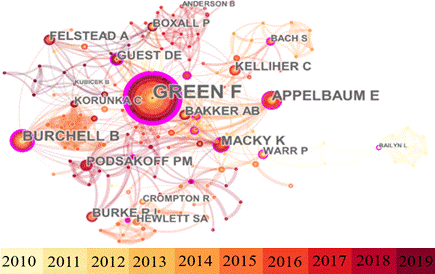
Figure 5
Network of authors cited in the papers
Source: Prepared by the authors
Another possible angle to analyze the cited authors is to examine the citations obtained by the authors of the articles surveyed in the sample (i.e., instead of focusing on the authors cited in the references of the articles in the sample). In this case, the five authors with the highest number of citations in the period 2010-2019 were Kelliher, Clare (152 citations, England), Anderson, Deirdre (152, England), Kossek, Ellen Ernst (149, USA), Lewis, Suzan (149, England) and Hammer, Leslie B. (149, USA). These numbers give them the status of the most important authors in the contemporary debate on the subject and indicate the references that cannot be absent in the work of researchers. However, the authors with the largest number of published articles are Korunka, Christian (6 articles, Austria), Kubicek, Bettina (5, Austria), Boxall, Peter (3, New Zealand), Daniels, Kevin D. (3, USA) and Paškvan, Matea (3, Austria). Interestingly, although Austria is not particularly significant in the overall production ranking on work intensification, it gathers the most productive researchers on the subject.
4.4 Research Points of Interest
4.4.1 Research areas, themes, and professional contexts
As for research areas, they relate to the fields of knowledge to which the articles are linked. Table 2 presents the primary research areas, with at least four publications (ΣN). The corresponding period was divided into three temporal panels, showing the trends in the number of articles and citations by research area, in 2010-2014, 2015-2019, and finally, the whole period (2010-2019). The number of publications and citations in each area highlights the research trends of work intensification in different fields of knowledge.
Management is the most significant among all areas, totaling 713 citations and 40 articles. Other relevant areas are: Social Sciences (311 citations; 4 articles); Industrial Relations and Labor (305; 21); Sociology (212; 9); Economics (142; 8); Ergonomics (105; 8); Applied Psychology (88; 10), and Education (83; 7). This finding is noteworthy since it indicates that the theme has been an object of interest, above all, in management. By comparison, the social sciences, sociology, and industrial and labor relations (all of which traditionally discuss issues related to the context and working conditions) proved to have more modest global results.
| Research Areas | 2010-2014 | 2015-2019 | 2010-2019 | |||
| TC | N | TC | N | ΣTC | Σ N | |
| Management | 514 | 14 | 199 | 26 | 713 | 40 |
| Social Sciences | 307 | 3 | 4 | 1 | 311 | 4 |
| Industrial Relations & Labor | 196 | 6 | 109 | 15 | 305 | 21 |
| Sociology | 200 | 7 | 12 | 2 | 212 | 9 |
| Economics | 126 | 4 | 16 | 4 | 142 | 8 |
| Ergonomics | 81 | 4 | 24 | 4 | 105 | 8 |
| Psychology Applied | 34 | 3 | 54 | 7 | 88 | 10 |
| Education | 69 | 4 | 14 | 3 | 83 | 7 |
However, it should be noted that the number of publications (N) in the areas of Management, Industrial Relations, and Labor and Applied Psychology grew significantly between 2010 and 2019, although total citations (TC) only increased in Applied Psychology.
Figure 6 shows the co-occurrence analysis of research areas, including 27 nodes and 36 edges, where the most important ones are visible. This type of analysis investigates interdisciplinary relationships and can uncover connections between deeper, more intangible fields of knowledge through a network of common subjects and topics (Huang et al., 2020).
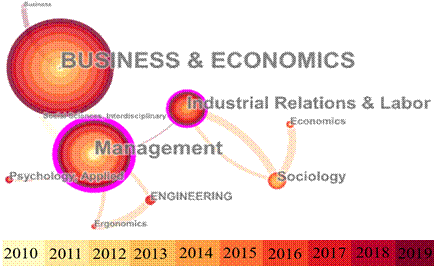
Figure 6
WoS Research Area Network
Source: Prepared by the authors.
Due to the existence of links between areas, we found that research on work intensification has an interdisciplinary and multidisciplinary character due to numerous area nodes. The three primary research areas are Business & Economics, Management, and Industrial relations & Labor. As per the intensity of the color chart, it is evident that fields such as Ergonomics, Engineering, and Applied Psychology have gained prominence more recently, after 2016.
These findings indicate that the articulation of different fields was paramount for global research on work intensification. The areas circled by purple rings (Management; Industrial Relations & Labor) have high centrality of intermediation (Chen & Song, 2019) and are configured as areas of knowledge that favor their connection with other ones. Despite the interdisciplinary nature of the research theme, as previously highlighted, Management (Business & Economy and Management) emerges as central in the debate. This, in turn, indicates that this field is particularly concerned with the individual, managerial or organizational implications of work intensification.
In a complementary manner, the content analysis of the surveyed papers was performed to deepen the understanding of the key issues addressed in studies on work intensification. The open coding, class formation, and abstraction procedures performed during the content analysis process identified the key themes and professional contexts encompassed by the analyzed articles, to which we relate each of the 98 papers in the surveyed sample. Table 3 presents the categorization of the 22 most discussed research themes in the scope of work intensification, and Table 4 shows the categorization of the occupational contexts in which the studies were conducted.
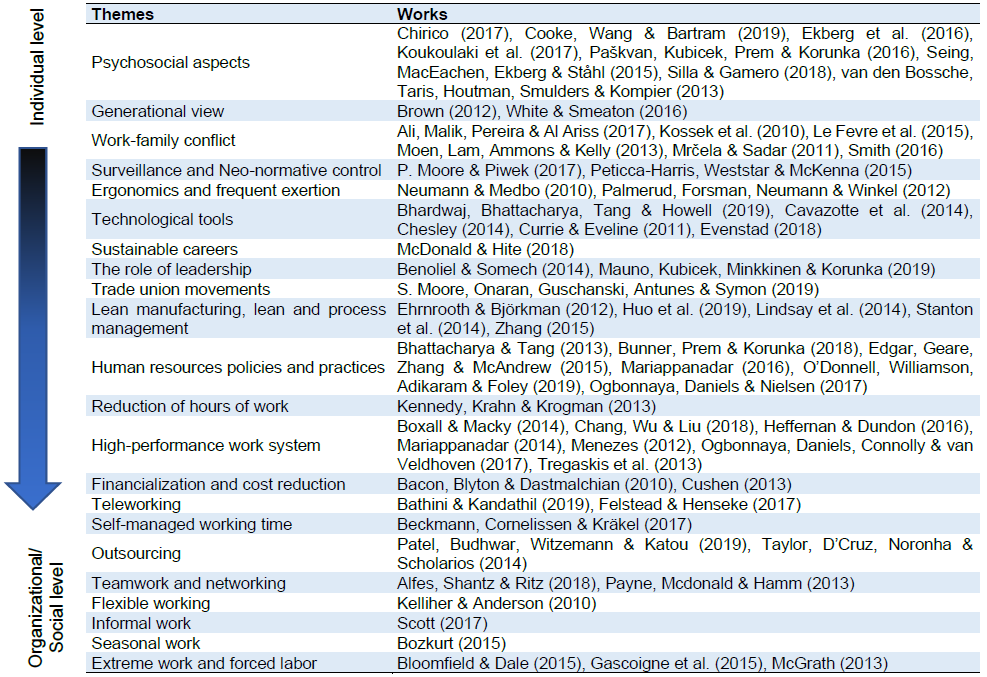
Source: Prepared by the authors.
The themes presented in Table 3 include individual and psychosocial aspects of work intensification, such as workplace violence(van den Bossche et al., 2013), stress, and emotional exhaustion (Chirico, 2017; Koukoulaki et al., 2017; Paškvan et al., 2016), and positive psychology (Cooke et al., 2019; Silla & Gamero, 2018). In the transition between individual and social issues, work intensification affects the job satisfaction of members of generation X and baby boomers in similar ways (Brown, 2012). Moreover, internal/neo-normative and organizational surveillance mechanisms are also drivers of work intensification practices (P. Moore & Piwek, 2017; Peticca-Harris et al., 2015).
One of the most prominent issues in research on work intensification is the impact of high demands and long working hours on work-family conflict (Ali et al., 2017; Kossek et al., 2010; Le Fevre et al., 2015; Moen et al., 2013; Mrčela & Sadar, 2011; Smith, 2016), a scenario that is often fostered by high-performance work systems (Boxall & Macky, 2014; Chang et al., 2018; Heffernan & Dundon, 2016; Menezes, 2012; Ogbonnaya, Daniels & Nielsen, 2017; Tregaskis et al., 2013), as well as the use of technological tools (Bhardwaj et al., 2019; Cavazotte et al., 2014; Chesley, 2014; Currie & Eveline, 2011; Evenstad, 2018) and lean organizational processes or approaches (Ehrnrooth & Björkman, 2012; Huo et al., 2019; Lindsay et al., 2014; Stanton et al., 2014; Zhang, 2015). Cost reduction and financialization can also engender intensified work practices(Bacon et al., 2010; Cushen, 2013) and seasonal work (Bozkurt, 2015).
Human resource practices can foster work intensification, and it is up to the organization to put in place sustainable human resource policies to foster well-being (Edgar et al., 2015; Mariappanadar, 2016), sustainable careers (McDonald & Hite, 2018) and curb work environments characterized by long working hours and frequent accidents (O’Donnell et al., 2019). Finally, such practices must consider that performance-based compensation is associated with work intensification (Ogbonnaya, Daniels & Nielsen, 2017). On the other hand, studies show that shorter working hours (Kennedy et al., 2013), participative leadership practices (Benoliel & Somech, 2014), and teamwork (Alfes et al., 2018; Payne et al., 2013) can decrease intensification, whereas lack of support by supervisors can increase it (Mauno et al., 2019).
In pandemic times, it is vital to acknowledge the negative impacts of telework, which have been reported in some studies. Research reveals that intensified work is accepted as a reward for the “benefit” of telework (Bathini & Kandathil, 2019; Felstead & Henseke, 2017) or flexible working hours (Kelliher & Anderson, 2010). In turn, self-managed working time can lead to longer periods of dedication to work (Beckmann et al., 2017).
Ergonomic aspects of production, such as performance times, walking distances, and layout space requirements, typical of production lines aimed at increasing productivity, can lead to intensification through increased repetitive work (Neumann & Medbo, 2010; Palmerud et al., 2012). This scenario of intensification in production lines is associated with an increase in behaviors detrimental to occupational safety and a higher frequency of occupational accidents (Bhattacharya & Tang, 2013; Bunner et al., 2018).
The outsourcing business model has impacted work intensification in various ways (Patel et al., 2019; Taylor et al., 2014). Outsourcing is one of the causes of disarticulation of professional categories because it subjects workers to intensified work practices. This, in turn, reinforces the need for collective representation to fight against such practices (S. Moore et al., 2019).
Regarding the professional contexts in which work intensification has been researched, Table 4 addresses and distinguishes each one of them.
| Professional Contexts | Papers |
| Health-related professions: Pharmacy, Nursing, Medicine | Blackman et al. (2018), Briskin (2012), Duffield, Roche, Wise & Debono (2020), Gidman (2011), Hart & Warren (2015), Ochoa (2018), Russell, Smith, Valsecchi & Andersson Bäck (2017), Wankhade, Stokes, Tarba & Rodgers (2020), Willis et al. (2018, 2016) |
| Maritime work | Akamangwa (2016) |
| Childcare, primary/secondary school, university, and research professions | Bullough, Hall-kenyon, Mackay & Marshall (2014), Caretta, Drozdzewski, Jokinen & Falconer (2018), Karousiou, Hajisoteriou & Angelides (2019), Keogh & Roan (2016), Lawrence et al. (2019), Loh & Hu (2014), Page (2015), Wilson & Holligan (2013) |
| Police work | Turnbull & Wass (2015) |
| Migrant labor | Alberti & Danaj (2017) |
| Public sector | Bigi, Greenan, Hamon-Cholet & Lanfranchi, 2018; Cunningham, 2016; Cunningham, Baines & Charlesworth, 2014; Esbenshade, Vidal, Fascilla & Ono, 2016; Omari & Paull (2015) |
| Senior home care service providers | Broadbent (2014), Burns, Hyde & Killett (2016), Jolanki (2015), Korunka et al. (2015), Kubicek, Korunka & Ulferts (2013), Kubicek et al. (2015) |
| High-status occupations | Moen et al. (2013) |
| Freelancers | Farrell & Morris (2017) |
| Domestic workers | Teeple Hopkins (2017) |
| Emotional labor | Curley & Royle (2013) |
One can see that work intensification in health care was widely studied (10 articles), followed by the education sector (8), senior home care services (6), and the public sector (5). Other occupational contexts were also loci of analysis, such as maritime, police, domestic, emotional, migrant, and freelance work. Finding that work intensification occurs in these specific contexts highlights the need to investigate and intervene in professional realities where work intensification seems to occur with greater frequency or expressiveness.
4.4.2 Most frequent keywords
Useful information can be obtained through the keywords of academic publications, and these are fundamental to investigating relevant topics in a given field (Wang, Zhao & Wang, 2018). Therefore, keyword co-occurrence analysis was performed using CiteSpace. This culminated in the network in Figure 7, which aims to identify the most important themes in work intensification studies on scientific grounds.
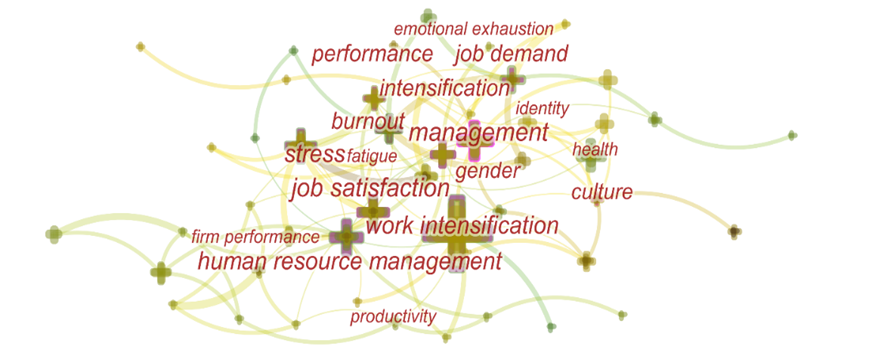
Figure 7
Keyword network
Source: Prepared by the authors.
The 57 nodes represent keywords, and the 111 edges represent their relationships. Not surprisingly, “work intensification” as the keyword of this research occupies the central position in this network. Other relevant themes from the point of view of betweenness centrality (BC) for the field of work intensification studies are job satisfaction; (BC: 12), management (11), stress (10), human resource management (BC: 10); performance (BC: 9), burnout (8), job demand (8); and gender (7).
Figure 8 shows the keywords characterized by a burst in uses and citations and the year of start and end of the burst, whose duration is represented by the red stripe. The keywords with a burst refer to those whose use surged during a given period. (Huang et al., 2020). Detecting the burst is a major analytical method for identifying the keywords that have received special attention from the scientific communities during a given period (Zhou et al., 2019).
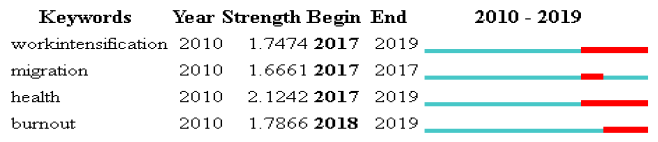
Figure 8
List of keywords with citation burst in the last three years.
Source: Prepared by the authors.
Thus, it is evident that work intensification, health, and burnout are active and emerging themes in work intensification studies. The keyword “burnout” has a slightly higher strength of connection than the central keyword of this study (“work intensification”). This highlights an intense association between the two themes and a likely causal relationship between work intensification and worker burnout. The occurrence of keywords such as “emotional exhaustion,” “stress,” “fatigue,” and “health” in the network reinforces the perception that research on work intensification has addressed the deleterious effects of this practice. It is also worth noting the burst of “migration” starting and ending in 2017, although this keyword is no longer as active in the current scenario. The keyword analysis performed in this section also reveals that the field typically transits between multiple levels of analysis by considering, for example, issues related to identity, emotional exhaustion (individual level), work demands and human resource management (institutional level), and, finally, culture and gender (national and social level)
Figure 9 summarizes the research topics by presenting directions, themes, keywords, and professional contexts that may interest social researchers who wish to examine intensified work practices.
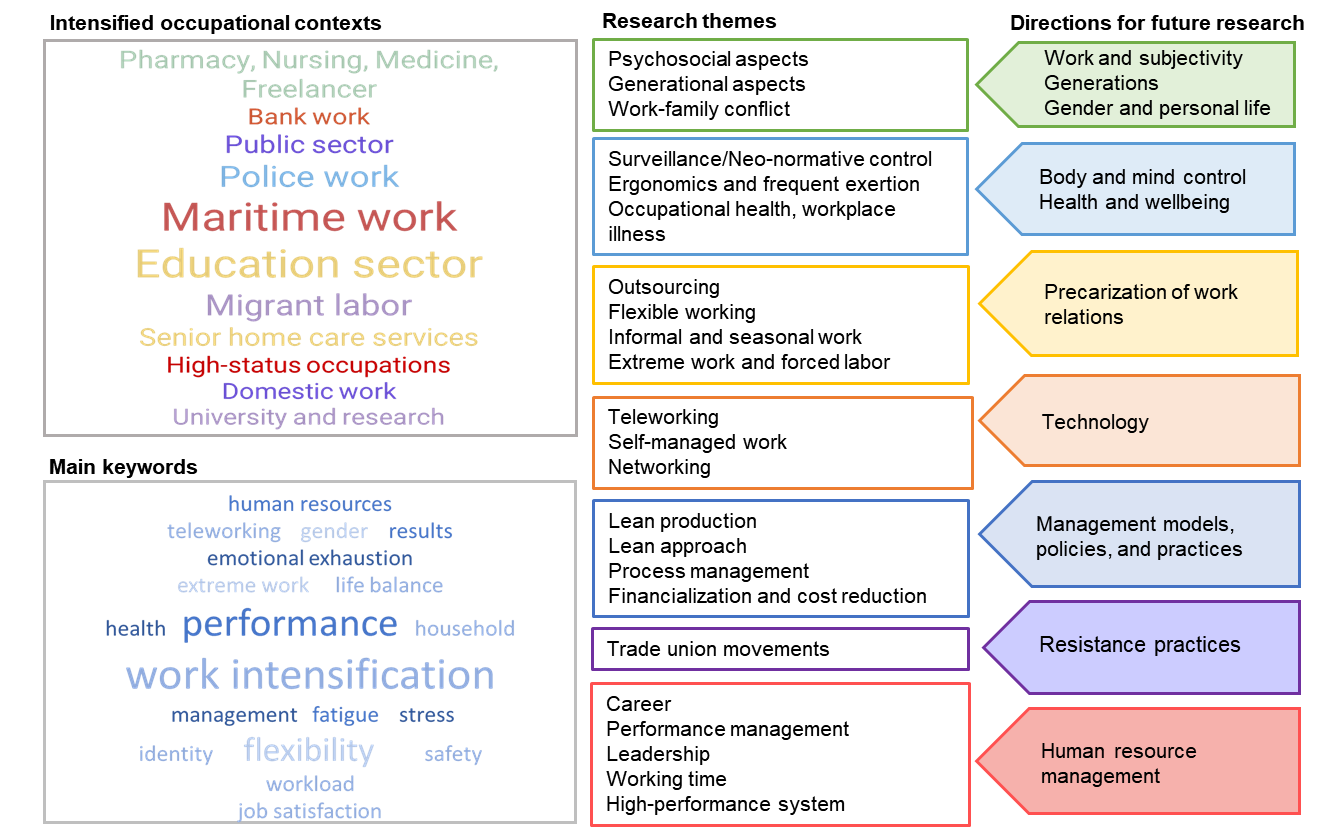
Figure 9
Work intensification framework
Source: Prepared by the authors.
The theoretical-practical framework clarifies several challenges and research themes regarded as integral to the intensified work phenomenon. In addition, it highlights the occupations identified in the surveyed studies that experience intensification in everyday work the most. The proposed typology also helps guide future research agendas as it aligns theory and professional practice. Thus, the priority in addressing research directions and themes goes back to the need for academic research that may have a practical impact on reducing work exploitation and intensification.
5 RESEARCH AGENDA
Knowing the gaps in the field and the possibilities for future studies is a fertile ground for the constant development of scientific knowledge. In this sense, identifying contexts in which flexible work may not lead to work overload stands out as an essential item on the work intensification research agenda(Kelliher & Anderson, 2010). Thus, regarding research on hours dedicated to work, Moen et al. (2013) highlight the need for research focused on working-time management, considering the work-family conflict; that is, the scenario in which workers with children
perform double duties dividing their attention between work and family chores. Accordingly, Kennedy et al. (2013) suggest further research on reducing work intensity for individuals, especially female workers, to enable a better work-family-personal life balance (Currie & Eveline, 2011).
Gender issues, especially women’s work, should be further explored in future research on the subject, especially regarding the interfaces between intensified work and family life. Along these lines, Ali et al. (2017) suggest further research to address gender at work among Muslim migrants, to identify whether highly qualified female professionals can achieve a balance between work and social life, as well as map possible differences in work opportunities between Muslim and non-Muslim women workers, based on the potential challenges of cultural understanding in the labor market. A study conducted in Finland and Sweden found that female workers find it difficult to balance family roles (more precisely, the role of caring for their elderly parents) and work. It is, therefore, necessary to challenge gender stereotypes (Jolanki, 2015). Accordingly, Teeple Hopkins (2017) suggests that further research should encompass the work of feminist geographer Geraldine Pratt with that of political economist Leah F. Vosko to discuss the intensification of paid domestic work for women.
In the technological sphere, Felstead e Henseke (2017) and Chesley (2014) pointed out the importance that future studies re-examine the benefits of remote work and the reduction of tension and distress caused by the use of ICT, respectively. In the same vein, P. Moore e Piwek (2017) highlight the significance of future research on mobile devices and tracking technology in contemporary professional environments.
In lean management, Cushen (2013) advises conducting research centered on micro-level interventions to understand the structure of financialization in workplaces. Nonetheless, Stanton et al. (2014) believe that new studies should combine various levels of analysis, such as social, political, and sectoral, to outline an assessment of organizational change and strategy. For Zhang (2015), understanding lean management’s internal tensions and dynamic behavior depends on further investigations focused on the capitalist labor process, management control, and workforce positioning and tracking. To examine the sustainability of the new structure of outsourced labor, Taylor et al. (2014) propose that future longitudinal analyses be conducted on labor structure, employment relations, and human resource management.
Due to the growing quest for increased production and financial return, many companies have chosen to adopt high-performance work practices that often result in work overload and physical strain. According to Ogbonnaya, Daniels, Connolly, et al. (2017), future research may examine the correlation between high-performance work conditions and occupational health. In the same way, Chirico (2017) draws attention to the need for new studies focused on the psychosocial risks caused by work intensification.
As for the organizational climate, Bunner et al. (2018) point out that the safety climate in organizations has worsened with work intensification and propose new studies addressing the adverse effects of work intensification on other types of organizational climate. Still on the subject of organizational climate, Silla e Gamero (2018) emphasize that future research could examine whether safety climate could be shared and affected by time pressures and intensification experienced by remote workers, which is of utmost importance in pandemic times.
On the other hand, from the point of view of aid and support, Alfes et al. (2018) suggest that future studies look at the functions of human resource management to understand the mechanisms by which employees assign workloads to particular individuals and the consequent impacts on well-being and the moderating role played by group or individual support in the stress-health relationship. Lastly, Hart e Warren (2015) show that the climate of work relations is crucial for workers to perceive their real working conditions, safety, and well-being, as a professional category.
Figure 10 synthesizes new research directions by dividing the themes into three levels of analysis, namely individual, institutional, and social. Also, at the individual level, the challenge is to investigate facilitating mechanisms and barriers to intensification that emerge from individuals and the consequences of intensified work for workers’ health, well-being, and personal life. Special importance must be given to the intensification of goals in teleworking contexts since this work modality has been widely adopted in the context of the COVID-19 pandemic. At the meso level, it is salutary to identify the existence of practices that legitimize/institutionalize work intensification. At the macro level, studies investigating how political actions, union movements, and legislation can help confront intensified work are welcome.
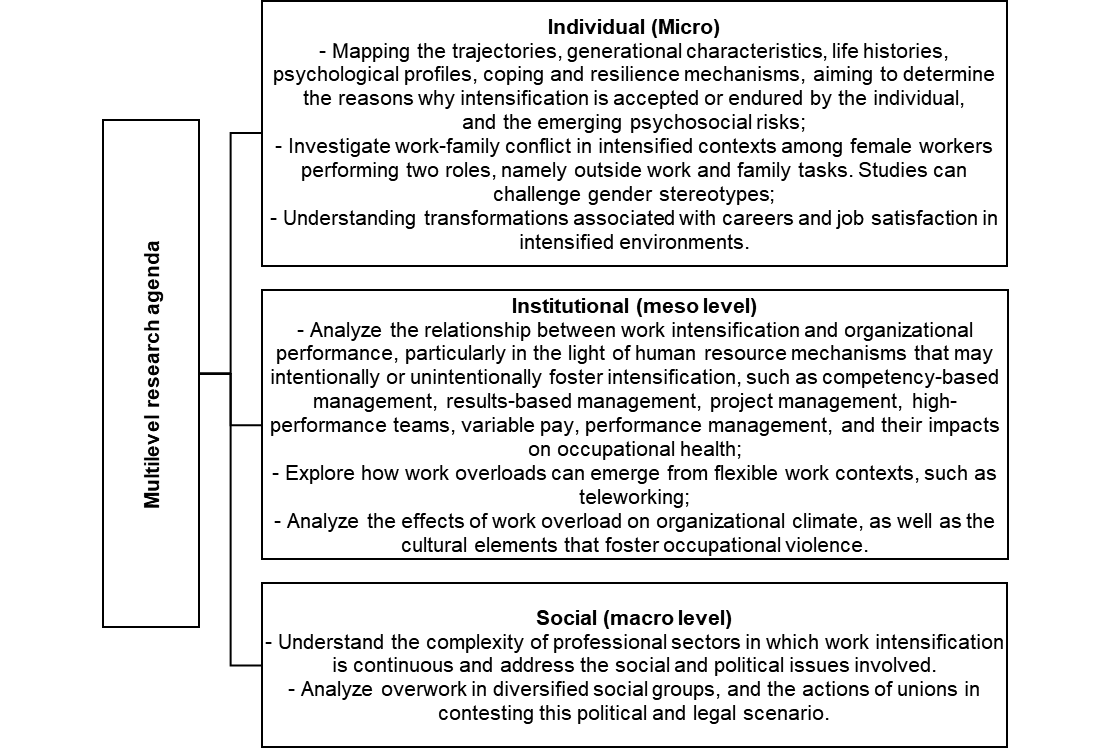
Figure 10
Future research agenda in work intensification
Source: Prepared by the authors.
In addition, from the identification of the themes addressed in the papers, we realized that there is room for future research to identify (a) the strategies used by workers to reconcile intensified work and personal life; (b) the dynamics that trigger the social reproduction of intensified work practices; (c) the various psychosocial risks arising from work intensification, such as depression, anxiety, burnout, and other syndromes. In addition, studies mapping people management and information and communication technology practices, work processes, and leadership styles most likely to generate work intensification are welcome in this field of investigation.
Additionally, we suggest research that expands the understanding of the subjective aspects that propitiate and/or facilitate adherence to intensified work practices and studies discussing the emancipatory role of the individual experience of intensification. The perception that the legal context that enables and institutionalizes work intensification has remained scarcely explored also poses an opportunity for future studies. Finally, it would be worthwhile to further the investigation of intensification manifestations in the private, public, voluntary, and informal sectors.
As for the sectors and professional categories less frequently addressed in research and which deserve attention due to the nature and dynamics of work that tends to be intensified, we can cite the banking, consulting, telemarketing, and rural sectors, in addition to workers with low professional qualifications and digital, gig economy, or “uberized” workers.
The research agenda reveals a commitment to critical studies focused on work intensification. According to Davel & Alcadipani (1990), the three pillars of critical studies are (I) a critical view of management, (II) an intention detached from performance, and (III) an emancipatory intention. Thus, several articles suggested new research with great adherence to the Critical Administration Studies (ECA) movement since it fosters critical reflections, questioning, and organizational restructuring. (Davel & Alcadipani, 1990).
6 FINAL REMARKS
This paper analyzed the scientific literature on work intensification to map the field of studies and propose a research agenda on the subject addressed here. By adopting the Web of Science Core Collection as a data source, bibliometric, scientometric, and content analyses were performed, capturing relevant information on the theme, and achieving the proposed research objective. From its findings, it has been possible to offer new research directions with ample potential to fill the gaps in the field. Moreover, the proposed agenda may broaden the managerial implications of the research while helping to conduct studies that positively impact workers’ quality of life.
In particular, we categorized the themes and occupational contexts related to the articles. This paper revealed that the most prevalent themes in research on work intensification involve its psychosocial consequences and gender and work-family conflicts. Furthermore, the themes addressed revolve around repetitive strain, impacts of technology, lean production, human resource policies, and process management in the scope of work intensification. Finally, special attention should be given to teleworking and self-managed work modalities, which emerge as mechanisms that can potentially foster intensified work practices.
As for the occupations characterized by higher degrees of work intensification, they include health services, education and research, general public services, police officers, maritime workers, high-ranking managers, freelancers, domestic workers, and senior home care service providers. This list informs us that work intensification is present in various professional contexts, whether formal or informal, which imposes the need for research in the area to develop mechanisms to confront the naturalization of this phenomenon. In other words, it is worth noting that the deleterious effects of work intensification reported in many articles reinforce the importance of expanding research addressing work intensification from a critical perspective.
The findings of the present investigation allowed us to suggest a robust research agenda encompassing themes that have been scarcely explored in the studies surveyed here while indicating trends that deserve to be further addressed.
As for the limitations, we highlight that the study relied exclusively on an international database, which does not allow it to elucidate specific aspects regarding the Brazilian scenario, although the database includes Brazilian authors and journals. Future studies may adapt the analyses performed here to the Brazilian context or other developing countries since work intensification may be accompanied by precarization of work and lack of social protection for workers (Mrčela & Sadar, 2011), and these are very frequent aspects in these contexts. The mapping of the scientific production on work intensification can also serve as a basis to deepen the content analysis of the researched articles through the elaboration of a literature review.
In terms of practical contributions, this study can help managers better understand the negative implications of work intensification and its impacts on management, performance, careers, and leadership. We sought to contribute to theory and practice in several ways. Firstly, by mapping the primary themes and occupational groups researched, we pointed to paths that can be taken in the field, both in the sense of advancing topics already discussed and exploring those that lack further investigation. Also, by identifying the most cited articles, researchers, and journals in the field, we have suggested the most relevant readings to the researchers interested in this theme. Moreover, by presenting the key areas in which such studies have been conducted and the connections between them, we indicated the various perspectives informing the theme. Finally, by presenting graphical views of a considerable volume of publications through maps and figures, we provided a panoramic view of the research field and the observation of patterns and connections that can inspire future research. In short, there are many research possibilities to be explored by researchers interested in work intensification.
REFERENCES
Afshari, L., Hayat, A., Ramachandran, K. K., Bartram, T., & Balakrishnan, B. K. P. D. (2022). Threat or opportunity: accelerated job demands during COVID-19 pandemic. Personnel Review, Vol. ahead. https://doi.org/10.1108/PR-02-2021-0098
Akamangwa, N. (2016). Working for the environment and against safety: How compliance affects health and safety on board ships. Safety Science, 87, 131-143. https://doi.org/10.1016/j.ssci.2016.03.027
Alberti, G., & Danaj, S. (2017). Posting and agency work in British construction and hospitality: the role of regulation in differentiating the experiences of migrants. International Journal of Human Resource Management, 28(21), 3059-3082. https://doi.org/10.1080/09585192.2017.1365746
Alfes, K., Shantz, A. D., & Ritz, A. (2018). A multilevel examination of the relationship between role overload and employee subjective health: The buffering effect of support climates. Human Resource Management, 57(2), 659-673. https://doi.org/10.1002/hrm.21859
Ali, F., Malik, A., Pereira, V., & Al Ariss, A. (2017). A relational understanding of work-life balance of Muslim migrant women in the west: future research agenda. International Journal of Human Resource Management, 28(8), 1163-1181. https://doi.org/10.1080/09585192.2016.1166784
Araújo, C. A. (2006). Bibliometria: evolução histórica e questões atuais. Em Questão, 12(1), 11-32. Retrieved from https://www.seer.ufrgs.br/EmQuestao/article/view/16
Bacon, N., Blyton, P., & Dastmalchian, A. (2010). The impact of organizational change on steelworkers in craft and production occupational groups. Human Relations, 63(8), 1223-1248. https://doi.org/10.1177/0018726709356599
Bathini, D. R., & Kandathil, G. M. (2019). An orchestrated negotiated exchange: Trading home-based telework for intensified work. Journal of Business Ethics, 154(2), 411-423. https://doi.org/10.1007/s10551-017-3449-y
Beckmann, M., Cornelissen, T., & Kräkel, M. (2017). Self-managed working time and employee effort: Theory and evidence. Journal of Economic Behavior and Organization, 133, 285-302.https://doi.org/10.1016/j.jebo.2016.11.013
Benoliel, P., & Somech, A. (2014). The health and performance effects of participative leadership: Exploring the moderating role of the Big Five personality dimensions. European Journal of Work and Organizational Psychology, 23(2), 277-294. https://doi.org/10.1080/1359432X.2012.717689
Bhardwaj, S., Bhattacharya, S., Tang, L., & Howell, K. E. (2019). Technology introduction on ships: The tension between safety and economic rationality. Safety Science, 115, 329-338. https://doi.org/10.1016/j.ssci.2019.02.025
Bhattacharya, S., & Tang, L. (2013). Fatigued for safety? Supply chain occupational health and safety initiatives in shipping. Economic and Industrial Democracy, 34(3), 383-399. https://doi.org/10.1177/0143831X12439760
Bigi, M., Greenan, N., Hamon-Cholet, S., & Lanfranchi, J. (2018). The human sustainability of ICT and management changes: Evidence for the French public and private sectors. Sustainability (Switzerland), 10(10), 1-23. https://doi.org/10.3390/su10103570
Blackman, I., Lye, C. Y., Darmawan, I. G. N., Henderson, J., Giles, T., Willis, E., Toffoli, L., Xiao, L., Verrall, C. (2018). Modeling Missed Care: Implications for Evidence-Based Practice. Worldviews on Evidence-Based Nursing, 15(3), 178-188. https://doi.org/10.1111/wvn.12285
Bloomfield, B., & Dale, K. (2015). Fit for work? Redefining ‘Normal’ and ‘Extreme’ through human enhancement technologies. Organization, 22(4), 552-569. https://doi.org/10.1177/1350508415572507
Boltanski, L., & Chiapello, E. (2009). O Novo Espírito do Capitalismo. Martins Fontes.
Bornmann, L., & Leydesdorff, L. (2013). Macro-Indicators of Citation Impacts of Six Prolific Countries: InCites Data and the Statistical Significance of Trends. PLoS ONE, 8(2), 1-5. https://doi.org/10.1371/journal.pone.0056768
Boxall, P., & Macky, K. (2014). High-involvement work processes, work intensification and employee well-being. Work, Employment and Society, 28(6), 963-984. https://doi.org/10.1177/0950017013512714
Bozkurt, Ö. (2015). The punctuation of mundane jobs with extreme work: Christmas at the supermarket deli counter. Organization, 22(4), 476-492. https://doi.org/10.1177/1350508415572512
Briskin, L. (2012). Resistance, mobilization and militancy: Nurses on strike. Nursing Inquiry, 19(4), 285-296. https://doi.org/10.1111/j.1440-1800.2011.00585.x
Broadbent, K. (2014). ‘I’d rather work in a supermarket’: privatization of home care work in Japan. Work, Employment and Society, 28(5), 702-717. https://doi.org/10.1177/0950017013500113
Brown, M. (2012). Responses to work intensification: Does generation matter? International Journal of Human Resource Management, 23(17), 3578-3595. https://doi.org/10.1080/09585192.2011.654348
Bullough, R. V, Hall-kenyon, K. M., Mackay, K. L., & Marshall, E. E. (2014). Head start and the intensification of teaching in early childhood education. Teaching and Teacher Education, 37, 55-63. https://doi.org/10.1016/j.tate.2013.09.006
Bunner, J., Prem, R., & Korunka, C. (2018). How work intensification relates to organization-level safety performance: The mediating roles of safety climate, safety motivation, and safety knowledge. Frontiers in Psychology, 9, 1-13. https://doi.org/10.3389/fpsyg.2018.02575
Burns, D. J., Hyde, P. J., & Killett, A. M. (2016). How financial cutbacks affect the quality of jobs and care for the elderly. Industrial and Labor Relations Review, 69(4), 991-1016. https://doi.org/10.1177/0019793916640491
Caretta, M. A., Drozdzewski, D., Jokinen, J. C., & Falconer, E. (2018). “Who can play this game?” The lived experiences of doctoral candidates and early career women in the neoliberal university. Journal of Geography in Higher Education, 42(2), 261-275. https://doi.org/10.1080/03098265.2018.1434762
Castel, R. (1998). As metamorfoses da questão social: uma crônica do salário. Rio de Janeiro: Vozes.
Cavazotte, F., Heloisa Lemos, A., & Villadsen, K. (2014). Corporate smart phones: Professionals’ conscious engagement in escalating work connectivity. New Technology, Work and Employment, 29(1), 72-87. https://doi.org/10.1111/ntwe.12022
Chang, P. C., Wu, T., & Liu, C. L. (2018). Do high-performance work systems really satisfy employees? Evidence from China. Sustainability (Switzerland), 10(10), 15-18. https://doi.org/10.3390/su10103360
Chen, C. (2006). CiteSpace II: Detecting and Visualizing Emerging Trends and Transient Patterns in Scientific Literature. Journal of the American Society for Information Science and Technology, 57(3), 359-377. https://doi.org/10.1002/asi.20317
Chen, C., & Leydesdorff, L. (2014). Patterns of Connections and Movements in Dual-Map Overlays: A New Method of Publication Portfolio Analysis. Journal of the Association for Information Science and Technology, 65(2), 334-351. https://doi.org/10.1002/asi.22968
Chen, C., & Song, M. (2019). Visualizing a field of research: A methodology of systematic scientometric reviews. PLoS ONE, 14(10). https://doi.org/10.1371/journal.pone.0223994
Chesley, N. (2014). Information and communication technology use, work intensification and employee strain and distress. Work, Employment and Society, 28(4), 589-610. https://doi.org/10.1177/0950017013500112
Chirico, F. (2017). The forgotten realm of the new and emerging psychosocial risk factors. Journal of Occupational Health, 59(5), 433-435. https://doi.org/10.1539%2Fjoh.17-0111-OP
Cooke, F. L., Wang, J., & Bartram, T. (2019). Can a supportive workplace impact employee resilience in a high pressure performance environment? An investigation of the Chinese banking industry. Applied Psychology, 68(4), 695-718. https://doi.org/10.1111/apps.12184
Cunningham, I. (2016). Non-profits and the ‘hollowed out’ state: The transformation of working conditions through personalizing social care services during an era of austerity. Work, Employment and Society, 30(4), 649-668. https://doi.org/10.1177/0950017016636983
Cunningham, I., Baines, D., & Charlesworth, S. (2014). Government funding, employment conditions, and work organization in non-profit community services: A comparative study. Public Administration, 92(3), 582-598. https://doi.org/10.1111/padm.12060
Curley, C., & Royle, T. (2013). The degradation of work and the end of the skilled emotion worker at Aer Lingus: Is it all trolley dollies now? Work, Employment and Society, 27(1), 105-121.https://doi.org/10.1177/0950017012460317
Currie, J., & Eveline, J. (2011). E-technology and work/life balance for academics with young children. Higher Education, 62(4), 533-550. https://doi.org/10.1007/s10734-010-9404-9
Cushen, J. (2013). Financialization in the workplace: Hegemonic narratives, performative interventions and the angry knowledge worker. Accounting, Organizations and Society, 38(4), 314-331. https://doi.org/10.1016/j.aos.2013.06.001
Davel, E., & Alcadipani, R. (1990). Estudos críticos em Administração: a Produção científica brasileira nos anos 1990. RAE, 43(4), 72-85. https://doi.org/10.1590/S0034-75902003000400006
Druck, G. (2013). A precarização social do trabalho no Brasil: Alguns indicadores. In R. Antunes (Ed.), Riqueza e Miseria do Trabalho no Brasil (p. 448). São Paulo: Boitempo.
Duffield, C., Roche, M. A., Wise, S., & Debono, D. (2020). Harnessing ward-level administrative data and expert knowledge to improve staffing decisions: A multi-method case study. Journal of Advanced Nursing, 76(1), 287-296. https://doi.org/10.1111/jan.14207
Edgar, F., Geare, A., Zhang, J. A., & McAndrew, I. (2015). Mutual gains or conflicting outcomes? How HRM benefits professionals. International Journal of Manpower, 36(8), 1248-1265. https://doi.org/10.1108/IJM-12-2014-0254
Ehrnrooth, M., & Björkman, I. (2012). An integrative HRM process theorization: Beyond signalling effects and mutual gains. Journal of Management Studies, 49(6), 1109-1135. https://doi.org/10.1111/j.1467-6486.2012.01055.x
Ekberg, K., Pransky, G. S., Besen, E., Fassier, J.-B., Feuerstein, M., Munir, F., & Blanck, P. (2016). New business structures creating organizational opportunities and challenges for work disability prevention. Journal of Occupational Rehabilitation, 26(4), 480-489. https://doi.org/10.1007/s10926-016-9671-0
Elo, S., & Kyngäs, H. (2008). The qualitative content analysis process. Journal of Advanced Nursing, 62(1), 107-115. https://doi.org/10.1111/j.1365-2648.2007.04569.x
Esbenshade, J., Vidal, M., Fascilla, G., & Ono, M. (2016). Customer-driven management models for choiceless clientele? Business process reengineering in a California welfare agency. Work, Employment & Society, 30(1), 77-96. https://doi.org/10.1177/0950017015604109
Evenstad, S. B. N. (2018). The virtuous circle of ephemeralization and the vicious circle of stress: A systemic perspective on ICT worker burnout. Futures, 103, 61-72. https://doi.org/10.1177/0950017015604109
Farrell, C., & Morris, J. (2017). Neo-bureaucratic organisational forms, technology, control and contingent work: The case of UK TV. New Technology, Work and Employment, 32(2), 115-130. https://doi.org/10.1111/ntwe.12088
Felstead, A., & Henseke, G. (2017). Assessing the growth of remote working and its consequences for effort, well-being and work-life balance. New Technology, Work and Employment, 32(3), 195-212. https://doi.org/10.1111/ntwe.12097
Gascoigne, C., Parry, E., & Buchanan, D. (2015). Extreme work, gendered work? How extreme jobs and the discourse of ‘personal choice’ perpetuate gender inequality. Organization, 22(4), 457-475. https://doi.org/10.1177/1350508415572511
Gidman, W. (2011). Increasing community pharmacy workloads in England: Causes and consequences. International Journal of Clinical Pharmacy, 33(3), 512-520. https://doi.org/10.1007/s11096-011-9498-x
Green, F. (2004). Why has work effort become more intense? Industrial Relations, 43(4), 709-741. https://doi.org/10.1111/j.0019-8676.2004.00359.x
Hart, S. M., & Warren, A. M. (2015). Understanding nurses’ work: Exploring the links between changing work, labour relations, workload, stress, retention and recruitment. Economic and Industrial Democracy, 36(2), 305-329. https://doi.org/10.1177/0143831X13505119
Heffernan, M., & Dundon, T. (2016). Cross-level effects of high-performance work systems (HPWS) and employee well-being: The mediating effect of organisational justice. Human Resource Management Journal, 26(2), 211-231. https://doi.org/10.1111/1748-8583.12095
Huang, L., Zhou, M., Lv, J., & Chen, K. (2020). Trends in global research in forest carbon sequestration: A bibliometric analysis. Journal of Cleaner Production, 252, 119908. https://doi.org/10.1016/j.jclepro.2019.119908
Huo, M. L., Boxall, P., & Cheung, G. W. (2019). Lean production, work intensification and employee wellbeing: Can line-manager support make a difference? Economic and Industrial Democracy. https://doi.org/10.1177/0143831X19890678
Jolanki, O. (2015). To work or to care? Working women’s decision-making. Community, Work & Family, 18(3), 268-283. https://doi.org/10.1080/13668803.2014.997194
Karousiou, C., Hajisoteriou, C., & Angelides, P. (2019). Teachers’ professional identity in super-diverse school settings: teachers as agents of intercultural education. Teachers and Teaching: Theory and Practice, 25(2), 240-258. https://doi.org/10.1080/13540602.2018.1544121
Kelliher, C., & Anderson, D. (2010). Doing more with less? Flexible working practices and the intensification of work. Human Relations, 63(1), 83-106. https://doi.org/10.1177/0018726709349199
Kennedy, E. H., Krahn, H., & Krogman, N. T. (2013). Downshifting: An exploration of motivations, quality of life, and environmental practices. Sociological Forum, 28(4), 764-783. https://doi.org/10.1111/socf.12057
Keogh, M., & Roan, A. (2016). Exploring teachers’ early-retirement decisions: A qualitative study. Work, Aging and Retirement, 2(4), 436-446. https://doi.org/10.1093/workar/waw016
Korunka, C., Kubicek, B., Paškvan, M., & Ulferts, H. (2015). Changes in work intensification and intensified learning: Challenge or hindrance demands? Journal of Managerial Psychology, 30(7), 786-800. https://doi.org/10.1108/JMP-02-2013-0065
Kossek, E. E., Lewis, S., & Hammer, L. B. (2010). Work-life initiatives and organizational change: Overcoming mixed messages to move from the margin to the mainstream. Human Relations, 63(1), 3-19. https://doi.org/10.1177/0018726709352385
Koukoulaki, T., Pinotsi, D., Geogiadou, P., Daikou, A., Zorba, K., Targoutzidis, A.,Poulios, K., Naris, S., Panousi, P., Skoulatakis., Drivas, S., Kapsali, K., Pahkin, K. (2017). Restructuring seriously damages well-being of workers: The case of the restructuring programme in local administration in Greece. Safety Science, 100, 30-36. https://doi.org/10.1016/j.ssci.2017.06.002
Kubicek, B., Korunka, C., & Ulferts, H. (2013). Acceleration in the care of older adults: New demands as predictors of employee burnout and engagement. Journal of Advanced Nursing, 69(7), 1525-1538.https://doi.org/10.1111/jan.12011
Kubicek, B., Paškvan, M., & Korunka, C. (2015). Development and validation of an instrument for assessing job demands arising from accelerated change: The intensification of job demands scale (IDS). European Journal of Work and Organizational Psychology, 24(6), 898-913. https://doi.org/10.1080/1359432X.2014.979160
Lawrence, D. F., Loi, N. M., & Gudex, B. W. (2019). Understanding the relationship between work intensification and burnout in secondary teachers. Teachers and Teaching: Theory and Practice, 25(2), 189-199. https://doi.org/10.1080/13540602.2018.1544551
Le Fevre, M., Boxall, P., & Macky, K. (2015). Which workers are more vulnerable to work intensification? An analysis of two national surveys. International Journal of Manpower, 36(6), 966-983.https://doi.org/10.1108/IJM-01-2014-0035
Lemos, A. H. C., Gottlieb, L. S. N., & Costa, A. S. M. (2016). Pressure, Performance and Prestige: Dilemmas for contemporary Professionals. Organizações & Sociedade, 23(79), 539-552. https://doi.org/10.1590/1984-9230791
Lindsay, C., Commander, J., Findlay, P., Bennie, M., Dunlop Corcoran, E., & Van Der Meer, R. (2014). ‘Lean’, new technologies and employment in public health services: employees’ experiences in the National Health Service. International Journal of Human Resource Management, 25(21), 2941-2956. https://doi.org/10.1080/09585192.2014.948900
Loh, J., & Hu, G. (2014). Subdued by the system: Neoliberalism and the beginning teacher. Teaching and Teacher Education, 41, 13-21. https://doi.org/10.1016/j.tate.2014.03.005
Mariappanadar, S. (2014). Stakeholder harm index: A framework to review work intensification from the critical HRM perspective. Human Resource Management Review, 24(4), 313-329. https://doi.org/10.1016/j.hrmr.2014.03.009
Mariappanadar, S. (2016). Health harm of work from the sustainable HRM perspective: Scale development and validation. International Journal of Manpower, 37(6), 924-944. https://doi.org/10.1108/IJM-12-2015-0204
Martín-Martín, A., Orduna-Malea, E., Ayllón, J. M., & Delgado López-Cózar, E. (2016). Back to the past: oOn the shoulders of an academic search engine giant. Scientometrics, 107(3), 1477-1487. https://doi.org/10.1007/s11192-016-1917-2
Mauno, S., Kubicek, B., Minkkinen, J., & Korunka, C. (2019). Antecedents of intensified job demands: Evidence from Austria. Employee Relations, 41(4), 694-707. https://doi.org/10.1108/ER-04-2018-0094
McDonald, K. S., & Hite, L. M. (2018). Conceptualizing and creating sustainable careers. Human Resource Development Review, 17(4), 349-372. https://doi.org/10.1177/1534484318796318
McGrath, S. (2013). Fuelling global production networks with slave labour?: Migrant sugar cane workers in the Brazilian ethanol GPN. Geoforum, 44, 32-43. https://doi.org/10.1016/j.geoforum.2012.06.011
Menezes, L. M. de. (2012). Job satisfaction and quality management: An empirical analysis. International Journal of Operations and Production Management, 32(3), 308-328. https://doi.org/10.1108/01443571211212592
Mingers, J., & Leydesdorff, L. (2015). A review of theory and practice in scientometrics. European Journal of Operational Research, 246(1), 1-19. https://doi.org/10.1016/j.ejor.2015.04.002
Moen, P., Lam, J., Ammons, S., & Kelly, E. L. (2013). Time Work by Overworked Professionals: Strategies in Response to the Stress of Higher Status. Work and Occupations, 40(2), 79-114. https://doi.org/10.1177/0730888413481482
Moore, P., & Piwek, L. (2017). Regulating wellbeing in the brave new quantified workplace. Employee Relations, 39(3), 308-316. https://doi.org/10.1108/ER-06-2016-0126
Moore, S., Onaran, O., Guschanski, A., Antunes, B., & Symon, G. (2019). The resilience of collective bargaining - a renewed logic for joint regulation? Employee Relations, 41(2), 279-295. https://doi.org/10.1108/ER-09-2018-0256
Morgan, G. (2005). Paradigmas, metáforas e resolução de quebra-cabeças na teoria das organizações. RAE - Revista de Administração de Empresas, 45(1), 58-71.
Mrčela, A. K., & Sadar, N. Č. (2011). Social policies related to parenthood and capabilities of slovenian parents. Social Politics, 18(2), 199-231. https://doi.org/10.1093/sp/jxr010
Neumann, W. P., & Medbo, L. (2010). Ergonomic and technical aspects in the redesign of material supply systems: Big boxes vs. narrow bins. International Journal of Industrial Ergonomics, 40(5), 541-548. https://doi.org/10.1016/j.ergon.2010.06.004
O’Donnell, M., Williamson, S., Adikaram, A., & Foley, M. (2019). Human resource managers as liaisons between firms and labour. Employee Relations, 41(6), 1224-1237. https://doi.org/10.1108/ER-11-2017-0281
Ochoa, P. (2018). Impact of burnout on organizational outcomes, the influence of legal demands: The case of Ecuadorian physicians. Frontiers in Psychology, 9, 1-11. https://doi.org/10.3389/fpsyg.2018.00662
Ogbonnaya, C., Daniels, K., Connolly, S., & van Veldhoven, M. (2017). Integrated and isolated impact of high-performance work practices on employee health and well-being: A comparative study. Journal of Occupational Health Psychology, 22(1), 98-114. https://doi.org/10.1037/ocp0000027
Ogbonnaya, C., Daniels, K., & Nielsen, K. (2017). Does contingent pay encourage positive employee attitudes and intensify work? Human Resource Management Journal, 27(1), 94-112. https://doi.org/10.1111/1748-8583.12130
Omari, M., & Paull, M. (2015). Public sector work intensification and negative behaviors. Journal of Organizational Change Management, 28(4), 603-613. https://doi.org/10.1108/JOCM-11-2013-0225
Page, D. (2015). Teachers’ personal web use at work. Behaviour and Information Technology, 34(5), 443-453. https://doi.org/10.1080/0144929X.2014.928744
Palmerud, G., Forsman, M., Neumann, W. P., & Winkel, J. (2012). Mechanical exposure implications of rationalization: A comparison of two flow strategies in a Swedish manufacturing plant. Applied Ergonomics, 43(6), 1110-1121. https://doi.org/10.1016/j.apergo.2012.04.001
Paškvan, M., Kubicek, B., Prem, R., & Korunka, C. (2016). Cognitive appraisal of work intensification. International Journal of Stress Management, 23(2), 124-146. https://doi.org/10.1037/a0039689
Patel, C., Budhwar, P., Witzemann, A., & Katou, A. (2019). HR outsourcing: the impact on HR’s strategic role and remaining in-house HR function. Journal of Business Research, 103, 397-406. https://doi.org/10.1016/j.jbusres.2017.11.007
Payne, J., Mcdonald, S., & Hamm, L. (2013). Production teams and producing racial diversity in workplace relationships. Sociological Forum, 28(2), 326-349. https://doi.org/10.1111/socf.12021
Peticca-Harris, A., Weststar, J., & McKenna, S. (2015). The perils of project-based work: Attempting resistance to extreme work practices in video game development. Organization, 22(4), 570-587. https://doi.org/10.1177/1350508415572509
Ramsay, H., Scholarios, D., & Harley, B. (2000). Employees and high-performance work systems: Testing inside the black box. British Journal of Industrial Relations, 38(4), 501-531. https://doi.org/10.1111/1467-8543.00178
Rosso, S. D. (2008). Mais trabalho! A intensificação do labor na sociedade contemporânea. São Paulo: Boitempo.
Russell, B., Smith, C., Valsecchi, R., & Andersson Bäck, M. (2017). System, society and dominance effects in the adoption of tele-health: A tri-country comparison. Economic and Industrial Democracy, 38(3), 425-447. https://doi.org/10.1177/0143831X15579287
Santos, R., & Kobashi, N. (2009). Bibliometria, cientometria, infometria: conceitos e aplicações. Pesquisa Brasileira em Ciência da Informação, 2(1), 155-172.
Scott, S. (2017). Informalisation in Low-wage Labour Markets: a Case Study of the UK Food Industry. Population, Space and Place, 23(7). https://doi.org/10.1002/psp.2043
Seing, I., MacEachen, E., Ekberg, K., & Ståhl, C. (2015). Return to work or job transition? Employer dilemmas in taking social responsibility for return to work in local workplace practice. Disability and Rehabilitation, 37(19), 1760-1769. https://doi.org/10.3109/09638288.2014.978509
Silla, I., & Gamero, N. (2018). Psychological safety climate and professional drivers’ well-being: The mediating role of time pressure. Transportation Research Part F: Traffic Psychology and Behaviour, 53, 84-92. https://doi.org/10.1016/j.trf.2017.12.002
Smith, A. (2016). ‘The Magnificent 7[am]?’ Work-life articulation beyond the 9[am] to 5[pm] ‘norm.’ New Technology, Work and Employment, 31(3), 209-222. https://doi.org/10.1111/ntwe.12070
Stanton, P., Gough, R., Ballardie, R., Bartram, T., Bamber, G. J., & Sohal, A. (2014). Implementing lean management/Six Sigma in hospitals: Beyond empowerment or work intensification? International Journal of Human Resource Management, 25(21), 2926-2940. https://doi.org/10.1080/09585192.2014.963138
Taylor, P., D’Cruz, P., Noronha, E., & Scholarios, D. (2014). “From boom to where?”: The impact of crisis on work and employment in Indian BPO. New Technology, Work and Employment, 29(2), 105-123. https://doi.org/10.1111/ntwe.12027
Teeple Hopkins, C. (2017). Work intensifications, injuries and legal exclusions for paid domestic workers in Montréal, Québec. Gender, Place and Culture, 24(2), 201-212. https://doi.org/10.1080/0966369X.2017.1298573
Tregaskis, O., Daniels, K., Glover, L., Butler, P., & Meyer, M. (2013). High performance work practices and firm performance: A longitudinal case study. British Journal of Management, 24(2), 225-244. https://doi.org/10.1111/j.1467-8551.2011.00800.x
Turnbull, P. J., & Wass, V. (2015). Normalizing extreme work in the Police Service? Austerity and the inspecting ranks. Organization, 22(4), 512-529. https://doi.org/10.1177/1350508415572513
van den Bossche, S., Taris, T., Houtman, I., Smulders, P., & Kompier, M. (2013). Workplace violence and the changing nature of work in Europe: Trends and risk groups. European Journal of Work and Organizational Psychology, 22(5), 588-600. https://doi.org/10.1080/1359432X.2012.690557
Venz, L., & Boettcher, K. (2021). Leading in times of crisis: How perceived COVID-19-related work intensification links to daily e-mail demands and leader outcomes. Applied Psychology, (October), 1-23. https://doi.org/10.1111/apps.12357
Wang, Z., Zhao, Y., & Wang, B. (2018). A bibliometric analysis of climate change adaptation based on massive research literature data. Journal of Cleaner Production, 199, 1072-1082. https://doi.org/10.1016/j.jclepro.2018.06.183
Wankhade, P., Stokes, P., Tarba, S., & Rodgers, P. (2020). Work intensification and ambidexterity - the notions of extreme and ‘everyday’ experiences in emergency contexts: surfacing dynamics in the ambulance service. Public Management Review, 22(1), 48-74. https://doi.org/10.1080/14719037.2019.1642377
White, M., & Smeaton, D. (2016). Older British employees’ declining attitudes over 20 years and across classes. Human Relations, 69(8), 1619-1641. https://doi.org/10.1177/0018726715618765
Willis, E., Harvey, C., Thompson, S., Pearson, M., & Meyer, A. (2018). Work Intensification and Quality Assurance: Missed Nursing Care. Journal of Nursing Care Quality, 33(2), 10-16. https://doi.org/10.1097/NCQ.0000000000000277
Willis, E., Toffoli, L., Henderson, J., Couzner, L., Hamilton, P., Verrall, C., & Blackman, I. (2016). Rounding, work intensification and new public management. Nursing Inquiry, 23(2), 158-168. https://doi.org/10.1111/nin.12116
Wilson, M., & Holligan, C. (2013). Performativity, work-related emotions and collective research identities in UK university education departments: An exploratory study. Cambridge Journal of Education, 43(2), 223-241. https://doi.org/10.1080/0305764X.2013.774321
Zhang, L. (2015). Lean Production “with Chinese Characteristics”: A case study of China’s Automobile Industry. International Journal of Sociology, 45(2), 152-170. https://doi.org/10.1080/00207659.2015.1061861
Zhou, W., Chen, J., & Huang, Y. (2019). Co-citation analysis and burst detection on financial bubbles with Scientometrics approach. Economic Research, 32(1), 2310-2328. https://doi.org/10.1080/1331677X.2019.1645716