Between the instrumental and the substantive: Paradoxes of a “common” project
Entre o instrumental e o substantivo: Paradoxos de um projeto “comum”
Entre lo instrumental y el sustantivo: Paradojas de un proyecto "común"
 Simone Alves Pacheco de Campos simone.campos@ufsm.br
Rubia Goi Becker rubiagoibecker@gmail.com
Matheus Machado Laurini mmlaurini@ucs.br
Simone Alves Pacheco de Campos simone.campos@ufsm.br
Rubia Goi Becker rubiagoibecker@gmail.com
Matheus Machado Laurini mmlaurini@ucs.br
Between the instrumental and the substantive: Paradoxes of a “common” project
Contextus – Revista Contemporânea de Economia e Gestão, vol. 20, pp. 219-234, 2022
Universidade Federal do Ceará

Esta obra está bajo una Licencia Creative Commons Atribución-NoComercial 4.0 Internacional.
Recepción: 15 Septiembre 2021
Aprobación: 01 Junio 2022
Publicación: 09 Agosto 2022
Abstract: The aim of the present study is to investigate the paradoxes concerning the construction of a social development project run by an NGO and a company in the recycling sector. The case study of the Southern Development Project is herein assessed. Data were collected through semi-structured interviews and treated through content analysis. Based on the results, the company did not fail to meet its commercial requirements, even when it sought some social impact; the NGO, in its turn, pursued social ambitions, while seeking financial support. The paradox emerged from the social-economic relationship, since organizational actors find mismatches and dilemma when they struggle to reconcile CSA’s ethical to the business case.
Keywords: paradox, social development project, instrumental and substantive rationality, economic versus social, sustainability.
Resumo: Este estudo busca compreender os paradoxos envolvidos na construção de um projeto de desenvolvimento social entre ONG e empresa, no setor da reciclagem. Através de um estudo de caso do Projeto de Desenvolvimento Sul, os dados foram coletados por entrevistas semiestruturadas e tratados por análise de conteúdo. Os resultados apontam que mesmo buscando impacto social, a empresa não deixa de atender suas exigências comerciais; enquanto a ONG persegue ambições sociais, sem deixar de buscar apoio financeiro. O paradoxo emerge da relação social-econômico, evidenciando que atores organizacionais encontram incompatibilidades e dilemas, lutando a fim de reconciliar o caso ético e o caso de negócio da RSC.
Palavras-chave: paradoxo, projeto de desenvolvimento social, racionalidade instrumental e substantiva, econômico versus social, sustentabilidade.
Resumen: Este estudio busca comprender las paradojas que implica la construcción de un proyecto de desarrollo social entre ONG y empresas del sector del reciclaje. A través de un estudio de caso del Proyecto de Desarrollo Sur, los datos fueron recolectados a través de entrevistas semiestructuradas y tratados mediante análisis de contenido. Los resultados muestran que aun buscando impacto social, la empresa no deja de cumplir con sus requerimientos comerciales; mientras que la ONG persigue ambiciones sociales, mientras busca apoyo financiero. La paradoja surge de la relación socioeconómica, mostrando que los actores organizacionales encuentran incompatibilidades y dilemas, luchando por conciliar el caso ético y el caso empresarial de la RSE.
Palabras clave: paradoja, proyecto de desarrollo social, racionalidad instrumental y sustantiva, económico versus social, sustentabilidad.
1 INTRODUCTION
The literature on rationality has been the very target of interest in several knowledge fields (Alcadipani, 2017; Serva et al., 2015; Soares, Rebouças, & Lazaro, 2020). The current article shines light on the contradictory demands observed in organizational environments by using the perspective of paradox to go on in the (de)construction of what is herein understood as substantive and instrumental organizations (Colle, Henriques & Sarasvathy, 2014; González-González et al., 2019; Handy, 1994; Hoffmann, 2018; Miron-Spektor et al., 2018; Osuji, 2015; Pérezts, Bouilloud & De Gaulejac, 2011; Putnam et al., 2016; Smith & Lewis, 2011; Van der Byl & Slawinski, 2015).
As companies start acting in the governance of global environmental and social matters (Deakin & Hobbs, 2007) – which are among the main causes of cooperation to Governments and Non-governmental organizations (NGOs) -, the paradox approach emerges as theoretical alternative to understand the tensions substantiating organizational relationships (Miron-Spektor et al., 2018), mainly those regarding corporate social accountability (CSA) (Van der Byl & Slawinski, 2015). The paradox perspective argues that organizations face multiple tensions that can be better understood as interrelated contradictions (Smith & Lewis, 2011). We herein understand that the paradox inherent to CSA encompasses tensions to simultaneously hold the competing economic, environmental and social concerns that are actually intertwined, but that also live at different levels and operate at different logics, times and spaces (Colle et al., 2014; Hahn et al., 2015).
Thus, the paradox approach allows disclosing the shades inherent to partnerships set between NGOs and companies by opening room for tensions set between opposition and collaboration (Osuji, 2015). The understanding about the NGO/Company relationship is substantiated by the Anthropology of Development by Sardan (2005), mainly by the concept of Social Development Project (SPD) proposed by this approach. According to Sardan (2005), SDP is a heterogeneous set of individuals who have several particularities and interests, but who share the same goals. Hence, based on a first tension plan, which can lead to the best understanding of the real practice to help the construction of the theory, the herein adopted concept of paradox implies an approach focused on tension; it advocates for the assumption that organizations are conflicting locations for human activity (Trethewey & Ashcraft, 2004).
NGOs reflect a substantive logic and become part of changing-moves towards social transformation based on communities’ demands. However, in order to be inserted and to be successful in terms of current demands, NGOs must act in an institutional way. It is important starting from the idea that acting also demands having a rational attitude due to the need of capturing resources, mainly when it comes to partnerships set with the private sector for social development projects (SDPs). Establishing these partnership relationships insert these NGOs in business logic, a fact that leads to the adoption of features and traces typical of these organizations. Thus, NGOs are SDP agents, according to whom, development - in its operational form – starts from development and field agents, and it allows the interface between project and its recipients (Sardan, 1995).
Development agents are mediators of knowledge and comprehension, because “at the right time, the development agent must praise the technical-scientific knowledge in opposition to popular knowledge, it must also match them” (Sardan, 1995, p. 155). On the other hand, field agents refer to agents through whom development institutions, which are their employers, start addressing development recipients, herein referred to as recyclers. Field agents must outspread the technical message to target populations, since they are in charge of sensitizing communities and of making them aware (Sardan, 1995). Therefore, a NGO is a field agent and individuals involved in it are development agents.
NGO/companies’ initiatives have contradictory nature since they generate multiple tension between opposition and collaboration; in other words, a paradox, since they reflect opposite behaviors. Accordingly, SDPs emerge as tension and contradiction spaces, given the confrontation between their social nature and the particular interests of companies that use their CSA actions in favor of their institutional image. If, on the one hand, NGOs have advantages related to the costs and investments in economy, and it enables them to put their projects in practice; on the other hand, private companies have more legitimacy and visibility in society, best manage their human resources by attracting good professionals, as well as by developing volunteering (Austin, 2001).
NGOs are inserted in a business logic by acting in an institutional way and by adopting features and traces typical of this organization type. Thus, given the influence of market factors, NGOs are encouraged to adopt action patterns moved by the certainty of putting their projects in practice - it is ensured by economic benefit. Such an understanding directly regards the propositions and contributions by Solé (2004) about “the world’s entrepreneurship”, which is understood as distortion in social-attitude rules and standards, based on market operation rules and standards. It aims at interpreting reality in terms of instrumental rationality interests that lead to such a distortion.
In order to understand the paradoxes and tensions linked to the construction of a social development project by NGOs and private companies, the aim of the present study was to fulfil the observed theoretical-empirical gap to understand these topics from the perspective launched by the sociology of development, by following the idea of SDP proposed by Sardan (2005). It was done through discussions about instrumental and substantive rationality (Ramos, 1989), and through the rise of a “company world” (Solé, 2004), as well as through shining light on the object that has been marginalized by the academic mainstream, namely: recycling cooperatives. Nevertheless, it is expected that the multiple comprehension of the dialogic and contradictory reality inherent to SDP construction makes it possible to get to know different approaches, other than the dichotomous and reductionist ones, in order to minimize the sovereignty of the Cartesian-positivist logic. Thus, it is possible to go farther in the understanding of the NGO/Company relationship through references that are far from the Anglo-Saxon mainstream, which mainly focus on a strategic-profile CSA (Porter & Kramer, 2006). It is also important highlighting that such topics are extremely relevant for the exploration of the herein analyzed object, i.e., NGO/Companies relationships focused on development and on the generation of job positions and income in recycling cooperatives. The management of solid waste is an issue that demands multiple solutions (Candido et al., 2019), and it boosts policies based on setting partnerships between public and private organizations, inter-organizational cooperation and alliances among actors.
Scholars in the CSA field (Banerjee, 2008; Bittencourt & Carrieri, 2005; Campos, Gallon & Becker, 2021; Castro et al., 2018; Faria, 2014; Lélé, 1991; Misoczky & Andrade, 2005; Hoffmann, 2018; Holanda, 2011; Perpetua & Thomaz, 2018) acknowledge that research on NGO/Company partnerships remain limited to the traditional approach, which is focused on defining its phases, or on barriers to and factors facilitating, this process. Partnerships among the private sector, local populations and general society demand close attention given the hard time implementing successful CSA initiatives. It is worth pointing out the relevance of studies aimed at understating the construction of links between the involved actors (Hole, Pawar-Hole & Bendale, 2019). At this point, monitoring CSA activities makes it possible clarifying how interested parts get involved to each other as implementation partners (Manchiraju & Rajgopal, 2017), such as the partnership between companies and NGOs.
CSA did not traditionally encourage the in-depth debate about the company/society relationship, since the legitimacy of ways to think these issues act as barrier for advancements in debates about this topic and open room for studies less focused on perspectives centered on business, but that rather seek to investigate CSA as the likelihood of producing knowledge and contextual theories to be used as alternative to definitions substantiated by Anglo-Saxon understandings (Blowfield, 2005; Brammer et al., 2012; Dawkins & Ngunjiri, 2008). Farrington, Curran, Gori, O’Gorman and Queenan (2017) assessed the potential of CSA’s ethical approaches presented by a global variety of philosophical inheritances and traditions that must be explored through the development of a critical view of it.
Accordingly, by shining light on CSA’s paradoxes and tensions, the current study is justified by the theoretical gap it is inserted in. Other efforts were made to investigate the paradoxical associations between NGOs and companies (Farrington et al., 2017; Sharma & Bansa, 2017; Smith & Besharov, 2017; Smith et al., 2013). The herein observed differential lies either on the study object by dealing with an often forgotten and marginalized sector of society, such as recyclers (Candido et al., 2019), or on the used theoretical framework, since it gathers critical perspectives based on studies by Guerreiro Ramos,NSardan and Solé, to understand a matter that was supposedly naturalized by the management mainstream (Sardan, 1995; Sardan, 2005; Ramos, 1989; Solé, 2004).
The present study was divided into six sections, besides the introduction; it started with the Paradox of a Social Development Project, which was followed by a Business and Society section, and by a Method section. Subsequently, it crossed the Paradoxes of Organizational Logic: social vs. economic; this section was subdivided into Collaboration vs. Conflict, Wished vs. Accomplished, and into Results’ Discussion and Conclusion.
2 PARADOX OF A SOCIAL DEVELOPMENT PROJECT: SOCIAL VS. ECONOMIC
Paradox is inherent to the organization life, it is understood as opposite concept and behavior from which one sees the rise of tensions and contradictions, it is a shock of ideas, principles and actions (Putnam et al., 2016). By having in mind an individual logic, paradoxes highlight an inconsistent, and sometimes absurd, outcome, when they are entangled (Smith & Lewis, 2011). In order to deal with the multiplicity of tensions linked to CSA, we herein focus on the theory of paradox as an alternative understanding, since it provides a holistic explanation about how organizational actors experience and answer to tensions concerning SDP construction.
Other theoretical efforts were made to understand the NGO/Company relationship by using the concept of Institutional Logic (Mikołajczak, 2020) and Inter-Sectoral Partnerships (Bode & Bransen, 2014; Campos et al., 2021). However, a growing number of actors and studies (Colle et al., 2014; González-González et al., 2019; Handy, 1994; Hoffmann, 2018; Pérezts et al., 2011; Smith & Lewis, 2011; Van der Byl & Slawinski, 2015) explicitly express the need of empirically investigating CSA’s tensions and paradoxes (Battilana & Dorado, 2010; Osuji, 2015; Smith & Besharov, 2017; Smith et al., 2013) to gather theoretical knowledge and to set proper methodologies to conceive the influence, changes and development of this concept in organizations. This theoretical line was chosen due to the fact that it opens room for the understanding of contradictions among independent elements (Schad et al. 2016) affecting tensions in cognitive and practical models, and outcomes (Andriopoulos et al., 2018; Hahn et al., 2015; Jay, 2013; Slawinski & Bansal, 2015; Smith et al., 2013; Van der Byl & Slawinski, 2015). Acknowledging the paradox between the humanitarian logic and the cooperative one - which is advocated by NGOs – to the detriment of market goals targeted by companies, implies understanding the action context of these actors as the arena for discussion and deliberations. This arena encompasses tension relationships and the union of substantive and instrumental rationality systems (Ramos, 1989; Weber, 1999), by having in mind the dialogic nature immersed in SDP (Sardan, 2005).
Ramos (1989) introduces the substantive rationality as natural feature of humans; it is part of the psyche. The substantive rationality, or rationality of value, is determined, regardless of its success expectations, but it is not featured by any human action focused on the achievement of a prior outcome (Ramos 1989). After all that said, based on Ramos (1989), the substantive rationality can be seen as the very basis of an ethical and responsible human life, since it shines light on intelligent perceptions about the interrelations of events and makes it possible having independent judgments. The formal and instrument rationality, in its turn, is determined by the expectation for outcomes or for calculated ends (Ramos, 1989; Weber, 1999). Different from the instrumental rationality, the substantive bias focuses on the means, rather than on the ends, because it has in mind a logic set by attitudes that disregard its success expectations and that do not feature any action interested in achieving an outcome prior to it (Weber, 1999).
With respect to SDP, the conflict between rationalities trigger organizational tensions that encompass what Siltaoja and Onkila (2013, p. 357) identify as the very core of the discussion between business and society: “how is it possible improving social well-being, enjoying the benefits of technical and economic development, and, at the same time, preserving and taking care of the natural environment?” - in other words, a paradox between the will of a given company to be responsible and its relationship with economic development (social role vs. economic outcomes).
Sardan (2005) understands economic development as a set of social processes induced by voluntary operations to change a social medium; these operations are performed based on the guidance of institutions or actors that are external to this medium, of resources and/or knowledge. SDP, in its turn, regards a system of resources and opportunities that are disputed by actors in a political arena (Sardan, 1995). Accordingly, development is understood as a political arena that features the social space where one finds the confrontations and competitions among social actors who face each other.
By seeking to understand the social role vs. economic outcomes paradox in the current study, it is important paying close attention to the presence of two subcategories of contradictions, namely: collaboration vs. conflict, and wished vs. accomplished. Based on discussions in other studies (Banerjee, 2008; Bjerregaard & Lauring, 2013; Campos et al., 2019; Campos et al., 2021; Carneiro, 2012; Castro et al., 2018; Sardan, 2005; Smith & Besharov, 2017; Smith et al., 2013; Solé, 2004; Trethewey & Ashcraft, 2004), the understanding about tensions and contradictions that give birth to the subcategories of social role vs. economic outcomes in SDP contributes to a broader dialogue and to a collaborative discourse substantiated by other CSA arms and critical theoretical approaches, such as entrepreneurship (Solé, 2004). Contradictions in the collaboration vs. conflict relationship between NGOs and companies are traditionally associated with a reactive attitude towards their activities. However, it has gradually changed in the last few years, and it made it possible to have the joined action materialized in collaboration relationships. Thus, collaboration can become confrontation, and confrontation can turn into collaboration. In other words, it is a dialogic process of negotiation and interaction between parts immersed in a dynamic and mutable interaction.
The second contradiction regards SDP results, since they do not refer only to the intersection of individual interests, but they are the very product of a shared understanding and of interactions among actors. This contradiction can be expressed by the wished vs. accomplished relationship. Because SDP is set by different actors who have their own perspectives, desires and needs, it must have some flexibility to fulfil the expectations of multiple groups.
Gohn (2013, p. 247) points out the clearly defined ideology as NGO’s features, since they “talk on behalf of pluralism, they advocate for the policy of partnerships between the public sector and non-profit private entities, and the expansion of the non-state public space”. Thus, SDP is a process of multiple negotiations and struggles that make its outcomes assumingly different from those predicted by the planning process (Carneiro, 2012).
This crossing produces multiple and divergent crossing, and it regards an interaction that leads to a social situation different from that projected by the actors, it has its own features, which are not observed at the moment to start the process (Carneiro, 2012). Sardan (2005) argues that a core concept of this approach lies on the entanglement of social logics that understand development as social field where one finds the relationship among several actors, heterogeneous interests, logic of plural actions and diverging symbolic universes. A likely counterpoint between the instrumental and substantive rationalities, as dispute arena, lies over these relationships.
Accordingly, SDP rises as satisfactory alternative according to which, governments, companies or communities can benefit from collective actions, within a win-win type situation. Hahn and Figge (2011) state that trade-off situations among different aspects of CSA can be solved without the systematic subordination of environmental and social matters external to economy, as it happens with the business-case paradigm.
3 BUSINESS AND SOCIETY: NEW FOUNDATIONS OR OLD CONCERNS?
The relationship among government, NGOs and companies derives from a broader movement of inter-sectoral partnerships; they refer to projects developed to deal with social issues actively concerning partners in a continuous way (Lozano et al., 2008). Companies can benefit from the search for legitimacy when they set partnerships, so that they can reach favorable institutional conditions regarding a reliable attitude, since they integrate agents that give them socio-political legitimacy (Hahn & Pinkse, 2014; Roberts, 2003). The challenge lies on the fact that by extrapolating the publicity plan and by reaching real communities, buzz typical of contradictions, whose ideology aims clouding (Žižek, 2012), becomes unhidden. According to Bittencourt and Carrieri (2005), programs and actions developed by corporations aim at outspreading a socially responsible image by introducing little effectiveness in the positive transformation of affected communities.
Based on such a line of thinking, Banerjee (2008) advocates that, as long as the very basis of the relationship between company and society is economic, there will be no space for other relationships rather than the ones based on servitude and subordination. Thus, the critical research, by accepting and embodying the subjectivities observed in the organizational context (Faria, 2014; Lélé, 1991; Misoczky & Andrade, 2005), presupposes contradictions and assumes that, whenever confronted to the trade-off relation, companies tend to prioritize a business case to the detriment of an ethical cause (Bjerregaard & Lauring, 2013). Authors like Perpetua and Thomaz (2018) understand that CSA cannot be taken from a simple linear causality relationship, because the capital accumulation dynamics does not match any legitimate concern about anything rather than profit and systematic capital accumulation itself. The possibility of a paradoxical situation results from the decision made by managers about increasing revenues in the short-term or about paying close attention to the interests of communities they are inserted in, when it comes to respect, and be concerned with, environmental and society conditions (Cruz et al., 2006; Faria, 2014); i.e., crossing from an economic-financial logic to a sustainable one (Castro et al., 2018).
It is possible generating distortions in the nature of substantive organizations by extrapolating the business management methods and procedures to the scope of organizations that target goals strange to the market’s logic - by being forced to adopt managerial techniques and tools supported by the instrumental rational, they face assumptions such as pragmatism, yield, constant calculations between means and ends, efficiency, competitiveness and individualism (Holanda, 2011). According to Castro and collaborators (2018), it does not simply concern discussing contradictory situations, such as the fact that organizations develop programs to create the feeling of playing their role to mitigate the negative impact of their activity. Discussions about CSA require a critical sight, either theoretical and practical, over subordinated social actors, i.e., it is necessary conceiving the relationships among State, society and companies based on less conservative perceptions, by adopting theoretical and methodological inputs that allow elucidating actors and social phenomena masked by the traditional, empirical and academic perspectives (Fontoura et al., 2019).
These conditions seem to intensify the conflicting pressures, so that paradox, contradiction and irony become part of the organizational experience and reflect a factor that is blurred by rationality and by other myths that change the prevailing logics (Trethewey & Ashcraft, 2004). It is in this space that Solé (2004) seeks to discuss the concept of entrepreneurship, which suggests that the “great capitalist company” has been continuously fixing and confirming itself in society as benchmark for almost all human activities, and it results in the emergence of a company-world. Entrepreneurship is the process through which organizations adopt business languages, techniques and tools to search for economic benefits (Solé, 2004).
Thus, shining light over organizational tensions is a fundamental merit of paradoxical approaches because they provide an alternative to the instrumental thinking by assuming that several corporative decisions related to social and environmental issues do not appear as overcoming, but they express themselves as dilemma (Crane et al., 2014). As organizational actors face mismatch and dilemma, they experience tensions defined as dualism and discomfort at the time to make choices and to keep on going within organization situations (Lewis, 2002; Smith, 2014). Thus, Hahn et al. (2015) highlight the importance of acknowledging tensions in corporative sustainability and of challenging CSA’s instrumental rationality.
Hoffmann (2018) states that the paradox is turned into organizational hypocrisy, and that it can be interpreted as legitimate figure, although non-existing one; and as existing figure, although not legitimate. Accordingly, Kuhn and Deetz (2008) advocate that critical research on CSA can and must exceed such a quite cynical reasoning. Replacing hypocrisy figures by paradoxical ones, that can account for the normative complexity of organizational tensions, can be an important step towards such a direction (Hoffmann, 2018).
4 METHOD
The investigation was carried out through basic qualitative case study (Godoy, 2006) because this research type – whenever it is oriented to the discovery and understanding of the assessed phenomenon – contributes either at theoretical or professional-practice level (Godoy & Forte, 2007). The South Development Project, which is a social development project set by a NGO and Plástica Company (fictional name), is the current case study.
Recycling in Porto Alegre metropolitan region, Rio Grande do Sul State, emerges as a complex matter, according to which, leader companies and a non-governmental organization got together to develop the social development project for the recycling cooperative. The South Development Project was chosen as analysis unit given its representativeness, social importance and its role in developing initiatives along with scavengers and the assisted cooperatives. This project is one of the most representative among the ones that have been conducted by the NGO, since it supports 38 recycling facilities (cooperatives and associations), based on an investment higher than R$ 3 million and on broad technological support, mainly on production logistics and trading. The project encompasses approximately 830 people – mostly women – and operates in partnership with international institutions, big companies and with the government.
The NGO conducting the South Development Project was launched in 1983, and its headquarters is located in Porto Alegre City. It stands out for having broad social coverage and representativeness in struggles for social transformation and for support to vulnerable populations. It has been acting in the Social Partnership Network Project by the State Government, also known as RPS, which aims at ensuring tax exemption for companies sponsoring social projects. With respect to Plástica Company, it is a petrochemical plastic manufacturer that has issued a way to potentiate its CSA actions in 2009. This company is a leader in the Latin American petrochemical sector; it counts on industrial facilities and offices in Brazil, and on commercial offices in the USA and Argentina. Plástica also emerges in the international scene as leader in the Americas in thermoplastic resin capacity. Given the nature of its product and of its action sector, this company has countless social and environmental projects, mainly in the recycling sector, where its actions are focused on the disposal of and destination given to plastic waste. The SDP set between the NGO and Plástica – object of study – covered 8 recycling cooperatives and associations; it stood out for the accomplished social outcomes.
Data collection took place through semi-structured interviews, observation and documental research. Interviews were carried out with three NGO members; one of them was in charge of coordinating SDP. Having in mind that the analysis object of the current study was the project itself, in other words, its structure as tension and contradiction space, rather than its results in the assisted cooperatives, the interview was only performed with the company and NGO’s managers. Managers were chosen as subjects, due to the fact that they progressively developed a collective reference framework that has established shared and homogeneous perceptions about organizational targets, performance and organization’s background (Cramer et al., 2004). According to Maon et al. (2008), managers account for organizational strategies focused on CSA, and it makes their perceptions capable of somehow interpreting the organization based on CSA.
The interviews were recorded and later transcribed, interviewees’ names were changed in order to make sure about information secrecy (Table 1). Data collected through the interviews were completed with other data collected through observation and from documents. Observations were carried out through meetings’ follow-up, visitations to cooperatives and throogh workshops provided by the NGO in the cooperatives. Observations were recorded in field journal and they were used in the analysis as researchers’ considerations. Documental data encompassed NGO materials, background, formal documents, project minutes, company's social report and CSA management reports.
| Partner Institution | Interviewee | Function | Formation | Interview duration |
| NGO | Paulo | Social Worker | Occupational therapy | 2’22’ |
| Carla | Social Worker | Sociology | 3’15’’ | |
| Marcos | NGO manager in charge of SDP coordination | Business | 2’32’’ | |
| Plástica | Lucas | Corporative Image Manager | Publicity and marketing | 1’54’’ |
| Pedro | Plástica’s Social Accountability manager | Chemical engineering | 2’12’’ |
Data analysis was carried out through content analysis (Bardin, 2009), based on the data transcription, reading and organization stages supported by previously defined categories (Table 2) that were substantiated by the adopted theoretical reference: social role vs. economic outcomes that, in its turn, becomes collaboration vs. conflict, and wished vs. accomplished.
| Analysis topic | Categories | Description | Authors |
| Social role vs. economic outcome | Collaboration vs. conflict | ● Dialogic process of dynamic and mutable negotiation and interaction between NGO and companies. Actors are guided by interests and by their ability to advance in these interests. | Trethewey and Ashcraft (2004), Carneiro (2012), Sardan (2005). |
| Wished vs. accomplished | ● Tensions between independent and conflicting economic and social goals. ● Different perspectives, wishes and needs between actors in comparison to their outcomes. | Bjerregaard and Lauring (2013), Banerjee (2008), Solé (2004), Trethewey and Ashcraft (2004), Castro, Campos and Trevisan (2018). |
5 PARADOXES OF ORGANIZATIONAL LOGICS: SOCIAL VS. ECONOMIC
The paradox perspective provides an alternative to corporative narratives concerning the harmony, efficacy and relationships of mutually benefited interested parts (Hoffmann, 2018). Plástica’s case will be herein addressed to understand this association. This petrochemical company started its activities in 2002 and, at that time, it already felt the need of adopting a socially responsible attitude. This need mainly emerged from features inherent to its action sector, which demands environmental concerns. Thus, CSA is acknowledged for seeking to fulfil institutional determinations, rather than just business strategies. The analysis applied to Marcos’ narrative on behalf of the company allows observing that, although it is influenced by an instrumental rationality, it aimed at developing its role in society, given the fact that it generates social development: “I bring along social development, the generation of new job positions, by paying taxes, part of the Brazilian GDP comes from here”.
According to Hoffmann (2018), companies are instrumental rationality oriented when they try to convince stakeholders that CSA is intrinsically encouraged; therefore, it blocks the substantive logic. Given such contradictions, it is important pointing out elements of contractual and ideological nature to legitimate the continuum that rules the CSA conduct based on the herein referred SDP bias. Because of a whole net of market exchange relationships that are based on extra-economic fundamentals – reliability, moral principles and ethical perspectives -, it is important building a tension and contradiction arena that has developed itself in the paradox between the substantive and instrumental rationalities.
5.1 Collaboration vs. Conflict
The paradox evidences the association between social interests and the economic ones, since SDP derives from the CSA initiative. These interests are related to the effort to fulfil the duties of companies towards the community, since it is the way for it to mitigate past transgressions or to express that contemporary corporations are not explorer monsters hunger for profit (Kuhn & Deetz, 2008). Based on Lucas:
Plástica does not see a business form in it (…) our only goal is to have an image (…), to show society, ‘look, we are doing our part by contributing to the social and to the environment’, and on the other hand, we are showing that plastic is not a monster.
Corporative documents related to sustainability reinforce the companies’ action towards its image. The company set the principles and values of its actions in an open letter to the Brazilian society called “Public commitment”. Among them, one finds “contributing to the country’s economic and social growth through technical development, the conquest of the international market, income generation and the offer of products that can help improving population’s quality of life”; “acting based on sustainable development principles”; “seeking integration with communities they act in, preserving the environment and investing in regional vocations”. Still, project minutes reinforce the need of linking the company’s image to the cooperatives and to the NGO; it is done to evidence visitations to the cooperatives - all of them count on the presence of a plate depicting the company and the NGO’s logo, and the following slogan: “it is impossible celebrating alone”. According to Dyllick & Hockerts (2002), companies that seek to commit to sustainability through social accountability actions also engage in initiatives to add value to the communities they act in, since they promote social capital.
By acting based on a dubious discourse, some companies seem to hide the reality linked to “socially responsible activities”, and it blurs contradictions that enable socioeconomic corporative domination. However, Hahn and Pinkse (2014) advocate that legitimacy judgements are not monolithic, but they come up from discursive social processes. Thus, partnerships make it possible for NGOs to appropriate the company’s power in order to fulfil its own lobby activities, since it aims at improving its legitimacy and, therefore, its political power:
All relationships are somehow driven by some sort of interest, no matter what, (…) but it is obvious that they know that you are not one of them, it is quite good to make this difference well-featured, broader acceptance comes from the fact that you are not one of them (Carla).
When sustainability interests are turned into concern with the way the public sees and influences the corporation, and its commercial activities, agents who advocate for the environmental logic resist it, they hope - at least they try to – to change the general dominating ideologies (Roberts, 2003). At this point, it is possible observing that the partnership between the NGO and the accessed company is substantiated by the completion aim set among logics, despite the oppositional nature of the relationship set between these actors.
The company’s vocation is its product, Plástica is the plastic products, but it also has social accountability, so, in order to achieve it, it will set partnerships with educators, there is this language that is linked to the task of following-up these socio-environmental ventures, (…) sensitivity to realize that each leader is different, (…) this things educators keep on learning (Carla).
Compliance with these findings is added to the discussion about elements highlighted in observations about the perception by NGO’s members about the action in SDP along with companies. It is possible noticing that NGO members find ways to justify their collaboration attitudes at different moments. Sometimes, there is an outstanding fight about activist ideas and the need for collaboration, it is seen that, although some believe that collaboration between these actors is natural, some others also say that it regards contradictory scopes. Interviewee Carla reports, at different moments, that “talking about it means getting into a field I’m not sure about, there would be millions of leftist people aiming at criticizing me. But this is real, and it is a responsibility I have for my public, the responsibility that this people does not know what means to do, for example, social mobilization or to have a party… But they want to be people…”
Similarly, when she was argued about the hard time acting in favor of big companies, Carla simply stated: “well, if I was Jacque, the Sociology student who laid on the street in front of a bus and cars as a demonstration action, this one would never do what I do… But people need to understand that things have changed, that we live a new reality nowadays, and that there is no room for utopia. We have to help the community, and companies are willing to do so”.
The dualism in the NGO/company relationship is expressed by the coexistence of contradictory elements joined as “two sides of the same coin” (Lewis, 2002), but they remain because they are inseparable (Smith, 2014), they also concern Marco’s narrative: “we have a sight turned to the social part of it, ‘my income has increased, and if it has increased, it is good”. Kuhn and Deetz (2008) have advocated that economic and social targets require organizational governance changes, as well as changes in decision-making processes, in order to include faster decisions to represent different business and community values, and to generate an explicit counter-position to values, as observed in Carla’s speech:
When the company says (…) this vulnerability is, at all terms, not just economic, but a matter of self-esteem. Thus, think about what it means to them when Plástica’s institutional director gets to their facility, they feel valorized, (…) the factor helping such a relationship is not the reports, but empathy, it is to feel and experience, it is to go to the location.
Cooperation between public and private regulators gathers social and environmental challenges that will only be understood if accountabilities are shared and the active collaboration of social actors is assumed (Lozano et al., 2008); it can be done by acknowledging such a close connection among business decisions, their public consequences and the speed of adjustments Kuhn & Deetz, 2008). It is possible observing that development is always a slow process if one takes into account the adjustments between different logics of both the NGO and the company, as clarified by Lucas: “the response time of a NGO and of a company is quite different and sometimes the company does not have too much time available and the necessary resources to it, (…) companies want faster results”.
The combination of these institutional logics results in a latent organizational paradox that involves contradictory interpretative schemes, as highlighted by Carla; “this relationship with the private company ends up forcing NGOs to work based on another paradigm. You have to show results”. Smith and Lewis (2011) suggest that performance paradoxes can take place in organizations given the plurality of interested parts and goals that have used corporative social initiatives as context, but they did not present an empirical picture of this idea. This dialogic is typical of the instrumental rationality, which focuses on SDP’s performance:
From the time the cooperative starts getting this support, it is argued by the company, it becomes accountable for such requirements and (…) it has to be part of the business (…). If it does not act as entrepreneur and, at a certain point, as businessman, it will not evolve and the business will be over (Paulo).
These findings are in compliance with Solé’s (2004) assumptions about entrepreneurship. Accordingly, the process to get closer to the company-world emerged as capable of having impact on these organizations’ different dimensions, be it because of hiring processes, of the definition of labor routines or of financial control. Collaboration between these organizational agents seems to be linked to interests focused on normative and outcome factors, such as those observed in the speech by Lucas: “there are screening units that sometimes are quite bad, that I won’t get close to, (…) Plástica won’t really do anything, because it is very difficult, it will be hard, results won’t be good”. Shining light on the contradictory relationship concerning corporative decision-making processes implies acknowledging the heuristics of rationalities kept by the NGO to the detriment of the company, as reported by Carla:
NGOs always had a more activist action, (…) but sometimes they do not have the tools to measure effectiveness, since private companies work with targets, indicators. This relationship set between private company and NGO forces NGOs to change their perceptions.
Accordingly, it is possible acknowledging that the managerial concept observed in the assessed partnership is linked to reputation and to competitiveness, given the financial perspective emerging from market pressure and from managers’ activism in response to social expectations, such as that advocated by Osuji (2015). Thus, based on it, Carla argues that “the company’s vocation is its product (…), but that it has social accountability, thus, in order to achieve it, it will set partnerships with educators”.
CSA gathers the mechanisms to line-up the corporative behavior to broader social and environmental targets, according to which, general financial and regulatory aspects are combined to each other (Deakin & Hobbs, 2007). Thus, CSA efforts will be effective as long as they are guided by project-participation features, as highlighted by Carla:
Our problem was not technical, the problem was social (…) you have to make that social fabric embody knowledge, to added value to materials and to have an income, a person goes from scavenger to recycling worker (…). It is so, because if you have one opportunity or the other, the person will leave, so this fabric gets disrupted, you lose all you have spent in there, in terms of qualification.
Collaboration ties set between Company and NGO are observed in the interactions between partners, as well as in the Company’s influence in the NGO’s actions and behaviors. These understandings are expressed by the treatment actors give to each other. This understanding is reinforced by interviewee Pedro, who – at a certain point of his discourse and in his interaction with the members of the cooperative – features the herein assessed NGO as “Big partner”. The use of such an adjective point out the proximity relationship confirmed by the decision-making process concerning projects yet to be supported; decisions are made in a collective way through constant exchange of ideas, opinions and positions that come from engagement and understanding (Burchell & Cook, 2006). On the other hand, such a proximity was not observed between cooperative members and company. The observation has clearly shown the mediation role established by the NGO, which is oftentimes seen as the messenger and translator of the company and cooperative’s needs – these actors do not have an open dialogue. These propositions directly address the ability acquired by the NGO to cross the business world due to the instrumental rationality, which also puts it in a position far from that of cooperatives.
It is worth highlighting that markets are socially built (Swedberg, 2003), they are mediated by social relationships and by actors’ interests (Candido, Soulé & Sacomano, 2019); however, there are also social and economic issues resulting from wrong understandings about scavengers’ role and effective ability to manage solid waste based on the company’s interests. Thus, the same historical process that takes these individuals far from the market, also “qualifies” them for the collection of recycling products (Bosi, 2008).
The contradiction between the company and the NGO’s logics seems to emerge from the fact that while the company is driven by market forces and competition pressure, the NGO is built from a symbolic capital whose ontology seeks to change the corporative action in order to trigger changes in core values of companies and of civil society. Therefore, the partnership observed in SDP points out that both parts must act as business partners, rather than as contenders, in order to prevent a single logic to guide their respective political interests.
When the company says (…) this vulnerability is, at all terms, not just economic, but a matter of self-esteem. Thus, think about what it means to them when Plástica’s institutional director gets to their facility, they feel valorized, (…) the factor helping such a relationship is not the reports, but empathy, it is to feel and experience, it is to go to the location.
5.2 Wished vs. Accomplished
The society/company relationship, which is featured from the perspective of a “company-world”, joined a world organized for and by companies (Solé, 2004). The NGO seems to embody new action logics within this process due to the introduction of rational instrumentalized standards and criteria common to companies,
this relationship between NGOs and private companies (…) ends up promoting, in the mid- and long-term, by breaking some paradigms, (…) these tools that I had to take to the facility, can you think of scavengers who pull their carts to now stand in front of a computer to feed Excel charts (Carla).
The NGO expresses the evidence of market factors that demand new action patterns by assuming features and traces typical of business organizations (Solé, 2004). The NGO aims at both educating and complying with a wide range of SDP participants by embodying certain aspects of the business logic, as shown in Pedro’s speech: “dealing with the social fabric is a psychosocial matter, oftentimes companies do not have such a bias, it is actually tomorrow’s result, I want to expose my brand”.
Accordingly, Solé (2014) points towards the fact that relationships start adopting business mechanisms by advocating for the rise of the world’s entrepreneurial process; they highlight a growing commodification phenomenon. Thus, the NGO/Company partnership can directly or indirectly help constructing the politicized corporative role, as stated by Paulo:
We know that companies invest the capital, which is essential for project conduction, but we just become allies to companies that actually want it to happen and that understand why it must happen, (…) it is not because it is coming and giving me money that I will let you do whatever you want.
Therefore, the expansion of businesses focused on the social sector points towards an apparent ideological change that has been favoring the slow acceptance of commercial models. The traces of such an evolution are acknowledged by Carla:
Without the company’s resources it would not do anything, just as the company without the NGO, without educators’ knowledge and support would also not do anything, they complete each other in the individual weakness each one them has, they reinforce themselves within this process.
The success of the partnership is linked to the individual’s identification with the whole and with its contribution, based on its most different skills. Thus, by setting the partnership, both the NGO and the company get engaged in favor of their own interests, but actually they converge to each other, since they help each other by discussing social, environmental and economic matters based on a learning process that takes into consideration the actions by others, and by reinforcing the maintenance of interdependent interests, as highlighted by Lucas:
Cooperatives need money and investment in order to grow, it is unquestionable, (…) they see Plástica as an important institution to them, not just for the machines it has given to them, (…) but because it is providing knowledge and make them also develop.
Actors are tight to a paradox, or ignore the positions of opposite elements, when they are paralyzed by opposing features; they simply chose two opposite elements. Actors gain another profile, which is often temporary, when they chose one element to the detriment of another (Lewis, 2002; Smith & Lewis, 2011). It regards a process that is linked to the construction of a sense, where time prevails over results’ effectiveness, be them more visible, quickly achieved; or to involvement and changes that are possible to be reached in the long-run, as shown by Paulo:
Groups deal with long-term activities. Within one year I got them to clean the cooperative, to use gloves and boots, I got them to have an Internal Standard, but I did not get them to change the way they see their own business.
It is necessary having in mind the value and importance of what is actually being measured in comparison to what is wished in order to measure CSA outcomes (Colle et al., 2014). Therefore, the attitude driving SDP partnerships does not accept a deterministic orientation, since, as shown by Lucas, “they have their own reality, their movement, their work, (…) we cannot ask for much, since we are not paying their whole salary, but it could be better, (…) be much faster”.
The association between cognition and action points to Lewis’ (2002) description about “virtuous cycles”. Organizational partners find ways to approach project issues and, by getting organized within an instant, they commit to a categorical flow in cognition,
I always say that there are two concepts of success, success when you compare to another person or object, or success when you compare it to yourself. The overcoming issue, if it is compared to the other project they are investigating, because it is another project, another reality, another leadership profile, another population profile, including history (Carla).
Smith and Lewis (2011) acknowledged that paradoxical inclusion and exclusion tensions lead to organizational changes, they make rewards to be earn from different ways, rather than just from the capitalist gain; and it triggers the plurality of viewpoints and paradoxical cognitions at the time to redefine agents’ identity limits. Thus, as the company creates projects and processes that present goals opposite to the instrumental rationality, one can observe contradictions being generated:
Plástica encourages recycling, the environmental/social matter, these recycling projects focus on environmental and social issues, the reduction of materials going to sanitary landfills and income increase for those working with recycling, be those in selection, NGOs, people who are working with recycling countrywide (Lucas).
Smith and Lewis (2011) warn about the relevance of dynamic balance in these relationships, since they encourage and reinforce the commitment to multiple competing agendas. Accordingly, Pedro states: “it is a sustainable company, it is that balance thing, of the three pillars, to develop, to generate wealth to the country, to generate job positions, to pay their taxes, without having impact on the environment”. Thus, tensions between the organization and project performance can be summarized by interaction between means and ends, or between process and outcome:
It is clear that if we have data to prove that a given investment was feasible is extremely important, but we have to start from other measurement parameters (…), a person’s life changing. From a citizen who earned 438 Reais and who did not even have a bathroom home, to a citizen who nowadays, two and a half years later, earns 1,280 Reais/month, 1,300 Reais, who even has a car, a vehicle to his family (Paulo).
By acknowledging these logical differences, it is easy to highlight a given distancing between company and project, and it points out a limited involvement by the company in comparison to the NGO’s routine. This evidence is observed in Paulo’s narrative: “the company, nowadays, invests its resources, follows the project up, and sets some partnerships based on making its technicians available for some specific sectors”.
It is understandable that the SDP partnership starts from different goals that, although supported by a common end – since, according to Sardan (2005), they are driven by more or lesser compatible interests -, are material and symbolic, and present higher or lower influence and power level. Such a finding can be observed in Paulo’s statement:
The matter concerning these people’s inclusion in the labor market and the environmental issues, are things we work out with them (…). Their cause is their families, their family incomes. If you cannot get them committed to a given cause and to believe in it, you won’t get to have them engaged to it.
The tension between contradictory goals is ruled out when companies chose one goal to the detriment of another (Smith & Lewis, 2011). At this point, the reasons behind companies’ actions are evidenced, as shown by Pedro: “commitment is Plástica’s DNA, and it is different from leaving a mark, you install a plate and bye! (…) there is a whole work in the social fabric, in people”. Pedro also talks about the interest in choosing specific projects: “we insist in choosing entities that already have some expertise, a pedigree, entities that have an adequate condition and action, I won’t associate myself with a bad example of entity”.
Whenever companies are forced to choose between financial and social goals, they oftentimes opt for the first ones (Slawinski & Bansal, 2015). Consequently, sustainability targets become secondary, and they overcome the interest for the project to be guided by instrumental means, as highlighted by Pedro, “I need to have a license to operate in society, it is not the environmental bureau that grants me the operation license, but society (…), it is a natural process, first to add value to the business”.
Thus, one can argue whether corporative activities actually promote community interests. Accordingly, Lucas reports that: “we try to show that recycling facilities are feasible (…). People collect this material, separate and wash it, and it increases their income, improves their quality of life, the social matter has these two image biases”. This narrative is related to the motive paradox, since intrinsic motives are seen as driven by CSA practices, which account for supporting the ethical case and are distinguishable from the extrinsic motives, as factors driving the practices substantiating the business (Hoffmann, 2018). The company also discloses social practices that oppose each other, although they are considered equally legitimate and relevant for its success, as advocated by Pedro:
I will interact with society, the main point of sustainability lies on it, (…) my relationship with society, but if I have not had it done, I could also be sustainable, because I allow social development, the generation of new job positions and wealth (…), part of Brazil’s GDP comes from here and from other Plástica facilities, so I have three pillars, just here.
Based on such evidences, it is possible considering that the reasons driving corporations to act in SDP prove some extrinsic factors or factors of their interest, or yet intrinsic or altruistic factors. While the extrinsic factors aim at improving the brand’s well-being (higher profit or improve corporative image), the remaining factors aim at doing good to society and/or at fulfilling duties towards society. Thus, the effects of CSA, which must be substantiated by ethical elements, can have negative consequences for companies’ revenue, and it meets the argument by Hahn et al. (2015). These reasons are clearly introduced by Paulo, when he reports that:
Based on some investors, if I do not get to prove that I have evolved from five to ten, although I had achieved change (…), they do not approve. We are not talking about an investment of 100 thousand Reais, we are talking about a high value. The scavenger must spend a long time working on it and its return is very small.
The instrumentalization of the CSA concept was evidenced in Luca’s words, when he considered it possible having financial advantages, image gains and value addition to products: “plastic’s image is Plástica’s image, the outcomes from private social investments, is a way to pay back to society what Plástica has gained in return, so it is not so strong”. It points out that, as more successful CSA is, more counter-action behaviors can come up, and it is in compliance with what is pointed out by Colle et al. (2014).
The difficulty in highlighting the logic imposed by the company generates tension within the project, based on Lucas “most people working in NGOs do not have it clear that companies want fast results, (…) because companies cannot keep a project for long, resources are scarce”. It is possible observing that even the most genuine action of kindness, deriving from the ethical case, seems to be absorbed by the market logic, since it is possible doing good through commercial transactions, as shown by Lucas:
I do not think about closing the recycling facility, (…) from my viewpoint it is a plus (…), the volume of material going to the landfill is too high, (…) and the money lost. This is wasted money, this is energy.
After all that said, the sense of trade-off leads to a proposition where the gain from the net is positive for CSA, and its impact on economic development is negative (Van der Byl & Slawinski, 2015). Thus, assumingly, CSA depends on identifying the company and society as different agents, and the specification of the causality links set between them. This condition highlights the existence of an opportunistic attempt of getting the sympathy of the public opinion, as evidenced by Lucas:
We were rewarded with the Top Marketing prize, as well as with Top sustainability by ADVB, it was never a goal for Plástica to gain a prize, (…) the real goal was to show to society, to the marketing word, that likes this type of prize, ‘look how cool it is!”.
All the components highlighted in the paradox observed in the wished vs. accomplished relationship point to the need of denaturalizing the company’s centrality given the combination of different action and thinking modes that are developed and naturalized throughout social relationships. It suggests the entanglement of nationalities that meet each other and overlap at certain moments to give birth to the company-world concept. Accordingly, one of the ways to deal with this paradox would lie on adopting a different corporative mind-set, since, even by dealing with more substantive aspects, NGOs are forced to adopt practices typical of the business world, to be subjected to efficiency and competitiveness criteria. By being incorporated to the common way of doing business The partnership between NGOs and companies shows that, despite their differences, agents share similarities, be them guided by social demands, by the search for legitimacy or by financial stability.
Without the company’s resources it would not do anything, just as the company without the NGO, without educators’ knowledge and support would also not do anything, they complete each other in the individual weakness each one them has, they reinforce themselves within this process.
6 DISCUSSION OF RESULTS
Based on the findings, the paradox observed in CSA constitution emerges from the existing opposition between NGOs’ social role and the economic results pursued by the company, which are depicted by the contradiction between collaboration and conflict, and between wished x accomplished, as shown in Figure 1. If, on the one hand, the company seeks social impact and commercial demands; on the other hand, the NGO pursues social ambitions, but it also needs financial support. Thus, CSA emerges as the arena for disputes and negotiation (Sardan, 1995).
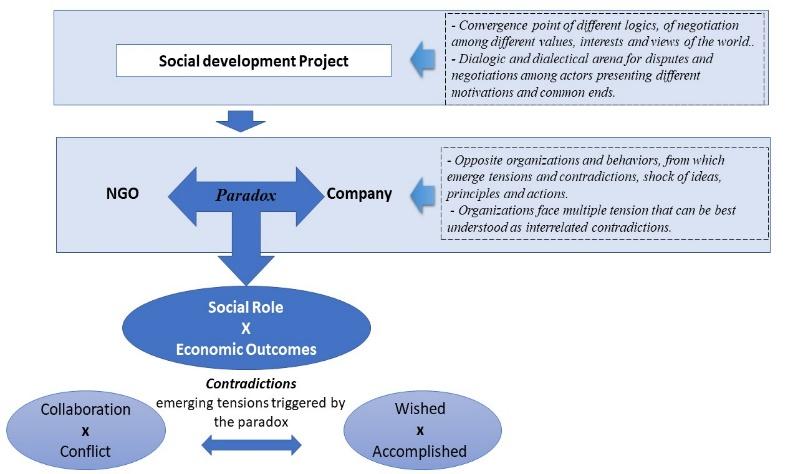
Figure 1
Paradoxes and tensions involved in the construction of a Social Development Project.
Source: Research results.
Both demands (commercial and social) reflect contradictory organizational goals, structures, processes and capabilities, and it creates the herein addressed social vs. economic paradox. The engagement level of this paradox points towards a collaborative and productive scenario, as well as represents a bridge over the cliff observed between the NGO and the company. Thus, CSA embodies an antagonistic role by accepting the tensions among economic, environmental and social interests and by deconstructing the deterministic profile between substantive and instrumental organizations, by opening negotiation margin for more significant corporative contributions to sustainable development, by balancing and combining instrumental initiatives to moral initiatives.
Findings also showed a CSA focused on promoting intangible assets, mainly at the company image scope, by adding value to the brand and by making it more competitive in the market. These evidences point towards the likely CSA entrepreneurship process that would be built from the commitment profile and outspread of an optimistic discourse based on individual interest, according to which, companies that do good will also succeed. These conclusions corroborate Hahn and Pinkse (2014), since they see that the partnership actors pursue particular interests; they select and strategically outspread standards and rules that benefit their legitimacy.
Extrinsic results infer the collaboration x conflict relationship. The dynamic of interests involved in this partnership relationship is quire influential, it involves either economic interest aspects linked to gain of legitimacy, or intrinsic aspects concerning symbolism and subjectivity (Ramos, 1989). Given the wished x accomplished contradiction, some entrepreneurship aspects appear as inherent to the SDP creation process, so that tensions between organization and project performance can be summarized by the interaction between means and ends, or between process and outcomes. The shock between the NGO’s expectations and those of the company concerns the projects’ financial benefits and beneficiaries (social well-being and local development), it presents the existing interdependence between cooperation, so that the outcomes just make it possible combining these logics, although both are driven by different goals.
7 CONCLUSIONS
The current study has challenged the linear thinking about collaboration and conflict, as well as between what is wished and actually accomplished by seeking to understand the paradoxes and challenges involved in having NGOs and companies constructing a SDP. The development of SDP projects between NGOs and companies derives from actors’ acknowledgement; these actors have to face the contradiction between collaboration and conflict, and between wished and accomplished, which have benefited from and performed an essential role in the existence of this paradox. This finding is mainly important for nowadays debates about how to establish responsibility and to demand accountability concerning the responsibility for business entities in society.
The emerging paradox on the social-economic relation highlights the struggle for a win-win dynamics in order to gather CSA’s ethical and business cases. When it comes to inter-sectoral partnerships, it is suggested that the contradictory and dialogical tensions observed in social projects must be explored for both possibilities, rather for solutions, as in the case of trade-off and dilemma. The interrelation of competing demands can be found and it can contribute to the management of complex issues related to SDP. Similarly, understanding the economic-social paradox is not a simple intellectual effort, but it requires new critical sights over social and environmental matters that, neither NGOs nor companies, can solve on their own. Assumingly, the paradox perspective can help to understand the entrepreneurship process of social relationships not as something to be fought, but actually to be embodied by actors as imperative or fluid in order to lead to long-lasting and expanding outcomes in SDP conduction.
Thus, although the relationship between NGOs and companies is market by tensions and contradictions, it is possible arguing that dual elements are persistently linked and entangled to each other. From the paradox viewpoint, it is not possible aiming to identify balance, but to support that tensions lead to possibilities due to the interaction between different goals that are combined in order to achieve the same purpose, in this case, CSA conduction. It is also possible pointing out the relevance of this topic and the need of deepening it, given the amplitude of it, as well as of adopting paradox solutions that have the potential to generate other organizational contexts.
The herein performed discussions and analyses allow clarifying aspects concerning the dynamics of social development projects’ construction as a process immersed in tensions and contradictions, given the very nature of interests by the involved social actors. NGOs have been acknowledged as active actors in the development process, mainly due to their approximation to the private sector. Accordingly, it is important emphasizing that these partnerships have also been acknowledged for their inherent potential to solve complex social issues, as well as to generate social changes. Besides the social outcomes inherent to inter-sectoral cooperation, one can see the rise of enquires related to the clear conflicts and tensions experienced by actors who have different logics. Accordingly, it is important featuring inter-sectoral collaboration as an arena where the involved ones dispute positions to defend their own interests, although there is a common background on which the involved ones interact to each other.
Thus, the present results help improving the understanding about the paradox on the NGO/company relationship by evidencing that the implicit agreement between society and business organizations is subjected to multiple tensions and to social, environmental and occupational changes that must be faced by both organizations and individuals. Yet, the present study also shows the possibility of understanding social development projects as tension and contradiction spaces found in the relation between such actors; it boosts changes in paradigms, attitudes and in awareness when it deals with challenging matters focused on ruling out socioeconomic inequalities – marginalized groups must become active parts of the country’s economy. Other important contribution from the current research lies on NGOs’ entrepreneurship, since they are not affected by the business logic; they are forced to adopt practices typical of the business world, they end up subjected to efficiency and competitiveness criteria. These assumptions are often far from the goals of traditional communities that deal with the most substantive aspects of the organized life.
Yet, the present study helps this topic by addressing the NGO’s denaturation as organization inherent to the substantive rationality by disclosing the consequent instrumentalization of its actions, even if keeps its mostly substantive goal, namely social transformation, as well as the consequent entrepreneurship process deriving from such an instrumentalization. An important aspect of NGOs that work in partnership with companies, in this case with big companies, lies on the existence of a use value and of an exchange value in their transactions. In other words, by acting as operational agents for the exercise of corporative social accountability practices in these companies, the herein assessed NGO embodied its position in the capitalist system as “business” entity – therefore, it is now part of the business world – by using its knowledge on the local community in order to adopt a partnership model, which is one of the only forms to remain supporting the recycling cooperatives.
Finally, is it worth highlighting that project development within a partnership scene between companies and NGOs is not more than a learning process. Thus, it represents a challenge to all involved organizations, mainly due to their differences. By turning its sight to the analysis of actors’ paradox relationships, the present study has contributed to clarify these differences and to practically help the involved ones to understand the very nature of SDP construction process.
Limitations inherent to the adopted theoretical and methodological approaches can be listed. Another limitation refers to the data source and to the small number of conducted interviews. In order to mitigate such a limitation, we used several data sources based on the combination of collection methods. Finally, a third limitation concerns its analytical cut, which did not cover the cooperatives and associations benefited by the project. It is recommended to perform further studies aimed at understanding SDP in other sectors and action fields, as well as studies involving different sectors (companies, universities, non-governmental organizations and the State). We also suggest other studies to investigate the reality of communities embraced by social development projects.
REFERENCES
Alcadipani, R. (2017). Reclaiming sociological reduction: Analysing the circulation of management education in the periphery. Management Learning, 48(5), 535-551. https://doi.org/10.1177%2F1350507617710321
Andriopoulos, C., Gotsi, M., Lewis, M. W., & Ingram, A. E. (2018). Turning the sword: How NPD teams cope with front-end NPD tensions. Journal of Product Innovation Management, 35(3), 427-445. https://doi.org/10.1111/jpim.12423
Austin, J. E. (2001). Parcerias: Fundamentos e benefícios para o terceiro setor. São Paulo: Futura.
Banerjee, S. B. (2008). Corporate social responsibility: The good, the bad and the ugly. Critical Sociology, 34(1), 51-79. https://doi.org/10.1177/0896920507084623
Bardin, L. (2009). Análise de conteúdo. Lisboa: Edições 70.
Battilana, J., & Dorado, S. (2010). Building sustainable hybrid organizations: The case of a commercial microfinance organization. Academy of Management Journal, 53(6), 1419-1440. https://doi.org/10.5465/amj.2010.57318391
Bittencourt, E., & Carrieri, A. (2005). Responsabilidade social: Ideologia, poder e discurso na lógica empresarial. Revista de Administração de empresas, 45(esp), 10-22. https://doi.org/10.1590/S0034-75902005000500001
Bjerregaard, T., & Lauring, J. (2013). Managing contradictions of corporate social responsibility: The sustainability of diversity in a frontrunner firm. Business Ethics: A European Review, 22(2), 131-142. https://doi.org/10.1111/beer.12014
Blowfield, M. (2005), Corporate social responsibility: The failing discipline and why it matters for international relations, International Relations, 19(2), 173-191. https://doi.org/10.1177/0047117805052812
Bode, I., & Brandsen, T. (2014). State-Third sector partnerships: A Short overview of key issues in the debate. Public Management Review, 16(8), 1055-1066. https://doi.org/10.1080/14719037.2014.957344
Bosi, A. P. (2008). A organização capitalista do trabalho "informal": O caso dos catadores de recicláveis. Revista Brasileira de Ciências Sociais, 23(67), 101-116. https://doi.org/10.1590/S0102-69092008000200008
Brammer, S., Jackson, G., & Matten, D. (2012). Corporate social responsibility and institutional theory: New perspectives on private governance. Socio-Economic Review, 10(1), 3-28. https://doi.org/10.1093/ser/mwr030
Burchell, J., & Cook, J. (2006), Confronting the “corporate citizen”: Shaping the discourse of corporate social responsibility. International Journal of Sociology and Social Policy, 26(3/4), 121-137. https://doi.org/10.1108/01443330610657188
Campos, S. A. P., Gallon, S., & Becker, R. G. (2019). Não não é lixo, é resíduo: A mudança social na reciclagem à luz da teoria da atividade histórico-cultural. Revista Brasileira da Pesquisa Sócio-Histórico-Cultural e da Atividade, 1(2), 01-25.
Campos, S. A. P., Gallon, S., & Becker, R. G. (2021). Intersectoral partnerships in the recycling secto. Social Responsibility Journal, 18(3), 534-550. https://doi.org/10.1108/SRJ-06-2020-0234
Candido, S. E. A., Soulé, F. V., & Sacomano, M., Neto. (2019). The Emergence of “Solidarity Recycling” in Brazil: Structural convergences and strategic actions in interconnected fields. Organization & Environment, 32(3), 363-385. https://doi.org/10.1177/1086026618759835
Carneiro, M. S. (2012). Práticas, discursos e arenas: Notas sobre a socioantropologia do desenvolvimento. Sociologia e Antropologia, 2(4), 129-158. https://doi.org/10.1590/2238-38752012v247
Castro, A. G., Campos, S. A. P., & Trevisan, M. (2018). A institucionalização (ou banalização) da sustentabilidade organizacional à luz da teoria crítica. Revista Pensamento Contemporâneo em Administração, 12(3), 110-123. https://doi.org/10.12712/rpca.v12i3.12552
Colle, S., Henriques, A., & Sarasvathy, S. (2014). The paradox of corporate social responsibility standards. Journal of Business Ethics, 125(2), 177-191. https://doi.org/10.1007/s10551-013-1912-y
Cramer, J., Jonker, J. & Heijden, A. (2004). Making sense of corporate social responsibility. Journal of Business Ethics, 55(2), 215-222. https://doi.org/10.1007/s10551-004-1903-0
Crane, A., Palazzo, G., Spence, L. J., & Matten, D. (2014). Contesting the value of “creating shared value”. California management review, 56(2), 130-153. https://doi.org/10.1525/cmr.2014.56.2.130
Cruz, L. B., Pedrozo, E. A., & Estivalete, V. F. B. (2006). Towards sustainable development strategies. Management Decision, 44(7), 871-891. https://doi.org/10.1108/00251740610680578
Dawkins, C., & Ngunjiri, F. W. (2008). Corporate social responsibility reporting in South Africa: A descriptive and comparative analysis. The Journal of Business Communication, 45(3), 286-307. https://doi.org/10.1177/0021943608317111
Deakin, S., & Hobbs, R. (2007). False dawn for CSR? Shifts in regulatory policy and the response of the corporate and financial sectors in Britain. Corporate Governance: An International Review, 15(1), 68-76. https://doi.org/10.1111/j.1467-8683.2007.00543.x
Dyllick, T., & Hockerts, K. (2002). Beyond the business case for corporate sustainability. Business Strategy and the Environment, 11(2), 130-141. https://doi.org/10.1002/bse.323
Faria, J. H. (2014). Por uma teoria crítica da sustentabilidade. Organizações e Sustentabilidade, 2(1), 2-25.
Farrington, T., Curran, R., Gori, K., O’Gorman, K. D., & Queenan, C. J. (2017). Corporate social responsibility: Reviewed, rated, revised. International Journal of Contemporary Hospitality Management, 29(1), 30-47. https://doi.org/10.1108/IJCHM-05-2015-0236
Fontoura, Y., Naves, F., Teodósio, A. S. S., & Gomes, M. V. P. (2019). Da lama ao caos: Reflexões sobre a crise ambiental e as relações Estado-Empresa-Sociedade. Farol, 6(15), 17-41. https://doi.org/10.25113/farol.v6i15.5440
Godoy, A. S. (2006). Estudo de caso qualitativo. In C. K. Godoi, R. Bandeira-de-Mello & A. B. Silva. Pesquisa qualitativa em estudos organizacionais: Paradigmas, estratégias e métodos (pp. 115-146). São Paulo: Saraiva.
Godoy, A. S., & Forte, D. (2007). Competências adquiridas durante os anos de graduação: Um estudo de caso a partir das opiniões de alunos formandos de um curso de administração de empresas. Gestão & Regionalidade, 23(68), 56-69. https://doi.org/10.13037/gr.vol23n68.80
Gohn, M. G. (2013). Sociedade civil no Brasil: Movimentos sociais e ONGs. Meta: Avaliação, 5(14), 238-253. http://doi.org/10.22347/2175-2753v5i14.145
González-González, J.M., Bretones, F.D., González-Martínez, R. & Francés-Gómez, P. (2019). The future of an illusion: A paradoxes of CSR. Journal of Organizational Change Management, 32(1), 2-14. https://doi.org/10.1108/JOCM-01-2018-0018
Hahn, T., & Figge, F. (2011). Beyond the bounded instrumentality in current corporate sustainability research: Toward an inclusive notion of profitability. Journal of Business Ethics, 104(3), 325-345. https://doi.org/10.1007/s10551-011-0911-0
Hahn, T., & Pinkse, J. (2014). Private environmental governance through cross-sector partnerships: Tensions between competition and effectiveness. Organization & Environment, 27(2), 140-160. https://doi.org/10.1177/1086026614530996
Hahn, T., Pinkse, J., Preuss, L. &, Figge, F. (2015). Tensions in corporate sustainability: Towards an integrative framework. Journal of Business Ethics, 127(2), 297-316. https://doi.org/10.1007/s10551-014-2047-5
Handy, C.B. (1994). The Age of Paradox. Boston: Harvard Business School Press.
Hoffmann, J. (2018). Talking into (non) existence: Denying or constituting paradoxes of Corporate Social Responsibility. Human Relations, 71(5), 668-691. https://doi.org/10.1177/0018726717721306
Holanda, L. A. H. (2011). Resistência e apropriação de práticas de management no organizar de coletivos da cultura popular (Tese de doutorado). Universidade Federal de Pernambuco, Recife, Pernambuco, Brasil. https://repositorio.ufpe.br/handle/123456789/594
Hole, Y., Pawar-Hole, S., & Bendale, S. (2019). Corporate Social Responsibility (CSR) in India: A conceptual framework. GIS Business, 14(6), 330-340. https://gisbusiness.org/index.php/gis/article/view/11844
Jay, J. (2013). Navigating Paradox as a Mechanism of Change and Innovation in Hybrid Organizations. Academy of Management Journal, 56(1), 137-159. https://doi.org/10.5465/amj.2010.0772
Kuhn, T. R., & Deetz, S. (2008). Critical theory and corporate social responsibility. In A. Crane et al. (Eds.). The Oxford handbook of corporate social responsibility (pp. 173-196). Oxford: Oxford University Press.
Lélé, S. M. (1991). Sustainable development: A critical review. World Development, 19(6), 607-621. https://doi.org/10.1016/0305-750X(91)90197-P
Lewis, D. (2002). Civil society in African contexts: Reflections on the usefulness of a concept. Development and Change, 33(4), 569-586. https://doi.org/10.1111/1467-7660.00270
Lozano, J. M., Albareda, L., & Ysa, T. (2008). Governments and Corporate Social Responsibility: Public Policies beyond Regulation and Voluntary Compliance. Basingstoke: Palgrave Macmillan.
Manchiraju, H., & Rajgopal, S. (2017). Does corporate social responsibility (CSR) create shareholder value? Evidence from the Indian Companies Act 2013. Journal of Accounting Research, 55(5), 1257-1300. https://doi.org/10.1111/1475-679X.12174
Maon, F., Lindgreen, A., & Swaen, V. (2009). Designing and implementing corporate social responsibility: An integrative framework grounded in theory and practice. Journal of Business Ethics, (87), 71-89. https://doi.org/10.1007/s10551-008-9804-2
Mikołajczak, P. (2020). Social enterprises’ hybridity in the concept of institutional logics: Evidence from Polish NGOs. Voluntas, 31, 472-483. https://doi.org/10.1007/s11266-020-00195-9
Miron-Spektor, E., Ingram, A., Keller, J., Smith, W. K., & Lewis, M. W. (2018). Microfoundations of organizational paradox: The problem is how we think about the problem. Academy of Management Journal, 61(1), 26-45. https://doi.org/10.5465/amj.2016.0594
Misoczky, M. C.; Andrade, J. A. (2005). Uma crítica à crítica domesticada nos estudos organizacionais. Revista de Administração Contemporânea, 9(1), 193-212. https://doi.org/10.1590/S1415-65552005000100010
Osuji, O. K. (2015). Corporate social responsibility, juridification and globalisation: ‘Inventive interventionism’ for a ‘paradox’. International Journal of Law in Context, 11(3), 265-298. https://doi.org/10.1017/S1744552315000154
Pérezts, M., Bouilloud, J. F., & De Gaulejac, V. (2011). “Serving two masters: the contradictory organization”. Journal of Business Ethics, 101(1), 33-34. https://doi.org/10.1007/s10551-011-1176-3
Perpetua, G. M., & Thomaz, A, Junior. (2018). Os sentidos territoriais estratégicos da responsabilidade social empresarial: Uma análise a partir das corporações de celulose no Brasil. Geosul, 33(68), 98-115. http://doi.org/10.5007/2177-5230.2018v33n68p98
Porter, M. E., & Kramer, M. R. (2006). The link between competitive advantage and corporate social responsibility. Harvard Business Review, 84(12), 78-92.
Putnam, L. L., Fairhurst, G. T., & Banghart, S. (2016). Contradictions, Dialectics, and Paradoxes in Organizations: A Constitutive Approach. Academy of Management Annals, 10(1), 65-171. https://doi.org/10.5465/19416520.2016.1162421
Ramos, A. G. (1989). A nova ciência das organizações (2 ed.). Rio de Janeiro: Editora da Fundação Getúlio Vargas.
Roberts, J. (2003). The manufacture of corporate social responsibility: Constructing corporate sensibility. Organization, 10(2), 249-265. https://doi.org/10.1177/1350508403010002004
Sardan, J. O. (1995). Antropologie et development: essai en socio-antropologie du chagement social. Paris: Karthala Editions.
Sardan, J. O. (2005). Anthropology and development: Understanding contemporary social change. London: Zed Books.
Schad, J., Lewis, M. W., Raisch, S., & Smith, W. K. (2016). Paradox Research in Management Science: Looking Back to Move Forward. Academy of Management Annals, 10(1), 5-64. https://doi.org/10.5465/19416520.2016.1162422
Serva, M., Caitano, D., Santos, L., & Siqueira, G. (2015). A análise da racionalidade nas organizações - um balanço do desenvolvimento de um campo de estudos no Brasil. Cadernos Ebape, 13(3), 414-437. https://doi.org/10.1590/1679-395116344
Sharma, G. & Bansa, P. (2017). Partners for good: How business and NGOs engage the commercial–social paradox. Organization Studies, 38(3-4), 341-364. https://doi.org/10.1177/0170840616683739
Siltaoja, M. E., & Onkila, T. J. (2013). Business in society or business and society: The construction of business–society relations in responsibility reports from a critical discursive perspective. Business Ethics: A European Review, 22(4), 357-373. https://doi.org/10.1111/beer.12028
Slawinski, N., & Bansal, P. (2015). Short on time: Intertemporal tensions in business sustainability. Organization Science, 26(2), 531-549. https://doi.org/10.1287/orsc.2014.0960
Smith, W. K. (2014). Dynamic decision making: A model of senior leaders managing strategic paradoxes. Academy of Management Journal, 57(6), 1592-1623. https://doi.org/10.5465/amj.2011.0932
Smith, W. K., & Lewis, M. W. (2011). Toward a theory of paradox: A dynamic equilibrium model of organizing. Academy of Management Review, 36(2), 381-403. https://doi.org/10.5465/amr.2009.0223
Smith, W.K., & Besharov, M.L. (2017). Bowing before dual gods: How structured flexibility sustains organizational hybridity. Admininstrative Science Quarterly, 64(1), 1-44. https://doi.org/10.1177%2F0001839217750826
Smith, W.K., Gonin, M., & Besharov, M.L. (2013). Managing social-business tensions: A review and research agenda for social enterprise. Business Ethics Quarterly, 23(3), 407-442. https://doi.org/10.5840/beq201323327
Soares, M. N. M., Rebouças, S. M. D. P., & Lazaro, J. C. (2020). The substantive rationality of self-management practices: An analysis of the organizational dynamics of women in solidarity economy from the perspective of oral history. Revista de Administração da UFSM, 13, 1216-1234. https://doi.org/10.5902/1983465943355
Solé, A. (2004). ¿Qué es una empresa? Construcción de un idealtipo transdisciplinario. Paris: Working Paper.
Swedberg, R. (2003). Economic versus Sociological Approaches to Organization Theory. In C. Knudsen & H. Tsoukas (Eds.), The Oxford Handbook of Organization Theory. https://doi.org/10.1093/oxfordhb/9780199275250.003.0014
Trethewey, G. A., & Ashcraft, K. L. (2004). Special issue introduction: Practicing disorganization: The development of applied perspectives on living with tension. Journal of Applied Communication Research, 32(2), 81-88. https://doi.org/10.1080/0090988042000210007
Van der Byl, C. A., & Slawinski, N. (2015). Embracing tensions in corporate sustainability: A review of research from win-wins and trade-offs to paradoxes and beyond. Organization & Environment, 28(1), 54-79. https://doi.org/10.1177/1086026615575047
Weber, M. (1999). Economia e Sociedade: Fundamentos da sociologia contemporânea. Brasília: Editora da UnB.
Žižek, S. (2012). Vivendo no fim dos tempos. São Paulo: Boitempo.