Artigos
Women's work in dairy farming: analysis in modern, traditional and transitional production contexts in Rio Grande do Sul (Brazil)
O trabalho das mulheres na pecuária leiteira: análise em contextos de produção modernos, tradicionais e em transição no Rio Grande do Sul (Brasil)
El trabajo de las mujeres en la producción lechera: análisis en contextos de producción modernos, tradicionales y de transición en Rio Grande do Sul (Brasil)
 Rosani Marisa Spanevello rspanevello@yahoo.com.br
Sibele Vasconcelos de Oliveira sibele_oliveira@yahoo.com.br
Adriano Lago adrianolago@yahoo.com.br
Luciana Fagundes Christofari luciana_christofari@ufsm.br
Tanice Andreatta tani.andreatta@hotmail.com
Leticia Andrea Chechi Leticia.chechi@udesc.br
Rosani Marisa Spanevello rspanevello@yahoo.com.br
Sibele Vasconcelos de Oliveira sibele_oliveira@yahoo.com.br
Adriano Lago adrianolago@yahoo.com.br
Luciana Fagundes Christofari luciana_christofari@ufsm.br
Tanice Andreatta tani.andreatta@hotmail.com
Leticia Andrea Chechi Leticia.chechi@udesc.br
Women's work in dairy farming: analysis in modern, traditional and transitional production contexts in Rio Grande do Sul (Brazil)
Desenvolvimento Regional em Debate, vol. 10, pp. 655-676, 2020
Universidade do Contestado
Received: 29 April 2020
Accepted: 08 June 2020
Abstract: Studies that address the issue of gender in rural areas have explored questions about the sexual division of labor and the invisibility of women in this context. However, women develop many productive activities, and their recognition has been claimed in several spaces. Considering that women are key agents in the operationalization of dairy production in properties, this study has the objective of analyzing how women are inserted in the management of rural properties according to the degree of technification of dairy production. 68 interviews were conducted with women in 21 municipalities in the northern region of Rio Grande do Sul. Through the analysis of the primary data, three groups were constructed based on degree of technification of the milk activity: modern, in transition and traditional. Statistical tests were implemented to evaluate the difference between the groups analyzed. Differences were observed regarding management and work according to the group: women with modern productive activity have greater insertion in management, while those in the transition and traditional group present greater dedication to work.
Keywords: Female Work, Technification, Family Farming, Rural Devlopment.
Resumen: Los estudios que abordan el tema del género en las áreas rurales han explorado preguntas sobre la división sexual del trabajo y la invisibilidad de las mujeres en este contexto. Sin embargo, las mujeres desarrollan varias actividades productivas, y su reconocimiento ha sido reclamado en varios espacios. Teniendo en cuenta que las mujeres son agentes clave en la operacionalización de la producción lechera en las propiedades, este estudio tiene el objetivo de analizar cómo las mujeres se insertan en la gestión de las propiedades rurales de acuerdo con el grado de tecnificación de la producción lechera. Se realizaron 68 entrevistas con mujeres en 21 municipios de la región norte de Rio Grande do Sul. A través del análisis de los datos primarios, se construyeron tres grupos basados en el grado de tecnificación de la actividad láctea: moderna, en transición y tradicional. Se implementaron pruebas estadísticas para evaluar la diferencia entre los grupos analizados. Se observaron diferencias en la gestión y el trabajo según el grupo: las mujeres con actividad productiva moderna tienen una mayor inserción en la gestión, mientras que las del grupo de transición y tradicional presentan una mayor dedicación al trabajo.
Palabras clave: Trabajo Feminino, Tecnificación, La Agricultura Familiar, Desarrollo Rural.
Resumo: Estudos que abordam a questão de gênero no meio rural têm explorado questões sobre a divisão sexual do trabalho e a invisibilidade da mulher nesse contexto. Contudo, a mulher desenvolve diversas atividades produtivas, e seu reconhecimento vem sendo reivindicado em diversos espaços. Considerando que as mulheres são agentes-chave na operacionalização da produção leiteira nas propriedades, este estudo tem como objetivo analisar como as mulheres estão inseridas no trabalho e na gestão das propriedades rurais de acordo com o grau de tecnificação da produção leiteira. Foram realizadas 68 entrevistas com mulheres em 21 municípios da região norte do Rio Grande do Sul. Através da análise de dados primários, foram construídos três grupos com base no grau de tecnificação da atividade leiteira: moderna, em transição e tradicional. Testes estatísticos foram implementados para avaliar a diferença entre os grupos analisados. Diferenças na gestão e no trabalho foram observadas de acordo com o grupo: as mulheres com atividade produtiva moderna têm maior inserção na gestão, enquanto as do grupo de transição e tradicional têm maior dedicação ao trabalho.
Palavras-chave: Trabalho Feminino, Tecnificação, Agricultura Familiar, Desenvolvimento Rural.
1 INTRODUCTION
Under the socioeconomic and technological dimensions, the productive chain of milk in Brazil has gone through important transformations in the last decades. The deregulation of the market, the international opening and the change in the customers' behavior demand adaptations from the economical agents aiming at modernizing the activity (LEMOS et al., 2003).
Above all, it is worth mentioning that the modernization process goes through a technical and productive reorganization of the industrial and agricultural establishments. In the case of the latter, it is observed the investment in new technologies and equipment in order to meet the demand of the processing companies and the expectations of the end consumers, that are increasingly eager for quality, certifications and food safety (WAGNER; GEHLEN; WIEST, 2004).
However, it is worth highlighting that the impacts of the process of technical, productive, and economical transformation through which the Brazilian agribusiness has gone through were not equitable in the different regions of the country. Especially, it is understood that dairy farming has been the target of intense investments in productive and technological terms due to the pressure for production in quantity and quality imposed by the market. However, not all farmers can modernize in the homogeneous way the market demands (WAGNER; GEHLEN; WIEST, 2004).
According to data from the Agricultural Census of 2017, in Brazil there are 1,171,190 dairy productive properties, with 11,506,788 milked cows, corresponding to the production capacity of 30,158,279 (thousand) litters of milk (IBGE, 2017). From the total of the Brazilian properties with records of dairy production, 15.17% are in Rio Grande do Sul, whose productive base is multiple. Also, Silva Neto and Basso (2005) remember that the dairy farming is a basic activity for most part of the farmers in the regions in which familiar farming is predominant, especially those that own small and medium properties.
In its work force composition, family farming is equipped with a set of members that live in the properties (parents and children) and that ensure its reproduction in a short and long term (GASSON; ERRINGTON, 1993). According to data from the 2017 Census of Agriculture, there are about 3.9 million establishments classified as family farming[1] in Brazil, of which only 18.7% are managed by women (IBGE, 2017). However, although they are present in a smaller number in the rural environment, women represent an important workforce in about 80% of the family properties dedicating to domestic and agricultural work (BRUMER; SPANEVELLO, 2012).
Considering the reality of dairy farming in Rio Grande do Sul and the transformations through which it has been going through, in this study we seek to analyze how women are inserted in the work and management of rural properties according to the degree of technification of dairy production, that is, we search to identify what the role of the women is in dairy production in contexts of more or less modernized production. For that, there was a gathering and analysis of the primary data, being that statistical tests were implemented to evaluate the difference between the groups analyzed.
The region chosen for the study was the Citizenship Territory of the Northwest Colonial Gaúcho, a territory that is characterized by the protagonism of family farming and important indicators in relation to milk production in Rio Grande do Sul (IBGE, 2017; EMATER, 2017). Specifically, it is important to highlight that this set of municipalities represents one of the largest dairy bases in the state, with a heterogeneity of producer types. Studies developed in the same territory point to important issues related to gender in this context (HERNANDEZ, 2009; BRUMER; SPANEVELLO, 2012; SPANEVELLO; MATTE; BOSCARDIN, 2016).
This study is structured in four sections in addition to this introduction. The first presents a brief theoretical contextualization on the theme. Following, the research methodological procedures are presented. The next section addresses the results and discussion of this study, followed by final considerations.
2 FEMALE WORK AND MANAGEMENT IN DAIRY FARMING
Studies that address the gender issue in rural areas have been increasingly frequent. According to Brumer (2004) and Brumer and Anjos (2008), high rates of female migration from rural areas, related to issues such as succession problems, masculinization and aging of the rural population, have stimulate these researches. Studies indicate that women have historically been excluded from succession processes, your work should be “light”, contemplating the care of the children, with the house, the family's food. When women work in agricultural production, they are referred to as “help”, usually without pay (BRUMER, 2004; PAULILO, 1987).
A recent study shows that in Latin America and the Caribbean, 40% of women living in the countryside do not have their own income, less than a third of women own the land on which they live and there is no recognition of the various types that work carried out by women. However, in addition to fulfilling a key role in the home, women develop various productive activities, being co-responsible for the productive development and the survival of their families. Nevertheless, this recognition is being claimed in the United Nations (UN) Sustainable Development Goals: “Achieve gender equality and empower all women and girls” (OTERO, 2019).
In this context, studies related to gender are relevant. In all sociological discourse, for example, there is a fact that emerges frequently: women are considered reliable to perform their functions with most care and attention. This fact is even more smoldering in the case of agriculture and similar activities (KASI, 2010). In general lines, the involvement of women in livestock production and development has been a long-standing worldwide tradition. In rural areas, they are involved in different tasks, from dawn to dusk, such as the treatment of animals, including food and cleaning, household chores such as washing and cooking, working in vegetable gardens and orchards, education of the sons, among others (AKHTAR; KHAN, 2000).
Adenugba e Raji-Mustapha (2013, p. 51) argue that the contributions of rural women to the economy can be examined from three perspectives: i) reproductive work; ii) productive work; and iii) community managing and community politics. The reproductive function comprises the child support responsibilities and domestic chores, both of which are necessary to ensure the reproduction of the family workforce. In turn, productive work corresponds to activities that generate income, have real or potential exchange value. Furthermore, the role of community management includes measures to ensure scarce resources for collective consumption, such as water, health care and education (ADENUGBA; RAJI-MUSTAPHA, 2013).
According to Kasi (2010), several studies have highlighted the vital role women play in all activities related to agriculture and livestock exploration, which range from the treatment of animals until the commercialization of the products. They constitute a high proportion of the workforce in the agricultural sector, although they are not active in decision-making.
In family farming, women are responsible for important productive activities, especially those that require manual execution (cleaning and harvesting the products), processing, handling and daily care of animals (milking, feeding the birds) and work in the garden. In addition to productive work, women develop domestic activities such as child care, home, clothing, food preparation, among others (SPANEVELLO; MATTE; BOSCARDIN, 2016).
Specially, according to Akhatar and Khan (2000), the dairy production is originally understood as a female activity. In several countries, women are the ones responsible for milking the cows, making butter, cheese and other byproducts. However, as Batool et al. (2014) highlight, the participation of women in dairy farming varies according to the region, their culture and their socioeconomic status.
In general, women contribute to various dairy farming practices, such as routine breeding and nutritional management (BATOOL et al., 2014).Ogdand and Hembade (2014) state that women's knowledge and skills in the dairy sector affect the efficiency of the activity, as well as the economic performance of rural enterprise itself.
According to Menasche and Escher (1996), the dairy farming performed in rural properties in the south region of Brazil is called "women's work", because among the descending farmers, the cow was part of the dowry their daughters had when they got married, and the young men, until recently, did not even learn how to milk. The production techniques are the type of knowledge passed from mother to daughter since their childhood. When she marries and continues in the rural environment, she already knows the activity.
According to Magalhães (2009), the same way that women "help" with farming, men "help" in milking or feeding the cows and "help" in the domestic chores, such as washing the dishes and cleaning the house. In that sense, men have a secondary character in dairy farming, especially in the milking, cleaning and manufacture of byproducts. When it comes to contact with the technicians, the purchase of supplies, the sale of the production (the invoices are issued in their name), these activities are generally men's responsibilities.
With the modernization in the rural environment, the technological transformations in the activity milkmaid, the requirements of the market related to the product could modify this culture that the milk activity is a feminine task. In addition, in recent years this activity has ascended beyond the scope of family consumption and has built as the most stable source of income for many rural families, a transformation that has provoked changes in the traditional way of organizing and dividing labor in the activity (CELUPPI; PANZER, 2005).
However, according to Grandi (1999) and Magalhães (2009), modernization and intensification of technology seem to not have promoted a greater inclusion of women in management and command of the activity. According to these authors, when the milk starts giving profit and it becomes the main income source of the property, the activity starts being controlled by the men. The participation of men at work and mainly in the control of dairy farming seems to grow proportionally to the importance this activity reaches in the composition of monetary income of the property (MENASCHE; BELÉM, 1998).
In this way, it is recurrent the men to be responsible for the management of the activity, especially the financial one. Men are inserted in activities related to technical assistance, genetic improvement of the dairy herd, discussions on negotiation on the price of milk, among others, while the woman continues only with the milk milking function (CELUPPI; PANZER, 2005). Still, according to the same authors, even the woman being of great importance in the milk activity, because it dominated until then, at the moment of the professionalization and obtaining new knowledge about the production, who ends been attending the courses and lectures are the men.
In short, women participate in the whole production and organization process of the property, representing the main productive force of the dairy farming, but they do not have autonomy in the financial decisions. Their labor, many times invisible, does not reflect in participation in the management of the business. Milk keeps being a woman's "thing", but when it involves income, the money gained from the milk is a man's "thing".
3 METHODOLOGICAL PROCEDURES
The data that compose the results of this research, financed with the resources of the National Committee of Technological and Scientific Development (CNPq), were extracted from interviews carried out in 68 rural properties between 2012 and 2014, totalizing 68 woman's that live in the rural environment and work with the dairy production system in 21 cities in the Northwest Colonial Citizenship Territory of Rio Grande do Sul[2]. This territory is composed of 34 municipalities (Figure 1). The total population of the territory is 373,369 inhabitants, of which 99,695 live in the rural area, which corresponds to 26.70% of the total (IBGE, 2017), being basically family farmers with a focus on grain production and dairy farming.
The choice of this Territory to carry out the study is due to the fact that this group of municipalities represent one of the largest milk basins in Rio Grande do Sul, with different productive and technological qualifications among producers, from producers with manual milking to producers with fully mechanized milking (EMATER, 2017). It is essentially an activity developed by the hand of the family work, with special emphasis on women's work in this production system on the equipment cleaning activities, milking and feeding the animals.
Another aspect that justifies the choice of this location for data collection has to do with the studies of Hernandez (2009) with women from the Citizenship Territory of the Middle Upper Uruguay of Rio Grande do Sul, data analyzed by Brumer and Spanevello (2012) in the Citizenship Territories of RS and SC and the study Spanevello, Matte and Boscardin (2016) in the Territory of Citizenship of Northwest Colonial Rio Grande do Sul on women who access rural credit, with emphasis on Pronaf Mulher. As the study relataded, the greatest demands for Pronaf Women taken by rural workers are focused on the application in the dairy activity, whether to improve the herd, feeding, mechanize milking or build new facilities. This aspect suggests a differentiated participation of women in milk production, which may represent an activity in the planning and management of the activity.
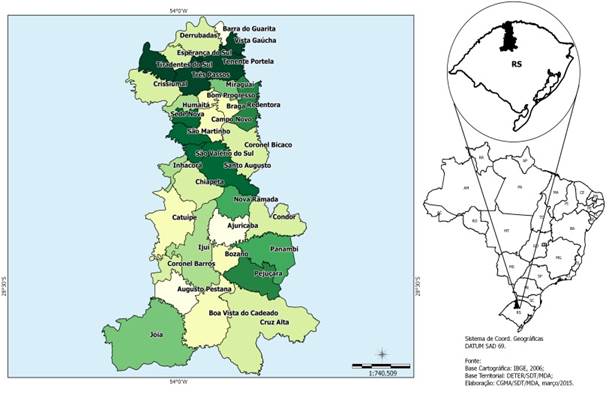
Figure 1
Citizenship Territory of the Colonial Northwest of the State of Rio Grande do Sul geographical location
Source: BRASIL, Ministry of Agrarian Development (2015)
Initially, contact was made with the Brazilian Technical Assistance and Rural Extension Company - EMATER, from each municipality, to present the research and prospect for possible interviewees. The effective return occurred in 21 of the 34 municipalities in the Territory of Citizenship. The ATER professionals proceeded with the indication of the women to be interviewed, starting the field research from an intentional research sample[3]. Local ATER professionals have in depth knowledge of the rural reality of the municipalities, justifying the option for intentional sampling through these actors.
The data was obtained from a research road map which covered issues related to the technological characterization of the property, the insertion of the women interviewed in the activity, the way they work, reinforcing specifically their labor and also their participation in management.
To guide the discussion referring to the insertion of women in dairy farming according to the technological production standard, a typology was constructed, adapted from the work of Wagner (2003) and Wagner, Gehlen e Wiest (2004) which classifies milk-producing properties as modern, in transition and traditional. In the group of modern properties were all the properties that present dairy farming as one of the main income sources in the property; hire specific labor for the activity; the income generated by the activity is superior to seven minimum wages; keep a significant number of cows in lactation, comparing to the total of dairy herd; have a daily production per animal superior to 20 liters; animals are acquired from producers specialized in the breed or raised in the property, having artificial insemination as the reproduction mode; the property has a milking parlor; the cooling of the milk is in bulk; the food of the animals is balanced according to its production; receive bonus for the production (quality, quantity, storage); pay attention to innovations in the activity; have invested annually or whenever it is necessary.
In the group of traditional properties, you find the properties that do not have dairy production as a priority; do not hire labor for the activity; the income generated by the activity is below five minimum salaries; the average daily production per animal is below 12 liters of milk; acquire the animals from neighbors or other producers, anywhere, or even raise them in the property itself, having natural mating as a reproduction means; a minority presents a milking parlor; the cooling of the milk is done in an ice cooler, there is no means of cooling the milk, and some have a bulk cooling system; the food is not balanced according to the production; they do not receive a bonus for the production; they have not done frequent investments in the activity.
Between the groups of modern and traditional properties is the group of properties in transition. In this group, milk is not the main income source; labor is rarely hired and, in case it is, it is temporary and not specific to the dairy farming; the income generated by the activity is between five and seven minimum wages; the average daily production per animal is between 12 and 20 liters of milk; the animals are raised in the property, and the reproduction means is artificial insemination; they have a milking parlor or they milk the cows in a common room with other animals; the cooling of the milk is in bulk; the food is not always balanced according to the production; they only receive bonus for the production per quantity and storage, not for quality; they pay attention to innovations, investing whenever it is necessary.
Later on, the variables[4] used to compose the typologies were subjected to the Chi-square test. According to Hair Junior et al. (2006), the Chi-square statistic is used to test the statistical significance between the distributions of frequency of two or more groups. In this study, the objective was to test the significance of variables that, when used with the typologies mentioned above, would show whether there is association among the groups. The significance level considered was of p=0,05. The Pearson Chi-square test is calculated with the formula:
χ2. = [(o - e)2 /e]
where:
o = frequency observed for each class,
e = frequency expected for that class.
According to the criteria used for the typification of rural properties in the present study, 22 properties have dairy activity considered modern, 21 in transition and 25 traditional.
4 ANALYSIS AND RESULTS DISCUSSION
This section will discuss the results of this study, starting with the characterization of the women interviewed, followed by the characterization of the management and qualification of the management according to the proposed typification. Then, the text discusses the insertion of women in the work and in the management of the milk activity; finally, a summary of the main differences between the groups in the question of work and property management is presented.
4.1 CHARACTERIZATION OF THE WOMEN INTERVIEWED
The characterization of the women interviewed takes into account the aspects related to age, marital status, number of children and school level, according to the following description.
In properties with dairy farming considered modern and in transition, most part of the women are between 36 and 50 years old. In the traditional properties, the number of women between 50 and 64 years old is greater than in the other groups, representing 40%. That is, while the number of women between 22 and 36 years old decreases in the properties with dairy farming considered modern until the traditional ones, the number of women between 50 and 64 has the opposite effect, reaching a percentage of 44% in the traditional properties.
As to school level, the women present few years of formal education. Great part of the interviewees studied up to the 8th grade (50% modern; 52.4% in transition; 56% traditional.) Regardless of the group, basically all women are married. As to the number of children, one can observe that most women have two children, regardless of the group.
These data are in line with the reported by Pinilla (2019), that rural women engaged in agriculture in Latin America have a low level of education, and also, with Brumer and Giacobbo (1993), when he presents the reduction in the fertility rate of Brazilian rural families.
4.2 MANAGEMENT AND QUALIFICATION OF THE PRODUCTION ACCORDING TO THE CLASSIFICATION
The criteria used for the classification of dairy farming in the properties present in the research can be observed on Table 1. The variables taken into account were the ones such as labor, income generated by the milk, the importance in the sum of the total property income, as well as productive technical aspects (such as production per animal, use of milking parlor, cooling, feeding and bonus), refreshment on the production and investments done. After the analysis of the Pearson Chi-square test, one can see that the variables considered presented significant differences among the groups, as exposed on Table 1.
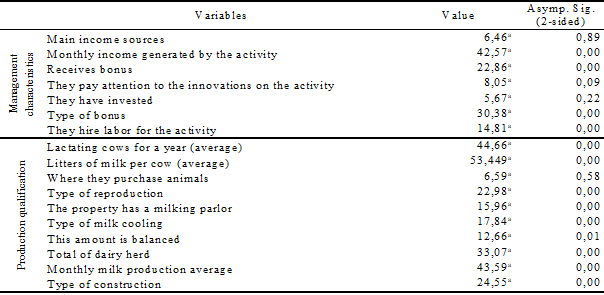
Table 1
Analysis of the Pearson Chi-square test applied to the variables used for the classification of dairy farming
Source: Prepared by the authors (2014)
Referring to the income generated by the dairy production, it presented difference among the groups. Approximately 80% of the modern properties generate more than seven minimum wages per month in dairy farming, while in the properties in transition the income generated by the activity is distributed, from less than five minimum wages to seven minimum wages. Regarding the traditional properties, more than 90% of those generate less than five minimum wages of income.
The value received per litter has also varied from R$ 0.68 to more than R$ 0.80 among the groups. One of the factors that contributes to this variation is the bonus received (or not) by the milk producers and the type of bonus. Basically, all properties with activities considered modern receive bonus for the quality, represented by the quantity of SCC (somatic cell count), TBC (total bacterial count) and the content of total solids, as well as by the quantity produced and the type of milk storage. More than half of the properties with dairy production in transition receive bonus and, in this group, the type of bonus is in some cases made by the quantity produced and the form of storage, in some others by the amount of milk. The properties with traditional activity do not receive bonus for the quality of the milk, but for the amount produced and the form of storage, and they represent less than 30% of this group.
Still regarding the variables related to the management of dairy farming, one can observe on Table 1 that there was no difference among the groups in the variable that questioned women if they paid attention to innovations on dairy farming. In this category, less than 10% of the women of traditional properties said they were not getting updated.
Another variable that did not present any difference among the groups was the volume of investments. All the properties with modern production declared to be investing, and the average of value invested in the last year was R$ 35,360.00. More than 80% of the women from properties with dairy farming in transition and traditional also affirmed to be investing, and the average in the last year was R$19,058.82 and R$9,110.53, respectively. Many times, even without effectively investing in dairy farming, the conflict on the concept of "investment" makes the interviewees declare they are investing.
However, women with in transition and traditional production said they are not investing in the activity. The justifications to not invest are focused on the difficulty in finding labor and the high value paid; the possibility of closing the activity due to age or lack of physical force to carry on with the work, because some of the women interviewed are retired; the low price paid for the milk, among others. Difficulties of generational succession are reported in the studies of Brumer (2004) and Brumer and Anjos (2008), which is also present in the traditional and transitioned rural properties surveyed, when they indicate the possibility of closing the dairy activity.
The hiring of labor is a variable related to the management of the dairy farming that presented difference among the groups because none of the women with traditional production hires labor; approximately 10% of the properties with production in transition and more than 50% of the properties with modern production hire labor. In the case of properties with modern production, there are cases in which the hired labor is permanent and exclusive to the development of dairy activities.
Considering the qualification of dairy farming in the properties interviewed, the variable referring to the number of cows in lactation per year presented a difference among the groups. Great part of the properties with modern activities has more than 21 cows in lactation, and this number varies to more than 100 animals. In the properties with activity considered in transition, the number of lactating cows is, in most of the cases, from 11 to 20 animals, and it is also expressive in the traditional properties. However, in the latter, there are many cases of 10 lactating cows. The number of lactating cows is associated to the total of the dairy herd, which showed the same difference among the groups as the variable presented previously.
Regarding the daily production per animal, there was also difference among the groups. The average daily production of milk per cow is above 20 liters for great part of the properties with modern activity, while none of the traditional ones reached that production. A great number of properties with activity in transition presented the average daily production per animal of 12 to 20 litters of milk. Meanwhile, in the properties with activity considered traditional, approximately 60% presented an average daily production per animal of less than 12 litters of milk. It is important to highlight that none of the properties with modern and in transition dairy farming had a production inferior to 12 liters per day per animal.
The production is a reflex of the animals that the property has. Referring to that, you can observe on Table 1 that there was no difference among the groups about the origin of the animals that compose the breeding stock. This is because, regardless of the group, raising in the property is the most affordable alternative for our interviewees. Some properties with modern production seek to acquire animals from producers specialized in the breed, while others purchase the animals anywhere, from neighbors or other producers, but those answers were not expressively represented.
What differentiates the groups is the type of reproduction they use. In the properties with modern dairy farming, artificial insemination is the only type of reproduction accepted, because there is an appreciation for the genetic enhancement of the breeding stock, having semen at the property and being a trained producer, or calling for technicians. On the other hand, in the properties with in-transition and traditional activity, natural mating appears in several cases. In many of these cases, the lack of knowledge on the technique of artificial insemination by the producers makes them disbelieve in its efficiency.
Also, on the variables related to the qualification of the production, regarding the property's infrastructure, one can observe that the milking parlor is present basically in all the properties with modern dairy production, in more than 50% of the ones in transition and in approximately 40% of the traditional ones. Moreover, the type of construction of the milking parlor also presented differences among the groups. While in the traditional properties the milking parlors are made of brickwork or mixed (brickwork and wood), in the in-transition and traditional properties there is an outstanding presence in the mixed and wood constructions.
Considering the infrastructure, the cooling of milk is in bulk in all the properties with activity considered modern and in transition; in the properties with traditional activity, the percentage is approximately 60%. In this group, you can also find cooling by an ice cooler representing more than 30% and another case where there is no type of milk cooling.
Regarding the balancing of the food according to the production of each animal, there was no expressive difference among the groups. You can see that in approximately 70% of the properties with modern activity and in more than 90% of the ones in transition this pattern of production balancing is followed. In the properties with a traditional production system, this happens in less than 50% of the cases. It is important to highlight that the properties in transition pay more attention to this productive item than the modern properties, which shows us an effort to improve productivity by looking at the details.
The monthly average production of milk presented difference among the groups, varying in the properties with modern system from 5,000 to 70,000 liters. In the properties with production system in transition, this production ranged from 3,000 to 30,000 liters, while in the properties with traditional production the production varies from 100 liters to up to 6,000 liters. The diversity of milk producing properties in the northwest region of Rio Grande do Sul is pointed out by Lima and Basso (2018), noting that the creation of the Local Productive Arrangement of Leite Fronteira Noroeste, contemplating 20 municipalities, should consider this heterogeneity in their projects and actions.
4.3 INSERTION OF THE WOMEN INTERVIEWED IN WORK AND MANAGEMENT
The knowledge of dairy farming by great part of the women interviewed date from a long time ago. Most part of the women interviewed have worked with dairy farming for more than 20 years, declaring to have learned to work with this activity at home, with their parents. These teachings, passed from one generation to another, are part of one very peculiar characteristic of the family agriculture itself, which is to socialize the children since they are little in the work of the property so that they learn the occupation of farmer. This element is in line with what is reported by Menasche and Escher (1996) regarding the dairy activity to be considered, historically, the work of women, passing from generation to generation.
The women interviewed said they perform several activities in the property. Firstly, all of them perform domestic chores, which involves cleaning the house, washing clothes, grow and prepare food, treat little animals, take care of the garden, among others. In some cases, the women interviewed are helped by their daughters and by their sons in those activities, some others do not have any help. The importance of women in various activities was highlighted by Otero (2019).
As it can be observed from Table 2, the domestic chores are conciliated with the dedication to dairy farming, besides other specific activities in the properties.
| Modern | In transition | Traditional | ||
| Time in the activity | Up to 10 years | 13,60% | 9,50% | 12,00% |
| From 10 to 20 years | 27,30% | 33,30% | 24,00% | |
| More than 20 years | 59,10% | 57,20% | 64,00% | |
| Activities performed in the property | Domestic and milk | 63,60% | 66,60% | 64,00% |
| Domestic, milk and grains | 0,00% | 28,60% | 8,00% | |
| Domestic, milk and tobacco | 0,00% | 4,80% | 4,00% | |
| Domestic, milk and animal feeding | 36,40% | 0,00% | 24,00% | |
| Time dedicated to the activity | Up to 3 hours | 9,10% | 23,80% | 28,00% |
| From 3 to 6 hours | 63,60% | 61,90% | 68,00% | |
| More than 6 hours | 27,30% | 14,30% | 4,00% | |
| Tasks performed in the activity | Milking | 19,00% | 0,00% | 0,00% |
| Milking and cleaning | 63,60% | 42,80% | 36,00% | |
| Milking, cleaning and feeding | 27,30% | 52,40% | 52,00% | |
| Milking, cleaning and manufacture of byproducts | 0,00% | 0,00% | 12,00% | |
| Feeding | 9,10% | 0,00% | 0,00% | |
| Feeding and cleaning | 0,00% | 4,80% | 4,00% | |
| Help in the activity | Husband | 45,40% | 28,60% | 48,00% |
| Children | 4,50% | 14,30% | 4,00% | |
| Husband and children | 18,20% | 42,70% | 44,00% | |
| Husband and employees | 9,10% | 0,00% | 0,00% | |
| Employees | 9,10% | 0,00% | 0,00% | |
| Husband, children and employees | 9,10% | 4,80% | 0,00% | |
| No one | 0,00% | 4,80% | 0,00% | |
| Another situation[5] | 4,50% | 4,80% | 4,00% | |
Regarding the tasks performed in the property, most part of the women interviewed, regardless of their group, performed domestic activities and dairy activities (63.6% modern; 66.6% in transition; 63% traditional), highlighting their importance in the small family property, as mentioned by Magalhães (2009) in his study. Besides performing these activities, 36.4% of the women interviewed from the properties with modern production and 24% of the women interviewed with traditional production, perform the task of feeding the animals that are raised in the property. Some women (28.6% in transition and 8% traditional), in addition to performing domestic activities and dairy production activities, help with farming, plantation, cleaning and harvest. In some cases, where those operations are manual, and in others, when even mechanized, the women stay in the planter, paying attention to the seeds and fertilization that are being launched into the earth. In other more specific activities, just like in the production of tobacco, the women belonging to the traditional and in-transition groups conciliate to domestic and dairy activities with this production.
Based on those examples, you can see that women conciliate two, three or more activities in the property, having therefore two or three shifts of work. This analysis meets what was proposed in Brummer and Giacobbo (1993)'s study, in which the authors highlight the importance of a woman's work in the more no capitalized properties for the maintenance of the domestic group.
Considering the work in dairy production, the most performed tasks within the activity are milking, cleaning or hygiene of animals and equipment before and after the milking. In some cases, the women also manufactured the byproducts such as cheese and butter. This represents, somehow, the sexual division of labor in rural areas, as already reported by Brumer (2004), Paulilo (1987), and specifically in the dairy activity by Magalhães (2009).
The women interviewed that have modern dairy farming (approximately half of them) work in the milking of animals and cleaning or hygiene. There are exceptions where the women have the help of their husbands, employees, sons and daughter in milking. Cleaning is a task dedicated exclusively to women. Men are responsible for feeding the animals (providing food in the moment of milking, preparation of pastures, among others). In the 22 properties with production classified as modern, nine hire employees permanently or temporarily.
In the properties with dairy farming considered in transition, basically half of the women (42.8%) are responsible for the milking and for the cleaning, another parcel (52.4%) also has the task of feeding the animals, and there is still a case (4.8%) in which the woman is responsible for the feeding of the animals and cleaning (from the 22 properties analyzed, only one hires employees). In the properties with traditional production, 36% of the women perform chores of milking and cleaning; 52% perform milking, cleaning and feeding. In one case, the woman works with feeding and cleaning, and 12% of the women interviewed are responsible for the milking, cleaning and manufacture of the byproducts for the family consumption. In the properties of this group, employees are not hired. The husband and the children help the women in dairy farming.
In properties with modern production, most of the women (45.4%) are helped by their husbands, and the others are helped by the whole family (husband and children) or only the children. The employees, in some cases, join in the workforce with the husband and children. In the properties in transition, the women are mainly helped by their husband and children (42.7%) and by the husband (28.6%). In this group, an interviewee declared not having any help, and she is the only one responsible for the dairy farming. The help by the husband also occurs in most of the cases in the properties with traditional production (48%), followed by the husband and children (44%).
The help of the children varies a lot within the groups analyzed. This is because many children do not live with their parents in the property anymore due to migration. In some cases, although the children are at home, they cannot be counted on because they do not like the activity or are busy with other agricultural and livestock or domestic activity.
The women interviewed dedicate daily from 3 to 6 hours of their time to the activity, in most cases (63.6% modern; 61.9% in transition; 68% traditional), but this time varies a lot. A percentage of 27.3% of women of the properties with production considered modern, 14.3% of the ones in transition and 4% of the traditional ones dedicate more than 6 daily hours to the dairy production. There are still some cases (9.1% modern; 23.8% in transition; 28% traditional) in which the women dedicate less than 3 hours for the activity. This variation occurs due to the level of technification of the production, the number of animals to be milked, the frequency of milking, the number of people involved in the activity, among other factors.
Consolidating the perspective of the sexual division of labor already reported in the literature (BRUMER, 2004; PAULILO, 1987; MAGALHÃES, 2009), it was possible to verify that, in general, there is a division of chores within the dairy production among men and women, regardless of the productive and technological condition. Women have as main tasks the milking and cleaning or hygiene. On the other hand, one can see the almost nonexistence of men in those chores. In the great majority of the cases, the men's role (husband and sons) is, mainly, to feed the animals. This includes not only the supply of food at the moment of milking, but also the preparation of pastures (involving the purchase of seeds, fertilizers, soil preparation, among others) and animal food. We also highlight that other women affirmed to take on all the responsibility with the productive part and count on the help of their husband when they are home or when they do not have any appointments with other activities, that is, when they can.
Researchers conducted in other regions of the world have found similar results on the role played by women in dairy production. Jadav and Durgga Rani (2014) state that, although women are fully involved in the operationalization of the dairy business - responsible for the storage and feeding of animals, collection of fodder, monitoring of animal reproduction, animal health care, among others -, they are less involved than men in the financial management and maintenance of accounting records of the activity. In a study conducted in India, Kathiriya, Damasia and Kabaria (2013) concluded that women participate in non-financial activities of dairy business.
4.4 SUMMARY OF THE MAIN DIFFERENCES AMONG THE GROUPS REGARDING WORK AND MANAGEMENT OF PROPERTIES
Considering the differences among the groups regarding the characterization, the work and the management process of the dairy farming, it is seen that the women interviewed presented differences. We can highlight:
a) The women interviewed belonging to the group with dairy farming classified as modern are younger comparing to the women of the other groups, and they have a higher education level, in addition to a significantly higher income. The age factor can be seen as positive aspect when it comes to a greater participation of younger women in the activity compared to the older ones.
Regarding work, many count on the help of their employees and, therefore, great part only milks or only milks and feeds. Moreover, the women with more modernized dairy farming also present a higher education level, and they can be in an important condition mainly regarding the participation of spaces (contact with technicians, courses, lectures) related to the improvement of production, because they can better understand the technical contents passed. For Brumer and Giacobbo (1993), it is the school level and technical knowledge that enables the women to work in the management of the properties, since the same is not valid for the men, who are generally at the command of the properties, regardless of their school level.
However, one can realize that their involvement in the production (in terms of busy hours) is greater than the time spent only for the milking and feeding. This means that women have a greater involvement in the management of the activity in tasks such as contact with technicians, purchase of supplies and refreshing events (with monthly participation in more than one event). The same way, it is this group that presents greater possibilities of success regarding their daughters, comparing to the others.
b) The women who are part of the group with dairy farming in transition, following the example of the modern ones, also belong to the younger group when compared to the traditional ones, and in great part they have only completed middle school.
In this group, one cannot find only women that work in the milking, but also in milking and cleaning or cleaning and feeding; therefore, they need to dedicate from 3 to 6 hours of work per day. That is, differently from the modern ones, they dedicate more hours for the work itself and not to the management of the activity because their husbands are the ones who most expressively contact the technicians, purchase supplies and sell the production. At most, women divide the mentioned chores with their husbands, working alone only in a smaller number of cases. Regarding the participation in refreshing events, the greatest frequency is in yearly events. The current income is inferior to the modern ones.
c) In the group with traditional dairy farming we can find the oldest women from all the ones interviewed, with a school level that does not go beyond middle school; They live in rural properties where dairy production is not the center of income generation, so the importance of a rural retirement is frequent (in this extract is the lowest income compared to the modern and in transition properties). The daily dedication time to the activity is between 3 and 6 hours, and the chores are milking and cleaning, milking, cleaning and feeding or even milking, cleaning, feeding and manufacture of byproducts (such as cheese). This aspect differs from the women interviewed in the other two groups, where only in the modern group we could find women that perform only milking, and there was no record of manufacture of byproducts among those and the ones in transition. In the activity, they count on their husbands and children's help, once there are no employees. Regarding management, the activities such as contact with the technicians, purchase of supplies or sale of production in most cases are the responsibility of the husband or the husband with the wives that perform these tasks. For that, it is worth highlighting that the daily occupation in the activity is much more focused on the execution of the work than on the management, differently from what happens in the modern properties.
In addition, it is the only group where there are cases of women interviewed that never take part in refreshing courses about dairy production. A hypothesis to be raised regarding this group is directly related to the issue of age with the more effective participation in the production: because they are older women, with perspective of reducing the activity due to fatigue, one can infer that the smaller actuation is directly related to this factor, in addition to an increase in the income resulting from rural retirement. Compared to the other groups, they present a smaller percentage of young women living in the property, that is, they may have difficulties regarding the succession process by their daughters.
5 FINAL CONSIDERATIONS
Corroborating with other studies, it was possible to observe that the dairy activity is historically developed by women (MENASCHE; ESCHER, 1996). However, as already verified in extensive analyzes of work by rural families (BRUMER, 2004; PAULILO, 1987), in the dairy activity there is also a sexual division of labor, a question also presented by Magalhães (2009) in his study.
We observed that the participation of women in dairy farming is complex. The distribution of the interview itself among the groups of modern, in transition and traditional rural property does not enable us to find clear characteristics in the definition of the "types". However, although there is difficulty of "classification", the results found allow us to conclude that, in general, women present autonomy in part or in some stage of the management process. However, despite the division of activities, the women interviewed themselves prefer to admit that they manage together with their husbands and there is a mutual help in the productive stages. That is, even if the modernization in the rural environment and the technological transformation in the dairy farming have forced the producers to meet the market's demands to keep in production, the role of women in the activity, in most cases, remains the same.
In general, the results of the research point out that the women's responsibilities in the rural property are focused mainly on the domestic activities such as cleaning the house, wash clothes, prepare food and work in the dairy farming, being this last one a task that the women learned from their parents when they were children. These responsibilities were declared by women from all the groups (modern, in transition and traditional). On the other hand, regarding dairy farming, the male participation both in production and in management tends to be related to the degree of intensification, as well as the income obtained from the development of the activity.
The findings found by this study may be reflected in the generational succession of the activity by the daughters, which can be harmed. Even if dairy production generates income and involves the whole family, with regard to work, women have no autonomy to make decisions. Additionally, this article contributes to the understanding of the role of women in dairy farming, considering properties with different degrees of technification. From the results found in this study, as well as data on the Brazilian rural environment, it is possible to see that gender studies in agricultural activities are very relevant, observing how women have been gaining or losing space in this environment.
It is important to highlight the possible limitations of the study, related to the intentional sample of the research, which may not have included impoverished milk producers or other categories that are not served or known by the municipal ATER service. Future research can be carried out based on a random sample, in addition to seeking to explore other elements, such as the succession aspects, health issues and the use of information and communication technologies.
REFERENCES
ADENUGBA, A. O.; RAJI-MUSTAPHA, N. O. The role of women in promoting agricultural productivity and developing skills for improved quality of life in rural areas. Journal of Engineering, v. 3, n. 8, p. 51-58, 2013.
AKHTAR, H.; KHAN, B. B. Women: dynamic partners in livestock production: review. Pak. Agri. Sci. Vat., v. 37, p. 3-4, 2000.
BATOOL, Z. et al. Participation of women in dairy farm practices under smallholder production system in Punjab, Pakistan. Journal of Animal And Plant Sciences, v. 24, n. 4, p.1263-1265, 2014.
BRASIL Ministério do Desenvolvimento Agrário (MDA). Caderno Territorial 147: Noroeste Colonial. Sistema de Informações Territoriais, 2015. Disponível em: http://sit.mda.gov.br/download/caderno/caderno_territorial_147_Noroeste%20Colonial%20-%20RS.pdf. Acesso em: 04 jul. 2020..
BRUMER, A. Gênero e agricultura: a situação da mulher na agricultura do Rio Grande do Sul. Revistas de Estudos Feministas. Florianópolis, 2004.
BRUMER, A.; ANJOS, G. Gênero e reprodução social na agricultura familiar. Revista Nera. Presidente Prudente, v. 11, n. 12, p. 6-17, 2008. Disponível em: http://www2.fct.unesp.br/nera/revistas/12/6_brumer_e_anjos_12.pdf. Acesso em: 04. Jun. 2020.
BRUMER, A.; GIACOBBO, E. O. A mulher na pequena agricultura modernizada. Humanas, Porto Alegre, v. 16, n. 1, p. 139-165, 1993.
BRUMER, A.; SPANEVELLO, R. M. O papel dos mediadores no acesso das mulheres ao PRONAF mulher. Revista Anthropológicas, v. 23, p. 97-117, 2012. Disponível em: https://periodicos.ufpe.br/revistas/revistaanthropologicas/article/view/23746. Acesso em: 23 abr. 2020.
CELUPPI, D.; PANZER, M. H. A gestão do trabalho a partir do olhar das mulheres agricultoras familiares. Relatório de pesquisa. RIMISP, UERGS: Francisco Beltrão, 2005.
EMATER. Rio Grande do Sul/ASCAR. Relatório socioeconômico da cadeia produtiva do leite no Rio Grande do Sul: 2017. Porto Alegre, RS: 2017. 64 p. Disponível em: http://biblioteca.emater.tche.br:8080/pergamumweb/vinculos/000006/00000679.pdf. Acesso em: 4 jun. 2020.
GASSON, R.; ERRINGTON, A. The farm family business. Wallingford: Cab International, 1993.
GRANDI, A. Relações de gênero nas famílias agricultoras associadas a miniusinas de leite no estado de Santa Catarina. Florianópolis. 1999. Dissertação (Mestrado em Sociologia Política) - Universidade Federal de Santa Catarina. Florianópolis, 1999. Disponível em: https://repositorio.ufsc.br/handle/123456789/80793. Acesso em: 23 abr. 2020.
HAIR JUNIOR, J. F. et al. Fundamentos de métodos de pesquisa em administração. Porto Alegre: Bookman, 2005. Reimpressão 2006.
HERNÁNDEZ, C. O. Política de crédito rural com perspectiva de gênero: um meio de “empoderamento” para as mulheres rurais? Porto Alegre. 2009. Tese (Doutorado em Desenvolvimento Rural) - Universidade Federal do Rio Grande do Sul. Porto Alegre, 2009. Disponível em: https://lume.ufrgs.br/bitstream/handle/10183/16405/000696957.pdf?sequence=1&isAllowed=y. Acesso em: 04. Jun. 2020.
IBGE (INSTITUTO BRASILEIRO DE GEOGRAFIA E ESTATÍSTICA). Censo Agropecuário de 2017. 2017. Disponível em: http://www.ibge.gov.br. Acesso em: 21 abr. 2020..
JADAV, S. J.; DURGGA RANI, V. Participation of farm women in rural dairy enterprise- a review. Trends in Biosciences, v. 7, n. 13, p. 1381-1384, 2014
KATHIRIYA, J. B.; DAMASIA, D. M.; KABARIA, B. B. Role of rural women in dairy farming of Rajkot District. Tamilnadu J. Veterinary & Animal Sciences, v. 9, n. 4, p. 239 - 247, 2013.
KASI, E. Role of women in sericulture and community development: a study from a South Indian Village. Gender Technology and Development, v. 14, n. 3, p. 441-449, 2010.
LEMOS, M. B. et al. Tecnologia, especialização regional e produtividade: um estudo da pecuária leiteira em Minas Gerais. Rev. Econ. Sociol. Rural, Brasília, v. 41, n. 3, p. 117-138, 2003.
LIMA, J. M.; BASSO, D. Diversidade de sistemas de produção no arranjo produtivo local do leite na Região Fronteira Noroeste do Rio Grande do Sul. In.: I Simpósio latino-americano de estudos de desenvolvimento regional, 16-18 jul. 2018, Ijuí. Anais [...]. UNIJUÍ, 2018. Disponível em: https://publicacoeseventos.unijui.edu.br/index.php/ slaedr/article/download/10574/9252/. Acesso em: 04 jun. 2020.
MAGALHÃES, R. S. A "masculinização" da produção de leite. Revista de Economia, Administração e Sociologia Rural, v. 47, n.1, p. 275-299, 2009.
MENASCHE, R.; BELÉM, R. C. Gênero e agricultura familiar: trabalho e vida na produção de leite do sul do Brasil. Revista Raízes, v. 17, n. 17, p. 135-142, 1998.
MENASCHE, R.; ESCHER, S. Gênero e agricultura familiar: cotidiano de vida e trabalho na produção de leite. Relatório de pesquisa. DESER/CEMTR, 1996. Disponível em: http://deser.org.br/pub_read.asp?id=60. Acesso em: 20 de ago. 2020.
OGDAND, G.; HEMBADE, A. S. Studies on the participation of women in decision making about dairy occupation in Parbhani District of Maharashtra State. International Journal of Current Research and Academic Review, v. 2, n. 8, p. 367-372, 2014.
OTERO, M. Lutadoras: mulheres rurais no mundo. Instituto Interamericano de Cooperação para a Agricultura. 2. ed. San José, C.R.: IICA, 2019. p.5-9. Disponível em: http://mulheresrurais.iica.int/pdf/IICA-LibroMujerRural-Portuguez-2019(web).pdf. Acesso em: 04 jun. 2020..
PAULILO, M. O peso do trabalho leve. Ciência Hoje, Rio de Janeiro, v. 5, n. 28, p. 64-70, 1987.
PINILLA, S. Desenvolvimento territorial, melhores oportunidades para as mulheres Rurais. In.: IICA. Lutadoras: mulheres rurais no mundo. Instituto Interamericano de Cooperação para a Agricultura. 2. ed. San José, C.R.: IICA, 2019. p.173-182.
SILVA NETO, B.; BASSO, D. A produção de leite como estratégia de desenvolvimento para o Rio Grande do Sul. Desenvolvimento em Questão, v. 3, n. 5, p. 53-72, 2005.
SPANEVELLO, R. M.; MATTE, A.; BOSCARDIN, M. Crédito rural na perspectiva das mulheres trabalhadoras rurais da agricultura familiar: uma análise do Programa Nacional de Fortalecimento da Agricultura Familiar (PRONAF). Polis, v. 15, p. 1-19, 2016.
WAGNER, S. A. O leite observado através de diferentes tipologias nas unidades de produção familiar no Rio Grande do Sul/BR e suas relações com formas organizativas e inovações tecnológicas. 2003. Tese (Doutorado em Ciências Veterinárias) - Universidade Federal de Rio Grande do Sul. Porto Alegre, 2003.
WAGNER, S. A.; GEHLEN, I.; WIEST, J. M. Padrão tecnológico em unidades de produção familiar de leite no Rio Grande do Sul relacionado com diferentes tipologias. Ciência Rural, Santa Maria, v. 34, n. 5, p. 1579-1584, 2004.
Notes