Nature of Science and Philosophy of Science in Education: a Dialogue based on Philosophy Textbooks
Natureza da Ciência e Filosofia da Ciência no Ensino: um Diálogo a partir dos Livros Didáticos de Filosofia
Nature of Science and Philosophy of Science in Education: a Dialogue based on Philosophy Textbooks
Revista Brasileira de Pesquisa em Educação em Ciências, vol. 22, pp. 1-30, 2022
Associação Brasileira de Pesquisa em Educação em Ciências
Recepción: 12 Julio 2021
Aprobación: 18 Octubre 2021
Abstract: The comprehension of the nature of science (NOS) is widely accepted as a fundamental component of scientific literacy and a central goal in science education. At the same time, the teaching of Philosophy (including philosophy of science) is present in pre-college education in different countries, Brazil being among them. However, little has been discussed concerning the possible interplay between these two fields and its implications. The present study investigates the topics on philosophy of science addressed by Philosophy textbooks included in the National Textbook Program 2018 by means of content analysis. The convergences and divergences between the images of science conveyed by the textbooks and the literature on NOS are discussed. The need for further dialogue between science and Philosophy education, both in school practice and research, is pointed out.
Keywords: NATURE OF SCIENCE, PHILOSOPHY OF SCIENCE, PHILOSOPHY TEACHING, TEXTBOOK.
Resumo: A compreensão da natureza da ciência (NdC) é amplamente aceita como componente fundamental da alfabetização científica e dos objetivos centrais do ensino de ciências. Ao mesmo tempo, o ensino de Filosofia (incluindo a Filosofia da ciência) está presente na educação básica em diferentes países, entre eles o Brasil. Contudo, pouco tem se discutido sobre os possíveis intercâmbios entre essas duas áreas e suas implicações. O presente trabalho investiga os temas de filosofia da ciência abordados nos livros didáticos de Filosofia do PNLD 2018 por meio da análise de conteúdo. As convergências e divergências no que diz respeito às imagens de ciência veiculadas pelos livros e a literatura em NdC são discutidas. Aponta-se a necessidade de maior diálogo entre as áreas de ensino de ciências e ensino de Filosofia, tanto no ensino quanto na pesquisa.
Palavras-chave: NATUREZA DA CIÊNCIA, FILOSOFIA DA CIÊNCIA, ENSINO DE FILOSOFIA, LIVRO DIDÁTICO.
Introduction
Nature of Science (NOS) is one of the structural axes of scientific literacy (Sasseron & Carvalho, 2011) and its importance as a fundamental dimension of science education is consensual. Discussions in the field are largely based on the contributions of metascientific disciplines like history, philosophy, and sociology of science. At the same time the teaching of Philosophy in precollege education is a reality in many countries (Unesco, 2007), even if unevenly accessible. In Brazil, Philosophy education begins during the sixteenth century (Pinho, 2014), albeit it had an inconstant presence in the curriculum over the course of history. In 2008 the discipline of Philosophy in secondary education becomes mandatory by law (Lei Nº 11.684, 2008) and with the current reform its presence is characterized as “studies and practices” (Lei Nº 13.415, 2017).
Taking into consideration that philosophy of Science is a discipline of reference for the discussions about the inclusion of NOS into science education and at the same time a branch of philosophy (which also has its place in the curriculum of precollege education) one could anticipate a potential convergence and even overlap between these two fields. However, what exists is silence in the communication between them. (Nagayoshi & Scarpa, 2018).
The present study aims to contribute to the exploration of this intersection by looking into Philosophy textbooks. The Programa Nacional do Livro Didático (PNLD; National Textbook Program) provides textbooks to schools all over the country reaching students and teachers of various disciplines. The analysis of the philosophy of science contents included in the Philosophy textbooks given to secondary students of the whole country through the PNLD allows us to verify the image of science conveyed by these materials with potential implications for the teaching of both disciplines. Thus, this investigation aims to characterize the image of science explicitly conveyed by Philosophy textbooks from PNLD 2018. Such aim unfolds in the following specific questions:
1. What themes or topics from philosophy of science are included in Philosophy textbooks?
2. What is the explicit position presented by the textbook (if any) concerning these themes or topics?
Nature of science, philosophy of science and philosophy education
Even though the concern with the inclusion of NOS in education dates back to the nineteenth century (Hodson, 2014), the expression such as currently known starts to appear in the literature of the field in the fifties and sixties (Robinson, 1965; Wilson, 1954). The discussions in the field since that time have been profoundly informed by metascientific disciplines such as history and philosophy of science. It is interesting to notice however that during the sixties while philosophers debated Kuhn’s ideas presented in The Structure of Scientific Revolutions the field of education largely ignored it seeking philosophical support in logical empiricism (Matthews, 2004). This leads Duschl (1985) to say that science education and philosophy of science developed independently whileone ignored the advancements of the other during a period that would extend until the second half of the eighties, despite some divergent voices (for example, Scheffler, 1973). It is around that time that the International History, Philosophy and Science Teaching Group is organized and forms a community of educators, historians and philosophers of science that seek to bring those fields closer together. The IHPST group organizes international conferences on the subject and since 2010 also a Latin America regional edition. Brazil has hosted both the regional (in 2010 and 2019), and the main event (in 2015). In the beginning of the nineties is created the journal Science & Education exclusively dedicated to research on this intersection.
Given the acknowledgment of the importance of NOS in education Much research has been dedicated to identifying NOS conceptions among different social groups. Various tools have been developed for that purpose (Lederman et al., 2014) and studies of that sort continue to this day (Azevedo & Scarpa, 2017). Lederman (1992; 2007) reviewed the research on the subject and identified many conceptions considered problematic or inadequate (or even “naive”) about science among various groups including students of different levels and science teachers. The group of researchers then led by that author elected the aspects of NOS they consider must be taught at K-12 level given its relevance and adequacy to the age of the students (Lederman et al., 2002). These aspects reflect those widely held conceptions considered inadequate. Around the same time Gil-Pérez and colleagues also reached similar conclusions about the deformed image of science often present in education and the need to overcome it (Pérez et al., 2001).
The approach advanced by Lederman’s group came to be known as the “consensus view” for emphasizing those aspects considered consensual among philosophers of science leaving aside the controversies of the field viewed by the authors as irrelevant and inaccessible to most students. Although a detailed analysis of the debate spawned by the view of consensus is out of the scope of the present article, it is worth to notice that the arguments raised in such debate are largely based on philosophy of science (for example, Alters, 1997; Duschl & Grandy, 2012; Eflin et al., 1999; Matthews, 2012; among others).
More recently different approaches to include NOS in the classroom have been proposed often in contrast with the consensus view and always based on the history and philosophy of science. For example, Allchin defends an approach where science is viewed in an integral manner (whole science) with a focus on the reliability of science in authentic contexts (Allchin, 2011, 2013; Allchin et al., 2014). One of the approaches gaining momentum is the “family resemblance approach” (FRA). Proposed initially by Irzik and Nola (2011) and further developed by Dagher e Erduran (2016), it is based on an old debate in philosophy of science namely the demarcation problem and finds support in the philosophy of Wittgenstein. Also Kötter and Hammann (2017) seek reference in German Philosophy education documents to argue that philosophical controversies should be integrated into the teaching of NOS as a way of fostering students’ epistemic competency.
If on the one hand the discussion over the inclusion of NOS in science education is largely based on the philosophy of science, on the other the presence of philosophy of science on Philosophy education has been widely neglected.
In Brazil the possibility of a dialogue with the natural sciences is acknowledged in the literature in Philosophy education (Becker et al., 2013; Nascimento, 1986; Plastino, 1986, 2017; Silva, 2004), as well as in official documents. The Parâmetros Curriculares Nacionais (PCN; National Curricular Standards), for example, state that “Philosophy can, for example, lead the student to reflectively apprehend concepts, discursive modes and problems of the Natural Sciences (issues of method, logical-mathematical discursive structures, the empirical-analytical enunciation etc.)” (Ministério da Educação, 1998, p. 57). The Orientações Educacionais Complementares aos Parâmetros Curriculares Nacionais (PCN+; Complementary Educational Guidelines) suggest the inclusion of themes like “Philosophy, science and technocracy”, “characteristics of the scientific method”, “Themythofscientism: thereductionistconceptionsofscience” and“Technology in service of human goals and the risks of technocracy” (Ministério da Educação, 2002, p. 53) in Philosophy courses while the National Curricular Guidelines (OCN; Orientações Curriculares Nacionais para o Ensino Médio) propose the themes “philosophy and science”; “the Viena Circle”; “contemporary epistemologies”; “philosophy of science”; and “the problem of demarcation between science and metaphysics” (Ministério da Educação, 2006, pp. 34–35). In the National Common Curricular Base (BNCC; Base Nacional Comum Curricular), the presence of Philosophy in the curriculum is reduced. The ability EM13CHS103, present in the Applied Social and Human Sciences area, states that the student must be capable of “formulating hypotheses, selecting evidence and compose arguments relating to epistemological processes” based on philosophical texts, which suggests some space, even if very limited, for philosophical reflection on science (Ministério da Educação, 2018, p. 560). In the section referring to the Natural Sciences there is no explicit mention to philosophy although there is some reference to the inquiry process and to scientific models which might point in the direction of philosophical discussions. However, in practice, the communication between the communities of Science and Philosophy education concerning philosophy of science has been essentially silent (Nagayoshi & Scarpa, 2018). These two communities tend to conduct parallel discussions with little or no interaction between them.
Textbooks
The textbook often determines the curriculum effectively taught in the classroom (Fávero et al., 2004; Höttecke & Silva, 2011; McDonald & Abd-El-Khalick, 2017). However, research on Science textbooks shows that these often devote little attention to NOS and/or present inadequate views of science (Chiappetta et al., 1991; Knain, 2001; Leite, 2002; McDonald & Abd-El-Khalick, 2017; Niaz, 2014).
In the field of Philosophy education there are few and recent studies with a focus on textbooks that seek to evaluate the book as a whole (Von Zuben et al., 2013), analyze the underlying conception of philosophy (Almeida et al., 2018) or investigate the process of choice of textbooks in schools (Sturza, 2017). No study specifically addressing philosophy of science in philosophy textbooks was found. The lack of studies on textbooks contrasts with the importance and the reach of these texts in Philosophy education. According to Gontijo (2017), the PNLD represents one of the great editorial processes responsible for the propagation of philosophy in Brazil.
The Programa Nacional do Livro e do Material Didático (PNLD; National Textbook Program) is a program by the federal government (Ministry of Education and National Fund for the Development of Education) with the objective of selecting, acquiring and distributing textbooks and other materials to schools. In 2018 the PNLD acquired, just for secondary education, 89.381.588 textbooks of all disciplines for 19.921 schools and 7.085.669 students all over the country (Fundo Nacional de Desenvolvimento da Educação, 2019). The numbers show the extent of the Program’s reach and its importance for Philosophy education in Brazil. For the 2018 edition the federal government launched an official notice inviting publishers to submit their textbooks for selection (Ministério da Educação, 2015). The notice stablishes norms and standards for the format of the textbooks. In the next step the schools chose the textbooks among those approved. Eight Philosophy textbooks have been approved (Ministério da Educação, 2017):
Filosofia e Filosofias: Existência e Sentidos, by Juvenal Savian Filho, 1st edition, Autêntica, 2016.
Filosofia: Experiência do Pensamento, by Sílvio Gallo, 2nd edition, Scipione, 2016.
Reflexões: Filosofia e Cotidiano, by José Antonio Vasconcelos, 1st edition, SM, 2016.
Filosofia: Temas e Percursos, by Vinicius de Figueiredo (org.), Luiz Repa, João Vergílio Cuter, Roberto Bolzani Filho, Marco Valentim and Paulo Vieira Neto, 2nd edition, Berlendis & Vertecchia, 2016.
Fundamentos de Filosofia, by Gilberto Cotrim and Mirna Fernandes, 4th edition, Saraiva, 2016.
Iniciação à Filosofia, by Marilena Chaui, 3rd edition, Ática, 2016.
Filosofando: Introdução à Filosofia, by Maria Helena Pires Martins and Maria Lúcia de Arruda Aranha, 6th edition, Moderna, 2016.
Diálogo: Primeiros Estudos em Filosofia, by Ricardo Melani, 2nd edition, Moderna, 2016
The total number of printed copies of the referred textbooks (including the book of the student and book of the teacher) was 7.591.386 (Fundo Nacional de Desenvolvimento da Educação, 2019). All of them explicitly included themes related to philosophy of science.
If we take into consideration: the relevance of the textbooks for the processes of teaching and learning; the reach of the PNLD; and the fact that all textbooks include themes from philosophy of science; it is clear the importance of analyzing such themes and how they are addressed in these texts. In other words, it is necessary to investigate the image of science conveyed by Philosophy textbooks given its potential to influence NOS views held by the students and, therefore, its relevance for science education.
The goal of this study is to identify the themes of philosophy of science addressed by the Philosophy textbooks from the PNLD 2018 and the position made explicit in the texts regarding those themes. The result is what one may call an “image of Science” conveyed by the textbook.
Methodology
The sample includes all the Philosophy textbooks from PNLD 2018 (indicated above). Excerpts were selected from each book explicitly dedicated to themes from philosophy of science. Those excerpts can be chapters, units, several chapters spread throughout the book, sections within chapters etc, depending on the way the relevant topics are distributed in each book. The excerpts of interest were identified based on explicit indications on the texts that they were related to philosophy of science (for example, the titles indicated in the summary, tables of contents etc.). The decision of restricting the analysis to those excerpts that are explicitly related to philosophy of science is justified because: a) those are the parts of the text where the author(s) had the explicit intention of presenting philosophical issues related to science; b) the teacher who decides to make use of the textbook to teach philosophy of science will probably seek those excerpts as support and indicate them to the students; and c) when studying themes of philosophy of science with the help of the textbooks the students will likely search for those sections explicitly indicated as referring to the subject. For these reasons such excerpts are the ones with the greater potential to convey an image of science to the students. Figure 1 lists the analyzed excerpts:

Figure 1.
Analyzed Excerpts from Philosophy Textbooks in PNLD 2018
the authors.

Figure 1.
Analyzed Excerpts from Philosophy Textbooks in PNLD 2018 (continuation)
the authors.
The methodology is based on content analysis (Bardin, 2009). The categories were elaborated based on the literature and intend to represent the main topics in philosophy of science. They encompass topics concerning the epistemology of natural sciences in general. Thus, the categories do not intend to include themes related to, for instance, ethics in science, philosophy of specific scientific disciplines or the human sciences. Evidently there are cases Where these themes are closely related to the epistemological topics of interest such as, for example, the discussion about the role of values in scientific activity (which is directly connected to ethical issues) or the problem of demarcation among scientific disciplines (that touches on specific aspects of each scientific discipline). Such cases were included in the categories.
The elaboration of the categories was based on higher education books on philosophy of science that were: written by experts; broad in scope with the intention of presenting to the reader an overview of the main topics on philosophy of science; and organized mainly by topics as opposed to those organized chronologically or “by philosophers”. The option for such criteria is justified because the fitting books are those where the choice of themes reflect the intention of the author(s) of selecting the most relevant topics in philosophy of science. However, many of those books are organized chronologically. Since the objective was to produce categories that represented themes or topics of discussion the preference was given to books that were organized by themes and not chronologically. Besides, with the intention of making an encompassing list of categories books written by authors of different countries and different philosophical perspectives (examples of books consulted include Dutra, 2017; Díez & Moulines, 1999; e Rosenberg, 2005).
Categories encompassing the topics found were elaborated after the full reading of one book. The list of categories was then updated after the reading of each subsequent book. The process was repeated until redundancy, that is, until the point where after the reading of a new book there was no need to update the categories.
This process led to a list of categories that went through a step of validation. In this step the list of categories was sent to three university professors, two of which are experts in philosophy of science and one from science education with experience in philosophy of science. Based on the comments from the professor the list was once again updated. Throughout the whole process the categories were contrasted with the analyzed textbooks as a way of making them adequate to the object of analysis, that is, the way the themes were organized in the categories and its alignment with the way they were presented in the textbooks were taken into consideration to allow the analysis. The possibility that textbooks included themes from philosophy of science not anticipated in the categories was also considered. To handle such cases a posteriori categories were created which correspond to numbers 17 and on. Figure 2 presents the categories and a brief description of each one including the a posteriori categories found in the texbooks.

Figure 2.
Description of the Categories of Analysis
the authors.

Figure 2.
Description of the Categories of Analysis (continuation)
the authors.

Figure 2.
Description of the Categories of Analysis (continuation)
the authors.

Figure 2.
Description of the Categories of Analysis (continuation)
the authors.
A choice was made to create a posteriori categories 19 (experimentation) and 20 (hypothesis) separately from category 14 (method(s) in science) since the formers refer to the definition of those notions and their characteristics (what is a hypothesis? What is “experimentation”?) while the latter refers to the general notion of scientific method(s). Recording and context units (Bardin, 2009) for the categories were sought in each excerpt, that is, passages that referred to one of the elaborated categories. The unit is thematic, that is, not predetermined as being a word or sentence (Krippendorff, 2004). In the case of the identification of some topic not anticipated the passage would be recorded in a new a posterior category (categories 17 and on). Also for each coded passage it wasrecorded whether it represented an explicit position relating to the category or not.
Even though the elaboration of any and every text involves choices (of themes, words, structure etc.) expressing different positions that can be more or less clear to the reader depending on the depth of reading and analysis, the goal here is to identify those positions that can be clearly recognized even with a superficial reading. “Explicit position” here means those passages where the author(s) explicitly affirm a philosophical position in the text. For example, the passage
The history of scientific thought is not like a road that cuts through a flat terrain in a straight line. It is more like a route full of curves, turns, ruptures, and returns. Instead of linear the scientific development is characterized by revolutions as, by the way, is defended by an important philosopher of science of the twentieth century, Thomas Kuhn (Figueiredo, 2016, p.151).
represents an explicit position since the authors are assertive about the nature of the development of scientific thought as well as their affiliation to the thought of a specific philosopher (Kuhn).
In contrast there are passages where the texts present problems or philosophical questions without explicitly committing to any possible answers or present the ideas of philosophers without necessarily committing to them. These cases were not considered explicit positions.
The occurrences in each category and each book were counted as a way of indicating the emphasis given to each category in each and in all textbooks. The proportion of explicit positions (EP), which corresponds to the number of explicit position occurrences divided by the total number of occurrences of all categories, expressed in percentage, was calculated for each textbook. The EP value indicates the tendency of the book to explicitly express its position regarding the themes from the categories. Na EP was also calculated for each category, that is, the number of explicit occurrences of a category divided by the total number of occurrences of that category in all textbooks, also in percentage. This number indicates the tendency of all textbooks explicitly presenting some position regarding that category.
Only the explicit occurrences were subsequently selected as a way of revealing the image of science explicitly conveyed to the reader. A synthesis of the explicit occurrences of each category in each textbook was elaborated in the form of a text that articulates the direct quotations from the analyzed textbooks as to express the ideas explicitly conveyed regarding that category. The analysis was conducted by one of the authors and reviewed by the other.
The occurrence of the categories in each book thus reveals the themes of philosophy of science present while the synthesis reveals the explicit positions from the textbooks for each theme, which allows us to address the research questions.
Results and discussion
Figure 3 indicates the number of books where each category is present not taking into consideration the number of occurrences.
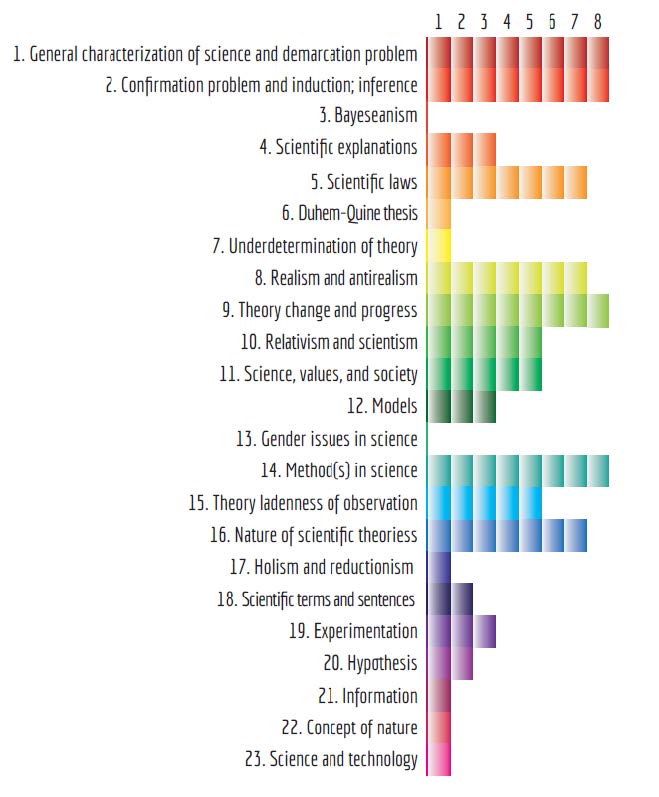
Figure 3.
Number of Textbooks where each Category is Present
the authors.
Despite appearing in different textbooks, the categories did not necessarily receive the same emphasis. The emphasis given to each category was inferred through the relative number of occurrences in each textbook and the sum of the percentages for each category in all textbooks gives us a broad view of the general emphasis given to each one (Figure 4).
Figure 4 indicates the sum of the percentages of categories found in all textbooks which is an indication of the general emphasis given to each category in all textbooks. The maximum total corresponds to 800%, which would represent total emphasis in all books.
Due to space constraints only the analysis of some categories considered more relevant are presented here. Four categories occur in all textbooks: 1 (General characterization of science and demarcation problem), 2 (Confirmation problem and induction; inference), 9 (Theory change and progress) e 14 (Method(s) in science). Categories 5 (Scientific laws), 8 (Realism and antirealism) e 16 (Nature of scientific theories) appear in seven textbooks. Categories 10 (Relativism and scientism), 11 (Science, values, and society) e 15 (Theory ladenness of observation) occur in five textbooks. All the Other categories appear in less than four textbooks. In a first analysis, thus, these would be the main themes of philosophy of science found in the textbooks. For this reason, these categories will be discussed in further detail.
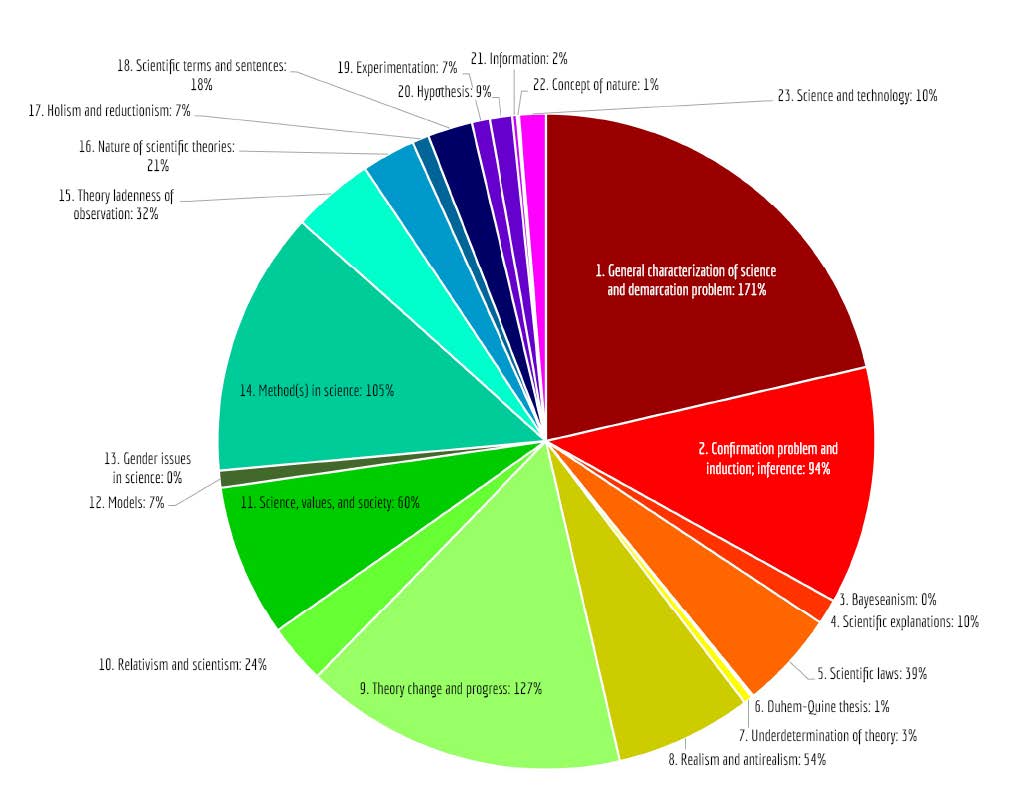
Figure 4.
Sum of Percentages of the Categories in all Textbooks
the authors.
Category 1: General characterization of science and demarcation problem
Category 1 is not only present in al textbooks but is also the one with the greatest sum of percentages which indicates it is the main topic addressed by the Philosophy textbooks. This can be partly explained by the broad scope of the category.
The tendency in the textbooks is to present a general characterization of science through its properties or qualities. Some recurring examples include the broad scope/ universality of scientific knowledge; its rigor and/or objectivity; its systematicity; its empirical/experimental character; and occasionally the importance of method and mathematics/quantification.
The discussions about the demarcation problem assume different perspectives in the textbooks: some distinguish Science from common sense by contrasting their characteristics; others distinguish between different scientific fields (or specific scientific disciplines) by specifying their specific objects of study; some also draw a line between science and other forms of knowledge like philosophy which sometimes is done through their scopes and sometimes is not clearly defined. Only one textbook presents an explicit position concerning the distinction between science and pseudoscience.
Even though the recent discussions on NOS have focused less on the general characterization of science and more one on specific aspects of scientific knowledge and practice, one of the main instruments used for identifying NOS conceptions, the VNOS, brings questions like “what is science?” and “what makes science different from other disciplines of inquiry (e.g., religion, philosophy etc.)?” (Lederman et al., 2002). The objective of the questions is to prompt responses that express the conceptions of the respondents regarding the item in the list of consensuses. In this sense, the responses offered by the textbooks emphasize, for example, the empirical/experimental aspect of science which is one of the items in that list.
The discussion about the demarcation problem is at the base of the FRA in such a way that, even though it is not in any of the categories proposed by Dagher and Erduran (2016), it permeates all of them. When discussing the demarcation problem, the textbooks tend to refer to science in general, which is precisely the point of criticism by the FRA, that is, the lack of sensitivity to the particularities of each scientific discipline. However, at least part of the textbooks refer to the different scientific disciplines even though its specificity is associated only with the object of study.
Category 2: Confirmation problem and induction; inference
Category 2 is also present in all textbooks. Most of them uses terms like “confirm”, “verify” and “prove” to refer to hypotheses, laws and/or scientific theories, which may suggest to the reader the strong interpretation that these can be definitively stablished. However, they also emphasize that science is not static and scientific knowledge is always provisional. Overall, it is not clear to the reader how to articulate these two views. None of the textbooks goes into details about the confirmation problem itself, although Melani’s textbook (2016) mentions the notion of verifiability of scientific theories associatedwith the philosophers from the Vienna Circle and Vasconcelos’ textbook presents the Popperian criticism to the notion of confirmation. These same textbooks formally present the problem of induction and use it as an argument to affirm that scientific knowledge cannot provide absolute certainties.
The idea that scientific knowledge stablishes absolute truths has been found in studies on NOS conceptions for decades (Lederman, 1992) and the warning found in the textbooks that in reality it is provisional constitutes a potential contribution to the deconstruction of this myth. The presentation of the problem of induction may constitute a strong argument in that direction. However, the use of terms like “confirmation”, “verification” and “prove” can lead the reader in the opposite direction. Not only that, but the idea that scientific knowledge cannot provide absolute truths, especially When associated with the problem of induction may take the reader to the extreme opposite, that is, relativism. In this regard, Allchin’s emphasis on the reliability of science when dealing with NOS, as well as the focus on contextualized scientific cases (be them historical, contemporary or inquiry) (Allchin et al., 2014) is justified since it allows the questioning of the extent to which scientists’ conclusions are open to discussion and, at the same time, based on evidence.
Category 5: Scientific laws
Category 5 appears in seven textbooks, all of them presenting explicit occurrences. The laws are presented in four textbooks as descriptions of regularities or general patterns of phenomena. Also, the ideas that laws are encompassing or universal and that they are necessary appear in three textbooks each. “Necessary” is construed as the notion that the regularities described by the laws do not admit exceptions, that is, the phenomena must necessarily conform to the predictions of the law.
The idea that scientific laws describe regularities or relations between phenomena is similar to that present in the consensus view, even if the latter does not discuss the idea of necessity. That approach construes laws and theories as essentially different things while two of the textbooks treat laws as parts of theories and one textbook treats one kind of (general) laws as being the scientific theories themselves. A fourth textbook considers laws as explanatory which, for the group formerly led by Lederman, would be a distinctive trait of theories.
Category 8: Realism and antirealism
The category was identified in seven out of eight textbooks (absent only in Cotrim and Fernandes’ textbook, 2016), but did not present explicit positions in Vasconcelos’ (2016) and Melani’s (2016) textbooks. The former poses the question: “does science guarantee an objective knowledge of reality?” (Vasconscelos, 2016, p. 183) and formally presents the theme in an activity proposal: “scientific realism, that affirms the objectivity of the results of science, and scientific antirealism that affirms the relativity of those results” (Vasconscelos, 2016, p. 199). The way the text associates realism to objectivity and antirealism to relativism can be philosophically questioned; at the same time this books is the only to formally present these terms and the existence of the debate.
Some textbooks present a realist position while others, despite not taking sides, present a position of rejecting a form of realism that can be considered “naive”, that is, the idea that science is a direct portrait of reality.
The debate about realism is taken by Lederman (2002) as an example of theme that should not be taught in K-12 science classes for being at one time too abstract and little or no relevant for everyday life. Other approaches usually do not discuss the subject except for Matthews (2012) who suggests the theme “realism and constructivism” as a possible topic to be discussed with the students.
Category 9: Theory change and progress
The category was identified in all textbooks presenting explicit occurrences in six of them. All textbooks recognize that science changes over time and scientific theories are tentative (in this regard They are aligned with one of the items in the consensus view). However, there are differences in the way the textbooks construe the process. Cotrim and Fernandes (2016), for example, reject the idea that science always makes progress. Chauí (2016) is even more emphatic affirming that epistemology has refuted the idea of progress in science and that it is an ideological illusion. In contrast, Figueiredo et al. (2016) are categorical affirming that “discoveries and technological inventions often promote scientific progress” (p. 150). Aranha and Martins (2016) give the example of the transition from newtonian to einsteinian physics (the authors use the term “supplanted” to refer to Newton’s physics) and say that the former was not abandoned but it was recognized that it has limitations since it applies to a restricted sector of reality. This passage can be understood as indicating a form of progress.
It is interesting tonoticethat, despite thecontrastingpositionsconcerningprogress, almost all of them adhere to the ideas of Thomas Kuhn. Cotrim and Fernandes (2016) and Figueiredo et al. (2016) cite the philosopher by name and explicitly subscribe to his thought. Chauí (2016) and Aranha and Martins (2016) also present the philosopher’s ideas and the latter authors state that Science develops based on paradigms as does Melani (2016). Even the textbooks Where explicit occurrences of this category were not identified (Vasconcelos, 2016 and Savian Filho, 2016) present Kuhn’s ideas, albeit without explicitly affiliating themselves with the author. Thomas Kuhn thus appears as the main philosopher mentioned in the textbooks when it comes to the theme of progress.
The idea that scientific knowledge transforms over time is dear to NOS authors since many studies have shown that students of different levels have the idea that science produces absolute truths (Lederman, 1992; 2007). At the same time, Kuhn a name from philosophy of science with great influence on NOS discussions (Matthews, 2004). However, nowhere in the different NOS approaches is it proposed that his ideas and their consequences to the notion of progress in science should be studied at K-12 level. In this aspect the textbooks diverge from the NOS approaches by addressing the ideas of a specific philosopher.
Category 10: Relativism and scientism
The category appears in five textbooks, two of which present explicit occurrences. Cotrim and Fernandes (2016) oppose what they call the “myth of scientism”which the authors define as the “idea that scientific knowledge is perfect, science always moves toward progress and the technology developed by science can answer to all human needs” (p. 376) or as “the belief in science’s power to explain everything and above all the belief in its neutrality, the idea that scientific knowledge is devoid of interests and impartial” (p. 378) (Gallo, 2016 also uses the expression “scientism” in a similar sense, although not presenting an explicit position). The authors say that such myth has been questioned, which has been “relativizing” the idea of the superiority of scientific knowledge in relation to other forms of knowledge. In contrast, Vasconcelos (2016) comments on the relativist interpretation of Kuhn by saying that “it is not always the case of absolute relativism for in many cases it is possible to identify criteria shared by different paradigms” (p. 197). Melani (2016) also comments on the relativista interpretation of Kuhn and contrasts it with the idea that scientific knowledge tends to be considered by society as safe and superior to other forms of knowledge although this author does not present an explicit position.
Figueiredo et al. (2016) also introduce the debate when presenting two different views. The authors suggest the reader imagine that “someone tells them this: ‘Science is not debatable. Each one has their own science. Ptolemy had his, Copernicus had another and Einstein had another, even more different. None is better than the other. They are just different.’” (p. 303). At the same time, they say that “most people tend to think that when it comes to science the standards are absolute” (p. 304). The authors then introduce Kuhn’s ideas but do not assume an explicit position.
The issue of relativism and scientism is not usually addressed (at least not in those terms) in the various NOS approaches. However, there is a clear connection between this theme and Allchin’s approach that seeks to emphasize the reliability of science. His approach focuses on, among other things, how evidence and the methods of science can produce reliable knowledge (as well as the possible sources of error and how to correct them) with the goal of giving to the student the resources to recognize claims that may or may not be considered reliable in their everyday life. The discussion is not based on the general definition of those terms but on the concrete analysis of individual cases.
In the perspective advanced by Kotter and Hamman (2017) of bringing controversies into the classroom it would be possible to present the terms “relativism” and “scientism”, the debate, and the various arguments from both sides. The value of such approach, argue the authors, would be the development of the student’s epistemic competency in dealing with controversial metascientific issues.
Category 11: Science, values, and society
The category appears in five textbooks, all with explicit occurrences. All textbooks discuss the influence of values and interests of different social groups in scientific research and its application. Cotrim and Fernandes (2016), for example, say thatscience, like its many uses, is not neutral and give the example of the investment in the development of weaponry and other technologies with potential military applications moved by economic interests. Gallo (2016) asserts that science is no longer guided just by the pursuit of knowledge and is now oriented toward its practical applications and invites the reader to a reflection on the political and economic interests that might be behind scientific development. Aranha and Martins (2016) follow the same line when affirming that science is not neutral and that this means we should reflect on the ethical and political aspects of the aims of scientific research. Chauí (2016) also says that since its birth science had the objective of dominating nature through technique to explore it which would allow the increase of work capacity and the accumulation of capital. Melani (2016) also says the intention of dominating nature is at the foundation of modern science mentioning Bacon and Descartes.
As can be seen the theme of the role of values and interests of different sectors of society in scientific research is considered relevant by most textbooks. All the textbooks that presented explicit occurrences have similar views on the matter. It is interesting to notice however that none of them discusses the possibility that such values and interests might interfere in the elaboration and validation of the scientific theories themselves. Melani (2016) gets close when stating that “the conceptions of science and the actions of scientists are influenced by the values and objectives, worldview, religion, belief, art, in sum, by the modes of life of a community” (p. 354).
The idea that science must be viewed by the students as part of a larger social context with which it stablishes multiple and complex relations is seen as key by many NOS authors. One of the items of the consensus list is the insertion of science in a sociocultural milieu (Lederman et al., 2002); the family resemblance approach includes in it outermost circles categories that refer to different dimensions of this interaction between science and its social context such as “social values”, “political power structures”, “financial systems” etc.; Allchin’s approach proposes that science should be treated as a whole, which includes the different ways scientific research influences and is influenced by society; and Matthews includes in his list the item “values and socioscientific issues”. It is, therefore, a clear point of convergence between the teaching of philosophy of science and NOS.
Category 14: Method(s) in science
The category appeared in all textbooks with explicit occurrences in five of them.
Three textbooks refer to the “scientific” or “experimental method” as a series of steps to be followed when conducting scientific research. For Cotrim and Fernandes (2016), “the scientific method is generally based on a logical structure encompassing many steps which must be followed when seeking the solution for a given problem” (p. 365). They are: formulation of a problem; formulation of a hypothesis; experimental testing of the hypothesis; and conclusion. For Para Gallo (2016), the scientific method can be characterized by five steps: observation; formulation of a hypothesis; experimentation;generalization; and formulation of theories (models). For Aranha and Martins (2016), the scientific method consists of the steps of observation, hypothesis, experimentation, generalization (law) and theory. As can be seen despite minor variations the steps described by these three textbooks are very similar.
The authors of all three textbooks clarify that the descriptions of the scientific method presented should not be understood in an excessively rigid way. Cotrim and Fernandes (2016), for example, say the scientific method can present variations according to the problem under study and the available resources and emphasize the importance of the scientist’s imagination. Gallo (2016) also admits the possibility of adaptations of the scientific method. Aranha and Martins (2016) say the order of the steps might vary according to the intuition of the scientist or simply by chance.
Chauí (2016) and Melani (2016) use the expression “methods”, plural, and do not presente a series of steps to be followed. Chauí (2016) brings a list of activities scientists do When conducting scientific research while Melani (2016) says direct observation and the experiment are two “methodological principles” in science. In this regard both authors present less rigid views of the methods employed by scientists than the others.
Figueiredo et al. (2016) and Savian Filho (2016) had only one and two (non- explicit) occurrences in this category, respectively. Vasconcelos (2016) presents greater dedication to the topic contrasting the inductive and deductive approaches based on different authors (mainly Bacon and Einstein) without assuming an explicit position.
The tendency of NOS authors has been to avoid the idea of a universal scientific method as a series of steps to be followed. This notion is considered by some authors as one of the most common misconceptions about NOS (Lederman et al., 2002). For this reason, the family resemblance approach contains a category referring to “methods and methodological rules” that includes the various possible methodological approaches in different sciences (Irzik & Nola, 2011). Allchin (2011) also emphasizes the analysis of the methods employed in concrete cases aiming at a functional knowledge of NOS as opposed to a general declarative knowledge about the scientific method. In the view of these authors the notion of a scientific method as a series of steps cannot fully embrace the methodological complexity of scientific research in practice, a point that has been widely discussed in the history and philosophy of science.
Category 15: Theory ladenness of observation
The category occurs in five textbooks presenting explicit occurrences in two of them.
Aranha and Martins (2016) explicitly affirm that “scientific observation istheory laden” (p. 322), since what the scientist sees is oriented by a previous theory that guides them in the interpretation of what they observe. Melani (2016) does not use the expression. “theory laden” but says that two people can have different visual experiences observing the same object and that previous knowledge affects perception. This could put in check the notion of a fully objective observation. In the Other three textbooksWhere the category appears (Cotrim and Fernandes, 2016; Savian Filho, 2016; and Vasconcelos, 2016), the theme comes up amidst the explanation or direct citation of philosophers and the authors do not assume an explicit position.
The theme of theory ladennes of observation has been extensively discussed by several authors from philosophy of science in different perspectives but it is not that frequent in the Philosophy textbooks. Likewise, in NOS the theme appears in theoretical discussions but tends to not be treated in depth with the students. The consensus view, for example, recognizes that science is theory laden which influences the observations of scientists (Abd-El-Khalick, 2012; Lederman et al., 2002). However, the authors do not further the discussion on the how theory can be related to and influence observation and the possible consequences for science.
Category 16: Nature of scientific theories
The category appears in seven textbooks, presenting explicit occurrences in five. Aranha and Martins (2016) consider theories as encompassing, unifying and heuristic laws. Cotrim and Fernandes (2016) consider theories as abstractions that explain the causes and regularities described by laws. Gallo (2016) seems to identify theories with models. Chauí (2016) defends theories are systems of sentences that explain phenomena based on principles and seems to imply that laws are part of theories.
Finally,Vasconcelos (2016) understands that theories articulate laws as a way of answering the questions posed by theory.
Some aspects of this group of views are noteworthy. The first is the diversity of conceptions about what would be a scientific theory. The second concerns the relation between theories and laws. Aranha and Martins (2016) identify theories with a specific kind of laws (that is, theories would be a subset of laws), while Cotrim and Fernandes (2016) seem to treat both notions as distinct and Chauí (2016) seems to treat laws as being part of theories. In NOS the consensus view is the one giving the greatest emphasis to this relation and understands that laws and theories are distinct since the former describes the regularity of phenomena while the latter offers explanations (Lederman et al., 2002). A third remark concerns what seems to be the philosophical affiliation of the different texts in this aspect. When Chauí (2016) affirms that scientific theories are systems of sentences based on principles she seems to align with the orthodox or received view of scientific theories as empirically interpreted axiomatic systems (Díez & Moulines, 1999), while Gallo (2016) by identifying theories and models suggests an affiliation with the semantic view that understands science as classes of models (Díez & Moulines, 1999).
Although the notion of theory is considered an important aspect in the consensus view other authors in the field give it less emphasis to the definition of theory when teaching NOS. Allchin, for instance, considers fully comprehending the meaning of the terms “theory” or “law” and the relation between them less important than being capable of assessing the reliability of scientific claims based on evidence. According to the author,
Least of all does one need to distinguish between laws and theories […]. What matters, again, is how (irrespective of labels) one ascertains the degree of confidence in a particular claim. Indeed, the best way to disarm criticism of evolution as “merely a theory” may not be by clarifying the meaning of the term “theory,” but rather by rendering the whole discussion moot by redirecting focus to the robustness of the evidence. (Allchin, 2011, p.523).
Philosophy of Science in the textbooks
It is important to remark that some of these categories do not occur as a formal presentation of the theme or philosophical problem they entail. For example, in category 2, not all textbooks formally present the problem of confirmation or induction but present a position that can be observed through the use of terms and expressions such as “scientists confirm their theories” or “hypotheses must be verified” and similar ones. The same happens with category 8: the problem of the relation between scientific theories and reality and the possible positions within the debate are rarely made explicit. In most cases, however, there is a position that can be observed through the use of expressions such as “science reveals reality behind the appearances” or “scientific theories are not a portrait of reality as it is”. This means the presence of a category in most of the textbooks should not be construed as to imply that the readers will necessarily be formally introduced to that philosophy of science topic.
Conclusions and implications
It is possible to say that, in general, there is a significant variation in the explicit positions among the textbooks in the various categories, that is, the images of science significantly even though there are some points of convergence. The option for distinguishing the occurrences between those representing explicit and non-explicit positions is an attempt to raise the image of science conveyed by the textbooks even through a superficial reading. However, in future investigations a deeper analysis on the way each text presents (or not) their position would contribute to have a better idea of how exactly such image reaches the reader. For example, the choice for of presenting the ideas of this or that philosopher on a particular issue or philosophical problem, even if sides are not clearly being taken, is still a form of non-explicit position relevant to the image of science being formed by the reader. A deeper analysis of the themes on which the textbooks are silent and the reasons for it would also be equally valuable. For example, the theme of gender issues in science (category 13) is absent from the textbooks even though it is a current topic in epistemology. Why such silence? What can that tell us about the Philosophy and the Science being taught and the image of science being construed by the students? Evidently the image of science formed by the reader does not depend exclusively on the text itself; however, a deeper knowledge of the image presented by the textbooks would contribute to a better understanding of the process of formation of NOS views by the students.
Still, the results show there is a significant overlap between the themes in the Philosophy textbooks and various aspects of NOS emphasized in the different approaches found in the literature. If, on the one hand, such overlap was expected since NOS extracts its themes from philosophy of science itself (among other academic disciplines), on the other, the results support that expectation. This means the readers of these textbooks, be them students or teachers, will find there elements with the potential to influence the way they understand the NOS.
There are points of clear thematic convergence between the textbooks and the discussions in NOS. An example is category 11 (about the relations between values, science and society), where we can see alignment between them. Category 14 (about the issue of scientific method(s)) also represents a theme widely discussed by both the textbooks and the NOS approaches. However, some textbooks present a view that is the opposite of what most NOS approaches propose (i.e., the idea that there is one scientific method composed of a series of steps to be followed). Other textbooks present a more flexible view with room for the diversity of methodological approaches in science which is closer to the discussions in NOS.
There are also categories representing themes from philosophy of science little explored in NOS. Category 8 (about the debate over realism) is an example. It is also the case of category 9 (on progress in science), one of the most emphasized by the textbooks. Even though one point in common between the textbooks and the field of NOS is the acknowledgement that scientific theories change over time, the Philosophy textbooks present the ideas of Thomas Kuhn, which is not the case in NOS. The conceptual discussion on how exactly change happens and whether that represents some form of progress is not something usually treated by the NOS approaches even if Kuhn is an important reference in both fields.
There are also some themes not included in the textbooks which are mentioned in NOS. It is the case of category 13 (about gender issues in science). Finally, there some themes not included in any of them such as category 13 (about bayeseanism).
Thus, it can be said that while there is some overlap of themes between the Philosophy textbooks and the NOS approaches, there are topics addressed just by one or the other. This means there is na intersection of themes but not a full overlap which supports Allchin’s statement that “NOS is not philosophy of science” (2011, p. 523). Besides, even within the themes found in that intersection different textbooks present different explicit positions which at times is aligned with and at times is opposed to what is defended by NOS approaches. This reinforces the need for both teachers and researchers in science education to take into consideration the nature of the contact with philosophy of science students might have in Philosophy classes.
Since the comprehension of NOS is considered a fundamental aspect of scientific literacy (Sasseron & Carvalho, 2011) and therefore science courses must include in their planning goals that foster its development (Khishfe & Abd-El-Khalick, 2002), the knowledge of the images of science conveyed in Philosophy classes becomes relevantinformation for the teacher to plan the lessons. At the same time science education research must extend its gaze beyond science education; it must seek to identify points of contact with other disciplines taught in school and the ways they dialogue (or not) with science education. What the student learns about science, after all, does not depend solely on what happens inside the Science classroom but also on what goes on in other classes such as Philosophy. In this regard one remark about the impact of the results here presented on the research in science education is that studies that seek to measure the effect of interventions (for example, didactic sequences) on the NOS views of secondary students must take into consideration the influences of other spaces like the Philosophy class. Many such studies consist of pre- and post-intervention assessments that seek to identify changes in students’ NOS views and link them to the intervention. However, if the student has contact with themes from philosophy of science in the Philosophy class, one cannot directly attribute their NOS views to any intervention in the Science class without further looking into it. The Philosophy class thus becomes a critical variable to be taken into consideration by researchers that seek to understand the process of production of NOS views in secondary education. More investigations are necessary in the direction of comprehending how exactly the Philosophy class influences what students learn about science.
Just like by looking into the teaching of other disciplines one can learn a lot about science education, it is also possible to draw relevant considerations for those other subjects. The results obtained in the present study are equally relevant for Philosophy education. The knowledge of the way Philosophy textbooks relate to what is found in science education research is food for the teacher and philosophy of science education researcher’s thought. For example, the idea that the scientific method is a universal sequence of steps adopted by at least part of the textbooks’ authors can be reviewed in light of the literature on NOS arguing against the oversimplification represented by such view and taught in a different way in Philosophy classes. At the same time the results show the textbooks present very different explicit positions concerning some of the categories. Taking into consideration that for many students the textbook might be the first and only philosophy text it is especially important that Philosophy education make it clear for the student that the presented position is one among other possibilities within a debate and, therefore, always subject to questioning. The teaching of Philosophy that allows the student to know and adopt only one answer for each question is sterile. It is in this sense that Tozzi (2011) considers that “problématisation” (problematization) is one of the fundamental competencies to philosophizing. Cerletti (2009) speaks of the importance of an education that has a philosophical attitude as key, that is, this permanent restlessness that makes the philosopher not accept that which is given as granted; and that leads them to constantly problematize, question, revise.
Thus, the present study points in the direction of the need for greater dialogue between Philosophy and Science education with potential benefits for both. The greatest beneficiary, however, will be the student, final point of convergence of teachers and education researchers alike.
References
Abd-El-Khalick, F. (2012). Teaching With and About Nature of Science, and Science Teacher Knowledge Domains. Science and Education, 22(9), 2087–2107. https://doi.org/10.1007/s11191-012-9520-2
Allchin, D. (2011). Evaluating knowledge of the nature of (whole) science. Science Education, 95(3), 518–542. https://doi.org/10.1002/sce.20432
Allchin, D. (2013). Teaching the Nature of Science: Perspectives & Resources. SHiPS Education Press.
Allchin, D., Andersen, H. M., & Nielsen, K. (2014). Complementary Approaches to Teaching Nature of Science: Integrating Student Inquiry, Historical Cases, and Contemporary Cases in Classroom Practice. Science Education, 98(3), 461–486. https:// doi.org/10.1002/sce.21111
Almeida, A. T. de, Araújo, M. A. C. de, Silva, N. G. da, & Silva, P. L. da. (2018). Os Fundamentos do Ensino de Filosofia nos Livros Didáticos Aprovados pelo PNLD 2018. Problemata: Revista Internacional de Filosofia, 9(3), 243–251.
Alters, B. J. (1997). Whose nature of science?. Journal of Research in Science Teaching, 34(1), 39–55. https://doi.org/10.1002/(SICI)1098-2736
Azevedo, N. H., & Scarpa, D. L. (2017). Revisão Sistemática de Trabalhos sobre Concepções de Natureza da Ciência no Ensino de Ciências. Revista Brasileira de Pesquisa em Educação em Ciências, 17(2), 579–619. https://periodicos.ufmg.br/index.php/rbpec/article/view/4551
Bardin, L. (2009). Análise de Conteúdo. Edições 70.
Becker, E., Balieiro, M., & Tolle, O. (Eds.) (2013). Filosofia no Ensino Médio: Filosofia da Ciência. Editora UFS.
Cerletti, A. (2009). O Ensino de Filosofia como Problema Filosófico. Autêntica Editora.
Chauí, M. (2016). Iniciação à Filosofia (3ª ed.). Ática
Chiappetta, E. L., Fillman, D. A., & Sethna, G. H. (1991). A method to quantify major themes of scientific literacy in science textbooks. Journal of Research in Science Teaching, 28(8), 713–725. https://doi.org/10.1002/tea.3660280808
Cotrim, G., & Fernandes, M. (2016). Fundamentos de Filosofia (4ª ed.). Saraiva.
Dagher, Z. R., & Erduran, S. (2016). Reconceptualizing the Nature of Science for Science Education. Science and Education, 25, 147–164. https://doi.org/10.1007/s11191-015-9800-8
Díez, J. A., & Moulines, C. U. (1999). Fundamentos de Filosofía de la Ciencia (2ª ed.). Editorial Ariel, S.A.
Duschl, R. A. (1985). Science Education and Philosophy of Science Twenty-Five Years of Mutually Exclusive Development. School Science and Mathematics, 85(7), 541–555. https://doi.org/10.1111/j.1949-8594.1985.tb09662.x
Duschl, R. A., & Grandy, R. (2012). Two Views About Explicitly Teaching Nature of Science. Science and Education, 22(9), 2109–2139. https://doi.org/10.1007/s11191-012-9539-4
Dutra, L. H. A. (2017). Introdução à Teoria da Ciência (4ª ed.). UFSC.
Eflin, J. T., Glennan, S., & Reisch, G. (1999). The nature of science: A perspective from the philosophy of science. Journal of Research in Science Teaching, 36(1), 107–116. https:// doi.org/10.1002/(SICI)1098-2736
Fávero, A. A., Ceppas, F., Gontijo, P. E., Gallo, S., & Kohan, W. O. (2004). O Ensino da Filosofia no Brasil: um Mapa das Condições Atuais. Cadernos Cedes, 24(64), 257–284.
Figueiredo, V. (Org.). (2016). Filosofia: temas e percursos (2ª ed.). Berlendis & Vertecchia Editores.
Fundo Nacional de Desenvolvimento da Educação (2019). Dados Estatísticos. http:// www.fnde.gov.br/index.php/programas/programas-do-livro/pnld/dados-estatisticos
Gallo, S. (2016). Filosofia: Experiência do Pensamento (2ª ed.). Scipione
Gontijo, P. (2017). O Ensino de Filosofia no Brasil: Algumas notas sobre avanços e desafios. Perspectivas, 2(1), 3–17.
Hodson, D. (2014). Nature of Science in the Science Curriculum: Origin, Development, Implications and Shifting Emphases. In M. R. Matthews (Ed.), International Handbook of Research in History, Philosophy and Science Teaching (pp. 911–970). Springer.
Höttecke, D., & Silva, C. C. (2011). Why Implementing History and Philosophy in School Science Education is a Challenge: An Analysis of Obstacles. Science and Education, 20(3), 293–316. https://doi.org/10.1007/s11191-010-9285-4
Irzik, G., & Nola, R. (2011). A Family Resemblance Approach to the Nature of Science for Science Education. Science and Education, 20(7), 591–607. https://doi.org/10.1007/ s11191-010-9293-4
Khishfe, R., & Abd-El-Khalick, F. (2002). Influence of explicit and reflective versus implicit inquiry-oriented instruction on sixth graders’ views of nature of science. Journal of Research in Science Teaching, 39(7), 551–578. https://doi.org/10.1002/tea.10036
Knain, E. (2001). Ideologies in school science textbooks. International Journal of Science Education, 23(3), 319–329. https://doi.org/10.1080/095006901750066547
Kötter, M., & Hammann, M. (2017). Controversy as a Blind Spot in Teaching Nature of Science — Why the Range of Different Positions Concerning Nature of Science Should Be an Issue in the Science Classroom. Science & Education, 26(5), 451–482. https://doi.org/10.1007/s11191-017-9913-3
Lederman, N. G. (1992). Students’ and teachers’ conceptions of the nature of science: A review of the research. Journal of Research in Science Teaching, 29(4), 331–359. https:// doi.org/10.1002/tea.3660290404
Lederman, N. G., Abd-El-Khalick, F., Bell, R. L., & Schwartz, R. S. (2002). Views of Nature of Science Questionnaire: Toward Valid and Meaningful Assessment of Learners’ Conceptions of Nature of Science. Journal of Research in Science Teaching, 39(6), 497–521. https://doi.org/10.1002/tea.10034
Lederman, N. G. (2007). Nature of Science: Past, Present and Future. In S. K. Abell & N. G. Lederman (Eds.), Handbook of Research on Science Education (pp. 831–879). Routledge Taylor & Francis Group.
Lederman, N. G., Bartos, S. A., & Lederman, J. S. (2014). The Development, Use, and Interpretation of Nature of Science Assessments. In M. R. Matthews (Ed.), International Handbook of Research in History, Philosophy and Science Teaching (pp. 971–997). Springer.
Lei Nº 11.684 de 2 de Junho de 2008 (2008). Altera o art. 36 da Lei nº 9.394, de 20 de dezembro de 1996, que estabelece as diretrizes e bases da educação nacional, para incluir a Filosofia e a Sociologia como disciplinas obrigatórias nos currículos do ensino médio. http://www.planalto.gov.br/ccivil_03/_Ato2007-2010/2008/Lei/L11684.htm#art1
Lei Nº 13.415 de 16 de Fevereiro de 2017 (2017). Altera as Leis nº 9.394, de 20 de dezembro de 1996, que estabelece as diretrizes e bases da educação nacional, e 11.494, de 20 de junho 2007, que regulamenta o Fundo de Manutenção e Desenvolvimento da Educação Básica e de Valorização dos Profissionais da Educação, a Consolidação das Leis do Trabalho - CLT, aprovada pelo Decreto-Lei nº 5.452, de 1º de maio de 1943, e o Decreto- Lei nº 236, de 28 de fevereiro de 1967; revoga a Lei nº 11.161, de 5 de agosto de 2005; e institui a Política de Fomento à Implementação de Escolas de Ensino Médio em Tempo Integral. http://www.planalto.gov.br/ccivil_03/_Ato2015-2018/2017/Lei/L13415.htm
Leite, L. (2002). History of science in science education: Development and validation of a checklist for analysing the historical content of science textbooks. Science and Education, 11(4), 333–359. https://doi.org/10.1023/A:1016063432662
Martins, M. H. P., & Aranha, M. L. A. (2016). Filosofando: Introdução à Filosofia (6ª ed.). Moderna.
Matthews, M. R. (2004). Thomas Kuhn’s Impact on Science Education: What Lessons Can Be Learned?. Science Education, 88(1), 90–118. https://doi.org/10.1002/sce.10111
Matthews, M. R. (2012). Changing the Focus: From Nature of Science (NOS) to Features of Science (FOS). In M. S. Khine (Ed.), Advances in Nature of Science Research (pp. 3–26). Springer.
McDonald, C. V., & Abd-El-Khalick, F. (2017). Representations of nature of science in school science textbooks. In C. V. McDonald & F. Abd-El-Khalick (Eds.), Representations of nature of science in school science textbooks: A global perspective (pp. 1–19). Routledge.
Melani, R. (2016). Diálogo: Primeiros Estudos em Filosofia (2ª ed.). Moderna.
Ministério da Educação (1998). Parâmetros Curriculares Nacionais: Ensino Médio (Parte IV — Ciências Humanas e suas Tecnologias). http://portal.mec.gov.br/seb/arquivos/pdf/cienciah.pdf
Ministério da Educação (2002). PCNs+ Ensino Médio: orientações educacionais complementares aos Parâmetros Curriculares Nacionais (Ciências Humanas e suas Tecnologias). http://portal.mec.gov.br/seb/arquivos/pdf/CienciasHumanas.pdf
Ministério da Educação (2006). Orientações Curriculares para o Ensino Médio: Ciências Humanas e suas Tecnologias - Volume 3. http://portal.mec.gov.br/seb/arquivos/pdf/ book_volume_03_internet.pdf
Ministério da Educação (2015). Edital de Convocação 04/2015 — CGPLI Edital de Convocação para o Processo de Inscrição e Avaliação de Obras Didáticas para o Programa Nacional do Livro Didático PNLD 2018. http://portal.mec.gov.br/docman/maio-2016- pdf/39561-pnld-2018-edital-pdf
Ministério da Educação (2017). PNLD 2018: filosofia — guia de livros didáticos — Ensino Médio. https://www.fnde.gov.br/pnld-2018/
Ministério da Educação (2018). Base Nacional Comum Curricular: Ensino Médio. http:// basenacionalcomum.mec.gov.br/abase/
Nagayoshi, C. S., & Scarpa, D. L. (2018). Ensino de Filosofia e Ensino de Ciências: Um estranho silêncio. Revista Digital de Ensino de Filosofia — REFilo, 4(1). https://doi.org/10.5902/2448065730757
Nascimento, M. M. do. (1986). A Filosofia no 2º Grau (sua Importância, sua Especificidade). In H. N. Neto (Ed.), O Ensino da Filosofia no 2º Grau (pp. 115–118). SEAF/ Sofia.
Niaz, M. (2014). Science Textbooks: The Role of History and Philosophy of Science. InM. R. Matthews (Ed.), International Handbook of Research in History, Philosophy and Science Teaching (pp. 1411–1441). Springer.
Pérez, D. G., Montoro, I. F., Alís, J. C., Cachapuz, A., & Praia, J. (2001). Para uma Imagem não Deformada do Trabalho Científico. Ciência e Educação, 7(2), 125–153.
Pinho, R. I. B. V. (2014). O Ensino da Filosofia no Brasil: Considerações Históricas e Político-Legislativas. Educação e Filosofia, 28(56), 757–771.
Plastino, C. E. (1986). O ensino de filosofia das ciências naturais no secundário. In H. N. Neto (Ed.), O Ensino da Filosofia no Segundo Grau. São Paulo: SEAF/Sofia.
Plastino, C. E. (2017). Teoria do Conhecimento e Filosofia da Ciência e o seu Ensino. InA. M. Maamari (Ed.), Novas Tendências para o Ensino de Filosofia (p. 144). Editora CRV.
Robinson, J. T. (1965). Science Teaching and the Nature of Science. Journal of Research in Science Teaching, 3, 37–50.
Rosenberg, A. (2005). Philosophy of Science: A Contemporary Introduction (2ª ed.). Routledge Taylor and Francis Group.
Sasseron, L. H., & Carvalho, A. M. P. De. (2011). Alfabetização científica: uma revisão bibliográfica. Investigações Em Ensino de Ciências, 16(1), 59–77.
Savian Filho, J. (2016). Filosofia e Filosofias: Existência e Sentidos. Autêntica
Scheffler, I. (1973). Philosophy and the Curriculum. In Reason and Teaching (pp. 31–41). Routledge & Kegan Paul.
Silva, M. R. da. (2004). A Filosofia da Ciência e sua Contribuição para o Ensino de Ciências. In C. Candido & V. Carbonara (Eds.), Filosofia e Ensino: um diálogo transdiciplinar (pp. 437–456). Unijuí.
Sturza, R. B. (2017). Livros Didáticos de Filosofia no Ensino Médio: da Gestão Escolar à Sala de Aula. Refilo — Revista Digital de Ensino de Filosofia, 3(2), 219–232.
Tozzi, M. (2011). Penser par si-même (7ª ed.). Chronicle sociale.
Unesco (2007). Philosophy A School of Freedom: teaching philosophy and learning to philosophize; status and prospects. https://unesdoc.unesco.org/ark:/48223/pf0000154173
Vasconscelos, J. A. (2016). Reflexões: Filosofia e Cotidiano. SM.
Von Zuben, M. de C., Araújo, J. S. de, & Costa, I. de M. (2013). Avaliação dos principais Livros Didáticos de Filosofia para o Ensino Médio Existentes no Mercado Editorial Brasileiro. Revista Sul-Americana de Filosofia e Educação — RESAFE, (20), 157–178.
Wilson, L. L. (1954). A Study of Opinions Related to the Nature of Science and its Purpose in Society. Science Education, 38(2), 159–164.