Science and Mathematics Education in Brazil: a Systematic Review of 25 Years of Research (1994–2018)
Educação em Ciências e Matemática no Brasil: uma Revisão Sistemática de 25 Anos de Pesquisa (1994–2018)
Science and Mathematics Education in Brazil: a Systematic Review of 25 Years of Research (1994–2018)
Revista Brasileira de Pesquisa em Educação em Ciências, vol. 22, pp. 1-29, 2022
Associação Brasileira de Pesquisa em Educação em Ciências
Recepción: 25 Noviembre 2021
Aprobación: 15 Marzo 2022
Abstract: To understand how research in science and mathematics education has developed in Brazil in the last 25 years (from 1994 to 2018) we analyzed the 10 best-rated Brazilian journals in the field. We built an extensive dataset with all articles published in the selected journals about research in science and mathematics education since 1994. We categorized 3014 articles as national production and 584 as foreign and then analyzed the profile of the authors. In the studies from national production, we also analyzed: (i) the nature of the study (empirical research, experience report, or theoretical essay), (ii) research strands and (iii) textual content (titles, abstracts, and keywords). Our results indicated that in the last 25 years, cutting-edge research in science and mathematics education has mainly been led by male researchers from public Universities in the southeast of Brazil. The main thematic strands were teaching and learning and teacher training and the main subjects researched were teacher formation, textbook, and environmental education. In general, foreign articles had only one author from countries in Latin America, Portugal, or Spain. Through the analysis of a considerable amount of publications, our work presented an overview of the scientific production of the field in recent years.
Keywords: BRAZILIAN SCIENTIFIC LITERATURE, SCIENCE EDUCATION JOURNALS, SYSTEMATIC REVIEW, TEXTUAL ANALYSIS.
Resumo: Para entender como a pesquisa em educação científica e matemática se desenvolveu no Brasil nos últimos 25 anos (de 1994 à 2018), analisamos os 10 periódicos brasileiros mais bem avaliados na área. Construímos um extenso conjunto de dados com todos os artigos publicados nas revistas selecionadas sobre pesquisa em educação científica e matemática desde 1994. Categorizamos 3.014 artigos como de produção nacional e 584 como estrangeiros e, em seguida, analisamos o perfil dos autores. Nos estudos de produção nacional também analisamos: (i) a natureza do estudo (pesquisa empírica, relato de experiência ou ensaio teórico), (ii) temas de pesquisa e (iii) conteúdo textual (título, resumo e palavras-chave). Nossos resultados indicaram que, nos últimos 25 anos, as pesquisas em educação científica e matemática têm sido conduzidas principalmente por pesquisadores do gênero masculino de universidades públicas do sudeste do Brasil. As principais áreas de pesquisa foram ensino e aprendizagem e formação de professores, os principais temas pesquisados foram formação de professores, livro didático e educação ambiental. Em geral, os artigos estrangeiros tinham apenas um autor de países da América Latina, Portugal ou Espanha. Por meio da análise de uma quantidade considerável de publicações, nosso trabalho apresentou um panorama da produção científica da área nos últimos anos.
Palavras-chave: LITERATURA CIENTÍFICA BRASILEIRA, REVISTAS DE EDUCAÇÃO CIENTÍFICA, REVISÃO SISTEMÁTICA, ANÁLISE TEXTUAL.
Introduction
The field of science and mathematics education has expanded in Brazil in the last decades (Nardi, 2007). The diversification of subjects researched (Krasilchik, 2004) and the increase in number of publications (i.e., Articles, Dissertations and Theses) are expressive, especially from the 1980s. More than three thousand Dissertations and Theses in the field are estimated to have been published in the country between 1972 and 2004 (Teixeira, 2008). This process was largely influenced by the expansion of Brazilian post-graduation programs, which culminated in more researchers and teachers being trained and in the strengthening of a scientific community in the field (Feres, 2010).
In a field study, some subjects become prevalent over the years, some received high investments during a period of time and others received very little analytical attention. This greater emphasis on specific subjects and themes is tied to historical, social and political processes of each society and, therefore, gains prominence among the scientific community, as well as in the school curriculum. According to Bourdieu,
Researchers or dominant researches define what, at a given moment in time, is the set of important objects, that is, the set of questions that matter to researchers, on which they will focus their efforts and, if I may say so, "compensate", determining a concentration of research efforts (Bourdieu, 2004, p. 25 — authors translation).
Because of this, researchers have used different methods and approaches to understand the characteristics, structure and processes of science and mathematics education in the country, as well as to synthesize and systematize the knowledge accumulated in the field. Some researches focused only on one of its fields: biology (e.g., Slongo, 2004), chemistry (e.g., Schnetzler, 2002), physics (e.g., Salem, 2012) or mathematics (e.g., Groenwald et al., 2004). Other researches were broad minded and investigated the field as one (e.g., Nardi, 2005; Ferreira, 2007; Megid-Neto, 2007; Cachapuz et al. 2008). For example, Mortimer (1996) analyzed its main trends and prospects and projected possible scenarios for the field and Kawamura and Salem (2008) showed how different subjects gained or lost prominence in published articles over the years. However, in spite of considering the field as a unit, most of these studies used specific theoretical and/or methodological perspectives or addresses particular themes in the field (Nardi, 2007).
Comprehensive studies that tried to organize the body of knowledge produced and provide an overview of science and mathematics education in Brazil have concluded that there are still different unexplored work fronts for conducting research in the field (Ferreira, 2007; Nardi, 2007; Almeida, 2012). Cachapuz and colleagues (2008) indicate emerging topics to be investigated and research questions to be answered, to raise new perspectives for the field. The authors highlight a trend towards “the weakening of lines centered on the psychology of education, such as concept learning, and towards the strengthening of lines centered on the philosophy and sociology of science and on multidisciplinary approaches, such as Science, Technology and Society (STS). (p. 19, authors translation). Produce and disseminate studies that analyze academic production is one of the suggestions given by these researchers to change this scenario and, above all, the results of these analyses can help to improve education in the country by giving visibility to the knowledge produced. Thus, although the quantitative growth of research in science and mathematics education brought the country to a new status in the international point of view, we agree with other researchers that it is extremely important to follow this expansion by a reflexive process on the existing investigations and support a critical analysis of the field trajectory (Megid-Neto, 2007; Nardi, 2007; Ferreira, 2007).
Therefore, we conducted this study to describe how research in science and mathematics education has developed in Brazil in the last 25 years (from 1994 to 2018). We used a software to analyze, both statistically and qualitatively, an extensive dataset with all scientific articles published in the 10 best-rated Brazilian journals in the field since 1994. From these data, we categorized articles as of national or foreign production and then analyzed the profile of the authors. From the articles categorized as national production we also analyzed the nature of the study, research strands and textual content. We describe the conditions of existence of the researchers" discourses, understanding them as an utterance or a set of utterances (Foucault, 2012). Based in this considerable effort, we believe that this study presents a robust overview of the field of science and mathematics education in Brazil in recent years.
Methodology
We selected scientific publications as our body of analyses because we understand that from this source discourses and practices that have been used in a field can emerge, as well as theoretical and empirical approaches related to a certain period. As most manuscripts are currently peer-reviewed before publication, scientific journals are a valid source of information recognized by the scientific community. In Brazil, the most accepted system to evaluate scientific journals is Qualis, organized by the Coordination for the Improvement of Higher Education Personnel (CAPES, in Portuguese), a foundation linked to the Ministry of Education. Qualis classifies national and international scientific publishing vehicles (e.g., journals and books) by area (e.g., Education, Teaching, Interdisciplinary, Biodiversity) and ranks them by excellence from A1 (best ranked) to C (lowest ranked) with six positions in between. Thus, we evaluated the 10 best-rated journals classified under the Teaching1 area of Qualis, which concentrates journals which address pedagogical knowledge and disciplinary content (e.g., biology, chemistry), and that deal with science and mathematics education in Brazil (described in their title or scope). In this classification, there are other journals that also publish articles relevant to the field, however, we specifically selected these journals because they concentrate studies by researchers and teachers of science and mathematics in the country and have a considerable history of publications in the field. Because of this they present themes, theories and concepts that have had great impact in research of the field in recent years. They are also the studies which circulate in Brazilian Universities, schools and events. In this sense, we emphasize that, when choosing the best-rated journals, we are directing our analysis to the publications that have a greater prominence in the field, either by the journal in which the text was published or by the authors" option to publish their research in journals that have a higher academic prestige, given their rated.
We evaluated all articles published in the 10 best-rated journals between 1994 and 2018. This interval was chosen to ensure the robustness of the data, considering that among the selected journals, seven were first published in 1994 or later. We analyzed the articles by titles, abstracts and keywords, and selected only those which addressed science and mathematics education. We did not select, for example, publications focused on the discussion of theoretical concepts, technical laboratory experiments, presentation of a new technique for handling a scientific apparatus and interviews. We justify this choice because many of the selected journals, especially in their early years, allocated specific numbers or sections to theoretical articles or texts with particular discussions, such as concepts and calculations in physics or mathematics, without an analysis that affected the science and mathematics education. Thus, we chose to analyze only the texts that, in one way or another, presented specific discussions in the field of science and mathematics education. From the selected papers, we analyzed the language of the text and its first authors. If the article was written in an other language that was not Brazilian Portuguese, the article was labelled as foreign production, regardless of its author Institution. If the first author of an article in Brazilian Portuguese was from a foreign Institution the work was also labelled as foreign. All other cases were labelled as of national (Brazilian) production.
he content of the articles allocated as national publication were tabulated based on the variables: (i) journal; (ii) volume and issue; (iii) year of publication; (iv) authors (1st to 4th); (v) affiliation of the first author; (vi) title; (vii) abstract; (viii) keywords; (ix) knowledge area (e.g., science education; physics; chemistry; biology or mathematics)2;(x) nature of analyses (e.g., theoretical essay: when authors do not indicate an empirical source being analyzed; experience report: when the authors only report an activity; empirical research: when empirical sources were analyzed); and (xi) research strands (we classified each article in one of 15 thematic strands3). The content of the articles labelled as foreign production was tabulated in: (i) journals; (ii) volume and issue; (iii) year of publication; (iv) authors (1st to 4th); (v) if individual or collaborative publication;(vi) affiliation of the first author and its (vii) country of origin.
We analyzed the metadata extracted from the articles using the R program, a free software that uses programming language to manipulate and analyze data, as well as to produce graphs and statistical calculations (R Core Team, 2018). R offers a wide variety of statistical analysis, works with open source and uses libraries with data and functions, called packages for different knowledge areas. We used R to produce statistical data and text mining, using the packages: "ggraph"; "igraph"; "tm"; "tidyverse"; "tidytext"; "snowballcc"; "ggplot2"; "wordcloud"; "biclust"; "cluster"; "dplyr" and "readr" (R Core Team, 2018). The greater part of the data was analyzed by descriptive statistics (i.e., when data, numerical or not, is organized and summarized in percentages to provide a greater understanding of a subject). We also analyzed the frequency of words in the titles, abstracts and keywords of the articles categorized as national production. Titles and keywords were analyzed for the whole studied period (1994 to 2018), however the contents of the abstracts, because of their greater complexity and extent, were analyzed in four periods: 1994 to 2000, 2001 to 2007, 2008 to 2013 and 2014 to 2018. We used as a criterion the moments in which it was possible to observe a considerable increase in publications in the field, as is the case of the years 2001 and 2014. We performed this procedure to equalize the volume of data in each set and to perceive if, at the moment more researches emerge, the words used by the researchers vary. These results were presented in word clouds. The combination of methods used enabled us, through the concept of textual similarity, to observe not only the information which was similar to each other, but also those which were dissimilar (Corrêa et al., 2012).
Michel Foucault"s theoretical and methodological perspective inspired us both in contact with the empirical source and in understanding the scientific and pedagogical discourses, as well as their effects in the field of science and mathematics education (Foucault, 2012). The handling of the articles that we carried out provided the problematization that was developed in the research and the treatment with the archive. The Foucauldian theoretical-methodological perspective allowed articulating the productions, formations, and discursive practices that involved the field (Foucault, 2013). Through the analysis of Brazilian journals and these regularities, we demonstrate the circulation of scientific and educational knowledge. We show how some notions become problematized in the last 25 years of the historical development of the field and the discursive regularities in the articles.
We, therefore, created an analytical tool inspired by discourse analysis (Foucault, 2012, 2013), which was used to analyze the discourses in the field of science and mathematics education, in which we outlined: (i) the texts that concentrate the discourse of authors; (ii) the different notions that are used by the authors to deal with topics relevant to the field; and, (iii) our descriptions of the uses of these notions in each article. This tool was used to direct our thoughts and highlight the discursive and argumentative mechanisms used by the authors to address the different themes investigated. From the discursive analysis in the Foucauldian perspective, we describe the conditions of existence of the researchers" discourses that represent science and mathematics education. Our interest focused on the sets of statements that are related and assume an organization, as they are part of the same discursive order. We describe the discourses that are present in the articles and show some discursive formations that constitue the field. The analysis of the texts made it possible to generate units of meaning and to find points of convergence in the discourse of the researchers who formed an argumentative network.
Therefore, we understand that in order to think about science teaching practices, we can analyze the discourses of researchers that constitute a way of teaching science and are published in scientific journals. Therefore, this research aims to deepen the analysis with the intention of problematizing the recurrent presence of terms and themes in the discourses of researchers in the field and the effects of this order of discourse on the practices of science and mathematics education. We also emphasize that characteristics of science, such as rigor, the constant presence of mathematics and scientific logic are established in the teaching of science and mathematics. This understanding also produces a questioning stance on educational processes and their relationship with power and knowledge (Foucault, 2012). We consider the teaching of science and mathematics an important space to be problematized, as it brings together scientific and pedagogical discourses to promote a teaching perspective. Taking into account the presence of science in society, the strength of its discourse to constitute a regime of truth and the regulation it makes of itself, we wonder what would be the effects of this meeting of scientific and educational discourses in science education; how this field is historically organized between these two discourses that have their own characteristics; and what implications occur when education and science are brought together to foster a pedagogical practice.
Research in science and mathematics education in Brazil: 25 years of national production
We found 3598 articles in the journals analyzed that addressed topics of science and mathematics education, of which 3014 were labeled as national and 584 as foreign productions (Table 1). Results are presented in the following order: first, we gave attention to the scientific articles from national production, where we presented the profile of researchers and their Institutions, the contribution of different knowledge areas to the field, nature, and strands of research, and the frequency of words used in titles, abstracts, and keywords of the manuscripts. Therefore, we examined the publication of a foreign nature in Brazilian science and mathematics education journals over the past 25 years.
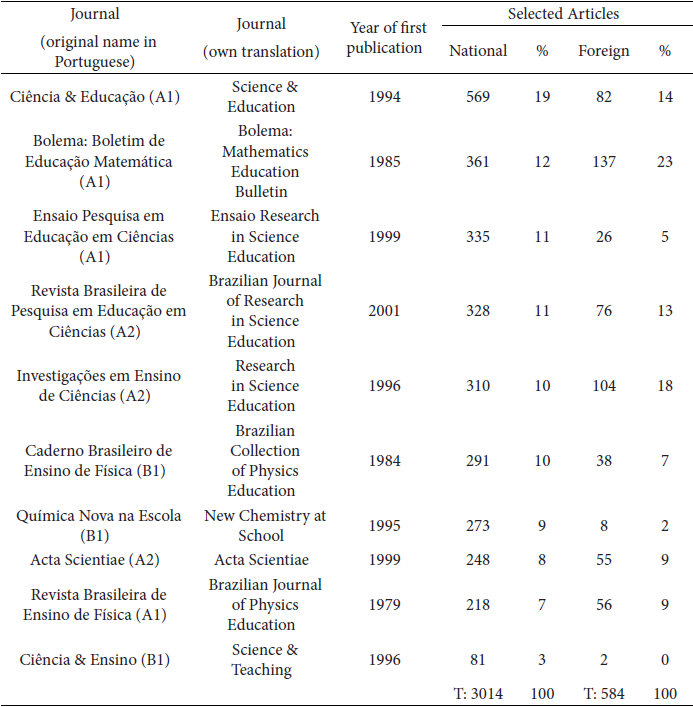
Table 1.
The 10 selected journals, their evaluation (A1>A2>B1), the year of first publication and the number of articles of national and foreign production selected in each journal of science and mathematics education in Brazil from 1994 to 2018
authors
National production on Science and Mathematics Education (1994-2018)
The analyzed journals presented significant differences between the number of articles published about science and mathematics education. Ciência & Educação journal presented the highest production (n=569) in the analyzed period, accounting for almost 20% of all articles analyzed. At the same time, Ciência & Ensino presented the lowest production (n=81) with only 3% of the total. The total amount of articles published by each journal was influenced by (i) the scope of the journal, since only articles about science and mathematics education were considered; (ii) the number of volumes, editions, and articles by edition per year; and (iii) by the year of its first publication. For example, the Revista Brasileira de Pesquisa em Educação em Ciências only started to publish in 2001, but yet presented more articles (n=328) that the Revista Brasileira de Ensino de Física (n=218), the oldest journal in the field (opened in 1979).
The number of articles published showed a constant growth between 1994 and 2018 (Figure 1). In 1994, only 13 articles were published on the subject in contrast with the 253 articles published in 2018. The year 2015 presented the highest number of publications (n=262) in the whole period analyzed. The periods between the years of 2000-2001 and 2013-2015 presented the highest increases. The number of published texts between 2010 and 2018 (n=2110) was twice as high as the previous period (1994– 2009, n=904). These results indicate that Brazilian journals and the field itself have been consolidated in the last 25 years. On the other hand, the field is still recent when compared to other fields in Brazilian studies, such as education (Salem, 2012).
We consider research in science and mathematics education as discursive practices that constitute the field, based on the knowledge that occupies specific spaces and times (Foucault, 2007). According to the author, it is through discourse that the relations of knowledge and power are formed. Therefore, this increase in articles published in science and mathematics education demonstrates that the field is consolidated as a producer of discourses that establish and validate knowledge, as it approaches the constitution of an order of discourse (Foucault, 2012). The author states that there is a threshold of scientificity to which only some discourses reach and that positivity would reinforce these practices within a regime that welcomes them and makes them function as true. In this sense, the considerable increase in published articles, according to our results, implies an unprecedented concentration of discourses and practices for the field, which reinforces the interest of researchers in developing certain themes that have greater acceptance within the field.
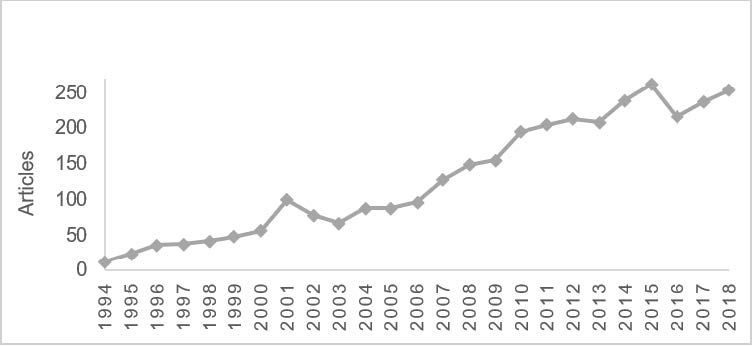
Figure 1.
Distribution by year of publication of the 3014 national articles from the 10 journals analyzed (1994–2018)
authors
Researchers profile and institutions
Two thousand, nine hundred and twenty-six (2926) different authors were identified in the national production. The researchers published 1.68 manuscripts on average over the analyzed period, ranging from one to 37. Half of the articles were published by only one (n=576) or two authors (n=1534) and 2150 authors published only one article, which indicates a high concentration of publications by few researchers. Although only 34 authors (1.16%) collaborated with more than 10 published articles, their publications represented almost 20% (n=603) of the total. Eight of the 10 researchers who published most were physicists and two were chemists, and all were from public Brazilian Universities. They were supervisors in postgraduate programs and have published in the analyzed journals continuously over the past 25 years. Thus, although there is a group of professionals who have consolidated their position in the field, there is a wider group that has been hesitant as contributors, which indicates that the field has yet to be consolidated. These results also indicate that, in the perspective of the community of actors, some researches affect the actions of others, forming hierarchies and structures that shape the identity of the field (Bourdieu, 1983). In other words, the researchers which are considered "scientific authorities" in the field influenced a part of the main ideas circulating in the field over the past 25 years, through their research, interests, and scientific practice.
More than half of the authors were female (54%). Nonetheless, this percentage changed when associated with the number of publications per researcher (Figure 2). The more publications a researcher had, the less likely to be a woman. If we take into account the 100 authors who published the most, 49% (n=1439) were female, but if we consider the 25 who published the most, only 32% were female. This data contributes to the discussions about the representativeness of women in science and the field of Humanities. Canino and Vessuri (2008), discuss how motherhood, double working hours, and family responsibilities, historically attributed to women, hinder the development of their scientific careers. Also, Osada and Costa (2006) affirm that there are fields considered by society as more feminine than others, such as the Human Sciences, since the act of educating is culturally associated with female skills. Thus, even though in the field of science and mathematics education, as presented in our data, the presence of women is slightly larger than men (54 to 46%), the difference between the number of publications by gender is expressive, as men represent 68% of the 25 researchers who published most in the last 25 years. As is known, publishing research in peer-reviewed journals is a strong indicator of the success of a professor-researcher or his/her "status". This means that publishing less or not publishing in these high-rated journals results practically in less funding and represents obstacles to occupying spaces in research Institutions.
This point is important to understand the effects of this academic prestige on science and mathematics education and the ideas naturalized in the field. This posture implies highlighting the researcher"s position, his commitments, and contexts, questioning science as the space of truth. In this process, the production of scientific knowledge becomes an object of problematization, highlighting the sometimes artificial character of statements, educational knowledge, and knowledge considered legitimate, especially due to the concentration of researchers and institutions, as shown by our results.
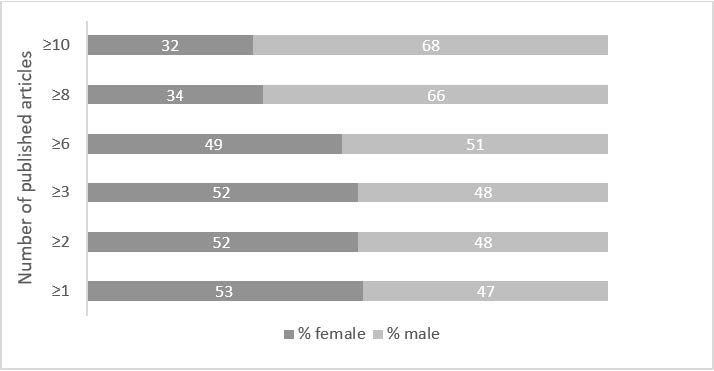
Figure 2.
Representation (percentage) of the genders (male and female) of science and mathematics education researchers (n=2926) in relation to the number of articles published between 1994 and 2018
authors
We found 273 different Institutions associated with the first authors of the analyzed articles. The University of São Paulo and the São Paulo State University were associated with the largest number of first authors, with 254 and 245 respectively. From the 10 Institutions with more authors associated, nine are public, and all summed up approximately half of the total of first authors. Public Universities represented almost 35% of the 273 Institutions and concentrated about 80% of the first authors. This means that eight out of 10 authors who work with science and mathematics education in the country were in public Universities. Although private Universities (30%), when compared to public Universities, represented a similar percentage of the Institutions investigated, they had a smaller concentration of researchers as first authors (12%). Schools and education departments accounted for a small number of the Institutions (n=43) and the first authors (n=49) investigated.
The Southeast region of Brazil, a highly developed region that includes the States of São Paulo and Rio de Janeiro, concentrated most Institutions (n=115) and also authors (n=1516) of the articles analyzed (Figure 3). Together, the South and the Southeast regions of Brazil accounted for almost 70% of all Institutions and approximately 80% of authors working with science and mathematics education. The Northern region, where the largest part of the Amazon rainforest is found, has the lowest number of Institutions (n=21) and authors (n=58). Even though the Northeastern region, which includes the states of Bahia and Ceará, does not have high numbers of Institutions (16%) and authors (12%). It stands out as the third region that concentrated the most researchers and Institutions in the field. The State of São Paulo has the largest number of Institutions (n=51), followed by the Rio Grande do Sul (n=36) and Minas Gerais (n=30). On the other hand, the states of Acre and Roraima (in the Northern region) have only one.
The results of this section reinforce the rationale that there is a group of authors and institutions which build and maintain hierarchies and influence the development of the field. According to Bourdieu (1983), for the dominant scientific order to perpetuate, it requires a set of institutions to be responsible for ensuring scientific publications, authorities and journals. This arrangement gives institutions and actors the power to influence the structure and behavior of other social actors within the field. In this scenario, symbols, forms and patterns that promote regulations and norms of educational experiences and practices have repercussions on these higher education institutions (Foucault, 2007).
Scientific production, characterized by the concentration of authors and institutions in the field, implies a constant reinforcement of rules and parameters arising from their own norms, getting less involved with external echoes of what is considered scientific, such as traditional knowledge, for example. Scientific knowledge develops as a legitimizing root of a discourse, supported by a set of Institutions and authors that reinforce a certain set of ideas (Foucault, 2012). This position gives him characteristics of neutrality and, to its own limits, beneficial. However, as we have highlighted, scientific production still tries to deal with the problems created by this model, which supports a set of ideas and has little room for thematic diversity. This conjuncture presented encourages us to think about the process of the constitution of science itself: scientists consider themselves the only ones capable of evaluating their own production. This gives it a centralizing posture, protecting a domain over what is said, done, and criticized in scientific processes. Therefore, it seems important to problematize this central space that some Institutions and researchers, according to our results, have reached in the field over the last 25 years.
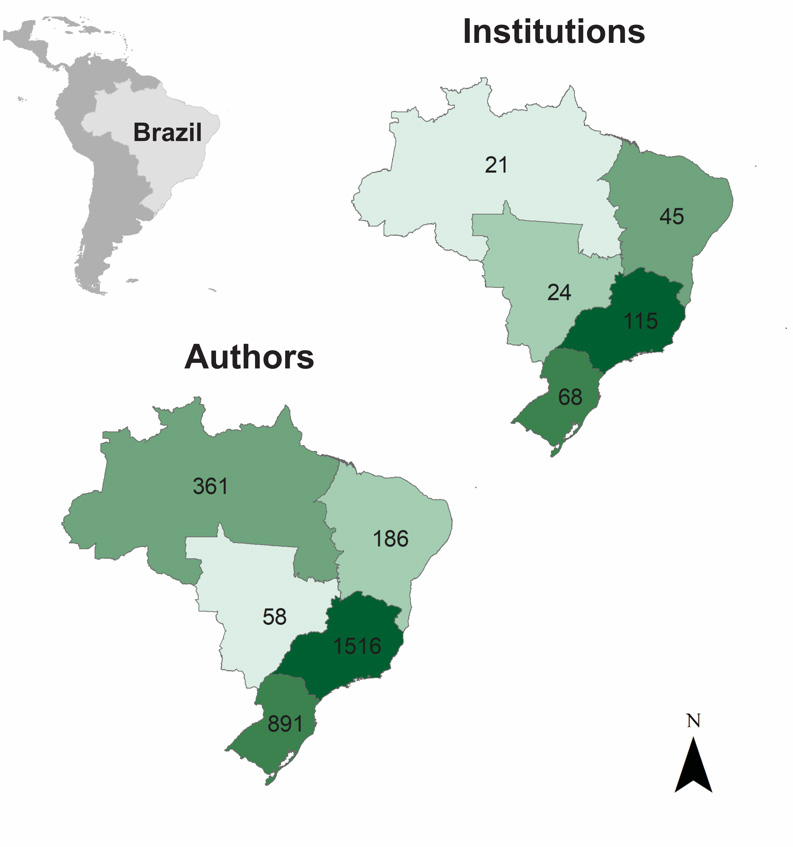
Figure 3.
Number of first authors and Institutions to which they are linked, found in the 3014 articles analyzed between 1994 and 2018, distributed in the five Brazilian regions (South, Southeast, Midwest, Northeast and North)
authors
Researches knowledge areas, nature and strands
Around 40% (n=1206) of all articles analyzed from the national production addressed science education as a unit. Physics education was the specific knowledge area most addressed on the articles, corresponding to 21% of the total (n=638), followed by mathematics education with 18% (n=533), chemistry education with 15% (n=451) and biology education with only 6% (n=186). Therefore, physics education has been the highest studied knowledge area of the science and mathematics education field in the last 25 years in Brazil. Mathematics and chemistry education were not far behind, showing an important growth over the years, which will be evidenced also in the results from the textual analysis. Biology was the least studied knowledge area in the analyzed period, not receiving much attention from researchers in the country. When analyzing only over the last four years, from 2014 to 2018, the proportion of articles from each area remained similar, with science education accounting for 39% (n=383) of all production, mathematics education for 19% (n=192), physics education for 18% (n=180), chemistry education for 17% (n=165) and biology for 7% (n=65). Yet, the production in the mathematics education area exceeded physics education in this period, presenting a slow movement of increase in this area, while the production in biology education remains far from the other areas of knowledge.
All studies from national production were categorized according to the nature of its research: theoretical essay, experience report or empirical research. Most (59%) of the articles analyzed were based on empirical research, followed by theoretical essays (24%) and experience reports (17%). The greater presence of empirical researches in the analyzed articles could be explained by the scope of the journals evaluated, which could be selecting more or only articles of this nature, and or by the type of study being conducted by the researchers publishing in those journals. Both options could be emphasizing a greater valuation of empirical researches by the scientific community in the field. As it is known, science has values and principles that regulate the knowledge produced and influence the evaluation and dissemination of scientific research (Lacey, 2004). In other words, in this case, empirical research could be receiving more attention than the other types of procedure because there are tacit values added to research of this nature that drive researchers and journals to value it more, which could even be understood as a future trend of the field. Even representing a smaller number (41%) of researches, theoretical essays (n=721) and experience reports (n=523) are important formats for the field. Theoretical essays, for example, present arguments, discussions and positioning of researchers on a theme, subjects or scientific concepts, addressing them from historical or philosophical perspectives, which has great impact on the field. In the same sense, articles which report experiences describe practices in the classroom and other aspects of teachers" training, which are key to thinking of teaching in different social contexts and in helping to develop a sense of community in the field.
In science and mathematics education, a space that brings together the scientific andpedagogicalperspectives, thereisaconcerntoeducateavalidscience, producedwithin the standards established by the scientific community. Educating, in this bias, is strongly related to attempts to legitimize a thought and science accepted by the community and society. In this context, we understand that scientific education is immersed in relations of power and knowledge, representative of a specific way of governing and educating people (Foucault, 2007). Research in science and mathematics education reproduces, at the same time as they produce, an educational model: since modernity, education has exposed ideas and models idealized by the State, such as understanding what the subject is and what are the roles that students play in society. There is a pedagogical project in the school that puts practices linked to power and justified by knowledge, which demonstrates an interest in education and its social function. The researches represent, within this context, a reinforcement of certain modes of investigation, discursive and thematic practices that, as we have shown, have been more valued by scientific journals. All articles from national production were also categorized in one of 15 research strands (Figure 4). Teaching and learning scientific concepts and processes (TLC) was the strand with most articles, with 739 (25%), followed by science teacher training (STT), with 585 (19%) and history, philosophy and sociology of science (HPS), with 451 (15%).
These 3 strands accounted for 59% of all articles, which emphasizes the greater attention that these three strands have received in the field in the last 25 years. The seven following strands with more articles presented similar number of articles (from 197 to 111). The five strands with fewer articles accounted together for only 8% of articles. They were: science assessment (SAE - n=65); diversity, multiculturalism, interculturality (DMI - n=60); theoretical and methodological issues of research (TMI - n=59); educational policies (EPE - n=42); and health education (HES - n=39).
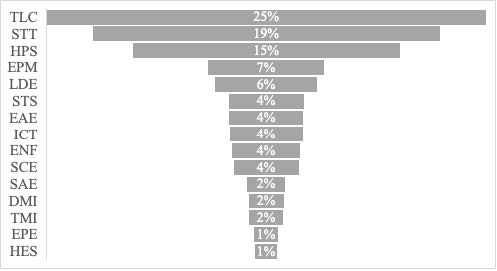
Figure 4.
Distribution of 3014 science and mathematics education articles in 15 thematic strands
authors
Note. teaching and learning scientific concepts and processes (TLC); science teacher training (STT); history, philosophy and sociology of science (HPS); educational processes and materials (EPM); languages and discourse (LDE); scientific and technological literacy, STS/STSE approaches (STS); environmental education (EAE); information and communication technologies (ICT); education in non-formal spaces and scientific divulgation (ENF); science curricula (SCE); science assessment (SAE); diversity, multiculturalism, interculturality (DMI); theoretical and methodological issues of research (TMI); educational policies (EPE) and health education (HES).
We then, crossed the results about knowledge areas, nature and strands of researches in our body of analyze, which showed that certain strands used more certain research formats. The nature of researches most adopted by the strands was empirical research. Only three strands presented higher number of articles using theoretical essays or experience reports, which indicates that the field is giving (has been giving) a greater attention to this type of procedure, regardless of the topics being addressed. The strands of science teacher training (STT), science assessment (SAE) and health education (HES) presented high numbers of articles than empirical research, 74%, 75% and 82%, respectively. On the other hand, more than half of the articles with the strands of both, history, philosophy and sociology of science (HPS - 58%) and theoretical and methodological issues of research (TMI - 51%), were theoretical essays. Almost half of the articles (47%) under the strand of educational processes and materials (EPM) and 34% under information and communication technologies (ICT) were experience reports. Thus, both strands (EPM and ICT) were commonly associated with articles which reported the outcomes of using didactical materials or teaching and developing practical experiments in the classroom.
As Foucault (2013) indicates, knowledge maintains a strict relationship with power, so scientific knowledge does not belong to a single institution or is outside political, economic, or ethical relationships. We consider that, in the case of our results for the different thematic areas in which the articles were classified, the area develops and organizes an apparatus with researchers, research groups, curricula, teaching materials around these areas. Therefore, the competence of researchers in science and mathematics education to analyze this different knowledge is attributed. Foucault (2007) shows us that these different thematic strands define the field as a domain of objects, a set of methods, a corpus of propositions considered true, a set of rules, definitions, techniques, and instruments. As themes, this knowledge can be controlled, have their theoretical references organized, delimiting a field of knowledge. In this understanding, we consider the institutionalization of these thematic aspects as a way of marking the educational and scientific discourse. It is in these publications that truths about the history and philosophy of science, for example, circulate. Therefore, this knowledge becomes circumscribed by an order of discourse and positivity that recognizes it as an academic prestige, while so many other thematic aspects are not recognized in the field, such as traditional knowledge. With the formation of a policy of truth, we believe that knowledge moves away from neutrality, as it is intricate in a network of power that makes it more accepted than others, and this also occurs with scientific knowledge. According to Foucault (2012), “every education system is a political way of maintaining or modifying the appropriation of discourses, with the knowledge and powers they bring with them” (p. 45 - authors translation).
Comparing research knowledge areas and nature, articles from biology education were based mostly on empirical researches (81%). The other areas also showed a high percentage of articles being based in empirical researches: 59% in each of science education and chemistry, 57% in mathematics and 53% in physics. The knowledge areas of chemistry and physics education stood out with 28% and 24%, respectively, of its articles based on the report of experiences, which could be explained by the nature of its subjects, deeply related to experimenting processes and materials. Science education and mathematics education areas both had 29% of their articles based on theoretical essays, followed by physics with 23%. Therefore, while research in biology education seems to focus its efforts almost entirely on empirical researches, the area of physics education seems to be more balanced, which could indicate a greater maturity of the knowledge area.
When comparing knowledge areas with strands, the results reinforced the prominence of three strands, which concentrated the higher number of articles, regardless of the area: teaching and learning scientific concepts and processes (TLC), science teacher training (STT) and history, philosophy and sociology of science (HPS). TLC was the most addressed in all knowledge areas (physics: 32%; biology: 31%; mathematics: 28%; science education: 18%) as well as chemistry (23%), where STT was the most addressed topic (24%). Mathematics education was the area where HPS appeared most (18%). Two topics where not addressed at all by Biology education: diversity, multiculturalism, interculturality (DMI) and educational policies (EPE), whereas this area concentrated the largest number of articles (3%) on health education (HES). In mathematics education, the science assessment (SAE) strand was the most frequent (4%), but education in non-formal spaces and scientific divulgation (ENF) and environmental education (EAE) appeared in only one article each. Physics education presented the greatest number of papers (11%) addressing educational processes and materials (EPM), as well as information and communication technologies (ICT) (7%), which were also largely address by mathematics education (6%). On the other hand, these two areas presented a low concentration of articles (physics: 2%; mathematics: 1%) dealing with the strand of scientific and technological literacy, STS/STSE approaches (STS). The science curricula (SCE) received more attention in mathematics (6%) and chemistry (5%). Finally, the strand of languages and discourse (LDE) was little addressed in articles from physics, mathematics and biology (4% each), but was expressively used in science education (7%) and even more in chemistry (9%).
According to Krasilchik (2004), researchers" investments in specific research areas are aligned with a field motivation to present proposals and techniques to solve current problems, such as overcoming traditional teaching. In fact, one of the most important requirements for the qualification of science teaching is the requirement of scientific and pedagogical training of teachers, and in Brazilian degrees, there is an emphasis on specific training in areas, whether biology or mathematics and pedagogical complementation, notably at the end of undergraduate courses. This thematic orientation of the field indicates an effort, undertaken mainly by researchers, both in qualifying classroom practice in the exploration of theoretical and didactic resources and in the relations between science and society. That is, there is an investment in researching what and how we teach.
Textual Analysis of titles, abstracts and keywords
In this section we present the textual analysis conducted with the titles, abstracts and keywords of the 3014 articles analyzed as being of national production. The terms more used in the titles of articles in the field in the last 25 years were "teaching" and "science" (fig. 5). The words "education", "chemistry", "mathematics" and "physics" were also very frequent, which indicates that researchers commonly used the titles to define the field and knowledge area where the work is centered. Other words as "formation", "teacher" and "secondary" also appeared among the 10 most frequent words, often inside terms such as "teacher formation" or "secondary school". These results indicate that investigations about teachers, their formation and secondary school have been at the center of Brazilian research in recent years.
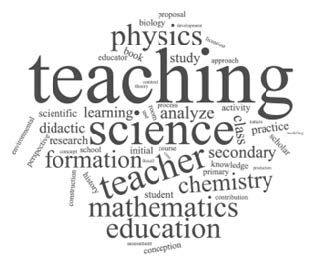
Figure 5.
Word cloud with the 50 terms that appear most frequently in the titles of the 3014 articles of science and mathematics education in Brazil
authors
The word "history" was also among the most frequent words used in titles, which indicates the investigations of historical narratives in the field (Figure 5). Other frequent words were: (i) "environmental", often used in reference to Environmental Education, which points to the emergence of the field; (ii) "book", which indicates the textbook as a tool of researchers" interest; and (iii) "analysis", associated with scientific research methods, often used as "analysis of " associated with empirical materials under investigation. Between the 50 words most cited in the titles were terms that could be considered as scientific markers: "practice", "research", "scientific", "development", "production", "construction" and "theory". These words are sometimes used by researchers as a way to associate their publications with subjects that are receiving great attention from the scientific community or that are related to tacit values that scientific research fields associate with, such as logic, methods, and applicable results. In this way, their manuscripts may be accepted in more important journals, be noticed and shared on a greater scale by the academic community, indicating that there is a "confirmatory bias" (i.e., a tendency to emphasize and believe experiences that support one"s views and to ignore or discredit those which do not) in the field (Mahoney, 1977).
One of the effects of the acceptance and circulation of certain discourses is the naturalization of certain practices, which come to be understood as traditional. In the field of science and mathematics education, we can perceive certain discourses that are accepted as a natural activity, such as historical narratives and environmental education. Therefore, it is important to think about how these practices are consolidated as something usual and what effects this composition of different discourses has in the field. In the analyzed articles, it was possible to perceive that there is a repetition of themes, as is the case of teacher training and textbooks. For these topics to appear in science and mathematics education, as well as being sources of research and production, they need to enter an order of discourse (Foucault, 2012). In other words, the themes found in these discussions are present in journals with wide circulation in Brazil, as they are inscribed in a discursive order that accepts these themes as possible practices.
In the abstracts, words such as "teaching", "work", "study", "objective", "proposal" and "approach" appeared frequently among the 40 most common terms, in all the four periods analyzed: 1994 to 2000, 2001 to 2007, 2008 to 2013 and 2014 to 2018 (Figure 6). Although these words have changed positions over the years, these changes were small. For example, the word "science", as expected, remained among the four most used terms in abstracts (between 2nd and 4th position) during all periods analyzed. Similarly, scientific markers also appeared between the 40 most commonly used words in the abstracts, such as "analysis", "result", "content", "problem", "conceptions" and "perspective". Some of these words were recurrent not only in titles but also in abstracts, and became more frequent over the years such as "research", "data" and "investigation". On the other hand, although the school is the place where the formal teaching takes place, this word only appears in two of the four periods analyzed, 2001 to 2007 and 2008 to 2013, and in the last positions (38th and 31st, respectively). The school represents an important idea for a field that researches educational themes, mainly because the teaching and learning process takes place in the classroom, which should certainly be a space of intense scientific production and analysis (Gil-Pérez, 1996). Far from it, our results suggest that the school has not been the main subject of Brazilian researchers in science and mathematics education.
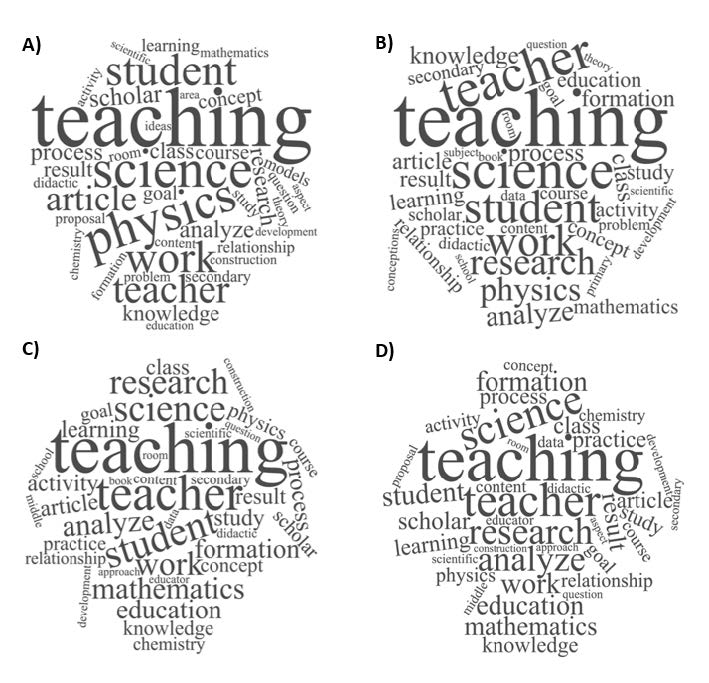
Figure 6.
Word cloud with the 40 most used terms by researchers in the 3014 abstracts that address science and mathematics education, separated into 4 sets: A) 1994 to 2000; B) 2001 to 2007; C) 2008 to 2013 and D) 2014 to 2018
authors
On the contrary, other words changed their positions among the most used terms significantly over the years. For example, the word "mathematics" was the 30th most used word in abstracts between 1994 and 2000, but became more frequent in the following years (10th in the last period). The same occurred with the word "education", which changed from the 38th position in the first period analyzed to the 9th position in the last period, and "physics", which were the third most used word in abstracts between 1994 to 2000 but lost positions over the years. "Chemistry", in turn, was not even among the 40 words most used in abstracts between 2001 and 2007, but occupied the 24th position from 2008 to 2013. "Biology" never appeared between the 40 words most used in abstracts during the whole period analyzed, occupying the following positions 283rd, 65th, 76th and 81st consecutively. These results corroborate with the ones presented above, which suggest that some knowledge areas have received far more attention them others in research from science and mathematics education in Brazil over the years. Whereas physics education has shared its protagonism with chemistry education in the field over the periods analyzed, biology is not yet a prominent knowledge area in investigations.
The word "formation" has already between the most used in abstracts in the first period analyzed (32nd position) and reached the 7th position in the last period. This word often appeared in our data close to the words "teachers" and, less frequently, "students", which reinforced the suggested concern of science and mathematics education researchers with teachers and student"s formation. In this context, "formation" is often used by researchers as the formal instruction, based on a specific knowledge, required to exercise a certain activity, noticeable in the terms such as "formation of scientists", "professional formation" and "formation of individuals" which are examples used in this sense. However, there are also cases in which the word "formation" is related to an ideal, principle or value, such as "formation of a worldview", "citizen formation" and "critical formation", arguing from a specific way to teach students and train teachers and the application of this demand to the educational process. The word "book" was frequently used in abstracts over the whole period analyzed, but specially between 2001 and 2013, which indicates the importance of textbooks as materials analyzed by researchers over the last 25 years.
Finally, between the keywords most used in the national production of the field in recent years (1994–2018) were "teaching", in accordance with titles and abstracts, followed by "science" and "education" (Figure 7). The word "education" was not only used to describe the field, such as in science education and physics education, but to refer to teaching itself, such as in "quality education" and "education research". The words "mathematics", "physics", "chemistry" and now "biology" also appeared between the most frequent words used. It is noteworthy that other words frequent in titles and abstracts, such as "formation", "teacher", "book" and "environmental" (related to "literacy", "awareness", "issues", "law" and "dimension") also stood out.
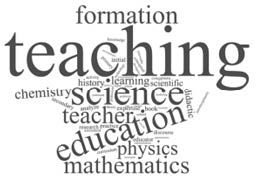
Figure 7.
Word cloud with the 50 most used expressions in the keywords of the 3014 articles of science and mathematics education analyzed from 1994 to 2018
authors
Some words appeared for the first time as most frequent, such as "learning" (9th position), "history" (10th), "discourse" (22nd) and "curriculum" (24th position). The word "discourse" appeared related to "teachers", "classroom", "scientific", "analysis" and "pedagogical". These results indicate that although some subjects are not the main topics being addressed in the research, they are being used as frameworks, methods or as orientation for the research and the researchers are highlighting them as keywords. This is also the case of "evaluation", "divulgation", "modelling" and "experimentation".
We understand that how science and mathematics are taught is linked to the concepts of science, which are already agreed upon, and we start from them to propose a model of teaching. That is, we research and analyze how to teach science, but we question science less, even though, as we have already highlighted, the history and philosophy of science is a line of interest for investigations and the space, a priori, for this discussion. However, this bias still follows historical linearity, in which there is an evolutionary perspective of knowledge, that is, we are, with scientific and technological advances, generating more and more new knowledge. At the same time, we understand science and mathematics education as a space in which pedagogical and scientific discourses meet, leading to a specific approach to educational theories to teach science, which becomes a characteristic of the field according to the results of the textual analysis.
We understand that investigating research in science and mathematics education is a way of questioning scientific truths, as well as understanding the processes of construction of educational and scientific knowledge in Brazil. The field of science and mathematics education brings together scientific and pedagogical knowledge and, therefore, represents a way of teaching that also reproduces characteristics of science, as shown in our results. We understand that we need to move away from a linear understanding of history, traditional issues, structured methods, homogenizing categories, and universalities in order to critically understand the production of knowledge in the field (Foucault, 2007). We believe that to problematize science teaching and its practices, we need to gather knowledge from different fields, with different knowledge, to explore and compare other analyzes for the problems of the field. We base this choice on the diffusion that science and education reach in today"s society, as it is not difficult to see how much living in society today presupposes a very close contact with science and technology and this directly impacts the role of science education in this context.
Researching a field of knowledge from Foucault"s theoretical and methodological perspective is to put into practice a thought that crosses different fields of knowledge. Foucault (2012) demonstrates how a critical investigation is considered a way of questioning our relationship with the truth, why we believe it is true and what are the reasons for this attitude. In our analysis, we consider that the discourse published in scientific journals by researchers in the field is being presented as truth for teaching, especially from some themes that have gained prominence over time, such as environmental education and textbooks. In any case, the themes that gained more relevance reinforce the presence of certain discourses in the field. As they are recurrent objects in research, they build a type of science, which we understand here as a producer of truths. Thus, when we observe, in the midst of our results, this demand for literacy in science or for another structuring axis, we understand that these proposals go through a process of social pedagogization. In fact, these demands show growth, with science teaching as the vanguard in this action, to bring science closer to society. Education reflects institutional discourses that make promises and commitments to form critical subjects that are able to promote changes in society. This commitment to education produces a constant commitment to the training of these students, in the obligation that science teaching will be able to meet these expectations, which has repercussions on our results.
Foreign production in Brazilian Journals of Science and Mathematics Education (1994–2018)
We categorized 584 publications about science and mathematics education from the period analyzed as foreign production (i.e., published in a foreign language or with the first author being from a foreign Institution). The largest number of foreign articles (23%, n=137) was found in the journal Bolema: Boletim de Educação Matemática and then in Investigações em Ensino de Ciências (18%, n=104). Some journals presented very low numbers of publications, such as Química Nova na Escola (n=8) and Ciência & Ensino (n=2). Between 1994 and 2000 no more than 13 foreign articles were published per year in the journals analyzed. From 2001 onwards, foreign production increased and reached its highest number of publications in a year in 2014 (n=69).
We found 232 different Institutions related to the first authors of a foreign production (n=584). Ten Institutions concentrate 31% of all foreign authors, being the National University of Central Buenos Aires (Argentina, n=27), Pedagogical Experimental University Libertador (Venezuela, n=27) and the National University of Tucumán (Argentina, n=25) as the ones related to more authors. The Aalborg University, in Denmark, is the first foreign Institution which has English as its first language to appear in the ranking, with only five authors. When analyzed the distribution of these Institutions worldwide (fig. 8), it is possible to see that most countries with researchers publishing in Brazilian journals are from countries in America (56%, n=329). Argentina, Brazil (authors who published in foreign language) and Chile are the main ones. Countries in Europe accounted for 40% (n=233) of all authors, with Spain and Portugal presenting the highest numbers, followed by France, Germany and the United Kingdom. Fourteen authors were from Asia, four from Africa and four from Oceania. On the same way, Spanish (48%) was the most common language used in the foreign manuscripts, followed by English (28%) and Portuguese (from Brazil and Portugal, 23%).
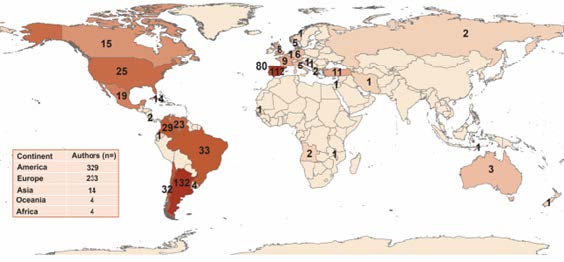
Figure 8.
Worldwide distribution of the 584 first foreign authors who published in Brazilian journals on science and mathematics education from 1994 to 2018
authors
Nowadays, the internationalization of scientific journals is desired by the scientific Institutions of a country, since it can contribute to increase the visibility and appreciation of researches produced in the country, increasing international cooperation (Trzesniak, 2000). This is the case of the CAPES foundation, responsible for the evaluation of journals in Brazil, which measures as indicators of Brazilian journals internationalization a set of variables, such as the number of articles published in foreign language (e.g., English, Spanish, French), the number of citations by international journals and the number of publications by foreign researchers. According to a survey conducted by the Scientific Electronic Library Online hosting portal, the internationalization of Brazilian journals is very recent (Scielo, 2017), because a key requirement for this process is to master the English language, the common language of the scientific community. Still, it is not enough to be able to read, but it is also required to be able to write and speak English well, skills which are still impediments to the internationalization of many fields in Brazil (Fradkin, 2017). There are also challenges to internalization requirements about high quality standards of research, partnerships with foreign authors and editors and reviewers able to support this process (Trzesniak, 2000). This may explain why few Brazilian journals in the field of science and mathematics education are being successful in publishing foreign articles, why so few countries which have English as their first or second language are publishing in these journals and why Spanish is the most common language. It is essential to interrogate these relationships between the publication of articles and the acceptance of a specific language, to perceive them as a social and historical product, organized in networks of power, which establish methods, knowledge, truths and, at the same time, determine who can produce scientific knowledge and feel like a researcher.
Eighty-six percent of all foreign articles had only one author. According to Trzesniak (2000), it is common for a foreign researcher or research group, recognized among peers, to be invited by the editors of a journal to publish in their journal to bring attention to the journal and encourage the publication of foreign authors. This could explain the high number of articles written by only one researcher. The 14% of articles with more than one author presented both, authors from the same Institutions or partnerships between different Institutions and countries. It is noteworthy that a Brazilian researcher was the one who most published articles (n=25) in this category of foreign production, both in foreign language and in partnership with foreign authors as first authors, which may indicate that journals are supporting publications of Brazilian authors in partnership with foreigners or in foreign languages to achieve internationalization. Among the 100 researchers who published three times or more in the last 25 years under the foreign category, 52% were men. However, contrary to what was seen in the analyses of the national production, among the 25 researchers who published most articles, six times or more in the last 25 years, women were the majority (64%).
Based on our results, it is possible to affirm that the foreign production in Brazilian journals of science and mathematics education are strongly related with Latin America countries and Portugal and Spain, probably due to geographical and or language proximity. The presence of 33 Brazilian authors in this category shows that some Brazilian researchers are choosing to publish their investigations in a foreign language (Fradkin, 2017). The constant presence of the English language in science is linked to the legitimacy and guidance of scientific actions for what should and for whom should speak. Science coordinates strategies for its own legitimation and builds barriers, such as language, so that its production and operations are restrictive. Scientific discourse produces and distributes its products, determines their truths, and guarantees legitimacy, a status of veracity accepted in society. The teaching of science and mathematics understood as a pedagogy that guides ways of relating to scientific knowledge, produces a practice that is supported by this circulation and acceptance of this discourse in society. From this perspective, discourse is understood as a practice that is present in society and in the construction of subjects, as well as established in the relations between knowledge and power (Foucault, 2013). We show, therefore, that in the field of science and mathematics education there is a growing number of publications in a foreign language. This investment in foreign publications suggests the development of scientific training adequate to international standards and a need to exercise a model of citizenship that reinforces a specific discourse of construction of a way of being a subject in society.
Final Considerations
Based on Foucauldian theorization, the discourses of researchers in science and mathematics education were analyzed. With this exercise, we describe the conditions of the possibility of emergencies and events in the field, using the tools that allowed us to read this archive. With this research, we try to develop a critique of the production of scientific knowledge in the field of science and mathematics education. According to Foucault (2007), even if we are governed in one way, in the midst of dominant knowledge and powers, the refusal or resistance to these impositions would consist of a critical attitude. That is, by detaching thought from the formal structures that we face in science and mathematics education, for example, we can face other possibilities and answers to what is considered already naturalized, considered essential for the field. “In short, it is about transforming the criticism exercised in the form of the necessary limitation into a practical criticism in the form of a possible transgression” (Foucault, 2013, p. 574 — authors translation).
It is possible to affirm, from the investigation of the articles published in the 10 best-rated journals of Brazil about science and mathematics education, that publications, both in national and foreign production, have increase in the last 25 years. The national production of the field showed to be mainly led by male researchers working on public Universities from the Southeast region of Brazil. The knowledge area which received most attention over the analyzed period was science education in a broad sense, followed by physics education, while biology received very little attention. A large percentage of the analyzed articles were based on three strands: teaching and learning scientific concepts and processes (TLC), science teacher training (STT) and history, philosophy and sociology of science (HPS), and almost none dealt with diversity, multiculturalism, interculturality (DMI) and educational policies (EPE). These discursive mechanisms are organized, fundamentally, from the figure of experts, who are linked to higher education institutions and regulate the true discourse of science and mathematics education. These discourses produce notions about what a biology class should be like, what it means to be a teacher or student, and what spaces are possible to occupy. These practices manufacture a norm, favor some actions over others and create an identity as a parameter for what it is to teach, for example. Therefore, it is important to question these discourses, as there are knowledge, content, methodologies, theories, and references naturalized in this field and, while enjoying acceptance, they leave out other possible perspectives.
The titles of Brazilian studies commonly named the specific knowledge area addressed on the study. The subjects "teacher formation", "research on secondary school", "textbook" and "environmental education" were the main topics used in the titles of the analyzed articles, which could be assumed as being the main topics addressed by the studies in the field over the last 25 years. The analysis of the words used on abstracts in different periods revealed that words such as "teaching" and "physics" became less common over the years, while words such as "formation" and "teacher" became more frequent in the field. Surprisingly, the word "school" was rarely among the most frequent words used over the whole period analyzed, which indicates that this expression is not being used by researchers in their discourse. We understand that there is a position for researchers to associate their production with scientific markers. This attitude could be related to the tacit values that scientific research has, such as acceptance, rigor and applicable results, which would be noticed and shared by the researchers in the field. This textual analysis provided a robust vision of how concepts, subjects and knowledge areas have gained or lost prominence over the years in the field, and, ultimately, how the field and its discourses have changed.
As to the concern of foreign production, there has been an increase in the number of publications over the last years, specially between 2014 and 2018, which could indicate that some journals are direction their efforts to reach internationalization. However, many journals are not publishing foreign articles with periodicity. Most foreign production in the last 25 years was related to countries in Latin America, Portugal and Spain, suggesting a close relation based on linguistic and geographical similarities. Although publications in English have increased, especially in the last years, they are still far from leading in the language of foreign publication. Low levels of collaboration between Brazilian and foreign researchers were also found. In this sense, if, as expected, the journals continue to pursue national policies for internationalization, the difficulty of researchers in publishing articles could increase, especially due to the requirements of English-language publishing, resulting in the hierarchization of the community of authors and in many other effects in the field (e.g., low diversity of research strands, concentration of researches in a few institutions and authors).
The analysis of the national and foreign production enabled us to reveal the main ideas addressed by the researchers and provide an overview of how the scientific production of science and mathematics education in Brazil developed in the last 25 years. The recurrence of some themes in the researcher"s discourses to the detriment of others, over time, reinforces the need to analyze these discourses to understand how the field has been constituting and focusing on some problems, while others receive less analytical attention. The analytical tool developed was essential to scrutinize the argumentative frameworks used by the researchers, and to guide us through the ideas and concepts present in the articles. Therefore, it is essential to think of science and mathematics education as an inherently social process, in which non-epistemic elements such as values, professional interests, and economic pressures play a decisive role in the genesis and consolidation of some scientific and educational themes. The empirical source used made it possible to have a broad knowledge of the scientific literature produced, understand how the field has been structured and indicate future paths. In this sense, two ideas stand out: i) the existence of a scientific community in the field, with actors and institutions recognized as scientific authorities which establish hierarchies and ii) the presence of scientific markers, values and principles recognized and shared by the community of researches which influence the evaluation and dissemination of scientific research in the field.
Acknowledgments
The authors would like to thank the School of Education of the University of São Paulo for their support, as the host institution, in carrying out this research. This work was supported by the Research Support Foundation of the State of São Paulo (FAPESP, in Portuguese) through the processes 2015/21926-4 and 2017/07630-0.
Referências
Almeida, M. J. P. M. D. (2012). Meio século de educação em ciências: Foco nas recomendações ao professor de física. Livraria da Física, USP.
Bourdieu, P. (1983). O campo científico. In R. Ortiz (Ed.), Pierre Bourdieu: Sociologia(pp. 122–155). Ática.
Bourdieu, P. (2004). Usos sociais da ciência: Por uma sociologia clínica do campo científico. Editora UNESP.
Cachapuz, A., Paixão, F., Lopes, J. B., & Guerra, C. (2008). Do estado da arte da pesquisa em educação em ciências: Linhas de pesquisa e o caso ‘Ciência-Tecnologia-Sociedade’. Alexandria: Revista de Educação em Ciência e Tecnologia, 1(1), 27–49. https://periodicos.ufsc.br/index.php/alexandria/article/view/37408
Canino, M. V., & Vessuri, H. (2008). La Universidad en Femenino: Un cuadro de luces y sombras en la UCV. Arbor, 184(733), 845–861. https://doi.org/10.3989/arbor.2008.i733.229
Corrêa, G. N., Marcacini, R. M., & Rezende, S. O. (2012). Uso da mineração de textos na análise exploratória de artigos científicos — Relatório Técnico para o Instituto de Ciências Matemáticas e Computação da USP. Instituto de Ciências Matemáticas e Computação da USP. http://repositorio.icmc.usp.br//handle/RIICMC/6631
Feres, G. G. (2010). A pós-graduação em Ensino de Ciências no Brasil: Uma leitura a partir da teoria de Bourdieu (Tese de Doutorado, Universidade Estadual Paulista Júlio de Mesquita Filho, Bauru, São Paulo). Repositório Institucional UNESP. https://repositorio.unesp.br/handle/11449/102050
Ferreira, M. S. (2007). Como investigar a história da pesquisa em ensino de Ciências no Brasil? Reflexões teórico-metodológicas. In R. Nardi (Ed.), A pesquisa em ensino de ciências no Brasil: Alguns recortes (pp. 453–464). Escrituras.
Foucault, M. (2007). As palavras e as coisas: uma arqueologia das ciências humanas(9ª ed.). Martins Fontes.
Foucault, M. (2012). A ordem do discurso - Aula inaugural no Collège de France, pronunciada em 2 de dezembro de 1970 (24ª ed.). Edições Loyola.
Foucault, M. (2013). Arqueologia do saber (8ª ed.). Forense Universitária.
Fradkin, C. (2017). The Internationalization of Psychology Journals in Brazil: A Bibliometric Examination Based on Four Indices. Paidéia, 27(66), 7–15. https://doi.org/10.1590/1982-43272766201702
Gil‐Pérez, D. (1996). New trends in science education. International Journal of Science Education, 18(8), 889–901. https://doi.org/10.1080/0950069960180802
Groenwald, C. L. O., Silva, C. K. da, & Mora, C. D. (2004). Perspectivas em Educação Matemática. Acta Scientiae, 6(1), 37–56. http://www.periodicos.ulbra.br/index.php/acta/article/view/129
Kawamura, M. R. D., & Salem, S. (2008). Ensino de física no Brasil: Dissertações e teses (1996–2006) catálogo analítico. https://fep.if.usp.br/~profis/arquivo/catalogos/Catalogo_1996-2006.pdf
Krasilchik, M. (2004). Prática de Ensino de Biologia (4ª ed.). EdUSP.
Lacey, H. (2004). Is Science Value Free? Values and Scientific Understanding. Routledge.
Mahoney, M. J. (1977). Publication prejudices: An experimental study of confirmatory bias in the peer review system. Cognitive Therapy and Research, 1(2), 161–175. https://doi.org/10.1007/BF01173636
Megid-Neto, J. (2007). Três décadas de pesquisas em educação em ciências: Tendências de teses e dissertações (1972–2003). In R. Nardi (Ed.), A pesquisa em ensino de ciências no Brasil: Alguns recortes (pp. 341–355). Escrituras.
Mortimer, E. F. (1996). Construtivismo, mudança conceitual e ensino de ciências: Para onde vamos?. Investigações em Ensino de Ciências, 1(1), 20–39. https://www.if.ufrgs.br/cref/ojs/index.php/ienci/article/view/645
Nardi, R. (2005). A área de ensino de Ciências no Brasil: Fatores que determinaram sua constituição e suas características segundo pesquisadores brasileiros. Revista do IMEA- UNILA, 2(2), 13–46. http://hdl.handle.net/11449/135432
Nardi, R. (2007). A pesquisa em Ensino de Ciências no Brasil: Alguns recortes. Escrituras.
Osada, N. M., & Costa, M. C. da. (2006). A construção social de gênero na Biologia: Preconceitos e obstáculos na biologia molecular. Cadernos Pagu, (27), 279–299. https://doi.org/10.1590/S0104-83332006000200011
R Core Team. (2018). R: A language and environment for statistical computing. https:// www.Rproject.org/
Salem, S. (2012). Perfil, evolução e perspectivas da pesquisa em ensino de física no Brasil (Tese de Doutorado, Universidade de São Paulo, São Paulo, São Paulo). Biblioteca Digital de Teses e Dissertações da USP. https://teses.usp.br/teses/disponiveis/81/81131/tde-13082012-110821/pt-br.php
Schnetzler, R. P. (2002). A pesquisa em ensino de química no Brasil: Conquistas e perspectivas. Química Nova, 25(supl. 1), 14–24. https://doi.org/10.1590/S0100-40422002000800004
Scielo. (2017). Critérios, política e procedimentos para a admissão e a permanência de periódicos científicos na Coleção SciELO Brasil. https://wp.scielo.org/wp-content/uploads/20171000-Criterios-SciELO-Brasil.pdf
Slongo, I. I. P. (2004). A produção acadêmica em ensino de biologia: Um estudo a partir de teses e dissertações (Tese de Doutorado, Universidade Federal de Santa Catarina, Florianópolis, Santa Catarina). Repositório Institucional da UFSC. https://repositorio.ufsc.br/xmlui/handle/123456789/88012
Teixeira, P. M. M. (2008). Pesquisa em Ensino de Biologia no Brasil (1972–2004): Um estudo baseado em dissertações e teses [Tese de Doutorado]. Universidade Estadual de Campinas, Campinas, São Paulo.
Trzesniak, P. (2000). A concepção e a construção da revista científica. II Encontro de Editoração Científica e Cultural/IV Feira Pan-Amazônica do Livro (pp. 21–34), Belém, Pará.