Carátula del artículo
Meaning in life, likelihood of forgiveness, and religious faith in adults
Sentido de vida, probabilidad de perdón y fe religiosa en adultos
 Luz Angelica Edquén Orrillo luzedquen@upeu.edu.pe
Peruvian Union University, Perú
Gerson Venturo Lopez
Peruvian Union University, Perú
Sintia Salas Tuanama
Peruvian Union University, Perú
Jessica Aranda Turpo
Peruvian Union University, Perú
Joel Palomino Ccasa
Peruvian Union University, Perú
Revista Eugenio Espejo, vol. 19, núm. 3, pp. 36-53, 2025
Universidad Nacional de Chimborazo
Recepción: 19 Marzo 2025
Aprobación: 01 Julio 2025
INTRODUCTION
In Peru, the most frequently diagnosed mental health problem is anxiety, affecting 28.81% of the population, followed by depression, at 17.57 %. Both disorders are most common in the adult population (35.18 %) and young people (22.17 %). (1)
From a psychological perspective, both depression and anxiety are often related to difficulty finding a purpose in life; (2) this situation negatively impacts physical, psychological, emotional, spiritual, and social well-being. (3)
In this framework, human beings are constantly seeking coherence, meaning, and purpose that allows them to give meaning to their existence. (4) Such search is conceived as an inherent need of the individual, which can be developed both individually, (5) and in interaction with their social environment (6,7) In this sense, the purpose fulfills the function of guiding integral growth (8) and is expressed through optimism, faith, spirituality, (9) as well as hope, responsibility and proactivity, (10) constituting a key motivational factor to achieve goals and strengthen decision making. (11)
On the contrary, when a person lacks a sense of purpose in life, the risk of developing various psychological disorders increases (2,12), such as noogenic neurosis (13), suicidal behavior, addiction to smartphones (14), or online games. (15) In addition, they may adopt dysfunctional values (10) and experience existential voids characterized by pessimism, hopelessness, and conformism (16), which limits their ability to make positive changes in their lives. (17) Likewise, people who have grown up with absent parents tend to face greater difficulties in finding a sense of purpose in life as adults, as they often experience deep feelings of loneliness. (18)
In this regard, a study conducted in Poland revealed that experiencing God's presence plays a significant role in building meaning in life. (19) Similarly, it was shown that this experience is positively and significantly associated with the search for life purpose. (20)
On the other hand, in Australia, it was found that religious faith has a favorable effect on youth, directly influencing their personal growth. (21) During this period, young people explore their place in the world, trying out different roles they would like to play; however, they often face events that can transform their lives positively or negatively. (9)
In this context, religion emerges as an integral component, (11) fulfilling various essential functions (22) through which young people can find a profound meaning in their existence. (23) Indeed, religious faith plays a vital role in psychological well-being, (24) as it acts as a coping mechanism that provides hope and guides the definition of life goals. (25)
Likewise, religiosity is related to the capacity to forgive and is closely connected to the meaning of life. (5) Forgiveness, conceived as a conscious decision, allows us to free ourselves from negative emotions (26) and promotes reconciliation, creating opportunities to overcome bitterness and foster healthy interpersonal relationships. (19) In this way, the willingness to forgive could constitute a bridge between religious faith and the meaning of life. (23)
In Spain, research has shown that forgiveness, spirituality, and religiosity are associated with the design of effective psychological interventions aimed at enhancing personal well-being. (27) In contrast, when the willingness to forgive is low, an increase in guilt levels is observed. (28)
The present study analyzed these variables in a specific age group, thereby expanding knowledge in a field that has so far received little attention. The results and conclusions obtained will serve as a basis for future research, thereby contributing to the development of studies at regional, national, and international levels.
Therefore, the objective of this study is to determine whether the likelihood of granting forgiveness and religious faith predict the meaning of life among young people and adults in the San Martín region.
METHODOLOGY
This research is of an empirical, non-experimental type, employing an associative approach, specifically a cross-sectional predictive study, as the functional relationship between variables was analyzed to predict a criterion variable from one or more factors. (29)
For participant selection, non-probability convenience sampling was used, selecting participants deemed most suitable by the research team. The inclusion criteria were: being between 18 and 30 years old, belonging to a Christian religion, and completing the entire questionnaire. Those who did not meet the established age range and those who were foreigners were excluded.
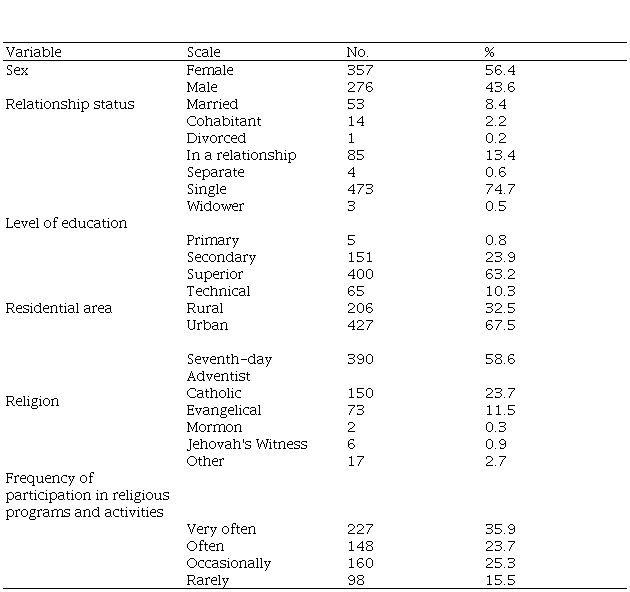
A total of 756 young people and adults from the San Martín region were surveyed. Of these, 69 did not profess any religion, 31 were outside the age range, and 23 decided not to participate in the study, resulting in a final sample of 633 people. 56.4 % of the participants were women between 18 and 30 years old (M = 21.5; SD = 3.5). The majority were single (74.7 %), had higher education (63.2 %), resided in urban areas (67.5 %), and identified as Seventh-day Adventists (58.6 %). Furthermore, 35.9% of participants frequently attended religious programs and activities.
Table 1
Participant characteristics
The Meaning of Life (MLQ) instrument was used, developed in the United States by (30), and adapted for use in Spanish in Argentina. Additionally, it was adapted and validated for use with young people and adults aged 18 to 40 in Peru. (32)
This questionnaire consists of ten items, presenting seven Likert-type response categories, from 1 to 7: 1) Absolutely false and 7) Absolutely true. They are composed of two dimensions: the presence of meaning and the search for meaning. Regarding its psychometric properties, the scale has validity based on its internal structure (CFI = 0.95, TLI = 0.92, RMSEA = 0.09), and it presents adequate levels of internal consistency for the dimensions of presence of meaning (α = 0.78) and search for meaning (α = 0.80).
In addition to the scale of probability of forgiveness, created by Rye, Loiacono, Folck, Olszewski, Heim, and Madia. (33) in Argentina. Adapted and validated in Peru by Caycho Tet., al (34) for young people aged 16 to 30, it consists of 8 items and is unidimensional. It presents a Likert-type score with 5 response categories, ranging from 1 ("not at all likely") to 5 ("completely likely"). The instrument showed validity in its internal structure with the following results: χ2 = 35.133, gl = 18; χ2/df = 1.952; CFI = .988; RMSEA = .044 [90% CI .021, .065]; SRMR = .0266; and AIC = 71.133. and reliability, as indicated by the omega coefficient of 0.83.
The Saint Clare Strength of Religious Faith Questionnaire, created by Plante, Boccaccini (35) adapted for Peruvian adolescents and adults by, (36) is unidimensional consisting of 10 items with 4 Likert-type response options, ranging from 1 ("totally disagree") to 4 ("totally agree"), who reported favorable results in terms of validity (χ2 = 67.10; gl = 35; p = 0.001; CFI = 0.99; TLI = 0.99; RMSEA = 0.089) and reliability (α = 0.98; ω = 0.98).
For data processing, Microsoft Excel was used for data treatment, including recoding, eliminating missing data, and calculating variables. Additionally, IBM SPSS Statistics V.29.0 was used for variable correlation, and Jamovi (v.1.2.2t7) was used for linear regression.
First, a goodness-of-fit test was performed to assess the normality of the data, using the Kolmogorov-Smirnov-Lilliefors (KSL) test, a modification of the Kolmogorov-Smirnov test that is recommended due to the latter's limitations, such as the tendency to over-accept the null hypothesis. (37)
Subsequently, Pearson's correlation coefficient was used, since the variables presented a normal distribution. (38)
The research was approved by the Ethics Committee of the Faculty of Health Sciences at the Peruvian Union University, following Resolution No. 0108-T-2024/UPeU-FCS-C. Data collection was conducted using online forms. In the first part, participants were informed of the research objectives. They were also asked for their informed consent. Their participation was voluntary, and they could stop answering the questionnaires at any time if they did not wish to continue. The data were treated confidentially and anonymously and used exclusively for the present research. The authors of this research declare no conflicts of interest.
RESULTS
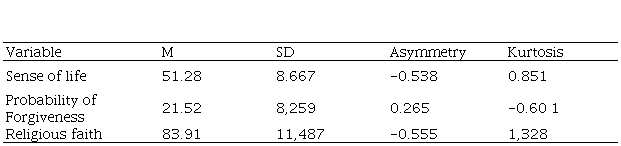
The descriptive analysis of the study variables is presented below. The skewness and kurtosis coefficients of the variables indicate that the sample is parametric, as they do not exceed the range of ±1.5. (39)
Table 2
Descriptive analysis of the variables
Regarding the difference according to sex, there are statistically significant differences between meaning of life (M=52.04) (t = -2.5, p = 0.01) and religious faith (M=84.74) (t = -2.07, p = 0.03) where women have a higher mean with a weak effect size, however, no significant difference was found according to sex in the probability of forgiveness (d = -0.2; -0.1).
Table 3
Differences between the meaning of life, the likelihood of forgiveness, and religious faith by sex
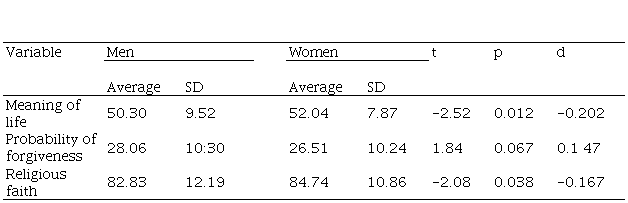
t-value (Student's t statistic), p-value, cohen’s d (effect size) for D1.
The results of the correlation analysis show a positive and significant relationship between variables related to meaning in life, likelihood of forgiveness, and religious faith. The effect size between meaning in life and religious faith (r = 0.879; p>*) is significant, while the effect size between likelihood of forgiveness and religious faith (r = 0.199*) is small.
Table 4
Felt correlation of life, probability of forgiveness, and religious faith
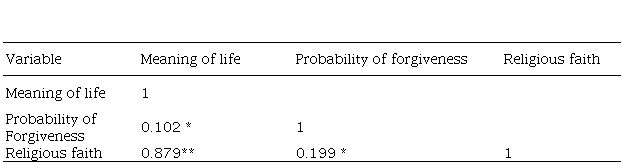
*. The correlation is significant at the 0.05 level (two-tailed).
**. The correlation is significant at the 0.01 level (two-tailed).
The results of the linear regression analysis indicate a satisfactory fit of the model (F test = 2149.388, p < 0.000b), in which religious faith (β = 0.879, p < 0.000) significantly predicts the meaning of life of participants in the San Martín region (adjusted R 2 = 0.773). The R-squared value indicates that the regression model has a high effect size, that is, religious faith predicts 77 % of the meaning of life. Furthermore, the t-values of the beta regression coefficients for the predictor variable are highly significant (p < 0.000).
Table 5
Prediction on how religious faith influences the meaning of life

Dependent variable = Meaning of life (F test = 2149.388, p<.000b; adjusted R2 = 0.773).
B: unstandardized coefficient; SE: standard error; β: regression coefficient, t: de Student.
DISCUSSION
In recent decades, psychology has initiated research on the search for meaning in life in individuals. (40) In this context, forgiveness and religiosity are proposed as potential mediators to achieve this meaning. (23) Therefore, the objective of this study was to determine whether the probability of forgiveness and religious faith predict the meaning of life in young people and adults in the San Martín region.
The comparative results indicate that there are no significant differences in the likelihood of forgiveness based on gender, which is consistent with the findings of Seyma, Soyer, and Mustafa. (41) This suggests that, at least in this sample, forgiveness is perceived as a personal trait and part of the lifestyle of both sexes. Furthermore, previous research has shown that religious individuals are more willing to acknowledge their mistakes, (42) although some studies also suggest that religious women tend to forgive more than men. (43)
Regarding religious faith by sex, a statistically significant difference in favor of women was observed, consistent with previous findings. (21,44,45,46,47) One possible explanation is that women attend religious services more frequently and participate more actively in them. (48) In contrast, men tend to live their faith more intellectually and are less likely to share their religious beliefs. (49) However, the suggestions made by Tamayo, Rungduin, and Rungduin. (51) who maintains that regardless of sex, the older the age, the more likely one is to forgive, possibly due to maturity and life experience.
Concerning the meaning of life according to sex, a significant difference was also found in favor of women. Along the same lines, (52) reported that 31.57 % of women reported a sense of life compared to 16.87 % of men. This could be because women tend to interact more with their social environment, where they find biopsychosocial support. However, a study by Lelek, Szczygieł (53) revealed that men, compared to women, had a greater sense of purpose in life. This reinforces the idea that the search for purpose is a natural and inherent part of the human experience, capable of opening up opportunities and addressing personal challenges.
Regarding the correlation analysis, statistically significant relationships were identified between meaning in life, the likelihood of forgiveness, and religious faith. Although the correlation between meaning in life and forgiveness was substantial, the effect size was very weak. Some studies(42, 54, 55) argue that forgiveness significantly influences the meaning of life since it relieves emotional burdens, strengthens interpersonal bonds, fosters personal growth, and improves mental health, thereby contributing to a fuller and more meaningful life. (56,57)
Likewise, a significant relationship was found between religious faith and the likelihood of forgiveness, which aligns with studies indicating that people with religious beliefs tend to experience less anger and resentment, and show a greater willingness to forgive. (58) In other words, a deeper faith in God is often related to a lower propensity to hold a grudge. Consequently, religious commitment appears to play a key role in the ability to forgive. (43)
The joint assessment of forgiveness likelihood and religious faith was also found to be statistically significant, indicating a correlation between the two variables. (43) People with an established religious practice tend to be more inclined to forgive, influenced by their values and principles. Religious faith promotes self-awareness, a crucial factor in forgiveness, and fosters harmonious relationships that enhance life purpose. (59) This can motivate forgiveness and help people find meaning in life. (60,61)
Similarly, a significant relationship was observed between religious faith and life meaning, in line with previous studies. (62,63) Additional research supports that religious commitment is an essential factor in strengthening meaning in life (50) as it creates a positive bond in the individual. (64,65) This perspective posits that religiosity is closely related to satisfaction in various areas of life, (65) serving as an important mediator in the pursuit of purpose.
The primary analysis, conducted using linear regression, revealed that religious faith has a significant impact on the sense of life among young people and adults, a finding consistent with previous studies. (66) According to Głaz , the perception of God's presence is the factor that most contributes to life's purpose. This relationship is explained by the central role of faith in logotherapy, as proposed by Frankl (67), which points out that a lack of spiritual strength can generate emotional instability and difficulty in finding meaning. In this sense, faith activates existential intelligence, facilitating the development of a system of beliefs and values essential to finding meaning. (40) Furthermore, participation in religious activities satisfies the need for social belonging, considered fundamental for well-being (68), which in turn improves the perception of meaning and satisfaction with life. (50) In summary, the findings support the significant relationship between the development of faith and meaning in life. (62)
Despite the relevant results, it is necessary to recognize certain limitations.
First, the data were collected using a Microsoft Forms online form, which could have introduced bias into the responses. However, a sizable sample was achieved.
Second, this was a cross-sectional study with probability sampling, conducted at a single point in time. Longitudinal studies, which allow for the observation of changes over time, are recommended.
Third, although a significant relationship was found between the likelihood of forgiveness and the other variables, it was weak. It is recommended that specific forgiveness instruments be employed to obtain more accurate data and enhance future research.
Fourth, sociodemographic characteristics also represent a limitation, as the sample consisted solely of young people and adults from the San Martín region. Therefore, future research should include people of other ages and areas to generalize the findings.
Finally, although religious faith was considered a predictor, other equally relevant variables—such as spirituality, self-esteem, resilience, life satisfaction, suicide, or psychological well-being—were not included. Future correlational, predictive, or explanatory studies could explore these dimensions to gain a deeper understanding of the phenomenon.
Conclusion
This study provided empirical evidence on the role of forgiveness and religious faith as factors related to meaning in life among young people and adults. The results showed that religious faith is a significant predictor of meaning in life and can serve as an effective tool for setting goals, fostering motivation, promoting emotional well-being, and enhancing interpersonal relationships.
In short, it was concluded that religious faith and the likelihood of forgiveness were key elements for cultivating a more fulfilling life. These findings support the importance of incorporating these factors into psychological intervention programs, as well as in future research that contributes to the holistic development of individuals.
Data Availability Statement
The authors made the data that support the conclusions of this article available, without undue reservation.
Funding: This research received no external funding. No financial support from any public or private institution was obtained for the development of this study, including data collection, statistical analysis, and manuscript writing. All activities were carried out with the research team's resources.
Conflict of interest: The authors declare that they have no conflicts of interest.
Contribution statement: Luz Angelica Edquén Orrillo, Gerson Venturo Lopez, Sintia Salas Tuanama, Jessica Aranda Turpo, Joel Palomino Ccasa, carried out the entire research process, collecting updated scientific information and writing the article.
Información adicional
redalyc-journal-id: 5728

