Artículos
Balanced Scorecard for decision making and development of sustainability strategies for a tourism destination
Cuadro de Mando Integral para la toma de decisiones y desarrollo de estrategias de sustentabilidad de un destino turístico

Balanced Scorecard for decision making and development of sustainability strategies for a tourism destination
Journal of business and entrepreneurial studies, vol. 5, núm. 3, 2021
Universidad de Oriente

Esta obra está bajo una Licencia Creative Commons Atribución-NoComercial-CompartirIgual 4.0 Internacional.
Recepción: 29 Julio 2020
Aprobación: 14 Diciembre 2020
Abstract: The objective of this article is to use the Balanced Scorecard (BSC) for tourism management in the tourist destinations of Sucre, San Vicente, Jama and Pedernales. The development of this research was carried out by means of the analytical-exploratory method; the techniques used were the following: bibliographic review, SWOT matrix and the Balanced Scorecard Matrix. In this regard, the BSC is one of the most efficient, effective and efficient management techniques. The purpose of the BSC is to develop a management system of key factors for success, based on indicators that facilitate follow-up and achievement of objectives. Accordingly, it is concluded that the Balanced Scorecard ensures alignment between the following perspectives: Financial, Customers, Training-Internal Processes and Environmental. In summary, the BSC will provide the study area with a complete vision for decision making for businessmen and authorities. The company's operations and measures to satisfy customers/tourists, level of innovation in processes and operational activities to improve environmental quality in the destinations in a sustainable manner, and thus improve the economy.
Keywords: Strategy, Value Creation, Sustainability, Balanced Scorecard.
Resumen: El presente artículo tiene por objetivo emplear el Cuadro de Mando Integral (CMI) a la gestión turística de los destinos turísticos Sucre, San Vicente, Jama y Pedernales. El desarrollo de esta investigación se ejecutó por medio del método analítico-exploratorio; las técnicas que se emplearon son las siguientes: revisión bibliográfica, matriz FODA y la Matriz Balanced Scorecard. Referente a esto el CMI es una de las técnicas de gestión con más eficacia, eficiencia y efectividad. La finalidad del CMI es desarrollar un sistema de gestión de factores claves para el éxito, basado en indicadores que faciliten su seguimiento y logro de los objetivos. De acuerdo con esto se concluye que el Cuadro de Mando Integral asegura la alineación entre las siguientes perspectivas: Financiera, Clientes, Formación-Procesos Internos y Ambiental. En resumen, el CMI proporcionará a la zona de estudio una visión completa para la toma de decisiones a empresarios y autoridades gubernamentales, así también las medidas operativas para satisfacer a los clientes/turistas, nivel de innovación en los procesos y actividades operativas para mejorar la calidad ambiental en los destinos de manera sustentable, y así mejorar la economía.
Palabras clave: Estrategia, Creación de Valor, Sustentabilidad, Cuadro de Mando Integral.
INTRODUCTION
Currently the companies or businesses that are involved in the tourist area of the province of Manabí, specifically in the Northern Zone, present great problems in the measurement of their processes and the tourist products they offer to the market. This occurs because they have insufficient control of tourism management, which affects the effectiveness, efficiency and effectiveness of the tourism system, hindering the decision-making process, therefore, is a barrier to the economy of the sector.
Achieving sustainable tourism is a necessity for the tourism sector in this province, requiring the design and implementation of comprehensive strategies that offer competitiveness and methodological attention to the tourism management of the destinations located in the study area.
The Northern Zone of Manabí is made up of four cantons: Sucre; San Vicente; Jama and Pedernales, these have a great diversity of: tourist attractions, fauna, flora, gastronomy and culture. Despite all the tourism potential, favorable results have not been obtained for these destinations, due to the lack of a strategy to define objectives, through indicators that are linked to action plans.
Based on the above, it is necessary to outline a strategy consolidated in a Balanced Scorecard in order toimprove tourism in the Northern Zone of Manabí; the use of this effective management tool will facilitate tourism development in the destinations located in this zone.
Muoz and De La Cuesta (2010) consider that the BSC is a management system that allows executives to use it as an instrument to achieve the company's success; it allows the company's mission and strategy to be translated into a set of performance measures that are configured to build a system of measures for strategy management. (p. 25)
The Balanced Scorecard is considered as an effective and valuable tool to formulate strategies, it helps to direct organizations and all its staff to achieve them through strategic management, hence its unique and valuable purpose "to translate those strategies into action" (Veneros, 2016, p. 9).
According to the above, it is necessary to apply this tool in tourist destinations in northern Manabi in order to take advantage of opportunities and improve the shortcomings through effective strategies, which are oriented to four perspectives: Financial, Customer, Environmental and Training-Internal Processes, it is worth mentioning that this is the innovation in this instrument, since the perspectives of this management method are generally directed to a business environment, but the authors of this research transformed them to show another approach and adjust to the problem.
MATERIALS AND METHODS
The methodological design of this research has as a conclusive objective the creation of a Balanced Scorecard for the tourist destinations of Sucre, San Vicente, Jama and Pedernales in the Northern Zone of Manabí. It consists of five stages, which were based on models proposed with respect to scientific research methods and the steps that must be taken to prepare a Balanced Scorecard. Figure 1 shows the steps to be followed.
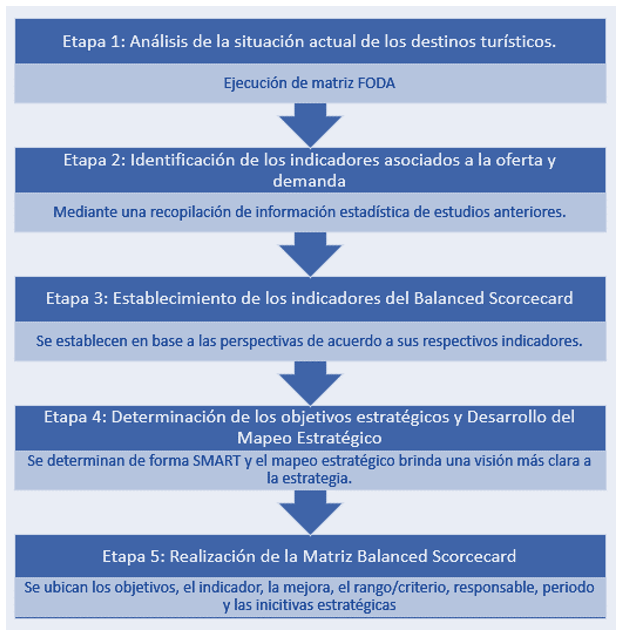
Figure 1
Stages of the management procedure for the elaboration of the Balanced Scorecard
RESULTS
The objective of this stage is to determine a SWOT analysis of tourism destinations. The data was established based on a study conducted by Guadamud and Bravo (2019). This study aims to contribute to the development of sustainable tourism in the tourist destinations Sucre, San Vicente, Jama and Pedernales, from which the following bank of acting forces of the environment, both internal and external to the tourist destinations, is obtained. For this purpose, the authors used techniques such as: inventory of attractions, cadastre, interviews and surveys.
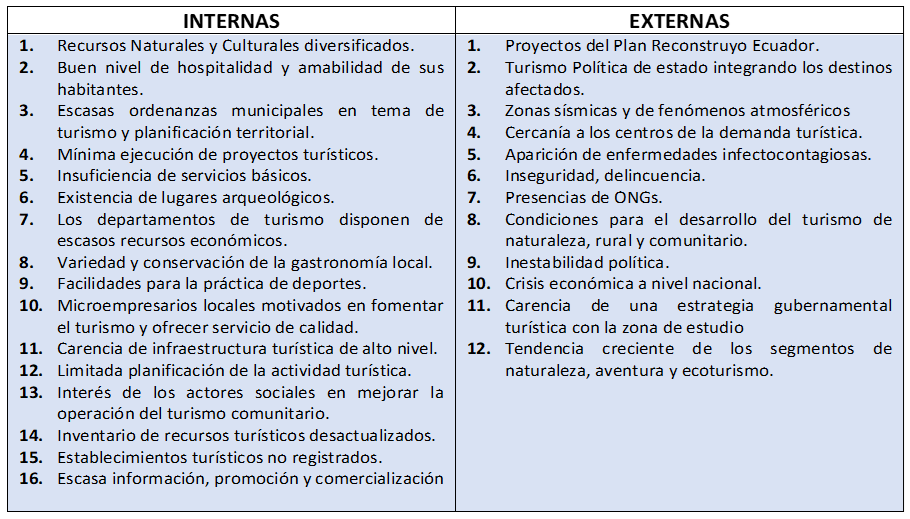
To carry out this process it is necessary to classify the forces in two environments: internal and external, depending on how they can affect the tourist destinations. Once classified, the priority matrix is used to determine their impact and thus select those that are in the quadrant with a high impact and a high probability of occurrence. Figure 2 shows how this procedure is carried out using the aforementioned matrix.
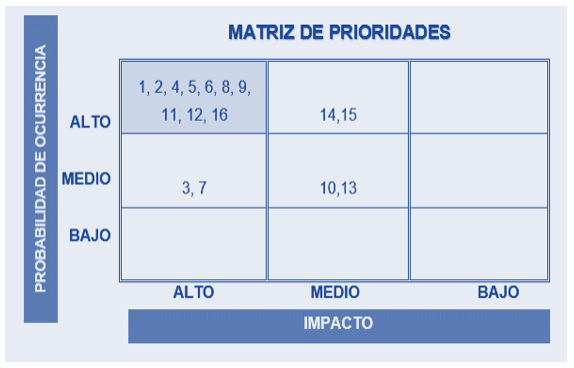
Figure 2
Use of the Priority Matrix on Internal Forces.
Resulting Internal Factors HIGH - HIGH quadrant
1. Diversified Natural and Cultural Resources.
2. Good level of hospitality and friendliness of its inhabitants.
4. Minimal execution of tourism projects.
5. Insufficient basic services.
6. Existence of archaeological sites.
8. Variety and preservation of local gastronomy.
9. Facilities for the practice of sports.
11. Lack of high-level tourism infrastructure.
12. Limited tourism planning.
16. Poor information, promotion and marketing
To determine whether the resulting factors are Weaknesses and Strengths, we proceed to use the Internal Strategic Profile Matrix, which is a graphic representation of the valuation given to each factor or key internal aspect, thus drawing a map of the different strengths and weaknesses of the tourist destinations. Figure 3 shows the use of the Internal Strategic Profile Matrix.
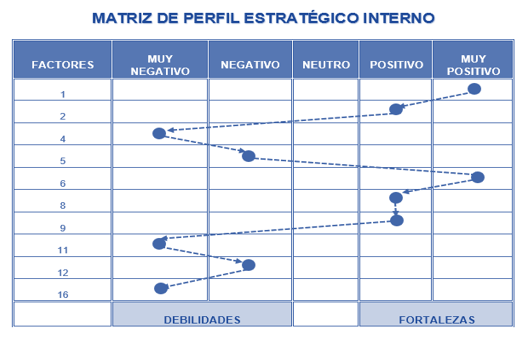
Figure 3
Use of the Internal Strategic Profile Matrix.
Weaknesses: These are those internal or specific factors of the tourist destinations that are weak aspects and need to be overcome to achieve higher levels of effectiveness. The tourist destinations of Sucre, San Vicente, Jama and Pedernales have the following weaknesses:
D1. Minimal implementation of tourism projects.
D2. Lack of high-level tourism infrastructure.
D3. Limited planning of tourism activities.
D4. Insufficiency of basic services.
D5. Scarce information, promotion and marketing.
Strengths: These are those internal factors of the tourist destinations that constitute the attributes that allow them to generate a competitive advantage over the rest of their competitors. The tourist destinations of Sucre, San Vicente, Jama and Pedernales have the following strengths:
F1. Diversified Natural and Cultural Resources.
F2. Good level of hospitality and friendliness of its inhabitants.
F3. Variety and preservation of local gastronomy.
F4. Facilities for the practice of sports.
F5. Existence of archaeological sites.
Determination of External Actuating Forces with High-High Impact
Similarly, the matrices are used for the external factors, in order to obtain the Threats and Opportunities that are present in the tourist destinations. Figure 4 shows the application of the priority matrix to the external factors in order to select those with a high probability of occurrence and a high impact on the environment.
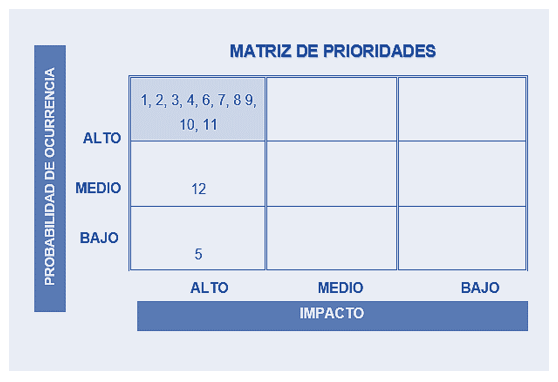
Figure 4
Use of the Priority Matrix for External Forces.
Resulting External Factors HIGH - HIGH quadrant
-
1. Projects of the Plan Reconstruyo Ecuador.
-
2. Tourism State policy integrating the affected destinations.
-
3. Seismic and atmospheric event zones.
-
4. Proximity to the centers of tourist demand.
-
6. Insecurity, crime.
-
7. Presence of NGOs.
-
8. Conditions for the development of nature, rural and community-based tourism.
-
9. Political instability.
-
10. National economic crisis.
-
11. Lack of a governmental strategy for tourism in the study area.
To determine whether the resulting factors are Threats or Opportunities, we proceed to use the External Strategic Profile Matrix, which is a graphic representation of the valuation given to each factor or key external aspect, thus drawing a map of the different strengths and weaknesses of the tourist destinations. Figure 5 shows the use of the External Strategic Profile Matrix.
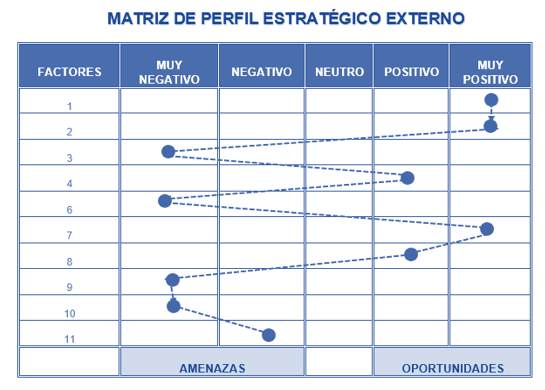
Figure 5
Use of the External Strategic Profile Matrix.
Threats and Opportunities
Threats
A1. Seismic and atmospheric phenomena zones.
A2. Insecurity, crime.
A3. Political instability.
A4. National economic crisis.
A5. Lack of a governmental tourism strategy for the study area.
Opportunities
O1. Projects of the Plan Reconstruyo Ecuador.
O2. Tourism State policy integrating the affected destinations.
O3. Proximity to the centers of tourism demand.
O4. Presence of NGOs.
O5. Conditions for the development of nature, rural and community-based tourism.
SWOT analysis is a study tool that "consists of carrying out an evaluation of the strong and weak factors that, as a whole, diagnose the internal situation of an organization, as well as its external evaluation, that is, the opportunities and threats" (González, 2020, p. 16).
The objective of this stage is to recognize the indicators associated with the supply and demand of the tourism sector in the study area, through a compilation of statistical information from previous studies.
According to the research conducted by Valls et al. (2016) the tourist destination Sucre presents the following results, from the analysis of the current situation this destination lacks indicators, due to the existing deficiency in the control of tourism management, which causes the lack of large provisions of effectiveness, efficiency and effectiveness in tourism companies in the sector.
The system designed is based on the bibliographic review, focusing on the management that will allow the process of economic reactivation and the influx of tourists in the canton of Sucre, it should be noted that this model can also be applied to the tourist destinations of San Vicente, Jama and Pedernales.
To identify the indicators, the authors established an initial list of 53 indicators by applying the Delphi Method in order to select indicators that are appropriate for the sector, and validated the information with the experience of 24 experts with more than 10 years of experience in tourism management. The results yielded 16 indicators with which tourism destinations should be managed.
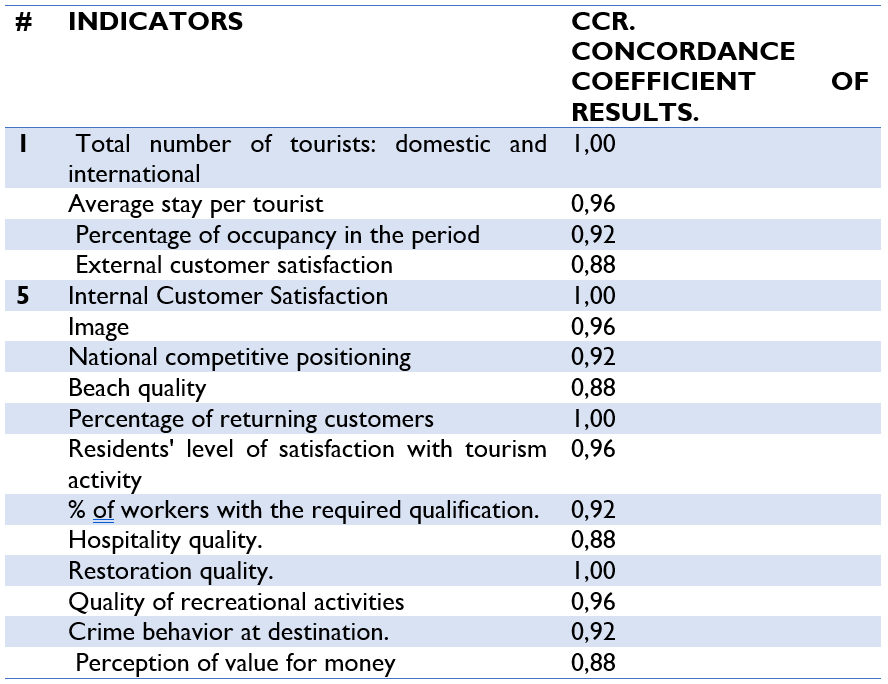
Source: M, Bazurto and W, Valls
Balanced Scorecard
It is a management tool that is being applied in companies around the world, given its characteristics of clarity, efficiency and integration, both in the construction and monitoring of the key factors that lead to business and organizational success. (Gan & Triginé, 2013, p. 462)
This management tool must be structured to transmit knowledge from top to bottom, facilitating useful knowledge for decision making by all the people in the organization, and from bottom to top to know the fulfillment of the strategy. (Fernandez, 2004)
According to Amo (2011), the Balanced Scorecard is a methodology or management technique that helps organizations to transform their strategy into measurable and interrelated operational objectives, facilitating that the behaviors of key people in the organization and its resources are strategically aligned. In a more synthetic way, it is defined as "Strategic Management focused on value creation".
Based on the above, the Balanced Scorecard is defined as a management tool that allows transforming strategies into action through a control board in which SMART operational objectives are established. Therefore, it is very effective and efficient for decision making in any business environment, because it provides summarized and organized information, which allows to direct the efforts of the organization in an appropriate way.
Establishment of the Balanced Scorcecard indicators applied to the Sucre - San Vicente - Jama - Pedernales tourist destinations
The Balanced Scorecard (BSC) complements performance measurement indicators with financial and non-financial indicators of the key factors that will influence future results, derived from the organization's vision and strategy. This technique emphasizes the conversion of the company's vision and strategy into strategic objectives and indicators. To this end, the perspective provided by Kaplan and Norton views the organization from four perspectives: financial, customer, internal operating processes, and learning and growth. (Kaplan & Norton, 2014, p. 6) Figure 6 shows the perspectives used in this management method.
"Perspectives correspond to the different groups that make up the analysis of results in any organization. [...] they frame the strategic objectives, their indicators and goals, as well as the strategic projects" (Martinez & Milla, 2012, p. 210). The methodology distinguishes two major types of perspectives, external and internal:
-
External perspectives encompass the results of the organization's performance. The most common examples are the financial perspective and the customer perspective.
-
The internal perspectives, on the other hand, include the objectives in which the company has scope for action. Traditionally, the BSC methodology proposes two internal perspectives: processes and strategic capabilities.
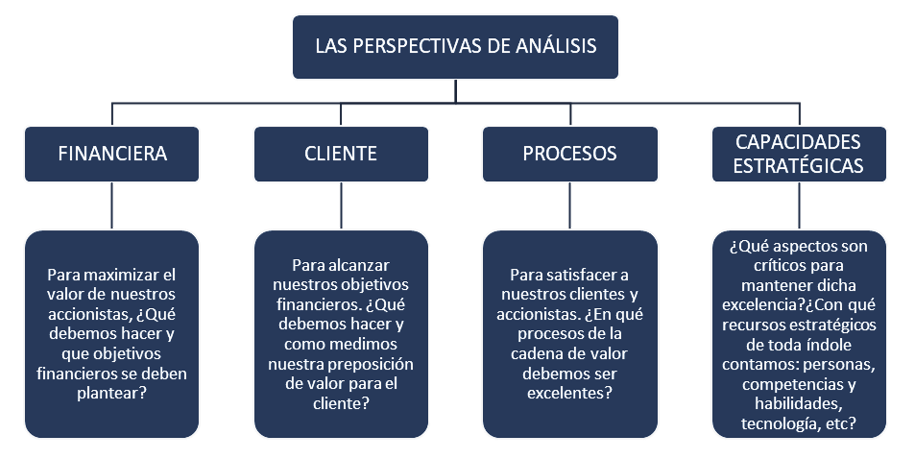
Figure 6
The Balanced Scorecard Analysis Perspectives
Based on the criteria of several authors, these are the perspectives usually used in this management tool, but the authors of this article have reinvented their perspectives to adapt them to the object of study. To this end, they propose the following: the external perspectives are: Financial and Customers; as internal perspectives: Environmental and Training-Internal Processes.
The objective of this stage is to select and establish those indicators associated with supply and demand that respond to the perspectives proposed in this tourism management model. The following are the key performance indicators, which were defined in relation to the concepts proposed for each of the perspectives established in the previous stage of this work.
It responds to the needs and expectations of the entrepreneurs involved in marketing tourism products in the study area, and is marked by the life cycle of the services offered.
-
Number of international tourists
-
Average stay per tourist
-
Percentage of occupancy in the period
-
Perception of value for money
It responds to the way in which the needs of customers, in this case national and international tourists, will be satisfied.
-
External customer satisfaction
-
Internal customer satisfaction
-
Image
-
Percentage of returning customers
Responds to improve and maintain the quality of the environment and seek sustainable practices with the environment in order to improve processes.
-
Quality of the beaches
-
Hospitality quality
-
Restoration quality
-
Quality of recreational activities
It responds to how to improve processes and develop operational excellence in companies that market tourism services and thus guarantee high quality standards.
-
National competitive positioning
-
Residents' level of satisfaction with tourism activity
-
% of workers with the required qualification
-
Crime behavior at destination
Determination of strategic objectives and Development of Strategic Mapping
The objective of this stage is the establishment of strategic objectives in each of the perspectives, this process should help the company to explain how it will achieve the implementation of its strategy both in the short and long term. (Martinez & Milla, 2012) The objectives must be elaborated in a SMART way in order to elaborate an action plan. To this end, these objectives must be Specific, Measurable, Achievable, Realistic and determined for a period of time.
In this perspective will be the strategic objectives that reflect how the organization intends to promote the growth of financial values linked to the growth of income and productivity.
- 1. Increase the demand of international tourists in the tourist destinations of the northern zone of Manabí by carrying out advertising campaigns through digital media for a period of 3 months.
- 2. Increase the participation and permanence of international tourists in the Sucre, San Vicente, Jama and Pedernales areas through recreational activities during a 6-month period.
The strategic objectives towards this perspective. They must be based on knowing what the customer needs to be satisfied with the service provided and transform it into strategic objectives.
- 1. Analyze the profile of tourists with the objective of providing updated information to tourism service companies during a period of 3 months in order to help the economy of the northern zone of Manabí.
- 2. Train owners of hotel, gastronomy and tourist guide services in tourist destinations for a period of 6 months to improve customer service in their services.
In this perspective, it is necessary to define objectives that allow developing operational excellence, i.e., improving processes, gaining scale and guaranteeing high quality standards.
- 1. Improve the quality of tourism services offered in tourist destinations for 1 year to achieve greater competitive positioning at the national level.
- 2. To reduce crime in the destinations through joint actions with the national police during 1 year to protect the safety of tourists.
In this perspective, the strategic objectives are developed with the purpose of improving and maintaining the quality of the environment and seeking environmentally sustainable practices in order to improve processes.
- 1. Implement sustainable tourism actions during the period of 1 year with the environment and thus offer quality beaches.
- 2. Improve the offer of restaurants, hotels and recreational activities during the 6-month period in tourist destinations in order to provide a better experience for tourists.
The BSC helps to constantly review the strategy; it is an innovative approach that has enriched management control and revolutionized it, helping to align the organization's objectives with those of each employee. [...] it is much more than a set of indicators that can report on the company's progress, and should be used as a system both for central management and for communication and training. (Salguero, 2015, p. 66).
In summary, the role of the strategy map in this model is to show an overview of the strategy.
Balanced Scorcecard Matrix
The objective of this stage is to create a Balanced Scorecard Matrix outline that explains the objectives to be followed in order to strategically improve the tourist destinations of Sucre, San Vicente, Jama and Pedernales.
It should be emphasized that these objectives are based on the indicators of each perspective, these are evaluated by the impact traffic light, the tactic to be developed for a given time is determined, who are responsible for that action, the execution time and what will be the future improvements. "The BSC stratifies the information according to the strategy and the structure of responsibilities in the organization" (Fernandez, 2004, p. 18).
The Balanced Scorecard Matrix is a powerful tool for strategic navigation, providing a comprehensive view of the company's overall performance. The Balanced Scorecard uses evaluation criteria and indicators to monitor efficiency and effectiveness in the fulfillment of the company's mission and objectives. This instrument shows the information in an organized and synthesized manner. (Fleitman, 2008, p.79).
DISCUSSION
Based on the following study, strategic planning is evident as a relevant element, since it affects the management activities of tourist destinations, so it is possible to assume that what is indicated by this tool will determine to a great extent both the operational planning and the current daily activities of the tourist destinations Sucre, San Vicente, Jama and Pedernales. "The Balanced Scorecard helps companies to overcome two key issues: the effective measurement of the work performed by the company and the implementation of the strategy" (Niven, 2003 cited in Galaviz & Méndez, 2020, p. 48).
So this tool is generally used in business environments, but the authors give it an innovative approach by directing it to the tourism environment, since the perspectives are: financial, customers, training-internal processes and environmental. It is worth mentioning that some authors affirm that it is convenient to use this tool in the management of tourist destinations because it creates a general vision of the strategy to be followed, based on a set of criteria or measurement indicators which are key to the development of strategies and action measures.
The application of BSC is not only a project that measures results, but affects many fundamental organizational procedures of tourism management. Through a detailed step-by-step discussion, this book provides a clear vision and practical solutions to the destinations in the study area. To this end, it is necessary to carry out a study of the supply and demand situation of the tourist destinations in the northern part of Manabí. To this end, information has been compiled from studies on the forces acting in the environment of the destinations of Sucre, San Vicente, Jama and Pedernales. Table 2 shows the execution of the SWOT Matrix in the tourist destinations of the study area. According to several authors, the use of this tool makes it possible to know the real situation of the company, business or destination, as well as the risks and opportunities offered by the market.
It is important to define the indicators associated with the supply and demand of tourist destinations. To identify the indicators, the authors established an initial list of 53 indicators by applying the Delphi Method in order to select the indicators that are appropriate for the sector, and validated the information with the experience of 24 experts with more than 10 years in tourism management. The results yielded 16 indicators with which tourism destinations should be managed.
Based on the indicators the strategic objectives are established, these should be related to the perspectives of the management model, so that it facilitates the development of the strategic mapping. "Strategy maps are a way to provide a macro view of the organization's strategy and provide a language to describe the strategy before choosing the metrics to evaluate its performance" (Andrade, 2012, p. 41).
And finally, the scorecard is designed in a striking and organized way, in such a way that it allows the analysis of the indicators and the evaluation of the improvement process of the tourist destinations. This will mean that the strategy will be disseminated and therefore be applied by all those responsible for the process, so that they can contribute to achieving the mission reflected in the Balanced Scorecard.
In summary, the CMI will provide the study area with a complete vision for decision making for entrepreneurs and government authorities, as well as operational measures to satisfy customers/tourists, level of innovation in processes and operational activities to improve environmental quality in destinations in a sustainable manner, and thus improve the economy.
CONCLUSIONS
It is established that the selected procedure will allow obtaining successful results in its application to the development of tourism in the tourist destinations of Sucre, San Vicente, Jama and Pedernales, because it ensures alignment between finances, market, processes, innovation and, in turn, the environment. In other words, it allows establishing a strategic direction focused on value creation. The tourist destinations of Sucre, San Vicente, Jama and Pedernales have the potential to become iconic places for tourism, which requires the support of an adequate infrastructure for their development and the adoption of the proposed strategy, which must be constantly renewed. The design of the strategy for the development of tourism in the destinations of the Northern Zone of Manabí is consolidated in a Balanced Scorecard, which is a powerful management tool to provide continuity to its tourism development, because it allows expressing the objectives and initiatives necessary to comply with its strategy.
REFERENCES
Amo, F. (2011). El Cuadro de Mando Integral «Balanced Scorecard». ESIC. https://books.google.com.ec/books?id=zJkkDwAAQBAJ&pg=PT12
Andrade, J. C. (2012). Diseño de un modelo de Cuadro de Mando Integral para una empresa productora y comercializadora de materiales de acero ubicada en la ciudad de Guayaquil [Universidad Politécnica Salesiana Sede Guayaquil]. https://dspace.ups.edu.ec/bitstream/123456789/2701/17/UPS-GT000306.pdf
Fernández, T. A. (2004). Claves para la implantación del cuadro de mando integral. Ediciones Deusto - Planeta de Agostini Profesional y Formación S.L. https://es.scribd.com/document/437097976/Claves-Para-La-Implantacion-Del-Cuadro-de-Mando-in-Claves-Para-La-Implantacion-Del-Cuadro-de-Mando-Integral
Fleitman, J. (2008). Evaluación integral para implantar modelos de calidad . Editorial Pax México. https://books.google.com.ec/books?id=j-B7FE7eWAYC&pg=PA79
Galaviz, J. V., & Méndez, J. L. (2020). Experiencias en gestión y manufactura de procesos industriales. Palibrio. https://books.google.com.ec/books?id=FrT4DwAAQBAJ&pg=PA48
Gan, F., & Triginé, J. (2013). Cuadro de Mando Integral. Ediciones Díaz de Santos. https://books.google.com.ec/books?id=09TBkkpG58gC&pg=PA462
González, M. C. (2020). Manos a la obra: compilación de artículos periodísticos publicados en Horizontes del Bibliotecario. Editorial Universitaria (Cuba). https://books.google.com.ec/books?id=u5v6DwAAQBAJ&pg=PA16
Guadamud, G. J., & Bravo, M. F. (2019). Plan estratégico que sustente la declaratoria como destinos turísticos priorizado a los cantones Pedernales, Jama, San Vicente, Sucre [Escuela Superior Politécnica Agropecuaria de Manabí Manuel Félix López]. http://repositorio.espam.edu.ec/bitstream/42000/1071/1/TTMT14.pdf
Kaplan, R. S., & Norton, D. P. (2014). El cuadro de mando integral: The balanced scorecard (3a. ed.). Grupo Planeta Spain. https://books.google.com.ec/books?id=eboSAQAAQBAJ&pg=PP6
Martinez, D., & Milla, A. (2012). Elementos básicos del Cuadro de Mando Integral . Ediciones Díaz de Santos. https://books.google.com.ec/books?id=h0Pl1DEdSN0C&pg=PA210
Muoz, M. J., & De La Cuesta, M. (2010). Gestión de la RSC . Netbiblo. https://books.google.com.ec/books?id=nO7AH-cxfZ4C&pg=PA25
Salguero, A. (2015). Indicadores de gestión y cuadro de mando. Ediciones Díaz de Santos. . https://elibro.net/es/ereader/uleam/63024?page=66
Valls, W., C Valls, L., & Bazurto, M. M. (2016). Sistema de indicadores para gestionar el destino turístico del Cantón Sucre Ecuador.
Veneros, D. E. (2016). Importancia del cuadro de mando integral como herramienta de gestión para mejorar los indicadores financieros de la empresa de transportes Ave Fenix SAC. [Universidad Nacional de Trujillo]. https://dspace.unitru.edu.pe/bitstream/handle/UNITRU/8015/venerosmartos_diana.pdf
Notas de autor