DOSSIÊ: Perspectivas locais em tempos globais. História Glocal como uma variável teórica e metodológica nos estudos históricos do espaço americano (séculos XV-XIX)
From the Global to the Local: Staffing the Jesuit Colegios in Puebla (Nueva España)
Do global ao local: recrutamento de pessoal nos colégios jesuítas de Puebla (Nova Espanha)
 Robert H. Jackson robertvianey@gmail.com
From the Global to the Local: Staffing the Jesuit Colegios in Puebla (Nueva España)
Anos 90, vol. 30, e2023201, 2023
Universidade Federal do Rio Grande do Sul, Programa de Pós-Graduação em
Received: 05 February 2023
Accepted: 10 July 2023
ABSTRACT: The Society of Jesus was an international Catholic order involved in educational and missionary activities around the globe. What was the origin of the men who joined the Society of Jesus? This article analyzes the profile of the Jesuits stationed on the five colegios in the Mexican city Puebla de los Ángeles in 1767 at the moment of the expulsion from Spanish territories. It finds, as have other studies, that the majority of the Jesuits were men born in the Americas, and mostly in Mexico. King Carlos III ordered them sent into exile in the Papal States in Italy, although a small number were held as prisoners in Spain. While the majority in Puebla were American-born, it also finds that Jesuits leaders showed a preference for European-born members of the Society on the frontier missions. This was the case of missions on the northern frontier of Mexico, and on the missions among the Guaraní in South America. Finally, the article discusses the process of the expulsion of the Jesuits from Puebla.
KEYWORDS: Society of Jesus, Puebla de los Ángeles, Profile, Jesuit expulsion.
RESUMO: A Companhia de Jesus foi uma ordem católica internacional envolvida em atividades educacionais e missionárias ao redor do globo. Qual a origem dos homens que ingressaram na Companhia de Jesus? Este artigo analisa o perfil dos jesuítas nos cinco colégios da cidade mexicana de Puebla de los Ángeles em 1767 no momento da expulsão dos territórios espanhóis. Ele descobre, como outros estudos, que a maioria dos jesuítas eram homens nascidos nas Américas e principalmente no México. O rei Carlos III ordenou que fossem exilados nos Estados papais na Itália, embora um pequeno número tenha sido mantido como prisioneiro na Espanha. Embora a maioria em Puebla tenha nascido nas Americas, também descobriu que os líderes jesuítas mostraram preferência por membros da Sociedade nascidos na Europa nas missões de fronteira. Foi o caso das missões na fronteira norte do México e das missões entre os guaranis na América do Sul. Finalmente, o artigo discute o processo de expulsão dos jesuítas de Puebla.
PALAVRAS-CHAVE: Companhia de Jesus, Puebla de los Ángeles, Perfil, Expulsão dos jesuítas.
RESUMEN: La Compañía de Jesús fue una orden católica internacional involucrada en actividades educativas y misioneras en todo el mundo. ¿Cuál fue el origen de los hombres que se unieron a la Compañía de Jesús? Este artículo analiza el perfil de los jesuitas en los cinco colegios de la ciudad mexicana Puebla de los Ángeles en 1767 en el momento de la expulsión de los territorios españoles. Encuentra, al igual que otros estudios, que la mayoría de los jesuitas eran hombres nacidos en las Américas, y principalmente en México. El rey Carlos III ordenó su exilio en los Estados Pontificios de Italia, aunque un pequeño número fue recluido como prisionero en España. Si bien la mayoría en Puebla nació en las Américas, también encuentra que los líderes jesuitas mostraron preferencia por los miembros de la Sociedad nacidos en Europa en las misiones fronterizas. Este fue el caso de las misiones en la frontera norte de México, y de las misiones entre los guaraníes en América del Sur. Finalmente, el artículo aborda el proceso de expulsión de los jesuitas de Puebla.
PALABRAS CLAVE: Compañía de Jesús, Puebla de los Ángeles, Perfil, Expulsión jesuíta.
The Society of Jesus was an international Catholic religious order founded during the cru- cible of the Reformation and the Counter-Reformation. The first General was Iñigo López de Loyola who later took the name Ignacio de Loyola. He was born around 1491 to a good family in Azpetia in Castilla. He initially pursued a military career, but was wounded in battle in 1530 and had a slow and painful recovery. During this period, he read about the life of Jesus and had a spiritual rebirth. He decided to dedicate his life to God. In 1534, Iñigo López de Loyola was in Rome, and there he along with Francisco Xavier, and seven others founded the Society of Jesus. Pope Paul III authorized the new order six years later in 1540. Ignacio de Loyola became the first General in 1541. He died in Rome on July 31, 1556. Depictions of his life and death became an important theme in Jesuit iconography.
In the sixteenth and seventeenth centuries the Jesuit Generals sent missionaries throughout the world to the Americas, Africa, and Asia. Jesuits found their way to Huronia in the French colony in Canada, the ancient kingdom of Ethiopia, Goa and other Portuguese outposts in India, the Ming Dynasty court in China, and to Japan where they baptized thousands until the government initiated an anti-Christian persecution that ultimately resulted in the expulsion of most Europeans and a policy of isolation that lasted for several centuries. The first act of persecution was the 1597 crucifixion in Nagasaki of Japanese Christians and a handful of foreign missionaries, a total of 26 men including three Japanese Jesuits. One was the Franciscan Felipe de Jesús who was a native of México City. Forty years later the Jesuits established a mission at the Guaraní village of Caaró (Rio Grande do Sul, Brazil) that they named Los Santos Mártires del Japón to commemorate the Nagasaki martyrs. The Jesuits also came to the Spanish territories in the Americas. They arrived in Lima in the Viceroyalty of Peru in 1568 and in the Viceroyalty of Nueva España four years later in 1572. As more personnel became available, the Jesuits expanded to other parts of Spanish America.
In 1750, the Society of Jesus reportedly had 22,642 members, of whom 11,345 were priests. There were five national level administrative units known as asistencias: Itálica, Portuguesa, Hispánica, Gálica, and Germánica. Germánica was the largest in terms of total numbers, and had 8,747 members. The asistencias were divided into 39 provinces. The largest province in the asis- tencia of Hispánica was Castilla, that counted 718 members, and the largest province in Spanish America was Nueva España with 622 (see Table 1)1.
The Jesuits had multiple roles in colonial Spanish America. One was in the cities, where they played an educational and evangelical role in the cities of Spanish America. They also served as intermediaries to a vengeful God who punished sin by sending epidemics and causing adverse weather, or at least that is what the Jesuits believed. They also organized what were called “Popular Missions,” or visitations to Catholic communities to test the doctrinal knowledge of the people and to correct errors in their understanding and practices. The Jesuits also staffed missions on the frontiers of Spanish America.
At the time of the Jesuit expulsion from Spanish territories in 1767, there were some 2,400 members of the Society of Jesus in Spanish America. Where did the Jesuit leaders recruit the mem- bers that staffed the different institutions in the Americas? This article uses documents generated at the time of and following the Jesuit expulsion to identify the place of origin of the members of the Society of Jesus in 1767 and their ages, and shows that most were American-born. It analyzes the case study of the Jesuits who staffed the five colegios located in the city of Puebla de los Ángeles in what today is Mexico. Puebla was the second largest city in colonial Mexico, and had the second largest number of members of the Society of Jesus.
A detailed document drafted in June of 1769 reported the number of Jesuits exiled from the Indies that arrived in the port of Santa María near Cadiz in Spain for their eventual exile in Italy2. The list contained the names of most but not all of the Jesuits expelled from the Indies, and did not include those from the Philippines. A total of 2,116 left the Americas, but 38 Jesuits died at sea including ten missionaries from the Guaraní missions lost in a storm, and 2,078 reached Spain where another 36 died. The list did not include the names of those who died while still in Mexico, or who were too ill to travel. The largest number came from México with 553.
Other sources provide additional information regarding the Jesuits at the time of and following the expulsion. A 1775 report provided a more detailed accounting of the expulsion of the Jesuits, their distribution in different institutions, and their fate following their exile from the Americas and the Philippines3. The 1775 report documents the status of the exiles as of October 1, 1775. The largest group that was in Italy totaled 1,697, another 80 remained in Spain for different reasons including 24 from the Americas, 317 had died, and 259 were foreign-born and did not receive a pension. Of those who remained in Spain, 37 lived in different convents and hospitals, 23 remai- ned in the Puerto de Santa María, 17 were in other cities, two were in prison in Madrid, and there is no information regarding one individual. The exiled Jesuit Rafael Zelis maintained a detailed record of those who had been in the Province of Nueva España (excluding the Philippines), and others maintained the record after Zelis himself died (ZELIS, 1871)4. These sources allow for a reconstruction of the profile of the Jesuits stationed in Puebla in June of 1767.
The Jesuit Institutions in Puebla de los Ángeles
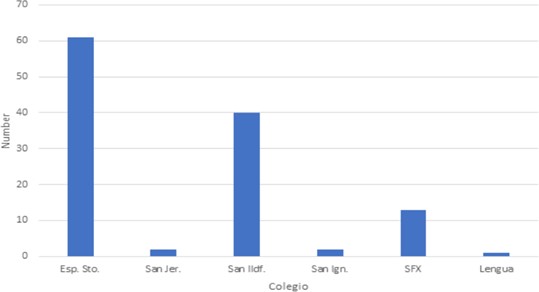
The Jesuits established five separate colegios in Puebla de los Ángeles, that played different roles within the scheme of urban education (see Table 2). Puebla counted the second largest number of Jesuits following Mexico City (see Graphs 1-2). It was also a recruiting-ground for new members. In June of 1767, 54 Jesuits in the Provincia de Nueva España were natives of the city. The largest complex in terms of its size and the number stationed there was the colegio de Espíritu Santo, and San Ildefonso was the second largest. Both were education centers: Espíritu Santo in grammar and rhetoric, and San Ildefonso in philosophy and theology (see Table 2). The seminary of San Jerónimo was across the street from Espíritu Santo, and San Ignacio across the street from San Ildefonso, and was a convictorio that housed students that attended San Ildefonso. San Francisco Xavier, located on the edge of the city, was a center for training missionaries for missions among indigenous peoples, and included a program for the teaching of indigenous languages (HERRERA FERIA, 2015)5.
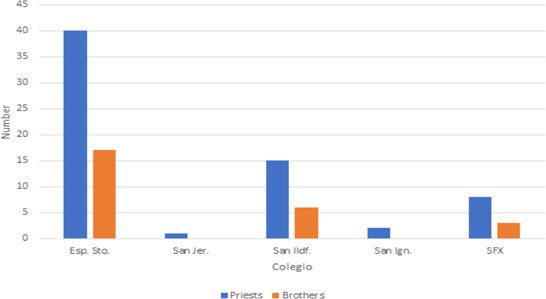
Graph 1 -
The number of Jesuits in Puebla in 1750.
Source: Torales Pacheco, 2019.
A detailed 1754 map of Puebla (see Figure 1) shows the locations of the five colegios in the city, and the considerable investment the Jesuits made in the construction of their urban complexes. The main complexes of Espíritu Santo-San Jerónimo are close to the main square and cathedral (see Figures 2-5). San Ildefonso-San Ignacio are located several blocks away. Following the Jesuit expulsion, the government used the ex-complexes for different purposes. San Ildefonso became the Hospicio de los Pobres in 1771, and following Mexican independence also was a barracks for soldiers. Espíritu Santo housed a state-run school, and in the nineteenth-century San Jerónimo was a customs office. In the nineteenth-century San Ignacio was also a barracks for soldiers, and San Francisco Xavier became a military hospital. Today San Francisco Xavier is a museum dedicated to military aviation, and the other four are administered by public state universities.
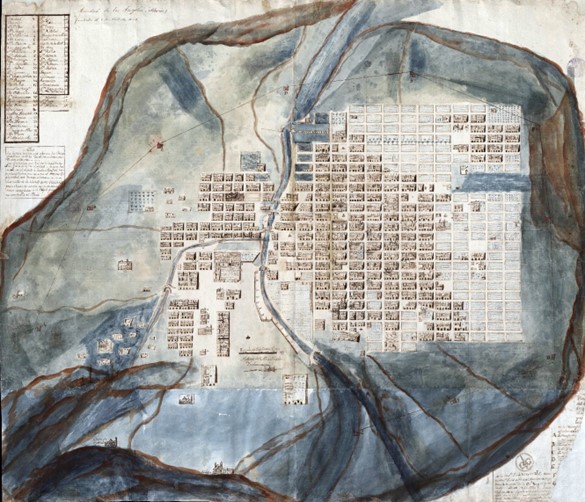
Figure 1 -
A c. 1760 map of Puebla. Antonio de Santa María Inchaurregui, Ciudad de los Angeles (México): fundada el 6 de Abril de 1531.
Source: Museo Naval de Madrid - Signatura: MN-P-13-3.
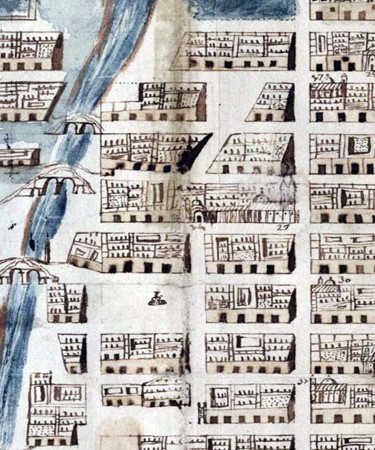
Figure 2 -
Detail of the map showing Espíritu Santo (marked as 27) and San Jerónimo. Antonio de Santa María Inchaurregui, Ciudad de los Angeles (México): fundada el 6 de Abril de 1531.
Source: Museo Naval de Madrid - Signatura: MN-P-13-3.
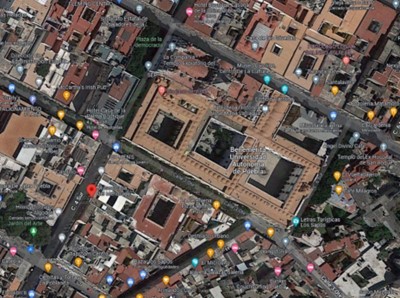
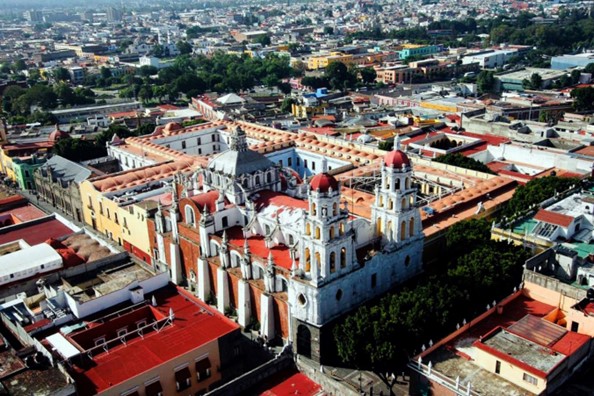
Figure 4 -
The Colegio del Espíritu Santo.
Source: Photograph in the collection of the author.
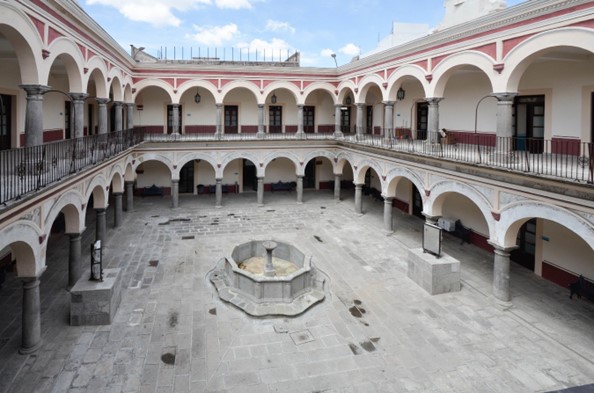
Figure 5 -
The Colegio de San Jerónimo.
Source: Photograph in the collection of the author.
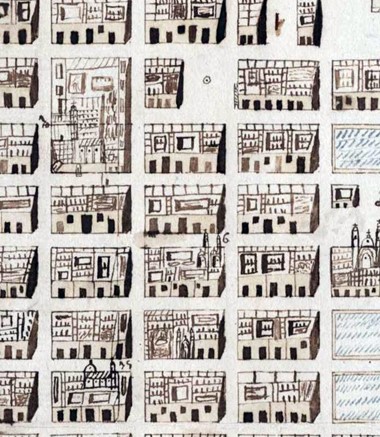
Figure 6 -
Detail of the 1754 map showing San Ildefonso (marked as 6) and San Ignacio. Antonio de Santa María Inchaurregui, Ciudad de los Angeles (México): fundada el 6 de Abril de 1531.
Source: Museo Naval de Madrid - Signatura: MN-P-13-3.
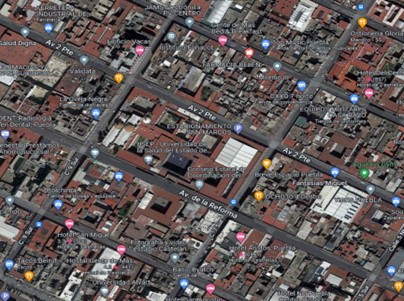
Figure 7 -
A Google map showing the location of the two complexes today.
Source: https://www.google.com.mx/maps/.
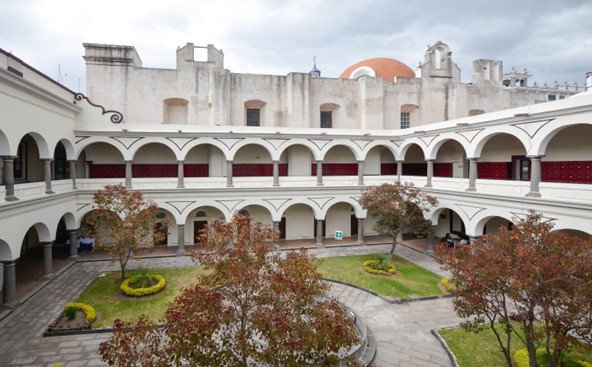
Figure 8-
The Colegio de San Ildefonso.
Source: Photograph in the collection of the author.
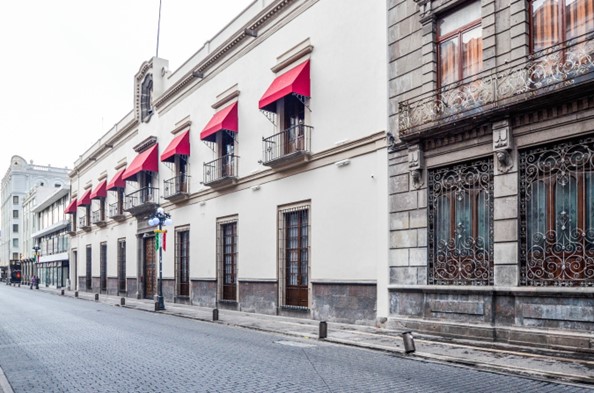
Figure 9 -
The Colegio de San Ignacio.
Source: Photograph in the collection of the author.
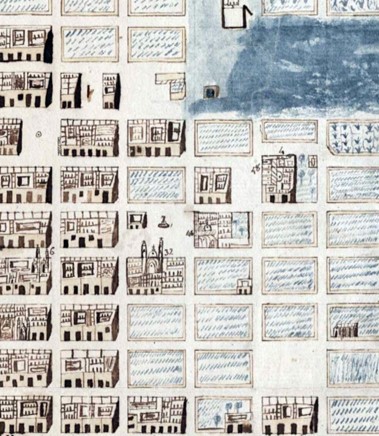
Figure 10 -
Detail of the map showing San Francisco Xavier (marked as 46). Antonio de Santa María Inchaurregui, Ciudad de los Angeles (México): fundada el 6 de Abril de 1531.
Source: Museo Naval de Madrid - Signatura: MN-P-13-3.
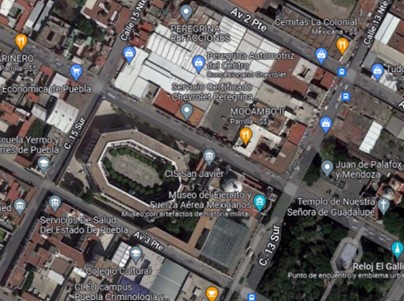
Figure 11 -
A Google map showing San Francisco Xavier.
Source: From https://www.google.com.mx/maps/.
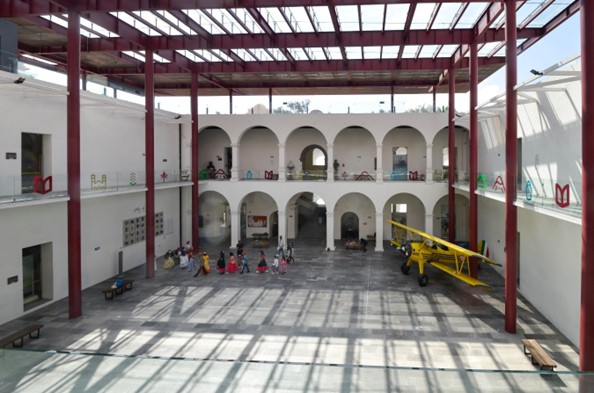
Figure 12 -
The Colegio de San Francisco Xavier. It is now a military museum.
Source: Photograph in the collection of the author.
The Profile of the Puebla Jesuits
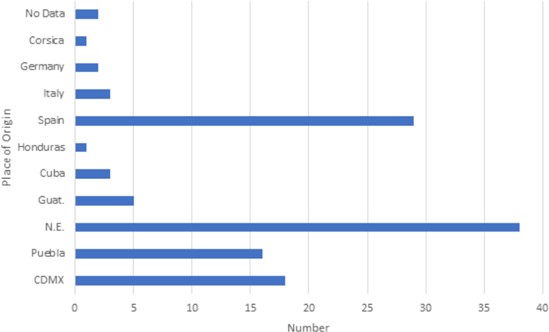
The Society of Jesus was a cosmopolitan international order with members recruited from across the globe. The place of origin of the members that staffed the five colegios in Puebla de los Ángeles in June of 1767 reflected this6. They were from Europe and the Americas. However, there is one important distinction. The majority were born in the Americas, with most coming from what today is Mexico. More than thirty were from Mexico City which was the single most impor- tant source of recruits, and, as already noted, from Puebla itself. Other places of origin included Cuba, Guatemala, and Honduras, that were regions within the larger Provincia de Nueva España (see Graph 3). Based on a 1750 report on the Society of Jesus, Torales Pacheco documented the predominance of American-born Jesuits. Alochia Maldovsky found that in the sixteenth-century the majority of Jesuits in the Andean region were Europeans, but this shifted in the seventeenth and eighteenth centuries (TORALES PACHECO, 2019; MALDOVSKY, 2013).7
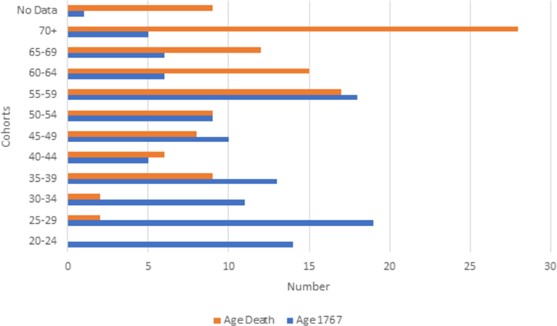
Life in the eighteenth-century was short for most people as shown in estimates of mean life expectancy at birth (MLE). For example, the MLE for Breslau (Germany) at the end of the seventeenth-century was 33.5 years, and 23.5 years for the population of Paris at the beginning of the eighteenth-century. Towards the end of the ancien regime in France the MLE was 28.8 years (ANTONOSVKY, 1967).8 Life was also short for indigenous peoples in the Americas brought to live on frontier missions. The MLE of the Guaraní populations living on the Jesuit missions was 21.5 years (JACKSON, 2004).9 There were instances of lower life expectancies on missions on the northern frontier of Nueva España. The Jesuit mission Comondú in Baja California is an example. In the years 1736-1765 during the Jesuit administration of the mission, the MLE was 13.3 years, and dropped to a mere 1.1 years in the period 1766-1800 as the mission population rapidly declined. In contrast the MLE of the California presidio populations was 31.4 in the years 1790-1834 (JACKSON, 2022a).10 However, this is not to say that some members of society, and particularly socio-economic elites, did not live longer, and the member of the Society of Jesus led privileged lives. This can be seen in the case of the Jesuits in Puebla at the time of the expulsion, where a total of 58 percent lived beyond the age of 60. Moreover, at the time of the expulsion the majority of the Jesuits in Puebla had already lived longer than the average person (see Graph 4).
Following the expulsion most of the Jesuits lived in Italy. This was the case with the Jesuits in Puebla at the time of the expulsion. However, some were held in Spain, including 11 Jesuits who had been in Puebla, but also a group of missionaries assigned to frontier missions who may have been identified as “enemies of the state” because of their knowledge of the frontier regions11. Twelve missionaries died in Mexico in transit to exile, including ten who died in Ixtlan (Nayarit). The pattern of deaths there suggests that they arrived during an epidemic. Another died at sea. Some were ill at the time of their arrival in the Puerto de Santa María and could not continue their journey. The Nayarit missionary Bartolomé Wolff (d. August 27, 1768), and the Sonora missiona- ries Jose Roldan (d. September 21, 1770) and Francisco Paver (d. January 6, 1770) were among the group that died in Mexico. However, others were held in Spain for different reasons. This was the case with 16 of the Jesuits who had been stationed on the Sonora missions. They initially were held in prison in the Puerto de Santa María. However the record of their lives in Spain is incomplete. For example, royal officials allowed Miguel Getzner to return to Germany in 1780. On the other hand, the Spanish-born Miguel Almela was held a prisoner in the Franciscan convent in Villalon for some 20 years, and died in Spain in 1792. In 1775, Jose Garrucho was being held in prison in Madrid. He died in 1783 in a Jeronymite convent where he was also being held. The last record for seven of the Sonora missionaries was that they were still being held in the Puerto de Santa María in 1775. Why did they receive this treatment. It is plausible that, having been on a frontier with mining activity, they were considered to be a security risk. Of the eight missionaries in the Pimeria Alta which was the northernmost part of Sonora, one died in 1768, a second in 1770 in the Puerto de Santa María, and the other six were held in Spain on the orders of royal officials. Two others held in Spain had staffed Cucurpe and Opodepe missions, located just south of the Pimeria Alta. Two others had been in the Pimeria Alta, but at the time of the expulsion were at missions further south. This supports the hypothesis that royal officials considered them to be security risks.
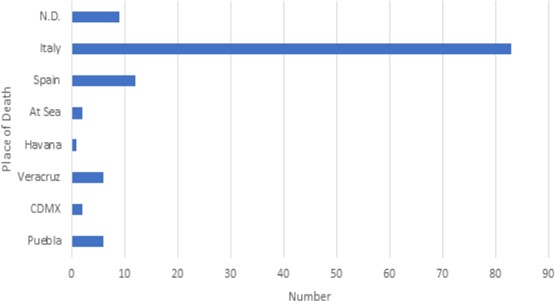
Graph 5 -
Place of death of the Jesuits in Puebla in June of 1767.
Source: Zelis, 1871; Jackson, 2022b.
The profile of the Jesuits assigned to frontier missions in northern New Spain was quite different from that of the Jesuits assigned to urban institutions, including those in Puebla. This can be seen in the cases of Chinipas that included Tepehuanes and Raramuri, Sonora and California. Unlike the urban institutions where Americans predominated, the Jesuits assigned to these missions were mostly Europeans. The Nayarit and Sinaloa missions profiled below were the exception. In the case of Nayarit four Jesuits were natives of Nueva España, but two were from Spain and one from France. The profile for the Chinipas missions shows one from Nueva España, four from Spain, two from Bohemia and one from neighboring Moravia, and one each from Germany and Italy. In the case of Sonora, eight missionaries were natives of Nueva España, including two from Mexico City and one from Puebla. However, 21 were from Europe, including 12 from Spain, six from what today is Germany, two from Bohemia, and one from Austria, all in the Asistencia Germánica. The profile of the missionaries in California showed an even more marked preference for Europeans. Two were from Mexico City, and the rest were Europeans: six from Spain, three from Germany, four from Bohemia, and one from Austria. In terms of the age profile there was a mix of older veterans in their 40s and 50s, and younger missionaries. This profile strongly suggests that the Jesuit leadership had greater confidence in the ability of Europeans as missionaries on the northern frontier of Nueva España. This most likely was a manifestation of the bias of the European-born who believed that natives of the Americas were inferior. It was this idea that Veracruz native Francisco Javier Clavijero, S.J. challenged in his writings.
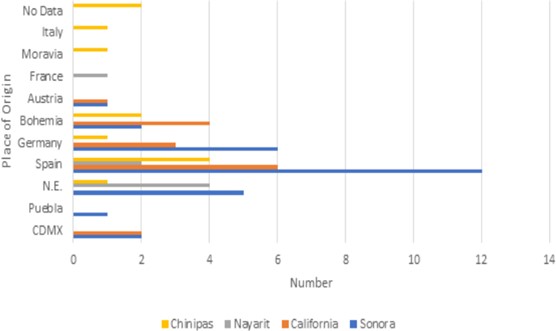
Graph 6 -
Place of origin of the Jesuit missionaries in Nayarit, Chinipas, Sonora, and California in June 1767.
Source: Jackson, 2022b.
This bias was not limited to missions on the northern frontier of Nueva España. At the time of the expulsion the Jesuit missions among the Guaraní in the Rio de la Plata region of South America were the most populous and it could be argued that they were the most important of the frontier missions the Jesuits staffed. The Jesuit leadership showed the same bias in assigning missionaries (see Graph 7). There were three Jesuits stationed on the missions who were natives of Asunción in Paraguay, one from Chile, and seven recruited in what today is Argentina. However, they represented only 14.5 percent of the group of 76 missionaries identified in the 1769 list. An analysis of the age structure in June of 1767 shows that this was a group of veteran and aging mis- sionaries. Those under age 40 constituted only 12 percent of the total group, while those over age 60 were 32 percent. Eight of the missionaries were already over age 70 (see Graph 8). Unlike the missionaries assigned to the northern frontier of Nueva España, where there was a mix of younger men and veterans, the missionaries on the missions among the Guaraní were predominately aging veterans. The American-born Jesuits were both younger men and older veterans, and the majority, seven of eleven, lived beyond age 60 (see Graph 9).12
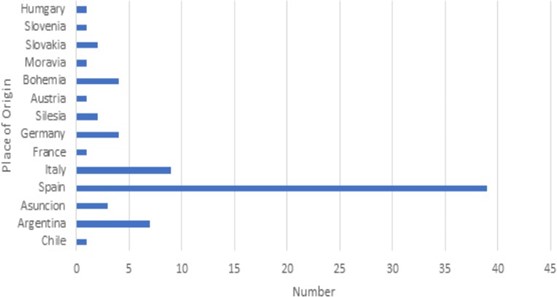
Graph 7 -
Place of origin of the missionaries stationed on the missions among the Guarani.
Source: Jackson, 2022b.
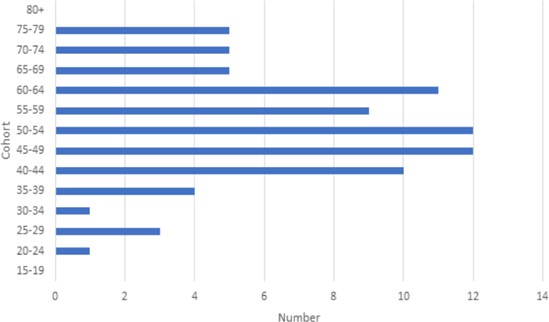
Graph 8 -
Age in June of 1767 of the missionaries stationed on the missions among the Guarani.
Source: Jackson, 2022b.
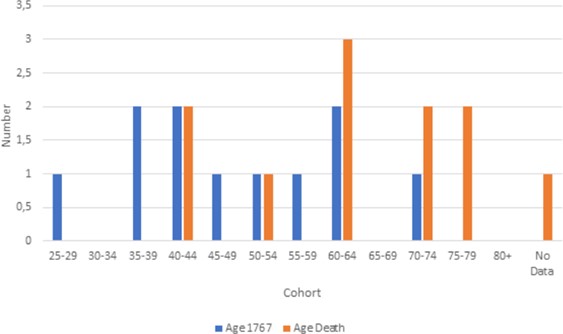
Graph 9 -
The age in 1767 and at death of the American-born Jesuits on the missions among the Guarani in June of 1767.
Source: Jackson, 2022b.
Expelling the Jesuits from Puebla
In the morning of June 25, 1767, militiamen entered the five Jesuit colegios in Puebla to implement the expulsion process. It was a well-organized military operation that required exten- sive reporting of how the process played out and particularly of the expenditure of funds such as for the rental of wagons for transport and provisions for the Jesuits while on the journey to the port city. For example, a map drafted in 1767 showed the locations of the militiamen mobilized to implement the expulsion order in Guanajuato, which was also the scene of civil unrest following the expulsion (see Figure 13). Royal officials mobilized a total of 890 militiamen from six militia units to carry-out the expulsion order in Puebla (see Table 3). The militiamen occupied the five colegios while implementing the expulsion, that included the preparation of inventories of the buildings and the property of the individual Jesuits. A total of 376 militiamen occupied the cole- gios, with the largest number, 163, assigned to Espíritu Santo (see Table 4). They also accompanied the Jesuits to Veracruz, and were available to control any civil unrest that might have occurred as news spread of the expulsion order.13
On June 25, the royal officials that entered the colegios enumerated the Jesuits, and identified those who were too ill to travel and who remained in Puebla as per the royal order. This group included two who were mentally-ill, and spent the rest of their lives in Mexico. Several Jesuits were not present in the colegios, including hacienda administrators and one who was “on vacation” at one of the rural properties that belonged to the colegio of Espíritu Santo. The first group of 86 Jesuits left Puebla for Xalapa on June 27, two days following the implementation of the expulsion order (see Table 5). The port of Veracruz was notoriously unhealthy because of tropical diseases such as yellow fever, so Xalapa which is located at a higher elevation was used as a staging ground. A total of 35 Jesuits expelled from Nueva España died in Veracruz. One of the Jesuits from this group returned to the Colegio de San Francisco Xavier in Puebla.
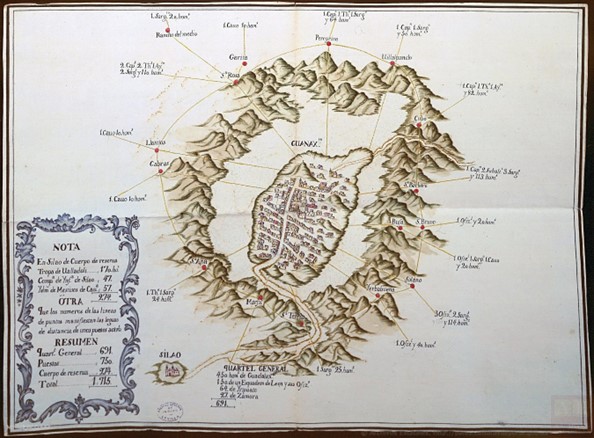
Figure 13 -
A 1767 map that shows the location of militiamen mobilized to implement the expulsion of the Jesuits from Guanajuato.
Source: Archivo General de las Indias, ES.41091.AGI//MP-MEXICO,687. In the public domain.
A group of Jesuits temporarily remained in Puebla, and were housed in several of the con- vents in the city (see Table 6). Twelve stayed in the Carmelite convent that was located on the edge of the city (see Figure 14). One who was to ill to be moved was in the infirmary of the Colegio del Espíritu Santo. The two described as “demented” were assigned to the Hospital de San Roque that housed the mentally ill. It is located immediately behind the Colegio del Espíritu Santo (see Figure 15). A group of 18 left Puebla on August 4 for Xalapa, including one from the Colegio de San Andrés. A third group of seven left in 1768 (see Table 7). Another six remained in Puebla, and never left for exile (see Table 8). This included the two considered mentally ill who eventually died in San Roque, as well as four to ill to travel. One died in 1767, a second in 1768, a third in 1778, and a fourth was relocated to the Hospital de San Pedro in Mexico City where he died in 1791.
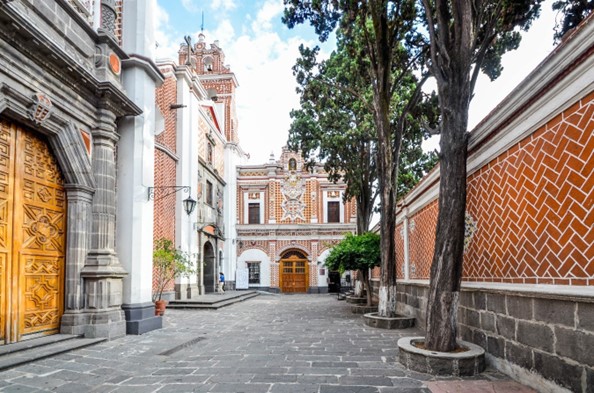
Figure 14 -
The Carmelite convent in Puebla.
Source: Photograph in the collection of the author.
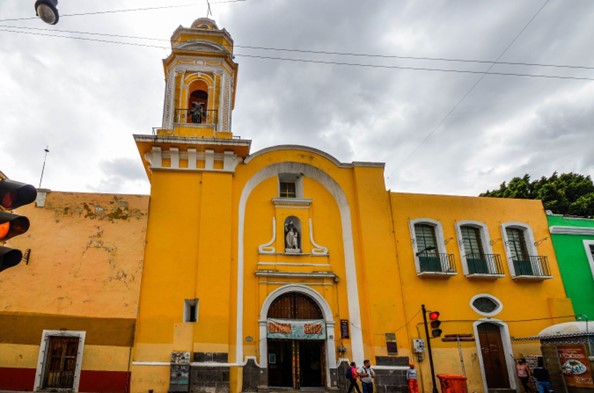
Figure 15 -
The Hospital de San Roque.
Source: Photograph in the collection of the author.
Conclusions
From the sixteenth to eighteenth centuries, the Society of Jesus had a global reach as both missionaries and educators. At the time of the expulsion in June of 1767, the Society of Jesus in Spanish America was predominately recruited from among the American-born Spanish population, the criollos. This was the case of the five Jesuit colegios in Puebla, and the majority were natives of Nueva España. Mexico City and Puebla itself were important recruiting grounds. Ironically, though, despite the predominance of American-born members, the Jesuit leadership evidenced a certain bias against the American-born. This can be seen in the staffing of frontier missions in northern Nueva España. The majority of the Jesuits assigned to a number of the mission rectorates were European-born. A comparison with the staffing of the Jesuit missions among the Guaraní in the Rio de la Plata region of South America documents an even more pronounced bias against the American-born. American-born Jesuits could educate the children of the mostly American-born Spanish American urban elites, but the Jesuit leadership did not have confidence in the American- born staffing many of the frontier missions.
When King Carlos III ordered the expulsion of the Jesuits, his plan was to send the members of the Society of Jesus to the Papal States in what today is Italy. This was, in many ways, a traumatic experience for the American-born majority, who were sent to a strange land overseas. Most who survived the journey to Europe lived-out the rest of their lives and died in Italy. However, a small number died in Spain. On arriving in Spain, the exiled Jesuits remained in the Puerto de Santa María near Cádiz while awaiting transport to Italy. Several of the Jesuits who had been in Puebla were ill and died there, but two of the American-born were held and died in Spain years following the expulsion. These cases, however, most likely were distinct from that of the frontier missionaries that royal officials viewed as “enemies of the state” because of their knowledge of the frontier, and imprisoned.
In 1799, a small group of exiled Jesuits attempted to return to Mexico. One was Lorenzo Cabo, a native of Guadalajara in Jalisco, who had been a missionary on the frontier. He died in Mexico in 1803. There were at least five and perhaps six others who were in the group that attempted to return to Mexico. Two died in Havana in 1799. They were Atanacio Portillo who was a native of Guatemala and Pedro Navarrete who was a native of Pátzcuaro. The Veracruz native Jose Cosio was captured and held in the Franciscan convent in Veracruz where he died in 1805. Cabo and a second made it to Mexico City, where they were captured and held captive. Joaquin Maneiro, also a native of Veracruz, was captured again in 1801 and was held in the convent of San Diego where he died in 1802. Manuel Miranda from Tlacomulco (Estado de Mexico) may have been in the group as well. He was in Italy following the expulsion, but died in San Luis Potosi in 1803. This episode ends this discussion of the Jesuits and their expulsion.
Archival Sources Biblioteca Nacional de España, Madrid:
TORO, Francisco Uruburu de. Lista de los jesuitas expulsados de Indias, llegados al Puerto de Santa María. June 30, 1769. MSS/12870.
ARCHIMBAUD Y SOLANO Juan Antonio . Estado general en que se demuestra el número y clase de regulares de la extinguida religión de la Compañía [de Jesús] que existían en España cuando se les intimó el Real Decreto de expulsión: los que han llegado de los reinos de la América al Puerto de Santa María, los que han fallecido desde aquella época hasta [el] 31 de octubre de 1775. 31 oct. 1775. MSS/9136.
Archival Sources Fondo Jesuita, Archivo Nacional de Chile, Tomo 292:
Colegio del Espiritu Santo de la Puebla de los Angeles. Resumen de la razón tomada por esta Contad(uri)a de las noventa y dos piezas de Autos de ocupación del Colegio del Espiritu Santo, y sus Haciendas dirigidas para este fin de acuerdo del Consejo en el Extraordinario.
Estado de los Oficiales, Sargentos, Cabos, y Soldados que desde el dia de la fecha han de quedar en guarderia de los cinco Colegios de esta Ciudad de Puebla.
Estado que manifiesto el numero de Religiosos de la Compañía de Jesus q(u)e se hallaron en los cinco Colegios de esta Ciu(da)d de Puebla y sus pertenencias.
Bibliography
ANTONOVSKY, Aaron. Social class, life expectancy and overall mortality. The Milbank Memorial Fund Quarterly, New York, v. 45, n. 2, p 31-73, 1967.
ASTORGANO ABAJO, Antonio. La reclusión perpetua de los misioneros Jesuitas expulsos mexicanos en conventos Extremeños (1775-1786). Montalbán, Venezuela, n. 58, p. 202-318, jul./dez. 2021.
HERRERA FERIA, Lourdes. La fundación del Hospicio de Pobres en Puebla de los Ángeles, 1771-1832. Revista Mexicana de Historia de la Educación, Ciudad de México, v. 3, n. 5, p. 69-96, 2015.
JACKSON, Robert H. Una mirada a los patrones demográficos de las misiones jesuitas de Paraguay. Fronteras de la Historia, Bogotá, n. 9, p. 129-178, 2004.
JACKSON, Robert H. The Bourbon Reforms and the remaking of Spanish Frontier Missions. Leiden: Brill Academic Publishers, 2022a.
JACKSON, Robert H. Creole Jesuits: a prosopographic study of the members of the Society of Jesus in Mexico City, Puebla de los Angeles, and Frontier Missions in 1767. Estudios Históricos, Rivera, ano 14, n. 28, dez. 2022b.
MALDOVSKY, Alochia. Vocaciones inciertas: Misión y misioneros en la provincia jesuita del Perú en los siglos XVI y XVII. Lima: CSIC-IFEA, 2013.
STORNI, Hugo. Catalogo de los Jesuitas de la Provincia de Paraguay (Cuenca del Plata) 1585-1768. Roma: Institutum Historicum S. I., 1980.
TORALES PACHECO, María Cristina. La provincia jesuita de Nueva España: Criollismo e identidad. In: MELEAN, Jorge Troisi; AMANTINO, Marcia (ed.). Jesuitas en las Américas: Presencia en el tiempo. Buenos Aires: Teseopress, 2019. p. 91-125.
ZAMBRANO, Francisco. Diccionario Bio-Biográfico de la Compañía de Jesús en México. México, D. F.: Editorial Tradición, 1977. Tomo XV.
ZELIS, Rafael de. Catálogo de los sujetos de la Compañía de Jesús que formaban la Provincia de México el día del arresto 25 de junio de 1767. México: Imprenta de I. Escalante y Cia, 1871.
Appendix

Source: Torales Pacheco (2019); Toro (1769); Archimbaud y Solano (1775); Zelis (1871); Zambrano (1977).


Source: Colegio del Espiritu Santo de la Puebla de los Angeles. Resumen de la razón tomada por esta Contad(uri) a de las noventa y dos piezas de Autos de ocupación del Colegio del Espiritu Santo, y sus Haciendas dirigidas para este fin de acuerdo del Consejo en el Extraordinario. Fondo Jesuita, Archivo Nacional de Chile, tomo 292.

Source: Estado de los Oficiales, Sargentos, Cabos, y Soldados que desde el dia de la fecha han de quedar en guarderia de los cinco Colegios de esta Ciudad de Puebla. Fondo Jesuita, Tomo 292, Archivo Nacional de Chile.

*One returned to San Francisco Xavier.
Notes
Author notes
E-mail: robertvianey@gmail.com