Artículos científicos
Received: 17 November 2017
Accepted: 06 November 2018
DOI: 10.21829/azm.2019.3502199
ABSTRACT: Paxillus MacLeay, 1819 is a genus widely distributed throughout the Americas and currently holds sixteen species. Seven species are known in the Amazon. Herein Paxillus elatus n. sp. is described and illustrated based on eight males and four females collected in the Brazilian Amazonian states Acre, Amazonas and Rondônia.
Key words: Amazon, bess beetle, Scarabaeoidea, taxonomy.
RESUMEN: Paxillus MacLeay, 1819 es un género distribuido en toda América y actualmente tiene dieciséis especies. Siete especies son conocidas para la Amazonia. En el presente trabajo Paxillus elatus n. sp., es descrita e ilustrada basándose en ocho machos y cuatro hembras colectados en los estados brasileños Amazónicos: Acre, Amazonas y Rondônia.
Palabras clave: Amazonía, passálido, Scarabaeoidea, taxonomía.
INTRODUCTION
PaxillusMacLeay, 1819 can be recognized by anterior angles of clypeus, in dorsal view, not visible, very reduced, completely under the frons; external tubercles with an acute apex, directed downwards; prosternal process always pentagonal; metasternal disc glabrous and wholly delimited (Reyes-Castillo, 1973). Paxillus is widely distributed and currently holds sixteen species. Seven out of the eight occurring in Brazil, can be found in Amazonia (Fonseca & Reyes-Castillo, 2004; Mattos & Mermudes, 2013; Jiménez-Ferbans & Reyes-Castillo, 2015). Jiménez-Ferbans and Reyes-Castillo (2015) have recently transferred two species, Paxillus macrocerusReyes-Castillo & Fonseca, 1992 and Paxillus corniculatusFonseca et al., 2008 into PassipassalusFonseca & Reyes-Castillo, 1993. Paxillus occurs from Mexico to southern Brazil.
MATERIAL AND METHODS
We have analyzed twelve specimens from Coleção Zoológica Prof. Paulo Bührnheim, Department of Zoology, Federal University of Amazonas, Manaus, Brazil (CZPB). Total length of the specimens was measured from the anterior border of the forehead to the apex of the elytra. The pictures were taken with a Leica DFC265 camera attached to a Leica M165C stereoscope microscope, connected to a computer with the Leica Application Suite software, which includes an auto-montage module. Illustrations of the specimens were vectorized using these photographs. The morphological terminology follows Reyes-Castillo (1970), except for the “ponte” (= bridge) and the “mamelão” (= mamelon) that follows Luederwaldt (1931). The mamelon is a structure like a wart in the angle of frontal ridges.
The label data is cited in full, with the original spelling, punctuation and dates. Information presented within square brackets are complementary data not included in the labels. Data from the same specimen but from different labels are separated by lashes. States are listed geographically from West to East and from North to South. Label information is organized as follows: locality, date, collector (number of specimens, collection acronym).
RESULTS
Description of Paxillus elatusn. sp.
Length: 13.5-16 mm.
Color: shiny black.
Figures 1-8
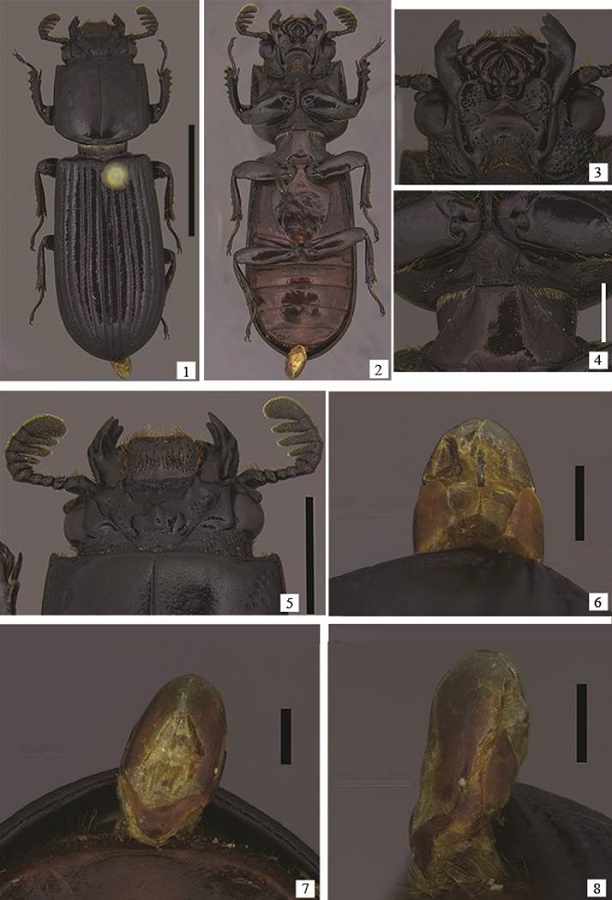
Paxillus elatus n. sp. 1, 2) habitus, dorsal and ventral view; 3) mentum; 4) prosternal process and metasternum; 5) head in dorsal view; 6-8) aedeagus in dorsal, ventral and lateral view.
Figures 9-15
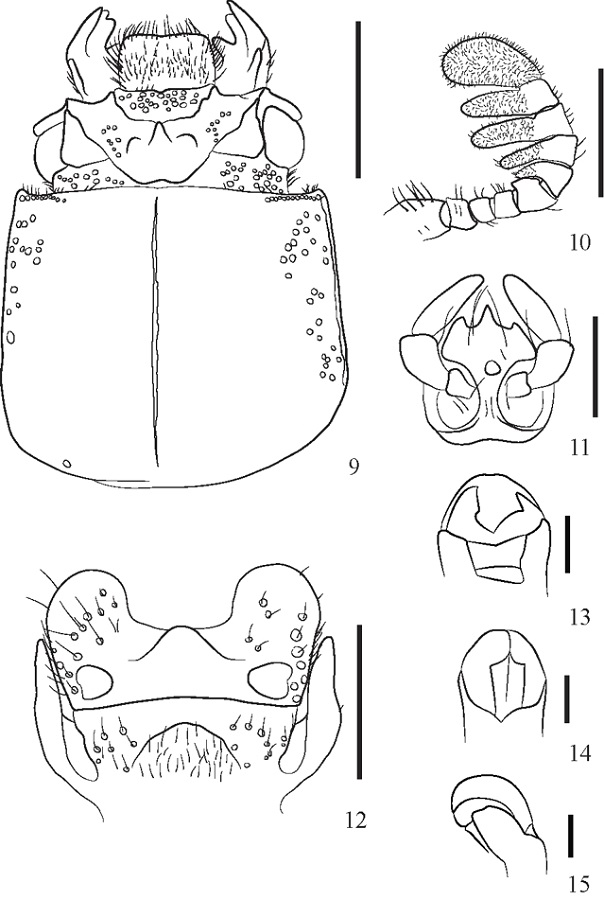
Paxillus elatus n. sp. 9) head and pronotum; 10) antenna in dorsal view; 11) ligule and labial palps; 12) mentum; 13-15) aedeagus in dorsal, ventral and lateral view.
Head male (Figs. 5, 3, 9, 12): labrum square-shaped with pubescence throughout. Anterior edge of the head sinuous with a notch in the middle. External tubercles well developed laterad. Anterior angles of the head straight. Anterior angles of clypeus not visible in dorsal view. Internal tubercles well developed, directed forward and contiguous to external tubercles. Frontal area wider than long, covered by many large punctuations. Mamelon absent. Frontal ridges low with a node in the middle, starting at the apex of central tubercle and ending at internal tubercles. Central tubercle well marked with acute apex, not free and the basis wide. Transversal tubercles well developed and well-marked with round apex. Frontal fossae deep, shiny and with few sparse punctuations. Supra orbital ridges with two tubercles, the first tubercle inconspicuous. Occipital groove complete, very marked and biconcave. Occipital area with many punctuations through its whole extension. Ocular canthus with straight angle and median border with no curves. Bridge absent. Antennal club with five antennomers, the first one reduced and the other four subequal in length. Mandibula with trifid apical tooth, high dorsal tooth and equal-sized internal teeth in both mandibles. Mentum: lobes very rounded with large punctuations and pubescent; small scars, glabrous; median area shiny, smooth and glabrous, protruded, forming a very accentuated convexity at median-superior area. Submentum with little pubescence and few punctuations in the sides. Ligule tridentate, with pointed teeth, the middle one longer than others. Labial palps three segmented; the two distal segments are subequal and longer than first one. Hypostomal process near the mentum, reaching half of the height of lobes. Lacinia unidentate. Pronotum: anterior border almost straight, with straight angles. Anterior marginal grooves shallow with large punctuations, reaching half the width of pronotum. Lateral groove narrow. Few large punctuations, mostly in sides, never reaching half of the pronotum’s width. Median groove narrower in the extremities, reaching neither the anterior nor the posterior border. Prosternal process pentagonal with anterior area wider than posterior. Mesosternal scars deep, glabrous and smooth. Metasternal disc well delimited, smooth-surfaced with few large punctuations at sides. Metastenal scars wide, glabrous and not smooth as metasternal disc. Abdominal sternites glabrous, with marginal grooves. Legs: femur I with scarce pubescence at anterior and posterior borders. Tibia I with one apical spine. Femurs II and III glabrous and smooth. Tibia II and III with one lateral spine each. Elytra: striate with rounded and small-sized punctuations. Aedeagus: In ventral view the medial lobe shows two sclerotized plates far apart from each other and tapering apicad, covering almost all of it. Tegmen wide, in lateral view, reaching 1/3 of medium lobe height. Lateral lobes reaching 2/3 of medium lobe size.
Variations: the frontal fossae at times all smooth. Aedeagus cans present three states: with tegmen, with weak sutures in tegmen or with basal part totally separate of parammeres.
Etymology: From the Latin “elatus”, meaning “high, exalted”, referring to the very accentuated superior-median area of the mentum.
Material examined: Holotype: BRAZIL: Amazonas, Coari, rio Urucu, Ig[arapé]. Marta-3, 4º50’0,73’’S/ 65º02’37’’W. 22/viii/1993, P.F. Bührnheim et al. col. (1♂, CZPB). Paratypes: idem holotype, except: RU-27, 4º49’34’’S/ 65º15’37’’W. 12/iii/1994 (3♂, CZPB); idem: 15/iii/1994 (2♂, CZPB - UFAM); idem: 09/iii/1994 (1♀, CZPB). Acre, Plácido de Castro, Vila Califórnia. Proj[eto] RECA. Ramal Rio Novo +/- Km5. 15/iv/1992. J. Vicente as Silva col. (2♀, CZPB); Rio Branco, F. Catuaba, BR 364. 13-15/x/1993 (2♂, CZPB). Rondônia, Ouro Preto do Oeste. Res. [erva] do INPH. 27/viii/1986. F.F. Ramos col. (1♀, CZPB).
DISCUSSION
Paxillus elatus sp. n. is similar to P. pleuralisLuederwaldt, 1931 based on the frontal, like the frontal ridges well developed, reaching the external tubercles, the frontal area wider than long, but can be separated from the latter species by the absence of secondary tubercles and the reduced first antennomere. It can be separated from P. camerani (Rosmini, 1902) by the absent mamelon and the well-marked central tubercle. It differs from all the other Paxillus species by the superior-median border of mentum with a very strong protruding.
ACKNOWLEDGEMENTS.
We thank MSc Fabio Godoi, curator of the Coleção Zoológica Professor Paulo Bührnheim, for the loan of the specimens and to CAPES for the master’s research funding.
LITERATURE CITED
Fonseca, C. R. V., Reyes-Castillo, P. (1993) Novo gênero amazônico de Passalini (Coleoptera, Passalidae, Passalinae). Revista Brasileira de Entomologia, 37, 673-681.
Fonseca, C. R. V. , Gouveia, F. B. P., Fernandez, M. F. S. (2008) A new Paxillus MacLeay, 1819 (Coleoptera: Passalidae: Passalinae) from the state of Amazonas, Brazil. Acta Amazonica, 38, 811-814. http://dx.doi.org/10.1590/S0044-59672008000400028
Fonseca, C. R. V. da, Reyes-Castillo, P. (2004) Synopsis on Passalidae family (Coleoptera: Scarabaeoidea) of Brazil with description of a new species of Veturius Kaup, 1871. Zootaxa, 789, 1-26.
Jiménez-Ferbans, L., Reyes-Castillo, P. (2015) Phylogeny and Taxonomy of Paxillus MacLeay and Passipassalus Reyes-Castillo and Fonseca (Coleoptera : Passalidae : Passalini), with the Description of New Species. Annals of the Entomological Society of America Advance Access, 1-20. http://dx.doi.org/10.1093/aesa/sav019
Luederwaldt, H. (1931) Monografia dos passalídeos do Brasil (Col.). Revista do Museu Paulista, 17, 1-262.
MacLeay, W. S. (1819) Horae Entomologicae: or essays on the annulose animals. S. Bagster, Londres, 524 p.
Mattos, I., Mermudes, J. R. M. (2013) Synopsis of Paxillus MacLeay, 1819 (Coleoptera: Passalidae): distributional records and descriptions of four new species from Brazil. Zootaxa , 3652 (3), 327. http://dx.doi.org/10.11646/zootaxa.3652.3.2
Reyes-Castillo, P. (1970) Coleoptera, Passalidae: Morfologia y división en grandes grupos: géneros americanos. Folia Entomológica Mexicana, 20-22, 3-240.
Reyes-Castillo, P. (1973) Passalidae de la Guyana Francesa (Coleptera, Lamellicornia). Bulletin du Muséum National D’Histoire Naturelle1, 3 (197), 1541-1587.
Reyes-Castillo, P., Fonseca, C. R. V. (1992) Contribución al conocimiento de Paxillus MacLeay, con la descripción de una nueva especie Amazónica (Coleoptera: Lamellicornia). Folia Entomológica Mexicana , 84, 15-33.
Notes
Author notes
*Autor de correspondencia: <jefmorib@gmail.com>
