Original papers
A new species of the genus Aleuroparadoxus (Hemiptera: Aleyrodidae) from Oaxaca, Mexico
Una nueva especie del género Aleuroparadoxus (Hemiptera: Aleyrodidae) de Oaxaca, México
 Vicente Emilio Carapia-Ruiz
Antonio Castillo-Gutiérrez
Vicente Emilio Carapia-Ruiz
Antonio Castillo-Gutiérrez
A new species of the genus Aleuroparadoxus (Hemiptera: Aleyrodidae) from Oaxaca, Mexico
Acta zoológica mexicana, vol. 38, e3812400, 2022
Instituto de Ecología A.C.
Received: 15 March 2021
Accepted: 20 September 2022
Published: 07 October 2022
Abstract: A new species of whitefly is described, Aleuroparadoxus oaxacensis Carapia-Ruiz & Sánchez-Flores sp. nov., based on specimens collected on the upper side of leaves of Guaiacum coulteri A. Gray (Zygophyllacea) in Huatulco, Oaxaca, Mexico. This species does not present tubercles on the inner margin of the caudal ridges and the anterior and posterior halves of the pupa are of similar width and is included in the sapotae group as it presents dark brown color and semioval to semicircular form. Microphotographs of pupal morphological structures are provided and separation from similar species is briefly discussed. Also, a key to the Mexican species of Aleuroparadoxus is provided.
Key words: Whiteflies, Aleyrodinae, host, pupae.
Resumen: Una nueva especie de mosca blanca es descrita, Aleuroparadoxus oaxacensis Carapia-Ruiz & Sánchez-Flores sp. nov., con base en ejemplares recolectados en el haz de las hojas de Guaiacum coulteri A. Gray (Zygophyllacea) en Huatulco, Oaxaca, México. Esta especie no presenta tubérculos en el margen interno de las crestas caudales y las mitades anterior y posterior de la pupa con anchura simlar y es incluida en el grupo sapotae por presentar pupa de color marrón oscuro y forma semioval a semiesférica. Se proporcionan microfotografías de estructuras morfológicas de la pupa y se discute brevemente su separación de especies similares. También se presenta una clave para las especies mexicanas de Aleuroparadoxus.
Palabras clave: Moscas blancas, Aleyrodinae, hospedero, pupas.
Introduction
The whiteflies genus Aleuroparadoxus Quaintance & Baker comprises 13 species described in the New World (Evans, 2008; Ouvrard & Martin, 2019); of these, nine species have been reported for Mexico (Russell, 1947; Evans, 2008; Sánchez-Flores et al., 2017; Carapia-Ruiz & Sánchez-Flores, 2018; García-Ochaeta & Evans, 2020; Sánchez-Flores & Carapia-Ruiz, 2021). The genus is known only from America, most of the described species are from the southwestern United States of America, Mexico, Central America, and the Caribbean, only one species is known from Chile, in South America (Evans, 2008). Aleuroparadoxus iridescens was reported from Hawaii and Mexico by Garcia-Ochaeta and Evans (2020), without providing any specific data. Martin (2005) reported five Aleuroparadoxus species from Belize, of which three had been previously described and two were undescribed.
This suggests there are still different species of this genus awaiting description. Pupae of whiteflies of the genus Aleuroparadoxus were found in Oaxaca, Mexico. After examination, it was found that they did not belong to any of the known species; therefore, the new species is described in the present study.
Materials And Methods
Whitefly pupae (Aleyrodidae) were collected on the upper side of the leaves of Guaiacum coulteri (Zygophyllacea) in an urban wooded area of Huatulco, Oaxaca, Mexico (15° 49’ 57’’ N, 96° 19’ 1’’ W, 25 mamsl). The specimens were transferred to the Entomology and Acarology Laboratory of the Escuela de Estudios Superiores de Xalostoc, Universidad Autónoma del Estado de Morelos (ESSX-UAEM). Pupae were mounted on slides and studied using a phase-contrast Motic microscope. The methodology for slides preparation was that proposed by Martin (1987; 2004). Photographs were taken with a Nikon 5200® camera with 18-55 mm lens.
Specimens repositories:
CNIN- Colección Nacional de Insectos, Instituto de Biología, Universidad Nacional Autónoma de México.
OASF- Personal collection of Oscar Ángel Sánchez-Flores, Puebla, Mexico.
VECR- Personal collection of Vicente Emilio Carapia-Ruiz, Morelos, Mexico.
Results and discussion
Aleuroparadoxus Quaintance & Balker
This genus presents pupae with dentate margin and dorsal modified and reniform papillae. The pigmentation of the puparium is usually dark, being necessary a clearing process to determine its morphological characters. The submarginal papillae are usually arranged in a row, which secrete wax filaments as it is normally in the genus Trialeurodes. The genus Aleuroparadoxus is classified in the tribe Trialeurodini.
Aleuroparadoxus oaxacensis Carapia-Ruiz & Sánchez-Flores sp. nov.
http://zoobank.org/urn:lsid:zoobank.org:act:4949A018-8D53-43BE-B372-7EA144A24759
Figures 1-10.
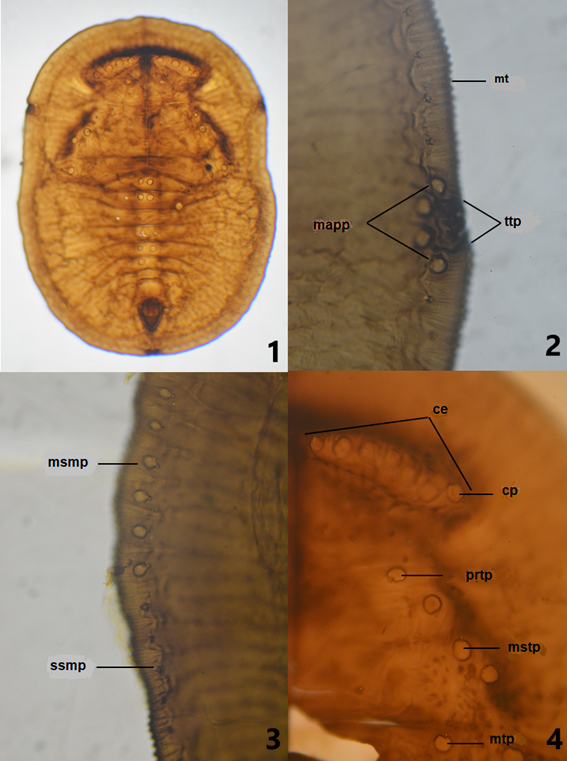
Pupa. In situ: dark brown, scattered in the upper side of leaves, apparently flat dorsally. On slide (n = 5): oval, 880-920 µm in length, 630-720 µm in width (Fig. 1).
Figures 1-4
Pupa of Aleuroparadoxus oaxacensis Carapia-Ruiz & Sánchez-Flores sp. nov. 1) dorsal view, 2) thoracic section, 3) margin and submargin, 4) cephalothoracic area. ce = cephalic elevation, cp = cephalic papillae, mt = marginal teeth, mapp = medium-size around the pore papillae, msmp = medium submarginal papillae, mstp = mesothoracic papillae, mtp = metathoracic papillae, prtp = prothoracic papillae, ttp = thoracic tracheal pore, ssmp = small submarginal papillae.
Margin. Dentate, approximately 17-22 rounded teeth, each 100 µm. Each thoracic tracheal pore with two lateral teeth and one middle tooth (Fig. 2), all with their apex at the level of the marginal teeth.
Submargin. Almost uniform in width, about 1/8 the width of pupa. Longitudinal lines mesad of submarginal papillae (Figs. 2, 3), generally in zig-zag-shaped ridges. Transverse lines (submarginal ridges) extending from margin to level of longitudinal lines and submarginal papillae (one ridge per tooth). 18-30 pairs of medium papillae (8-10 μm in diameter) and 33-58 pairs of small papillae (3-4 μm in diameter) in a single row in the submarginal area; 3-5 pairs of medium papillae around the tracheal thoracic pore (Fig. 2).
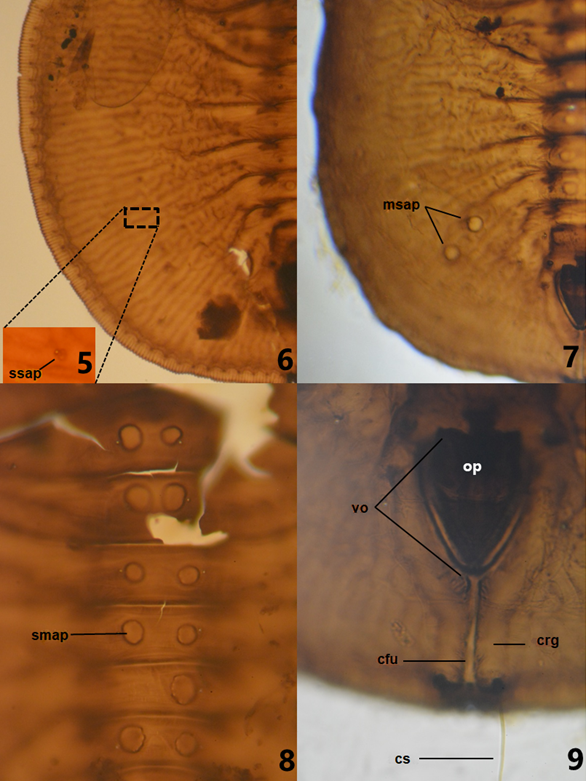
Dorsum. Cephalothorax: longitudinal molting suture 360-380 μm in length, reaching anterior margin of pupa; transverse molting suture 450-480 μm in length, ending before submarginal line. Slightly curved ocular marks in the subdorsal head zone, 32 µm long and 9 µm wide; two elevated head areas with 4-6 papillae each (Fig. 4); thoracic area with 6-7 pairs of papillae; 2 pairs of papillae in prothorax, 2 pairs of papillae in mesothorax, and 2-3 pairs of papillae in metathorax. Abdomen: subdorsal area (Figs. 2, 3, 6) with irregular transverse lines with 4-6 papillae in abdominal segments VII and VIII (Figs. 5, 7). Abdominal segments I-VI with 1 pair of papillae on its middle area (Fig. 8) and a pair of depressions near the papillae. Abdominal segments with approximate length measurements in the middle part as follows: segment I 62-73 μm, segment II 45-55 μm, segment III 45-55 μm, segment IV 45-55 μm, segment V 45-55 μm, segment VI 40-50 μm segment VII 33-40 μm, segment VIII 56-67 μm (from suture to anterior margin of vasiform orifice).
Figures 5-9
Pupa of Aleuroparadoxus oaxacensis Carapia-Ruiz & Sánchez-Flores sp. nov. 5) detail of subdorsal area, 6 and 7) subdorsal area, 8) abdominal segments, 9) posterior section. cfu = caudal furrow, crg = caudal ridge, cs = caudal seta, smap = submedian abdominal papillae, msap = medium subdorsal abdominal papillae, op = operculum, ssap = small subdorsal abdominal papillae, vo = vasiform orifice.
Vasiform orifice. Triangular-cordiform, straight-sided, clearly longer than wide, 85-95 μm in length, 60-70 μm in width (Fig. 9). Operculum cordate, 25-35 μm (length) by 38-48 μm (width), occupying almost half of vasiform orifice. Lingula is almost hidden by the operculum. Distance from pupal margin to posterior margin of vasiform orifice: 40-50 μm. Caudal furrow narrow, defined by a pair of lateral developed crests (caudal ridges) ending at caudal setae (Fig. 9).
Chaetotaxy. Cephalic setae 15-25 μm long; A1 and A8 setae present; caudal setae 30-50 μm long, located on the terminal part of the pupa.
Pores. Associated with papillae. Those near large circular papillae (12-22 μm diameter): 4-6 pairs in the cephalic area, 6-7 pairs in the thoracic area, 2 pairs in the subdorsal area, and 6 pairs in submedian area of abdominal segments I-VI. Those near small papillae (3-4 μm diameter): 10 pairs in three rows in the cephalothoracic area, 10 pairs in two rows in the subdorsal area of the abdomen, one pair on abdominal segment VIII, and about 70 pairs in the submarginal papillae row (Fig. 10).
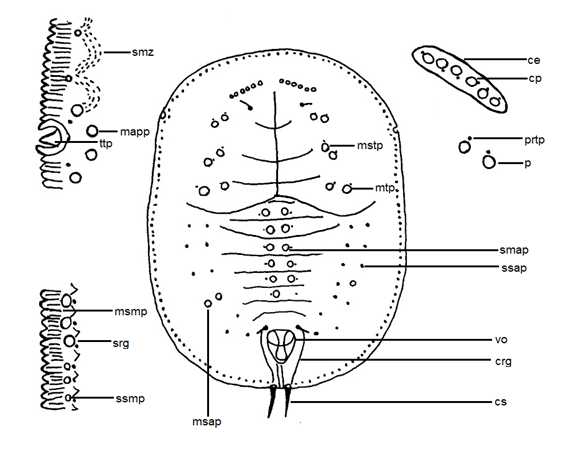
Figure 10
Pupa of Aleuroparadoxus oaxacensis Carapia-Ruiz & Sánchez-Flores sp. nov. ce = cephalic elevation, cfu = caudal furrow, cp = cephalic papillae, crg = caudal ridge, cs = caudal seta, mapp = medium-size around the pore papillae, msap = medium-sized subdorsal abdominal papillae, msmp = medium-size submarginal papillae, mstp = mesothoracic papillae, mtp = metathoracic papillae, p = pore, prtp = prothoracic papillae, smap = submedian abdominal papillae, smz = submarginal tublercles in zig-zag , srg = submarginal ridges, ssap = small-sized subdorsal abdominal papillae, ssmp = small-sized submarginal papillae, ttp = thoracic tracheal pore, vo = vasiform orifice.
Venter. Tracheal folds developed, smooth cuticle, and inconspicuous spines and setae at base of legs.
Comments.Aleuroparadoxus oaxacensis presents the common habit, as other species in the genus Aleuroparadoxus, of the pupae normally found on the upper side of the host's leaves. Other species of the different genera of Aleyrodidae are commonly found on the lower side of the leaves. Aleuroparadoxus oaxacensis belongs to the sapotae group, which present dark brown color and semioval to semicircular form. This species can be separated from the species A. truncatus Russell and A. punctatus Quaintance & Baker by the absence of the subdorsal thoracic-abdominal groove. Also, Aleuroparadoxus oaxacensis has 4-6 papillae in the subdorsal area of abdominal segments III-VIII, unlike A. trinidadensis Russell, which has 15-20 papillae in the same region. Additionally, the new species presents the submargin with a row of papillae of non-uniform size (small papillae group followed by a medium papillae group), inner margin of caudal ridges without tubercles, and body with the posterior half as wide as anterior half; contrastingly, A. sapotae Russell presents the submargin with short submarginal ridges, five tubercles at inner margin of caudal ridges, and body with the posterior half wider than anterior half (see Sánchez-Flores & Carapia-Ruiz, 2021). According to Martin (2005) and Garcia-Ochaeta & Evans (2021), more undescribed species of the genus await to be discovered.
Etymology. The specific epithet refers to the state of Oaxaca, where the specimens were collected.
Host plant.Guaiacum coulteri A. Gray (Zygophyllaceae), commonly known as “Palo Santo.”
Distribution. Mexico, Oaxaca (Huatulco).
Type material. HOLOTYPE: Pupa. MEXICO: Oaxaca, Huatulco, on leaves of Guaiacum coulteri, June 20, 2017, Col. Sánchez-Flores, O. A. (CNIN). PARATYPES: 4 pupae with same data as holotype (1 CNIN; 2 OASF; 1 VECR).
Key to species of Aleuroparadoxus from Mexico
-
1. Submarginal papillae contiguous, elongated ................................................................................................... 2
-
- Submarginal papillae separated, not elongated, almost as wide as long ............................................ 4
-
2(1). Thoracic tracheal pore not differentiated from the margin ..................... A. arctostaphyli Russell
-
- Thoracic tracheal pore differentiated from the margin, with three large marginal teeth .............. 3
-
3(2). Submarginal papillae clearly elongated, more than twice as long as wide ……………………………………………………………………………………………………………………... A. iridescens (Bemis)
-
- Submarginal papillae slightly elongated, less than twice as long as wide ..... A. gardeniae Russell
-
4(1). Semitriangular elongated body, posterior half narrower than the anterior half; eye spots absent ................................................................................................................................................................................... 5
-
- Semioval to semicircular body, almost as long as wide, posterior half as wide or wider than anterior half; eye spots present or absent .............................................................................................................. 7
-
5(4). Cephalic area with 2 groups of 3 short papillae each; submedian abdominal papillae almost twice as long as wide ..................................................................................................................... A. rhodae Russell
-
- Cephalic area with 2 groups of 6-9 large papillae each; submedian abdominal papillae semicircular, almost as long as wide ......................................................................................................................... 6
-
6(5). Cephalic papillae arranged in a transverse row ................... A. gabrieli García-Ochaeta & Evans
-
- Cephalic papillae arranged randomly, not in a transverse row ........................................................................................................................ A. carapiai García-Ochaeta & Evans
-
7(4). Without eye spots .............................................................................................................. A. ilicicola Russell
-
- With eye spots ............................................................................................................................................................. 8
-
8(7). Thorax and abdomen without subdorsal ridge; cephalic area with two groups of 6-8 papillae each ....................................................................................................................................................................................... 9
-
- Thorax and abdomen with a subdorsal ridge; cephalic area without papillae .......................................................................................................................................................... A. truncatus Russell
-
9(8). Submargin with non-uniform submarginal ridges; five tubercles on the inner caudal ridges; body with posterior half wider than anterior half ............................................................. A. sapotae Russell
-
- Submargin with uniform submarginal ridges; without tubercles on the inner caudal ridges; body with posterior half as wide as anterior half .................................................................. A. oaxacensis sp. nov.
Acknowledgments
To CONACYT for supporting the postdoctoral residency of the first author. Also, to Dr. José Angel Villarreal-Quintanilla, from the ANSA Herbarium, for identifying the host plant.
Literature cited
Carapia-Ruiz, V. E., Sánchez-Flores, O. A. (2018) Moscas blancas (Hemiptera: Aleyrodidae) de México. Entomología Mexicana, 5, 616-621. Available from: http://www.entomologia.socmexent.org/revista/2018/SM/SM%20616-621.pdf (consulted March 2021).
Evans, G. A. (2008) The whiteflies (Hemiptera: Aleyrodidae) of the world and their host plants and natural enemies. Available from: https://keys.lucidcentral.org/keys/v3/whitefly/PDF_PwP%20ETC/world-whitefly-catalog-Evans.pdf (consulted March 2021).
García-Ochaeta, J. F., Evans, G. A. (2020) El género Aleuroparadoxus Quaintance y Baker 1914, con descripción de tres nuevas especies, nuevos registros y clave para las especies (Hemiptera: Aleyrodidae). Insecta Mundi, 0749, 1-25. Available from: https://journals.flvc.org/mundi/article/view/120857 (consulted March 2021).
Martin, J. H. (1987) An identification guide to common whitefly pest species of the world (Homoptera: Aleyrodidae). Tropical Pest Management, 33, 298-322. https://doi.org/10.1080/09670878709371174
Martin, J. H. (2004) The whiteflies of Belize (Hemiptera: Aleyrodidae). Part 1- introduction and account of the subfamily Aleurodicinae Quaintance & Baker. Zootaxa, 681, 1-119. https://doi.org/10.11646/zootaxa.681.1.1
Martin, J. H. (2005) Whiteflies of Belize (Hemiptera: Aleyrodidae). Part 2- a review of the subfamily Aleyrodinae Westwood. Zootaxa, 1098, 1-116. https://doi.org/10.11646/zootaxa.1098.1.1
Ouvrard, D., Martin, J. H. (2019) The White-Files: Taxonomic checklist of the world’s whiteflies (Insecta: Hemiptera: Aleyrodidae) (version Feb 2019). In: Y. Roskov, G. Ower, T. Orrell, D. Nicolson, N. Bailly, P. M. Kirk, T. Bourgoin, R. E. De Walt, W. Decock, E. van Nieukerken, J. Zarucchi, L. Penev (Eds). Species 2000 & ITIS Catalogue of Life, 2019 Annual Checklist. Species 2000: Naturalis, Leiden, the Netherlands. ISSN 2405-884X. Available from: http://www.catalogueoflife.org/annual-checklist/2019 (consulted March 2021).
Russell, L. M. (1947) A classification of the whiteflies of the new tribe Trialeurodini (Homoptera: Aleyrodidae). Revista de Entomología, Rio de Janeiro, 18, 1-44.
Sánchez-Flores, O. A., Carapia-Ruiz, V. E. (2021) First Report of Aleuroparadoxuc sapotae Russell, 1947 (Hemiptera: Aleyrodidae) in Mexico. Proceedings of the Entomological Society of Washington, 123 (3), 683-685. https://doi.org/10.4289/0013-8797.123.3.682
Sánchez-Flores, O. A., García-Martínez, O., Carapia-Ruiz, V. E. (2017) Primer registro para México de Aleuroparadoxus arctostaphyli Russell, 1947 (Hemiptera: Aleyrodidae), sus hospederos, distribución y parasitoide. Acta Zoológica Mexicana (nueva serie), 33 (1), 143-145. https://doi.org/10.21829/azm.2017.3311027
Author notes
*Corresponding author: Oscar Ángel Sánchez-Flores. oscaruaaan@gmail.com