Articles
SAQs as a Socio-Political Programme: Some Challenges and Opportunities
Questões Socialmente Vivas (qsv) Como Programa Sociopolítico: Alguns Desafios e Oportunidades
SAQs as a Socio-Political Programme: Some Challenges and Opportunities
Sisyphus — Journal of Education, vol. 5, no. 2, pp. 25-39, 2017
Universidade de Lisboa

This work is licensed under Creative Commons Attribution-NonCommercial 4.0 International.
Received: April , 06, 2017
Accepted: June , 20, 2017
Published: June , 30, 2017
Abstract: In this article I argue for the role that approaches such as Socially Acute Questions (SAQs) can play in confronting the STEM discourse in the curriculum. For SAQs and similar approaches to be effective in enacting issues of social justice educators need to take account of local political contexts, the ethical and political assumptions which underpin values appertaining to social justice, such as concepts of communalism and libertarianism, and democratic practise in the school classroom where the students become co-enquirers in generating knowledge which aims to improve material realities. This is not a straightforward but one that demands reflection and critique throughout the process.
Keywords: Socially Acute Questions (SAQs), STEM, Science curriculum, Neoliberalism, Democracy, Action.
Resumo: Neste artigo discuto o papel que abordagens como as Questões Socialmente Vivas (QSVS) podem desempenhar quando confrontadas com os discursos sobre as STEM no currículo. Para que as QSV e outras abordagens similares sejam eficazes na adoção de questões de justiça social, os educadores precisam ter em conta os contextos políticos locais, os pressupostos éticos e políticos que sustentam os valores concernentes à justiça social, tais como conceitos de comunalismo e liberalismo e a prática democrática na sala de aula onde os alunos se tornam co-pesquisadores na produção de conhecimento com o objetivo de melhorar as realidades materiais. Não de uma forma automática, mas que exige reflexão e crítica ao longo do processo.
Palavras-chave: Questões Socialmente Vivas (QSV), STEM, Curriculum de ciências, Neoliberalismo, Democracia, Ação.
INTRODUCTION
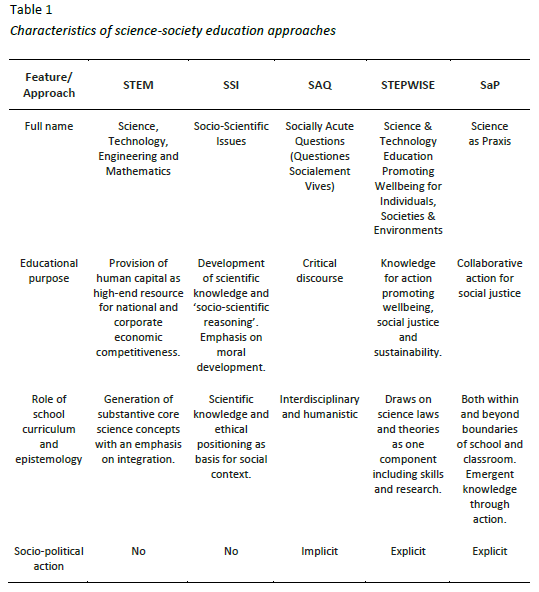
The discourse associated with socially acute questions (SAQs) or QSV has become more prominent in recent years as it has sought a distinctive but overlapping space in science–society education together with STS (Aikenhead, 1986), STS(E) (Pedretti & Nazir, 2011), SSI (Sadler, 2011), STEPWISE (Bencze et al., 2005) and Science as praxis (Roth & Lee, 2002). Where SAQs are distinctive is threefold: the omission of ‘science’ from the descriptor stressing multi- and inter-disciplinary approaches, hence a commonality with Fourez’s (1997) concept of ‘islands of rationality’; an emphasis on ‘acute’ questions, i.e. those that are controversial and socially urgent; and a socio-epistemic approach incorporating post-normal complexity, uncertainty and risk (Ravetz & Funtowicz, 1999). These generate pedagogic and school curricular implications to a greater extent than other science-society formulations because aspects such as complexity, risk and inter-disciplinarity receive greater emphasis. The loss of science also shifts thinking away from the application of disciplinary content to a social controversy, in curricular terms. However, as I indicate later, these possibilities for curriculum and pedagogy will vary and face different challenges depending on the regional and national contexts, and their socio-cultural and educational histories. SAQs reflect many of the realities encountered through technoscientific developments. Table 1 attempts to compare the different emphases of science-society approaches although I omit STS since its scope is too broad, and goes well beyond schools into the academe. Although Zeidler et al. (2005) have endeavoured to chart the characteristics of SSI, as they are in fact operationalised they incorporate a whole range of approaches from those that use it as a context to teach substantive science concepts to framing them within a critical thinking context. However, a common approach in SSIs is the development of moral character and reasoning. At any rate SSIs are deemed to have a less problematic epistemic relationship with national and regional curricula than the others.
Those advocating science-society approaches within school curricula face political, economic and educational challenges in the face of STEM, (Science, Technology, Engineering, Mathematics), an acronym that has crept up on the world of science education stealthily and with sudden rapidity, accompanied by terms such as ‘innovation’, ‘competitiveness’, ‘entrepreneurship’, ‘enterprise’ and ‘excellence’ (The Royal Society, 2009), all of which are prominent within neoliberal educational discourse, and point to a move in science and technology education to liaise more closely with business and private enterprise than with the public and state sectors. Hence, STEM has a social aspect – quite different in nature from that of SAQs. It makes particular claims for human capital to support technological innovation, and is itself a science-society formulation, hence its inclusion in Table 1. Implicit, too, in the term STEM is inter-disciplinarity. US schools and UK schools need to emphasize a STEM epistemology to justify its social and economic existence and the ways in which science can support technology and engineering (Gough, 2015), although little work on pedagogic and curricular integration has been done in this direction. But the motivations of STEM are economic and corporatist. They are also political because the question arises as to whose benefits such changes are directed (Owen et al., 2009).
And that is one of the challenges for SAQs because the underpinning drive in science education in STEM, is one which sees schools and education as sources of human capital for economic growth through increased consumption. That is a controversial issue. The problem is that the science–society link becomes one which is appropriated into a broader STEM discourse. Extracts from the foreword to The Royal Society’s report ‘Hidden wealth’ exemplify this:
How has science contributed to this growth of wealth and enhanced quality of life via services? . . .
. . . we set out to answer a simple question: where has science—in the widest sense—already contributed well to fostering innovation in the services sector and where and how might new policies enhance the situation? . . .
We anticipate services delivered much more cheaply, to better quality and personalised to millions of individuals where that is desired. While much of this will be provided by the private sector, government can enhance its own services hugely by cloning the best of private sector developments to maximise value for taxpayers’ money and to strengthen democracy. . .
Ever better collaboration between STEM practitioners and social scientists and those in the humanities will be essential if the services are to be acceptable and fit for purpose. Changes in our educational system would also make a material contribution to such success. (The Royal Society, 2009, v)
There is little political analysis within school education circles of the effect of STEM; the rapidity of its advance is testament to that. What I argue is missing from an SAQ approach, and indeed other similar processes, is a more prominent political analysis. The epistemological basis of SAQs makes it possibly a more fruitful means of political challenge. But what does a political challenge then incorporate?
In this article I shall first discuss the political and ethical challenges to SAQs and for socio-scientific approaches more broadly, the implications for schools, curricula and pedagogy together with some operational questions which confront us.
POLITICAL AND ETHICAL CHALLENGES
My core argument for the incorporation of political literacy[1] and action[2] in science-society approaches is that the lack of these components results in trivial outcomes as a sort of faux mimicry of consideration of socio-scientific issues, and an acquiescence to the status quo. The intellectual roots of such a critique lie in Critical Theory (McCarthy, 1978) which warned that the power of science through prediction and control resulting from The Enlightenment project was enmeshed in a set of political and economic practices which was as likely to make technoscience an instrument of domination as of emancipation. It is the explicit realisation of this problematic: the duality of liberation and oppression which need to be confronted in science-society programmes.
Many critical scholars (Dewey, 1916; Giroux, 1988; Greene, 1986; Simon, 1992) have addressed the question of the roles of schools in democratic societies. All of these writers stress principles of social justice, compassion, acknowledgements of diversity and difference, collaboration, and criticality. All have critiqued extant curricula and stressed the education of critical citizenry challenging a predominantly capitalist, and nowadays, corporatist and neoliberal environment which is predominantly enslaving[3]. There have also been alternative discourses, some critical of critical pedagogy, which have highlighted their omission of feminist (e.g. Ellsworth, 1989), environmentalist and post-colonial thinking which have stressed sustainability, equality, oppression and have been critical of Enlightenment and rationalist approaches which have failed to counter socially oppressive assumptions and institutions.
So science education, and its broader component of scientific literacy, operates in a politically complex environment. It is important to stress ‘complexity’ because the emphasis on neoliberalism and its manifestation in school policy and management can sometimes obscure other social, pedagogic and historical trends which still retain influence. These will be different according to national and regional context. In the U.K., for example, the historical fingerprints in science education are influenced by:
-
a. The 1944 Education act which opened up secondary education to women and working class children, comprehensivisation of schools in the 1960s, 16+ examinations for all and Science for All in the 1980s and the contemporary moves to ‘free’ schooling from local authority control in a mixture of state and privately controlled sectors.
b. The influence of science for the worker since the industrial revolution (Layton, 1973), the establishment of vocational science and separation from academic science (quite different, for example, from the situation in Germany), the petitioning from a socialist—and scientistic—perspective of the importance of science for working people in the 1930s (e.g. Hogben, 1959), and the science-society movement in schools which had its political impetus to try and regain public confidence in science after disasters such as the salmonella outbreak, BSE, Chernobyl (House of Lords, 2000).
c. The importance of a liberal education in the UK which has its roots in elite ‘public’ (i.e. independent) schools, stresses the pre-eminence of domain-specific knowledge, i.e. school subjects (Hirst & Peters, 1970), and maintains the ‘gold standard’ of academic qualifications in tightly-bounded subjects (Bernstein, 1973) such as physics and mathematics.
The point to stress here is that although the countervailing trends of STEM and science-society approaches in schools appear on the surface similar throughout the post-industrial world there are important local and historical differences which constrain what is possible, and the perspectives through which teachers, school policy makers and students come to these issues. In that sense my own perspective is from the context of experience of teaching in London schools and teacher education in England, hence the political, professional and historic lens through which I view SAQs. (The multi-disciplinary component of SAQs, for example, might pose greater structural and pedagogic challenges in U.K. schools, than in French schools).
The Relevance of Science Education (ROSE) study (Sjoberg & Schreiner, 2005) is an important signifier in terms of what is possible in national contexts because it shows a tension in rich countries between interest in science as a career, achievement in science and student identity. Japan, which regularly achieves enviable scores in PISA and is a source of emulation for countries like the U.S. and the U.K., comes right at the bottom of the ROSE survey for student interest in science as a career.
POLITICAL EDUCATION
While there has been a profusion of policy statements and curriculum developments which have as their base science and society and the scientific citizen (NRC, 1996), and profound socio-political critiques of these reforms (e.g. Bencze & Carter, 2011), these still do not provide a vision of the social and political nature such reforms, and their critiques, aspire to. (Incidentally by a vision, I do not mean a ‘blueprint’, that would be calamitous and regressive). Contemporary critiques are directed towards how science and technology buttress the more nefarious effects of globalisation and/or the consumerist-driven aspects of neoliberalism. Others critique the governance of science and its collaboration with a repressive world order. From a very different perspective yet others have questioned the epistemological justification for any conjuncture between science as a discipline and social science (Donnelly, 2004), particularly its relationship to social action (Hadzigeorgiou, 2015).
So, what is the problem when policy statements about the science curriculum and scientific literacy highlight reflection and informed decision-making? The relationship between informed decision-making at a political level and school science knowledge is at best notional and untested, and at worst misconceived (Ryder, 2001). A high level of school knowledge of science is not a prerequisite for effective decision-making, and if there is a relationship it is likely to be highly complex (Dawson, 2000). What is missing is how any enactment of curriculum reforms and their associated pedagogical strategies which instantiate social justice as their core commitment, reflect the political nature of a society that might be deemed desirable. Both policy reforms (usually in terms of democratic participation and national competitiveness) and their critiques (usually attacks on the instrumentalist and consumerist positions of the reforms) identify extant problems: what they fail to do is first to map out what social and political changes are necessary to encompass desirable actions to achieve social justice through science education, and more strikingly how such reforms might be achieved, hence the necessity of action.
School curricula in many countries now incorporate citizenship or political literacy either as a subject in its own right or in a cross-curricular way. Although there are differences of emphases between national ideas of citizenship education the main purposes are to enhance civic virtues towards the rights and responsibilities that are entailed by democratic participation. I think here this is a common concern of SAQs which recognises at source the influence of the products of science and technology on all our lives, and my point is that the political and action implications need greater emphasis and theorisation.
Contemporary views of social justice and the good society are frequently polarised between two foundational and incommensurate values: fairness in terms of equality (broadly egalitarianism) and freedom (broadly libertarianism). These portrayals are usually seen as a left-right divide respectively. Social justice for the left is a preference for the fair distribution of goods and necessities of life—access to health, food, education, and leisure—while for the right it is seen in terms of personal freedom ameliorated by some regulation to avoid poverty traps (Kymlicka, 2002). Ensuring fair distribution will necessarily affect personal freedom through strong regulatory measures to soften the effects of polarisation of wealth such as differential taxation schemes, while those in support of personal freedom will view state regulation as an unnecessary impediment to entrepreneurship and enterprise. An example of a socio-scientific issue which brings out these tensions is that of genetics where embryos can be genetically selected through ivf technology for certain features deemed desirable by prospective parents. A radical libertarian approach would be consistent with the technology that responds to market demands. This could portend a future where the wealthy have genetically selected children with so-called desirable characteristics which is not available to most people because of cost. There are, of course, deep ethical issues contingent with this technology. An egalitarian position would be consistent with an approach that has the technology available to all or to none. Making the technology available to all would, of course, put huge demands on the public health sector and a rational outcome could be that the technology is not made available to anyone, except in particular circumstances where life and/or health might be at risk. Note that expropriation of eggs from Third World countries (www.eggsploitation.com) is not excluded by either an egalitarian or libertarian approach although it possibly could be by the former when viewing egalitarianism in a more global context.
Freedom and equality are not the only foundational values in contemporary society—these include the common good (communitarianism), rights (libertarianism), identity (identity politics and multiculturalism), feminism, and so forth. Dworkin (cited in Kymlicka, 2002) argues that all plausible political theories must be egalitarian at base, i.e. treat and respect people as equals. So the fundamental argument is both moral and political—not whether people are equal but how to interpret equality and respect for human rights through social institutions such as technoscience. There seems to me to be a case to foreground this problematic as an interpretative framework for approaching technoscientific issues. School student activism therefore needs to:
-
i. Engage critically with the political knowledge and skills in any democratic process (for example, an explicit understanding of the potential conflicts between individual rights and distributive justice);
ii. Recognise the possibilities and limits of political action (conflicts between different interest groups; an understanding that moral outrage drives action which requires a rational understanding of conflicts of interest (Levinson, 2010).
So, there is not just the case of incorporating a political literacy component (knowledge of political systems and political morality) but there is the question of turning politically-informed desires into action.
THE ROLE OF ACTION
One of the problems, I think, which paralyses the possibilities of action in relation to knowledge is the dominance of the SSI paradigm in education that action presupposes conceptual knowledge (see Table 1). Historically this has its roots in Platonic thought and the separation between episteme (knowledge) (which arises from the contemplative, and hence privileged, life) and techne, i.e. doing (Dunne, 1993).
The rationale behind modern theories of praxis, derived from both Hegel and Marx, is the realisation of consciousness through action, which is a human engagement
embedded within a tradition of communally shared understandings and values, that remain vitally connected to peoples’ life-experience, that finds expression in their ordinary linguistic usage, and that, rather than being a means through which they achieve outcomes separate from themselves, is a kind of enactment through which they constitute themselves as persons in a historical community. It is through praxis that a person comes to have an individual identity, but at the same time it always transpires within an intersubjective medium. . . The moral subject, the subject of praxis, is inconceivable in abstraction from communicative relations with others. (McCarthy, 1978, p. 35)
So the relationship between knowledge and action is turned the other way around, that is, in a Deweyan sense, knowledge is accrued through collaborative inquiry in acting upon the world (Tobin, 2014). Action becomes an existential choice which becomes more challenging in a world saturated with discourses promoting a uniformity of consumption. There are aspects of action through praxis which cohere well with SAQ philosophy: the importance of language through collaborative discourse (although I see no good reason for any hierarchical analysis of these discourses) and the prominence in the urgency of SAQs of living in a late modern uncertain world (Giddens, 1990).
Action, as opposed to techne (Arendt, 1998) has no predetermined outcome. Because action involves participation and communication of diverse groups to change the world it must presuppose trust and openness. Knowledge grows through thought and action but is reflexive because the progress of action is always uncertain and leads to new sources of knowledge. However, unless political knowledge and nous underpin action the outcomes will be technical fixes, increased control or individualisation. Two examples illustrate my point.
The first derives from a research informed approach on assessment, particularly influential in school science education in the U.K., which was designed to make assessment more transparent to the learner and to open up a dialogue between peers and students and students and teachers to negotiate and inform learning (Black et al., 2003). Assessment was seen as a ‘black box’ which needed to be opened and reconfigured. The result of this research into Assessment for Learning. AfL, was disseminated as good practise in which dialogue, learning as a joint collective enterprise, was encouraged at the expense of metrics. An important lynchpin of AfL was teacher autonomy and reflection so that such practices were to be adapted for the educational context and not to be ritualised.
In 2008 the New Labour government invested £150 million over three years in an AfL strategy for teacher professional development ‘to improve the ways in which tests are used’ (House of Commons 2008, Ev 178 Q329). AfL became APP, Assessing Pupils’ Progress, a means of assessing pupils summatively against hierarchical National Curriculum levels (Swaffield, 2009), precisely the opposite of the ethos of AfL. APP has now become entrenched as common practise.
A second example concerns a group of 16-17 year old students at a school who objected to the presence of sugary drinks dispensers on the grounds of health and effects on learning. The students took their objections to the Principal who claimed the dispensers were beneficial because they raised money for out of school activities which were otherwise unaffordable. The students then drew on more research into the health and learning effects of sugary drinks, organised a campaign, and took their evidence and objections to the School Council, a student-teacher body set up to discuss school issues. The campaign was so successful that the School Council supported the students, the Principal agreed to remove the dispensers and they negotiated new ways of raising money through healthier but appetising drinks (Levinson & Turner, 2001).
The point about these two examples is the contrasting deployment of political knowledge and skills in enacting change for social justice. In the first case, progressive research was appropriated by government power and used for purposes of stratification. Political resistance and organisation were needed to anticipate and oppose such changes. In the second case political nous and scientific knowledge were used to muster support: in other words knowledgeable collaborative action together with political and scientific knowledge are presupposed by changes for social justice.
SCHOOLS
An implicit understanding of what has been discussed until now is that SAQs and other science-society educational formulations take place in schools. Schools, at least, are arenas where teachers and students can come together in a common enterprise such as engaging in SAQs. But, as also discussed earlier schools, while being released at least in the U.K.[4] from local control and being deregulated are still under the authority of central government, and are becoming handmaidens to neoliberal drives. Reforms in science education accompanied these changes. The Beyond 2000 report in the U.K. was ‘‘driven by a sense of a growing disparity between the science education provided in our schools and the needs and interests of the young people who will be our future citizens’’ and ‘‘the rapid pace of technological change and the globalisation of the marketplace have resulted in a need for individuals who have a broad general education, good communication skills, adaptability and a commitment to lifelong learning’’ (Millar & Osborne 1998, p. 2001).
The neoliberal assault on school education over the last twenty years has affected teaching and the curriculum as well as school organisation, with a teacher culture focused on short-term outcomes driven by an examination result culture (Hargreaves & Shirley, 2009), a culture of pedagogic conformism and performativity generated through new technologies of control, so that teachers become ‘fabricated’, change their identity to represent the performative culture of the organisation for appraisal (Ball, 2003).
In the light of such changes political action emanating from critical consideration of technoscientific issues seems a bleak prospect. Teachers are likely to take fewer risks in ‘heating up’ an issue (Simonneaux, 2014). So, however progressive the intentions of a school management they are unlikely to be effective in such an unpromising political environment. I am cautious about the prospects of SAQs, STEPWISE and SaP because such critical approaches are only likely to achieve little leeway in such a school environment.
While fully recognising that any radical changes to teaching will only come when school reform and teaching are linked to wider social struggles, Fielding and Moss (2011) propose ten indicators of commitment to democratic practices in schools among which are radical roles which characterise relationships as practised between teachers and pupils. I will aim to formulate six principles related to these roles within the context of socio-political scientific issues which are not sufficient in themselves but form the basis of realising meaningful action.
-
i. Students as data source. Students opinions to be taken seriously as related to their own academic achievement and through socio-political issues within the school arena, e.g. support for disabled students, reflection on the science curriculum, school cycling and safety campaigns
ii. Students as active respondents. Teachers have a duty to engage in dialogue with students about identifying the kinds of social-scientific issues which concern them, i.e. that these issues matter and have personal meaning for students, not those which teachers think might be good for students to discuss.
iii. Students as co-enquirers. Students encouraged to envisage what participatory research might look like and how it could be enacted,
iv. Students as knowledge creators. Students with staff support use their emerging political and scientific knowledge through co-enquiry to suggest change.
v. Students as joint authors. Students discuss strategy with peers and staff how change is to be enacted.
vi. Inter-generational learning as participatory democracy. Students and staff develop curricular schemes for involving younger students, and to engage extra-school agencies in support for enacting change.
The above suggestions are only a start for what enacted SAQs might look like but a vision which involves shared and negotiated values is a basis for further change.
CONCLUSIONS
I have suggested that the incorporation of political knowledge and literacy through SAQs and a commitment to action would build on a well-worked out pedagogic and curricular base. The process of change would mean negotiating very different regional and national educational territories as well as overcoming performative indicators stemming from a neoliberal hegemony in school education. But the process of change in unpromising environments can generate a fruitful dialectic. The awareness of limitations in what can be achieved can, nonetheless, raise consciousness about the possibilities of action which in itself is a form of action. In the last few years educators in fields in science and mathematics have developed innovative curriculum materials which challenge the STEM discourse, e.g. a mathematics which focuses on redistribution rather than consumer goods, science activities which question the science behind consumer goods, a focus on the technological means of production rather than the hazards of consumption. For example, while there are many activities which focus on the science behind digital technologies and the hazards of radiation, little attention is paid to the scandal of production of coltan (http://www.dailymail.co.uk/news/article-3280872/iPhone-mineral-miners-Africa-use-bare-hands-coltan.html) exposed through a right wing neo-conservative newspaper, one of the contradictions present in SAQs. Fielding and Moss’s (2011) indicators of democratic practise provide a not unproblematic way forward but one which has the potential to yield new and productive strategies.
References
Aikenhead, G. (1986). The content of STS education. STS Research Network Missive, 1(3), 18-23.
Arendt, H. (1998). The human condition (2nd edition). Chicago: University of Chicago Press.
Ball, S. J. (2003). The teacher's soul and the terrors of performativity. Journal of Education Policy, 18(2), 215-228. DOI: 10.1080/0268093022000043065
Bencze, l., & Carter, l. (2011). Globalizing students acting for the common good. Journal of Research in Science Teaching, 48(6), 648-669.
Bencze, l., Sperling, e., & Carter, l. (2012). Students’ research-informed socio- scientific activism: Re/visions for a sustainable future. Research in Science Education, 42(1), 129-148.
Bernstein, B. (1973). Class, codes and control (Vol. 3). London: Routledge.
Black, p., Harrison, c., Lee, c., Marshall, b., & Wiliam, d. (2003). Assessment for learning: Putting it into practice. Maidenhead, UK: Open University Press.
Dawson, C. (2000). Selling snake oil: Must science educators continue to promise what they can't deliver? Melbourne Studies in Education, 41(2), 121-132.
Dewey, J. (1916). Democracy and education. New York: Macmillan.
Donnelly, J. (2004). Humanising science education. Science Education, 88(5), 762-784.
Dunne, J. (1993). Back to the rough ground. Notre Dame: University of Notre Dame Press.
Ellsworth, E. (1989). Why doesn't this feel empowering? Working through the repressive myths of critical pedagogy. Harvard Educational Review, 59(3), 297-324.
Fielding, m., & Moss, p. (2011). Radical education and the common school: A democratic alternative. Abingdon: Routledge.
Fourez, g. (1997). Scientific and technological literacy as a social practice. Social Studies of Science, 27(6), 903-936.
Giddens, A. (1990). The consequences of modernity. Cambridge: Polity Press.
Giroux, H. A. (1988). Literacy and the pedagogy of voice and political empowerment. Educational Theory, 38(1), 61-75.
Gough, A. (2015). STEM policy and science education: scientistic curriculum and sociopolitical silences. Cultural Studies of Science Education, 10, 445-458. doi: 10.1007/s11422-014-9590-3.
Greene, M. (1986). In search of a critical pedagogy. Harvard Educational Review, 56(4), 427-441.
Hargreaves, A., & shirley, D. (2009). The persistence of presentism. Teachers College Record, 1110(11), 2505-2534.
Hadzigeorgiou, Y. (2015). A critique of science education as sociopolitical action from the perspective of liberal education. Science & Education, 24(3), 259-280.
Hogben, L. (1959). Science for the citizen: A self-educator based on the social background of scientific discovery. London: Allen & Unwin Ltd.
Hirst, P., & Peters, R. (1970). The logic of education. London: Routledge & Kegan Paul.
HOUSE OF LORDS (2000). Science and technology - third report. London: House of Lords.
Kymlicka, W. (2002). Contemporary political philosophy : An introduction. Oxford: Oxford University Press.
Layton, D. (1973). Science for the people: the origins of the school science curriculum in England. Allen and Unwin.
Levinson, R., & Turner, S. (2001). Valuable lessons. London: The Wellcome Trust.
Levinson, R. (2010). Science education and democratic participation: An uneasy congruence? Studies in Science Education, 46(1), 69-119.
McCarthy, T. A. (1978). The critical theory of Jurgen Habermas. Massachusetts Institute of Technology.
Millar, R., & Osborne, J. (1998). Beyond 2000: Science education for the future. London: King's College
NATIONAL RESEARCH COUNCIL (NRS) (1996). National science education standards. Washington DC: National Academy Press.
Owen, R., MacNaughten, P., & Stilgoe, J. (2009). Responsible research and innovation: From science in society to science for society, with society. Science and Public Policy, 39, 751‐760.
Pedretti, E., & Nazir, J. (2011). Currents in STSE education: mapping a complex field, 40 years on. Science Education, 95(4), 601-626.
Ravetz, J., & Funtowicz, S. (1999). Post-normal science: An insight now maturing. Futures, 31(7), 641-646.
Roth, W.-M., & Lee, S. (2002). Scientific literacy as collective praxis. Public Understanding of Science, 11(1), 33-56.
Ryder, J. (2001). Identifying science understanding for functional scientific literacy. Studies in Science Education, 36, 1-44.
Sadler, T. D. (Ed.). (2011). Socio-scientific issues in the classroom: Teaching, learning and research. Dordrecht: Springer.
Simon, R. (1992). Teaching against the grain: texts for a pedagogy of possibility. New York: Bergin & Garvey.
Simonneaux, L. (2014). From promoting the technosciences in activism – a variety of objectives involved in the teaching of SSIs. In L. Bencze & S. Alsop (Eds.), Activist science and technology education (pp. 99-112). Dordrecht: Springer.
Sjøberg, S., & Schreiner, C. (2005). How do learners in different cultures relate to science and technology? Asia-Pacific Forum on Science Learning and Teaching, 6(2).
Swaffield, S. (2009, September). The misrepresentation of Assessment for Learning – and the woeful waste of a wonderful opportunity. Paper presented at Association for Achievement and Improvement through Assessment Conference. Bournemouth,U.K. 16 – 18 September, 2009.
THE ROYAL SOCIETY. (2009). Hidden wealth: the contribution of science to service sector innovation. London: The Royal Society.
Tobin, K. (2014). Using collaborative inquiry to better understand teaching and learning. In L. Bencze & S. Alsop (Eds.), Activist science and technology education (pp. 127-148). Dordrecht: Springer.
Zeidler, D. L., Sadler, T. D., Simmons, M. L., & Howes, E. V. (2005). Beyond STS: A research-based framework for socioscientific issues education. Science Education, 89, 357-377.
Notes