Articles
Citizenship Education in Nanotechnologies as a Means of Developing Ethical Thinking Among Students
Educação Para a Cidadania em Nanotecnologias: Desenvolvimento do Pensamento Ético dos Estudantes
Education Citoyenne aux Nanotechnologies: Developpement de la Pensee Ethique des Etudiants
Citizenship Education in Nanotechnologies as a Means of Developing Ethical Thinking Among Students
Sisyphus — Journal of Education, vol. 5, no. 2, pp. 138-154, 2017
Universidade de Lisboa

This work is licensed under Creative Commons Attribution-NonCommercial 4.0 International.
Received: April , 06, 2017
Accepted: June , 05, 2017
Published: June , 30, 2017
Abstract: As pertains to the didactics of SAQs (Socially Acute Questions), we have experimented with educational devices contributing to the development of (i) controversial questions, (ii) engagement abilities and (iii) ethical thinking among learners. The work described in this paper has a praxeological aim. The combination of several theoretical fields related to nanotechnologies (nanoethics, sociology and political science, political philosophy) and their evolution during the past several decades, enables us to point out the lacunae and deficiencies that need to be addressed in order to build a citizenship education around this issue. Care Ethics provides some elements for building practical pedagogical devices capable of contributing to the development of hybrid, cosmopolitan and ethical thinking among—and even the empowerment of—learners. These elements can then be used as a guide for engineering debates and moral questioning on an SAQ related to nanomedicine.
Keywords: Socially Acute Questions (SAQ), Citizenship education in nanotechnologies, Ethics of care, Ethical thinking.
Resumo: No campo da didática das Questões Socialmente Vivas (QSV) experimentamos alguns dispositivos que contribuem para questões controversas, para as capacidades de envolvimento dos cidadãos e para o desenvolvimento do pensamento ético dos alunos. O trabalho descrito neste paper tem um objetivo praxeológico. O cruzamento de diversos campos teóricos relacionados com as nanotecnologias (a nanoética, a sociologia e as ciências políticas, la filosofia política), e sobretudo a sua evolução nos últimos 15 anos permitirão identificar as lacunas e deficiências necessárias para construir o pensamento em torno do tema da educação para a cidadania. As contribuições da ética do cuidado possibilitarão a construção de dispositivos pedagógicos práticos capazes de contribuir para o desenvolvimento do pensamento ético entre os alunos, assim como para a sua capacitação. Estes elementos poderão, então, ser utilizados para orientar a engenharia dos debates sobre QSV moralmente relacionadas com a nanomedicina.
Palavras-chave: Questões socialmente vivas, Ética do cuidado, Educação sobre as nanotecnologias, Pensamento ético.
Résumé: Dans le champ de la didactique des Questions Socialement Vives (QSV), nous expérimentons des dispositifs contribuant à la construction de questions controversés, de capacités d’engagement citoyens et le développement la pensée éthique de l’élève. Les travaux ici présentés ont une visée praxéologique. Le croisement de plusieurs champs théoriques en lien avec les nanotechnologies (la nanoéthique, la sociologie et les sciences politiques, la philosophie politique) et surtout de leur évolution depuis 15 ans permettra de mettre en évidence les lacunes à considérer pour penser cette éducation citoyenne. Les apports de l’éthique du care fourniront les jalons pour bâtir des dispositifs didactiques contribuant au développement de la pensée éthique chez les apprenants ainsi que leur empowerment. Ces jalons serviront ensuite de guide pour l’élaboration d’une ingénierie de débat sur une QSV en lien avec la nanomédecine reposant sur des dérangements moraux.
Mots clés: Questions socialement vives, Éthique du care, Éducation aux nanotechnologies, Pensée éthique.
NANOTECHNOLOGIES: AN OCEAN OF SOCIALLY ACUTE QUESTIONS
Citizenship education in technosciences necessarily relates to the idea of democracy in Western societies (Dewey, 1916), and to the relationships at work between democracy and education. In this paper, I shall inquire into such relationships, particularly with respect to the development of ethical thinking and empowerment in learners. My focus will be on a specific example of technoscience: nanotechnology and the teaching of social and ethical knowledge (Panissal & Brossais, 2012).
Among others technosciences (Hottois, 2006), nanotechnologies encompass a large array of techniques, applications and issues, making it difficult to attribute a stable definition to them. For now, there seems to be a kind of consensus about one common point: their scale (10-9 m), or that these technologies make it possible to miniaturize objects and materials to less than a hundred nanometers. Nanotechnology’s multi-sectored applications can be grouped into three main domains: materials, information technology and health. Nanotechnologies represent more than a technological shift, they also elicit considerable debate with respect to political and economic programs, ethical issues (Leweinstein, 2005) and civic participation (Laurent, 2010). Since they were introduced at the 1999 National Nanotechnology Initiative (NNI) in the United States, they have been developed with a clear itinerary and a precise calendar, including social preparation for nanotechnological applications (Tour, 2007). As a precaution, the Social and Human Sciences were involved in research programs from the inception of such technologies in order to control potential risks (Thoreau, 2012). The consideration of ethical issues over more than fifteen years has led to intense reflection on nanotechnologies and their Ethical, Legal and Social Implications (ELSI). A periodical, Nanoethics, was created in 2007; a code of good practice was published by the European Commission for researchers; lists of potential socioethical consequences, in terms of toxicity, protection of privacy, human improvement and social justice were produced (Thoreau, 2012). The ELSI method has been met with a number of criticisms regarding its heavy reliance cost/benefit analysis, and has been accused of avoiding the real ethical issue of nanotechnologies; namely, their capacity to affect our human condition and hypothetically our moral judgments. Many researchers in ethics therefore attempt to go beyond analysis through co-constructed and contextual intervention (Guchet, 2014). That kind of pragmatism calls into question the ways in which socioethical knowledge as it relates to nanotechnologies is taught in secondary education.
CITIZENSHIP EDUCATION: CONNECTION WITH THE ETHICS OF CARE
Within the framework of NanoEcole, we have been studying the ways in which nanotechnologies are being taught at the middle- and high- school levels since 2007. Pedagogical strategies aimed at providing a citizenship education in nanotechnologies have been developed by multidisciplinary teams of educators at the secondary school level (Panissal, Brossais & Vieu, 2010). Initially, our work focused on the teaching of socioethical controversies in the technosciences, and on the development of ethical thinking through SAQ-propelled debates. Although some might criticize this work based on its reliance on the ELSI method, we believe that the identification of ELSI is still essential for students. Indeed, it seems that the impact of nanotechnologies is lesser known by the public than in the case of other SAQs. Since we began researching these issues, we have systematically questioned students and teachers about their uncertainties related to nanotechnologies, and we have often gotten the same response: “we never imagined that there was so much to it”. It therefore seems worthwhile to target the construction of an ELSI type of socioethical knowledge. All the more so since SAQ-propelled debates have proven to be good pedagogical tools that allow students to delve into ethical issues related to nanotechnologies, to think critically about modes of governance (Bensaude-Vincent, 2009; Panissal, 2014; Panissal & Brossais, 2012), and to test out ethical issues in the real world. In that sense, even if debates up to now have been colored by the ELSI method, as discussions, they contribute to empowerment. After these past years of research, we believe it is worthwhile to deepen our understanding of how education can lead to empowerment through the development of ethical thinking.
Lipman (2003) defines three thinking styles: critical thinking, creative thinking and caring thinking. Critical thinking is a way to think with applications, to examine a fact or a principle to establish its relationship with judgement. Critical thinking facilitates judgement because is based on criteria (rules or principles), is self-correcting and sensitive to context. Creative thinking is an increase in a way of thinking, is a way to amplify the thought beyond the present situation. This kind of thinking mobilize abilities like imagination, transfer, originality, creativity, independence and detachment of field to create novel, original thought, to empowered thought. Creative thinking also use reasons, standards, criteria and involves critical thinking. Caring thinking allows the entry of emotions in thoughts. It is a way to be aware of the role of emotions in thinking. It is a way to build a different outlook on a situation, to appreciate the value of an object, idea, person, etc. For Lipman, caring thinking is an appreciative, affective, active, normative and empathetic thinking. Finally, for each of these three styles of thinking, thinking is the centre of a process, a pre-requisite to higher order thinking, and thinking is the subject of education.
We now focus on ethical thinking. For Lipman, thinking caringly “means to think ethically, affectively, normatively, appreciatively and to actively participate in society with a concern for the common good” (2002, p. 271). We use the term of “ethical thinking” in order to consider that thinking is more than accumulating knowledge. It involves the ability to value, choose and judge with the necessity of care and justice but also to insist on two important aspects of ethical thinking: care and normativity (cf. next paragraph). Ethical thinking is a way to evaluate and value nowadays’ technological innovations. Today we can observe in many people a devasting feeling that in the end perhaps nothing really matters, that no one person can really do anything that will make any real difference in creating a better world (Sharp, 2004). In this context, it is important to educate students that they really do matter for a sustainable society. Indeed, a good life is linked with what we care about, what we value, what we think truly important. For Sharp (1997), this is the source of the criteria we use to evaluate ideas, ideals, persons, events, things and their importance in our lives. The logics of technoscientific rationality has followed the path of hypermodernity. The pillars of modernity (the state, science, the market, the individual) have colluded with excess and have colonized the lived world, in the Habermassian sense, in the service of a new authority: economic profitability (Lipovestky, 2004). Left unchecked, hypermodernity has led to an excrescence of all the pillars of modernity (the state, science, the market, the individual), each with an outsize mission to exist at the expense of all the others pillars. But what might be capable of putting them in check? As in any struggle against domination, new tools for thinking must be created (Adorno & Horkheimer, 1974). The advances over the past 15 years of SHS research in nanotechnology (Guchet, 2014) highlight some elements that might prove useful in developing an ethical framework: targeting local contexts and affected communities, taking into account the present (what already exists), making use of the skills of all types of researchers, changing our ethical perspectives, examining moral routines in order to foster a process of questioning vis a vis our conceptions of the good life, considering ethics as a praxis.
Ethical thinking as a praxis cannot occur without collaboration, without inquiry. This collaborative inquiry in the classroom implies authentic dialogue, respect for each other as persons, a mutual trust and the ability to communicate with others. It allows learners to discover the values of others and to consider what other people care about. It promotes an environment in which students can behave emotionally, rationally, socially and politically:
This involves a consideration of alternatives through examination of the reasons supporting each alternative. Since the deliberation usually takes place in preparation for the making of a judgement, we speak of the process as a weighing of the reasons and the alternatives. (Lipman, 2003, p. 96)
It is an immersion into a democratic aesthetic experiment that guides interpretation of the sense of human action. We think, along with Dewey and Lipman, that one aim of the education system, in a democratic context, is to stimulate reflective and autonomous thought and give rise to dialogue and inquiry in order to fight against ignorance and injustice. “Our society could not be fully civilized and our schools could not be fully satisfactory (…) until students were converted to inquiry and thereby prepared to be participants in a society” (Lipman, 2003, p. 34). Finally, ethical thinking education in nanotechnology can be connected to such inquiry because caring, critical and creative thinking can make a collective discussion possible for the practice of high level thinking. Such an inquiry opens the investigation of the multiple challenges and the associated ethical and social vulnerabilities. As I now discuss, some elements cohere with many of the preoccupations at work in the field of the Ethics of Care (Fischer & Tronto, 1991; Gilligan, 1986).
Fischer and Tronto (1991) suggest that care be considered a generic activity that includes everything we do to maintain, perpetuate, and repair our world in order to live in it as well as we can. That world consists of our bodies, ourselves, and our environment all the elements we seek to connect in a complex network that sustains life. Their broad definition does not limit itself to human interactions, but also applies to the environment and to objects in our environment. It is also compatible with nanotechnologies, which implicitly contain the idea of a hybridization of the human body with technological elements. Although in moral philosophy Care Ethics is embedded in the events of daily life, several thinkers in the field suggest politicizing care in order to reposition it from its place of private morality into the sphere of political theory (Tronto, 1993). Care is a politics of the ordinary: in the face of ordinary reality, individuals take care of each other, thereby ensuring the continuity of the world (Laugier, 2013). Recast and politicized, care becomes a power distributed amongst all individuals, as well as a new form of organization for thinking, structuring and acting in society. Ethics of care can thus be applied to supplement contemporary moral theories of justice (which consider subjects to be autonomous and rational), whose political practices are grounded in universal rules and general principles that apply to all in the service of social cohesion. The concept of care undermines the idea of universalism through its focus on individuals outside of general frameworks. Its aim is not to make atypical people conform, but to take them into account, to come up with solutions that are not simply universal, but so as not to exclude people also specific. The moral stake here is to go beyond an idea of justice in terms of logic (in terms of rights), and to include a relational logics of responsibility toward one another (our relational co-responsibility). Care Ethics puts into action the conception of social justice through a conceptualization of attentive justice that takes into account specific realities. It sharpens the ways in which we look at behavior and often overlooked facts of life. It helps establish new moral criteria, such as attentiveness, listening, concern for others, and even understanding the vulnerability of the subject (Tronto, 1993). Today’s hypermodern world overemphasizes autonomy, which conceals one of humanity’s defining characteristics: its vulnerability and its intrinsic dependence on others. Care is not only an abstract moral principle; it is also a practice that encompasses need, attention, concern, commitment, the ability to act in a given context, and creative reflexivity. In her most recent work, Tronto (2013) has developed an idea of democracy and citizenship in relationship to care. Fischer and Tronto (1991), and Tronto (2013), have delineated the various facets of the praxis of care.
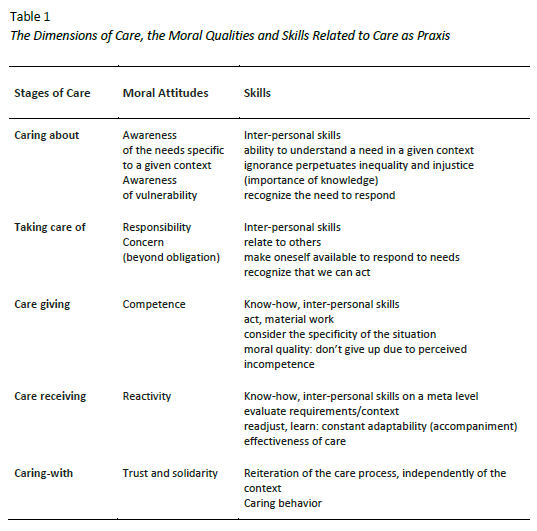
Table 1
The Dimensions of Care, the Moral Qualities and Skills Related to Care as Praxis
Care can only function if we modify the context in which we think. In order to think differently, we have to create moral and political criteria and new tools of thought. Studies undertaken in the field with professional healers, caregivers, and social workers demonstrate that professional behavior is affected by the encounter with others; it guides the moral stance of professionals (Molinier, 2010). It is for that reason that transposing the theory of Care Ethics into the field of education seems useful to us. Such a transposition encourages us to think about the various steps involved in education and about what elements might allow people to perceive the vulnerability of the world and ask good questions, with respect to present-day life and not a hypothetical future. The task is not easy. Steps have been taken, for instance, in the field of political science, where imagining a benevolent and responsible society entails conceiving of ways to change how the state operates so that it can become supportive and anticipatory (Guérin, 2011).
We have therefore worked to transpose the conceptual framework of care into the development of students’ ethical thinking by using nanotechnology-based SAQs. The aim is to help students develop an ethical framework for acting in their lives as future citizens. More specifically, during previous studies in which we analyzed students’ rationales with respect to Habermassian objective, social, and subjective worlds (Panissal, 2014), we revealed the importance of subjective and social rational thinking used by students. These forms of rationality relied on examples from students’ personal lives. They allowed students to problematize an ethical issue in order to discern what was important with respect to nanoelectronics and smart objects. For example, in 2013, a class of freshmen [troisième] engaged in a lively conversation on the ways in which we consent to delegating power to connected objects (refrigerators, smartphones), becoming more and more reliant upon objects and losing some of our autonomy and freedom (Panissal, 2014). That example reinforces the idea that, in order to facilitate students’ ability to make sense of ethical issues, it is worthwhile to encourage them to think from the present moment and about their own life experiences. However, in another sense, it is also worthwhile to guide young people away from the conformism and egocentrism inherent to the adolescent period in order to encourage them to develop their own ethical thinking. The dialectics of education are therefore complex: use the local (what is close to students) in order to awaken their sense of concern, and slowly guide them into more general topics. To that end, the conception of ethics in three dimensions (Morin, 1999) can serve as a guide for educators in their class preparations. 3D ethics demands that we think ethics in terms of ourselves, our moral responsibilities, and our integrity. It also makes use of a socioethical idea based on shared responsibility. That idea is motivated by a duty to justice that contains a legal responsibility toward political autonomy through democracy, as well as an anthropological ethics that takes all of humanity into account (historically and culturally speaking) and encourages reflection on the responsibility for sustaining the world while promoting a social responsibility toward progress and the autonomy of future generations. 3D ethics is a key ingredient in a complex thought process and acts as a counter-power to neoliberalism; it provides a sharp look into what is really important for people. The three-part idea, which serves as a guide for thinking about issues, is doubly interesting to us. On the one hand, it helps us envision a pedagogical model (through the preparation of a debate) that gets students thinking beyond the local and guides them toward imagining vulnerabilities that are more and more distant from themselves. On the other hand, this decentering from the context encourages students to rethink the limits of their conformist reasoning and helps them develop a post-conventional moral thought process (Kohlberg, 1969). In Table 2, we show the five stages of carethat were previously adopted by Tonto (2013) to reflect on possible elements which would inform an educational model linked to an SAQ-propelled debate.
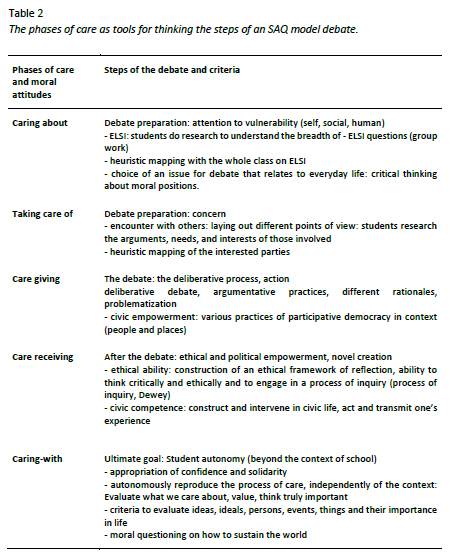
Table 2
The phases of care as tools for thinking the steps of an SAQ model debate.
IDEAS FOR A PEDAGOGICAL MODEL THAT GETS STUDENTS TO THINK ABOUT ETHICAL THINKING: THE EXAMPLE OF NANOTECHNOLOGIES
In our work, we have conceived of ethical thinking as the capacity to consider possible actions in a world filled with uncertainties. Ethical considerations, as Tronto (2013) tells us, must take into account the just and the important; we must sharpen our vision and rely on the right criteria at each step. The aim of our education device is to encourage students to think critically about technoscientific advances and to engage in a process of inquiry (in the service of problematization) according to Dewey’s conception (1916). It is to get them to conduct pragmatic inquiries, identify issues, envision scenarios, examine what works and should be conserved. This goal is intimately linked to the development of an ethical line of thinking that is sensitive to what makes for a fair and caring society and the sustainability of the world. Nowadays democracies must provide an education that addresses the increasing complexity of the world. Facing with globalization, society must ensure the empowerment of pupils and students, must provide an education that allows young people to mobilize their skills and understanding in order to confront the new challenges successfully.
IDEAS FOR MAKING STUDENTS ATTENTIVE TO VULNERABILITY
Document-based research on nanotechnologies and the practice of debate allows students to grasp the breadth of controversies within the field (ELSI); it awakens their thinking and it draws their attention to the vulnerability of humankind. Still, it is important to encourage adolescent students (who are developing their moral compasses) to consider the limits of their egocentric and conformist thinking and to develop a conception of morality that includes concern for others, the respect of social rules, the respect of the fundamental rights of a democratic society, of the right to life and liberty, and the construction of ethical principles that are universal to all of humanity. We believe that the debate preparation phase is fundamental and that it must include 3D care thinking (individual thinking, social thinking, humanity thinking). However, for the sake of efficiency, ethics is increasingly called upon to speak to specific contexts, becoming an ethics of accompaniment rather than an ethics of evaluation. In order to transpose ethical considerations into the field of education, it is important to consider well-anchored moral ideas, or the routines that we take for granted (Dewey, 1916). Such ideas or routines go unnoticed until they no longer work or no longer offer answers or strategies for guiding our behavior in new moral situations. For example, during an analysis within the context of medical care, traditional ethics requires that the doctor maintain patient confidentiality. Yet, if the patient’s disorder, because it has an inherited component, implies consequences for his or her (already born) descendants, does the doctor have a responsibility to inform the family or not? And would such a responsibility apply in cases that go against the patient’s wishes? Such a situation is complicated and would force the doctor to reconsider the notion of responsibility. Indeed, moral conduct corresponds to the implicit, unproblematic acceptance of routines. Ethics is most evident when there is a conflict. What must one do? Ethics therefore deals in controversy; it demands explanations and inquiry; it brings urgency to an issue of moral dilemma, and it is in this sense since it heats up a context that it is interesting for SAQs. Nanotechnologies undermine our moral judgments and force us to confront the unknown. Technoscientific advances will necessarily destabilize our moral routines. For instance, when DNA sequencing becomes affordable, what consequences will it have for potential forms of discrimination? Will we have to pay surcharges on our health insurance if we have genetic risk factors? Who will own, use and be responsible for the genetic information gathered on individuals? One pedagogical strategy might consist in eliciting a debate that undermines moral beliefs. Or posing ethical questions, based on present-day issues, that consider a future for which our cultural baggage does not have moral answers.
IDEAS FOR CONSTRUCTING RESPONSIBILITY
Analyzing arguments from the various interested parties in a debate is an indispensable tool in the pedagogical process, as it helps students consider and modify moral stances. Such an analysis encourages students to unpack discourse, and to make the sources of conflict visible in a far more nuanced manner than the type of black-and-white thinking promoted by the media. They are also encouraged to examine the economic, social, democratic, ethical and political stakes as they relate to each of the protagonists. The thoughts of the parties involved are thus put into context and historicized, which makes it easier for students to perceive oppositions and to engage in everyday ethical questioning. Encouraging students to take an interest in the needs of parties involved in a conflict, in the context of a pedagogical preparation for debate and with the help of heuristic mapping, seems to be an interesting way to reflect on moral routines, elicit good ethical questions (ethical problematization), and give meaning to values. Such debate preparation is essential, as it makes it possible to discuss and inquire into values with the class. Values are what humans respect, hope to obtain, recommend and consider ideal (Rezsohazy, 2006); they allow humans to adhere to goals, which serve interests that motivate them and that seem important in everyday life (Schwartz & Bilsky, 1987). They serve as a guide, as a yardstick to evaluate, dictate behavior and make choices. At times, values vary depending on context and the ways in which individuals prioritize. Nevertheless, they reflect a certain form of universalism, in the sense that they strive for human dignity and the common good. We are currently researching debate protocols on the previously mentioned issue of DNA tests. So far, the ongoing analyses of the heuristic mapping show that students are more likely to understanding the social and ethical stakes of an issue when they are asked to relate them to the various players involved (doctors, researchers, the social health care system, insurance companies, patients, families, pharmaceutical laboratories, IT professionals, lawyers, etc.) and to consider their underlying values and concerns. We hypothesize that, for students, the act of visualizing the arguments and underlying values of interested parties helps them to better understand the intricacies of the controversies and responsibilities at stake and to move away from the black-and-white thinking. The posture of care acts as a counter force, making way for an ethical relationship with others in a hypermodern world that prizes individualism.
IDEAS FOR COMPETENT ACTION
An SAQ-propelled debate in the context of a pedagogical discussion that has been engineered to build an appreciation of controversial scientific, social and ethical topics is an effective way to build knowledge (Panissal & Brossais, 2012). This type of debate also exercises participative democracy in a school setting. The Habermassian model of communicative action envisions space for deliberation in which each citizen is free to participate in a cooperative, truth-seeking debate that aims at resolving a problem in the lived world. The best argument in such a debate leads to consensus and the acceptance of common norms and/or the construction of knowledge and the elaboration of an issue (Panissal, 2014).
So conceived, civic participation relies on the effectiveness of the deliberative mechanisms at work in post-industrial democracies. However, today the available deliberative processes do not have the desired effect, and they remain dependent on the intervention of experts to fill in the gaps for which regular citizens are unable to account. They therefore perpetuate disciplinary divisions and make it impossible to properly conceive of uncertainty in complex situations. This phenomenon is all the more complex in the ambiguous context of the debates surrounding nanotechnologies, in which participative solutions engineered by research and development policies provide the appearance of an openness to civic society for responsible and acceptable innovation (Laurent, 2010). Empowerment, of course, relies upon a citizen’s ability to deliberate in a debate. SAQ-propelled debates on nanotechnologies at the middle- and high-school levels foster such a capacity. But civic empowerment goes beyond that; in order to make such skills emerge, it relies on the intermediary of the collective. The group and the individual are therefore agents in their own transformations (self-transformation) as well as in the transformation of their environment. That kind of governance demands a radical transformation of the agents (Maesschalck, 2008), forcing them to think beyond their local interests and imagine a universalism; it necessitates spaces for deliberation that encourage different points of view, the diversity of which work for the common interest and the construction of a patrimonial democracy. Civic empowerment leads to the creation of multiple, critical civic groups capable of focusing on different aspects of nanotechnologies: the creation of norms, questioning scientific policy and even the organization of a democratic society’s participative procedures. In sum, it fosters the existence of multiple groups with different preoccupations, and it is on this plurality that the lived world relies in order to give way to the emergence of criticism and action, to make democracy come alive and not as a frozen state, but as a dynamic process under construction.
IDEAS CAPABLE OF ELICITING REACTIVITY
This phase is essentially developed after the debate and takes on different forms: presentation to the class of knowledge that has been learned, heuristic mapping related to the adopted SAQs, end-of-year sketches for parents, role playing on ethical committees, posters, class newspaper, and fictional narratives. The various methods we tried were conceived to problematize ELSI forms of knowledge or to analyse the participation and argumentation of the participants of a debate in such a way as to meet the education system’s requirements at the middle- and high-school levels. The activities also encouraged students to explore the various elements that make up a participative democracy: citizens’ juries, whistle blowers, ethical committees, consumer groups, vulgarization of information. Meeting with people outside of school also allowed students to grasp the reality of their discussions.
Teaching science such as it is conceived in the SAQ model is not limited to teaching scientific concepts (including controversial ones); rather, it extends to topics ranging from the nature of science to the development of active democratic civic capacities (Simonneaux & Simonneaux, 2012). Pedagogical scenarios can therefore be used to lead teachers toward activism and to engage in social and political actions related to a given context in the classroom (Bencze & Sperling, 2012). Although they are still in laboratories, nanotechnologies already offer a number of avenues for examining the evolution of both new and existing values. In nanomedicine, for example, nanotechnologies have optimized DNA sequencing, reducing the cost and making it more accessible; as a result, health tests can be rendered massively availabble (see the 2014 Senate Report on nanomedicine). Dewey’s method of inquiry allows us to imagine possibilities, not as a direct link between pre-established means and ends which is to say, a genotyped patient digitized in big data whose health is managed by algorithms made from profitable genomic profiles but as an attentiveness to the pragmatic context’s vulnerabilities for the sake of creating a sustainable world. To borrow from Hodson (2010), students must also be able to live participation in order to be invited to negotiate tomorrow’s values. Thus, in order to encourage the development of moral judgment in students, educators should consider the mechanisms of ethical empowerment. A potential source of inspiration could be the groups and networks of civic empowerment that have been active in the world for the past twenty years. Those networks have been becoming increasingly institutionalized, across various sectors such as, for example, at the level of city politics, social economies, the environment, and health. Using local experience as a starting point, they have produced guides, feedback surveys, action plans, reports empowering citizens to act, and an array of materials designed to give individuals the tools to empower themselves and enact change. As Guchet (2014) has suggested for ethics committees, in the scholastic context, the aim would be to bring students into the laboratory, to the very place where nano-objects are still being developed, and have them dialogue with teams of researchers on the role of nanotechnologies in society. The following example may prove enlightening. During a freshman class debate [classe de troisième] on the potential toxicity of titanium dioxide found in sunscreen, one student wondered about the interaction between that nano product and the one in her watch that made it change color. “If I’m playing volleyball on the beach and I get hurt, what happens with the nano products in the sunscreen and the ones in my watch?” This example shows how even a high schooler’s perspective can lead to new research. If we want students to be able to create a new world, educating their minds and methods of thinking is essential.
CONCLUSION
Schools are particularly affected by today’s technological and scientific advances, and more generally by globalization. There is a need to inquire into the type of scientific and civic culture to transmit to the twenty-first century. The task is all the more urgent since “today’s neoliberal ideology has become hegemonic and seeks to impose onto school systems the values and social norms that suit the economic needs” of the market, replacing Keynesian state intervention (Lenoir, 2012, p. 12). The issue seems even more pressing since there are plans to institute nanotechnology programs across the world for young learners (Greenberg, 2009). It is worth wondering about the relationship between such programs and the thorny question of social acceptance with respect to nanotechnologies, and we might wonder whether “the functions of the educational system (…) have shifted from transmitting cultural tradition and knowledge (…) to acculturating students to a market economy in which all humans must submit to its demands, its limitations, its entrepreneurial ethics” (Lenoir, p. 16). It is essential that the school system as a pillar of democracy (Dewey, 1916) imagines education not as a process of adapting students to society’s current needs, but as a means of raising students for the future and building the foundation of a future harmonious society. The school system must help develop critical thought and judgment so that students can participate in the public sphere. The school system also has the difficult burden of taking on changes in a democratic society, contributing to democratic innovation and helping to sustain the world (Ballet, Dubois & Mahieu, 2005).
In terms of social pragmatism, Dewey (1916) provides a rich reflection on democracy and education. That theoretical framework seems particularly apt for considering nanotechnological issues and could serve as a reference for developing curricula on the ethics of nanotechnologies in the field of SAQs. In political philosophy, Maesschalck (2008) explicitly references pragmatist theories of education related to democracy, in order to foster participative capacities among interested parties so that they are capable of enacting democratic innovation. Nevertheless, the capacities cited by Maesshalck would be difficult to apply to the school system such as it is today. Indeed, their aim is civic empowerment. Beyond that, they seek to create a memory of moments of action that must be implemented and constructed over time and as a function of the results of the various groups of empowered agents. The transposition of Tronto’s work (2013) into the field of education practice makes for a critical pedagogy situated at the crossroads of power, educational practices, and values, and its goal is to change society. It values practices that inquire into how to live a better life and leads teachers onto and difficult territory that of going beyond their role as disciplinary experts. In such a context, teachers would have to rely on different sources of authority and epistemic communities. They have to adopt a particular view of personhood and pedagogical education in order to create an environment of the cultivation of such thought.
References
Adorno, T., & Horkheimer, M. (1974). La dialectique de la raison. Paris : Gallimard.
Ballet, J., Dubois, J. L., & Mahieu, F. R. (2005). L’autre développement, le développement socialement soutenable. Paris : l’Harmattan.
Bencze, J. L., & Sperling, E. R. (2012). Student-teachers as advovates for student-led research-informet socioscientific activism. Canadian Journal of Science, Mathematics & Technology Education, 12(1), 62-85.
Bensaude-Vincent, B. (2009). Les vertiges de la technoscience. Paris, Edition la découverte.
Dewey, J. (1916). Democracy and Education. Mineola (New York): Dover Fischer.
Fischer, B., & Tronto, J. (1991). Toward a Feminist Theory of Care. In E. Abel & M. Nelson (Dirs.), Circles of Care: Work and Identity in Women’s Lives. Albany, NY: State University of New York Press.
Gilligan, C. (1986). Une si grande différence. Paris : Flammarion.
Greenberg, A. (2009). Integrating Nanoscience into the Classroom: Perspectives on Nanoscience Education Projets. ACS Nano, 3(4), 762-769.
Guchet, X. (2014). Philosophie des nanotechnologies. Paris : Edition HERMANN.
Guerin, S. (2011). De care à la société accompagnante : une écologie politique du concret. Ecologie & Politique, 2(42), 115-134.
Hodson, D. (2010). Time for action. Science education for an alternative future. International Journal of Science Education, 25(6), 645-670.
Hottois, G. (2006). La technoscience : de l’origine du mot à son usage actuel. In J. Y. Goffi (Ed.), Regards sur les technosciences (pp. 21-38). Paris : Vrin.
Laugier, S. (2013). Le care, le souci du détail et la vulnérabilité du réel. Raison publique. Retrieved from http://raison-publique.fr/article656.html.
Laurent, B. (2010). Les politiques des nanotechnologies. Pour un traitement démocratique d’une science émergente. Paris : Charles Leopold-Mayer.
Lipman, M (2002). Thinking in education. Second edition. New York, Cambridge University Press.
Lipman, M. (2003). Thinking in Education. Cambridge: University Press.
Lipovetsky, G. (2004). Les Temps hypermodernes. Entretien avec Sébastien Charles. Paris : Grasset.
Lenoir, Y. (2012). Education scolaire, performance et équité sociale: des relations problématiques. Lingvarvm Arena, 3, 9-36.
Lewenstein, B. V. (2005). What counts as a social and ethical issues in nanotechnology? Hyle: International Journal for Philosophy of Chemistry, 11, 5-18.
Maesschalck, M. (2008). Normes de gouvernance et enrôlement des acteurs sociaux. Multitudes, 34, 182-194.
Molinier, P. (2010). Apprendre des aides-soignantes. Gérontologie et société, 133, 133-144.
Morin, E. (1999). Les sept savoirs nécessaires à l’éducation du futur. Paris: Seuil.
Panissal, N. (2014). Le débat sur des QSV : un outil pour une éducation post-moderne. Revue francophone du dévelopement durable, 4, 34-47.
Panissal, N., & Brossais, E. (2012). Citizenship Education to Nanotechnologies: Teaching Knowledge About Nanotechnologies and Educating for Responsible Citizenship. Journal of Social Science Education, 11(4), 96-116.
Panissal, N., Brossais, E., & Vieu, C. (2010). Les nanotechnologies au lycée, une ingénierie d'éducation citoyenne des sciences : compte-rendu d'innovation. Recherches en didactique des sciences et des technologies, 1, 319-338.
Rezsohazy, R. (2006). Sociologie des valeurs. Paris : Armand Colin.
Schwartz, S., & Bilsky, W. (1987). Toward a universal psychological structure of human values. Journal of Personality and Social Psychology, 53(3), 550-562.
Sharp, A. (1997) The aesthetic dimension of the Community of Inquiry. lnquiry: Critical Thinking Across the Disciplines, 17(1), 67-77.
Sharp, A. (2004). The Other Dimension of Caring Thinking. Critical & Creative Thinking, 12(1), 9-14.
Simonneaux, J., & Simonneaux, L. (2012). Educational configurations for teaching environmental socioscientific issues within the perspective of sustainability. Research in Science Education, 42(1), 75-94.
Thoreau, F. (2012). Nanotechnologies et innovation responsable : sur la gouvernementalité d’un concept. In C. Kermisch & M. G. Pinsart (Eds.), Ethiques en action, Les nanotechnologies : vers un changement d’échelle éthique (pp. 287-312). Bruxelles: EME.
Tour, J. (2007). Nanotechnology: The passive, Active and Hybrid Sides–Gauging the Investment Landscape front the Technology Perspective. Nanotechnology Law and Business, Fall, 361-373.
Tronto, J. (2009). Un monde vulnérable. Pour une politique du care. Paris : La Découverte.
Tronto, J. (2013). Caring Democracy: Markets, Equality, and Justice. New York: New York University Press.