Articles
Becoming a Science Activist: A Case Study of Students' Engagement in a Socioscientific Project
Tornando-se um Ativista da Ciência: um Estudo de Caso Sobre o Envolvimento dos Estudantes num Projeto Sociocientífico
Becoming a Science Activist: A Case Study of Students' Engagement in a Socioscientific Project
Sisyphus — Journal of Education, vol. 5, no. 3, pp. 44-67, 2017
Universidade de Lisboa

This work is licensed under Creative Commons Attribution-NonCommercial 4.0 International.
Received: July , 04, 2017
Accepted: October , 24, 2017
Published: 31 October 2017
Funding
Funding source: EU's Seventh Framework Programme (FP7)
Contract number: FP7 grant agreement No612438
Award recipient: “PARRISE” project
Abstract: Complications arising from socioscientific issues (SSI) call for immediate and responsible action and warrant students' activism on science-related issues. These issues therefore provide a solid learning context for the advancement of responsible research and innovation (RRI) in science education. This study investigates the development of students' identities as activists as they participate in a high-school project aimed at resolving the problem of global hunger. Drawing from practice-linked identity theory, we present the narratives of two students to examine how they came to embrace the identity of activist. Findings indicate that the students' identities as activists were supported through participation in highly contextual and emotionally charged experiences and through the ability to fill roles that were perceived as integral and authentic to the students. We discuss the potential of a well-structured activity to assist students in deeply engaging with responsible actions.
Keywords: Socioscientific issues (SSI), Responsible Research and Innovation (RRI), Activism, Identity.
Resumo: As complicações que advêm das questões sociocientíficas requerem ações imediatas e responsáveis e uma garantia de ativismo estudantil em questões relacionadas com a ciência. Estas questões fornecem, assim, um contexto de aprendizagem sólido para o avanço de uma Investigação e Inovação Responsáveis (IIR) em educação em ciências. Este estudo investiga o desenvolvimento da identidade dos estudantes como ativistas ao participarem num projeto da escola secundária destinado a resolver o problema da fome global. Com base numa teoria da identidade, ligada à prática, apresentamos as narrativas de dois estudantes, para analisar a forma como eles adotaram a identidade do ativista. Os resultados indicam que a identidade dos estudantes como ativistas fundamenta-se na participação em experiências altamente contextuais e carregadas de emoção e na capacidade para desempenhar papéis que foram percebidos como autênticos e íntegros pelos estudantes. Discutimos o potencial de uma atividade bem estruturada para ajudar os alunos a envolverem-se profundamente em ações responsáveis.
Palavras-chave: Questões sociocientíficas (QSC), Investigação e Inovação Responsáveis (IIR), Ativismo, Identidade.
Introduction
Today, science constitutes a dominant and pervasive aspect of the lives of individuals and societies (Bencze & Carter, 2011). This is exemplified by continuing discussions in the public sphere that focus on current issues, such as climate change, access to clean water, food shortages, genetic modification, and other critical issues that demand our immediate attention. The impact and reach of these issues extend beyond the dimensions of professional science to include political, economic, cultural and social dimensions (Sadler, 2009), and they are therefore typically termed socioscientific issues (SSI). Given their acute social urgency, it is imperative that all citizens—scientists and non-scientists alike—strive to garner knowledge related to SSI and, subsequently, engage critically and responsibly to offer scientifically informed solutions where social implications appear to exist (Kolstø, 2001; Zeidler, Sadler, Simmons & Howes, 2005).
The coupling of responsible scientific conduct and public involvement is represented by a novel concept termed responsible research and innovation (RRI), which emphasizes the importance of advancing science for the benefit of society through a process of negotiation and deliberation with the citizens who are expected to be affected by these new advances (Owen, Macnaghten, & Stilgoe, 2012). Being a relatively new concept, and because of the proximity between the two, attempts at promoting RRI in science education were primarily linked to SSI learning (Evagorou & Mauriz, 2017).
In science education, the need for responsible engagement with emergent concerns calls for preparing students to take informed actions and to work together toward providing a safer world; this can be effected by acting and inflicting a change on the implications arising from new scientific advances and technologies, as often reflected in SSI (Barton & Tan, 2010b; Bencze & Carter, 2011; Lee, Chang, Choi, Kim & Zeidler, 2012).
Current studies of SSI learning are primarily concerned with the examination of measurable discrete learning outcomes that are expected to be affected by the negotiation of SSI in the classroom, including: students' informed decision-making tendencies (Chang & Lee, 2010), development of reasoning skills (Sadler & Zeidler, 2005), and development of an understanding about the nature of science (Sadler, Chambers & Zeidler, 2004). These studies provide a wide base for understanding students' learning about SSI, but there are further areas to explore. For example, discussions in the literature about school-based activism are, more often than not, limited to the action itself, whereas questions as to how and why students might be willing to participate in such actions are marginalized (Barton & Tan, 2010a). This fragmented literature base has led to insufficient assessment of students' tendencies to engage in science activism. To engage students in such activism, we need to better understand why they choose to act on certain issues and how their actions affect them personally. More specifically, we need to better understand the connection between students' sense of self and the activity in which they are engaged. Therefore, important issues for exploration are the students' cultural experiences and the personal identities that emerge as they act upon SSI (Zeidler et al., 2005).
It follows that we need an investigation of the ways in which students' actions are connected with their personal identities and motives, and a determination of how we might advance the education of students who are willing to participate in civic action on SSI. The primary purpose of this study was therefore to explore the ways in which students practice and build their identities through their participation in a school-based socioscientific project involving an active effort to eliminate malnutrition in underdeveloped countries. Here, the construct of identity formation with a relation to practice is suggested as an analytical lens to examine students' participation and their related engagement with science activism.
Activism in Science Education
The ever growing body of scientific knowledge and the resulting development of new, and sometimes risky, technologies are greatly challenging our lives and the environment (Lee & Roth, 2002). For these challenges to be managed responsibly and in communicative coordination with those who are being affected by them, citizens' participation is essential.
In the EU, calls for increased attention in science education to elements of social and environmental responsibility in scientific research have recently gained prominence (Owen et al., 2012). These calls emphasize the concept of RRI in science education. RRI stresses the importance of communication between the different societal stakeholders, including scientists, governments, non-governmental organizations, businesses and the public at large, toward responsible involvement of citizens in the processes of scientific developments that could affect today's society (Levinson & The-PARRISE-Consortium, 2014). This concept is therefore structured on the idea that science should be conducted for society, i.e., while considering societal needs, and with society, i.e., in a process that involves deliberative discussions among the different stakeholders (Owen et al., 2012).
For communication between science experts and the general population to be effective, citizens should be able to understand the challenges and implications embedded within new scientific advances. This mandates a scientifically literate society that is able to participate in, and guide research and innovation in a responsible manner. In science education, the negotiation of SSI can therefore serve as a good learning context for the advancement of RRI as it encourages students to gain knowledge about current scientific dilemmas and their impacts on society, and to take a participatory and active stance toward these issues (Evagorou & Mauriz, 2017; Zeidler et al., 2005).
Advancing the notion of scientific understanding for responsible citizenship is, therefore, a central concern of the science education community. In support of such demands, Dos Santos (2009), for example, proposed a humanistic perspective on science literacy that emphasizes students' social action for the common good. He argued that science education should reflect on issues of social injustice and inequity and consequently, be aimed at the transformation and creation of a better society. Hodson (2003) emphasized the importance of students' activism as integral to the promotion of scientific literacy. Similar to Dos Santos (2009), he argued that we need to consider scientific literacy as a concept that should promote students' “capacity and commitment to take appropriate, responsible and effective action on matters of social, economic, environmental and moral-ethical concern” (Hodson, 2003). Another clear view of scientific literacy for civic change can be found in Aikenhead's (2006) position which highlights social responsibility and students' practical actions.
These conceptualizations of scientific literacy share an objective and a vision of science education that encourage students to take participatory action on issues that involve science and society. However, promotion of participatory and active citizenship has not made significant strides in actual classroom practice (Hodson, 2003). This is in part because in current practice, SSI instruction is mostly constrained to a presentation of the social dilemma, with no attempt to promote students' meaningful participatory engagement or action (Bencze & Sperling, 2012; Zeidler et al., 2005). For instance, Lee et al. (2013) implemented a learning unit on genetic modification technology with the aim of promoting students' feelings of accountability and willingness to act on SSI. Their unit did not include an active participation component; although the students in their study became more sensitive to the societal dimensions of scientific dilemmas simply by discussing SSI, they experienced challenges in demonstrating a willingness and efficacy to participate in an action toward SSI resolution. This type of action paralysis has been reported in similar studies in the context of climate change (Sternäng & Lundholm, 2011) and general environmental issues (Connell, Fien, Lee, Sykes, & Yencken, 1999). These empirical results call for the implementation of actual action into the learning practice of SSI.
Moreover, when students are actually asked to take participatory action, as in the case of public campaigns, the actions themselves are often mandated and little to no consideration is given to why such actions are required and how they should be carried out (Birmingham & Calabrese Barton, 2014). Mandating an action neutralizes the inherent complexity of SSI in that it imposes particular behaviours on students. Therefore, this course of action sidesteps the fundamental recommendation that science education reflect individual students' world views (Zeidler et al., 2005) and points of interests (Barton & Tan, 2010a) when addressing SSI. Such a conceptualization of action in science views students as a homogeneous group rather than valuing their unique personalities and views.
This homogeneity-producing approach to activism takes away students' freedom of opinion and expression, and their ability to contribute to society by acting upon the world in manners of their choosing. Such an approach disregards the essentiality of students' unique views and identities when deciding how and why to take action. In this paper, we join the recent calls in science education to take students' lives, worlds and identities into account when considering courses of action regarding SSI.
Identities of Science Activists
Arguing for a more pluralistic and personalized approach to science learning and science-related activism, several science education researchers have argued that increased attention should be given to the role of identity development in students' engagement in and with science (Barton & Tan, 2010a; Kozoll & Osborne, 2004; Roth & Lee, 2004; Sadler, 2009; Zeidler et al., 2005).
In their proposed framework for SSI instruction, Zeidler et al. (2005) suggested that the inherent social implications embedded in SSI can potentially bridge school science and students' individual lived experiences and identities. Therefore, they argued, it is beneficial to encourage the expression of diverse opinions and world views in the science classroom and to allow students to bring forth their own identities into the science-learning experiences. Empirical data to support such recommendations were presented by Kozoll and Osborne (2004), who conducted a study of the meaning of science to the lives of migrant agricultural workers. Their results explained how engagement with science can be more significant to participants when they are given the ability to include aspects of their own lives and identities into science learning, thus allowing them to be more successful in school science.
This notion, that attention to students' own lives and identities is essential to engagement with science, was then further developed to include specific links to activism in science. For example, Carlone and Johnson (2007) analysed the narratives of 15 women of colour to examine the persistence of minorities in science-related careers through the lens of identity-based research. Their results showed that when participants were able to tie their science skills to altruistic values, they could consolidate a strong science identity which ultimately contributed to their persistence in science-related careers. Roth and Lee (2004) investigated an educational program which involved students learning science through participation in an environmental project set in their community. They argued that activism on local science-related issues transforms not only the local community but also the identities of the participants themselves. When students acquire knowledge by contributing to their community, they argued, it can pave the way to lifelong participation and learning of science. Similar results were presented by Barton and Tan (2010a), who argued that students' participation in a science project that includes a component of activism for the benefit of their community shapes students' identities in ways that allow them to position themselves as “community science experts”, further deepening their desire to learn science.
In this study, we join these researchers in the belief that there is a link between the process of students' identity development and their willingness to engage in activism. We first examine how the construct of identity is addressed in the current literature. We then focus on a unique form of identity development linked to a specific practice, in what Nasir and Hand (2008) termed practice-linked identities. This unique construct articulates the process in which a person constructs and embraces an identity through participation in an activity.
Practice-Linked identities
Although it gets wide recognition, the literature does not present a consistent definition for the term identity. Whereas a number of theorists perceive identity as a global stable construct that a person carries across settings and contexts (Brewster, Suutari & Kohonen, 2005), others perceive it as a local construct that shifts in relation to the setting, practice, and context in which it is built (Gee, 2000; Nasir & Hand, 2008; Sadler, 2009). Here, we join the latter and use identity in its locally constructed definition. In this context, Gee (2000) offered a useful description of identity by describing it as the “kind of person one is recognized as being, at a given time and place”. This conception of identity highlights its context-dependent nature, and how it shifts in relation to different social settings and is affected by a person's relations with the world and with other people. In other words, as individuals participate in new experiences, Gee argued, their identities may be modified or changed.
Gee (2000) identified the importance of one's relationships with other individuals and social participation as fundamental to the process of identity development. That is because one cannot act as a particular "kind of person" (enacting an identity) in a void; to be recognized as a certain kind of person, they must require a context and the participation of other individuals. Wenger (2000), in his theory of communities of practice, continued along the same lines of understanding to frame the connection between the self and social participation, but elaborated on specific connections between the self and a given practice. He argued that one cannot simply identify oneself and be recognized as a competent practitioner unless one has the ability to display said competence in his or her respective social environment (Wenger, 2000). For example, teachers entering the science classroom should be able to demonstrate a certain knowledge, speak in a certain language and act according to prescribed professional norms for others to identify them as competent teachers. Thus, being in a practice requires knowledge and skills which define the discipline that the person is practicing. Therefore, for a person to identify oneself as a practitioner, he or she must acquire this new set of skills.
Identity is therefore a powerful construct that might hold explanatory power for the examination of students' activism because it could explain how and why individuals value an activity and its goals. Therefore, in this study, we frame activism in science as a practice and argue that, as with any other practice, those who participate in science-related activism construct and consolidate their identities by creating new relationships, displaying competence, and creating shifts in how others recognize them.
It is important to note that members of a community display different and individual forms of participation. In addition, not all practices are equal with regard to their ability to support identity development (Nasir & Hand, 2008). Such differences in participation are emphasized in the recent work of Nasir and Hand (2008) that highlights the notions of individual participation and supportive environments for identity development. In that work, the authors introduced the term practice-linked identities to describe the connection between the individual and the practice. They described practice-linked identities as “identities that people come to take on, construct and embrace that are linked to participation in particular social and cultural practices” (Nasir & Hand, 2008). The connection between the individual and the practice can be assessed by three identity resources that, the authors argued, are important for engagement with the practice (Nasir & Hand, 2008):
-
· Access to the domain – defined as “the extent to which participants have the opportunity to learn both about the practice as a whole and about the specific tasks and sub-skills that make up the domain.”
· Integral roles – defined as “the extent to which participants are held accountable for particular tasks in a practice and are expected to become competent and even expert in a subset of activities that are essential to the practice.”
· Opportunities for self-expression – defined as "ways that students can incorporate aspects of themselves into the practice." (Nasir & Hand, 2008, p. 148)
Here, we argue that as students participate in practices that offer access to the domain of activism, integral roles, and opportunities for self-expression, they may be able to embrace identities that are linked to participation in science activism.
The study
To illustrate the study of students' engagement with science-based activism, we qualitatively examined the narratives of two students, Yonatan and Karin (pseudonyms). The basis for our analysis was grounded in Nasir and Hand's (2008) theory of practice-linked identities. We specifically used their three types of identity resources (access to the domain, integral roles, and opportunities for self-expression) to examine the students' activism as participants in a school-based SSI project, by exploring the following research questions:
-
· What available identity resources encouraged students' engagement with the practice of science-related activism?
· What activity structure can foster the development of identities that support activism?
Research context
The Spirulina project is a voluntary program for high-school students in Herzeliya Gymnasium in Tel Aviv. The project originated during a citizenship class given by the school principal, who also leads and fully backs the project. This program explores the potential of the cyanobacteria Arthrospira, commonly known by the name Spirulina, in addressing the problem of world hunger. While the use of this organism as a protein source is being investigated, the production of Spirulina for agriculture remains expensive (Borowitzka, 1999). This feature makes it a less than desirable organism for agriculture. Therefore, the students were challenged to find optimal conditions to accelerate the growth of Spirulina in low-tech environments such that anyone who wants to can grow the Spirulina on their own.
The students grew the Spirulina in repurposed plastic bottles (Fig. 1) and open pool-like containers. Senior students (11th or 12th grades) were responsible for teaching the cultivation method to newcomers (9th or 10th grades). Some students also got to travel to different schools in Israel, as well as to remote places abroad, such as South Africa and Rwanda, to teach their method to others. Thus, the students not only developed the growing method for Spirulina, they were also responsible for communicating their findings to others, locally, nationally and globally.
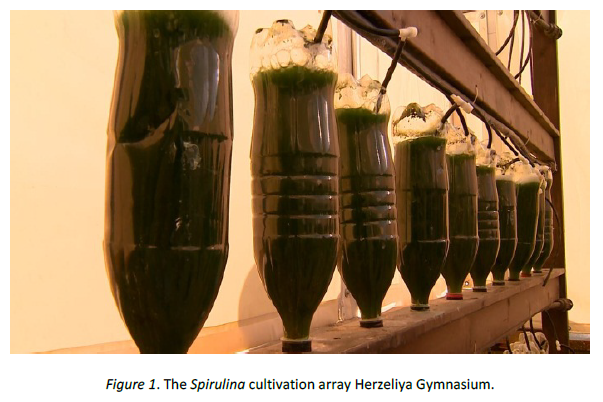
Figure 1
The Spirulina cultivation array Herzeliya Gymnasium
Crafting students' narratives
The data that assisted us in crafting the students' narratives included interviews, observations of students in practice and additional newspaper clippings. This use of multiple data sources alowed for triangulation of data and was used as a strategy for the validation of results. Individual interviews were conducted using the three-interview model described by Seidman (2013), which emphasizes the importance of understanding individuals’ actions within a particular context, as well as the meanings that they ascribe to their actions. The first interview focused on the broader context of the students' participation, the second interview focused on the concrete day-to-day details of their experiences, and the third interview focused on the participants' reflections. In the latter interview, we asked the students to generate a map illustrating the important events and experiences that summarize their participation in the project. Interviews lasted for 30 to 40 minutes and were transcribed verbatim. Additional observations allowed us to explore the students' actions in actual practice.
The first phase of our analysis included a process of focused coding. The codes for this phase were grounded in Nasir and Hand's (2008) theory of practice-linked identities and included the broad themes: access to the domain, integral roles, and opportunities for self-expression in practice. The second phase of our analysis included a process of open coding. The codes for this phase were generated using a grounded theory approach. Categorization was carried out independently by two researchers and a dialogue between the researchers was conducted to assure the accuracy of the categorization (Rolfe, 2006).
Below, we present Yonatan and Karin's narratives. As they were provided with access to the domain, integral roles and opportunities for self-expression, students’ identities as activists seemed to be supported by their practice-linked identities.
Yonatan's narrative
Yonatan (17 years old) was an honours student in the 11th grade who majored in Physics and Computer Science during the 2015–2016 academic year. Yonatan held a high status in the Spirulina project and presented himself as the "next generation" of students who will run the project, a title that other students participating in the project also attributed to him. We now tell his story with respect to Nasir and Hand's (2008) definitions of access to the domain, integral roles, and opportunities for expression.
Access to the domain
Yonatan used multiple resources to gain knowledge in the domain of the Spirulina project. The most dominant of these resources was the field trip to Rwanda, where he and other leading students (accompanied by the school principal and one other adult) worked with government officials, schools, and community health centres to promote Spirulina cultivation in Rwanda. In his map of critical events, Yonatan summarized his experiences in the form of a plot with dependent and independent variables (Fig. 2), the former being the meaning of the project to him, and the latter, time, as marked by significant events. Most evident in his graph is the steep incline in meaning which marks the trip to Rwanda.
When he explained why the trip was so important to him, Yonatan described the overwhelming adverse human conditions that he witnessed in the Sub-Saharan country. For him, this field trip was not only valuable for the experience in itself, but also as a way of gaining knowledge about the issue at hand. Ultimately, this experience assisted Yonatan in grasping the legitimacy of the project's aims:
We were very close to the people living there [in Rwanda], and that means seeing people in the streets, seeing how they live, seeing the slums. All of it made me realize that this could happen to anyone…all of a sudden, I started to realize that these gaps should not exist, and if I can do something to change it, then why shouldn’t I? It was most intense when I met young kids. It evoked something in me, that once, I too was a young child, and it could have been me [in their place]. (Yonatan, first interview, 7 Jan 2016)
![Yonatan's map of critical events.[1]](../575763878004_gf3.png)
Figure 2
Yonatan's map of critical events.[1]
Witnessing the conditions in Rwanda first-hand was informative for Yonatan as he was able to experience some of the harsh conditions there, such as water shortages and poor living conditions. In his descriptions, Yonatan tended to focus on the human element of the issue and placed the welfare and comfort of the suffering parties at the forefront, while also applying empathic emotions and imagining himself in the same situation. It appears then, that the trip to Rwanda was informative to Yonatan in a socio-affective manner. That is, it allowed him to identify empathetically and care for those who are suffering from malnutrition. Yonatan made direct connections between the knowledge that he gained through these experiences and his ability to feel empathic toward others, and this led to his willingness to be active for the benefit of the global community. Thus, Yonatan's ability to identify with the values and goals of the activity, and therefore to be willing to act, was permitted by the opportunity to gain extensive knowledge about the social situation in Rwanda.
For Yonatan, exposure to this new knowledge also revealed a considerable gap between what he expected to achieve from his participation in the project, and what he could actually achieve. His way of minimizing this gap was to develop a new trajectory for his own professional aspirations—to become a physician:
In Rwanda, I saw a lot of people who required immediate help, and the process of teaching others about the Spirulina is very long, during which time people are still dying. However, if you are a physician and you have medical knowledge, then you can give people immediate help and this is something that I would really like to do. (Yonatan, first interview, 7 Jan, 2016)
Yonatan concluded that he could engage in immediate action as a physician, and, as a consequence, aspired to become one. Yonatan's participation in the project thus provided him with enough support to close the gap between who is now and who he aspires to be.
Integral roles
The activity structure of the Spirulina project required many competencies from the students: researching and developing the growing method, cultivating the already growing Spirulina, instructing others about the method, meeting with municipal and government officials as well as with NGO officials, and fundraising. All participating students filled all of these positions but, naturally, some students felt more comfortable in some positions than others.
When Yonatan joined the project, his involvement was relatively moderate and he stated that he did not really believe that the project could ever succeed. However, he soon discovered a personal interest that was attributed to his role as an instructor in the project. This role was significant and carried with it an audience outside the school. Thus, it also made Yonatan a public representative of the program and a central member of the Spirulina project. Moreover, when he started to teach others, he said, he began to realize that the project could actually succeed and that his personal values and moral aspirations could be realized.
Yonatan received a unique opportunity to expand his role as instructor when he was asked to join the school delegation to Rwanda. The purpose of this delegation was to instruct Rwandan students about the Spirulina growing method with the intention of establishing the same operation in these schools. In the course of one week, the students taught Rwandan students from three different schools, as well as some Rwandan farmers. Practicing this role made Yonatan understand that solving a humanitarian issue can be challenging. He was particularly frustrated by the end result of the instructions. Yonatan described lacklustre behaviour on the part of those he was trying to help, who, as he perceived it, either rejected the students' attempt to help, or passively wished to remain dependent for their survival on the students' assistance. When asked about his take-home lessons from the trip to Rwanda, Yonatan expressed his reservations:
We are here at our school and we have this facility [where we grow Spirulina], but out there, we can't transfer it to others. I had some doubt with regard to the project, but it passed because I figured that you just have to keep trying. (Yonatan, second interview, 5 Apr 2016)
Being an instructor carried higher risks than other roles, because the success or failure of the project's goal to resolve global hunger depended mostly on the dissemination efforts of the students. Yonatan even defined his experiences as an instructor as "being on a mission". The risks associated with his performance as instructor provided authenticity for Yonatan and it mattered in a significant way. This authenticity led to Yonatan's decision to "keep trying" and keep acting. Some of Yonatan's own ideas to improve his instruction were to "add some humour or bring some graceful examples" into the instructions, or to "mingle with the children" before the instructions. The role of an instructor thus carried a deep sense of accountability, which encouraged Yonatan to overcome the challenges he faced and to improve his instruction skills.
Opportunities for self-expression
The reason that Yonatan initially joined the project was that it aligned well with his own personal ideology. He said, "I saw a lot of responsibility in it, one that I already felt, a responsibility toward the world." Being allowed to bring his own personal moral values into the daily practice of the project made it easier for him to participate in the actions of the project:
I think that, if it's someone else’s concern, it's my concern as well. And if there’s someone who can't live because he doesn’t have food, then I can’t enjoy my food. And if someone who has to work all day has to give up his studies, I feel that my studies are not worth much. (Yonatan, first interview, 7 Jan 2016)
Yonatan emphasized how his participation in the project was an expression of who he is. His moral concerns served as a driving force to act responsibly to resolve global issues. The contrast between his life and the lives of the Rwandan citizens was an existential challenge for him, but he was able to chip away at this challenge by participating in the project. Therefore, simply by acting in a context that relates to his values, he was given a voice for his own ideology.
Karin's Narrative
Karin (18 years old) was a highly successful 12th-grade student who majored in Arabic Studies and History during the 2015–2016 academic year. She joined the Spirulina project at the end of the 9th grade, one of the first to join. Like Yonatan, Karin entered the project with some concerns regarding its applicability, but over time, she became its most vocal advocator. She was interviewed by several national newspapers and online news websites to promote the project and to bring it to other people's attention. Similar to Yonatan, Karin's is a case of identity development through a process of interaction with the resources afforded by the Spirulina project. However, unlike Yonatan, Karin was not a science major, and as such, her story was about seeking new ways to learn and engage with science. Therefore, participating in the project allowed her to see science as more connected to the person she is.
Access to the domain
Similar to Yonatan, Karin viewed the trip to Rwanda as a critical experience. Karin also had the opportunity to travel to Cape Town, South Africa, with the aim of teaching South African students and citizens about the Spirulina cultivation method. However, in her interview she mostly focused on the field trip to Rwanda. In her map of critical events and experiences, she regarded both field trips as significant and important to her and to the project but added that the trip to Rwanda was also a "traumatic experience which left a huge mark on me" (Fig. 3).
Though Karin was familiar with the situation in Rwanda before the trip, witnessing it directly was a completely different experience:
It was like the poverty you only see in photos. [We saw] kids with no shoes, bloated bellies, without teeth, little kids that should have been bigger [for their age]. It was really difficult. (Karin, first interview, 12 Jan 2016)
Much like Yonatan, when Karin described her experiences in Rwanda, she tended to place humanitarian considerations at the forefront, with empathy and concern for others as the central features. Upon returning from Rwanda, Karin expressed her desire to quit the project. The trip was too much for her to go through without proper preparation. Eventually, she decided to stay because she recognized that the issue was too urgent to ignore:
[The trip] made us realize that this is really urgent and existing, and it is not something that you can postpone [acting on] because people are dying from it, now!...For me it was really difficult, but for the project, it really gave us a boost in terms of understanding how we need to act. (Karin, second interview, 7 Apr 2016)
Karin's argument for action relied mostly on humanitarian concerns which mediated her course of action on the issue of malnutrition in underdeveloped countries. This humanitarian lens shaped how she talked about the project, and it was made available to her as a result of her participation in the trip to Rwanda. Like Yonatan, her access to knowledge about the issue was increased by having the opportunity to directly witness the human condition in Rwanda, which in turn, promoted her willingness to act on the issue.
Integral roles
Karin considered her role as instructor to be important and integral and over time, it became the role she most identified with. In her map of critical events, Karin used the words teach or train when describing most of the events (Fig. 3). Most of her effort for the project was invested in advancing her lecturing skills. She continuously stated that her commitment to teaching others provided a stimulus for her to deepen her own knowledge on the subject, which was often embedded in scientific domains. She described the importance of learning the material so that she could give better instructions:
We want to teach others, and there is no way to teach others without knowing it thoroughly…if you understand it then it means that you can explain it. (Karin, first interview, 12 Jan 2016)
Karin described the personal learning potential when acting as an instructor, but she also wanted to expand her general, as well as scientific knowledge of the subject because she felt accountable in terms of filling the role of instructor to the best of her ability. The reason that she felt so responsible was that the instructions were deemed to be an essential part of achieving the goal of the Spirulina project, which is to reduce global hunger. This agenda was described in a school-issued flyer entitled: "Students teaching students about the alga Spirulina":
The idea is to transfer the knowledge (like in a relay race) so that others can teach more people, instead of just taking care of themselves.
The notion that instructing others is a legitimate form of action was thus reflected in the official agenda of the project. The students believed that through these instructions, they could give the local population the necessary tools to relieve their nutrition-related problems. This therefore made information dissemination an integral part of the project, which increased Karin's feelings of accountability to expand her knowledge and to perform better as an instructor.
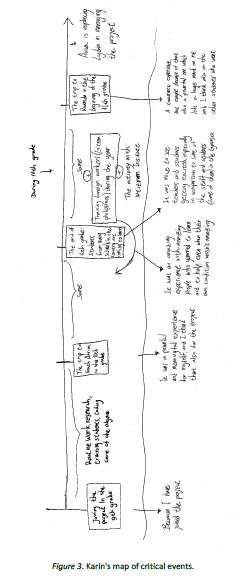
Figure 3
Karin's map of critical events
Opportunities for self-expression
As with Yonatan, Karin found an outlet for her own personal values in the project. What was appealing to Karin was that the project's declared goals aligned with her own perceptions of morality and values. She could therefore easily identify with the issue and the cause, which she perceived as acute and urgent, accordingly. For example, she said:
Children are dying. I don’t think that there's a more noble and important cause. (Karin, second interview, 7 Apr 2016)
This alignment between the project and her own beliefs made it easier for her to relate and feel a sense of belonging which, as a consequence, made her a more productive member in the project. By being a member in such a project, Karin also had a sense of belonging to a caring community in which her values and courses of action were perceived as normative. She spoke about this during one of her interviews (Weitz, 2015):
Being part of the project made me want to become a better person, and I think that this is what brings us together. The people I meet through the project are people who are trying to make the world a better, fairer, more equal place. Being surrounded by this company fills me with optimism. (Karin, interview to Maariv website, 19 Feb 2015)
Being a member in the project provided Karin with the ability to connect with other students who share the same world view, thereby producing support within this community for her participation. It was in this group structure that she felt that her values and opinions mattered, which in turn, made it easier for her to voice them. She was therefore allowed to be a member in a space that respects who she is, which made engagement in an action more feasible.
Karin also found opportunities for self-expression specifically through her role as an instructor. She used a flexible form of science information, that of drawing scientific diagrams, as a way to communicate her understanding of the subject. This use of skills was most handy when teaching audiences who struggled with language barriers. In the summer between Karin's 11th and 12th grade, and before her trip to Rwanda, a delegation of Rwandan farmers came to her school to learn from the students how to cultivate the Spirulina. Karin presented an introduction in which she explained scientific concepts such as photosynthesis and the water cycle. During the instruction, she carefully drew a diagram showing the sun's rays affecting the Spirulina culture and indicated the positive effect by drawing the sun with a smiley face (Fig. 4). She then explained how in very warm weather, water from the medium will evaporate, requiring the farmers to add water to the medium. She emphasized the evaporation effect in her diagram by drawing wavy lines coming out of the Spirulina bottle.
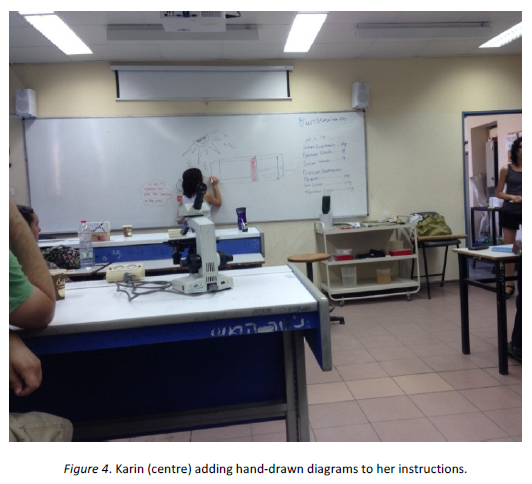
Figure 4
Karin (centre) adding hand-drawn diagrams to her instructions
Karin's drawings allowed her to engage with science by utilizing her drawing skills. For her, drawing graphical representations of different scientific concepts served as a way to express herself using a graphical medium. Karin's drawings were recognized as a means of enhancing instruction outcomes and she repeated this technique when she felt it was needed. This form of self-expression was thus welcomed by both her peers and the audiences of her instructions.
Discussion and conclusions
For science to be conducted with society and for society future citizens must be able to better understand scientific concepts and the impact of scientific and technological innovations on their lives (Levinson & The-PARRISE-Consortium, 2014; Owen et al., 2012). The role of science education in promoting this goal is therefore to educate students on the interactions between science and society so that they will be able to participate more actively in discussions about scientific and technological innovations. Here, we further argued that students should also be able to take a more active stance that include an action towards the resolution of these social complications in a way that benefits the general wellbeing of others. Therefore, throughout this investigation, we attempted to contribute to the existing research on activism in science education.
The primary purpose of this study was to explore the ways in which students practiced and constructed their identities through participation in a school-based socioscientific project that included activism. We explored the narratives of two students who participated in a school effort to reduce global hunger by finding optimal conditions for the cultivation of Spirulina. Our analyses showed that for Yonatan and Karin, similar resources supported their practice-linked identity development in the Spirulina project. Both were able to experience the humanitarian issues in Rwanda first-hand. This was probably the strongest resource provided to the students as it was connected to most parts of both students' narratives. Our findings suggest that having this wide access to knowledge of an issue initiated and motivated both students to take action. By taking on roles that were important to the success of the project, the students found meaning in their participation, which led to increased feelings of accountability and a desire for competency. Students also felt valued for who they are and for their ideas. This feeling was further expanded as the project's declared goals reflected their own feelings and values with respect to global hunger.
The cases of Yonatan and Karin are interesting to study together because though they share common themes, their experiences in the Spirulina project were also unique. Yonatan found humanitarian value and personal purpose in his participation in the project that set into motion his desire to find a career in a science-related field in which he could practice his activism. Karin, on the other hand, was not a science major, but she found a new appreciation for science and new ways to engage with science through contextual experiences that were valuable to her.
While encouragement of students to take social and political action continues to be a difficult task, our findings attempt to show how a specific activity structure and experiences may help students identify themselves as science activists. Utilizing a practice-linked identity lens to examine students' participation in activism allowed us to observe outcomes that could otherwise have gone undetected or been ignored. Our findings showed that both Yonatan's and Karin's identities as competent and active players were directly linked to the experiences and roles afforded by the unique structure of the Spirulina project. Looking across their narratives, what emerged was the structure of the project, and how it supported the development of the students' identities as activists.
Structuring an activity for identity development
Exposure to socially and emotionally loaded experiences that were presented in a contextually rich environment allowed the students to view global hunger as embedded in real-world events. Consequently, these experiences may have assisted them in cultivating feelings of care and empathy toward others. Contextualization of situations in SSI learning has been shown to generate emotions and a sense of responsibility in students (Molinatti, Girault, & Hammond, 2010). Here, when Karin and Yonatan negotiated courses of action, both tended to focus on the suffering of the individuals they encountered, and the feelings that emerged during these encounters were the main reason for their unique persistence in acting as members in the activity. Giving them the opportunity to experience and discuss real-world issues and problems allowed them to see the amount and severity of these issues in ways that provoked their feelings of social responsibility, therefore supporting their science-related activism. Building an activity in a contextual environment around an issue that promotes emotional involvement may therefore lead to students adopting a more active and responsible role (Fig. 5).
Though it calls for further research, this is consistent with past investigations that explored links between learning science in the context of SSI and the development of a moral character. For example, Zeidler and Schafer (1984) showed that when students were asked to make decisions on scientific dilemmas that involved people from the students' lived experiences, their decision-making regarding the issue was often directed by feelings of care and compassion. They argued that when students identified an emotionally charged issue, they tended to show increased moral sensibility. Berkowitz and Simmons (2003) further argued that providing students with the necessary skills to engage in social activism requires science educators to provoke moral emotions such as care and empathy in the science classroom. It is important to add that learning in contextualized environments reinforced by emotions may radicalize students' decision-making processes (Molinatti et al., 2010). Further exploration of the relationship between contextual social participation, the development of pro-social feelings and activism is therefore warranted.
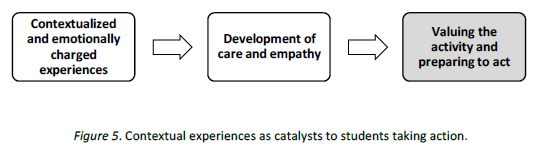
Figure 5
Contextual experiences as catalysts to students taking action
In addition, these contextual experiences can create opportunities for students to fill roles that are embedded in real-life situations. As instructors, Yonatan and Karin were integral players in the practice of the Spirulina project. Essentially, this role brought real authentic tension into their daily practice as it carried with it a sense of responsibility for the success of the project as a whole. Both students signed on to the idea of being activists though this role, which seemed to promote their competence as instructors and as activists. Their experiences illustrate how through this role, they were provided with a strong sense of what being a science activist is. Yonatan reported frustration about the end results of his actions, thus acknowledging that a different path of action is required. In Karin's' case, instructing others bolstered her scientific literacy and even though she was still not completely interested in science by the end of her participation in the Spirulina project, her engagement with science was influenced by the authenticity of her role in the activity. For both students, acting as instructors allowed them to express their opinions through actions in line with their own personal values. Therefore, beyond being integral for the success of the project, the role of instructor in and of itself included gateways for domain-specific knowledge and opportunities for self-expression.
As students took on roles that allowed for these opportunities, their willingness to act seemed to be supported. We could therefore argue that for a role to be considered engaging and appealing, it may need to incorporate the three elements of practice-linked identities: granting access to the domain, being integral, and permitting opportunities for self-expression. Other studies have presented similar arguments. For example, Barton and Tan (2010b) examined how students create their own pathways to learn science by authoring and expanding the roles that they play in the classroom to better fit their definitions of self. They argue that in filling these roles, knowledge about science becomes more accessible to the students and empowers them to take action. Somewhat similarly to the students in Barton and Tan's (2010b) study, Yonatan and Karin came to believe that through filling meaningful roles they could bring about a change in the world. Carefully structuring learning environments to allow the emergence of these types of roles may therefore have the potential to allow students to participate more actively, regardless of their initial interest and willingness to act.
In summary, like past studies on science-related activism (Barton & Tan, 2010b; Roth & Lee, 2004), this study found that participating in contextual activities seems to help students better engage in responsible actions for science-related issues. Here, the students' activism was supported by the filling of integral and meaningful roles that mattered to the students, as well as to the success of the project as a whole. Both Yonatan and Karin expressed their sense of self as being associated with their activism and with their desire to impact the future of the global community. These are good indicators of their activism competency and developed identities as activists.
Limitations
This study examined two cases of honours students who participated in science-related activism. The fact that only a small number of students from a narrow demographic range were examined constitutes a considerable limitation of this study. In addition, because of the small group of participants and the qualitative nature of the data, general claims could not be made about other students. Students were also afforded unusual and expensive resources to enrich their engagement with activism, circumstances that are generally less available to the student population at large. Therefore, this study does not attempt to provide solutions for students experiencing action paralysis; rather, it shows the value and feasibility for students of activism in science education.
implications
Yonatan and Karin's narratives on the Spirulina project and their roles as science activists present a compelling and nuanced description of how offering students opportunities to develop their identities as science activists can support students willingness to act responsibly through, and informed by, science. However, these findings should be viewed in consideration of the limitations of the study. As mentioned, the activity described in this study is expensive and complex to manage at the school level. In this context, previous studies showed how contextual learning exercises in the form of simulations of real-life situations and role-playing activities can lead to students' increased social responsibility and knowledge about social issues (Krain & Shadle, 2006; Navarro, 2009), therefore providing a simpler way for the incorporation of contextual learning into day-to-day teaching and learning practices. Further studies are required to determine if the findings from our study, namely increasing students' engagement with activism by ensuring access to knowledge, integral roles and creating opportunities for individuals to express themselves in practice, are generalizable to other, more accessible, activities.
Acknowledgments
The research leading to these results is part of the “PARRISE” project, which has received funding from the EU's Seventh Framework Programme (FP7) under grant agreement No [612438].
References
Aikenhead, G. S. (2006). Science education for everyday life: Evidence-based practice. New York, NY, USA: Teachers College Press.
Barton, A. C., & Tan, E. (2010a). “It changed our lives”: Activism, science, and greening the community. Canadian Journal of Science, Mathematics and Technology Education, 10(3), 207-222.
Barton, A. C., & Tan, E. (2010b). We be burnin'! Agency, identity, and science learning. The Journal of the Learning Sciences, 19(2), 187-229.
Bencze, L., & Carter, L. (2011). Globalizing students acting for the common good. Journal of Research in Science Teaching, 48(6), 648-669.
Bencze, L., & Sperling, E. R. (2012). Student teachers as advocates for student-led research-informed socioscientific activism. Canadian Journal of Science, Mathematics and Technology Education, 12(1), 62-85.
Berkowitz, M. W., & Simmons, P. E. (2003). Integrating science education and character education In, The Role of Moral reasoning on Socioscientific Issues and Discourse in Science Education (pp. 117-138). Springer.
Birmingham, D., & Calabrese Barton, A. (2014). Putting on a green carnival: Youth taking educated action on socioscientific issues. Journal of Research in Science Teaching, 51(3), 286-314.
Borowitzka, M. A. (1999). Commercial production of microalgae: ponds, tanks, tubes and fermenters. Journal of biotechnology, 70(1), 313-321.
Brewster, C., Suutari, V., & Kohonen, E. (2005). Developing global leaders through international assignments: An identity construction perspective. Personnel Review, 34(1), 22-36.
Carlone, H. B., & Johnson, A. (2007). Understanding the science experiences of successful women of color: Science identity as an analytic lens. Journal of Research in Science Teaching, 44(8), 1187-1218.
Chang, H.-S., & Lee, H.-J. (2010). College students' decision-making tendencies in the context of socioscientific issues (SSI). Journal of The Korean Association For Science Education, 30(7), 887-900.
Connell, S., Fien, J., Lee, J., Sykes, H., & Yencken, D. (1999). If it doesn't directly affect you, you don't think about it’: A qualitative study of young people's environmental attitudes in two Australian cities. Environmental Education Research, 5(1), 95-113.
Dos Santos, W. L. (2009). Scientific literacy: A Freirean perspective as a radical view of humanistic science education. Science Education, 93(2), 361-382.
Evagorou, M., & Mauriz, B. P. (2017). Engaging elementary school pre-service teachers in modeling a socioscientific issue as a way to help them appreciate the social aspects of science. International Journal of Education in Mathematics, Science and Technology, 5(2), 113-123.
Gee, J. P. (2000). Identity as an analytic lens for research in education. Review of research in education, 25, 99-125.
Hodson, D. (2003). Time for action: Science education for an alternative future. International Journal of Science Education, 25(6), 645-670.
Kolstø, S. D. (2001). Scientific literacy for citizenship: Tools for dealing with the science dimension of controversial socioscientific issues. Science Education, 85(3), 291-310.
Kozoll, R. H., & Osborne, M. D. (2004). Finding meaning in science: Lifeworld, identity, and self. Science Education, 88(2), 157-181.
Krain, M., & Shadle, C. J. (2006). Starving for knowledge: An active learning approach to teaching about world hunger. International Studies Perspectives, 7(1), 51-66.
Lee, H., Chang, H., Choi, K., Kim, S.-W., & Zeidler, D. L. (2012). Developing character and values for global citizens: Analysis of pre-service science teachers’ moral reasoning on socioscientific issues. International Journal of Science Education, 34(6), 925-953.
Lee, H., Yoo, J., Choi, K., Kim, S.-W., Krajcik, J., Herman, B. C., & Zeidler, D. L. (2013). Socioscientific issues as a vehicle for promoting character and values for global citizens. International Journal of Science Education, 35(12), 2079-2113.
Lee, S., & Roth, W.-M. (2002). Learning science in the community. Counterpoints, 210, 37-66.
Levinson, R., & The-PARRISE-Consortium. (2014). The SSIBL framework, D1 2 PARRISE, co-funded by the European Commission under the 7th Framework Programme, Utrecht, The Netherlands/ Institute of Education, London (UK).
Molinatti, G., Girault, Y., & Hammond, C. (2010). High School Students Debate the Use of Embryonic Stem Cells: The influence of context on decision‐making. International Journal of Science Education, 32(16), 2235-2251.
Nasir, N. i. S., & Hand, V. (2008). From the court to the classroom: Opportunities for engagement, learning, and identity in basketball and classroom mathematics. The Journal of the Learning Sciences, 17(2), 143-179.
Navarro, M. (2009). Transforming the Curriculum: Using Hunger Issues to Enhance Teaching and Learning. NACTA Journal, 15-20.
Owen, R., Macnaghten, P., & Stilgoe, J. (2012). Responsible research and innovation: From science in society to science for society, with society. Science and Public Policy, 39(6), 751-760.
Rolfe, G. (2006). Validity, trustworthiness and rigour: quality and the idea of qualitative research. Journal of advanced nursing, 53(3), 304-310.
Roth, W. M., & Lee, S. (2004). Science education as/for participation in the community. Science Education, 88(2), 263-291.
Sadler, T. D. (2009). Situated learning in science education: Socio‐scientific issues as contexts for practice. Studies in Science Education, 45(1), 1-42.
Sadler, T. D., Chambers, F. W., & Zeidler, D. L. (2004). Student conceptualizations of the nature of science in response to a socioscientific issue. International Journal of Science Education, 26(4), 387-409.
Sadler, T. D., & Zeidler, D. L. (2005). Patterns of informal reasoning in the context of socioscientific decision making. Journal of Research in Science Teaching, 42(1), 112-138.
Seidman, I. (2013). Interviewing as qualitative research: A guide for researchers in education and the social sciences. New York: Teachers college press.
Sternäng, L., & Lundholm, C. (2011). Climate Change and Morality: Students' perspectives on the individual and society. International Journal of Science Education, 33(8), 1131-1148.
Weitz, S. (2015). High School Students Trying to Find A Solution for Global Hunger. Maariv Online. Retrieved from https://tinyurl.com/yb358cdr
Wenger, E. (2000). Communities of practice and social learning systems. Organization, 7(2), 225-246.
Zeidler, D. L., Sadler, T. D., Simmons, M. L., & Howes, E. V. (2005). Beyond STS: A research‐based framework for socioscientific issues education. Science Education, 89(3), 357-377.
Zeidler, D. L., & Schafer, L. E. (1984). Identifying mediating factors of moral reasoning in science education. Journal of Research in Science Teaching, 21(1), 1-15.
Notes