Original Research Papers
Onion detopping machine - an emerging horticultural enterprising
Onion detopping machine - an emerging horticultural enterprising
Journal of Horticultural Sciences, vol. 17, núm. 1, pp. 199-203, 2022
Society for Promotion of Horticulture

Esta obra está bajo una Licencia Creative Commons Atribución-NoComercial-CompartirIgual 4.0 Internacional.
Recepción: 06 Abril 2021
Revisado: 30 Enero 2022
Aprobación: 05 Julio 2022
Abstract: Onion is the one of the important vegetable crops cultivated in India. Multiplier type onion is one among the three major types of onions. Tamil Nadu accounts for five per cent of country’s area under onion and more than 70 per cent of the area is cultivated by small onion (Allium cepavar. aggregatum). Around 90 per cent of country’s multiplier onion is produced from Tamil Nadu. Detopping is one of the steps in the on-farm processing carried out after harvest. Presently this is done manually by farm women. Individual onions are picked and detopping is done by using sickle. This operation is time consuming and highly drudgery in nature. An Onion detopping machine to remove the foliage after harvest was designed and developed in the present study. This machine has a capacity of 370 kg/h against 30 kg/h manual practice and works with an efficiency of 98%. The unique design of the detopper is that it is suitable for all sizes of onions. Also, the cluster is intact after detopping, which is very important requirement. This multiplier type onion is grown in Nagamangala (Tk), Mandya (Dt.) of Karnataka State. Two farmers of this area have installed this machine and running a successful enterprising. Cost involved in using this machine is Rs. 200 per quintal against Rs. 500 per quintal by manual detopping. Owing to the higher capacity by mechanization, the farmers will be able to process the higher volume of produce within a short span of time. Hence, this will facilitate the farmers to sell the produce, get good market price and earn higher returns.
Keywords: Aggregatum onion, enterprising, mechanization, onion detopper and multiplier onion.
INTRODUCTION
Onion (Allium cepaL.) is one of the most important commercial vegetable crops widely cultivated in India. India ranks 2nd in world’s onion production after China, contributing 21% of world’s onion requirement. In India, an area of 12.85 lakh ha is under onion cultivation with a production of 232.62 lakh MT of onions during 2018 (NHB, 2019) amounting to 12.50 % of area under vegetable cultivation and 12.62 % of vegetable production. Indian onion is broadly classified into three types viz., common onion, small common onion and multiplier onion (Fig. 1). Many varieties have been developed under each type of onion, having different traits suitable for different agro climatic zones, seasons, purposes, pest and diseases resistant etc. There are about 27 common onion varieties, two small common onion varieties and three multiplier onion varieties commercially available in India (NHRDF). The type and variety has also stake holder preference based on its pungency, which vary widely among types. All the above mentioned three types of onion have comprehensible morphological difference among them. Primarily common and small common onions are single bulbs but vary largely in size. The broad characteristics of the above three types of onion are presented in Table 1.
Among the above three types of onion, multiplier onion is known for its pungency and flavour which is commonly grown in Tamil Nadu. About 35,000 ha area is under multiplier onion cultivation in India which is about 2.7 % of area under onion production. About 3,32,500 MT of multiplier onion is being produced in India which is 1.5 % of onion production. Around 90% of country’s multiplier onion is produced from Tamil Nadu and Andhra Pradesh, South Karnataka, parts of Orissa, Kerala contribute for the remaining portion. In Tamil Nadu multiplier onion is cultivated in an area of 30,255 ha with a production of 2,86,000 MT (www.tn.gov.in).
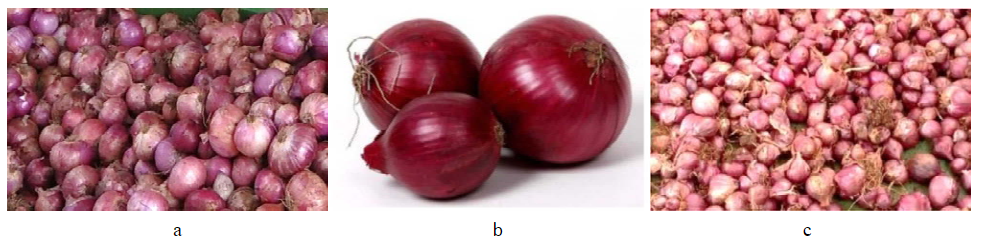
Fig. 1
Types of onion grown in India (a. Common onion b. Small Common onion c. Multiplier onion)
| S.No. | Type of onion | Shape | Size | Colour | TSS | Pungency | Storability |
| 1. | Common onion | global round in shape | big in size ( 40-60 mm dia.) | Ranges from light to dark red | 12° - 14° brix | 10.07- 13.0µmol/g FW | Very good to medium |
| 2. | Common small onion (Bengaluru rose onion) | flattish round in shape size | Small in ( 25 – 35 mm dia | Scarlet red in colour | 16°-18° brix | 10.27 µmol/ g FW | Good |
| 3. | Multiplier onion (sambar onion) | 5-6 bulblets clump in shape | 20 - 25 mm in size | Red in colour | 8°-18° brix | 10.13 µmol/g FW | Very good |
Detopping is one of the on-farm processing operations carried out after harvesting and it is removing of the leaves from the onion. Onion is harvested when 50% tops begin to collapse on the ground but before the foliage dries down completely (Anon, 2011). After digging, the onion is field-cured for 3-5 days, cut at the necks for separation of onion from the tops, graded, shed-cured and stored. Separation of onion bulbs from tops is called de-topping and women labourers are engaged for this operation. Individual onion is de-topped by sickle thus makes it highly drudgery that requires 12.5 woman-hours/t and time consuming (Anon, 2017.). The average weight of each clump of multiplier onion is about 60 g, thus one kg of onion contain about 15 individual onions. When huge quantity of onion needs to be harvested and processed, it needs mechanization. Onion detopping machine was designed and developed at ICAR-Indian Institute of Horticultural Research, Bengaluru. This machine has been demonstrated widely at farmers’ field. This paper discusses the entrepreneurial opportunities of this machine.
MATERIALS AND METHODS
Process of onion detopping
The matured onion is harvested and left in the field for 3-5 days for field curing. Afterwards they are detopped and stored or without detopping stored in a well-ventilated storage structures or facilities. The either second category is detopped and sold to trader based on market demand.
Onion detopping machine
The prototype onion de-topper consists of i) Feeding chute for feeding onion crop, ii) de-topping unit, iii) collection chutes for the de-topped onion bulbs and tops, iv) main frame and v) power transmission system (Fig. 2).
The feeding chute is for feeding of the onion crop to the onion de-topping unit. This was fabricated out of MS sheet of 1.5 mm thickness sheet and had dimensions of 700 mm x 400 mm X 200 mm (L x W
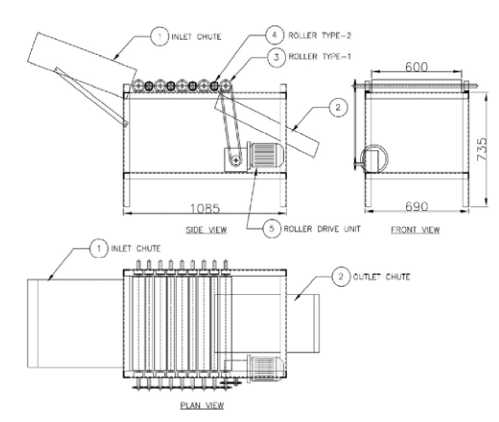
Fig. 2
Diagram of onion detopping machine all dimensions in mm
Fig. 2. Diagram of onion detopping machine all dimensions in mm
x H). The de-topping unit is the key component of the de-topping machine which should detop the onion tops efficiently without damaging the onion bulbs. The de- topping unit consists of i) set of de-topping rollers,ii) main frame and iii) power transmission system. The de-topping unit is a set of rollers comprising one roller having cutting edge along its length and the other one a plain roller. The cutting roller is fabricated out of M.S. square shaft having 35 mm cross section and 600 mm length. The plain roller is a G.I. Pipe having 600 mm length, 50 mm diameter and 3 mm thickness. Four such set of rollers were fabricated and mounted on a main frame. A clearance of 2 mm is provided between the rollers. The frame is fabricated out of M.S angle section of 40x40x5 mm having 1085 mm length and 690 mm width. The rollers were driven by sprocket and chain system and were counter rotated.
Collection chute was fabricated out of M.S sheet of 1 mm thickness having trapezoidal shape for directing the de-topped onion bulbs into the crates. The collection chute had a dimension of 530 mm width at the upper end, 150 mm at the lower end, 680 mm length and 200 mm height. This was fitted to the main frame at angle of 740 in order to have the free fall of the de-topped onion bulbs. A tray to collect the detopped onion leaves was fabricated and fitted below the rollers. The main frame of the machine was fabricated out of M.S. angle section of 40×40×5 mm. The feeding chute, de-topping unit, collection chute for de-topped onion bulbs, collection tray for onion tops, power transmission systems and electric motor were fitted to the main frame. A three phase, 1440 rpm, 2 hp electric motor was mounted on the main frame with necessary supports and gearbox of 1:30 reduction was fitted to the motor.
RESULTS AND DISCUSSION
Operation details
The cured onion crop was fed by the feeding conveyor to the de-topping unit. Due to counter rotating of the plain and cutting rollers, the onion tops were drawn in between the rollers and made an orientation of tops down position. The sharp edges of the shearing rollers further de-tops the onion tops and the onion tops were dropped down. Due to plurality of the rollers, the rollers conveyed the de-topped onion bulbs further for delivery. The plurality of rollers also ensured higher chances for de-topping the onion tops before the onion crop reaches the delivery. The de-topped onion tops were collected in the collection tray provided below the onion de-topping unit and de-topped onion bulbs were collected in crates which were guided by collection chute. The performance parameters of onion detopping machine is presented in the Table 2.
| Sl.No. | Performance parameters | |
| 1. | De-topping efficiency (%) | 95.20 ± 1.42 |
| 2. | Effectiveness of de-topping (%) | 97.80 ± 0.00 |
| 3. | Per cent damage (%) | 2.30 ± 0.29 |
| 4. | Per cent non-detopped onion (%) | 2.50±0.25 |
| 5. | Capacity (kg/h) | 372.88 ± 7.22 |
| 6. | Cost Economics | 37 % saving against conventional method |
The machine has been widely demonstrated in farmers’ field, National Exhibitions and Farmers’ Fairs.
Adoption of onion detopping machine as an enterprise
Nagamangala is a Taluk in Madhya (Dt.) of Karnataka State located at 12.82° N 76.76° E and 772 m elevation. This is multiplier onion growing cluster in Karnataka. About 2000 ha area in this Taluk produces multiplier onion with a production of about 17,000 MT. Planting is done during January and matured onion is harvested during March and April. The harvested onion along with top is bundled, and are stored in a well-ventilated facilities for a period of six months (Fig. 3). These kind of structures are also funded by Government of Karnataka. The stored onion is detopped and supplied to the market as per market demand. During lean season, the stored onion is detopped manually by the farm women and supplied to the market. However, during peak demand period, when the farmers’ desired to get better returns, the supply gets hampered due to limited detopping capacity in the existing manual practice and also availability of resources. It is also to be noted that towards the end of storage period, stored onions start sprouting. Hence, all the stored onion need to be detopped and supplied to the market. The manual detopping capacity is about 20 - 30 kg/h. One entrepreneur charged half of the cost meant for manual detopping and yet could gain a profit. While another entrepreneur changed Rs.200 per quintal & while manual stopping costs Rs. 500 per quintal. He obtained B: C ratio of 2.01:1 for 3 years. Hence, farmers are able to take the advantage of market price and sell the produce when the price is at its peak. Due to this farmers are benfitted in both ways i.e cost involved in detopping practice and peak market rate (Fig. 4). This machine also ensured timeliness of operation thus helped in tapping higher returns during peak market demand period.
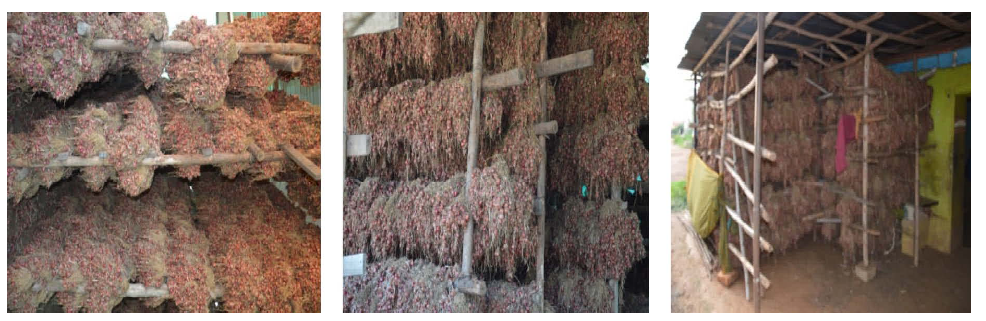
Fig. 3
Multiplier Onion storge
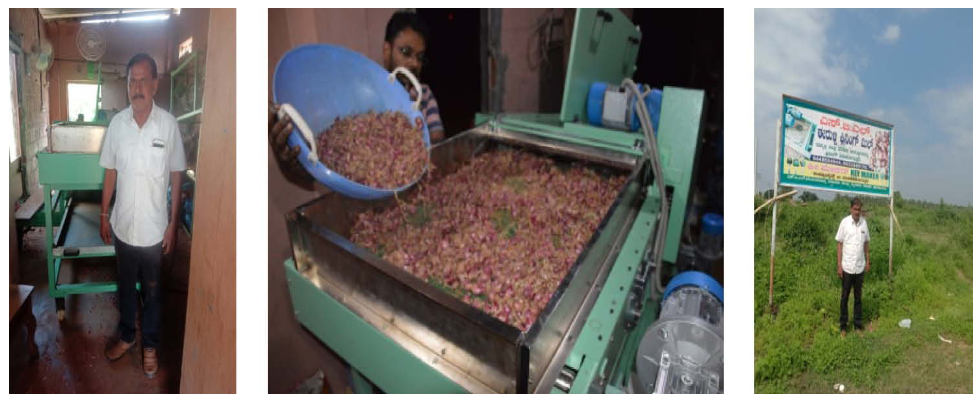
Fig. 4
ICAR-IIHR onion detopping machine installed at Nagamangala as entreprise
Acknowledgments
The authors express their heartfelt gratitude to The Director, ICAR-Indian Institute of Horticultural Research, Bengaluru for providing facility and extend his support to carry out this project.
REFERENCES
Anon, 2011. Onion Growing Technology, Krishi Dharshani, Mahatma Phule Krishi Vidyapeeth, Rahuri, Maharashtra. Page No. 118.
Anon, 2017. Proceedings of Brain storming Session on Challenges of mechanization in Onion and Garlic, ( Editors: Ashwini P. Benke, Shailendra S. Gadge, Yogesh Bhagat, Vijay Mahajan, Major Singh) 2nd December, 2017, Pune: 5-7.
Horticultural Statistics at a Glance 2019. Horticulture Statistics Division, Department of Agriculture, Cooperation & Farmers Welfare, Ministry of Agriculture & Farmers Welfare, Government of India.
Saraswathi, T., Sathiyamurthy, V.A., Tamilselvi, N. A. and Harish, S (2017). Review on aggregatum onion (Allium cepa L. var. aggregatum Don.). Int. J. Curr. Microbiol. App. Sci.,6(4):1649-1667.
Sabina Islam, Anil Khar, Shrawan Singh and Tomar. B.S. 2019. Variability, heritability and trait association studies for bulb and antioxidant traits in onion (Allium cepa) varieties. Indian Journal of Agricultural Sciences 89 (3): 450–7.