Abstract: The present study was conducted to study the morphological, physicochemical and colour characteristics of potato starch extracted by control and combined methods from potato varieties viz., Kufri Chipsona-4, Badshah, Pushkar, Bahar and Sindhuri (fresh and cured). Among these varieties, Kufri Chipsona-4 exhibited maximum percent of small size (< 30 µm) particles (48%). Kufri Sindhuri showed highest starch purity (87.1%) but lowest whiteness (92.2%) whereas, highest whiteness (95.4%) was recorded in starch extracted from Kufri Badshah. Among starch extraction methods, combined method showed significantly lower starch moisture content (11.8%), fat (0.28%), protein (0.31%), ash (0.28%) and crude fibre (0.15%) whereas; starch purity (87.2%), percentage of small size particles (45%) and starch whiteness (96.3%) were observed higher than control methods in all varieties.
Keywords: Curing, starch purity, starch whiteness and tuber.
Original Research Papers
Morphological, physiochemical and colour characteristics of fresh and cured starch in potato varieties
Society for Promotion of Horticulture

Esta obra está bajo una Licencia Creative Commons Atribución-NoComercial-CompartirIgual 4.0 Internacional.
Recepción: 16 Enero 2022
Revisado: 17 Febrero 2022
Aprobación: 02 Marzo 2022
Potato (Solanum tuberosum L.), the fourth most important vegetable crop, serves as an important raw source for starch extraction and applications in food industry. Potato starch can form thick visco-elastic gel unlike millet starches due to its composition of phosphate ester groups on amylopectin, larger granule size, longer amylose and amylopectin chain length, and higher purity (Singh et al.,2003). Its major application in food industry is limited by properties such as low shear resistance, thermal decomposition and thermal resistance, and its higher tendency towards retrogradation (Avula and Singh 2009). These limitations can be easily overcome by modification of extracted starch using extraction methods to meet the demands of final product (Liu et al.,2003). Changes in methods of extraction affect yield and recovery, cost, product purity, desired physico-chemical properties, and mechanical properties of starch. Potato starch is unique compared to cereal starches (corn, wheat, rice, etc.) because of its wider granule size and presence of phosphate ester groups on amylopectin, ability to exchange certain cations with corresponding effects on viscosity behaviour, ability to form a thick viscoelastic gel upon heating and subsequent cooling in water, and poor thermal as well as shear stability of this gel (Singh et al., 2003). Pre-treatments such as curing have also been reported to affect yield and amylose content of starch.
This investigation was thus performed out with an aim to characterize the morphological and physiochemical characteristics of potato starch extracted by control and combined method (extraction with ambient water 30oC + 0.25% NaOH + 2% w/v SDS: ME + 5.25% NaOCl + 0.15% cellulase enzyme) from fresh and curedtubers of five cultivars to identify varieties of potato with highest starch content so as to aid the farmers and industry.
The fresh harvested potato tuber (Solanum tuberosum L.) of Kufri Chipsona-4 (V ), Kufri Badshah (V ), purity, longer amylose and amylopectin chain length, Kufri Pushkar (V.), Kufri Bahar (V.) (white flesh varieties) and Kufri Sindhuri (V.) (pink flesh variety) were procured from Vegetable Farm, CCS Haryana Agricultural University, Hisar.They were sorted and cured without packaging in a BOD (Biological Oxygen Demand) incubator at ~22 oC temperature and 90% relative humidity in the dark for 18 days.
Fresh and cured potato tubers were used for starch extraction. For control extraction, starch was extracted as described by Peshin (2001) with slight modifications. For combined extraction, a combined method of Phogat et al., (2020) (extraction with water at 30oC +0.25% NaOH + 2% w/v SDS:ME + 5.25% NaOCl + 0.15% cellulase enzyme) was used. The starch was analysed for the following parameters:
Potato starch was analysed for moisture, crude protein, fat, ash, and crude fibre content by the AOAC (2006) method. Starch yield (%) or crude starch content was calculated by the following formula:
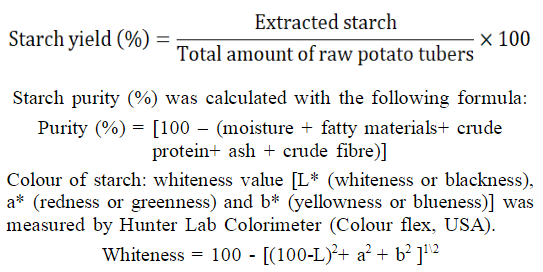
The shape and size of extracted starch particles were ascertained using an inverted compound microscope (Olympus, Japan; model: CX-41with 10× magnification) equipped with a digital camera. Starch particle size was measured using calibrated ocular scale fitted on the microscope lens.
The factorial CRD was used with three replications for analysis using OPStat software (Sheoran et al.,1998). Means were separated by critical difference (CD) at 5% significance level. Principal component analysis (PCA) was performed with PAST-3 software.
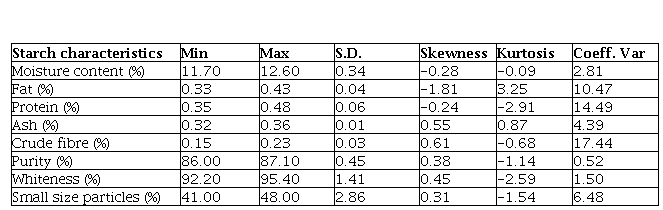
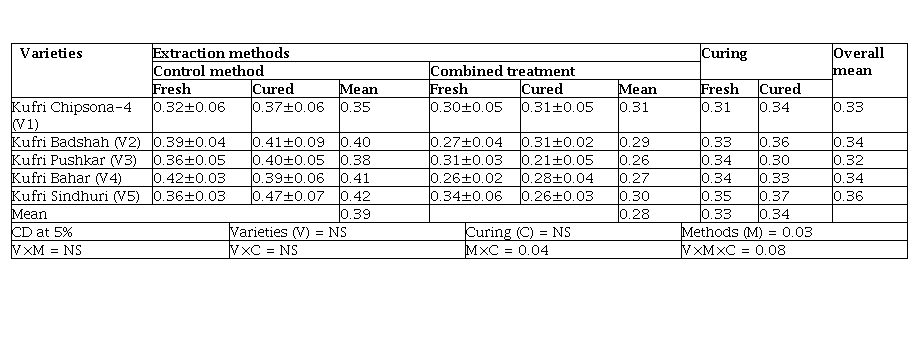
Varieties, curing and extraction methods had significant effect on physico-chemical properties of starch. Moisture content was varied from 11.7 to 12.6% (Table 1). Combined extraction method had lower starch moisture content.V5 had least (11.7%) starch moisture content and it was maximum (12.6%) in V2. The starch fat content ranged from 0.33 to 0.43% (Table 1). Combined treatment has significantly lower fat content. There was no significant difference in starch fat (%) extracted from 5 varieties, except V5 which exhibited significantly lower fat content (Table 3). The starch protein (%) of potato varieties ranged from 0.35 to 0.48% (Table 1). Combined treatment has significantly lower protein content. It was recorded minimum (0.35%) in V5 and maximum (0.48%) in V4 (Table 4). For all the varieties, there was nonsignificant effect of curing on starch moisture, fat and protein content (Table 2, 3 and 4). The starch ash content ranged from of 0.32 to 0.36% (Table 1). Variety and curing did not significantly affect ash content (Table 5). The starch crude fiber content ranged from 0.15 to 0.23% (Table 1). Combined treatment extracted starch had significantly lower ash and crude fiber. It was minimum (0.15%) in V3 and it was maximum (0.23%) in V1 (Table 6). Curing had non-significant affect in crude fiber.
The slight difference with respect to moisture content could be the result of extraction method, varieties, and curing (Table 2). Kim and co-workers (1995) reported differences ranging from 7.2-16.70% in starch moisture contents among 42 potato varieties. Karmakar et al., (2014) compared the moisture content of potato with taro and corn starch and pointed that starch moisture content also depends on the extent of drying. Similar was the observation by Abegunde et al., (2013). The lower fat (Table 3) and protein content (Table 4) in starch extracted by combined treatment attributed to the action of alkali and SDS used during extraction. NaOH, an alkali solvent, can easily solubilize major proteins enclosing the starch and thus soften-up the protein-starch matrix. Kaur and co-workers (2007) observed that the Kufri Sindhuri had highest ash content and Kufri Chandarmukhi the lowest.
The starch purity varied between 86.0 to 87.1% (Table 1). Variety and curing did not significantly affect the starch purity (Table 7). The starch purity for all the potato varieties was observed significantly higher
Summary statistics of starch characteristics of potato varieties.
Mean±SD; NS – non-significant
Moisture content (%) of starch as influenced by varieties, curing and extraction methods.

Fat content (%) of starch as influenced by varieties, curing and extraction methods.

Mean±SD; NS – non-significant
Protein content (%) of starch as influenced by varieties, curing and extraction methods.

Mean±SD; NS – non-significant
Ash content (%) of starch as influenced by varieties, curing and extraction methods
Mean±SD; NS – non-significant
Crude fibre content (%) of starch as influenced by varieties, curing and extraction methods.

Mean±SD; NS – non-significant
Purity (%) of starch as influencerd by varieties , curing and estraction methids
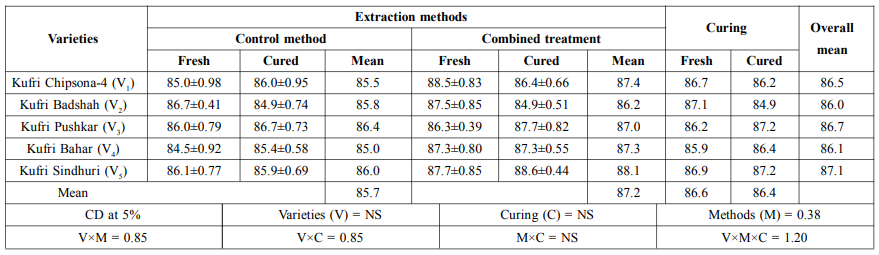
(87.2%) when starch was extracted by combined treatment. Pure starch had lower protein, fat, and ash content. Thus, the non-significant differences observed in purity of starches from different varieties was due to the nonsignificant differences in fat and ash contents of their starches (Table 5 and 6). Abegunde and co- workers (2013) reported that starch purity was reasonably high (>91%) in sweet potato cultivars due to low starch impurities (moisture, fat, protein, ash, and crude fibre). In the present study starch purity was maximum in V1 because it had less impurities (Table 7). Combined extraction resulted in significantly lower crude fibre, fat, protein and ash contents of starch hence combined treatment had lower impurity content in starch and thus produced starch with higher purity. Starch paste thought to be clear and did not contain any off colouration, especially if it’s to be used in food application. Kordylas (1990) reported that impurities in form of moisture, fat, protein, ash and crude fibre content decrease the starch whiteness value.
PCA was performed keeping in mind the characteristics of starch among the potato varieties. The eigenvalue, variance contribution rate of PCs and the cumulative variance are presented in Table 10. The first three PCs with eigen values >1.0 accounted for 92.71 % of variation among potato varieties. Other PCs were not interpreted since they had eigen values <1.0.The first PC, explained 56.56 % of total variation. Eigen vector of the first principal component had high loading values for starch moisture content (0.41), protein content (0.41), purity (-43) and whiteness (0.38). Second principal component which represented 21.47 % of total variation mainly represented the starch ash (0.56), fat (-44) content and starch small size particles (-0.53). Third principal component explained mainly crude fibre (0.64). The biplot between PC1 and PC2 (Fig 2) compares the potato varieties based on their starch characteristics.
Starch whiteness ranged from 92.2 to 95.4 (Table 1). Varieties, extraction methods and curing had significantly affected starch whiteness value. It was minimum (92.2) in V5 and it was maximum (95.4) in V2. For all the varieties, combined extraction method had significantly higher starch whiteness value and curing of potatoes resulted in significantly lower whiteness value of extracted starch (Table 8) Starch morphological, physiochemical and colour characteristics

Segregation of the potato varieties based on their respective starch traits as determined by PCA.
Combined method extracted starch had significantly higher starch whiteness because of bleaching action of chemicals or by decreased moisture content, protein, fat, ash, and crude fibre contents which act as impurity. Colour is an important criterion for starch quality, especially for use in various types of food products. Minimum whiteness value was recorded in starch extracted from Kufri Sindhuri (92.2) due to its pink flesh and maximum (95.4) in V2 (Table 8). Curing resulted in lower starch whiteness. Abegunde and co-workers (2013) also reported different whiteness values of starches extracted from varieties of sweet potato using multiple extraction methods to remove pigments from starch. This is in agreement with the reports of Hu and co-workers. (2011) who observed that starch colour isolated from two-day old root was slightly grey.
The percentage of small size particles (< 30 µm) in different potato varieties ranged from 41% to 48%. Curing and method of extraction non significantly affected the percentage of small size particles. Minimum number of small size particles was observed in V2 (41%) and V5 (42%) and maximum in V1 (48%). In the present investigation, Minimum number of small size particles was observed in V2 (41%) and V5 (42%) and maximum in V1 (48%) (Table 9& Figure 1). Minimum number of small size particles was observed in V2 (41%) and V5 (42%) and maximum in V1 (48%) (Table 9). This may be attributed to difference in temperature of the locations during tubers growth. Singh and Singh (2001) documented small and large starch granules of 15-20 µm and 20-45 µm respectively, with shapes ranging from oval to irregular or cuboidal, which may be attributed to difference in tubers growth. Further, it has also been reported that starch granule size is directly proportional to the weight of a potato tuber (Liu et al., 2003). During tuber development, the membranes and physical characteristics of plastids differ among potato varieties and this in turn lead to difference among shape of starch granules among varieties (Lindeboom et al., 2004). Physicochemical properties of starch had been linked to difference in its granule shape and size.
Skewness and kurtosis were calculated to analyse the genetic difference among potato varieties. The positive skewness was obtained for starch small size particles, yield, ash content, crude fibre, purity and whiteness whereas negative skewness was found for starch moisture content, fat and protein. The starch fat and ash content showed platykurtic distribution (positive) pattern. Leptokurtic distribution (negative) was followed by starch small size particles, crude fibre, purity, whiteness, peak viscosity, moisture, and protein content (Table 1).
Colour value (whiteness) of starch as influenced by varieties, curing and extraction methods.

Mean±SD; NS – non-significant
Percent of small size (< 30 µm) particles of starch as influenced by varieties, curing and extraction methods.

Mean±SD; NS – non-significant
Principal component (PC) loadings for quality variables of the potato starch

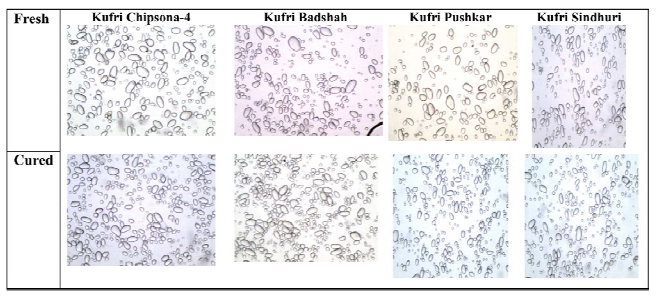
Fig. 1
Particle of starch from potato varieties as effected by curing (inverted compound microscope (Olympus, Japan; model: CX-41) equipped with digital camera facility at 10 x power lens.)
In the present study, biplot indicates that starch crude fibre, moisture, protein and starch whiteness correspond more to Kufri Badshah and Kufri Bahar whereas, starch fat (%), and small size particles values correspond more to Kufri Chipsona-4 (Fig. 2). The starch purity was more associated with the Kufri Sindhuri and Kufri Pushkar. The angle size between two or more traits in the biplot is directly proportional to correlation between those characters. A high positive correlation was discerned between the starch crude fibre, moisture, protein and starch whiteness value whereas, high negative correlation was discerned by starch purity with starch protein, moisture, crude fibre content, and starch whiteness. The biplot reflected diversity among potato varieties based on variables measured. Projection of the variables on the factors plane exhibits an independent group consisting of starch characteristics and the PCA analysis revealed several remarkable variations that exist among potato varieties. Kong et al., (2009) extracted four principal components (using 17 variables) that accounted for 88% of the total variance of starches properties, both physiochemical and functional, isolated from 15 amaranth grain cultivars.
Characteristics of starch extracted varied with potato variety, curing and, extraction method. Least moisture and protein content and highest starch purity was observed in Kufri Sindhuri. Kufri Sindhuri also resulted in least starch fat content and starch colour values. The percentage of small size particles was maximum in Kufri Chipsona-4 and minimum in Kufri Badshah. Starch extracted by combined method had lower starch moisture content, fat, protein, ash and crude fibre and higher starch purity, percentage of small size particles, yield, and starch colour values. Curing resulted in lower starch yield, starch whiteness value, higher peak viscosity. It can be thus concluded that it is profitable to extract starch by combined method from fresh tubers of variety Kufri Chipsona 4.
This work was supported by the Centre of Food Science and Technology, CCS Haryana Agricultural University, Hisar, India under the student research work for Ph.D.
Summary statistics of starch characteristics of potato varieties.
Mean±SD; NS – non-significant
Moisture content (%) of starch as influenced by varieties, curing and extraction methods.
Fat content (%) of starch as influenced by varieties, curing and extraction methods.
Mean±SD; NS – non-significant
Protein content (%) of starch as influenced by varieties, curing and extraction methods.
Mean±SD; NS – non-significant
Ash content (%) of starch as influenced by varieties, curing and extraction methods
Mean±SD; NS – non-significant
Crude fibre content (%) of starch as influenced by varieties, curing and extraction methods.
Mean±SD; NS – non-significant
Purity (%) of starch as influencerd by varieties , curing and estraction methids
Segregation of the potato varieties based on their respective starch traits as determined by PCA.
Colour value (whiteness) of starch as influenced by varieties, curing and extraction methods.
Mean±SD; NS – non-significant
Percent of small size (< 30 µm) particles of starch as influenced by varieties, curing and extraction methods.
Mean±SD; NS – non-significant
Principal component (PC) loadings for quality variables of the potato starch
Fig. 1
Particle of starch from potato varieties as effected by curing (inverted compound microscope (Olympus, Japan; model: CX-41) equipped with digital camera facility at 10 x power lens.)
