Artículos de investigación
THE MINIMUM STANDARD OF PROOF IN CRIMINAL PROCEEDINGS: A STUDY OF LEGAL CRITERIA FOR IMPOSING PRE-TRIAL DETENTION IN COLOMBIA, WITH A FOCUS ON TARUFFO’S THEORIES*
EL ESTÁNDAR MÍNIMO DE PRUEBA EN EL PROCESO PENAL ESTUDIO A PARTIR DE LOS CRITERIOS JURÍDICOS PARA IMPONER LA MEDIDA DE ASEGURAMIENTO PRIVATIVA DE LA LIBERTAD EN COLOMBIA, CON ENFOQUE EN EL PENSAMIENTO DE MICHELE TARUFFO
UM ESTUDO A PARTIR DOS CRITÉRIOS JURÍDICOS PARA IMPOR A MEDIDA DE PRISÃO PREVENTIVA NA COLÔMBIA, COM FOCO NO PENSAMENTO DE MICHELE TARUFFO.
 JUAN CAMILO YEPES YARCE juan.yepesya@unaula.edu.co
LUIS ORLANDO TORO GARZÓN ltoro@udem.edu.co
JUAN CAMILO YEPES YARCE juan.yepesya@unaula.edu.co
LUIS ORLANDO TORO GARZÓN ltoro@udem.edu.co
THE MINIMUM STANDARD OF PROOF IN CRIMINAL PROCEEDINGS: A STUDY OF LEGAL CRITERIA FOR IMPOSING PRE-TRIAL DETENTION IN COLOMBIA, WITH A FOCUS ON TARUFFO’S THEORIES*
Ratio Juris, vol. 19, núm. 38, pp. 189-216, 2024
Universidad Autónoma Latinoamericana
Recepção: 26 Setembro 2023
Aprovação: 22 Janeiro 2024
Publicado: 29 Janeiro 2024
Abstract: Navigating the legal universe of the standards of proof and acknowledging their impact not only in sentences but also in earlier or anticipated stages in the legal process is a responsibility of those who make legislative or jurisdictional decisions. It is also an ethical and professional duty for practicing and academic lawyers and a key aspect of legal education for legal scholars and those seeking advanced legal studies1. This study uses a qualitative methodology that includes theoretical, exploratory, and descriptive analysis, along with reflective, analytical, and proactive interpretation techniques. Its aim is to examine the legal criteria for imposing pre-trial detention in Colombia, drawing on Michele Taruffo's theories and his contributions to the field of the standards of proof, specifically regarding the minimum evidentiary standard of reasonable inference of perpetration or participation. The study highlights the importance of considering objective and subjective assumptions for the indictment and the requirements for imposing pre-trial detention, with emphasis on the boundaries of reasonable inference and constitutional analysis. These mandatory and properly related paths are necessary for the legal stability of the preliminary decision for a pre-trial detention measure. Also, the study suggests criteria for understanding and argumentation aimed at the academic and legal sectors concerning the application of the standard of reasonable inference of perpetration or participation.
Keywords: Standard of proof, pre-trial detention, reasonable inference, conviction, perpetration, participation.
Resumen: Ingresar al universo jurídico de los estándares de prueba y admitir su incidencia no solo en la sentencia, sino también en momentos procesales previos o anticipados es una obligación de quienes tienen el rol de tomar decisiones legislativas o jurisdiccionales; también es un deber ético y profesional de los abogados litigantes y doctrinantes, e igualmente es tarea por pedagogía jurídica de los estudiosos del derecho y de aquellos que buscan profesionalizarse en altos estudios jurídicos.16 Así, con fundamento en una metodología cualitativa de orden tipológico teórico, exploratorio y descriptivo, y con la técnica de la interpretación reflexiva, analítica y propositiva, se parte del objetivo de estudiar los criterios jurídicos para imponer la medida de aseguramiento privativa de la libertad en Colombia, con base en el pensamiento del jurista Michele Taruffo y sus aportes al campo del estándar de prueba, y con un énfasis particular en el estándar probatorio mínimo de inferencia razonable de autoría o participación. El estudio concluye que es importante considerar como necesarios e integrados los presupuestos objetivos y subjetivos de la formulación de la imputación de cargos, y los requisitos para imponer la medida de aseguramiento privativa de la libertad, con énfasis en la estructura de lo que ha de ser la frontera de la inferencia razonable y el análisis constitucional, los cuales son, en suma, recorridos conexos obligatorios y propios en función de la estabilidad jurídica de la decisión previa de medida cautelar personal, consistente en la detención preventiva. Para ello, se proponen criterios de comprensión y argumentación, destinados a los sectores académicos y jurídicos, sobre la aplicación del estándar de inferencia razonable de autoría o participación.
Palabras clave: Estándar de prueba, medida cautelar privativa de libertad, inferencia razonable, convicción, autoría, participación.
Resumo: Entrar no universo jurídico dos padrões de prova e reconhecer sua incidência não apenas na sentença, mas também em momentos processuais anteriores ou antecipados, é uma obrigação daqueles que têm o papel de tomar decisões legislativas ou jurisdicionais. Também é um dever ético e profissional dos advogados litigantes e doutrinadores, e igualmente é uma tarefa de pedagogia jurídica dos estudiosos do direito e daqueles que buscam se profissionalizar em estudos jurídicos avançados. Assim, com base em uma metodologia qualitativa de ordem tipológica teórica, exploratória e descritiva e com técnica de interpretação reflexiva, analítica e propositiva, parte-se do objetivo de estudar os critérios jurídicos para impor a medida de asseguramen-to privativa de liberdade na Colômbia, com foco no pensamento do jurista Michele Taruffo e suas contribuições para o campo do padrão de prova, com especial atenção para o padrão probatório mínimo de inferência razoável de autoria ou participação. O estudo conclui sobre a importância de considerar como necessários e integrados os pressupostos objetivos e subjetivos da formulação da imputação de acusações e os requisitos para impor a medida de asseguramento privativa de liberdade, com ênfase na estrutura do que deve ser a fronteira da inferência razoável e na análise constitucional, os quais são, em suma, percursos conexos obrigatórios e próprios em função da estabilidade jurídica da decisão prévia de medida cautelar pessoal consistente em detenção preventiva. Para isso, são propostos critérios de compreensão e argumentação, destinados aos setores acadêmicos e jurídicos sobre a aplicação do padrão de inferência razoável de autoria ou participação.
Palavras-chave: Padrão de prova, medida cautelar privativa de liberdade, inferência razoável, convicção, autoria, participação.
INTRODUCTION
In the Western world, particularly in the legal field, various topics have been extensively analyzed in studies conducted by renowned scholars and theorists in legal philosophy, especially in substantive and procedural criminal law. These studies encompass different approaches and draw on a range of epistemological resources depending on the evolving boundaries of law. Some focus on debates around evidence as a multifaceted phenomenon, both substantial and procedural in nature, while others examine evidence as a hybrid legal-linguistic sign that provides knowledge of the process. Research in these cognitive dimensions has also explored the rational assessment and justification of evidence, the pursuit of factual truth-as the core of the concept of justice-as well as issues such as what constitutes a fair decision, the relevance of legal argumentation theory, and the standards of proof. This last topic, with a fundamental hermeneutic shift, is the focus of this study.
The standard of proof is closely linked to the evaluation of evidence, although not integrated with it. Its significance as a benchmark becomes evident when considering the degree of knowledge gained in a specific case and contrasts with the level of understanding required by legal or constitutional mandates as a criterion of qualitative justice. Consequently, this standard often emerges in legal contexts as a statutory threshold, allowing (although not in every instance) a transition to take place from persistent uncertainty to a final decision. When determining whether something is proven or not proven (Ferrer, 2007b), the standard of proof must meet or surpass predefined benchmarks. This typically occurs at the sentencing phase or at earlier decision points with varying procedural impact, where individual and fundamental rights are often on the line.
In criminal law, the standard of proof, despite raising considerable concerns due to its relationship with subjective and objective decision-making, has been little explored in doctrinal and jurisprudential contexts, particularly in terms of its criteria and coverage in all procedural acts, whether investigative or trial-related. This has led to static understandings and a shallow legal framework, as internal environments and structural elements within each standard have not been pre-established, making it difficult for legal actors to self-regulate and predict successful or favorable outcomes during functional, constitutional, or conventional control phases (Nieva, 2010).
Given the lack of criteria in this metric, the available literature-local and comparative-although produced with seriousness and dedication by authors such as Laudan, Ferrer, and Taruffo, has been insufficient to definitively establish standardized guidelines for managing required knowledge without excesses or unlimited discretion. Taruffo, for instance, has conducted investigations into the understanding, conceptualization, and methodological practice of the standard of proof, known globally as beyond all reasonable doubt (BARD) (Toro, 2021). Building on his contributions, it is possible to conduct studies like this one, which address the standard of proof applied to pre-trial detention in criminal law, particularly decisions made before sentencing but with an immeasurable impact on the rights of the accused, specifically their right to liberty. This author, in fact, was the primary inspiration for this paper, as he is a visionary of the legal process and guarantees that should drive the practical application and evaluation of evidence.
This study, thus, focuses on the standard of proof in direct relation to the judicial conviction required to impose pre-trial detention measures in criminal proceedings in Colombia. It aims to explore questions and propose criteria beyond the concept of the standard of proof, that is, to establish paradigms that can help identify and balance criteria to enhance objectivity. Importantly, from Taruffo's perspective on the legal process, the epistemological concept of truth-seeking is relatively subjective, as its outcome is largely dependent on the available evidence supporting each side's often conflicting claims (Taruffo, 2006). This calls for a scenario of technical interaction with the information resulting from evaluating the evidence collected during the investigative phase, as well as with the legal premise established as a standard during this phase of the process, based on the principle of progressivity and legally defined as reasonable inference of perpetration and participation, as outlined in Article 308 of Law 906 of 2004. This law pertains to the responsibilities of the judge with guarantee supervisory powers and the reasoning needed to restrict liberty.
Given this approach, which reveals the degree to which something can be factually proven, and the associated evidentiary standard-both of which are necessary for determining the degree of conviction, persuasion, or certainty-the judge with guarantee supervisory powers faces the imperative of deciding whether or not to impose pre-trial detention. This decision is especially challenging when it involves imprisonment, as the impact is significantly different from that of house arrest. Additionally, the judge must navigate significant constitutional, conventional, and legal challenges to uphold the principle of affirming the right to liberty (Ferrer, 2007a)2.
GENERAL ASPECTS OF THE STANDARD OF PROOF
Conceptualization
From the beginning of human history, people have had a fundamental need to believe in or cling to something or someone to feel secure and satisfied in their convictions. This need for proof is a fundamental aspect of human nature, and it reaches its fullest expression when interacting with others, forming the basis of social groups. Under this premise, evidence becomes a crucial institution that supports all areas of human social life (Peláez, 2013). For instance, after school, children often rush home to share a song or something they learned from their teacher, offering proof of their education and effort. Similarly, specific knowledge is assessed through written exams, or an identity document is presented to verify who we claim to be. These examples illustrate that the need for evidence and its validation is intrinsic to every social individual.
For this reason, it is important for humanity to conduct its social activities according to unified standards that various social groups can adopt in different contexts. This ensures that managing factual and legal matters based on individuals' behavior promotes coexistence rather than rebellion, as seen in past social revolutions. Categories such as hot and cold, positive and negative, high and low, sweet and bitter, affectionate and violent, proven and unproven reflect individuals' judgments with varying degrees of objectivity, which result from reasoning and the integration of decision-making models. In social, cultural, religious, philosophical, and legal domains, as well as other areas related to human experience, everything can vary from one person to another due to different causal factors. For example, what one person considers loud might be quiet or tolerable to another. This underscores the need to reach as much consensus as possible, especially in the administration of justice, where perceptual errors caused by natural irrationality can lead to irreparable harm.
Standards or patterns arise from what is inductively perceived or experienced through receptor cells, that is, from stimuli received through the senses or from repeated consequences of the same cause occurring at a given frequency (Stein, 2008). Thus, partial phenomena or events, such as a and b, contribute to the development of general probability structures or rules, which are strengthened when other harmonious events such as c, d, e, and f are added. This cycle of reinforcing probability through increased sampling makes it more likely to achieve optimal or appropriate outcomes. The process is further strengthened if we effectively use techniques for combining or integrating experience, skill, and available knowledge resources. From this foundation, culturally and legally appropriate and legitimate decisions can be made. In light of this, it is clear that standards serve as interpretive and argumentative tools for making sound decisions.
According to Guerra Bonet (2020), measurement allows certain standards to be determined quantitatively. This approach, however, should also incorporate qualitative aspects through logical reasoning, adhering to the structure of antecedents and consequences in inductive, deductive, or abductive inferential sequences. For instance, one can say that something is sweet if it contains a certain concentration of sugar per cubic centimeter, or that someone has a fever if their body temperature exceeds 100°F, and if it surpasses 107.6°F, brain damage may occur. All of these examples demonstrate that standards provide limits or parameters for doing things right or making decisions about ongoing or completed activities, which require resolute conclusions at specific times and are often subject to the risk of errors or lack of social support.
Given these considerations, there is a common need to standardize decision-making models with a focus on balancing objectivity and subjectivity in a human-centric, rights-based manner, covering all aspects of human activity. In the case of the human and social sciences, law is no exception to the principles of humanism and the rights-based approach. It incorporates legal categories that are both descriptive and prescriptive in an abstract form, which demands a judicial governance that creates and customizes rules but that is moderated by democratic criteria.
Clearly, legislative specificity and precision models in the legal domain, designed to resolve factual situations presented as litis, serve as mechanisms to aid in decision-making. These mechanisms also help determine, with nuanced reasoning, whether there is malice or negligence, the severity of any harm (whether serious, minor, or negligible), whether a person is guilty or innocent, and whether actions are conscious or involuntary. The goal is to confirm the occurrence of an event and determine the strength of the causal evidence and responsibility to apply the most suitable legal consequence. In this context, evidence law is indeed closely associated with standards. These standards aim to categorize external events within a normative factual scenario, provided the requirements for conviction set by the legislator are met.
The level of conviction imposed by law, thus, aligns with the concept of standards of proof, which exist outside the realm of evidence assessment yet are directly linked to its informative outcome. Standards are typically based on aspects of probability, specifically logical and linguistic probability, which involves organizing antecedents based on observable objects and constructing formulas representing causality and effect. These probability criteria, although aligned with Aristotelian logic and dynamic jurisprudential development, are integrated into contemporary legal systems that are constitutionalized, conventionalized, and universalized, aiming to achieve a consensual increase in global legal protection. To achieve this, humanizing principles such as due process, the presumption of innocence, and in dubio pro reo are activated relying on proportionality or reasonableness, alongside other guarantees that limit free interpretation and expansive application of the law in fields like criminal law (Schum, 2016).
Considering the different paradigms that emerge from these principles and their relationship with the standard of proof, it is important to clarify the definition of standard. It can be defined as the level or threshold that must be reached to achieve a reasonable level of confirmation of a hypothesis (Bustamante & Toro, 2016). This requires comprehensive criteria and evaluative reflections by judges and other decision-makers beyond the specific evidence at hand. From this perspective, a hypothesis may be deemed proven or not proven based on the level of probability that gains support, firstly at the legislative level and then at higher or social levels. As stated by De Vecchi and Cumiz (2019), the sufficiency of evidence for the acceptance of a factual statement as proven is always linked to the fulfillment of a specific standard of proof.
In addition to what has been stated so far, several authors have attempted to define the conceptual boundaries of the standard of proof, and others, with valid reasons, even deny its existence (Laudan, 2005). However, the clearest and most comprehensive interpretation is provided by Taruffo (2005a), for whom a criminal judge should convict the defendant only when there is at least some degree of certainty of guilt. Conversely, the defendant should be acquitted whenever there is reasonable doubt about their potential innocence, even if evidence is presented against them.
The process of identifying, understanding, and navigating the conceptual framework of the standard of proof requires evaluating evidence and pinpointing specific information. This leads to a level of knowledge that can be high, medium, or low depending on the evidence presented and ultimately results in a degree of conviction or acceptance of what is considered possible. This level of knowledge and conviction is then applied within the rational scope of the standard of proof. Nonetheless, the interactive context with the standard does not justify revisiting the evaluation process. Hence, the process involves, on the one hand, assessing the evidence using principles of sound judgment and, on the other hand, comparing the outcome with the required standard of proof.
Classification
In both criminal and civil proceedings, different levels of judicial knowledge are required to issue a sentence. According to Fernández (2005), a criminal conviction requires proof beyond a reasonable doubt, though there is no clear definition of its scope. The only consensus is that beyond a reasonable doubt does not equate to "beyond any shadow of a doubt." In contrast, civil proceedings demand a significantly lower standard of proof, as it suffices for the claim to be established through preponderance of evidence3 (Fernández, 2005).
Concerning the criminal standard-beyond that of beyond a reasonable doubt-when delivering a verdict, modern law is gradually accepting lower standards of proof for other punitive decisions. These lower standards can serve as a foundation for reinforcing the conviction standard. Examples include the base standards for imposing pre-trial detention and formulating charges and accusations, among other decisions that may be made individually (Camargo, 2012). In this regard, standards that are considered moderate or minimum are also recognized, which differ from the maximum standard required for a guilty verdict. This approach ensures thoughtful and reasoned justice through optimized decision-making patterns and control against arbitrary discretion.
These emerging standards can be identified through terms such as reasonable grounds, reasonable inference of perpetration and participation, and probability of the existence of the crime and perpetration (Londoño, 2019). Other standards may also gradually emerge or be specified under different contexts during investigative and trial activities. This classification, which is outlined in the local Criminal Procedure Code (CPC) or in some international codes, is based on an increasing degree of knowledge necessary to decide on investigative actions, charges, or accusations.
Structure of the standard
In general, a standard of proof requires, beyond the conceptual level, structural elements and interpretative and application tools. These must be cognitive, reflective, and ethical in nature and may be grounded more in cultural, religious, human, and social concepts than in normative ones. Applying this structural approach and its ethical foundation to the criminal field highlights the importance of minimizing the risk of convicting an innocent person or making irrational decisions that infringe on the rights of individuals facing criminal accusations (Whitman, 2015). While the guilty is indeed guilty, the concern is how much guilt can be inferred when there is no way to conclusively prove, through the evidence presented, what happened with no margins of error.
This reopens the discussion on the technical preference that should guide investigation and judgment in each case: whether decision-makers should focus solely on the objectives of procedural law or the aims of the process4, or whether they should democratically prioritize the goals of evidence to determine the truth by probability. This consideration aligns with contemporary constitutionalism, which emphasizes systematization and values as protective aspirations aimed at reducing the risk of convicting the innocent and ensuring fair decisions, rather than adhering to strict legal standards based on prescriptive or static law. For these reasons, the standard for criminal matters is essential throughout the entire process and should be more stringent than that applied in civil matters, which rely on the preponderance of evidence (Fernández, 2005).
Effects of the absence of a unified standard of proof
In the absence of an established standard of proof grounded in justice, the likelihood of relying on strictly personal judgments and interpretations of evidence increases. This can result in decisions being influenced by chance in both factual and legal resolutions. What is deemed acceptable or unacceptable in a context lacking unified criteria can vary according to the interests of the parties and the cultural background of the society. Consequently, what seems plausible may be mistaken for what is proven true.
We believe that this scenario does not contribute to rational decision-making at the desired optimal levels. The absence of standards, as well as the lack of methodological development and operational expertise, can lead to a regression in justice. This signifies a shift back in time toward conditions that undermine constitutional principles and compromise previous advancements in the field. It takes us back to a form of justice reminiscent of the dark ages of civilization and law.
Standards, whether normative or not, are essential for providing decision-makers with objective and reliable tools, particularly when faced with complexity and doubt. Whether something is true or what occurred, whether a judge makes autonomous decisions or follows objective rules, how to understand and manage the existence of truth and probability, how rationality prevails when choosing among different alternatives, and what is indeed rational are central questions to the judicial process and demand a definitive answer. This answer, nonetheless, cannot be just any answer at any time; it must satisfy the need for timeliness and fairness in decision-making.
Precisely, the aim of rational decision-making aligns with the need for unifying standards. This is achieved, however, through interpretative and adaptive criteria tailored to each individual case; otherwise, we risk reverting to excessive formalism.
In each instance of legally relevant events, evidentiary information can satisfy the desire for knowledge to a certain extent, which in turn allows for the construction of numerous hypotheses. However, the challenge lies in resolving discussions or conflicts of interest using stable arguments that can be upheld in higher functional control cycles. Figure 1 illustrates the impact of knowledge percentages.
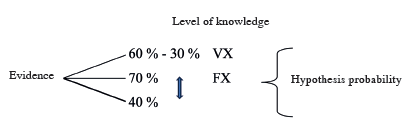
Figure 1
Representation of evidence with knowledge percentages and its implications for hypotheses (VX indicates weak inference, while FX indicates strong inference).
Source: Reference images taken from a lecture by Michele Taruffo in the master's program in Contemporary Procedural Law at Universidad de Medellín, Cohort 19, April 15-17, 2015.
Unquestionably, judges must make decisions even in the presence of doubt, which depends on the strength of the indicative facts and the inferential results identified as either logically strong or weak. As a consequence, possible inferences may vary in cognitive strength, and judges must choose the most reasonable (rationally credible or justifiable), consistent, and coherent inference to resolve the legal conflict at hand. This aligns with Haack's (2013) concept of epistemological probabilities.
In this context, the most reasonable resolution must be based on implications of probability, certainty, human judgment, and legal stability. Therefore, any decision accompanied by a low probability of occurrence of legally relevant facts and lacking support from the corresponding standard of proof may be deemed irrational.
In the analysis and decision-making process, judges must choose the hypothesis most strongly supported by evidence while also finely integrating it with the standard of each specific context. This requires operating within the brightest circle of light in relation to the truth (Figure 2).
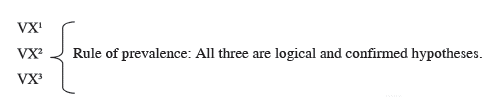
Figure 2
Alternative hypotheses for judicial decisions ( VXindicates possible inference).
Source: Reference images taken from a lecture by Michele Taruffo in the master's program in Contemporary Procedural Law at Universidad de Medellín, Cohort 19, April 15-17, 2015.
TARUFFO'S5 APPROACH TO THE STANDARD OF PROOF
According to Taruffo (2008), the standard of proof is a key procedural institution that plays a crucial role in the legal process, particularly in the decision-making stage. He sees the standard as a threshold designed to increase objectivity as a result of legislative evolution influenced by constitutionalization and the development of procedural and jurisprudential doctrine. Judges must navigate this standard to reach a decision when they have already qualitatively assessed information following contemporary assessment systems, which differ from the rules for assessing evidence or reasonable conviction.
Although the author primarily focuses on civil proceedings and consequently discusses the burden of proof known as more probable than not or preponderance of evidence (Taruffo, 2005b), which he views as essential in analyzing the truth in legal proceedings, he also acknowledges that this standard originates from criminal proceedings. In the criminal context, it is known as the BARD standard, which, for him, requires a higher level of probability for rational decision-making. This is in contrast to the less stringent standard in civil proceedings, likely due to the difference in procedural systems on each side.
Taruffo thoughtfully notes that legislators strive to equip judges with concrete, albeit general, criteria for evaluating and making procedural decisions. He bases this assertion on the various factual aspects that influence litigation or disputes between parties.
Regarding the institutional and legal provisions of the BARD standard, the author does not delve into subclassifications or the existence of minimum, moderate, or other levels of standards, such as weak or strong. Nevertheless, his recognition and debate of maximum or stricter standards, especially in comparison to positions like Larry Laudan's, does not preclude the acceptance of other standards inherent to criminal proceedings, which are already regulated in the Colombian criminal procedural legislation (Taruffo, 2005b).
CONSTITUTIONAL CRITERIA FOR IMPOSING PRE-TRIAL DETENTION BASED ON THE STANDARDS OF PROOF
Pre-trial detention does not represent the precautionary application of an abstract transfer (with no legal personality) from the current accusatory criminal procedural system to the constitutional system. Rather, the identity and protection of liberty are intrinsically matters of universal human rights and a fundamental right subject to enhanced constitutional protection. Therefore, the main source of control originates in and is continuously optimized based on the constitutional principles of humanization.
In this regard, the Inter-American Court of Human Rights6, the Constitutional Court of Colombia7, and the Supreme Court of Justice of Colombia8 all emphatically agree that preventive detention should not be treated as anticipated punishment but as a non-punitive precautionary measure. Given the fundamental nature of the right to liberty, any precautionary measure (including those that restrict or deprive liberty) must be approached with care during the procedural resolution of the request for the measure. It should not be considered an early imposition of a sentence (Jaramillo, 2023), as the purposes of sentencing differ significantly from those of pre-trial detention measures. These latter are part of the range of precautionary actions designed to protect the effectiveness of the judicial process (Benavente, 2011).
Importantly, a detention measure requires material or physical evidence from which the existence of the act and the alleged responsibility of the defendant or accused can logically be inferred (Law 906 of 2004, Article 308). Additionally, a strict constitutional balancing test must be carried out concerning the right in question. In contrast, a conviction requires evidence with a much higher level of probability of criminal responsibility (Law 906 of 2004, Article 372).
Opting for a conviction entails undertaking the commitment of a probability judgment with high evidentiary requirements and balancing it against a higher standard, namely, beyond all reasonable doubt (Law 906 of 2004, Article 381). The presumption of innocence is considered a rule of judgment (Fernández, 2005; Sanchis, 2007). This highlights the high evidentiary standard to shift the balance towards responsibility, despite the reinforced protection of the attribute of innocence and favorable doubt in the constitutional spectrum.
Regarding preventive measures, Méndez (2002) explains that judicial officers must justify and evaluate each case individually, considering all aspects of the accused's involvement in the process to determine whether, for example, the accused will appear at trial. He also analyzes Articles 308 to 312 of the Colombian CPC, which have constitutional standing, regarding the imposition of detention measures based on necessity, appropriateness, proportionality, and reasonableness.
For consistency with constitutional principles, pre-trial detention should not serve punitive purposes; instead, it should have procedural goals. This measure ensures the preservation of important evidence for uncovering the truth and securing the accused's appearance in court while also protecting the victim (goals that sometimes overlap). It should not be applied as punishment. In criminal proceedings and their interpretive methods, the general rule prioritizes the right to liberty and limits its restriction only to extraordinary circumstances due to supranational mandate, in accordance with the principle of minimal criminal law. Therefore, there must be a synergy between the evaluated data, which inform a subject's objective factual relationship with specific normative circumstances justifying a detention measure, and their level of interaction with the standard of reasonable inference as a subjective point of fairness in decision-making.
Pava (2009) notes that, in criminal proceedings, some jurisdictional acts may designate criminal responsibility or even impose precautionary measures on assets as a result of investigative actions, which can lead to the restriction of some fundamental rights and impair the presumption of innocence. Their purpose is to collect material evidence with evidentiary value. Additionally, there are verification acts also subject to the justice obligations required of a judge. Their impact on the presumption of innocence may be potential, seeking to determine whether the presumption should be reaffirmed or provisionally affected based on cognitive means supporting the evidentiary standard of founded reasons or reasonable inference of perpetration or participation (Pava, 2009).
Reasoning about the imposition of pre-trial detention is a matter of great judicial importance. Focusing solely on the gravity of the offense, the accused's dangerousness, and prevention is not enough. The evidentiary findings supporting a detention measure must meet other crucial standards of evaluation and conviction. This begins with a protective presumption against imposing the measure, with strict adherence to constitutional reasonableness and proportionality, while considering the broad scope of constitutional principles. As Foucault (1996) rightly points out, it "is not a question of content, but rather a form of knowledge which is at the intersection of a type of power and a certain number of contents of knowledge"9 (p. 341).
In its landmark Judgment C-774 of 2001, the Constitutional Court of Colombia elevated the right to liberty to a protected status within the block of constitutionality10, with a broad spectrum between legality and constitutionality. The Court presented a detention measure as a delicate issue, considering the bounds of the presumption of innocence. It recognized that the right to personal liberty, although acknowledged as a fundamental and structural element of the rule of law, is not absolute or unlimited within the legal system (Constitutional Court of Colombia, 2001). Despite this, the court reaffirmed the importance of reasonableness and proportionality to avoid general and arbitrary stances when imposing pre-trial detention.
The reason for the foregoing is that the principle of the presumption of innocence is established as a right in the Colombian Constitution. This fundamental right cannot be overlooked; it states that every person is presumed innocent until proven guilty in a court of law, as specified in Article 29 of the Constitution and Article 7 of the CPC. Thus, it serves as a rule of judgment in criminal matters, as noted by Fernández (2005). According to this author, the presumption of innocence also acts as a decision-making tool in situations where the judge has not attained enough certainty to issue a verdict, either for acquittal or conviction-that is, in cases involving irresolvable doubt. In this sense, the presumption of innocence constitutes the legal rule to avoid non liquet (Fernández, 2005).
To supplement this, Bustamante and Palomo (2018) adopt the idea that the presumption of innocence as a rule of judgment11 is linked to the interpretation of the evidentiary presumption of innocence. This raises the question of whether the presumption of innocence is part of the application of the evidentiary rule12 or if it comes into play at a later stage. It is possible to argue that while both scenarios significantly impact the evidentiary aspect of the decision-making process, their underlying principles and timing of application differ.
On the one hand, the presumption of innocence as an evidentiary rule requires the existence of evidence with all necessary safeguards so that its absence compels the jurisdictional body to issue an acquittal. On the other hand, although the outcome is the same (declaration of innocence of the accused), its function as a rule of judgment plays a crucial role at a later stage. Specifically, this occurs when the evaluation of evidence conducted with all necessary safeguards (overcoming the presumption of innocence as an evidentiary rule) yields an inconclusive result, preventing the judicial body from ruling according to it. In such cases, doubts arising from insufficient evidence must be resolved in favor of the accused through the application of the presumption of innocence.
THE MINIMUM STANDARD OF PROOF FOR REASONABLE INFERENCE OF PERPETRATION OR PARTICIPATION AND PRE-TRIAL DETENTION
From a historical and evolutionary hermeneutic perspective, Law 906 of 2004 (Criminal Procedure Code) in Colombia serves as the legislative framework that establishes the standard of proof for investigative acts, trials, judicial decisions, and proceedings free from the excessive formalism typical of traditional legal systems. This shift is particularly important when decisions carry the risk of infringing on rights and legal guarantees due to cognitive uncertainty and irrational subjectivism, especially in cases involving the fundamental right to liberty.
The right to liberty, due to its significance in the context of human dignity, holds the status of a fundamental right with reinforced protection. This protection is not only guaranteed through constitutional law but also through international and global human rights laws. In this context of liberty, pre-trial detention measures are legal institutions in the criminal justice system that should be used only in exceptional cases. This is based on the primacy of the principle of the presumption of liberty, implying that a competent judge should always prioritize considering liberty as the foremost factor in interpretation and judgment, with fundamental support as if the judge were strictly constitutional; hence, the importance and necessary implementation of the standard of reasonable inference of perpetration or participation, as outlined in the Colombian CPC (Law 906 of 2004, art. 308)13.
This standard emphasizes the importance of ensuring judicial security rather than controlling decisions that precede or occur during earlier trial phases.
This approach reinforces the emergence and consolidation of other decision-making patterns or thresholds, which we may refer to as preliminary, minimum, or moderate standards, beyond the maximum or final standard that supports judgments, particularly in criminal convictions. In this regard, Ferrer (2007a) advocates for the potential existence of these standards, which differ from the well-known BARD standard. Similarly, when discussing the relative nature of the sufficiency of evidence for decision-making in judicial proceedings in relation to the standards of proof, De Vecchi and Cumiz (2019) state that possible standards may vary significantly from one context to another.
When considering the standard of proof related to the possibility of imposing any of the preventive measures provided for in the criminal process, it is clear that judges must identify the assumptions they need to use to assess the available information against the required standard for making a decision. This, in turn, involves the need to establish reasonable conviction and construct a sufficient argument, which may vary depending on whether a detention measure, such as imprisonment or home arrest, is imposed.
Such assumptions revolve around both objective and subjective considerations. On the objective side, for instance, the decision must take into account the severity of the crime, including those assigned to specialized circuit criminal judges or cases investigated ex officio where the penalty set by the legislator is four years or more. This also includes considering the thresholds for crimes against copyright, as well as the accused's conditions, such as the risk of obstructing justice, the accused's potential danger to the victim and society, and the risk of non-appearance. On the subjective side, regarding the potential perpetrator or participant, the standard specifically set as a threshold by the Colombian legislator is termed reasonable inference of perpetration or participation, which, in this study, is referred to as the minimum or preliminary standard of proof.
The minimum standard of proof encompasses criteria such as post-evaluation reasoning, which first involves evaluating the cognitive means of the investigation process and then transitioning to considering whether the level of inference satisfies the demands of justice. This assessment is based on the alignment between the individual identified as a potential perpetrator or participant in the crime under investigation and the reasonableness of treating them as such, given the sufficiency of the evidence. This reasoning forms the core aspect of belief and acceptance of the inferential outcome deemed reasonable by the judge with guarantee supervisory powers. It follows a sequence of conditional logic, meaning that there must be a valid relationship between the inductive antecedent and result in the procedure of determining the probability of reasonable perpetration or participation.
In addition to these assumptions, during the preliminary hearing on the imposition of detention measures14, the judge with guarantee supervisory powers must weigh and balance the principles of necessity, appropriateness, proportionality, and reasonableness of the measure taking into account all constitutional and conventional mandates. This involves a favorable interpretation of all sources of constitutional law15 and achieving a balance between human and social considerations.
Thus, arguments concerning these objective and subjective assumptions, as well as the technique of weighing constitutional and conventional mandates, must adhere to the principles of affirming liberty, logic, and sufficient reason. This should emphasize greater consistency and rigor in analyzing all determining factors, particularly when a detention measure leads to incarceration, as in the case of a stronger minimum or preliminary standard of reasonable inference of perpetration.
Importantly, compliance with the standard of reasonable inference of perpetration or participation is circumstantial. Due to the principle of procedural progressiveness and the dynamics of evidence, this reasonable inference may weaken over time. Consequently, revoking a pre-trial detention measure in ordinary jurisdiction or through constitutional actions such as habeas corpus is entirely feasible.
CONCLUSIONS
Figure 3 presents the conclusions of the cycle of assumptions necessary for the legal validity and stability of a pre-trial detention measure.
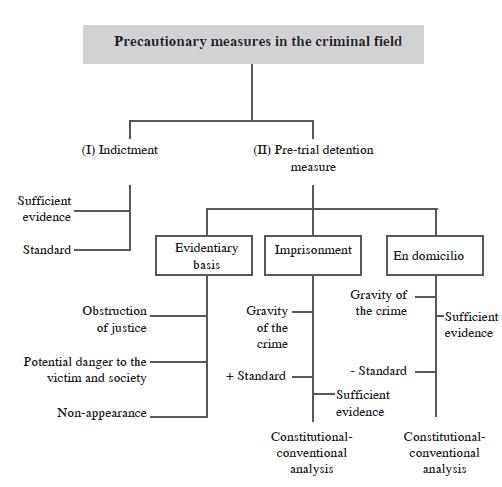
Figure 3
Objective and subjective assumptions for pre-trial detention.
Source: Own work.
Figure 3 clearly demonstrates the importance of meeting the formal assumptions of the indictment to proceed with requesting pre-trial detention. Additionally, within the framework of such measure, there must be an objective assessment of the risk of obstruction of justice, danger to the victim or society, and non-appearance. It is also essential to determine whether the charged offense fits within a crime carrying a minimum prison sentence of four years.
In addition, following from the above, it is crucial to support, with a structured set of criteria, the alignment of the evidentiary outcome with the minimum standard of proof for a reasonable inference of perpetration or participation. This standard is particularly stricter when the restriction of liberty occurs in a prison setting. Moreover, the measure must undergo constitutional and conventional analysis to respect the human dignity of the perpetrator or participant in the crime, as shown in Figure 4.
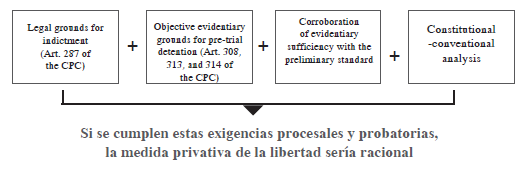
Figure 4
Identification of criteria for and against assessing reasonableness of perpetration or participation concerning pre-trial detention and the structure of the constitutional analysis for the imposition of such measure.
Source: Own work.
As illustrated in Figure 4, failure to comply with any of the objective or subjective assumptions outlined in the cycles would indicate that the appropriate constitutional and rational course of action is the protection of liberty, even over the prosecution's or victim's request for its restriction. It is also clear from the figure that the decision of the judge with guarantee supervisory powers to choose the restriction of liberty for the accused is a complex matter that requires constructing arguments, logical-legal reasoning, and providing sufficient justification to achieve jurisdictional functionality, social legitimacy, and, above all, legal certainty.
REFERENCES
Benavente Chorres, H. (2011). La aplicación de la teoría del caso y la teoría del delito en el proceso penal acusatorio. Bosch editor.
Bojczuk, W. (1993). Evidence textbook. 5th ed. HLT Publications.
Bustamante Rúa, M. & Palomo Velez, D. (2018). La presunción de inocencia como regla de juicio y el estándar de prueba de la duda razonable en el proceso penal. Una lectura desde Colombia y Chile. Ius et Praxis, vol. 24, issue 3.
Bustamante Rúa, M. & Toro Garzón, L. (2016). El Estándar de prueba en el proceso penal "El conocimiento más allá de toda duda razonable" algunas generalidades desde la legislación y la jurisprudencia colombiana. El derecho probatorio y la decisión judicial. Sello Editorial Universidad de Medellín.
Camargo, P. (2012). Manual de enjuiciamiento penal. Sistema acusatorio y juicio oral y público. Editorial Leyer.
Colombian Constitution (1991). Gaceta Constitucional, No. 114. https://www.suin-juris-col.gov.co/viewDocument.asp?ruta=Constitucion/1687988
Congress of the Republic of Colombia (2003). Gazette number 339 of July 23. Proyecto de ley estatutaria número 001 del 20 de julio, Cámara, por la cual se expide el Código de Procedimiento Penal.
Congress of the Republic of Colombia (September 1, 2004). Law 906 of 2004. Por la cual se expide el Código de Procedimiento Penal. Diario Oficial, 45.658.
Constitutional Court of Colombia. (July 25, 2001). Judgment C-774/01. Reporting Judge Rodrigo Escobar Gil.
Constitutional Court of Colombia. (May 13, 2015). Judgment C-284/15. Reporting Judge Mauricio González Cuervo.
Constitutional Court of Colombia. (October 9, 2013). Judgment C-695/13. Reporting Judge Nilson Pinilla Pinilla.
Cooper, S., Murphy, P. & Beaumont, J. (1994). Case and materials on evidence. 2nd ed. Blackstone Press Limited.
De Paul Velasco, J. M. (1999). Instrucciones al Jurado. Observaciones prácticas con alguna incursión teórica. En Problemas del juicio oral con jurado (pp. 203-279). Manuales de Formación Continuada, No. 1.
De Vecchi, D. & Cumiz, J. (2019). Estándares de suficiencia probatoria y ponderación de derechos: una aproximación a partir de la jurisprudencia de la Corte Penal Internacional. Marcial Pons. Ediciones Jurídicas y Sociales.
Dennis, I. H. (2002). The Law of Evidence. 2nd ed. Sweet & Maxwell.
Fernández López, M. (2005). La presunción de inocencia como regla de juicio en el proceso penal. En Prueba y presunción de inocencia (pp. 157-279). Editorial Iustel.
Ferrer Beltrán, J. (2007a). Los estándares de prueba en el proceso penal español. Cuadernos electrónicos de filosofía del derecho, (15). Dedicado a: XXI Jornadas de la Sociedad Española de Filosofía Jurídica y Política, "Problemas actuales de la Filosofía del Derecho", Universidad de Alcalá, 28, 29 y 30 de Marzo. https://www.uv.es/cefd/15/ferrer.pdf
Ferrer Beltrán, J. (2007b). La valoración racional de la prueba. Editorial Marcial Pons.
Fierro Méndez, H. (2002). Manual de derecho procesal penal acorde con el nuevo código de procedimiento penal. 2nd ed. Editorial Leyer.
Foucault, M. (1996). La verdad y las formas jurídicas. Editorial Gedisa.
Guerra Bonet, J. (2020). Derecho Probatorio. Desafíos y perspectivas. Estándares de prueba: Una mirada desde la probabilidad. Universidad Externado de Colombia.
Haack, S. (2013). El probabilismo jurídico: una disensión epistemológica. In M. del C. Vásquez Rojas (Coord.), Estándares de prueba y prueba científica. Ensayos de epistemología jurídica (pp. 65-98). Editorial Marcial Pons.
Inter-American Court of Human Rights, Acosta Calderón Case. (June 24, 2005). Judgment, Series C. No. 129. F.J. 75.
Jaramillo Díaz, J. (2023). Estructura básica de la actuación penal. Ediciones Unaula.
Laudan, L. (2005). Por qué un estándar de prueba subjetivo y ambiguo no es un estándar. Doxa. Cuadernos de Filosofía del Derecho, (28), 95-113. DOI: https://doi.org/10.14198/DOXA2005.28.08
Londoño Ayala, C. (2019). Medidas de Aseguramiento. Análisis Constitucional. Ediciones Nueva Jurídica.
Murphy, P. (1992). A practical approach to evidence. 4th ed. Blackstone Press Limited.
Nieva Fenoll, J. (2010). La valoración de la prueba. Editorial Marcial Pons.
Organization of American States. (1969). Convención Americana sobre Derechos Humanos (Pacto de San José). Official Gazette, No. 9460. https://www.oas.org/dil/esp/1969_Convenci%C3%B3n_Americana_sobre_Derechos_Humanos.pdf
Pava Lugo, M. (2009). La defensa en el sistema acusatorio. 1st ed. Ediciones jurídicas.
Peláez Hernández, R. (2013). Manual para el manejo de la prueba. 3rd ed. Ediciones Doctrina y ley.
Pezo Jiménez, O. & Mamani Huaman, S. (2022). La formación académica de los jueces supremos del Perú en 2022. Revista: pedagogía universitaria y didáctica del derecho vol. 9 (2). 223-238 DOI 10.5354/07195885.2022.67769
Prieto Sanchis, L. (2007). El juicio de ponderación constitucional. In El Principio de Proporcionalidad en el Estado Constitucional. Universidad Externado de Colombia. Primera Edición, 2007, p. 130-131.
Schum, D. (2016). Los fundamentos probatorios del razonamiento probabilístico. Orión Vargas (translation by Orión Vargas V.).
Stein, F. (2008). El conocimiento privado del juez. 3rd ed. Editorial Temis S. A.
Supreme Court of Justice of Colombia. (October 12, 2016) Auto interlocutorio AP7109- 2016. Rad. 46148. Reporting Judge Patricia Salazar Cuéllar.
Taruffo, M. (2005a). Nuevas tendencias del derecho procesal constitucional y legal. Editorial Universidad de Medellín.
Taruffo, M. (2005b). Tres observaciones sobre "por qué un estándar de prueba subjetivo y ambiguo no es un estándar", de Larry Laudan. Doxa. Cuadernos de Filosofía del Derecho, 28. pp.119.
Taruffo, M. (2006). Sobre las fronteras. Escritos sobre la justicia civil. Editorial Temis.
Taruffo, M. (2008). La Prueba. Editorial Marcial Pons.
Toro Garzón, L. & Ocampo Henao, L. (2021). Estándares de prueba: realidad o ficción en la obra de Michele Taruffo. In M. M. Bustamante Rúa; A. Henao Ochoa & D. M. Ramírez Carvajal (Coords.), Homenaje a Michele Taruffo un jurista del futuro: el legado de Taruffo para Latinoamérica (pp. 405-422). Editorial Institución Universitaria de Envigado, Red para el Estudio del Proceso y la Justicia.
United Nations General Assembly. (1966). International Covenant on Civil and Political Rights. https://www.ohchr.org/es/instruments-mechanis-ms/instruments/international-covenant-civil-and-political-rights
Whitman, J. (2015). Orígenes de la duda razonable. Raíces teológicas del proceso penal. Universidad de Palermo (translation by Nicolas Schiavo).
Notas
Notas
Notas