Artículos de investigación
POLITICAL IDEOLOGY, SOCIAL BELIEFS, AND POLARIZATION AS PSYCHOSOCIAL BARRIERS TO DEMOCRACY AND PEACE IN COLOMBIA 2016-2020*
LA IDEOLOGÍA POLÍTICA, LAS CREENCIAS SOCIALES Y LA POLARIZACIÓN COMO OBSTÁCULOS PSICOSOCIALES PARA LA DEMOCRACIA Y LA PAZ EN COLOMBIA, 2016-2020
IDEOLOGIA POLÍTICA, CRENÇAS SOCIAIS E POLARIZAÇÃO COMO OBSTÁCULOS PSICOSSOCIAIS PARA A DEMOCRACIA E A PAZ NA COLÔMBIA 2016-2020
 JUAN DAVID VILLA-GÓMEZ juan.villag@upb.edu.co
IVONNE LEADITH DÍAZ-PÉREZ idiaz@javerianacali.edu.co
TATIANA SAAVEDRA-FLOREZ tsaavedra@javerianacali.edu.co
CARLOS ANDRÉS SANCHEZ-JARAMILLO casanchezj@usbcali.edu.co
ALFONSO INSUASTY RODRÍGUEZ Alfonso.insuasty@gmail.com
JUAN DAVID VILLA-GÓMEZ juan.villag@upb.edu.co
IVONNE LEADITH DÍAZ-PÉREZ idiaz@javerianacali.edu.co
TATIANA SAAVEDRA-FLOREZ tsaavedra@javerianacali.edu.co
CARLOS ANDRÉS SANCHEZ-JARAMILLO casanchezj@usbcali.edu.co
ALFONSO INSUASTY RODRÍGUEZ Alfonso.insuasty@gmail.com
POLITICAL IDEOLOGY, SOCIAL BELIEFS, AND POLARIZATION AS PSYCHOSOCIAL BARRIERS TO DEMOCRACY AND PEACE IN COLOMBIA 2016-2020*
Ratio Juris, vol. 19, núm. 38, pp. 259-298, 2024
Universidad Autónoma Latinoamericana
Recepção: 26 Setembro 2023
Aprovação: 22 Janeiro 2024
Publicado: 29 Junho 2024
Abstract: The study presented in this article aims to understand social beliefs as they configure themselves into ideology and become associated with political polarization, thus constituting psychosocial barriers to peace and democracy in Colombia between 2016 and 2020. Employing a qualitative methodology from a hermeneutic perspective, 256 in-depth phenomenological interviews were conducted with participants from nine cities across the country. The results unveiled deeply entrenched beliefs concerning polarization and radical convictions regarding security, justice, equity, and freedom. Moreover, there was evidence of delegitimization and disqualification of the political adversary. In this context, rather than merely ideological divergence, affective polarization scenarios were constituted. Therefore, it can be asserted that polarization extends beyond ideological opposition, encompassing the demonization of the adversary, thereby perpetrating a scenario of antagonistic confrontation that is rooted in the violent history of the country.
Keywords: Psychosocial barriers to peace, social beliefs, ethos of conflict, ideology, polarization, armed conflict, peacebuilding, democracy crisis.
Resumen: El estudio presentado en este artículo tiene como objetivo comprender las creencias sociales en tanto se configuran como ideología y están asociadas a la polarización política y su impacto, de tal manera que se constituyen en obstáculos psicosociales para la paz y la democracia en Colombia entre 2016 y 2020. Se emplea un método cualitativo desde una perspectiva hermenéutica, mediante el cual se realizan doscientas cincuenta y seis entrevistas fenomenológicas y en profundidad a participantes de nueve ciudades del país. Los resultados revelan creencias arraigadas sobre la polarización y las convicciones radicales en torno a temas como la seguridad, la justicia, la equidad y la libertad, así como la deslegitimación y la descalificación del adversario político. En este marco, más que una lógica de polarización ideológica, se constituyen escenarios de polarización afectiva. Por eso, se concluye que la polarización no se limita a una contraposición ideológica, sino que implica la descalificación del otro como enemigo absoluto, alimentando un escenario de confrontación antagónica arraigado en la historia violenta del país.
Palabras clave: Barreras psicosociales para la paz, creencias sociales, ethos del conflicto, ideología, polarización, conflicto armado, construcción de paz, crisis de la democracia.
Resumo: O estudo apresentado neste artigo tem como objetivo compreender as crenças sociais na medida em que se configuram como ideologia e estão associadas à polarização política e seu impacto, de modo que se constituem em obstáculos psicossociais para a paz e a democracia na Colômbia entre 2016 e 2020. Foi utilizado um método qualitativo a partir de uma perspectiva hermenêutica, através do qual foram realizadas 256 entrevistas fenomenológicas e em profundidade com participantes de 9 cidades do país. Os resultados revelaram crenças arraigadas sobre a polarização e convicções radicais em torno de temas como segurança, justiça, equidade e liberdade, bem como des-legitimação e desqualificação do adversário político. Neste contexto, mais do que uma lógica de polarização ideológica, são constituídos cenários de polarização afetiva. Portanto, conclui-se que a polarização não se limita a uma oposição ideológica, mas implica a desqualificação do outro como inimigo absoluto, alimentando um cenário de confronto antagônico enraizado na história violenta do país.
Palavras-chave: Barreiras psicossociais para a paz, crenças sociais, ethos do conflito, ideologia, polarização, conflito armado, construção da paz, crise da democracia.
INTRODUCTION
In recent years, social psychology, political science, social sciences, and political psychology have been analyzing the impact of polarization on democratic debate and the barriers it creates for reaching agreements on public policies and state action. As part of the research project Barreras psi-cosociales para la construcción de la paz y la reconciliación en Colombia (Psychosocial Barriers to Peacebuilding and Reconciliation in Colombia), conducted in nine cities in Colombia (Neiva, Bucaramanga, Medellín, Cali, Palmira, Pereira, Armenia, Quibdó, and Bogotá) between the second semester of 2018 and the first semester of 2020, a question emerged about the political and social relations between collectives and groups within a society and the way debates, links, ruptures, discussions, and interactions are established regarding the various problems affecting the country.
This question has been taken up in the research project Subjetividades políticas en contextos de crisis de la democracia (Political Subjectivities in Contexts of Democratic Crisis). Within the disciplinary framework of social and political psychology, this study has proposed to describe and analyze processes of polarization and soft fanaticism to comprehend the social beliefs that have become psychosocial repertoires, have obstructed the construction of a stable and lasting peace, and have exacerbated the crisis of democracy in Colombia. This analysis has been performed between 2016 and 2020.
Before this period, as outlined by Roncallo-Dow et al. (2019), the country was immersed in a process of polarization in the context of the 2014 presidential election. This scenario constituted a kind of first plebiscite on the political negotiation of the conflict between the state and the Revolutionary Armed Forces of Colombia - People's Army (abbreviated FARC-EP in Spanish), in which the process initiated by the then-presidential candidate Juan Manuel Santos was at stake, as opposed to the candidate of the Centro Democrático party, Oscar Iván Zuluaga. In this context, both candidates employed various methods and strategies to mobilize the electorate's emotions on this issue, thereby dividing the citizenry (Nasi & Hurtado, 2018).
Subsequently, Colombia experienced two situations that created division in the social and political dynamics of the country. The first was the peace plebiscite, which called for a decision on whether or not to approve the agreement signed between the FARC-EP and the Santos government. The "No" vote won by a narrow margin (49.78% for "Yes" and 50.21% for "No"), which worsened the emotional climate of polarization in the country (Estrada et al., 2019; Rico-Revelo & Barreto, 2021; Basset, 2018; Pulido et al., 2020). Nevertheless, a nearly 60% abstention rate also indicated a certain degree of apathy among some segments of the population. During the plebiscite process, post-truth, fake news, and other manipulation strategies were disseminated in social networks, the press, radio, and television, influencing the electorate (Basset, 2018; López de la Roche, 2019). Therefore, this study focuses on the shared beliefs and ideological constructs of those who took part in this electoral contest.
The second situation took place throughout Santos' second presidential term. There was a division in society regarding the negotiated end of the conflict, which broadened during the 2018 presidential campaign. In this election, Iván Duque, representing the Centro Democrático party, proposed the dissolution of the peace agreement and received 10,373,080 votes (53.98%). His opponent, Gustavo Petro, from the leftist Colombia Humana party, who advocated strengthening the implementation of the agreement, garnered 8,034,189 votes (41.81%) (National Registry of Civil Status of Colombia, 2018). Indeed, Duque's government slowed down the implementation of the peace agreement, thereby spreading a profound societal discord. This also obstructed the communities' and general population's understanding of the implications of this peacebuilding process for the country (Rettberg & Quiroga Ángel, 2018).
Socio-psychological or psychosocial barriers to peace are associated with a series of cognitive, narrative, and affective repertoires that perpetuate conflicts and hinder peacebuilding. These repertoires engender an ethos of conflict shaped by radical, biased, and distorted social beliefs that favor its continuity over time (Bar-Tal & Halperin, 2011, 2014; Bar-Tal et al., 2010; Barrera & Villa, 2018; Rosler et al., 2020; Villa et al., 2021).
These social beliefs constitute a fundamental aspect of the cognitive representations that, together with the self-categorization of the self, define the social identity of the members of a group. They also serve to generate a sense of belonging and to guide actions. Moreover, they involve norms, values, goals, and group ideologies that motivate the process of differentiation and in-group favoritism. Some of these beliefs are assumed to be true and originate in social stereotypes and prejudices constructed by the group (Bar-Tal, 1996, 2013; Tajfel, 1984).
The set of beliefs shared by a social group is part of the ideology and is neither justified nor completely objective. Rather, it serves to fulfill a social function associated with political power. The enunciation of these beliefs makes it possible to accomplish a given goal, either by favoring an achievement or by maintaining the power of that group. These beliefs are shaped by the social situation and the position in the relations of production in a particular context. They also reflect the ties of union of the subjects with the groups to which they belong. For this reason, ideology has a social function, implies collective acceptance, and plays a role in processes of domination (Villorio, 2007).
Ideology, as an ordered system of ideas and conceptions shared by a group, determines social relations, organizes the world, and explains and justifies ends and objectives for action (Bar-Tal, 1996, 2013; Villoro, 2007). In contexts of conflict, according to Blanco (2005), it may constitute beliefs that make the group (in-group) feel superior and consider its values to be better than those of the adversary (out-group). This opposing group is categorized as a threat against which vulnerability is experienced and its members are blamed for past or present grievances, thereby devaluing, disqualifying, and dehumanizing them.
Family tradition, school, friends, social media, and mass media play a fundamental role in the development of frameworks for understanding reality that configure ideological processes, as they distribute values, beliefs, and political ideologies that affect emotions, personal actions, and daily relationships (Avendaño & Villa, 2021; González, 2015; Morales et al., 2018; Romero-Rodríguez et al., 2018; Velásquez et al., 2020, 2021; Villa et al., 2020).
Ideology is complemented by the circulation of knowledge around power and from a concrete exercise of domination. It can reveal itself in everyday life, social relations, the political arena, and even science, although it is always related to its practices (Foucault, 2008; 2010). This illustrates the underlying rationale behind the formation of representations and knowledge, expressed in a continuous discourse, which implies that it is always opposed to a notion of truth that cannot be separated from knowledge-power. The notion of truth is only applicable within the context of specific discourses that are not necessarily true or false. Consequently, ideology is contingent upon a specific context, related to particular discourses and subjects, and circumscribed by micro or macro structures (Foucault, 2019).
Polarization, in its ideological sense, is understood as a difference in conceptions about the state, the economy, and society in the democratic disputes between candidates, parties, and voters. Although considered normal and an integral part of the political system of the rule of law, polarization has become a contemporary challenge to democracy due to the escalation of political radicalization (Kessler & Vommaro, 2023; Waisbord, 2020). These authors posit that as scenarios of emotional disputes and opposition are created, a binary and radical logic that denies the other is established, increasing the dynamics of political sectarianism that threatens tolerance and destroys the diversity of perspectives.
Some studies have found that polarization includes affective aspects related to ideology that foster the difference between groups, favoring severe divisions between us and them. This is because personalistic links are established with electoral candidates that lead to a consideration of the other as an enemy. Hence, polarization has an emotional and affective dimension that unfolds in social life and everyday relationships and goes beyond ideological opposition. For various authors, it is an affective polarization associated with social beliefs and the configuration of the other as an enemy or adversary. This results in moral disqualification of the opponent, oversimplification of their position, exacerbation of disputes in everyday interactions, and personalization of political events. These dynamics ultimately derive in the exclusion of individuals or groups, the use of symbolic violence, and the emergence of fanaticisms that the authors categorize as "soft" (Aguirre et al., 2021; Alonso, 2018; Iyengar & Westwood, 2015; Moreno-Barreneche, 2020; Murillo, 2020; Silva, 2014; Suárez-Ruiz, 2021; Velásquez et al., 2021; Villa et al., 2019; Villa & Sarmiento, 2023).
Other researchers concur with this perspective, stating that the intensification of certain political emotions (indignation, hatred, rage, resentment, anger, fear, among others) is associated with polarization processes. These emotions may cause distancing between individuals, influencing thought and action in an unreflective manner that may give rise to soft fanaticism, both during electoral periods and in daily life. This situation further fragments society and, in some cases, can be a catalyst or justification for forms of symbolic or physical violence (Aguirre et al., 2021; Falla Mera, 2020; Hernández Díaz & Echeverri Martínez, 2018; Manfredi-Sánchez et al., 2021; Moreno-Barreneche, 2020; Murillo, 2020; Prada & Romero, 2018; Velásquez et al., 2020, 2021).
In the political arena, polarization is clearly visible because it is where the attitudes and beliefs that collectives profess grow more intense. For Martín Beristain (2021), polarization is the process by which positions on an issue or situation are reduced to opposing schemes that are mutually exclusive, as the approach to one pole implies the distancing and rejection of the other. Polarization, therefore, entails that one's own thinking is subsumed by the ideological framework of the group with which one identifies, leading to the rejection of the opposing positions and the people who hold them. According to this same author, three phenomena can reinforce polarization: the aggravation of the armed conflict, the emergence of a form of violence that penetrates and breaks the social fabric, and the attempt to position society in opposite extremes as a strategy to prevail in a conflict. In the latter scenario, referred to as intentional polarization, adversaries are labeled as the "incarnation of evil," which dehumanizes them and further divides society.
In this last form, political adversaries are constructed as enemies that must be eliminated, either symbolically, through the disqualification and denial of their humanity, or in a real manner, as in the long Colombian history of bipartisan political violence during the 19th and 20th centuries, or in the framework of the contemporary armed conflict. As Angarita et al. (2015) have observed, when the opponent becomes an enemy that must be eradicated, the conflict degenerates.
In this process of enemy construction, Angarita et al. (2015) distinguish between the political enemy and the absolute enemy. The political enemy engages in confrontation and competition for power in the political arena, where dissent and negotiation of differences are a fundamental part of modern democracies. As a result, this process constitutes an agonistic rather than an antagonistic process (Mouffe, 2011, 2014). The friend-enemy relationship does not exist, and the notion of adversary is introduced. This is because left and right share democratic principles of freedom and equality-a matter that allows parties to treat each other's claims with respect (Mouffe, 2011, 2014; Mouffe & Laclau, 2004).
On the other hand, the absolute enemy is considered to be detached from humanity, which justifies their annihilation. According to Angarita et al. (2015), conflict is degraded when the opponent is considered an enemy to be eliminated, denying their humanity and promoting their extermination regardless of how it is carried out. Consequently, there is no moral or rational limit to the annihilation of the opponent (Angarita et al., 2015; Schmidt, 1998), which results in the violent management of the political contradiction (Villa et al., 2022; Villa & Sarmiento, 2023). Various political sectors appeal to the absolute enemy to affirm in-group identities about that other, who acts as an external and alien entity to the identity construction they wish to reinforce and to the senses of belonging that develop among the members of this group (Tajfel, 1984).
Angarita et al. (2015) consider this a discursive maneuver that leads to conferring enemies an animal identity to differentiate them from humans and justify their criminalization, hunting, capture, torture, or murder without any remorse. This process, they argue, eliminates any form of compassion or consideration and strips them of all rights. However, neither side acknowledges this process of dehumanization of the other.
Authors such as Amossy (2014), Charaudeau (2005), and Mouffe (2011, 2014) have described this strategy of disqualifying the adversary or constructing the enemy as one of the main causes of the current global crisis of democracy. This implies that the agonistic debate within the framework of an ideological opposition moves to another plane, where the contender is transformed into an antagonist whose position and existence is excluded. This is a zero-sum logic where only one's own point of view must be imposed, while that of the adversary must be disqualified, delegitimized, and erased. Angarita et al. (2015), Blair (1995), Villa (2019), and Villa et al. (2022) have proposed that this problem may be a contributing factor to the Colombian conflict and may constitute the psychosocial repertoire that makes it challenging to achieve peace and consolidate democracy.
Amossy (2014) links political polarization with polemical discourse, characterized by three modes of violent conflict management: dichotomization, polarization, and disqualification of the other. From this perspective, di-chotomization refers to the clash of opposing, irreconcilable, and excluding opinions that radicalize the debate to the point of making it impossible to resolve. The author posits that controversy gives rise to a two-pole discursive scenario, which is reduced to two semantic categories distributed in a binary opposition. This demonstrates that conflicting discourses exist if and only if there is an opponent that delimits and frames them. Thus, in each debate, each party incorporates the opposing discourse into their own, inverting its sense and meaning. The adversary is used and referred to solely to transform them into a negative version and the nemesis of one's own discourse.
Polarization is a process by which an audience with divergent posi-tions-which can express itself through various textures of discourse-ends up grouping and merging, typically into two contrasting and excluding collectives, with assumed fundamental points of view and values that each group shares in solidarity (Amossy, 2014). This is how enemy camps are established, more as a relational phenomenon than as an abstract division of antagonistic theses. In this regrouping by identification, adversaries are disqualified to strengthen the identity of the group; the opponent is invalidated or presented pejoratively; and denigration maneuvers are used to discredit them and pigeonhole them as biased and ill-intentioned.
Charaudeau (2005) proposes disqualifying the adversary as one of the main strategies employed in certain political discourses, which focus on stigmatizing the other as a source of evil. This is achieved by pointing out the negative consequences of their ideas for the people or for their image itself. In other words, the aim is to configure their ethos. This strategy employs resources such as irony, mockery, the pointing out of contradictions, and the manipulation of the citizenry.
Spillmann and Spilhminn (1991) posit that the image of enemies is constructed on mistrust due to the perception of their motives as immoral or fraudulent. They are attributed with a negative attitude due to the assumption that they would always have the intention of harming their own group. For this reason, they are held responsible for the negative things that have happened in the past, are happening in the present, and are to happen in the future. Consequently, they are labeled as an evil target that must be destroyed. This process of negative simplification involves the denial of the enemies' identity and the suspension of empathy. As a result, their elimination, both symbolic and real, is justified.
Based on this description, Blair (1995) points out that the "representation of the enemy" imbues the interpretation of political reality with meaning in the Colombian society. As a result, the enemy is configured as an element of the political subjectivation process. Around the enemy, meanings, references, and common scenarios are collectively constructed among diverse social groups. Thus, political polarization and enemy construction converge in the radicalization of extreme thoughts that have ultimately hindered peace and democracy in the country.
In Colombia, we can identify a sum of intentions, considering the signing of significant agreements with paramilitary groups in 2005, the subsequent achievement of a peace agreement with the FARC-EP in 2016, and the current efforts to formalize a state policy called Total Peace. This policy involves negotiation processes with the National Liberation Army (abbreviated ELN in Spanish) and exploratory processes with organized armed groups anchored to the dynamics of illegal activities and territorial control. The objective of these processes is to submit these groups to justice. However, some authors have warned that these groups are a legacy of paramilitarism that, in some cases, have links with political, business, and military sectors. The Special Jurisdiction for Peace (abbreviated JEP in Spanish) has facilitated the uncovering of these connections in its justice administration processes, with the support of the reports of the National Center for Historical Memory and the Truth Commission (Commission for the Elucidation of Truth, 2022).
Polarization and war are inextricably linked. They are phenomena that intertwine and unfold according to the interests of the actors involved. It is crucial to keep in mind that non-visible actors ultimately reap significant economic and political benefits from these phenomena, which feed large and powerful national and international businesses.
METHODOLOGY
Type of study
This qualitative study employed a transdisciplinary approach, incorporating insights from political psychology, critical social psychology, and critical realism (Blanco & Gaborit, 2016). To gather information, a series of phenomenological and in-depth interviews were conducted. Additionally, a hermeneutic perspective was utilized to elucidate the social beliefs that have impeded peacebuilding efforts.
Participants
The sampling was intentional, theoretical, typological, and purposive (Hernández et al., 2014). The process involved selecting participants based on their position on the peace agreement. The interviews were conducted in each city until each of the categories was saturated. Participants had to meet the following criteria: being adults regardless of gender, having different socioeconomic strata, living in urban areas, having different levels of schooling, and having different professions. A further criterion was having voted in the 2016 plebiscite and in the 2018 presidential elections. In addition, participants were required not to be part of political parties, NGOs, victims' organizations, human rights organizations, or social movements. Furthermore, they were not to be government officials with expertise in these issues or scholars dedicated to the armed conflict. The participants (N=256) are identified in the following table:
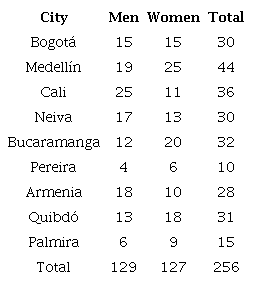
Note. Number of participants per city. Source: Own work.
The categorization of the participants according to their position on the peace agreement (A: agreement, D: disagreement, Amb: ambivalent) was determined by two criteria: their vote in the plebiscite and their own testimony, which provided an account of their ideological position and their beliefs concerning politics.
Data collection technique
Data were collected through phenomenological and in-depth interviews. Although a semi-structured guide was employed, the method focused on the conversation with participants, which gave rise to in-depth questions on their points of view, feelings, and framework of beliefs. This opened the way to discover their ideological positions, convictions, and emotional dispositions regarding the issues discussed. The guide addressed questions and topics related to the origin and process of the armed conflict and its actors. Conversations were developed around their conceptions of peace and their positions on the political negotiation of the armed conflict. In this conversational process, the phenomenon of ideological and affective polarization emerged, which serves as the rationale for this manuscript.
Procedure
The interviews were recorded after the participants had signed the informed consent form. The interviews were then transcribed in full and the content was analyzed using a hermeneutic approach. The information was then organized according to theoretical categories through an intra-subject process, resulting in a coherence matrix. This matrix implied a new ordering of the information within the text, guided by the categories, in a deductive and inductive exercise. This process involved the construction of 256 matrices, one for each participant.
Subsequently, an intertextual analysis was performed to compare the participants' responses in the selected category, namely Polarization. This constituted a new textual structure in which the signifiers and narratives of all the participants were intertwined. From this point on, some steps of the Grounded Theory (Gibbs, 2012) were followed: initially, first-level or descriptive theoretical codes were generated. Subsequently, second-level codes were constructed, which, in a synthetic and inductive manner, gave rise to a categorical order and a theoretical framework for the presentation of the results. Finally, in dialogue with the theoretical framework and background, all the information corresponding to the Polarization category was triangulated to construct the discussion and conclusions. The following categories emerged during this process:

Source: Own work.
RESULTS
The study analyzed social beliefs and polarization in the context of the 2016 peace plebiscite and the 2018 presidential election in Colombia. By examining this scenario of political and social division, it was found that the polarization between those who supported the peace agreement and those who opposed it was rooted in a previous ideological opposition, which was supported by social beliefs. This leads to a reflection on the ways antagonism and enemy construction occur in the political scenario and the relationships that are woven around politics in social contexts. The participants who supported the political negotiation with the FARC-EP were found to have a center, center-left, or left political position. Those who opposed the agreement and voted "No" in the plebiscite were found to have a right or extreme right political position. Those who were ambivalent were situated in the center-right and center positions.
The analysis did not focus on the ideological difference, which is considered a constitutive part of the debate inherent to a democracy (Mouffe, 2011, 2014), but rather on how the parties profile each other as opponents. They move from political adversaries to absolute enemies (Angarita et al., 2015; Schmidt, 1998) or antagonists (Mouffe, 2011, 2014). As a result, they perceive each other with fear, distrust, indignation, and hatred. They categorize opponents in a negative way, pointing them out as the cause of problems, identifying them with evil and diabolical figures, and justifying their exclusion and elimination. This social construction of polarization can be evidenced in the development of the emerging categories in the analysis.
Agonistic debate and ideological polarization
The first category of analysis places us within the context of the debates inherent to the democratic contest in a state governed by the rule of law. These debates encompass ideological positioning, the dispute over ideas and conceptions for the organization of a society and a state, the discussion about how a country should be run, the styles of governance, the preferred public policies, and the orientation of the values, beliefs, and ideas. In the academic debate, this type of polarization is usually referred to as ideological polarization. It does not imply the disqualification, delegitimization, or elimination (either symbolic or real) of the adversary. Rather, it involves the confrontation of frameworks of understanding about the socio-political reality of a territory, as outlined in the introduction (Amossy, 2014; Kessler & Vommaro, 2023; Mouffe 2011, 2014; Waisbord, 2020).
In this sense, according to participants A, the main drivers of the left's political work are social justice and equity. These are the pillars of their ethical purposes and horizons. Rather than a mere way of thinking, they are the grounds on which they configure their action, which is related to the search for general welfare through mutual support and solidarity. Within this horizon, they advocate for the addressing of issues such as poverty, global warming, climate change, human rights violations, gaps in popular participation, exclusion of indigenous and Afro-Colombian communities, and maldistribution of wealth-which they view as a fundamental responsibility of the state:
I have traveled almost all over Chocó. I have witnessed the region's extreme poverty. One day, at 3 p.m., I asked a five-year-old child: "What did you have for breakfast?" And he replied: "My mother sent me to the neighbor's house because we had no food ..." If we had socialism, that family would get, at least, something to eat. I would prefer that, at least, we all eat something ... I would prefer that the state give what it has to the poor (E8-Quibdó-A).
Human development should not be measured in terms of financial productivity but in terms of good living, human dignity ... quality of life, natural resources. I think we should fight for education and health as rights, for a place where we all fit and where we can deliberate, not where we are all equal, but where the common good prevails over the individual (E19-Medellín-A).
For these participants, it is the state that must guarantee equity and social justice. Therefore, this should not be expected from the owners of capital or from businesspeople who work for their own interests. Nevertheless, they do not want a welfare state that gives people things as handouts; rather, they desire a state that, in accordance with the constitution and the social model of law, regulates markets and redistributes wealth in such a way as to ensure that the most vulnerable are able to satisfy their basic needs:
Equity cannot be confused with communism. We want a country where redistribution can be carried out without affecting the welfare of the population (E3-Bucaramanga-A). They think I want the government to give me everything, but I am not asking for a handout. I am demanding my rights (E10-Bucaramanga-A).
Participants A recognize two distinct visions or ideologies that can legitimately and democratically confront each other in the political arena as part of a process of agonistic debate that constitutes the political game in a modern democracy (Mouffe, 2011, 2014). For these participants, the left is progressive and more open to the population's demands and diversity. It is inclusive of women, the LGTBQ+ community, and minorities in general. In contrast, the right is conservative, legitimizes the status quo, and is more concerned with security, established order, and stability:
I think conservatives were more concerned about protecting traditional family values, while liberals were more interested in progress and other things (E27-Cali). Unfortunately, Colombia is a very conservative and right-wing country that has not wanted to embrace new ideals (E17-Armenia-A).
I think-I do not know if I am right-most people who do not agree with the peace process are conservative . They come up with other conservative ideas and end up discriminating against people or making others feel bad (E17-Bucaramanga-A).
Participants D, for their part, tend to identify with right-wing political tendencies and assert that the parties they support are those that have managed to "preserve" democracy in Colombia and have succeeded in protecting capital, building companies, and bringing development. Their position is based on the premise that only hard work can bring wealth:
For me, no matter how bad the right-wing government has been, there is still freedom to do what you want. Logically, there will be many taxes, but we will still be in democracy (E26-Bucaramanga-D).
I think it is good for the economy and investment. I believe that we will have more opportunities when we go out to work. It seems to me that the economic and social project of Uribism is much more viable (E2-Bogotá-D).
The social beliefs of these participants reveal a confrontation between two state models of the modern social order: society and market. As long as this confrontation is maintained, a scenario of ideological polarization is being configured, which, within the framework of an agonistic debate (Mouffe, 2011, 2014), is an integral part of a legitimate democratic process. Thus, the problem is not the clash of ideas, frameworks of meaning, and public policy horizons, but the ascription of qualifiers. These two horizons of understanding and meaning about the country's order and the social, political, and economic relations have permeated the citizenry, as evidenced by the following account:
Basically, left and right are two fronts that have always been in dispute. The right focuses on a capitalist ideal and the left on a socialist ideal. What I remember is that communism seeks that everything is equally distributed; that there is no distinction in social classes or socioeconomic strata . Communism seeks that everyone live under the same social conditions. In contrast, in capitalism, everyone receives according to what they do (E9-Palmira-D).
Following the above account, the problem begins when one of the parties employs the epithet "communist" to discredit the ideas and projects of the democratic left: Why does this disqualification arise? Upon examination of both sides, where does a binary, extreme, and polarizing configuration of their points of view emerge from?
The majority of participants A affirm that they are not communists and question, as do participants D and Amb, the legitimacy of regimes that restrict freedom in the name of equality, as in the case of Cuba, Nicaragua, and Venezuela. For participants A, the pursuit of social justice, equity, and rights, as well as the defense of the environment cannot, "be confused with communism [because social reforms] can be implemented without compromising the welfare of the population" (E3-Bucaramanga-A).
For their part, participants D assert that desiring economic progress and a market economy, promoting individual liberties, defending the traditional family structure, valuing capital generation, opposing a peace agreement that, in their opinion, did not favor the Colombian state, and demanding for security and an iron fist against criminals, does not make them perpetrators of inequality, poverty, and violence. They maintain that their intentions are also for the progress and development of the country and that they do not understand why the left attributes perverse intentions to them. This is why they have supported right-wing governments, as is the case of former President Álvaro Uribe Vélez:
When Uribe was president, his people admired him because he did very good things . he never spoke of peace directly, but he showed people how war was fought. So, for many people, Uribe's government was one of the good ones because everyone thought he was brave. He was not afraid of anything. (E30-Medellín-D)
In Colombia, we had it better when Álvaro Uribe was in charge. You could go out . It was a calm time . Now they are telling young people that Dr. Álvaro Uribe is a murderer . Then, we lived very calmly; we felt accompanied by the armed forces (E7-Quibdo-D).
Delegitimization and disqualification of the adversary turned antagonistic enemy
The argumentation presented thus far leads to the conclusion that polarization, as outlined in the introduction, begins at this juncture. The disqualification of the (democratic) left political, social, and economic aspirations, pointing them out as communist to compare their project with what happened in Cuba and Venezuela, goes beyond the limits of agonistic debate in a democracy (Mouffe, 2011, 2014) and moves into the field of devaluation and delegitimization of the opposing point of view. Likewise, when right-wing positions are qualified as morally evil and inherently perverse, the possibilities of agonistic debate are exhausted, which results in the configuration of an antagonist, an absolute enemy that must be physically or symbolically excluded in order for the legitimacy of its elimination to be accepted.
Participants D perceive leftists as idealistic because they seek a change in power but lack a realistic understanding of the context and criticize established structures but do not offer constructive solutions. Moreover, they consider leftists an obstacle to governance and development because, when they assume power, they often behave irresponsibly and lack the requisite skills to govern effectively:
They want to damage the government and the image of what the institutions are now . That is what they are doing. But let's see what they show to the people; let's see what they tell us; let's see what they are looking for. What do they really want? They do not tell us because they want to destabilize the institutions (E5-Bucaramanga-D).
Furthermore, they categorize progressive center-left and democratic left ideas as communist and ascribe to them the generation of chaos, destruction, loss of individual freedoms, economic crisis, and disaster. They claim that leftist governments anywhere in the world have been disastrous. For these participants, leftists seek to establish a communist dictatorship that would put an end to private enterprise and prosperity. They are also attributed with the intention of destabilizing democracy. This perspective is, therefore, absolutely disqualifying:
There is no freedom. You cannot even have an opinion. It is the same story in Cuba, Nicaragua, and even Bolivia. These are leftist governments that want to stay in power, and there is no one to stop them. How many years has Ortega been in power? (E8-Pereira-D).
It is dangerous because you can see how the country is being de-institutionalized, how the constitution is being modified, how the separation of powers is being lost, and how a communist dictatorship is being configurated . It scares me a lot because we are on the same path as Venezuela (E1-Medellín-D).
It is important to note that these participants do not identify right-wing authoritarian processes as a potential threat to democracy. In addition, they argue that the left mobilizes the class struggle against the rich, claiming that it promotes hatred towards the ruling classes and those who hold power and wealth. However, they fail to recognize that these individuals can also be the driving forces behind a country's economic growth. Consequently, they perceive this type of discourse as populist in nature:
They adopt a manipulative stance or strategy ... Because of the hatred of social classes, for example, if I were to discuss the armed conflict on Facebook, my friends-who are supposed to be friends-who study at the Universidad Nacional or at the Universidad Industrial de Santander, would immediately jump on me and say that I have no right to express my opinion, simply because I study at a private university and I have never had to work to study. That is where I am going with the hatred of social classes. It is true that I have not had to work, but that does not mean I do not make an effort . and I cannot give my opinion, right? Because we are all free to express our opinions. So, they are feeding and nurturing that hatred of low-income people who have not had opportunities (E6-Bucaramanga-D).
These participants D self-designate themselves as "good people," an attribution with religious implications that connotes an excluding meaning. The characteristics, principles, traditions, and values associated with the signifier good leave out those who do not adhere to them. From this place of enunciation, leftists would be the "evil people." In essence, they ascribe to leftist militants malevolent attitudes, behaviors, and intentions, which underlie this opposition between the "good people" and those who lack the moral "integrity" to maintain the order and values of society:
I believe that Uribism champions the cause of the good people . For me, good people are not those who have money . They are ethical individuals who have not taken advantage of others to achieve their goals . Because it seems like those on the other side think that those who have come out ahead have found the money along the way . I think there are a lot of people who like the easy life. They say they are defending and taking up arms to defend, but then they do not get up to work. They live off others. They want the state to give them everything (E32-Bucaramanga-D).
More than one Commie has a rogue face. They can wear a suit and tie or have studied anywhere, but when you see them, you say: "He has a rogue face." Then you find out that they have been stealing a lot (E23-Cali-D).
Therefore, it is the right-wing parties and right-wing individuals who should govern and direct the destinies of the nation. For these participants, governments should be in the hands of those who defend good values and preserve order:
We like democracy. We like the freedom to create wealth and to take our country forward with exports, imports, jobs, and opportunities. We know that once socialism is established, the big companies will leave, and the first to pay the price will be the poor . There will be more poverty, and instability will start from the bottom up. Those who can afford it will leave the country, and those who cannot will have to make do. And what is going to happen? What is going on in Venezuela (E4-Medellín-D).
However, participants A also hold opinions about right-wing individuals that evidence social distance and discrimination. They consider them to be people interested only in money, conservative, attached to religion, close-minded, intransigent, unwilling to engage in dialogue, authoritarian, and lacking empathy. They assume a logic of qualification in which the adversary is not assumed as a legitimate other in the political confrontation. In addition to being conservative, right-wing individuals are perceived by these participants as clinging to their beliefs, engaging in discriminatory practices, and exhibiting intolerance and violence:
This country every day demonstrates that it is very conservative. I do not understand why, but it is still stuck in its traditional ways. And that is precisely what Centro Democrático offers: something traditional, something that is already established, something that does not alter the social order ... They do not want to give up power, nor the economy, nor control, nor anything (E22-Bogotá-A).
We can say that the current government [that of Iván Duque] is purely conservative and leans towards the ultra-right. We see how ultra-right ideas are hardly censored by the media and praised by the social networks (E7-Pereira-A).
They profile the people who voted the Centro Democrático party as corrupt, attached to money, paramilitaries, and supporters of dictatorial systems, which makes them indifferent to the pain of the victims and leads them to justify human rights violations. They would be in favor of war and that is why they voted "No" in the plebiscite for peace and elected Duque, promoting hatred for their own benefit:
We are in a dictatorship masquerading as democracy. Here, this man does whatever he wants with the country, and we let him. He has many followers because most of the country is behind Uribe (El-Neiva-A).
I understand them. I mean, if Uribe supposedly brought them peace, why not vote for him? I do not know what they think about the fact that he brought peace to some, but killed others. I suppose they are only thinking about their own well-being ... but peace is not just for a few; it is for everyone (E23-Bogotá- A).
They posit that the right governs solely for its own benefit, promoting savage capitalism regardless of the misery it causes and prioritizing the agendas of the elite and the United States. They argue that its followers are conformists with unjust and corrupt governments, as well as selfish, self-serving, indolent, and opportunistic. They also qualify right-wing people as racists, classists, and misogynists. They say that their only interests are business, profits, and their own security. They are thought to lack an understanding of reality and live in a bubble:
They are people with ultra-right ideals. Just like the others, they are only interested in money ... I think Uribism is more than just a political party; it is a religion (El-Neiva-A).
They agree that things should stay the same. They think everything they are doing and everything they promise is wonderful (E23-Nei-va-A).
But it is evident that the ultra-right has benefited from encouraging hatred as a political banner. The term "castrochavismo" suited them down to the ground because it stirs up more hatred and fear of repeating the story of Venezuela. They take advantage of that to attract followers, but not with the hope that everything will get better, but with the certainty that we will stay the same (E6-Medellín-A).
Some participants A recognize that polarization represents an obstacle to public debate as a process of democracy-building and blocks channels of dialogue, thus leading to an aporia where each party closes itself and interprets the other in a paranoid manner (Martín-Baró, 1989):
I am not saying I have the revealed truth. This is just what I think. As my position on Uribism is radical, I prefer not to talk to Uribists. They are not going to change their minds and I am not going to change my mind, so we are not going to get anywhere. I do not know if I am more radical than they are, but I would rather not talk to that kind of people (El2-Cali-A).
From polarization to violence: demonization of the other
This profiling of the counterpart is driven by negative emotional orientations and beliefs that cause the other to be seen as an absolute enemy rather than an adversary. This polarization ends up obstructing peacebuil-ding efforts and affecting democratic processes. According to Blanco (2007), the first step in this process is categorization and social distance. These processes involve the use of emotional devices that mobilize indignation, rage, fear, and hatred to facilitate distancing and moral qualifiers towards the other. This results in the other being read with suspicion, distrust, and fear, which in turn initiates a process of discrimination that disqualifies their ideas, attitudes, intentions, and actions.
Thus, participants D ascribe a kind of malevolence to leftist individuals and perspectives, considering their ideas, proposals, and perspectives to be sources of social deterioration, chaos, poverty, disorder, immorality, and even destruction. Therefore, they ascribe to them hidden interests that would affect the nation. In an exclusive logic, the objectives of those who militate on the left are not recognized or legitimized:
They are people who resent society because they lacked love, affection, and support, so they became like that (E13-Medellín-D).
What I see is arrogant people. What I see is people with hatred and resentment ... They are resentful, but one should not sow hatred. It is just that not everyone thinks alike (E29-Bogotá-D).
The following dialogue illustrates this situation:
I: What do they [leftists] want?
E4: To destabilize the rule of law that we currently have.
I: And to what end?
E4: They want to take power and impose their ideals, impose their leftist ideas ... We have seen this in South America ... Thank God, people are realizing that this was a distraction. They told people they would live better lives . But look at Venezuela . It was once a rich country, but it is poorly managed (E4-Bucaramanga-D).
This qualification of leftist political positions, according to some participants A, has historically led to stigmatization in Colombia and has impeded access to places of power and social, political, and economic transformation proper of a social rule of law, as proposed by the 1991 constitution. The identification of progressive and center-left positions with communism is also part of a logic of historical polarization, which has been both a cause and an effect of the armed conflict (Martín Beristain, 2021; Commission for the Elucidation of Truth, 2022):
Let's say that it was a complete exclusion of everything that sme-lled left, of politics that had that leftist tinge. All this was branded as communism . That is something peculiar in Colombian politics. This history and this panorama of violence and guerrilla have left a permanent mark, a very strong damage in politics. The left in our country has not been able to develop properly because they have had a stigma, and I think they will have it for a long time, the stigma of communism (E10-Bogotá-A).
From this point, participants assert the following, for example:
Our constitution, since it was modified in 1991, was made by drug traffickers and corrupt people (E23-Cali-D).
In the context of this study, it can be posited that participants D demo-nize leftist individuals, leaders, political parties, and social movements and organizations. They associate the left with all that is wrong and illegitimate, absolutely disqualifying this position:
The left is the opposite. They try to attack others all the time; they always take the opposite side. You know? The left is the other side, the opposite side, and also the illegal side ... They are the revolution, but a revolution to attack others (E20-Medellín-D).
In this discursive logic, the left is equated with armed insurgency and terrorism. Consequently, the ideological construction endorses its political exclusion or elimination. A security and defense perspective is legitimized, invoking self-protection and prevention to justify the violent attack, elimination, and extermination of those who profess this "perverse ideology." Leftists would then be antisocial individuals who cannot be tolerated, as they transmit hatred and go against society:
They are dangerous and incendiary. They are not working for the country . What I see is that they are arrogant people. What I see is people with a lot of hatred and resentment. They are very dangerous. There is a lot of ignorance and social resentment here. They are dangerous because of what I am saying, because of political interests (E4-Bogotá-D).
According to the Truth Commission (Commission for the Elucidation of Truth, 2022), the belief that links any leftist referent with communism, dictatorship, chaos, and destruction is part of the internal enemy construction within the security dynamics developed by the Colombian state and the elites in power throughout the Cold War, which have been maintained to the present day. This discourse continues to offer electoral benefits to the right-wing parties, as a significant portion of the population assimilates and repeats it in an unreflective and systematic manner:
The real fear is that the guerrilla will take over our country and it will become like Venezuela (E18-Armenia-D).
Without food, without a job. Or like Cuba, where people have to pay for everything with a voucher. No! That is horrible!" (E16-Armenia-D).
Many participants A also exhibit a disposition to violence that is rooted in the way the history of the armed conflict has permeated daily life and political relations:
So, I say that, if they would pay me a lot of money, I would fill myself with dynamite; I would go and blow up Uribe Vélez and all those bastards. I would do it just to make things change (E11-Cali-A).
This mode of understanding the adversarial point of view borders on the inability to recognize the legitimacy of the opposing party. The possibility of building a democracy open to agonistic debate is broken, and a scenario of antagonistic confrontation has materialized, which is both a cause and a consequence of the militarization of daily life resulting from the socio-political conflict in Colombia (Martín Beristain, 2021; García Villegas, 2020). The dynamics of polarization can lead to a paranoid interpretation of the other and a desire to eliminate them before they can "cause harm."
DISCUSSION
From the analysis of the interviews, it is possible to identify several aspects derived from social beliefs that radicalize political polarization and obstruct, from psychosocial repertoires, the processes aimed at building peace and democracy. Firstly, polarization is imbued with affective and emotional nuances. In other words, it is not grounded on disputes and debates between ideological frameworks but on the desire to disqualify and exclude the opponent to the extent that they become an antagonist. Such desire is driven by indignation, rage, fear, and hatred and articulated from positions of power. This results in the legitimization of the symbolic or real elimination of the adversary turned absolute enemy and their possible extermination. The Colombian socio-political conflict, which has its roots in the bipartisan violence of the 19th and 20th centuries, as well as the dynamics of the contemporary armed conflict, are linked to these forms of polar interaction in the political game (Angarita et al., 2015; García Villegas, 2020; Villa, 2019).
The political scenario is simplified by translating it into the confrontation between the "good people" (right) and the "evil people" (left), and vice versa. This negative reduction of conflict (Spillmann & Spilhminn, 1991) is expressed at the discursive level in dichotomization (Amossy, 2014), that is, in the use of antagonistic semantic categories that radicalize and divide society into irreconcilable poles. This is one of the main discursive characteristics of the beliefs about the left and the right.
According to the interviewees, the left, which proclaimed itself in favor of the peace agreement, is associated in positive terms with the search for equity and social justice, an open and progressive approach to issues such as wealth redistribution by the state, concern for the most vulnerable, and the inclusion of minorities (cf. Haidt, 2019). In contrast, in negative terms, it is related to idealistic individuals who do not offer solutions, lack the capacity to govern efficiently, and support communist ideologies or governments. This perception is exemplified by the belief that if the left were to govern, the country would become a replica of Cuba or Venezuela. In Colombia, from a historical perspective, there is an underlying association of the left with the armed insurgency. This is evidenced by a discursive leitmotiv that links drug trafficking, terrorism, and guerrilla (pursuit of power in a merciless, greedy, and avaricious manner) to communism of the left (generation of chaos and destruction) (Villa et al., 2022). Consequently, it is disqualified and excluded from access to power or from having sufficient governability in case of gaining access to it.
The right is mainly associated with the legitimization of the status quo, the defense of order and security, and the search for stability and accumulation of capital (wealth for private benefit) (cf. Haidt, 2019). In negative terms, the right is related to a conservative model, exacerbated by aspects such as discrimination, authoritarianism, the gap between rich and poor, and the defense of capitalism in its most savage form. Notably, the rhetoric of the conflict in Colombia privileges dichotomization as a discursive strategy and polarization as a social strategy.
The dynamics of this conflict illustrate how the three types of polarization described by Martín Beristain (2021) reinforce each other. In the narrative of the participants, scenarios of polarization resulting from the escalation of the conflict (first type of polarization) can be identified, as well as its permeation into the social fabric (second type of polarization) and its various impacts on the civilian population (third type of polarization). However, intentional polarization emerges prominently, aiming to divide the political landscape into those who "want war" and those who "advocate for peace"; those who "prioritize social justice" and those who "prioritize selfish interests"; those who "would bringing chaos, destruction, and misery" and those who "bring stability, order, and freedom." This delineates two opposing and mutually exclusive poles of the conflict, where some are labeled as the "axis of evil" and others as the "bearers of good and salvation," within a framework of beliefs that resembles religious conviction.
This scenario refers to social beliefs and group norms, values, goals, and ideologies that foster differentiation and in-group favoritism (Bar Tal, 1996; Tajfel, 1984). These beliefs are mobilized by emotional devices that seemingly promote soft fanaticism (Aguirre et al., 2021; Alonso, 2018; Iyengar & Westwood, 2015; Moreno-Barreneche, 2020; Silva, 2014; Suárez-Ruiz, 2021; Velásquez et al., 2021; Villa et al., 2019; Villa & Sarmiento, 2023). However, in the Colombian context, this has been manifested in various forms of symbolic and direct violence as a consequence of the historical partisan division that has hindered the construction of an inclusive democracy.
The interviews demonstrate that the processes of differentiation in the country tend to result in the exclusion of the other (García Villegas, 2020). These processes typically commence with rejection, disregard of ideas, and the annulment of positions, which can ultimately lead to expulsion and, in some cases, annihilation. Additionally, the interviews indicate a high ideological content. Regardless of whether the participants identify as leftist or rightist, they express a superiority of the in-group and assume that their values are superior to those of the other group (Blanco, 2007). Furthermore, there is a notion of the intimidating out-group, which not only threatens the in-group but also the country and democracy. The out-group is devalued and blamed (Blanco, 2005), as it is assumed responsible for leading the country to failure. All alternatives other than one's own are stigmatized, reflecting a set of shared beliefs that are not necessarily objective but are nonetheless internally justified (García Villegas, 2020; Villorio, 2007).
According to Foucault (2010, 2008), ideology circulates as a discourse insofar as knowledge-power relations are established and their assertions are assumed as true. The interviewees consider that they are right when it comes to the significance of their group and the relevance of their political notion for the sake of the country. Conversely, they assume, without verifying, that individuals with different political ideas are to blame for the past, present, and future problems. Therefore, since they consider that their value statements-irrespective of their nature-regarding the in-group and the out-group are valid and true, they disseminate them as discourses (Foucault, 2019).
These representations of themselves and others have been built, kept, and spread around political aspects, preventing an approach between different perspectives of the state and the government. This dynamic is evidenced in daily interactions between individuals with different political views that are assumed as opposed and narratively understood as antagonistic. They go from discussing to ignoring the subject or to attacking, mocking, discrediting, removing, and cancelling each other (Velásquez et al., 2020, 2021; Avendaño & Villa, 2021).
In this sense, the results, at least from the perspective of the participants, proved the existence of a rhetoric of conflict in which the political enemy (Angarita et al., 2015) or agonistic adversary (Mouffe, 2014) is non-existent. There is no interest in dealing with conflicts by means of democracy and negotiation but in strategically increasing social division. Thus, the construction and configuration of an adversary susceptible to becoming an absolute enemy take place (Schmidt, 1998) in order to justify the violent resolution of conflicts.
These absolute enemies are criticized for their ideas, the negative social consequences of their actions, and their image (Charaudeau, 2005). Notably, the disqualification strategy alludes to the opponent ethos as morally harmful. Additionally, rhetoric resources of mockery, ad hominem attacks, and promotion of negative emotions become naturalized political practices, blocking paths to authentic democracy and reinforcing logics of exclusion and violence, which have been foundational of the Colombian armed conflict. These psychosocial repertoires have been employed across the globe to strengthen extremist ideological systems based on a reality distorted by the media, leading to confusion, disinformation, and polarization of the public opinion (Rojas Bolaños et al., 2020).
During the history of Colombia, this profiling has aimed at delegiti-mizing, disqualifying, and eradicating the ideas and essence of each other, resulting in political exclusion and physical elimination of adversaries (García Villegas, 2020; Villa & Sarmiento, 2023). By relating opponents to evil and by finger-pointing them as its origin, they cease to be worthy of trust and empathy, ruling out the possibility of a critical and collaborative approach for peacebuilding and democracy.
In conclusion, social beliefs associated with the left and the right in Colombia are marked by a strong political polarization of an emotional and social-rather than ideological-nature whose core element is the configuration of actors as absolute enemies. Such condition leads to a violent conflict resolution, as it authorizes not only disqualifying and delegitimizing practices but, above all, the actual or symbolic elimination of each other, hindering and obstructing peacebuilding, democracy, and reconciliation.
It is worth highlighting that armed conflict and violence associated with territorial control for illegal activities persist in Colombia despite different peace agreements, suggesting that their signing has been insufficient to fully eradicate violence and confrontation in the country. Thus, identifying the actors that have taken advantage of both war and polarization as continuity of violent confrontation becomes necessary.
In this regard, it is key to mention that, over the last 30 years, violence in Colombia has been mainly rooted in criminal economic matters associated with large corporations' interests. Accordingly, persisting armed conflict and violence are linked to various illegal activities including the control of extractivism in territories. This violence-economy relation emphasizes the complexity of conflict and the influence of economic interests on perpetuating it.
Consequently, polarization can be understood as a control strategy insofar as it is evidently and closely related to manipulation strategies and the positioning of only one actor, who is seen as a hero, and the finger-pointing and construction of an absolute enemy. This polarization is used as a tool to preserve and consolidate economic and political power, encouraging confrontation and division between different sectors in society. Invisible actors draw many economic and political benefits from lingering violence and polarization in the conflict scenario, which questions the interests at risk and the reasons behind the continuity of conflict.
In Colombia, the analysis is more complex and multifaceted, as it involves the interaction of political, economic, and social factors. Perpetuation of the armed conflict, political polarization, and influence of invisible actors pose significant challenges to peacebuilding and democratic stability in the country.
CONCLUSIONS
The results revealed deep-seated beliefs about polarization and radical convictions around topics such as security, justice, equity, and liberty, as well as delegitimization and disqualification of political adversaries. Not only is polarization limited to ideological discussions, but it entails the configuration of the opponent as absolute enemy, bolstering a landscape of antagonistic confrontation that has taken root throughout the violent history of Colombia.
As a result, there is a clear emotional polarization aligned with an ingrained social exclusion. In Colombia, this phenomenon is characterized by an intense emotional mobilization leading to disqualification and exclusion of opponents and turning them into absolute enemies. This hinders peacebuilding and democracy, as it legitimizes symbolic and direct violence. However, this reality is the product of a deliberate media effort. The left-right dichotomization simplifies the political conflict by reducing it to a confrontation between good and evil. In turn, this simplification prevents a constructive dialogue to take place and fosters dispute instead of negotiation and consensus.
The dynamics of biased construction throughout history play a pivotal role in the worsening of political polarization in the country. Their aim is to convince people that the motives of certain actors are altruistic, even when crimes against humanity are committed, when human rights are infringed, and when constitutional rules are disregarded. Political polarization feeds on armed conflict and vice versa, creating a cycle that perpetuates confrontation and division within Colombian society and obstructs the construction of stable and comprehensive participatory democracy.
This study offers a deep understanding of how manipulation and distortion of information by the media contribute to polarization, as they confuse and disinform the public opinion. In addition, it shows the existence of forces that benefit from this polarization, fostering radical and extremist ideological systems that fuel confrontation and division within society. This situation questions the interests at stake and the reasons behind the perpetuation of conflict.
This line of research is vital to "realize" our subjective conditions and our biased beliefs. Therefore, studies should focus on theses that lead to analyzing in depth the impacts of polarization on democracy and peace-building. Likewise, they should aim to understand how political polarization affects the quality of Colombian democracy, analyzing its influence on citizen participation, decision-making, and institutional legitimacy.
Furthermore, exploring strategies to encourage reconciliation and peacebuilding narratives in Colombia becomes paramount, as they counteract polarization and foster intersectoral dialogue and political inclusion. Similarly, conducting collective psychosocial interventions that promote empathy, understanding, and social cohesion is essential to addressing emotional and social barriers that are partially responsible for political polarization in Colombia. Finally, inquiring about media strategies and increasingly turning to alternative media are necessary actions to dispel polarization, since massive media seem to insist on biased information. In that way, research could address not only evident political divisions, but also distorted narratives perpetuating polarization and undermining peacebuilding and reconciliation efforts. Research proposals would be strengthened by focusing on the disarticulation of such narratives and the promotion of more balanced and objective information as part of the endeavors to overcome polarization.
REFERENCES
Aguirre, V., Caucil, E., & Villa, J.D. (2021). Polarización, creencias sociales y orientaciones emocionales movilizadas en facciones políticas, "petristas" y "uribistas" del Área Metropolitana del Valle de Aburrá. En, J.D. Villa, V. Andrade y L.M. Quiceno, Orientaciones emocionales colectivas y polarización sociopolítica como barreras psicosociales para la paz, la reconciliación y la reintegración en Colombia, (pp. 279 - 321). Editorial Universidad Pontificia Bolivariana.
Alonso, D. (2018). Cultura política en un escenario electoral de polarización en Argentina. Revista de Investigación Psicológica; 19(7), 39-59. http://hdl.handle.net/11336/104399
Amossy, R. (2014). Apologie de la polémique. Presses Universitaires de France, PUF.
Angarita, P.E., Gallo, H., Jiménez, B.I., Londoño, H., Londoño, Medina, D, Mesa, J.A., Ramírez, D., Ramírez, M.E, & Ruíz, A.M. (2015). La construcción del enemigo en el conflicto armado colombiano. Universidad de Antioquia.
Avendaño, M. & Villa, J.D. (2021). Polarización Política y Relaciones Familiares: Prácticas relacionales y mecanismos de configuración de la postura política como barreras psicosociales para la democracia y la paz en Medellín. El Agora USB, 21(1): 34-60.
Bar-Tal, D. & Halperin, E. (2011). Socio-psychological barriers to conflict resolution. In D. Bar-Tal (Ed.). Intergroup conflicts and their resolution: Social psychological perspective (pp. 217-240). NY: Psy-chology Press.
Bar-Tal, D. & Halperin, E. (2014). Barreras sociopsicológicas para la paz e ideas para superarlas. Revista de Psicología Social, 29(1): 15-30.
Bar-Tal, D. (1996). Las creencias grupales como expresión de la identidad social. In Morales, J. F., Paéz, D., Deschamp, J. C., Worchel, S. (1996). Identidad social: aproximaciones psicosociales a los grupos y a las relaciones entre grupos. (pp. 255-286). Promolibro.
Bar-Tal, D. (2013). Intractable Conflicts: Socio-Psychological foundations and Dynamics. Cambridge: University Press.
Bar-Tal, D., Halperin, E., & Oren, N. (2010). Socio-Psychological Barriers to Peace Making: The Case of the Israeli Jewish Society. Social Issues and Policy Review, 4(1), 63-109.
Basset, Y. (2018). Claves del rechazo del plebiscito para la paz en Colombia. Estudios Políticos, 52(2): 241-265.
Blair, E. (1995). La imagen del enemigo: ¿un nuevo imaginario social? Estudios Políticos, 6, 47-71. Retrieved from https://revistas.udea.edu.co/index.php/estudiospoliticos/article/view/15666
Blanco, A. & Gaborit, M. (2016). La racionalidad inmanente a la psicología como ciencia y como profesión. In I. Martín-Baró, El Realismo Crítico: fundamentos y aplicaciones (pp. 3-75). UCA Editores.
Blanco, A. (2005). Obediencia, desindividuación e ideología: el drama de la libertad. In Blanco, Aguila, R. & Sabucedo, JM. (Ed,), Madrid 11-M un análisis del mal y sus consecuencias (pp. 153-187). Editorial Trotta.
Blanco, A. (2007). La condición de enemigo. El ocaso de la inocencia. In M. Cancio & L. Pozuelo, Política criminal en vanguardia (pp. 259-305). Thompson/Civitas.
Charaudeau (2005). Le discours politique, les maques du pouvoir. París, Vuibert.
Commission for the Elucidation of Truth (2022). Final report, Volume I: Hallazgos y Recomendaciones. In: https://www.comisiondelaverdad.co/hay-futuro-si-hay-verdad
Estrada, C. Oliveros, J., & Rentería, L. (2019). Emociones sociales que constituyen barreras psicosociales para el perdón y la reconciliación en Medellín. In: Carmona, J. y Moreno, F. (2019) Reconstrucción de subjetividades, identidades y del tejido social en contextos afectados por la guerra en Colombia. XIV Cátedra Mercedes Rodrigo, (pp. 388-406). Universidad de Manizales.
Falla Mera, D.J. (2020). El uso de la polarización en los discursos públicos de los candidatos a la presidencia de Colombia, 2018-2022. Bachelor of Psychology's Graduation Project. Institute of Psychology, Universidad del Valle. Retreived from: https://bibliotecadigital.univalle.edu.co/bits-tream/handle/10893/20070/Uso-Polarizaci%C3%B3n-Discursos-Falla-Da-vid-3461-F194.pdf?sequence=1
Foucault, M. (2008). Defender la sociedad. Fondo de Cultura Económica
Foucault, M. (2010). La arqueología del saber. Siglo XXI Editores
Foucault, M. (2019). Microfísica del poder. Siglo XXI Editores
García Villegas, M. (2020). El país de las emociones tristes: una explicación de los pesares de Colombia desde las emociones, las furias y los odios. Ariel.
Gibbs, G. (2012). El análisis de datos cualitativos en investigación cualitativa. Ediciones Morata.
González, D. M. (2015). Estado del arte: La familia como texto y contexto para la socialización política de los niños y las niñas. Katharsis, (19), 99-134. https://doi.org/10.25057/25005731.491
Haidt, J. (2019). La mente de los justos. Por qué la política y la religión dividen a la gente sensata. Ariel-Planeta.
Hernández Díaz, J. C. & Echeverri Martínez, L. M. (2018). Democracia electoral en Colombia desde una visión de competencia. El Ágora USB, 18(2), 496-511. https://doi.org/10.21500/16578031.3829
Hernández, R., Fernández, C. & Sampieri, P. (2014). Metodología de la Investigación. Mc Graw Hill.
Iyengar, S. & Westwood, S. (2015). Fear and loathing across party lines: New evidence on group polarization. American Journal of Political Science59(3), 690-707. https://www.jstor.org/stable/24583091
Kessler, G. & Vommaro, G. (2023). Forms of discontent in Latin America: Polarization, generalized discontent and divisive leaderships. Paper submitted to the Changing Societies and Political Discontent Conference, ILAS-Columbia University, March 30-31.
Manfredi-Sánchez, J.L., Amado-Suárez, A. & Waisbor, S. (2021). Twitter presidencial ante la COVID-19: entre el populismo y la política pop. Comunicar, 66(XXXIV), 83-94. DOI https://doi.org/10.3916/C66-2021-07
Martín Beristain, C. (2021). Diálogos con Ignacio Martín Baró sobre conflicto y polarización social. Editorial Pontificia Universidad Javeriana.
Martín-Baró, I. (1989). La violencia política y la guerra como causas de trauma y psicosocial en El Salvador. In Martín Baró, I. (ed.) Psicología social de la guerra: trauma y terapia en el Salvador, (pp. 66 - 87). UCA Editores.
Morales, Y., Villasmil, J., & Martínez, R. (2018). Contexto histórico - político de Colombia y su influencia en la socialización política familiar. Revista de Ciencias Sociales, XXIV(1), 57-66. http://hdl.handle.net/20.500.12442/2357
Moreno-Barreneche, S. (2020), Polarización política y fanatismo 'blando': una hipótesis semiótica. DeSignis33, 143-158. http://dx.doi.org/10.35659/designis.i33p143-158
Mouffe, C. & Laclau, E. (2004). Hegemonía y estrategia socialista. Fondo de Cultura Económica de Madrid.
Mouffe, C. (2011). El retorno de lo político. Comunidad, ciudadanía, pluralismo, democracia radical. Fondo de Cultura Económica de Argentina.
Mouffe, C. (2014). Agonística: pensar el mundo políticamente. Fondo de Cultura Económica de Argentina.
Murillo, F. (2020). ¿Votamos como lo dictan nuestras creencias políticas? Sincronías y diacronías entre las creencias políticas y las preferencias electorales en Medellín en torno a los candidatos Iván Duque, Sergio Fajardo y Gustavo Petro en el marco de las elecciones presidenciales del 2018. Master's thesis. FLACSO. Sede Académica Argentina, Buenos Aires. https://repositorio.flacsoandes.edu.ec/handle/10469/17040
Nasi, C. & Hurtado, M. (2018). Las elecciones presidenciales del 2014 y las negociaciones de paz con las FARC: cuando la estrategia de polarizar no basta para ganar. In: Botero, F.; García Sánchez, M. & Wills-Otero, L. (Comps.). Polarización y posconflicto: las elecciones nacionales y lacles, 2014 - 2017, (pp. 229 - 267). Universidad de Los Andes.
National Registry of Civil Status of Colombia. (2018). Second round pre-count results. https://elecciones1.registraduria.gov.co/pre_pres_2018/re-sultados/2html/resultados.html
Prada, O. & Romero, L.M. (2018). Polarización y demonización en la campaña presidencial de Colombia de 2018: análisis del comportamiento comunicacional en el Twitter de Gustavo Petro e Iván Duque. Revista de la Escuela de Estudios Generales, 9(1), 1-26. DOI: https://doi.org/10.15517/ri.v9i1.35343
Pulido, P., Rojas, L., Restrepo, H., Zambrano, S., & Barreto, I. (2020). Estilos lingüísticos y emociones intergrupales en el plebiscito: Un análisis en la red social digital Twitter. In D. Rico & I. Medina-Arboleda (Eds.). Construcción de Paz en el Postacuerdo: Avances, Tensiones y Desafíos. (pp. 17-37). Ediciones Uninorte.
Rettberg, A. & Quiroga Ángel, D. (2018). Más allá de la firma: las elecciones legislativas (2014) y locales (2015) y la implementación de la paz en Colombia. In: Botero, F.; García Sánchez, M. & Wills-Otero, L. (Comps.). Polarización y posconflicto: las elecciones nacionales y lacles, 2014 - 2017, (pp. 177 - 207). Universidad de Los Andes.
Rico-Revelo, D. & Barreto, I. (2021). Unfreezing of the Conflict Due to the Peace Agreement With FARC-EP in Colombia: Signature (2016) and Implementation (2018). Peace and Conflict: Journal of Peace Psychology. Advance online publication. http://dx.doi.org/10.1037/pac0000545.
Rojas Bolaños, O., Insuasty Rodriguez, A., Valencia Grajales , J. F., Mesa Duque, N., & Zuluaga Cometa, H. (December 2020). Teoría social del falso positivo. Obtenido de Kavilando: https://www.kavilando.org/lineas-kavilando/conflicto-social-y-paz/8171-teoria-social-del-falso-positivo
Romero-Rodríguez, L., Chaves-Montero, A., & Torres-Toukoumidis, Á. (2018). Neopopulismo, poder y control social: las competencias mediáticas en ideología y valores como defensa de la ciudadanía. Lumina, 12(1), 40-54. https://doi.org/10.34019/1981-4070.2018.v12.21492
Roncallo-Dow, S.; Cárdenas Ruiz, J.D. y Gómez Giraldo, J.C. (2019). Introducción: mover las almas. In: Roncallo-Dow, S.; Cárdenas Ruiz, J.D. y Gómez Giraldo, J.C. (Eds.) Nosotros, Colombia... Comunicación, paz y posconflicto. (pp. 11 - 2020). Universidad de la Sabana and Editorial Eafit.
Rosler, N., Hagage, H., & Bar-Tal, D. (2020). Rhetorical expressions of ethos of conflict and policymaking in intractable conflict by leaders: A comparative study of two Israeli prime ministers. Peace and Conflict Journal of Peace Psychology, 27(3), 381-392. http://dx.doi.org/10.1037/pac0000491
Schmidt, C. (1998). El concepto de lo político. Alianza Editorial.
Silva, S. (2014). Polarización política: superando mitos y aceptando realidades. El Eafitense. 122-139. https://www.eafit.edu.co/medios/eleafi-tense/106/Paginas/polarizacion-en-colombia.aspx
Spillmann, K. & Spilhminn, K. (1991). L'Image de l'ennemi et l'escalade des conflits. UNESCO (1991). Revista Internacional de Ciencias Sociales, XLIII(1), 59-79. https://unesdoc.unesco.org/ark:/48223/pf0000088109_fre
Suárez-Ruíz, E. J. (2021). La polarización política como problema de salud pública durante la pandemia de COVID-19. Cuadernos Filosóficos / Segunda Época, (18). https://doi.org/10.35305/cf2.vi18.130
Tajfel, H. (1984). Grupos humanos y categorías sociales. Herder.
Velásquez, N., Barrera, D., & Villa, J.D. (2020). Polarización política, relaciones familiares y barreras psicosociales para la paz en Medellín - Colombia. Revista Paz y Conflictos, 13(1): 149 - 174. http://revistaseug.ugr.es/index.php/revpaz/article/view/9529
Velásquez, Y.N., Barrera, D., & Villa, J.D. (2021). "Yo no sé si se pueda separar la postura política de lo que una persona es". Construcción de identidad social y relación con la diferencia política en familias. In J.D. Villa Gómez, V. Andrade, & L.M. Quiceno, Orientaciones emocionales colectivas y polarización sociopolítica como barreras psicosociales para la paz, la reconciliación y la reintegración en Colombia, (pp. 323 - 369). Editorial Universidad Pontificia Bolivariana.
Villa, J.D & Sarmiento, J.C. (2023). Polarización y creencias sociales en algunos militantes políticos antagónicos en el marco del posconflicto en Colombia. Revista Guillermo de Ockham, 21(2), en prensa.
Villa, J.D. (2019). Representaciones sociales del enemigo como barreras psicosociales para la construcción de la paz y la reconciliación en Colombia. In. J. Carmona y F: Moreno (Eds.), Reconstrucción de subjetividades e identidades en contextos de guerra y posguerra (pp. 365 - 387). XIV Cátedra Colombiana de Psicología Mercedes Rodrigo. Editorial Universidad de Manizales y ASCOFAPSI
Villa, J.D., Díaz Pérez, I.L., Barrera Machado, D., Velásquez Cuartas, Y.N., & Avendaño Ramírez, M. (2021). ¿Por qué hablar de barreras psicosociales para la paz en el contexto colombiano? En J.D. Villa, V. Andrade, & L.M. Quiceno. (Eds.), Ethos del conflicto y creencias sociales como barreras psicosociales para la paz y la reconciliación en Colombia (pp. 24-59). Universidad Bolivariana Pontificia. https://repository.upb.edu.co/handle/20.500.11912/9575
Villa, J.D., Quiceno, LM, Aguirre, V., & Causil, E. (2019). El fenómeno de polarización entre 'Petristas' y 'Uribistas' de la ciudad de Mede-llín: creencias y emociones movilizadas en los grupos frente al adversario y sus respectivas figuras políticas, Revista Kavilando, 11 (21), 266-287 https://www.kavilando.org/revista/index.php/kavilando/article/view/345
Villa, J.D., Velásquez, M., Piedrahita, M., Barrera, D., Quiceno, L., & Insuasty, A. (2022). Los hilos invisibles de la memoria hegemónica: representaciones sociales de hechos históricos, olvidos convenientes y silencios instalados. Ratio Juris, 17(35), 1 - 26.
Villa, J.D., Velásquez, N., Barrera, D., & Avendaño, M. (2020). El papel de los medios de comunicación en la fabricación de recuerdos, emociones y creencias sobre el enemigo que facilitan la polarización política y legitiman la violencia. El Ágora USB, 20(1). 18-52.
Villorio, L. (2007). El concepto de ideología y otros ensayos. México: Fondo de Cultura Económico.
Waisbord, S. (2020). ¿Es válido atribuir la polarización política a la comunicación digital?: sobre burbujas, plataformas y polarización afectiva. Revista SAAP: Sociedad Argentina de Análisis Político, 14(2), 249-279. Retreived from: https://doi.org/https://dialnet.unirioja.es/descarga/articu-lo/7791273.pdf
Notas