Artículos
Electrical indication of modified concrete's and mortar's ability to resist chloride ion penetration
Indicación eléctrica de la capacidad de concreto y mortero modificado para resistir la penetración de iones de cloruro
Electrical indication of modified concrete's and mortar's ability to resist chloride ion penetration
Lámpsakos, no. 18, pp. 21-27, 2017
Universidad Católica Luis Amigó
Received: 08 February 2017
Accepted: 11 May 2017
Abstract : This article describes the ability of concrete and mortar mixtures with different fly ash contents to resist chloride ion penetration 14 and 28 days after casting. The Rapid Chloride Permeability Test (RCPT) in accordance to the norm ASTM C1202 was used in order to obtain qualitative indications of the chloride ion penetrability depending on the electrical conductance of concrete respectively mortar samples. Furthermore, the Automatic Concrete Water Permeability Apparatus at Four Cells C430X from Matest was used to measure the water permeability 28 days after casting. Finally, the uniaxial compressive strength was measured 28 days after casting. The following conclusions can be made. The results of the Chloride Permeability Test (RCPT) did not show a clear correlation between the ash content, the a/c ratio and the Chloride Ion Penetrability. However, the chloride diffusion coefficient for the hormone and mortar at 28 days tends to increase with increasing a / c ratio and decreases with the age of hydration. As for permeability, an increase in the permeability was found at 28 days of age with an increasing ratio of a/c ratio.
Keywords: Concrete, Chloride ion, mortar, permeability.
Resumen : Este artículo describe la capacidad de mezclas de hormigón y mortero con diferentes contenidos de cenizas volantes para resistir la penetración de iones cloruro a 14 y 28 días de edad. Se utilizó la Prueba de Permeabilidad Rápida de Cloruro (RCPT) de acuerdo con la norma ASTM C1202 para obtener indicaciones cualitativas de la penetrabilidad de iones cloruro dependiendo de la conductancia eléctrica en muestras de hormigón y de mortero. Adicionalmente, se utilizó el Aparato Automático de Permeabilidad al Agua Cuatro Células C430X de Matest para medir la permeabilidad y la resistencia a la compresión uniaxial a los 28 días de edad. Los resultados de la Prueba de Permeabilidad Rápida por Cloruro (RCPT) no mostraron una clara correlación entre el contenido de cenizas, la proporción a/c y la Penetrabilidad de Ion de Cloruro. Sin embargo, el coeficiente de difusión de cloruro para el hormigón y el mortero a los 28 días tiende a aumentar con el aumento de la relación a/c y disminuye con la edad de hidratación. En cuanto a la permeabilidad se encontró un aumento dela misma a los 28 días de edad con una relación creciente de relación a/c.
Palabras clave: Concreto, ion cloruro, mortero, permeabilidad.
1. INTRODUCTION
It is well know that the use of the alternative cementitious materials (ACMs), suchs as fly ash, ground granulated blast furnace slag or silica fume improve pore structure and reduce permeability of hardened concrete[1] [2].
The ability of concrete to resist chloride ion penetration is one of the critical parameters, which needs to be considered when it comes to resistance and durability problems of concrete structures. Especially because chloride ion penetration can be the cause of chloride induced corrosion. The main source of chloride ions are seawater, brackish groundwater and deicing salts used in winter on road structures[3]
The objective of this investigation was to detect the ability of concrete and mortar modified with fly ash from the production of fossil fuels to resist ion chloride penetration. In order to obtain qualitative indications of the chloride penetrability, the Rapid Chloride Permeability Test (RCPT) in accordance to the norm ASTM C1202 was used[4], [5].
Furthermore, the water permeability as well as the uniaxial compressive strength were measured.
2. METHODS
2.1 Rapid Chloride Permeability Test
All information concerning Reagents, Materials, and Test Cell of the Rapid Chloride Permeability Test (RCPT) can be looked up at item 3. This test method consists of monitoring the amount of electrical current passed through 50-mm thick slices of 100mm nominal diameter cores or cylinders during a 6-hperiod. A potential difference of 60 V DC is maintained across the ends of the specimen, one of which is immersed in a sodium chloride solution, the other in a sodium hydroxide solution. The total charge passed, in coulombs, has been found to be related to the resistance of the specimen to chloride ion penetration according to [6], [7]. The total charge passed can be calculated based on the trapezoidal rule according to (1):

Where Q charge passes (Coulombs)
Io current (amperes) immediately after voltage is applied
It current (amperes) at t min after voltage is applied
This test was performed 14 and 28 days after casting.
| Charge Passed (coulombs) | Chloride Ion Penetrability |
| >4.000 | High |
| 2.000-4.000 | Moderate |
| 1.000-2.000 | Low |
| 100-1.000 | Very Low |
| <100 | Very Low |
2.2 Water Permeability
Concrete is a composite material with coarse and fine aggregates embedded in a cement paste matrix [6]. As such, the aggregate and the cement paste as well as the interfacial zone between them affect the mechanical behaviour and permeability, thus durability of concrete. Generally not the porosity but the pore structure that is essential in establishing the permeability. In addition to that, microcracks in the matrix may contribute significantly to the permeability[8].
The Automatic Concrete Water Permeabilty Apparatus at Four Cells C430X from Matest is designed to carry out water permeability tests on cubic concrete specimens max. 150 mm side and cylinder specimens max. 160 mm diameter. The exact procedure can be looked up at the instruction manual for the product the C430X of Matest [9]. Following these instructions together with (2) one obtains the permeability coefficient in cm/sec (Darcy coefficient).
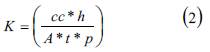
Where cc permeated water in (cubic centimeter)
h specimen height (centimeter)
A specimen area surface (square centimeter)
t time to permeate (seconds)
p hydrostatic pressure of water column (centimeter)
This test was performed 28 days after casting
2.3 Uniaxial compressive strength
The uniaxial compressive strength was measured 28 days after casting with a uniaxial compressive test machine. To estimate the strength of the concrete in situ, ASTM C31 formulates the procedures for field curing tests. The cylindrical specimens are subjected to an assay in accordance with ASTM C39, "Standard method of compressive strength test of cylindrical specimens of concrete" [10] and ASTM C109, "Standard Test Method for Compressive Strength of Hydraulic Cement Mortar (Using 2-in. Or [50-mm] Cube Specimens" [11].
3. TEST SPECIMENS
The test specimens consist of 27 specimens for each concrete and mortars. Each, the concrete and mortar mixtures, can be divided into three groups with w/c-ratios 0.45, 0.5, 0.55. Because of workability problems during casting, slight adjustments of the w/c ratio had to be made, which resulted in w/c-ratios of 0.5, 0.54, 0.59, 0.64 for concrete mixtures and 0.47, 0.5, 0.55 for mortar mixtures.
These groups can be divided into subgroups which each consist of 3 different mixtures with fly ash contents of 0%, 5% and 10%, but constant amount of sand as well as coarse aggregates [12]. The exact amount of the mixture components can be looked up at table 2 and 3.
| Sample | Ash (%) | Water/Cement |
|---|---|---|
| Sample 1.1 | 0 | 0.50 |
| Sample 1.2 | 5 | 0.50 |
| Sample 1.3 | 10 | 0.50 |
| Sample 2.1 | 0 | 0.50 |
| Sample 2.2 | 5 | 0.50 |
| Sample 2.3 | 10 | 0.50 |
| Sample 3.1 | 0 | 0.50 |
| Sample 3.2 | 5 | 0.50 |
| Sample 3.3 | 10 | 0.50 |
| Sample 4.1 | 0 | 0.55 |
| Sample 4.2 | 5 | 0.55 |
| Sample 4.3 | 10 | 0.55 |
| Sample 5.1 | 0 | 0.55 |
| Sample 5.2 | 5 | 0.55 |
| Sample 5.3 | 10 | 0.55 |
| Sample 6.1 | 0 | 0.55 |
| Sample 6.2 | 5 | 0.55 |
| Sample 6.3 | 10 | 0.55 |
| Sample 7.1 | 0 | 0.45 |
| Sample 7.2 | 5 | 0.45 |
| Sample 7.3 | 10 | 0.45 |
| Sample 8.1 | 0 | 0.45 |
| Sample 8.2 | 5 | 0.45 |
| Sample 8.3 | 10 | 0.45 |
| Sample 9.1 | 0 | 0.45 |
| Sample 9.2 | 5 | 0.45 |
| Sample 9.3 | 10 | 0.45 |
| Sample | Ash (%) | Water/Cement |
|---|---|---|
| Sample 10.1 | 0 | 0.50 |
| Sample 10.2 | 5 | 0.50 |
| Sample 10.3 | 10 | 0.50 |
| Sample 11.1 | 0 | 0.50 |
| Sample 11.2 | 5 | 0.50 |
| Sample 11.3 | 10 | 0.50 |
| Sample 12.1 | 0 | 0.50 |
| Sample 12.2 | 5 | 0.50 |
| Sample 12.3 | 10 | 0.50 |
| Sample 13.1 | 0 | 0.55 |
| Sample 13.2 | 5 | 0.55 |
| Sample 13.3 | 10 | 0.55 |
| Sample 14.1 | 0 | 0.55 |
| Sample 14.2 | 5 | 0.55 |
| Sample 14.3 | 10 | 0.55 |
| Sample 15.1 | 0 | 0.55 |
| Sample 15.2 | 5 | 0.55 |
| Sample 15.3 | 10 | 0.55 |
| Sample 16.1 | 0 | 0.45 |
| Sample 16.2 | 5 | 0.45 |
| Sample 16.3 | 10 | 0.45 |
| Sample 17.1 | 0 | 0.45 |
| Sample 17.2 | 5 | 0.45 |
| Sample 17.3 | 10 | 0.45 |
| Sample 18.1 | 0 | 0.45 |
| Sample 18.2 | 5 | 0.45 |
| Sample 18.3 | 10 | 0.45 |
3.1 PRODUCTION AND SAMPLE PREPARATION
For the compressive strength tests as well as the Rapid Chloride Permeability tests, samples with diameter of 10cm and height of 20cm were produced [13].
For the water permeability test, samples with diameter of 15cm and height of 30cm were produced, Fig.1. After casting, the samples were put into the curing room with a temperature of 23° and a relative humidity of 95% for 28 days [14].
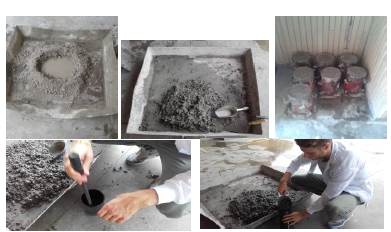
Fig. 1
Production of samples.
Source: authors
The samples for the Rapid Chloride Permeability Tests needed to be cut into 50-mm thick slices with top and bottom surface exposed concrete weft. The samples for the water permeability test needed to be cut to a maximum height of 160mm as well as the grinding the diameter in order to fit into the test mold, Fig 2. Also the sides of the specimens needed to be varnished using epoxy resin, so that the surfaces are waterproof and water cannot pass through (only axial direction).
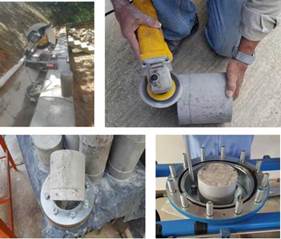
Fig. 2
Samples preparation.
Source: authors
4. RESULTS AND DISCUSSION
4.1 CLORIDE ION PENETRABILITY
The Fig. 3 shows the results obtained from Rapid Chloride Permeability Test for the concrete samples ((a) and (b)) resp. mortar samples ((c) and (d)) 14 days ((a) and (c)) resp. 28 days ((b) and (d)) after casting.
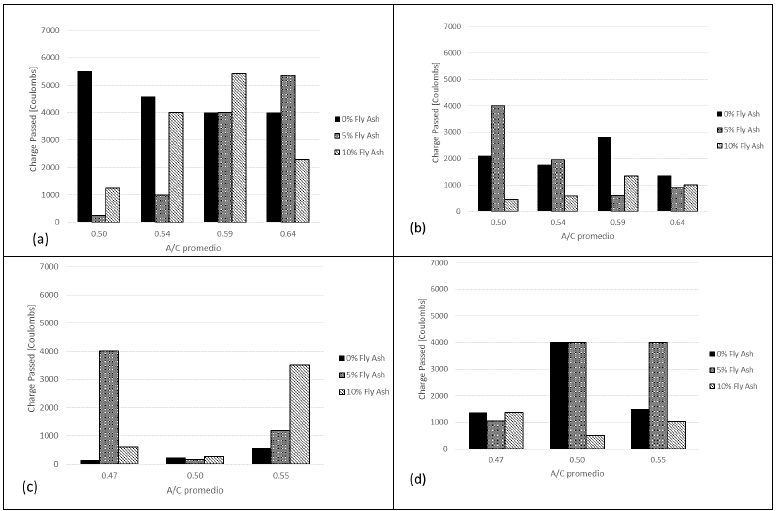
Fig. 3
(a) Charge Passed 14 days after casting for concrete samples (b) Charge Passed 28 days after casting for concrete samples (c) Charge Passed 14 days after casting for mortar samples (d) Charge Passed 28 days after casting for mortar samples
Source: authors
Whereas for concrete samples, the chloride diffusion coefficient results obtained from the RCPT show a reasonable decrease with hydration age, for mortar mixtures there is no obvious correlation visible.
Generally, the permeability against Chloride Ion ingress increases with the increase of water cement ratio for both, mortar and concrete samples 28 days after casting, although after exceeding a certain w/c ratio it seems to be decreasing again.
The replacement of cement with fly ash (5% respectively 10%) generally decreases the Chloride Ion Penetrability although the obtained results did not show clear tendencies.
4.2 WATER PERMEABILITY
The Fig. 4 shows the Darcy coefficient 28 days after casting for concrete samples (a) resptively mortar samples (b).
![(a) Darcy coefficient [cm/sec] 28 days after casting for concrete samples (b) Darcy coefficient [cm/sec] 28 days after casting for mortar samples.](../2145-4086-lamp-18-21-gf4.gif)
Fig. 4
(a) Darcy coefficient [cm/sec] 28 days after casting for concrete samples (b) Darcy coefficient [cm/sec] 28 days after casting for mortar samples.
Source: authors
The Darcy coefficient for the concrete samples 28 days after casting increases with increasing w/c ratio as one would expect. For the mortar mixtures, again there is no clear tendency visible. The addition of fly ash (5% respectively 10%) changes the water permeability but again no clear correlation can be seen.
The Fig. 5 shows the compressive strength 28 days after casting for concrete samples (a) resptively mortar samples (b). For mortars and concretes mixtures without addition of fly ash, the compressive strength 28 days after casting decreases with increasing w/c ratio. For the tested concrete specimens, the compressive strength for specimens with 10% fly ash replacement is on average 2,5 % higher (COV=99%) than the equivalent (same w/c ratio) specimen with 5% fly ash replacement. On the other hand, the mortar specimens show a significant higher (0=35% with COV=100%) compressive strength for 5% fly ash replacement then for 10% fly ash replacement with an equivalent w/c ratio.
![(a) Compressive strength [MPa] 28 days after casting for concrete samples (b) Compressive strength [MPa] 28 days after casting for mortar samples.](../2145-4086-lamp-18-21-gf5.gif)
Fig. 5
(a) Compressive strength [MPa] 28 days after casting for concrete samples (b) Compressive strength [MPa] 28 days after casting for mortar samples.
Source: authors
The results also confirm that the replacement of cement with fly ash has a negative effect on the compressive strength. The Fig. 6 shows the general fracture pattern of the tested samples.
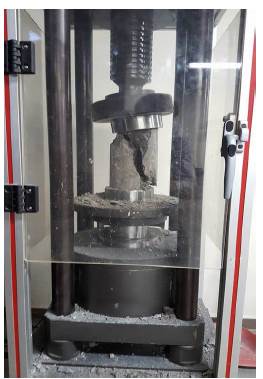
Fig. 6
General fracture pattern of the samples
Source: authors
5. FUTURE WORKS
It is considered important the continuity of the research using other percentages of ash and w/c ratios, as well as the evaluation at ages over 28 days.
6. CONCLUSIONS
The results of the Rapid Chloride Permeability Test (RCPT) showed no clear correlation between fly ash content, w/c-ratio and Chloride Ion Penetrability. However, the chloride diffusion coefficient for both the concrete and mortar samples 28 days after casting tends to increase with increasing w/c-ratio and decreases with hydration age [15].
The results of the Water Permability Test showed an increase of the Darcy coefficient for the concrete samples 28 days after casting with increasing w/c ratio. For the mortar mixtures again there is no clear correlation visible. The addition of fly ash (5% respectively 10%) changes the water permeability but again no clear correlation can be seen.
The uniaxial compressive strength test showed a decrease of compressive strength with increasing w/c-ratio for the reference samples without addition of fly ash 28 days after casting. For the tested concrete specimens, the compressive strength for specimens with 10% fly ash replacement is on average 2,5 % higher (COV=99%) than the equivalent (same w/c ratio) specimen with 5% fly ash replacement. On the other hand, the mortar specimens show a significant higher (0=35% with COV=100%) compressive strength for 5% fly ash replacement then for 10% fly ash replacement with the same w/c-ratio. The results also confirm that the replacement of cement with fly ash has a negative effect on the compressive strength.
7. ACKNOWLEDGEMENTS
This work was financially supported by the direction of research (DTI) at the Universidad Pontificia Bolivariana Bucaramanga. This support is gratefully acknowledged. Also gratefully acknowledged is the support of this work by the assistant MSc. Imhof Anick as well as the whole crew of the materials resistance lab.
BIBLIOGRAPHY
[1] J. Bijen, "Benefits of slag and fly ash," Constr. Build. Mater., vol. 10, no. 5 SPEC. ISS., pp. 309-314, 1996. http://dx.doi.org/10.1016/0950-0618(95)00014-3
[2] S. Antiohos, K. Maganari, and S. Tsimas, "Evaluation of blends of high and low calcium fly ashes for use as supplementary cementing materials," Cem. Concr. Compos., vol. 27, no. 3, pp. 349-356, 2005. http://dx.doi.org/10.1016/j.cemconcomp.2004.05.001
[3] S. Ahmad, "Reinforcement corrosion in concrete structures, its monitoring and service life prediction -A review," Cem. Concr. Compos., vol. 25, no. 4-5 SPEC, pp. 459-471, 2003. http://dx.doi.org/10.1016/50958-9465(02)00086-0
[4] T. R. Naik, "Chloride Ion Penetration Test, Carbonation Depth test and Salt Scaling Test," Rilem, no. August, pp. 1-9, 2004. https://www4.uwm.edu/cbu/Papers/2004%20CBU%2 0Reports/REP-566.pdf
[5] M. D. A. Thomas, "Optimizing the Use of Fly Ash in Concrete," Portl. Cem. Assoc., p. 24, 2007. http://dx.doi.org/10.1016/0950-0618(95)00014-3
[6] C.-C. Yang, Y.-S. Yang, and R. Huang, "The effect of aggregate volume ratio on the elastic modulus and compressive strength of lightweight concrete," Journal of MarineScience and Technology. 1997. http://jmst.ntou.edu.tw/marine/5/31-38.pdf
[7] Dhir, R.K. and Hewlett, P.C. Concrete Durability and Repair Technology. Proceedings of The International Seminar Held at The University of Dundee, Scotland, United Kingdom. https://books.google.com.co/books?hl=es&lr=&id=JueMm00Odn0C&oi=fnd&pg=PR1&dq=Dhir,+R.K.+and+Hewlett,+P.C.+Concrete+Durability+and+Repair+Te chnology.+Proceedings+of+The+International+Seminar+Held+at+The+University+of+Dundee,+Scotland, +United+Kingdom.&ots=ICr4HS70Jj&sig=Kbz-y5EcbFIwh3mLbV8tPwtsutI#v=onepage&q&f=false
[8] K. S. Chia and M. H. Zhang, "Water permeability and chloride penetrability of high-strength lightweight aggregate concrete," Cem. Concr. Res., vol. 32, no. 4, pp. 639-645, 2002. http://dx.doi.org/10.1016/S0008-8846(01)00738-4
[9] Controls Group. Water permeability apparatus. http://www.controls-group.com/eng/concrete-testing-equipment/water-permeability-apparatus.php
[10] C. C. T. Speci-, T. D. Cores, C. C. T. Speci-, B. Statements, and C. Testing, "Standard Test Method for Compressive Strength of Cylindrical Concrete Specimens ASTM C39M-37," vol. 4, no. March, pp. 1-5, 2001. http://dx.doi.org/10.1520/C0039_C0039M-17B
[11] E. C. Nacional, R. Calzada, and A. Azul, "Norma técnica guatemalteca ASTM C-109," no. 502, 2013. https://conred.gob.gt/site/normas/NRD3/1_CEMENT O/2_NORMA_NTG_41003h4_ASTM_c109-c109m-11_b.pdf
[12] R. Siddique, "Effect of fine aggregate replacement with Class F fly ash on the abrasion resistance of concrete. Cement and Concrete Research," Cem. Concr. Res., vol. 33, no. 11, pp. 1877-1881, 2003. https://doi.org/10.1016/S0008-8846(02)01000-1
[13] E. A. Kaur, "Strength and Duriabilty Properties of Concrete with Partial Replacement of Cement with Metakaolin and Marble Dust," vol. 4, no. 7, pp. 1032-1035, 2015. http://www.kresttechnology.com/krest-academic-projects/krest-mtechprojects/Civil/Civil%20M.tech%20Projects%202017%20-2018/2.%20Concrete%20Projects/BASE%20PAPER S/26.%20Strength%20and%20durability%20study% 20of%20metakaoline.pdf
[14] B. S. Mohammed, K. M. A. Hossain, and W. L. Foo, "Rapid Chloride Permeability Test on Lightweight Concrete Made with Oil Palm Clinker," vol. 1, no. 4, pp. 1863-1870, 1870. https://pdfs.semanticscholar.org/4cac/7e57f25b86722d0898a179c90e8450fd7e6a.pdf
[15] and S. J. K. Y. Y. Kim, K. M. Lee, J.W. Bang, "Effect of W/C ratio on durability and porosity in cementmortar with constant cement amount," Adv. inMaterials Sci. Eng., vol. 2014, 2014. http://dx.doi.org/10.1155/2014/273460.
Notes