Artigo
READING SKILLS AND TEXT COMPREHENSION COMPETENCES OF SCHOLARSHIP STUDENTS FROM INDIGENOUS AMAZONIAN COMMUNITIES: AN EYE TRACKING CASE STUDY
HABILIDADES DE LEITURA E COMPETÊNCIAS DE COMPREENSÃO DE TEXTO DE ESTUDANTES BOLSISTAS ORIUNDOS DE COMUNIDADES DA AMAZÔNIA: ESTUDO DE CASO COM A UTILIZAÇÃO DE EYE TRACKER
HABILIDADES DE LECTURA Y COMPETENCIAS DE COMPRENSIÓN DE TEXTO DE ESTUDIANTES CON BECAS DE LAS COMUNIDADES AMAZONICAS: ESTUDIO DE CASO CON LA UTILIZACIÓN DE EYE TRACKER
 Gabriel LEVRINI
READING SKILLS AND TEXT COMPREHENSION COMPETENCES OF SCHOLARSHIP STUDENTS FROM INDIGENOUS AMAZONIAN COMMUNITIES: AN EYE TRACKING CASE STUDY
Revista Ibero-Americana de Estudos em Educação, vol. 15, no. 3, pp. 1094-1114, 2020
Universidade Estadual Paulista Júlio de Mesquita Filho
Received: 11 June 2019
Revised document received: 20 August 2019
Accepted: 02 February 2020
ABSTRACT: The objective of this research is to analyze the reading skills of scholars with eye tracking device from native Amazonian communities contemplated with universities scholarships from the Government of Peru using biometric, linguistic and psychological techniques. Two group of escolar were selected as experiment sample: the first group 48 selected scholarship students from five different Peruvian Amazon public and private universities; and the second group, used as control, contained 46 scholarship student from three different universities based in metropolitan Lima. Literature research explore educational potential in relation to the individual characteristic of reading comprehension skills, which, by definition, is related to learning from text reading.The main research conclusions are: a) on average, scholarship beneficiaries from indigenous communities have a greater fixation duration than recipients from Lima based students’ in all the Areas of Interest; b) on average, grantees from Amazon communities had more fixation points in all the areas of interest, which could mean greater difficulty understanding the texts, in some AOI, significant differences were found between the groups; c) grantees from Amazon communities had greater fixation duration and more fixation points, which indicates longer reading time and potential problems in reading comprehension; d) Scholars also showed more difficulty to understanding texts. Nevertheless their proved that their major effort in the reading process also represents a major greater success for them as scholarship members.
KEYWORDS: Reading, Amazon native scholarship students, Eye-tracking.
RESUMO: O objetivo desta pesquisa é analisar as habilidades de leitura de escolares com dispositivo de rastreamento ocular de comunidades nativas da Amazônia contempladas com bolsas de estudo de universidades do Governo do Peru, utilizando técnicas biométricas, linguísticas e psicológicas. Dois grupos de escolares foram selecionados como amostra experimental: o primeiro grupo selecionou 48 estudantes bolsistas de cinco diferentes universidades públicas e privadas da Amazônia peruana; e o segundo grupo, usado como controle, continha 46 bolsistas de três universidades diferentes localizadas na região metropolitana de Lima. A pesquisa em literatura explora o potencial educativo em relação à característica individual das habilidades de compreensão de leitura, que, por definição, está relacionada ao aprendizado a partir da leitura de textos. As principais conclusões da pesquisa são: a) em média, os beneficiários de bolsas de estudos de comunidades indígenas têm uma duração de fixação maior do que os beneficiários de estudantes sediados em Lima em todas as áreas de interesse; b) em média, os beneficiados das comunidades amazônicas possuíam mais pontos de fixação em todas as áreas de interesse, o que poderia significar maior dificuldade de compreensão dos textos; em algumas das AOI, diferenças significativas foram encontradas entre os grupos; c) os bolsistas das comunidades amazônicas tiveram maior tempo de fixação e mais pontos de fixação, o que indica maior tempo de leitura e potenciais problemas de compreensão de leitura; d) Os acadêmicos também mostraram mais dificuldade em compreender textos. No entanto, provaram que seu maior esforço no processo de leitura também representa um grande sucesso maior para eles como membros da bolsa de estudos.
PALAVRAS-CHAVE: Leitura, Estudantes com bolsa de estudos da Amazônia, Eye-tracking.
RESUMEN: El objetivo de esta investigación es analizar las habilidades de lectura de los académicos con dispositivos de seguimiento ocular de comunidades amazónicas nativas contempladas con becas universitarias del Gobierno del Perú utilizando técnicas biométricas, lingüísticas y psicológicas. Se seleccionaron dos grupos de escolares como muestra experimental: el primer grupo seleccionó a 48 becarios de cinco universidades públicas y privadas de la Amazonía peruana diferentes; y el segundo grupo, utilizado como control, contenía 46 becarios de tres universidades diferentes ubicadas en Lima metropolitana. La investigación literaria explora el potencial educativo en relación con las características individuales de las habilidades de comprensión de lectura, que, por definición, se relaciona con el aprendizaje de la lectura de textos. Las principales conclusiones de la investigación son: a) en promedio, los beneficiarios de becas de las comunidades indígenas tienen una mayor duración de la fijación que los beneficiarios de estudiantes con base en Lima en todas las Áreas de interés; b) en promedio, los beneficiarios de las comunidades amazónicas tenían más puntos de fijación en todas las áreas de interés, lo que podría significar una mayor dificultad para comprender los textos; en algunos AOI, se encontraron diferencias significativas entre los grupos; c) los beneficiarios de las comunidades amazónicas tuvieron una mayor duración de la fijación y más puntos de fijación, lo que indica un mayor tiempo de lectura y posibles problemas en la comprensión de la lectura; d) Los académicos también mostraron más dificultad para entender los textos. Sin embargo, demostraron que su mayor esfuerzo en el proceso de lectura también representa un mayor éxito para ellos como becarios.
PALABRAS CLAVE: Lectura, Estudiantes becarios de la Amazonia, Eye-tracking.
Introduction
According to the Peruvian National Institute of Statistics and Informatics (INEI), the 2017 census showed that the indigenous population in Peruvian Amazonia amounts to 332.000 individuals, of which 52.2% are men and 47.8%, are women. By age groups, 47.5% are under 15 years old, 50.6% are between 15 and 64 years old and 1.9% are over 64 years of age. These Amazonian communities represent 43 ethnics groups and 13 linguistic families. The cultural preservation and development of these ethnic groups is a social inclusion priority for the Peruvian government, especially in terms of health and education.
The Economic and Business Development Institute (IEDEP), which administers the Peruvian Human Development Index (HDI)) has noted that Peru’s HDI is currently ranked 84th (out of 187 countries) with a country averaged of 0.734 (below the index average of 0.744). By region, the Amazonian HDI index averaged 0.4846 with an average annual income of US$435.7. By contrast, the capital Lima has the highest HDI index in the country, 0.788 with an annual average income per year of US$ 1017.8. The IDH index reflects status, expenditures and performance in health, education and income (IEDEP, 2017).
Specialized neuroscience devices, such as eye trackers, allows measurement of reading comprehension skills, this by definition, is also related to learning by text reading, in terms of the register called fixes (or gaze stabilization points) that an individual performs when observing a content shown on a screen. Subsequently, series of metrics are calculated from the fixes, generated for a given area of the screen (known as the Area of Interest, AOI). The AOIs are the parts of the screen through which the visual attention of users (the overall time they spend looking at a certain area, or number of times they consult it). In this study, since we aim to evaluate reading performance and text comprehension, we create AOIs associated with screen areas of standardized content. Several authors (VAN; SCHEITER, 2010; KOSKI; OLSON; NEWCOMBE, 2013) have explored, relevant information intended for transmission through the texts shown on the computer screen.
The objective of this research is to analyze the reading skills and text comprehension of Peruvian Amazonian college students in comparison with Lima based college students by way of biometric, linguistic and psychological techniques and a specialized eye-tracking device. For our sample, we drew on recipients of college scholarships awarded by The National Program for Scholarships and Education Credit (PRONABEC), a view to gaining in-depth understanding of differences due to individuals’ ethnicities. We hypothesized for our research, that both student- and text-related characteristic influence the reading process, that the reading process is correlated with text comprehension and that this is therefore a predictor of students’ performance. The results of our research could enable PRONABEC, to take corrective actions and strengthen its social inclusion and talent identification policies.
Literature review
The incorporation of eye tracking techniques can be an ideal complement to the use of classic data collection techniques, such as efficiency analysis through multimedia materials (HYONA, 2010). The main advantage of incorporating this additional source of information lies in its objective nature. Compared with questionnaires or surveys, which have a more subjective character, the eye-tracking technique, provides objective information that is, not consciously controlled by the subjects.
There is already an extensive eye tracking research literature covering different areas, such as brain disease studies, off-line and on-line advertising evaluation, and website user interfaces evaluation (POOLE; BALL, 2005). In the educational field, the number of studies is lower (MOLINA et al., 2014; MASON; TORNATORA; PLUCHINO, 2013), especially in the case of comparative studies of individuals from minority groups.
Eye movements have been studied for more than fifty years. Only in the last decade, that their measurement has led to important discoveries regarding the psychological processes that occur during reading tasks, such as visual search, and scene perception (LIVERSEDGE et al, 2006). These eyes movements serve to move the fovea, (the high-resolution part of the retina) encompassing 2 degrees at the center of the visual field, to an AOI, thus achieving better process detail. Eye movement (or saccade) vision is generally suppressed, while, new information is more common acquired during fixations (RAYNER, 1998).
Theoretical background
We identify several models (Figure 1) that explain the interface between vision and low-level aspects of language processing, in other words, models that specify some combination of the following components of reading: eye movement control, visual spatial attention, and visual processing of words.
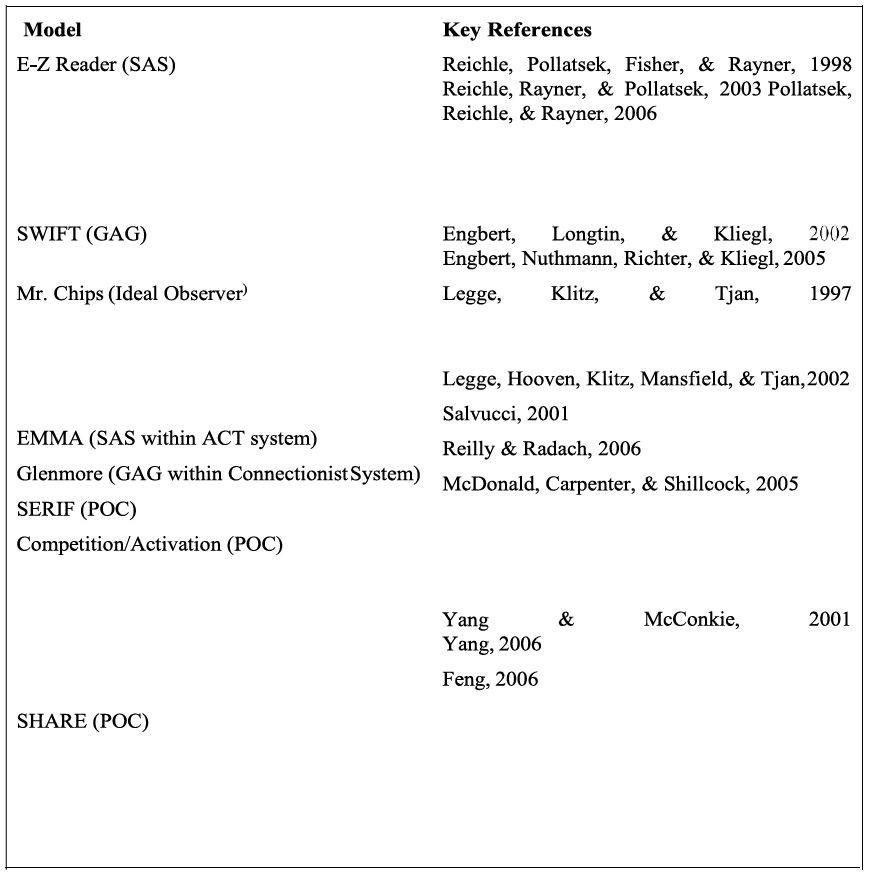
The E-Z Reader model (REICHLE et al, 1998) does a better job of accounting for a wide range of data than other models. The E-Z Reader, operates on the basic assumption that on-going cognitive (i.e., linguistic) processing influences eye movements during reading, basically, because its purpose was not developed for deeper understanding of the reading process (it does not consider other parallel effects of higher-level linguistic processing on eye movements). In authors’ opinion, the E-Z Reader model constitutes a simulation of what happens when reading process goes normally. Thus, the implication is that the model does not adequately cover or explain certain issues, such as for example, inter-word regressions.
In the E-Z Reader model, fixation locations are determined by a combination of visual, oculomotor, and linguistic factors. According to the model, five processes determine when and where the eyes move: I) lexical familiarity, II) the completion of lexical access, III) labile and IV) non-labile stages of saccadic programming, and V) dynamics of saccades (REICHLE, et al, 1998). In Figure 1, we summarize the major models that are predominant in literature:
In Table 1, it is possible to compare, eye movement characteristics during reading, scene perception, and visual search. It can be inferred, that the values presented are quite representative of the different tasks, although there is considerable variability in the range of average fixation durations, (fixation durations and saccade lengths). During the reading process, fixation duration is about 225-250 ms, and saccade size are generally being 8-9 character spaces (RAYNER, 1998).
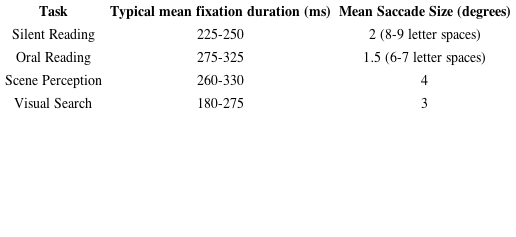
Source: Rayner (1998).
Eye movements: reading and skipping reading
While reading, the eyes follow certain specific patterns known as saccades and fixations. Eye movements are considered to be a reflection of the cognitive process (RAYNER, 1998). In general, the reader’s interest is revealed by a fixation. The retrieval of information in reading is done during the fixations; no information is obtained during a saccade (between two fixations) (RAYNER, 2009).
In reading, unlike other visual tasks, character spaces are used rather than visual angles. This is because it has been demonstrated (CASTELHANO; HENDERSON, 2007) that character spaces are the more appropriate unit of measurement than visual angle. Readers characteristic movement (which in the case of reading occurs about 10-15% of the time), is that readers move their eyes (regression) back to previously words in the text. The frequency of regressions usually depends on text difficulty (CASTELHANO; HENDERSON, 2007; MORRISON; RAYNER, 1981), vocabulary and working memory. In addition, saccade size and fixation duration are both modulated by text difficulty: as the text become more difficult, saccade size tends to decrease, fixation durations tend to increase, and regressions tend to increase. From these measurements, it is clear that general text properties influence eye movements significantly. In other words, the type of material being read, and the reader’s basic objective in reading (RAYNER, 2009) also influence global measures such as saccade size, fixation duration, and the number of regressions (ESKENAZI; FOLK, 2015; WILLIAMS; MORRIS, 2004).
An important issue to consider when measuring reading is how much information the reader is able to process and use during a single fixation (around 200-250 ms). This measure is referred to as the functional field of view (WILLIAMS; MORRIS, 2004), also influenced by several linguistic factors (Figure 2):
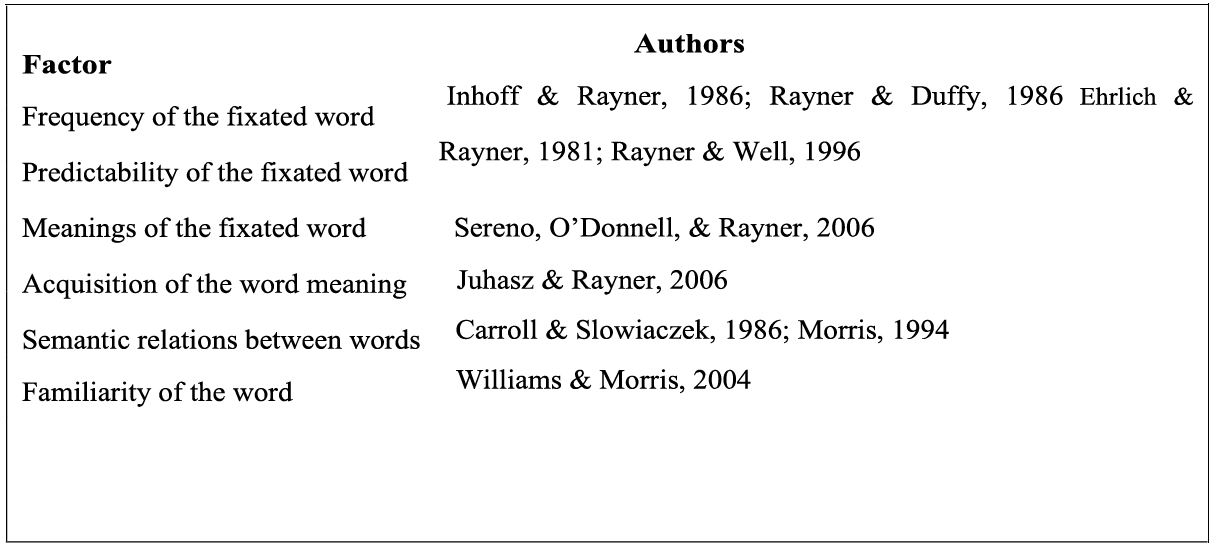
Figure 2
- Linguistic factors as time Influencers
Source: The authors, based on Castellano & Henderson (2007).
Adult readers skip approximately one third of the words in a text as they read (RAYNER, 1998; 2009). There are two different views about what drives the decision of when to move the eyes. The dominant view, is that it depends entirely on the ongoing word processing: the decision to move the eyes is made only when the processing of the currently fixated word has reached a certain point (REICHLE; RAYNER; POLLATSEK, 2003) and when a proportion of saccades are triggered autonomously after a certain period of ongoing text processing (ESKENAZI; FOLK, 2015).
Readers’ eyes often skip over words as they read. Skipping rates are largely determined by word length; short words are skipped more than long words. However, the predictability of a word in context, also has an impact on skipping rates. (REICHLE; DRIEGUE, 2015). To read efficiently, the eyes must remain fixated on words, just long enough for identification. However, words differ in terms of how easy they are to process, and therefore how long they need to be fixated during reading (RAYNER, 1998; 2009). Ending a fixation, requires programming a saccade to a new location which takes approximately 125-150 ms. Therefore, efficient reading process requires that readers learn to program eye movements to new locations in advance of the completion of ongoing word processing. Fail to do this, would result in the eyes remaining in locations longer than is optimal (RAYNER, 2009).
The issue of word skipping concerns the decision related to first-pass, forward, interword eye movements. Both, the E-Z Reader (REICHLE; DRIEGUE, 2015) and SWIFT (ENGBERT et al., 2005) models, predict that word skipping can occur based on incomplete lexical processing of the upcoming word, albeit for different reasons. In the case of the E-Z Reader, intended skips of an upcoming word (n+1) will be triggered when the initial stage of lexical processing (L1) of word n+1 is completed before the initial stage of oculomotor processing (M1) from word n is completed. However, with SWIFT, intended skips occur when the lexical activation of word n+2 (or beyond) is greater than the lexical activation of word n+1. Therefore, with the E-Z Reader, the important factor is how much lexical processing of the upcoming word has occurred, but for the SWIFT model, the important factor is the relative degree of lexical processing for the upcoming words. The word selected, depends on the length of the words and their distance from the current fixation position (POLLATSEK; REICHLE; RAYNER, 2006; LITZINGER, et al., 2007).
Text comprehension and mental models
Eye movements provide evidence on the relationship between students’ cognitive and linguistic characteristics like word decoding, vocabulary, comprehension skill, short-term memory, working memory, nonverbal intelligence (LEEW; SEGERS; VERHOEVEN, 2015) and text comprehension (VAN DEN BROEK et al., 2005; JUST; CARPENTER, 1980). The results show that differential effects of reader and text characteristics affect skipping probability, driven by decoding and nonverbal intelligence. A prerequisite for text comprehension is the construction of a coherent mental model (KINTSCH, 2004) with decoding influenced by regression probability and regression path duration showing that reading behavior is related to student´s skills and text comprehension measures. In sum, reading behavior tends to be related to both students’ skills and text comprehension measures. (BLANC et al., 2008).
Mental models
Resting and updating mental models occur, by creating links between the propositions with the aid of inferences generated either through information within the current mental model (memory-based inferences) or prior knowledge (elaborate inferences) (VAN DEN BROEK; RAPP; KENDEOU, 2005). Coherent mental models are constructed during reading, by means of constant updating of the current model (KINTSCH, 2004). In addition, readers’ skills and capabilities also influence mental model building. Greater vocabulary knowledge helps the reader to better understand the concepts within the text, which in turn increases the chance of memory-based inferences (CALVO et al., 2001) thus, as vocabulary is related to world knowledge, a wider vocabulary also increases the chance of making elaborate inferences and linking the text to prior knowledge (VAN DEN BROEK et al., 2005).
Text comprehension is highly related to the number of inferences generated during reading so, short-term and working memory are important predictors of reading comprehension (CAIN et al., 2001). Previous research has found that nonverbal intelligence and comprehension scores are correlated with developing readers to predict reading comprehension over and above language and memory skills (TIU; THOMPSON; LEWIS, 2003)
Reader’s characteristics
The literature has shown that student characteristics affect reading comprehension processes (RAYNER, 1985). Text-related effects may vary as a function of several student-related characteristics, such as word length and word frequency effects. Moreover, readers do not pay equal attention to all words (KINTSCH, 2004) and skilled developing readers spend more time on important text elements such as headings, abstracts, etc. (VAN; SCHEITER, 2010). Hence, the way readers allocate their attention depends on both, the word and its position within the sentence and paragraph. (CALVO et al., 2001).
Educational potential associated with to the individuals’ characteristic of reading and comprehension skills is related to learning through text (CROMLEY; SNYDER-HOGAN; LUCIW-DUBAS; 2010; MASON et al., 2015; LEEUW; SEGERS; VERHOEVEN, 2015). On this basis, we have formulated the following hypotheses:
H1 – Student related characteristic influence the reading process, within the two groups.
As we noted the average HDI for Amazonia is 0.4846, while the average annual income is US$435.7, below the national average in both cases. Historically, governments have overlooked the region, and it is only in recent decades that social inclusion has been prioritized and programs have been developed with the aim of changing that pattern. However, government educational strategies, especially in underdeveloped areas like Amazonia, are less effective due to sociodemographic variables.
H2 - Indigenous Amazonian students will have longer fixation time in comparison with Lima based students
The context causes the fixations to be interpreted in different ways. For example, while browsing a webpage, a higher rate of fixations on a specific area can show a greater interest in that area fixed. It can also be an indication that the area is in some way more complex. These interpretations can be different if the fixations occur during a search task, for instance; in this case, a higher rate of fixation can indicate greater uncertainty when trying to recognize an item (POOLE; BALL, 2005).
H3 - Indigenous Amazonian students will have longer fixation points reflecting difficulties in text comprehension or lack of text meaning for the reader
The difficulty of a word is expressed in the duration of the fixations. When a reader encounters a word that is unfamiliar, he or she will fixate the word longer. Conversely, if the word has a high frequency or if it is familiar, the fixation on the word will be shorter. Nevertheless, the reader may encounter a word or a syntax that is problematic for him or her. When this happens, the number of fixations around this word and the duration of the fixations increase, while the reader tries to understand it (HYRSKYKARI et al., 2000). We predict that word decoding efficiency will have strong effects on eye movements for indigenous Amazonian students, as word decoding is highly related to the speed of reading (and eye movement durations). With respect to word position effects, we expected readers with greater skills to spend more time on text integration and more salient text regions (i.e., heading and first sentence of a paragraph). Furthermore, we expect working memory to predict regression behavior, and reading comprehension outcomes because a short memory span limits the amount of information available for maintaining coherence (e.g., by generating inferences).
Material and methods
Apparatus
To record the students’ eye movements, we used a Tobii X2-30 device, manufactured by Tobii Technology and using Tobii pro3.4.8 software (TOBII, 2014). This device works at a sampling frequency of 30 Hz and has a spatial resolution of less than 0.5º. We attached the eye tracker to a 24-inch TFT computer monitor with a maximum resolution of 1920 x 1200 pixels. The system allows ample head movements, providing an environment free of distractions to ensure natural behavior, and, therefore, valid results. High-accuracy and -precision tracking technology ensures that the results of the research are reliable (TOBII, 2014). The text margins were 200 pixels (px) from all sides of the screen. The font was Arial, 20 px, and line height 3 in roman style. Headings were presented in a similar font, but the headings were printed in bold, with 30 px, line height 2, and subheadings in 20 px, line height 2. Several studies (KOSKI; OLSON; NEWCOMBE, 2013; LAGUN et al., 2014; MASON et al., 2013; MOLINA et al., 2014) have used the same device and similar software with a greater or lesser presence of multimedia elements.
Student-related characteristics
Decoding efficiency: We measured decoding efficiency using a word-reading task (JONGEN; KROM, 2009). In this task, we presented students with 120 words ‘card, divided over four columns, and instructed them to read aloud as many words as possible within one minute. We awarded the students one point for every correctly read word. The internal consistency of the test was rated as good (α = .85) (EGBERINK; JANSSEN; VERMEULEN, 2014).
Vocabulary knowledge: We tested vocabulary knowledge using standardized passive vocabulary knowledge test (Vocabulary for Reading adapted from Verhoeven; Vermeer, 1999). This test consists of 30 multiple-choice items in which each word was presented within a short context. We asked students for the meaning of the underlined word from the different options presented, which included a synonym of the target word.
Memory: We utilized a memory task based on the Wechsler Intelligence Scale (KORT, et al., 2005) in which we read aloud a string of digits using a falling intonation and pausing for one second between the digits. In response, the students were instructed to remember the digits in the same order as they were presented. At the end, we administered a sentence repetition task to measures the memory of syntactical information (VERHOEVEN, et al., 2013).
Comprehension skills: We measured comprehension skills using a standardized test (FEENSTRA, 2008) consisting of five texts and 25 multiple-choice questions. The texts were both narrative and expository and included a mixture of text-based and inference-based questions.
Nonverbal intelligence: To assess nonverbal intelligence, we used the Standard Progressive Matrices (SPM) (RAVEN, 1981). This is a multiple-choice test, with 60 items that increase in difficulty, with exercises such as identifying the missing element to completes a pattern shown in a specific figure.
Experiment design
Pre-test: Individually, 120 students from colleges in metropolitan Lima and Amazonia took a pre-test consisting of a series of open-ended questions, which was intended to determine their prior knowledge of the content to be distributed later on in the process. As was expected, given the nature of the sociological content, no student proved to be knowledgeable about the content.
We applied Raven´s IQ test, and although the average mean (127.5) was 5.1 points lower for Amazon students when compared with Lima-based students, (SD=14, and a range from 100-140), the total test points were according to expectations for sample usage. |Then, we selected two groups containing individuals of both sexes aged between 17 and 20. The first group was made up of, 48 indigenous Amazonian Peruvians from five different public colleges; while the second group had 46 scholars from three different public colleges in metropolitan Lima. The experiment took place from June to November 2018 at the selected colleges.
Next, we asked student to sit in front of the monitor in order to perform the eye tracker calibration. The screen showed a 250-word sociological text entitled “Philosophical thinking and happiness since its beginnings in Greece” for 15 minutes, while the eye tracker recorded the fixations made by the students during the activity.
We asked students to answered two questions about the text content, each one with ten possible multiple-choice answers. Finally, once they completed the test, the students had to complete another questionnaire intended to measure the extent to which they had assimilated the content. The total time required for each student to complete all the phases was approximately 25 minutes.
We used Student's t-tests to compare the two samples of students. We used a Kolmogorov–Smirnov two-sample test to evaluate the two groups’ normal distribution. Even though payoffs in the two roles are slightly different, we did not find any significant difference between the two groups (indigenous Amazonian eye-tracking group vs. Lima based eye-tracking group”) (D=0.112, p=.97).
We performed the same analysis to test possible differences in response times, but again, we found no difference between the two groups (D=0.147, p=.36).
Results
The results of the student’s characteristics test are shown in Table 2 above. As we expected, significant differences between groups were found in vocabulary, reading comprehension and nonverbal intelligence, but to our surprise, the results for average differences in text comprehension between groups were not significant. The results are probably related to the individual efforts made by Amazonian students to obtain good scores considering that eligibility for PRONABEC scholarships requires good grades.
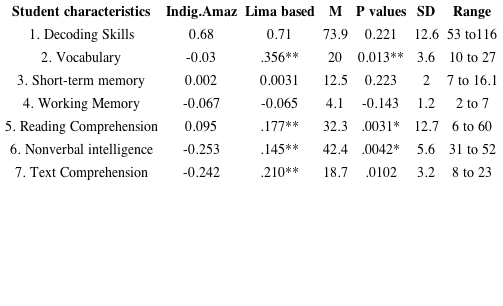
* p>0.010 ** p>0.005 Source: the authors (2019).
Areas of interest (AOI)
For AOI, we selected text sentence as the unit analysis, and divided it into nine areas of interest (Figure 3). We excluded participants for whom the eye tracker was poorly calibrated (three from the target and nine from control group).
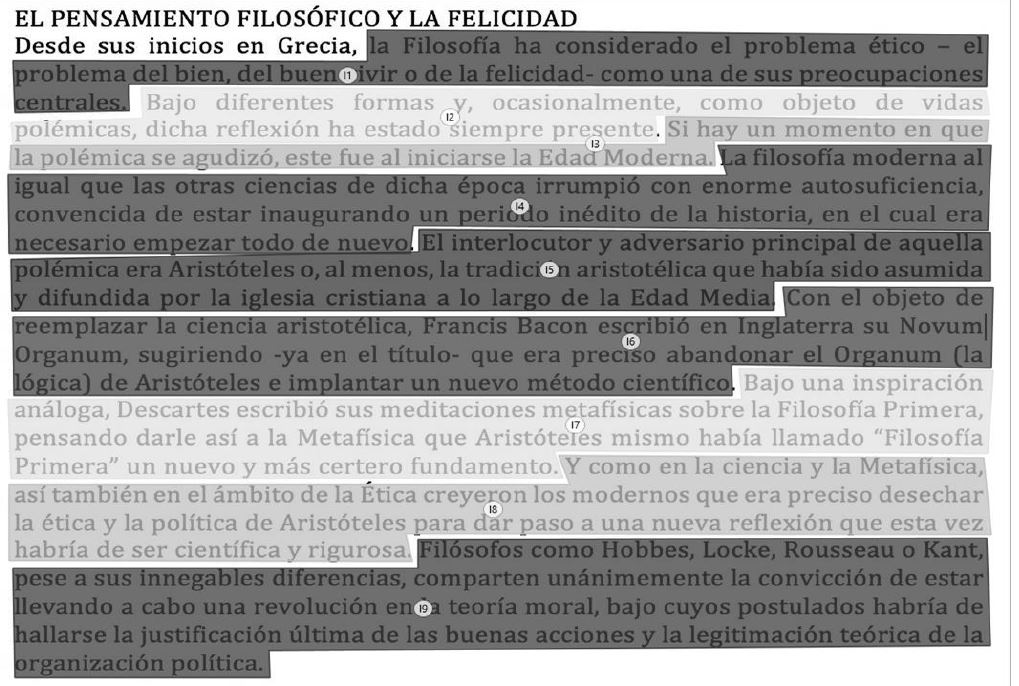
Figure 3
- Experiment text and defined AOIs
Source: Text from Aristotelian Ethics adapted by the Authors (2018).
The text had the characteristics set out in in Table 3 below:
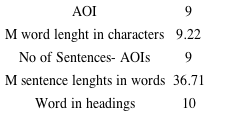
Source: The Authors (2019).
An overview of the fixations results and average fixation time is provided in Table 4 and Table 5:
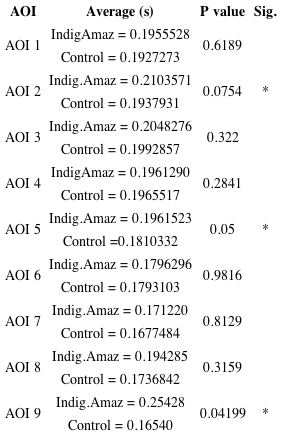
* p>0.010 ** p>0.005 Source: The Authors (2019).
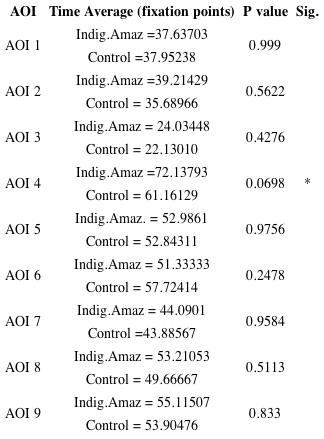
* p>0.010 ** p>0.005 Source: The Authors (2019).
Text comprehension
At the end of the session, all students answered two questions regarding the text content each one with ten possible multiple-choice answers. The results are as follows (Table 6):
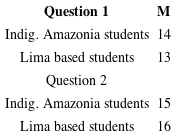
Source: The Authors (2019).
We performed a Biserial correlation test in order to show the correlations between fixation points and the two questions answered by the students after the application of the screen test. This test is widely used in experiments determine the correlation between two variables; in our case, that measured using the interval scale (AOI) and a dichotomous variable (time) (Figure 4).
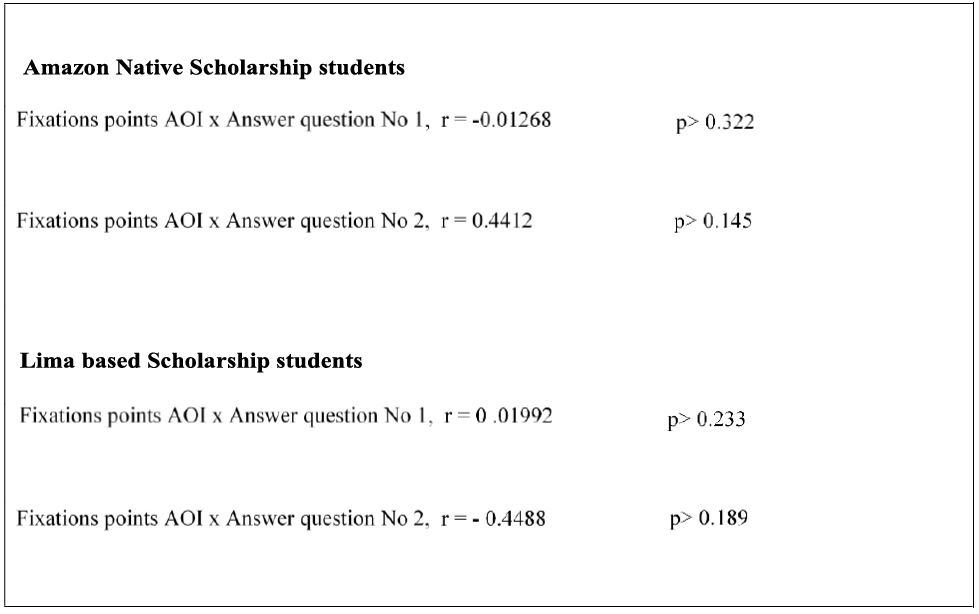
Figure 4
- Biserial Correlations
Source: The Authors (2019).
The biserial correlation results show close correlation as values are close to 0, although these are not significant since the p value is higher than 0.10.
Conclusions
Our objective in this study was to analyze the reading skills of students from indigenous Amazonian communities, who had been granted PRONABEC scholarships using biometric, linguistic and psychological techniques, in order to enable corrective actions and strengthen educational inclusion and talent identification policies.
It is quite clearly from the literature that saccade size and fixation duration are both modulated by text difficulty, how much information the reader is able to process, and by its use during a single fixation. Moreover, it is also well established that the difficulty of a word is expressed by the time duration of the fixations, when a reader encounters a word that is unfamiliar. Our research is supported by literature on academic potential, in relation to the individual’s characteristic of reading comprehension skills which, by definition, is related to learning by way of text reading. From our results, we find that:
-
H1 is partially proven, as differences between groups were only find in vocabulary, reading comprehension and nonverbal intelligence, but to our surprise, the results for average differences in text comprehension between groups were not significant,
-
H2 is proven only partially, as only AOI 4 was significant (at p < .10).
-
H3 is again partially proven, as only AOI 2, 5 and 9 were statistically significant (at p < .10). According to Hyrskykari, et al, (2000), the number of fixations around this word and the duration of fixations increase, when the reader tries to understand the text.
From this research, the main conclusions can be summarized as follows:
-
On average, grantees from Amazonian communities have longer fixation duration and more fixation points across all AOI, than students from Lima based students, which could mean longer reading time and potential problems in reading comprehension, and greater difficulty in understanding the text.
-
Grantees from Amazon communities have a moderate positive correlation, which means that the higher number of fixations, the better the response was. Nevertheless, an explanation for the results could be that their greater effort in the reading process also represents greater success for them as scholarship recipients.
-
We confirmed with this study the contribution of psychological techniques for the study of different individual responses in reading.
Contribution and practical implications
This empirical evaluation entailed a comparison of students of different ethnic origins through measurement of their learning characteristics and capabilities. The results are of major empirically verified importance, and could be of use in adapting Peru’s public educational policies with a view to attaining objective educational quality objective results. In addition, the results are useful in terms of the utilization, efficiency and application of public resources for the benefit of society. Finally, the academic contribution and benefits include the following:
-
Eye-tracking technology has the potential for use an educational technology. This study suggests that it can be used to model one of the most common learning activities in the school context reading.
-
The potential benefit of an eye-movement modelling example seems to extend to deeper learning from text comprehension and learning capabilities.
REFERENCES
BLANC, N.; KENDEOU, P.; VAN DEN BROEK, P. W.; BROUILLET, D. Updating situation models during reading of news reports: evidence from empirical data and simulations. Discourse Processes, v. 45, n. 2, p. 103-121, 2008. DOI: 10.1080/01638530701792784
CAIN, K.; OAKHILL, J.; BARNES, M. A.; BRYANT, P. E. Comprehension skill, inference-making ability, and their relation to knowledge. Memory & Cognition, v. 29, n. 6, p. 850-859, 2001. DOI: 10.3758/BF03196414
CALVO, M. G.; MESENGUER, E.; CARREIRAS, M. Inferences about predictable events: eye movements during reading. The Spanish Journal of Psychology, v. 5, n. 1, p. 66-77, jun. 2001. DOI: 10.1017/S1138741600005849
CASTELHANO, M. S.; HENDERSON, J. M. Initial scene representations facilitate eye movement guidance in visual search. Journal of Experimental Psychology: Human Perception and Performance, v. 33, n. 4, p. 753-763, 2007. DOI: 10.1037/0096-1523.33.4.753
CROMLEY, J.G.; SNYDER-HOGAN, L. E.; LUCIW-DUBAS, U. A. Reading comprehension of scientific text: a domain-specific test of the direct and inferential mediation model of reading comprehension. Journal of Educational Psychology, v. 102, n. 3, 687–700, 2010. DOI: 10.1037/a0019452.
ESKENAZI, M. A.; FOLK, J. R. Reading skill and word skipping: Implications for visual and linguistic accounts of word skipping. Journal of Experimental Psychology: Learning, Memory, and Cognition, v. 41, n. 6, p. 1923-1928, 2015. DOI: 10.1037/xlm0000156
ENGBERT, R.; NUTHMANN, A; RICHTER E.M.; KLIEGL, R. Swift: a dynamical model of saccade generation during reading. Psychol. Review, v. 112, n. 4, p. 777-813, out. 2005. DOI: 10.1037/0033-295X.112.4.777
FEENSTRA, H. Begrijpend lezen groep 6 [Reading Comprehension Grade 4]. Arnhem, the Netherlands: Cito, 2008.
HYRSKYKARI, A.; MARAJANTA, P.; AALTONEN, A.; KARI-JOUKO RAIHA Design issues of idict: a gaze-assisted translation aid. Proceedings of the 2000 Symposium on Eye Tracking Research & Applications, p. 9-14, 2000.
HYONA, J. The use of eye movements in the study of multimedia learning. Learning and Instruction, v. 20, n. 2, p. 172-176, 2010. DOI: 10.1016/ j.learninstruc.2009.02.013
IEDEP. Instituto de Economia y Desarollo Empresarial. Relatoria del Indice IDH para las provincias peruanas. Lima, Perú, 2017.
INEI. Instituto Nacional de Estadística e Informatica. Census Peru 2016. Lima, Perú, 2017.
JONGEN, I.; KROM, R. DMT en AVI: AVI Handleiding [DMT and AVI: AVI manual] Arnhem, the Netherlands: Cito, 2009.
JUST, M. A.; CARPENTER, P. A. The psychology of reading and language comprehension. Newtown, MA: Allyn and Bacon, 1987.
KORT W.; SCHITTEKATTE, M.; DEKKER, P.H.; VERHAEGHE, P.; Compaan EL, Bosmans M, Vermeir G. Wechsler intelligence scale for children derde editie NL. Handleiding en verantwoording. In: Wechsler Intelligence Scale for children in Dutch. Manual and justification. 3. ed. London: Harcourt, 2005.
KAUFMAN, A. S.; KAUFMAN, N. L. KBIT: Kaufman intelligence test. Madrid: Pearson, 2011.
KINTSCH, W. The construction-integration model of text comprehension and its implications for instruction. In: RUDDELL, R. B.; UNRAU, N. J. (Eds.). Theoretical models and processes of reading. 5. ed. Newark, NJ: International Reading Association, 2004, p. 1270-1328.
KOSKI, J.; OLSON, I. R.; NEWCOMBE, N. S., Tracking the eyes to see what children remember. Memory, v. 21, v. 3, p. 396-407, 2013. DOI: 10.1080/09658211.2012.735241
LAGUN, D.; HSIEH, C.H.; WEBSTER, D.; NAVALPAKKAM, V. Towards better measurement of attention and satisfaction in mobile search. In: International ACM SIGIR Conference on Research & Development in Information Retrieval, 37., 2014, Queensland, Proceedings […]. Queensland: ACM Press, 2014, p. 113-122. DOI: 10.1145/2600428.2609631
LEEW, L.; SEGERS, E.; VERHOEVEN, L. Role of text and student characteristics in real-time reading processes across the primary grades. Journal of Research in Reading, v. 39, n. 4, p. 389-408, 2015. DOI: 10.1111/1467-9817.12054
LVERSEDGE, S.P.; RAYNER, K.; WHITE, S.J.; FINDLAY, J.M.; Mc SORLEY, E. Binocular coordination of the eyes during reading. Current Biology, v. 16, p. 1726-1729, 2006. DOI: 10.1016/j.cub.2006.07.051
LITZINGER, T. A.; LEE, S. H.; WISE, J. C.; Felder, R. M. A Psychometric Study of the Index of learning styles. Journal of Engineering Education, v. 6, n. 4, p. 309-319, 2007. DOI: 10.1002/j.2168-9830
MASON, L.; PLUCINO, P.; TORNATORA, M. C. Eye-movement modeling of text and picture integration during reading: effects on processing and learning. Contemporary Educational Psychology, v. 14, p. 172-187, 2013. DOI: 10.1007/11145-015-9552-5
MOLINA, A. I.; REDONDO, M. A.; LACAVE, C.; ORTEGA, M. Assessing the effectiveness of new devices for accessing learning materials: An empirical analysis based on eye tracking and learner subjective perception. Computers in Human Behavior, v. 31, p. 475-490, 2014. DOI: 10.1016/j.chb.2013.04.022
MORRISON, R. E.; Rayner, K., Saccade size in reading depends upon character spaces and not visual angle. Perception & Psychophysics, v. 30, p. 395-396, 1981. DOI: 10.3758/BF03206156
POLLATSEK A.; REICHLE, E.D.; RAYNER, K., Tests of the E-Z Reader model: Exploring the interface between cognition and eye movements. Cognitive Psychology, v. 1, p. 52-56, 2006. DOI: 10.1016/j.cogpsych.2005.06.001
POOLE, A.; BALL, L. Eye tracking in human-computer interaction and usability research: current status and future. In:Encyclopedia of Human Computer Interaction, 2005.
RAYNER, K. Eye movements in reading and information processing: 20 years of research. Psychological Bulletin, v. 124, p. 372-422, 1998. DOI: 0033-2909/98
RAYNER, K. Eye Movements in attention in reading scene perception and visual search. Quaterly Journal Exp. Psychol, v. 62, n. 8, p. 1457-506, 2009. DOI: 10.1080/17470210902816461
RAVEN, J. Manual for Raven's progressive matrices and vocabulary scales. Research supplement n. 1: The 1979 British standardisation of the standard progressive matrices and Mill Hill vocabulary scales, together with comparative data from earlier studies in the UK, US, Canada, Germany and Ireland. San Antonio, Texas: Harcourt Assessment, 1981.
REICHLE, E.; POLLATSECK, A.; FISCHER, D.; RAYNER, K. Toward a model of eye movement control in reading. Psychological Review, v. 105, p. 125-157, 1998. PMID: 9450374
REICHLE, E.D.; RAYNER, K.; POLLATSECK, A. The E-Z Reader model of eye-movement control in reading: Comparisons to other models. Behavioural and Brain Sciences, v. 26, p. 445-476, 2003. PMID: 15067951
REICHLE, E.; DRIEGHE, D. Using E-Z Reader to examine the consequences of fixation- location measurement error. Journal of Experimental Psychology: Learning, Memory, and Cognition, v. 41, p. 262-270, 2015. DOI: 10.1037/a0037090
TIU, R. D. Jr.; THOMPSON, L. A.; LEWIS, B. A. The role of IQ in a component model of reading. Journal of Learning Disabilities, v. 36, n. 5, p. 424-436, 2003. DOI: 10.1177/00222194030360050401
TOBII. Eye tracking. Available at: http://www.tobii.com/. Access: 25 jan. 2019.
WILLIAMS, R.S.; MORRIS, R. K. Eye movements, word familiarity, and vocabulary acquisition. European Journal of Cognitive Psychology, v. 16, p. 312-339, 2004.
VAN DEN BROEK, P.; RAPP, D. N.; KENDEOU, P. Integrating memory-based and constructionist approaches in accounts of reading comprehension. Discourse Processes, v. 39, p. 299-316, 2005. DOI: 10.1080/0163853X.2005.9651685
VAN, T.; SCHEITER, K. Eye tracking as a tool to study and enhance multimedia learning Learning and Instruction, v. 20, n. 2, p. 95-99, 2010. DOI: 10.1016/j.learninstruc.2009.02.009
VERHOEVEN, L.; VERMEER, A. Leeswoordenschat.Vocabulary for reading. Arnhem, the Netherlands: Cito, 1999.
VERHOEVEN, L.; KEUNING, J.; HORSELS, L.; VAN BOXTEL, L. Testinstrumentarium taalontwikkelingsstoornissenvoor kinderen van 4 tot 10 jaar. Arnhem, the Netherlands: Cito, 2013.
Notes