Artigo
Received: 19 December 2019
Revised document received: 20 January 2020
Accepted: 15 February 2020
DOI: https://doi.org/10.21723/riaee.v15i3.13808
ABSTRACT: To develop a liberating education is to recognize that knowledge is a process of collective discovery, mediated by dialogue between teacher and student. Educating in a liberating perspective presupposes attending the singularity of each student, in a process of curricular development in which the evaluation assumes a formative function. We present a study, of a qualitative nature, developed in a group of schools, located in the North of Portugal, with the main objectives of evaluating the effects of a project to combat school failure, in basic education; and to know the dynamics that, in the opinion of the teachers, contributed to the success of the project. The instrument of data collection was the semi-structured interview, which was carried out with 10 teachers who held coordination positions during the duration of the project. The data were analyzed using content analysis. The results emphasize that the success of the project was mainly due to the cooperation dynamics of the education officers with the school. It has proved important to consolidate the flexibility of the curriculum, which allows the student to occupy the centrality in the process of curriculum development; and to encourage dialogue between teacher and student, particularly through feedback mechanisms, tracing a path of reflective and emancipatory evaluation.
KEYWORDS: Project, Evaluation, Elementary school.
RESUMO: Desenvolver uma educação libertadora é reconhecer que o conhecimento é um processo de descoberta coletiva, mediada pelo diálogo entre professor e aluno. Educar numa perspetiva libertadora pressupõe atender à singularidade de cada aluno, num processo de desenvolvimento curricular em que a avaliação assume uma função formadora. Apresentamos um estudo, de natureza qualitativa, desenvolvido num agrupamento de escolas, localizado na zona Norte de Portugal, tendo como principais objetivos avaliar os efeitos de um projeto de combate ao insucesso escolar, no ensino básico; e conhecer as dinâmicas que, na opinião dos professores, contribuíram para o sucesso do projeto. O instrumento de recolha de dados foi a entrevista semiestruturada, tendo sido realizadas a 10 professores que desempenharam cargos de coordenação durante a duração do projeto. Os dados foram analisados com recurso à análise de conteúdo. Os resultados salientam, o sucesso do projeto deveu-se, sobretudo, às dinâmicas de cooperação dos encarregados de educação com a escola. Revelou-se importante consolidar a flexibilização curricular, que permita atender ao aluno de forma a que ocupe a centralidade no processo de desenvolvimento do currículo; e fomentar o diálogo entre professor e aluno, nomeadamente, através de mecanismos de feedback, traçando um percurso de avaliação reflexivo e emancipador.
PALAVRAS-CHAVE: Projeto, Avaliação, Ensino básico.
RESUMEN: Desarrollar una educación libertadora es reconocer que el conocimiento es un proceso de descubierta colectiva, mediada por el diálogo entre profesor y alumno. Educar desde una perspectiva libertadora presupone atender a la singularidad de cada alumno, en un proceso de desarrollo curricular en que la evaluación asume una función formadora. Presentamos un estudio, de naturaleza cualitativa, desarrollado en un agrupamiento de escuelas, ubicado en la zona Norte de Portugal, teniendo como principales objetivos evaluar los efectos de un proyecto de combate al fracaso escolar, en la enseñanza básica; y conocer las dinámicas que, en la opinión de los profesores, contribuyeron para el suceso del proyecto. El instrumento de recopilación de datos fue la entrevista semiestructurada, y se han realizado a 10 profesores que desempeñaron cargos de coordinación durante la duración del proyecto. Los datos fueron analizados con recurso al análisis de contenido. Los resultados señalan, el suceso del proyecto sucedió, sobre todo, a las dinámicas de cooperación de los encargados de educación con la escuela. Se reveló importante consolidar la flexibilización curricular, que permitía atenderle al alumno de forma que ocupara la centralidad en el proceso de desarrollo del currículo; y fomentar el diálogo entre profesor y alumno, especialmente, desde mecanismos de feedback, planteando un camino de evaluación reflexivo y emancipador.
PALABRAS CLAVE: Proyecto, Evaluación, Enseñanza básica.
Student-centered learning
Legislative contributions
Citizen Education, a paradigm that supports the concept of Human Rights in education, is supported by “an education that politicizes itself and politicizes the world and people” and that “calls us and encourages us to make decisions based on what is best in women and men”3 (MACHADO, 2016). It is a condition of balanced epistemological citizenship of all the knowledge necessary for the human condition.
The school's formative role is contemplated in the diversity of the globalized context by knowledge selected by a society, and its values will be transmitted and constructed through educational actions. The school of all and for all, is not only access to school, but access to society's cultural assets: knowledge, languages, artistic expressions, social and moral practices, in short, the right to a legacy of historical achievements to which we confer value and which we hope the new generations will take over.
Legislation regarding the organization and management of basic and secondary education curricula, teaching and learning assessment and the curriculum development process of these levels of education, ensures the eminently formative dimension of assessment, which must be integrated and lead to improvements in teaching and learning.
Whereas an assessment model is all the more demanding the more it contemplates the introduction of higher quality mechanisms in teaching and learning, as it provides clear clues to lead to a progressive improvement in the practices to be developed and in the performance of each student, the requirement is built by pedagogical differentiation based on an early intervention in the learning path.
Aware of this situation, the government launched the National Program for the Promotion of School Success, with the purpose of promoting quality education and combating school failure. This program aims at valuing equal opportunities and increasing the efficiency and quality of public schools and its main guidelines are: the involvement of all social actors with an impact on the educational community; the creation of local dynamics of diagnosis and intervention, based on the knowledge produced by schools (educational offer); the promotion of practices that make it possible to anticipate and prevent failure, through a bet on early intervention; the promotion of a continuous formation program, which enables schools to reflect on local practices and to develop innovative and change-inducing strategies; monitoring and supervising local strategies for promoting school success; the production of scientific knowledge about school success and its conditions; the periodic evaluation of the Program, in its multiple dimensions. The regulations on the appraisal and certification regime for apprenticeships developed by primary school students (Normative Order no. 1-F/2016) present measures to promote educational success, designed by the class teacher and each class council, from an effective knowledge of the difficulties, according to the weaknesses to be overcome, taking into account the characteristics of the students and the possibilities of each school community. This regulation highlights the support in the classroom, valuing collaborative experiences and practices that lead to the improvement of practices; support for studies aimed at meeting specific needs, contributing to a work of proximity and effective monitoring of the student in the face of the difficulties detected; the implementation of tutorials, aiming at monitoring with a view to improving learning and developing personal and social skills of students.
These challenges led the Ministry of Education to propose to schools of basic education a curricular policy of voluntary participation “the Autonomy and Curricular Flexibility Project” (Normative Order no. 5908/2017), which aims to promote better learning that induces the development of higher level competences, assuming the centrality of schools, their students and teachers, and allowing the management of the curriculum in a flexible and contextualized way, recognizing that the effective exercise of autonomy in education is only fully guaranteed if the object of this autonomy is the curriculum. These measures, with a view to reaching a humanistic-based profile, led to the definition of a profile of students leaving compulsory schooling. It is about forming autonomous and responsible people, who are real active citizens.
Still in this alignment of educational policy, “new challenges, arising from accelerating technological development, are advocated, with the school having to prepare students, who will be young and adults in 2030, for jobs not yet created, for technologies not yet invented, for solving problems that are still unknown” (Decree-Law 55/2018). In order to achieve a humanistic-based profile, the curriculum aims to ensure that all students, regardless of the educational and formation offer they attend and reach the skills defined in the Profile of Students Leaving Mandatory Schooling. The law decree refers to a “Multilevel approach”, a methodological option that allows access to the curriculum adjusted to the students' potential and difficulties, using different levels of intervention; “Essential Learning”, a common set of knowledge to be acquired; “Curricular autonomy and flexibility”, the faculty given to the school to manage the curriculum of basic and secondary education, starting from the basic curricular matrices; the “Curricular documents”, a set of documents in which the knowledge to be acquired, the skills and attitudes to be developed by the students are expressed, namely, the programs, goals, guidelines, professional profiles; “The Domains of curricular autonomy” (DAC), areas of confluence of interdisciplinary work and or of curricular articulation; the “National Strategy for Education for Citizenship”, a strategy that aims to develop skills for a culture of democracy and learning with an impact on individual civic attitudes; the “basic curricular matrices”, a set of curriculum components, subject areas and disciplines, which integrate national curricular plans, by cycle and year of schooling; the “Profile of Students Leaving Mandatory Education”, which is structured on principles, vision and values.
An integrated assessment perspective: conditions for success
The assessment of learning “has been expanded in forms of formative assessment with the function of monitoring the entire teaching-learning process and contributing to the continuous improvement of learning”4 (ALVES; SÁ, 2014, p. 531). This formative logic has a continuous and systematic aspect and provides the teacher, the student, the guardian and the other speakers, with information on the development of the work, in order to allow the review and improvement of the teaching and learning process. The error will no longer be seen as a gap, but will be accepted as an indicator of the learning path and “feedback is important […] it regulates and controls the learning processes, as well as to improve motivation and self-esteem”5 (FERNANDES, 2006, p. 31).
Thus, feedback is an essential element of communication and interaction between the teacher and the student, it allows the first to understand the changes that he has to make to his teaching action, in order to be able to adjust it to the student's needs and enhance a greater awareness of your strengths, as well as the identification of your weaknesses to guide you in carrying out actions that reduce your difficulties. The student allows to have the notion, either of his successes, or of the way to overcome the failures that he is faced during his learning process. Alves, Aguiar and Oliveira (2014) add that the feedback can be written in the margins of the works, be of an oral nature (transmitted in classes or in individualized tutorial support sessions) and / or provided using new technologies. The use of adequate feedback can help the student to assume himself as an autonomous learner, building and using his metacognitive processes and self-assessing his learning. Thus, the student can learn from the mistakes made, read and reflect on what he did, as well as, find strategies for not making the mistakes in other tasks. The implementation of this type of practice in teaching opens the door to the implementation of other forms of assessment, which we consider fundamental for the success of students: self-assessment, metacognition, self-regulation, the development of autonomy and feedback, emphasizing the role of the student, placing him/her in a leading role in the teaching-learning process. In this regard, Lopes and Silva (2012) refer to the three evaluation guidelines: evaluation for learning; assessment as learning and assessment of learning. Assessment for learning promotes the consolidation of learning and placing the student at the center of the whole process, including self-assessment, peer assessment, feedback to support learning and effective questioning.
Assessment as learning emphasizes the responsibility of students in relation to learning and assessment involving them in the process of self and hetero-assessment (LOPES; SILVA, 2012). Finally, the assessment of learning is used by teachers to make a judgment about performance in relation to learning objectives and can occur in a teaching unit or in a period, this orientation being summative and the tests have been criticized for being biased and unfair (LOPES; SILVA, 2012).
This approach will allow the teacher to adapt the tasks to each specific situation because, given its continuous character, it occurs at different times (ALVES, 2004), that is, at the beginning of the task (proactive regulation); throughout the task (interactive regulation) and after the learning sequence (retroactive regulation), it is up to the teachers to select the various tasks and lead students to participate actively, so that the evaluation is integrated into the formative process.
In this sense, and as referred by Simão (2008, p. 125) “efforts to improve education require the improvement of assessment practices”6, emphasizing the role of regulation of assessment, as each teacher must adapt his action to the difficulties and needs that the student presents in his learning process, allowing him to move towards self-regulation, in order to build a personal system to learn, that is, as much as possible, that he learns to learn. The learning process is fundamentally based on the relationship established between the learner and knowledge, with the teacher playing a passive role (PINTO; SANTOS, 2006, p. 37). Students do not all acquire “the same learning at the same time, so, in order to prevent school failure, in order not to further aggravate initial inequalities, it is necessary to differentiate teaching and dedicate more time and more resources to help the less favored”7 (PERRENOUD, 2001, p. 49). Although the school is the main responsible for the students’ academic success, it cannot be responsible alone, there are several factors that explain the success and failure of the students, as it is necessary to hold parents responsible and involved in the education of their children (VIEIRA, 2003). The school, families, the state, or the economic system and the student himself are responsible for the failure (MARCHESI; GIL, 2004). The curriculum, in a broad sense, also corresponds to the body of learning (knowledge of various levels and types, values, techniques, others) that each society considers necessary to survive and that each one of its members needs to appropriate to integrate into it (ROLDÃO, 2013).
Study methodological options
Objectives and description of the study and study participants
The theoretical and legislative perspective that we have just presented led us to the objectives of the study, namely: - to evaluate the effects of the grouping project to combat school failure, in basic education; and to know the dynamics that, in the opinion of the teachers, contributed to the success of the project.
To achieve this, we opted for a case study that, as Bell (2002, p. 23) points out, “allows the researcher the possibility of focusing on a specific case or situation”8, justifying a qualitative methodological approach.
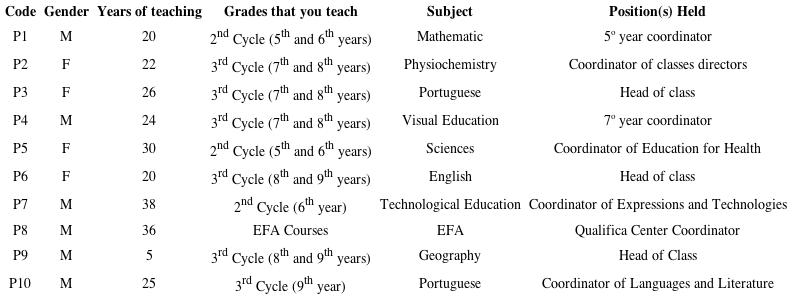
The School Group comprises three educational establishments from pre-school to the 3rd cycle of Basic Education, with 754 students, 38 classes and 81 teachers. We inquired, by interview, 10 teachers, which we characterize in table 1.
- Profile of respondents
Source: devised by the authors.
The teachers interviewed have between 20 and 38 years of teaching service, with only one teaching for 5 years; 40% are female and 60% are male. Regarding the level of education, three respondents teach in the 2nd Cycle (5th and 6th years of schooling), six teach in the 3rd Cycle (7th, 8th and 9th years of schooling) and one teaches in the Adult Education and Formation (EFA) courses.
As for the positions held, the interviewees exercise the following leadership roles in the group: two department coordinators; two year coordinators; a coordinator of the class directors; a qualified center coordinator; a health education coordinator and three class directors.
Interviews
Interviewing is one of the appropriate methods to use in a case study about educational institutions, as it allows to obtain pertinent information, which cannot be found in records or documentary sources. The use of the technique of semi-structured interviews allowed the researcher to “intuitively develop an idea about the way the subjects interpret aspects of the world”9 (BOGDAN; BIKLEN, 1994, p. 134). In this way, data were collected using semi-structured interviews. These, after observing all ethical norms, were recorded, transcribed and, subsequently, submitted to content analysis or thematic analysis (BARDIN, 2009, p. 198), which consists of the “operation of classification of elements constituting a set by differentiation and, subsequently, by grouping according to gender (analogy)”10 (BARDIN, 2009, p. 145).
Protection of the subjects' identity was ensured, having been assigned the code (P) for teacher, followed by number (from 1 to 10).
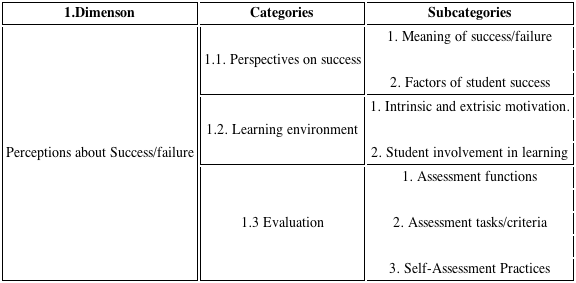
We proceeded with the full reading of the interviews and, then, a more in-depth reading, in a constant journey through each of the speeches, which opened the way for the identification of dimensions, the first being: “Perceptions about Success/failure”, which we subdivided into categories and subcategories, according to the registration units. In this text, we present the results of this dimension, the teachers' perceptions of success/failure, whose structure of analysis is shown in Table 2.
- Dimension, analysis categories and subcategories
Source: devised by the authors.
Presentation and analysis of results
After analyzing the interviews carried out with the 6 teachers, we proceed to the presentation of the results on their perspectives regarding school success, triangulating their perspectives with the theoretical dimension that underlies the present study.
Dimension: Perspectives on Success/Failure
This dimension encompasses three categories that allowed us to know and analyze the perspectives of teachers regarding success and assessment. Thus, the first category is called “Perspectives on success”, the second “Learning environment” and the third “Evaluation”, each of which is subsequently analyzed.
Perspectives of school success(failure)
For the interviewed teachers to succeed at school is to pass the year and acquire the expected skills. Failure is not being able to achieve the goals set for the student.
Teachers stress the importance of success as “A journey through cycles, without retention and with the vast set of knowledge, skills and attitudes”11 (P2); they add that “success is not just based on grades, the student must acquire all the necessary skills to be a good professional later”12 (P3). A teacher considers that students “start from different situations and some progress more than others, which does not mean that those who progress more achieve their defined competences for the discipline”13 (P5). They also state that it is very important “to have a critical spirit, to have an opinion, to feel good at school and not to feel that school is an obligation”14 (P6).
In the opinion of the interviewed teachers, the failure leads us to the processes of unsuitability for the school “not being able to follow the school requirements even if they benefit from all types of support”15 (P4). It is “evident that we want everyone to achieve the same skills and it is not always possible, as some do not succeed at the same time and are left behind”16 (P5); “I think that the obsession with numbers makes the concept of failure very reductive. A student may have had low ratings throughout his school period and, even so, have acquired life skills”17 (P1).
In another study, (SANTOS; ALVES, 2016) concluded that teachers consider that school success comes from effort, dedication and behavior; the evaluation controls the study, forces it to study and diagnoses what the students know. Strategies for approaching content and content do not motivate students. They believe that the study is very important for success.
Factors of student success
When asked about the reasons that explain their success or failure, they emphasize the importance of the social and family context: “They do not all start from the same level. Social and family issues are important (not everyone has the same protection, nor the same family environment). The tendency is to demand that everyone achieve the same skills at the same time and in the same way, it is difficult, because they cannot. This alone will differentiate between success and failure”18 (P5). They also consider that “it depends on the appreciation given to the relevance of the school for the achievement of its life goals, not only at a professional level, but also culturally and citizenship. This appreciation comes from family culture or other significant personal influences for the student. A family that sees the school as a mere repressive social instrument, that forces the frequency of activities and that the family considers unnecessary, will never be able to promote the student's academic success”19 (P6). Another pertinent aspect is the school's self-confidence and image: “Even outside the family, there may be actors who influence the student to consider the school in a positive way. Once this factor is ensured, it is also necessary for the student to later have confidence in his abilities and confidence in educational agents”20 (P1).
Learning environment
Teachers consider that study means effort in school tasks and refer to the importance and appreciation of the study for the future. However, “it is very rare for students to have intrinsic motivation to learn. We have to make them see what the study does in their formation”21 (P6).
Intrinsic and extrinsic motivation drives students to action: “A percentage of success is due to students' commitment and dedication; however, there is a large percentage of success that is due to the fulfillment of superior guidelines that increasingly point to the need for student results to mirror success”22 (P4); “Dedication and commitment of family support. In some cases this commitment has already been made personally by the students, however, in many cases, if there is no pressure (which does not necessarily have to be repressive) on the part of the family for the student to dedicate themselves”23 (P1).
The involvement of students in their learning: “A large part is involved in their own learning. Now, we want to keep them quiet, sitting in the same position and always listening, but if they are involved in activities, talking to each other, showing interest, it is already a step towards success”24 (P5); “Students who really want to learn are actively involved in their own learning (they question, research, seek to know more, mobilize their knowledge)”25 (P4).
From a different perspective, other teachers interviewed have the “very passive students waiting for the teacher to do it, they are not autonomous”26 (P3); “It is due to the effort, commitment, dedication, involvement, interaction and resilience of teachers, students, class directors, tutors and guardians”27 (P2).
Evaluation
Evaluation functions
The evaluation influences the motivation for the study, since “the assignment of levels at the end […]; levels that are relevant to the student's progression or not; it is currently perverse and leads students to compare themselves with other students, in an improper way, because the perception that remains is that the grades serve to distinguish the good from the bad students. There is nothing formative in this view of things”28 (P5). A teacher considers that “the evaluation in basic education should be absolutely and only formative: to evaluate to improve the student's learning and guide his work, as well as the teacher's work”29 (P1). Teachers recognize that “the evaluation serves to monitor learning and give feedback to students and parents/guardians about what has been learned and what aspects to improve or what to learn”30 (P1; P3); the evaluation has a “regulatory role mainly for the student and also for the teacher. For me to check if the student has learned and for the teacher to check if he taught in the best way”31 (P6).
Evaluation tasks/criteria
The teachers interviewed state that the assessment instruments they use most are “the tests naturally, the format sheets, class questions, reports of practical/experimental activities, research papers, daily notebook, systematic records of punctuality, homework”32 (P5; P2); “The tests are determined by the department, whether oral or written”33 (P6). “I use the evaluation criteria defined / imposed by the school. As imposed by the school, tests are the most important assessment tool”34 (P1); “In my discipline we have several instruments for the diversification of assessment: from reading sheets, grammar sheets, expressive assessment, participation in oral works (if he feels comfortable with classmates, if the speech is coherent, if he makes himself heard at the back of the room), all posture and it's not just writing and evaluating tests”35 (P3); “The assessment instruments are specific to my discipline, which is more practical. Thus, within the cognitive and psychomotor domain, I privilege knowledge of the contents, creativity and its application in individual works, as they have a greater weight in the evaluation”36 (P4).
Self-evaluation practices
The opinion of teachers who carry out formal self-evaluation at the end of the period is unanimous
“We should teach our students to do their self-assessment continuously, because (students must self-assess themselves in specific situations, case by case, and not at a certain time of the school year, when the grades will be given”37 (P2) ; “I have self-assessment practices, at the end of the period as everyone else does”38 (P5; P6); “In my case, students constantly self-assess, in discussion with the “provisional grade” whose quantitative value is reported practically in every class. Formal self-assessment, at the end of the periods, is carried out, but it is absolutely irrelevant and unfounded. In addition to the formal self-assessment moments provided, I always ask students to reflect (in writing, in the daily notebook) on the work developed, aspects that went less well and to be improved when the assessment sheets were handed over” (P1); “Whenever I talk to my students about their work, they make an oral reflection (self-assessment) about the work done and the commitment shown. In addition, at the end of each period, I ask for a more formal self-assessment about the work done during the period”39 (P4); “At the end of each period the school requires it to be so, but when I do an oral reading job I try to do their self-assessment”40 (P3).
Conclusions
As we were revealing, the teachers revealed their perspectives regarding success and assessment, highlighting a growing recognition of the importance of academic success for all students and the entire evaluation process. The assessment serves to monitor learning and provide feedback to students and parents/guardians about what has been learned and what aspects to improve or what to learn.
For teachers, students start from different levels, so some progress more than others. It is up to the teachers, in their practice, to select the different tasks and to take the students to participate actively, so that the evaluation is integrated in the formative process and it becomes possible to take the students to be fully involved in their learning process and to be encouraged to evaluate your own work.
The teachers interviewed reported that success is related to the value that students and school staff attribute to school; with students' motivation for learning; with the functions and evaluation practices.
It therefore seems relevant that the curriculum is adjusted to the students' potential and difficulties, using different levels of intervention; that there is a real curricular flexibility that puts the student at the center of the training process. It is essential to have a dialogical assessment, integrated in the curriculum development process and that the classroom is a space where teaching-learning-assessment procedures and strategies are discussed and shared. Such dynamics will lead to reflexivity and emancipation.
ACKNOWLEDGMENTS
This study was funded by CIEC (Research Center for Child Studies), by the Strategic Project UID/CED / 00317/2013, through the National Funds of FCT (Foundation for Science and Technology), co-financed by the European Fund Regional Development Program (FEDER) through COMPETE 2020 - Operational Program Competitiveness and Internationalization (POCI) with reference POCI-01-0145-FEDER-007562.
REFERENCES
ALVES, M. P. Currículo e avaliação: uma perspectiva integrada. Porto: Porto Editora, 2004.
ALVES, M. P; AGUIAR, M.; OLIVEIRA, S. Avaliação no ensino superior: Resultados de uma investigação no domínio das ciências da saúde. In: FERNANDES, D. et al., (Orgs.). Avaliação, ensino e aprendizagem no ensino superior em Portugal e no Brasil: realidades e perspetivas. Volume 2. Lisboa: Educa, 2014. p. 523-562.
BARDIN, L. Análise de conteúdo. Lisboa: Edições 70, 2009.
BELL, J. Como realizar um projeto de investigação. Lisboa: Gradiva, 2002.
BOGDAN, R.; BIKLEN, S. Investigação qualitativa em educação: uma introdução à teoria e aos métodos . Porto: Porto Editora, 1994.
FERNANDES, D. Para uma teoria da avaliação formativa. Revista Portuguesa de Educação, CIEd - Universidade do Minho, v. 19, n. 2, p. 21-50, 2006. Available at: www.scielo.oces.mctes.pt/pdf/rpe/v19n2/v19n2a03.pdf. Access: 3 jun. 2013.
LOPES, J.; SILVA, H. Técnicas de avaliação formativa. Lisboa: Edições LIDEL, 2012.
MACHADO, E. Educação que vem entre a performatividade e a esperança. Santo Tirso: whitebooks, 2016.
MARCHESI, A.; GIL, C. Fracasso escolar: uma perspetiva multicultural. Porto Alegre: Artmed, 2004
PINTO, J.; SANTOS, L. Modelos de avaliação das aprendizagens. Lisboa: Universidade Aberta, 2006.
PERRENOUD, P. A pedagogia na escola das diferenças. fragmentos de uma sociologia do fracasso. Porto Alegre: Artmed Editora, 2001.
ROLDÃO, M.,(2013) Desenvolvimento do currículo e a melhoria de processos e resultados. In: ALVES, M. et al., (Orgs.). Melhorar a Escola, sucesso escolar, disciplina, motivação, direção de escolas e politicas educativas. Porto: Faculdade de Educação e Psicologia da Universidade Católica:, 2013.
SANTOS, T.; ALVES, M. P.Avaliação como controle do estudo: perspetiva dos alunos. In: VEIGA, F. (Coord.) CONGRESSO INTERNACIONAL ENVOLVIMENTO DOS ALUNOS NA ESCOLA: perspetivas da psicologia e educação motivação para o desempenho académico, 2., 2016, Lisboa. Anais [...]. Lisboa: Instituto de Educação da Universidade de Lisboa, 2016. ISBN: 978-989-8753-35-9.
SIMÃO, A. Reforçar o valor regulador formativo e formador da avaliação das aprendizagens. In: ALVES, M. P.; MACHADO, E. A. Avaliação com sentido (s). Contributos e questionamentos. Santo Tirso: De Facto Editores, 2008.
VIEIRA, C. Relação escola-família: uma educação participada. In: PINTO, C. A.; TEIXEIRA, M. (Orgs.). Pais e escola: parceria para o sucesso. Porto: Edições ISET, 2003. p. 291-315.
Notes
