Artigos
LEARNING MATERIAL DESIGN FOR TEACHING GENETICS WHILE IMPLEMENTING FLIPPED CLASSROOM
LEARNING MATERIAL DESIGN FOR TEACHING GENETICS WHILE IMPLEMENTING FLIPPED CLASSROOM
Revista Ibero-Americana de Estudos em Educação, vol. 13, núm. Esp.1, pp. 468-478, 2018
Universidade Estadual Paulista Júlio de Mesquita Filho

Esta obra está bajo una Licencia Creative Commons Atribución-CompartirIgual 4.0 Internacional.
Recepción: 30 Octubre 2017
Aprobación: 30 Enero 2018
Abstract: This paper shows the process of research and design of learning materials for flipped classrooms, an active teaching method that intends to switch from the traditional acquisition of content in class and to the assignments’ resolution at home. In order to choose the content to be addressed, we based our efforts on a research that indicated "Genetics" as a subject of difficult comprehension. With the use of digital platforms, some flashcards, quizzes, mind maps, video and a website were produced to create the materials and promote the flipped classroom values. It is intended to show that the flipped classroom is an applicable approach, placing students at the center of the learning process.
Keywords: Flipped classroom, Active learning, Design of learning material, Genetics, High school.
Resumo: O presente artigo mostra o processo de pesquisa e produção de materiais didáticos para a metodologia da sala de aula invertida, uma metodologia de ensino ativa que pretende inverter o que normalmente é desenvolvido em sala de aula, verticalizando a relação professor-aluno. Para a escolha do conteúdo a ser abordado, recorremos a uma pesquisa que indicou a Genética como matéria de difícil compreensão. Os materiais didáticos foram produzidos com o objetivo de facilitar a aplicação desta metodologia. Com a utilização de plataformas digitais, foram produzidos: flashcards, quiz, mapa metal, vídeo e um site com intuito de divulgar os materiais e disseminar a sala de aula invertida. Pretendemos com este trabalho mostrar que a sala de aula invertida é uma metodologia aplicável, desde que o professor esteja disposto a superar as dificuldades.
Palavras-chave: Sala de aula invertida, Aprendizagem ativa, Produção de material didático, Genética, Ensino médio.
Resumen: El presente artículo muestra el proceso de investigación y producción de materiales didácticos para el enfoque del aula invertida, un método de enseñanza activo que pretende invertir la tradicional adquisición de contenido en clase y la resolución de ejercicios en casa. Para la elección del contenido a ser abordado, recurrimos a una investigación que indicó la “Genética” como asunto de difícil comprensión. Con el uso de plataformas digitales, fueron producidos: flashcards, quizes, mapa mental, video y un sitio con el propósito de divulgar los materiales y diseminar el aula invertida. Se pretende mostrar que el aula invertida es un enfoque aplicable, colocando al estudiante en el centro del proceso de enseñanza-aprendizaje.
Palabras clave: Sala de clase invertida, Aprendizaje activo, Producción de material didáctico, Genética, Escuela secundaria.
Introduction
Based on an educational system that aims at placing the importance on students' creations rather than on students memorizing contents, TAMK and HAMK Finnish Universities of Applied Science offered, in three different editions, promoted the training course for Brazilian teachers from the Federal Network of Technological Education, known as Vocational Education and Training (VET) - Teachers for the Future. Among the topics covered in the program, which formed the basis of the Finnish Educational System, also emerging among the best positions in the Program for International Student Assessment (PISA) ranking, we can highlight the flipped classroom, an approach generally applied in Finnish education and, in an expressive way, in the publications from the course of Physics of Tampere University of Applied Sciences (TIILI; SUHONEN, 2014; SUHONEN, 2016a; SUHONEN, 2016b).
The Flipped Classroom consists of an active learning method with the purpose of reversing the way contents are addressed in the classroom. The traditional classroom content and competences is now run at home, and what was traditionally done as homework is now done in the classroom (BERGMANN; SAMS, 2012, p. 11). Thus, the teacher previously provides all the content by means of an online or printed platform to raise the students’ awareness on the content. The classroom now becomes the place to work on the contents already studied, performing practical activities such as problem solving and projects, group discussion, laboratorial activities, etc. (VALENTE, 2014, p. 85). Through these activities, students practice what was learned at home with the teacher's guidance.
The flipped classroom is a hybrid teaching approach described by Salman Khan and developed by Jonathan Bergmann and Aaron Sams in 2007 (RODRIGUES; SPINASSE; VOSGERAU, 2015, p. 39284). Although it has been presented as something extremely new, the idea of "Flipping" the classroom has been in place since the 1990s, with the growth of the possibilities of use and access to Information and Communication Technologies (ICT) (SUHR, 2016, p. 6). According to BERGMANN and SAMS (2012): “They were not the first educators who made use of videos as a didactic tool, nor coined the term "Flipped Classroom", but they were the pioneers and ostensible proponents of this practice”.
The method was developed with the aim of improving the performance of high school students who had difficulties to attend classes, since they were absent, mostly by sport events, and had their performance hampered. Thus, teachers begin to develop the content through videos available on the Internet, so that students could keep up with the lessons. These videos were recorded by the authors of the method using screen capture software. The absent students loved the recorded lessons and were able to learn what they had missed. Others, who attended classes and listened to the lessons also began to watch the videos (BERGMANN; SAMS, 2012, p.3).
Within this learning model, the teacher continues to be the main responsible for guiding students on how to understand and apply new information, especially regarding the newly acquired ones, needing to use an interactive approach different from that used in traditional teaching (WILSON, 2013 apud RODRIGUES; SPINASSE; VOSGERAU, 2015, p. 39284). In addition, teacher loses the traditional vertical relationship, where he/she transmits contents for the students to assimilate them. Therefore, the teacher will play the role of tutor. According to Botti and Rego (2008), the tutor is one who teaches the student to "learn to learn", that is, the teacher becomes a facilitator in the teaching- learning process by deepening the theme seen at home and stimulating the debate among students and the tutor in order to provide students with a wide and complete learning as possible.
According to Bergmann and Sams (2012), in the flipped classroom routine, essentially, each class begins with a discussion about the videos that the students watched related to the content to be practiced, at this time, students ask questions drew up during their studies at home. After the discussions, the daily assignments are passed on to the students. They can be practical, for instance laboratory experiments, or theoretical as research and exercises. The number of activities to be carried out must be calculated according to the time the teacher has for the class.
Educational systems around the world have a number of qualities and flaws. A peculiarity of Brazil, in comparison to other regions and countries, such as Europe and the United States, is that the high-school system is content-centered (TEIXEIRA, 2010).
We put technologies in the university and in the schools, but in general, to continue doing the usual - the teacher talking and the student listening - with a veneer of modernity. Technologies are used more to illustrate the content of the teacher than to create new didactic challenges (MORÁN, 2004, p. 2).
Technology as a learning tool should be used beyond the presentations commonly used in the classroom. What technology brings today is the integration of all spaces and times. Teaching and learning takes place in a symbiotic, deep, constant interconnection between the physical world and the digital world (Moran, 2015, p.16). Hence, technology is able to bring knowledge where students are, allowing themselves to connect to the world through internet access. One consequence is that students are discovering how to learn better. “By guaranteeing students the choice of how to learn, we also give them control and guide over their own learning (BERGMANN; SAMS, 2012, p. 63)”.
Teachers interested in applying the flipped classroom model should be aware of the difficulties involved in implementing the method. It is likely that the most difficult task for teachers in attempting to flip the classroom is producing or acquiring quality videos (BERGMANN; SAMS, 2012, 32). The teacher is not required to use videos of their own. With the explosion of video sites such as YouTube©, it has become easier to search for quality videos of different subjects, but the teacher does not only have videos as a tool, there are software aimed at the area of education that offers a series of possibilities for the teacher.
It is very likely that students will also have to adapt to the new method because, with the breakdown of the traditional teaching model, students may feel insecure, since learning will depend even more on their commitment to studies. So the flipped classroom method must be applied gradually, allowing students to get used to it and through practice and development of their own learning. For these reasons, classroom activities should encourage and instigate students to become familiar with the method. As the teacher renounces control of the learning process, students take place at the center of their own learning and the educational process becomes an achievement to be undertaken on its own merits and efforts (BERGMANN; SAMS, 2012, p. 56).
Methodological Procedures
For the production of learning materials within the flipped classroom method, we chose to develop them in digital platforms. With the popularization of technology, and especially on-line assets, it has turned traditional classes less interesting than the smartphones that students carry in their pockets.
The digital space has thus become the most accessible route for all people who seek information and have access to the Internet and computers. And this can be a more socially inclusive space, if it offers accessibility to all, respecting their capacities and limitations (TORRES; MAZZONI; ALVES, 2002, p. 90).
The digital platforms used to produce didactic materials were:
GoConqr., a social network developed by private initiative to create an interactive learning environment allowing access to digital innovations for teachers, students and professionals. This platform has paid usage plans and a free plan open to any user, it also has numerous tools that can be used by both the teacher and the student. These tools allow you to create notes about content, mind maps, quizzes, exercise lists or even slides. Because it is a social network, the site is easy to use and allows students not to limit themselves to the content provided only by the teacher, it also has a search tab that allows you to search your database containing formerly developed materials of several contents. In this platform were developed: Flashcards, Mental Map and Quiz.
RawShort., an idealized platform for the purpose of elaborating short videos with animations, allowing paid and free versions. To make video production easier, RawShorts. has categories such as: Infographic and Education, with pre-made videos that can be used according to each author’s needs. To help video production, the platform provides a tutorial teaching step-by-step how to make use of the tools.
Wix. is a platform aimed at creating and editing websites, allowing the user to create his/her website without the knowledge of programming, being an easy-to-use and highly instructive tool. According to the goals, it can be used either for virtual store or business websites. Used as a way of bringing together and making available the developed materials and disseminating the flipped classroom method.
Personal files
Materials Produced
After choosing the digital platforms, learning materials were developed according to the tools each one provided. The content and skills related to the second year of high school were provided by the syllabus by the Secretariat of Education in São Paulo: Science of Nature - Biology, in 2015, and it has been accepted as the basis for preparing contents used by teachers interested in the materials produced in this study.
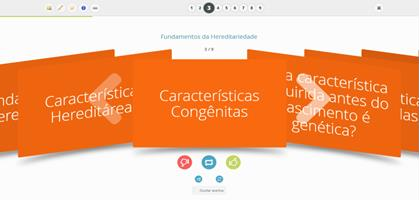
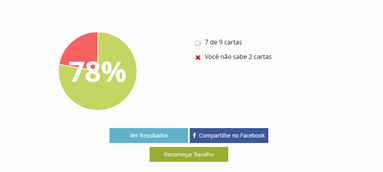
FlashCards are short notes on the content of heredity basics, question forms that help students in the learning process and can also serve as optimal resource for a review prior to assessments. When opening the FlashCards user interface (Figure 1), the student has tools to assist in their study, such as: indicate whether they know the contents of the card using the positive and negative sign, click on the card and get to know what it means. When students finish using the Flashcards, the website shows them any missed items and how many were missed (Figure 2), giving them the option of hiding the correct ones at which time the activity is restarted, so students could concentrate better on difficulties, and finally the program shows to the teacher the average accuracy of each student and the class overall average.
Personal files.
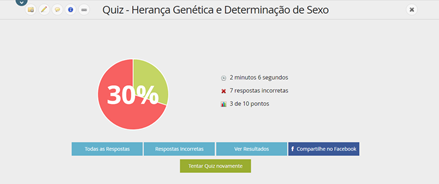
Quiz is an interactive game with questions and answers about genetic inheritance and sex determination, questions are multiple choice, there may be more than one correct answer, either true or false. At the end of the activity, students have access to a series of data that can help in their studies, such as: time taken to answer questions, number of correct answers and mistakes, explanation of answers, average group accuracy and an option to redo the questions that s/he might have missed (Figure 3). The teacher can use all the data shown in figure 3 to diagnose the class’ situation in relation to the content. However, the teacher can still make use of this tool to assess or grade, since the program allows attributing grades to the questions and the students would already have the correction with the answers and the explanations for their mistakes and doubts.
Personal files.
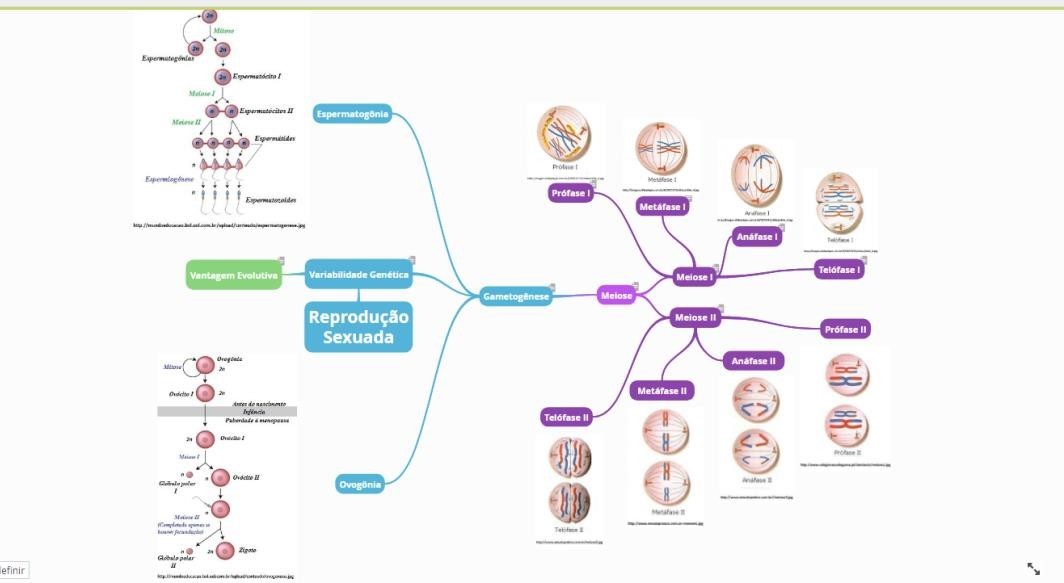
Mind mapping is a technique of representing knowledge by organizing it as a network or other non-linear diagram incorporating verbal and non-verbal elements (DHINDSA; KASIM; ANDERSON, 2010, p.187). Therefore, based on the content of a story, a map is assembled where ideas are organized by topics that are linked according to their proximity. Each topic contains a short explanatory text so that students understand what it means and why it is linked to another topic (Figure 4). The tool also features an animation that shows the topics coming out of a central point, the name of the story, and thus showing its subdivisions and subtopics. This method is quite efficient when students have the first contact with the content, since it groups information by proximity and establishes a connection among them.
Personal archive.
The video was elaborated to explain the main pre-Mendelian conceptions about heredity, which were historically contextualized, with the use of clear and objective language, as shown in figure 5. The results obtained by Mendel in the crosses of peas that originated the laws of the Monohybridism, Diibridism and Dominance, and the characteristics of each are explained. The video has approximately 10 minutes, with the use of animations, to facilitate students’ understanding.

Personal archive.
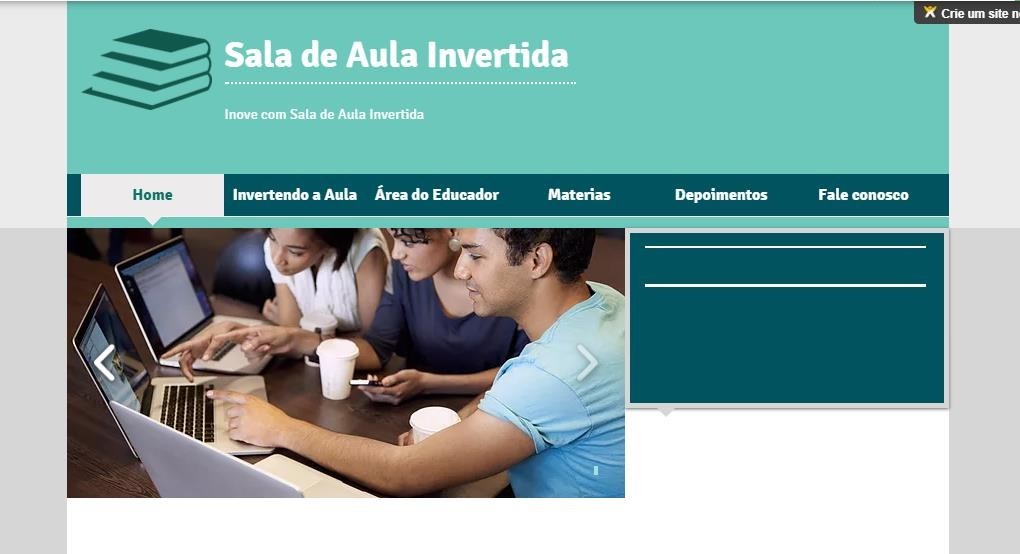
The Website is a way to make the materials produced available, as it allows you to create pages according to the theme and to attach them. Moreover, it is a way of publicizing the inverted classroom methodology, explain the advantages of working with this method and guide the teacher who wants to make use of the materials.
Personal archive.
Final considerations
We are in the information age, technology has been increasingly present in our daily lives, we have access to various contents with just a click, but schools have not been keeping up with the same pace. The law no. 12.730 from 2007, which forbids the use of mobile phones in public schools in the state of São Paulo, which highlights this hindrance to education. Well applied tools, such as the internet, allow students to access any subject without major difficulties. Technology can be an ally in the development of the teaching-learning process, as shown by the flipped classroom method.
The active learning methodologies allow a rupture of the traditional teaching model, inserting students actively in the classroom, encouraging group work, debates and the development of projects. Therefore, disseminating the flipped classroom methodology is important so that teachers realize that there are options and that they are applicable, and can transform the routine during the lessons, bringing benefits to teachers and students.
The materials were produced with a prerequisite of being facilitators of the implementation process of flipped classroom for teachers who are interested in incorporating the method in their classes. An application of this method has its challenges, it is up to the teacher to be persistent, to adapt materials and encourage students to develop their autonomy. Based on the experience described by Jonathan Bergmann and Aaron Sams, we have seen that implementing the method is possible as long as the teacher is willing to overcome the difficulties.
REFERENCES
ARAUJO, B. A.; GUSMÕES, F. A. F. As Principais Dificuldades Encontradas No Ensino De Genética Na Educação Básica Brasileira. Encontro Internacional de Formação de Professores e Fórum Permanente de Inovação Educacional, v. 10, n. 1. Anais 2017. p.1-11.
BERGMANN, J.; SAMS, A. Sala de aula invertida: uma metodologia ativa de aprendizagem. Livros Técnicos e Cientifios Editora Ltda. 1º ed. Rio de Janeiro. 2017.
MORAN, J. M. Mudando A Educação Com Metodologias Ativas In: SOUZA, C. A.; MORALES, O. E. T. Convergências midiáticas educação e cidadania aproximações jovens. Ponta Grossa: UEPG/PROEX, 2017.
MORAN, J. M. Os novos espaços de atuação do professor com as tecnologias. Revista Diálogo Educacional, Curitiba, v. 4, n.12, p.13-21, maio-ago. 2004.
PETROVICH, A. C. I. et al. Temas De Difícil Ensino E aprendizagem em ciências e biologia: experiências de professores em formação durante o período de regência. Revista da SBEnBio, n. 7, p. 363-373, out. 2014.
RODRIGUES, C. S.; SPINASSE, J. F.; VOSGERAU, D. Sant`Anna R. Sala de aula invertida- uma revisão sistemática. In: XII Congresso Nacional de Educação. 11º ed. 2015, Curitiba – PR: PUCPR. p. 39284–39295. Disponível em: http://educere.bruc.com.br/arquivo/pdf2015/16628_7354.pdf. Acesso em: 22 ago. 2017.
SUHR, I. R. F. Desafios no uso da sala de aula invertida no ensino superior. Revista Transmutare, Curitiba, v. 1, n. 1, p. 4-21, jan./jun. 2016.
TEIXEIRA. M. Simon Schwartzman: “o ensino médio no Brasil é formal, acadêmico, voltado para o vestibular. Não atende jovens com outros interesses”. Ensino Superior UNICAMP. Campinas - SP, 7 de junho de 2010.
TORRES, E. F.; MAZZONI, A. A.; AlVES, João B. M. A acessibilidade à informação no espaço digital. Ciência da Informação, Brasília, v. 31, n. 3, p. 83-91, set./dez. 2002.
VALENTE, J. A. Blended learning and changes in higher education: the inverted classroom proposal. Educar em Revista. Editora UFPR. Curitiba, Brasil, Edição Especial n. 4/2014, p. 79-97.