Articles
Received: 25 June 2020
Accepted: 09 November 2020
DOI: https://doi.org/10.12662/2447-6641oj.v19i30.p35-62.2021
ABSTRACT
Objective: This paper proposes a more in-depth approach to the issue of regulated professions and professional councils, based on political, legal, and philosophical-economic arguments, seeking to demonstrate that less professional regulation leads to higher quality and safety in service provision and not the other way around, as usually boasted.
Methodology: The paper was structured through qualitative and quantitative research, crossed with data analysis from national and international indexation systems. That reasoning is subjected, through inductive reasoning, to both a historical perspective and a contemporary one.
Results: It was possible to determine that the optimal regulation standard is a slight regulated one, and through its careful use, it is possible to gather advantages for society rather than the actual harmful excess of regulation predominant in Brazil.
Contributions: Among some of the oldest debates in Western civilization, the so-called liberal is the constant friction between individual freedoms and state intervention. One of the areas in which this friction is naturally more intense is in the professional field. In Brazil, the discussion was resumed after the presentation of a constitutional amendment that intends to prevent regulatory excess as well as remove from the State the responsibility to coordinate and control professional activities. This paper intends to shed some light and provide grounds in this relevant subject.
Keywords: Regulation, Constitutional Law, Economic freedom, Professional Councils, Free market.
RESUMO
Objetivo: Este artigo propõe uma abordagem aprofundada a respeito dos conselhos profissionais e regulamentação profissional, baseada em argumentos políticos, jurídicos e filosóficos-econômicos, buscando demonstrar que menos regulação profissional leva a maior qualidade e segurança na prestação de serviços e não o contrário, como normalmente se prega.
Metodologia: O trabalho foi estruturado por meio de pesquisa qualitativa e quantitativa, cruzada com análise de dados de sistemas nacionais e internacionais de indexação. Tudo por meio do raciocínio indutivo sob a perspectiva histórica e contemporânea do tema.
Resultados: Foi possível determinar que o padrão de regulação ideal e é o de um mercado levemente regulado e que, através de seu uso cuidadoso, é possível angariar vantagens para a sociedade ao contrário do excesso prejudicial de regulações no país.
Contribuições: Dentre os debates mais antigos da civilização ocidental, chamada liberal, está o constante atrito entre liberdade individual e intervenção do Estado. Uma das áreas em que essa fricção é naturalmente mais intensa é no campo profissional. No Brasil, a discussão foi resgatada após a apresentação de emenda à constituição que pretende inibir o excesso regulamentar profissional, bem como retirar do Estado a responsabilidade de coordenar e controlar as atividades de profissionais. Este artigo pretende lançar alguma luz e fornecer fundamentos para o debate deste relevante tema.
Palavras-chave: Regulação, Direito Constitucional, Liberdade Econômica, Conselhos Profissionais, Livre mercado.
RESUMEN
Objetivo: Este artículo propone un enfoque profundo de los consejos y la regulación profesionales, basado en argumentos políticos, jurídicos y filosóficos-económicos, buscando demostrar que menos regulación profesional conduce a una mayor calidad y seguridad en la prestación de servicios y no al revés, como se suele predicar.
Metodología: El trabajo se estructuró a través de investigaciones cualitativas y cuantitativas, seccionadas con análisis de datos de sistemas de indexación nacionales e internacionales. Todo a través del razonamiento inductivo desde la perspectiva histórica y contemporánea del tema.
Resultados: Fue posible determinar que la norma reguladora ideal es la de un mercado ligeramente regulado y que, a través de su uso cuidadoso, es posible plantear ventajas para la sociedad en lugar del perjudicial exceso de la regulación en el país.
Contribuciones: Entre los debates más antiguos de la civilización occidental, llamada liberal, está la constante fricción entre la libertad individual y la intervención del Estado. Una de las áreas donde esta fricción es naturalmente más intensa es en el campo profesional. En Brasil, el debate fue rescatado después de la presentación de una enmienda a la constitución que tiene como objetivo inhibir el exceso regulatorio profesional, así como eliminar del Estado la responsabilidad de coordinar y controlar las actividades de los profesionales. Este artículo tiene como objetivo arrojar algo de luz y proporcionar motivos para el debate sobre este pertinente tema.
Palabras clave: Regulación, Derecho constitucional, Libertad económica, Consejo profesional, Mercado libre.
1 INTRODUCTION
In July 2019, the Brazilian President of the Republic presented the Constitution amendment bill (PEC) No. 108/19, which would prohibit limitations on professional practices and remove the mandatory registration for some professions with councils, in addition to transforming these institutions into private non-profit organizations. Many professional councils rebelled against the government's bill, justifying uncertainty and potential dangers to society if the amendment was approved (RBA, 2019). The proposition rekindles an old debate that started with Law 9.649/98, which defined councils as private institutions but ended up being considered unconstitutional by the Brazilian Federal Supreme Court (STF) in the judgment of the Direct Action of Unconstitutionality No. 1717-6.1
Our objective in the present study is, through a legal-economic approach, to evaluate the relationship between economic development and state intervention. Therefore, we start from the premise of the factual and economic overcoming of the exploitation theory, which argued that capital is accumulated more where it already exists in large quantities and gradually dwindling where it is already scarce (MARX, 2019, p. 840-844), and that for a few to get rich, many will become poorer. Financial resources around the world have increased exponentially throughout history,2 which has benefited human society. That can be clearly seen by looking at the huge difference in the quality of life between a citizen of the current world and a compatriot from the previous century. In the words of Mises (2010, p. 691):
Only people blinded by preconceived ideas and partisan prejudices could resort to such an explanation [of the exploitation theory] at a time when the industry supplies the masses with new goods, hitherto unknown, and makes satisfactions available to the average worker with which, in the past, no king could even dream.
Therefore, it seems unquestionable the claim that the amount of wealth in the world has multiplied dramatically, which has led to an exponential increase in life quality, increasing wealth even in the poorest countries. The regions with greater economic freedom have this impact more perceptible than in those with less freedom precisely because of the ease in wealth circulation (graphs 1 and 2). We will address this issue further in Section 3.

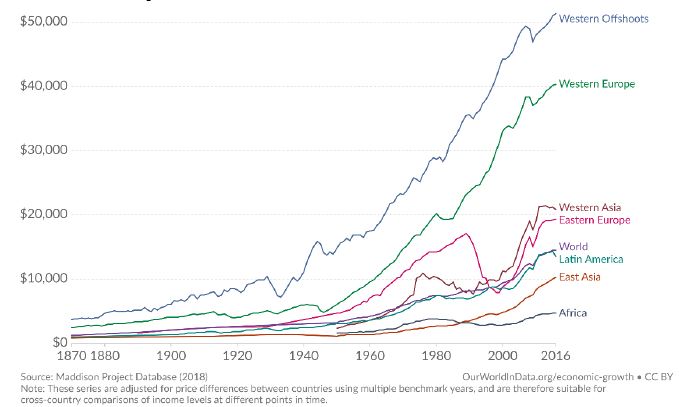
Graph 2
GDP per capita, 1870 to 2016. GDP per capita adjusted for price changes over time (inflation) and price differences between countries – it is measured in international-$ in 2011 prices.
Source: (OUR WORLD IN DATA, 2016, online).
This wealth multiplication began as a result of the social stability provided by the Rule of Law, which allowed voluntary exchanges without violent disputes. This legal stabilization started in the 18th century, stimulated the crucial notion that the State should not or could not control what an individual produces with his work and his property (SMITH, 1996, p. 367-434).
In Law, this notion was materialized as the First-Generation human rights (NOVELINO, 2016, p. 46-47). As the western civilization took those rights for granted, we started to look for other guarantees, hence the so-called Second, Third, and even Fourth and Fifth-generation rights (MARTINS; MENDES; NASCIMENTO, 2012, p. 696-697). But curious aftermath is being experienced. Insofar as the so-called First-Generation rights represented the withdrawal of the State from the private life (negative rights), all other dimensions of rights demanded the State once again intervening in the private life (positive rights). The Second-Generation required the State to provide positive rights such as education, health, work, and social security. Third-Generation determines that the State acts guaranteeing peace, security, protection of the environment, protection for the disabled, and so on (MARTINS; MENDES; NASCIMENTO, 2012, p. 444-445).
All these expectations provoked a clash with First-Generation rights, resulting in several conflicts between fundamental rights. Weighing techniques for resolving disputes on apparent conflicts between rights and guarantees have gained notoriety in judgments and doctrines in recent years. In this field, the Brazilian Supreme Court has stood out with the expansion of traditional hermeneutics techniques, sometimes transplanting methods3 of legal theory from other countries, such as the interpretation of “law as integrity,”4 created and developed by Ronald Dworkin to be used in the common law system. This kind of activism gives the impression that the national legal system has become some kind of chimera, trying to conform dimensions of fundamental rights in constant tension with interpretive techniques coined for different legal systems.
Despite the demonstrated decline in the relevance of the individual rights to the State and collective protagonism, and the enormous importance of debating this political movement, for the purposes of this article, we will use a very emblematic outline of this tortuous legal and economic path Brazil has been conducted through. We will problematize the Brazilian state regulation of professions and the so-called professional councils, responsible for regulating, organizing, and controlling the professions of given expertise or area of activity. Are those institutions really needed? Is the regulation more aligned to the consumer needs than the freedom of contract?
Through the methodology of qualitative and quantitative research, in national and international indexation systems, under the perspective of the economic liberalism approach, we hope to answer those questions in the Brazilian setting along with this paper, although not expecting to exhaust the subject.
2 NATIONAL OVERVIEW
In the past, guilds, or trade corporations, were responsible for aggregating any persons who proposed to perform a certain activity, defining, for example, prices to be charged and to whom a certain product or service should be provided (MISES, 2010, p. 373). It is not surprising that the objective of these corporations was to defend the interests of their associates since they were their actual clients, and not the consumers themselves.
The 1824 Constitution of the Empire of Brazil in its art. 179 extinguished professional corporations in Brazil, so that the professions would probably acquire for the first time, a free character in the national territory. Thus, whoever wanted to practice a certain activity, was no longer compelled to report to any professional corporation, being able to act as they pleased, only respecting the limits of the Law. This characteristic was maintained by the first constitution of the Brazilian Republic in 1891, thanks to the provision of art. 72, §24, which guaranteed the free exercise of any moral, intellectual, and industrial professions.
Nonetheless, during the Getulio Vargas administration, the 1934 Constitution expressly stated in its art. 5, XIX, k), that it was the competence of the Union to legislate on "conditions of capacity for the exercise of liberal and technical-scientific professions as well as journalism." If we review that historical period, Vargas had just been re-elected in a troubled world context. Emerging from the 1930's revolution, and sympathetic to models that proposed to centralize control of the population and the State in the hands of the ruler, Vargas overthrew the Federal Constitution in 1931. Influencing the 1934 Constitution enormously, he shaped it to his project of power, which can be confirmed by the express constitutional provision for control of the press. Following the economic model of Mussolini's "Corporate State," Getulio created a dependency on all private activities guaranteed by the State, from those of autonomous and self-employed professionals5 to working relationships between private individuals, which was consolidated on the Labor Law (CLT), in 1943.6 As Mussolini himself would say, "everything within the State, nothing outside the State, nothing against the State."
Individual freedom, the true antagonist of totalitarianism (ARENDT, 1989, p. 363), remained restricted in the following Federal Constitutions. The 1937 Constitution was prescribed in its art. 122, 8) that Brazilians and foreigners would be guaranteed the right to "freedom of choice of profession or the type of work, industry or commerce, subjected to the conditions of capacity and restrictions imposed by the public interests under the terms of the law." This article was soon suspended, in 1942, due to the presidential decree that declared a state of war in Brazil when the country joined the allies in World War II. The Constitutions of 1946 and 1967 determined, with identical wording, that the Union would legislate on conditions of capacity for the exercise of the liberal and technical-scientific professions. 7
Finally, the current 1988 Constitution was maintained in its art. 22, XVI, among other State interventions on private activity, the Union's private competence to legislate on the organization of the national employment system and conditions for the exercise of professions, and so it has done. According to the Ministry of Labor, there are 68 professions currently regulated in Brazil (CBO, 2020). It is worth mentioning that several professional regulation laws, such as the one that controlled journalistic work during Getulio's Estado Novo, are already expressly or tacitly revoked.
In this article, we will stick only to those still in effect. From this perspective, only one Law from the 1891 Constitution period still applies, but none from the period between the 1934 and 1937 Constitutions. From the 1946 Constitution period, 19 laws remain, representing 28% of the total. Many laws still in effect were enacted during the 1967 Constitution, a total of 32, which represents 47% of the total. Since the 1988 Constitution, 16 laws have been created; therefore, 24% of the assessed universe (graph 3).
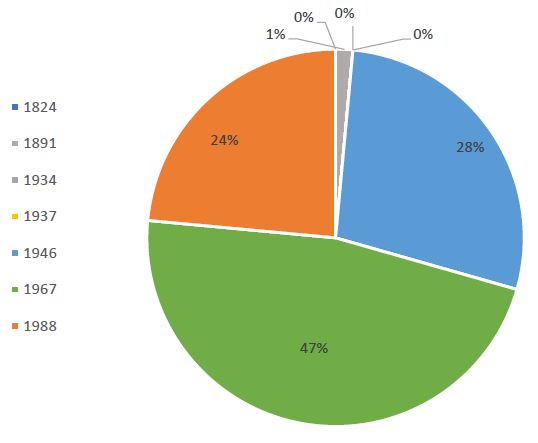
Graph 3
Professional regulation during Brazil’s history
Source: The author (2020).
The most widely used justification for this amount of regulation usually focuses on the explanation that government-accredited professionals are less likely to make mistakes or that regulation would prevent or mitigate consumers from being deceived (EXAME, 2020). In fact, the biggest concern should not be whether any professional is fallible or not. After all, training or certifications do not rule out human fallibility. The Law should always seek to distance itself from judgments of possibility, directing its energy towards judgments of factual and legal probability. These probability qualities can be verified only in concrete situations, and it is not possible to do it so for a generic collectivity.
Regulation never prevented, for example, a fraudster from deceiving, or avoided the mistake of those who cause damage without intention, even though they are regularly licensed. The hiring of an unskilled person who is not hiding such condition (what would constitute fraud and will occur, with or without a law that prohibits it) usually only affects those who are part of that contract. The individual must assume responsibility for their acts, both contracting and contracted parties, and any losses must be resolved between them or before the judiciary system. The more the State places itself as an intermediary or protector of the individuals, trying to shield and anticipate risks inherent in contracts, the more its freedom is curtailed, and the more power is concentrated in the hands of the government.
Thus, the preventive focus should be directed at the loss of third parties or damages beyond those expected or entitled to be supported in contractual relations.
This may involve, for example, a river that gets polluted because of action under an agreement, but that harms others who were not part of the original contract. In the economy, the impact of a person's actions on others not involved and not subject to charges or rewards from the original contract is called an externality, which can be positive, when it generates unexpected benefits, or negative when it causes losses (SOWELL, 2011, p. 546-549). Therefore, the State must try to prevent negative externalities during professional practice, which does not include the mere possibility of such occurrence in any generic profession.
3 PROFESSIONAL COUNCILS AND REGULATED PROFESSIONS
When the regulatory laws themselves did not create professional councils, immediately afterward, ministerial decrees or acts were issued to do so. These are considered regulatory agencies; therefore, bodies of the Public Administration, responsible for controlling, coordinating, and regulating the individual in their professional practice. With a closer look and based on what was presented in the previous section, it is easy to see that Brazil still has, strictly speaking, the private sector subjected to state supervision. The ideal of State control over the market in a kind of centralized economy, a model of the Corporate State and notably Fascist,8 is still used in Brazil, despite the tone of freedom that leads the wording of the current constitution.9
What usually occurs is that the population tries to circumvent these legal determinations that theoretically would be protective to the worker, in order to get rid of bureaucratic bonds and manage to survive and/or perform acts of the ordinary life that would otherwise be rendered unfeasible or extremely difficult. It is usually the creative use of hiring individuals as a legal entity to circumvent heavy taxation and the troublesome labor law (COPOLA, 2017). Another way to escape bureaucracy is the so-called "informal work," which usually results in heavy unrest for employees and employers due to the lack of legal certainty in their relationship (SILVEIRA; ALVARENGA, 2019). The rules that would be used to protect workers are the ones that harm them the most, making hiring unfeasible due to the high costs associated with the compliance with the Law.
Is there really a need for so much control? The Supreme Court has already positioned itself in the sense that professional freedom is the rule, while intervention in economic activity is exceptional, according to the excerpt from the following ruling:
Not all occupations or professions can be conditioned to the fulfillment of legal conditions for their exercise. The rule is freedom. Only when there is a harmful potential in the activity may it be required to enroll in a professional supervisory board (RE 414.426, Rel. Min. Ellen Gracie, Tribunal Pleno, j. 01.08.2011, DJe-194, Divulg. 07.10.2011, Public. 10.10.2011, Menu vol-02604-01, p. 76).
Two different situations are addressed in this emblematic citation. One that not every profession can be conditioned to the creation of a law for its exercise, and two that the registration in the council can only be required when there is a potential for harm in professional activity. Now, what makes someone a professional? Would it be exercising an activity, having academic expertise, or being enrolled in a professional council? According to Brazilian Law, any of the cases, sometimes combined, are necessary to define someone as a professional. Since "harmful potential" is a blank expression, we will use the definition contained in the Amendment Bill 108/19, which prohibits professional regulation unless its absence characterizes a risk of concrete damage to life, health,10 safety,11 or social order.12 It is important to highlight that activity to be considered as a risk of concrete damage. It is not enough that the profession is merely related to life, health, safety, or social order. There must be a relevant probability of harm arising from the unregulated performance of the professional.
Thus, we avoid the extensive interpretation of "harmful" (everything that is capable of causing damage, which could involve virtually any activity), seeking a restrictive interpretation (probability of causing significant damage, notably physical, environmental, or serious property damage). Professions in which poor performance can be reversed via negotiation or torts, we understand, are without harm potential. Using the criteria of those professions that can cause negative externalities or which reversion would be over costly, and scanning the professions currently regulated by Law, it is possible to sift the ones that could really be potentially harmful. Those who work in these specific risk professions in a reflexive manner or correlatedly, such as radiology technicians,13 are not necessarily prone to cause harm under these criteria because they are not decision-making professions, only performing the tasks necessary for a given activity in accordance with the definition made by a person responsible for that function. Damages caused by this type of professional, upon following orders, are the responsibility of their superior when carried out exclusively on their own behalf. It is their responsibility with or without regulatory Law. Analyzing the content of each Law, it is possible to detect some of them solely meant to describe professions or to merely create a professional council. Those professions are deemed without harm potential as well.
It so happens that in Brazil, laws exist to regulate professions that would hardly need any kind of government accreditation. It is curious the necessity to create laws that regulate professions such as masseuse,14 rodeo cowboy15 , or sommelier,16 to name a few. Of the 68 professions currently regulated, 54 of them, a total of 79%, were understood to be without the probability of concrete damage17 under the criteria presented (table 1):
Professional legislation and their actual risk of concrete damage

3.1 PROFESSIONAL COUNCILS
Friedman (2019, p. 152) was a staunch critic of the regulation of professions and dedicated an entire chapter of one of his books to "occupational licensing". For the economist, the regulation of professional activity is a way of reducing the supply of services, increasing the price of the activity thanks to the monopoly exercised. Friedman (2019, p. 144) points out that the ones most interested in regulations are the professionals themselves, contrary to what the Brazilian councils claim:
The pressure on legislators to impose prior occupation licensing for certain professions is rarely from members of the public who have already been deceived or harmed by practitioners of the activity. On the contrary, they are always exercised by practitioners of the profession themselves. There is no doubt, they are more aware than the public of how much they exploit customers and, so, perhaps, they are right when claiming the proof of specialized knowledge.
The author highlights three different levels of state control over professions (FRIEDMAN, 2019, p. 148-149): registration, certification, and licensing. Registration is the mere consignment with the government of the name and data of the person who wishes to carry out a professional activity. Certification is a document issued by the government, confirming that a certain individual is qualified to carry out an activity without, however, preventing anyone who does not have such accreditation from exercising the same activity. Finally, licensing18 would be about subjecting the interested party to obtain "a permit from a recognized public authority to exercise a certain profession."
In Brazil, depending on the profession, we have the three types of State intervention. Registration is a type of "qualified registration" in which solely registering the individual is not enough, but it is usually necessary, for example, to present the discharge of military service and proof of electoral voting; as it is the case with the registration for the exercise of the "profession of autonomous car washer and washer for motor vehicles."19 Very few professions work in the certification system, such as the secretariat,20 a job that can be performed by anyone, but there are certificates to prove training (technical courses, undergraduate degree, or even professional training). The vast majority of professions require licensing, in which it is necessary for the professional to have certain academic and / or technical qualifications in order to be granted a license to work in the area, normally combined with registration under a professional council.
That said, according to the concrete damage criteria presented by PEC108/19 and in line with the STF's hermeneutics, the few professions that were to be regulated would necessarily require licensing (the regulation would demand licensing), which is not to be confused with registration under a professional council, to be developed in the next Subsection. All other professions could be simply registered if the government considered such control to be useful, or certified, according to the interest and need of the market itself - consumers and service providers. In such cases, an academic degree would automatically have the function of registration and, depending on the profession. It could be used as a certification, which does not exclude non-professional certificates from the respective profession but highlights the training of those who are formally educated.
Thus, it should only be regulated, that is, required a condition for the individual to exercise any profession if the activity is classified as having a real probability of concrete damage in its unregulated exercise. The most common types of licensing are training, either academic or technical, in institutions endorsed by the government, in the figure of the Ministry of Education (MEC). Taking into account that the State has already endorsed the educational institution through MEC as well as the course from which the professional graduated and acquired their title for the exercise of the profession, what is the point in demanding from a citizen to also register themselves with a public body so that they can legally exercise a profession?21 Either the validation of courses and colleges carried out by MEC should no longer be a requirement for professional practice, and the State develops another form of licensing, or the mere training in an institution already endorsed by the government should be sufficient for the purposes of considering the citizen as licensed. What is unreasonable is to subject the individual in all his private life to the government wishes, first needing to seek a course and an institution that the government endorses, and then pay a public agency of that same government to be allowed to work.
Strictly speaking, in the current Brazilian model, the requirement to guarantee one's license for professional practice should have been fulfilled when acquiring an academic degree. Demanding a registration with a public council, in addition to being double licensed, is inconsistent. Especially when considering the total absence of will in the act of registration since it is usually imposed as a condition for professional practice. An annuity charge is required for something that the professional is obliged to participate and will hardly serve anything other than to prune professional freedom, especially considering that councils subject the individual to parameters that are hardly suited to their reality or needs. In the same way that unregulated professionals often need to evade labor laws, the tendency is that regulated professionals, especially beginners, simply ignore rules such as price tables imposed by their councils (in the same modus operandi of medieval guilds), being subject to competition persecution or disciplinary punishments.
If prior control of the professional by the government is already exercised via MEC, why should public councils have the power to issue rules to limit and control the performance of any professionals, since there is already a set of rules that regulate life in society, called Civil Code? Is it reasonable for a professional who acts in an unethical way or who might deceive a client to be prohibited from exercising that function by the State? How big is the power of a government that can intervene in this way in private activity? Is there any real claim under the State to punish this professional, to the point of imposing its own will over the individual,22 or is the claim exclusively of those who have been harmed? Shouldn't the professional be punished by the legal system exclusively after being properly sued by the offended, sentenced to indemnify those harmed, potentially having to answer by forfeiting their own freedom in a criminal court? How effective are the administrative processes of the councils to which the professionals who have exceeded themselves go through if all punishments are provisional?23 These reflections take us to the next topic, in which we will deal with professional performance without the monopoly of public or private professional councils.
3.2 PROFESSIONAL PRACTICE WITHOUT STATE COUNCILS
To protect society from the already defined negative externalities, it is reasonable that some specific laws are made to regulate professions likely to cause concrete damage to the parties involved or to unrelated third parties. But even in these cases, it is unacceptable that professionals have an obligation to subordinate themselves to the control of public agencies as if they were their employees. This almost hierarchical relationship between the State and the professional was typical of the Corporate State, but it does not make sense nowadays.
There being no more state councils, and once registered, certified, and/or licensed, it would be up to each professional to voluntarily gather in private associations (or not to join any if it were not in their best interest, assuming the risk for their independent performance), which would define their own particular rules of conduct and procedure, but according to legal guidelines in the case of regulated professions. Due to the competition that would arise, these associations would need to strive to try to bring together the best professionals of each branch, develop new techniques and organization, seeking superiority in costs and quality over competitors (SCHUMPETER, 1961, p. 103-113). Members could, for example, be identified as apt for certain specialties by means of certificates issued by the associations themselves, which, if they prove to be misleading, would lose the respect of consumers on their own, who would no longer hire anyone who owned such certificates or belong to untruthful associations. Competition among these associations would stimulate both an increase in quality and productivity, which is common in a free market (Graph 4).
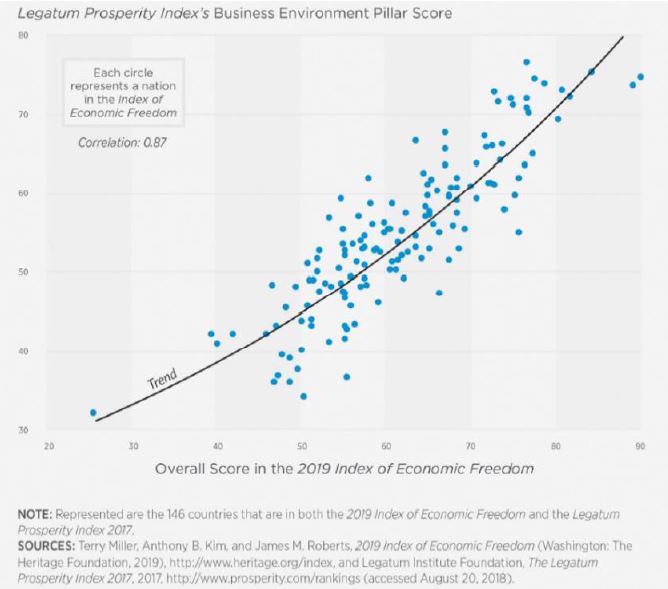
Not to mention that any eventual liability in the civil or criminal courts would reach the professional or even the association. That is exactly how the ratings given by credit rating agencies work,25 indicating who is a good payer and who may be insolvent.
The consumer would know they would be hired by the reputation of the professional association to which the contractor was linked, being able to filter who meets their financial capacity and personal interest. For example, lawyers' associations would compete to have the best lawyers in the market as members and would be extremely careful with rules of admission (requiring qualifications or tests) and expulsion in cases of misconduct (which would act as a disciplinary board) under penalty to see their reputation tarnished. As a profession that can cause concrete damage to the social order, some form of licensing of lawyers must be required, such as a college degree or an assessment test promoted by the State (never the two combined, which would be a double licensing), but it would not be necessary to join associations in order to represent a client's interests before a court.26 A lawyer could advance his career with his acceptance in initially simpler associations, and as he consolidated himself in the market, he would seek to join the most renowned ones. Dishonest lawyers would not be accepted in any serious association and would need to act on their own, eventually failing to get more clients and ending up excluded from this market by the consumers themselves. The market wins with increased competitiveness, the professional wins with freedom of action. The State wins with increased capital circulation and reduction of bureaucracy and, above all, the consumer wins with greater transparency, offer, and quality of products and services.
4 FREEDOM AND DEVELOPMENT
The Heritage Foundation classifies the economic freedom of countries in the world according to a scale ranging from 0 to 100 in four categories, each with three parameters.27 It is the average of these categories that defines the classification of the economy, being free (100-80),28 mostly free (79.9-70), moderately free (69.9-60), mostly unfree (59.9-50), and repressed (49.9- 40).
Brazil scores 53.7 and is in the 144th position of the ranking, being considered a mostly unfree economy.29 Scoring 49.5, the Democratic Republic of Congo, the first country in the range of repressed economies, is in position 162. Brazil is only four points, and eighteen positions, from economic repression. In the regulatory efficiency category, Brazil scores 60.5 in economic freedom, 49.5 in labor freedom, and 77.2 in monetary freedom. Freedom of business and work suffered a drastic decline between 2005 and 2015,30dropping from 70 points to less than 53.6 (graph 5). In 2017, after the labor reform, the rating rose to 61.3, and in 2020 it is scoring 60.5, close to the average of 63.8 that is counted for the world.
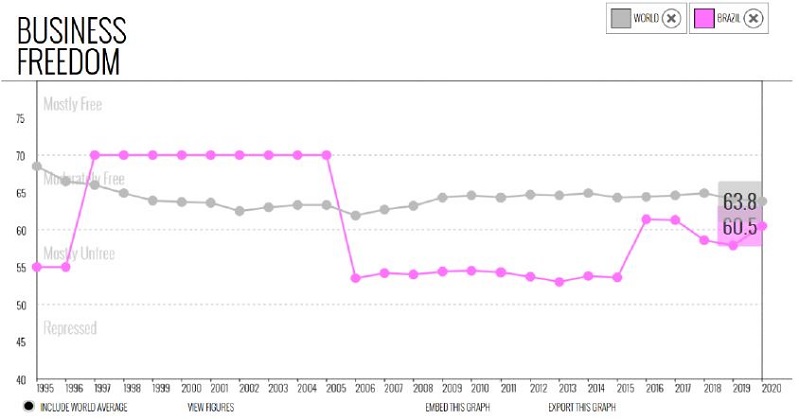
This drop comes as no surprise when these rates are confronted with the number of regulations approved in the period. Of the 16 regulatory laws created since 1988, 12 (75%) were enacted between 2007 and 2013. If we extrapolate these figures, we will notice that the entire economy ends up tied: by the criterion built throughout this article, only approximately 21% of the professions currently regulated should require state approval to be exercised, and none should be subjected to public professional councils. This logic of crossing so many functions through Law, regulation, and taxation makes the whole process of providing services more costly and usually slower and more bureaucratic. Innovation itself is directly hampered by the absence of freedom. The greater the freedom, the more innovation flows, an assertion easily observed when comparing countries with a free economy with those without freedom32 (graph 6).
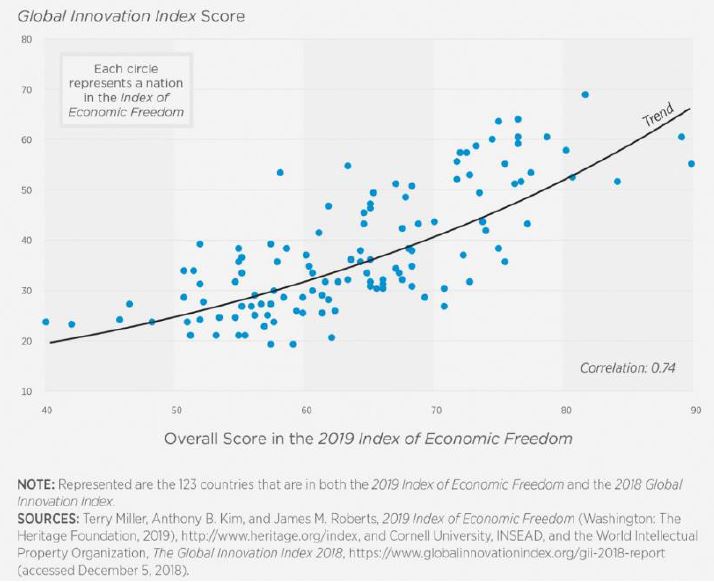
The free professional tends to have a greater incentive to innovate in view of constant competition, something that does not occur in a market that is strongly regulated and protected by market reserves.34 It is important to emphasize that poverty is directly proportional to intervention in the economy, which can be seen by the drastic drop in this figure, especially in the last three decades, after the average increase in the global economic freedom index (graphs 7 and 8). Once this logic is understood, it is possible to see that it extends to all social and economic fields. Countries with greater economic freedom are also those with the highest Human Development Index (HDI), security, educational quality, and efficiency of health systems.
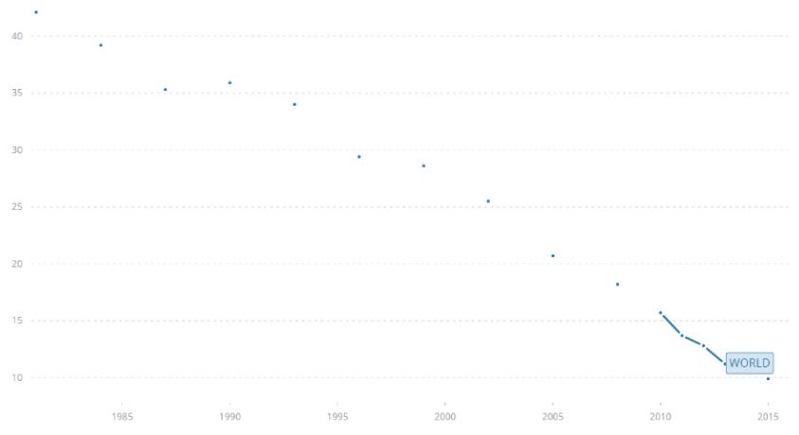
Graph 7
Poverty headcount ratio at $1.90 a day (2011 PPP) (% of population)
Source: (THE WORLD BANK, 2020).
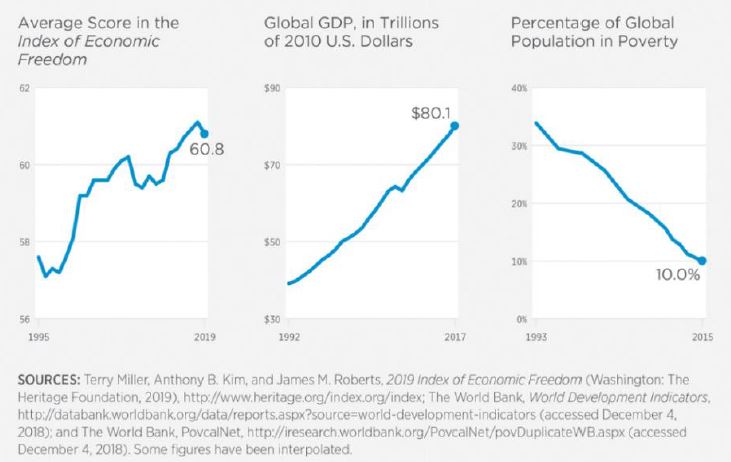
Graph 8
As economic freedom rises, the global economy expands and poverty falls
Source: (INDEX OF ECONOMIC FREEDOM, 2020).35
We will begin with the evaluation of the HDI measured by the UN, in which 188 countries are analyzed. Of these total, 49 are considered to be of very high human development (UNDP, 2019), with only 18 (37%) not being considered free or mostly free (INDEX OF ECONOMIC FREEDOM, 20 20) 36according to the Heritage Foundation ranking.37 Brazil is among the next 56, classified as high human development, in the 75th position. In the same category are four countries (7%) that are mostly free.38 The only six free countries all have a very high HDI.
Moving on to security assessment, according to the ranking of the World Economic Forum, which promotes the Global Peace Index (GPI) (VISIONS OF HUMANITY, 2020), among the 13 countries considered to have a very high peace status, only two (15%) are not free or mostly free by the Heritage Foundation scale,39 but all free ones are in that category. Brazil is ranked 126th out of a total of 163 countries and is considered of low peace. After the position 148th, countries are classified as having very low peace. Among the 64 medium and low peace countries, only 6 (9%) are mostly free,40 all the other 24 mostly free countries are of high peace.
This scenario repeats itself when evaluating the quality of education. In 2018, the PISA ranking assessed school performance among 15-year-old students in 78 nations under their knowledge in mathematics, science, and reading. The best results are those considered to have a score above 500 (FACTS MAPS, 2020). Among the 20 countries in this range, only 4 (20%) are not considered free or mostly free by the Heritage index.41 Once again, all free countries are top-ranked. In this list, Brazil is placed in 66th place and totals a score of 400 points, considered the worst classification for being below 450 points. Within the 34 countries with scores equal to or below 450, only 7 (21%) are mostly free.42
Finally, health is assessed by different criteria and research agencies. The most recognized that includes Brazil is Bloomberg (2020), which compares life expectancy, the cost of health care as a percentage of GDP, and the cost of health per capita to classify the world's health systems. According to the Bloomberg table, among the 20 most efficient countries in medical care, only 7 (35%) are not considered free or mostly free by Heritage.43 As in the other cases, the six freest countries are among those selected as the most efficient. The classification has 56 countries, and Brazil occupies the 51st position. Between the 20th and the 56th position, a total of 10 countries (27%) are free or mostly free.44
On the other hand, the reader may access the tables and references presented to check that the countries among the last positions in all indexes are necessarily the least economically free countries, as Brazil's own positions illustrate. Only three countries with low economic freedom were among the best placed in any of the four indexes presented: China and Greece in two and Argentina in one.
5 CONCLUSION
It is necessary to overcome the national imaginary that everything needs to be authorized by the State, requiring its prior evaluation for operation, or even that the State is more appropriate than the individual to assess whether one service provider is better or worse than another. The most successful countries in the world, by any measurable criteria, are also economically free countries, which necessarily involves untangled and unregulated professional practice. Five of the six countries considered free by Heritage Foundation were among the best classified in the four indexes presented in this paper, as well as two countries that are considered mostly free.
It is important to emphasize that deregulating or freeing professional practice is not a synonym for the State to abstain completely from acting. In fact, it will reserve its interventions to efficiently license the few professions that need it or to curb cases of abuse in professional practice that need the State to mediate the solution. In this scenario, professional conduct is no longer the subject of administrative procedures and is now sanctioned in civil and criminal courts or, even worse, condemned to the ostracism of the consumers, a life sentencing penalty.
The structure of the councils itself has difficulties in keeping up with the current speed of technological and human development. To concentrate control of the professionals' performance in a country with continental dimensions like Brazil, and of a dynamic society like the contemporary one, in federal and regional public agencies, is the same as to sentence them to failure or unproductivity.
To free the professional work is an essential step to stimulate the national economy, generating wealth and potentially raising other national parameters such as human development, security, education, health, and peace. It may be necessary to finish cutting the regulatory ties that unite Brazil of today to that of totalitarian periods in our history and bet on a future of greater freedom, targeting the free and prosperous nations without ever renouncing individual achievements over the centuries.
REFERENCES
ARENDT, Hannah. Origens do totalitarismo. São Paulo: Companhia das Letras, 1989.
BLOOMBERG. These Are the Economies with the Most (and Least) Efficient Health Care. Available at: https://www.bloomberg.com/news/articles/2018-09-19/u-s-near-bottom-of-health-index-hong-kong-and-singapore-at-top. Accessed on: 15 June 2020.
BRASIL. Supremo Tribunal Federal. ADI 1.717-6. Relator: Ministro Sydney Sanches. Diário de Justiça Eletrônico, Brasília, 7 nov. 2002. Available at: http://redir.stf.jus.br/paginadorpub/paginador.jsp?docTP=AC&docID=266741. Accessed on 21 Mar. 2020.
CARVALHO FILHO, José dos Santos. Manual de direito administrativo. Rio de Janeiro: Editora Lumen Juris, 2011.
CLASSIFICAÇÃO BRASILEIRA DE OCUPAÇÕES (CBO). Ministério do Trabalho. Listagem das profissões regulamentadas: normas regulamentadoras. Available at: http://www.mtecbo.gov.br/cbosite/pages/regulamentacao.jsf. Accessed on: 21 Mar. 2020.
CLASSIFICAÇÃO Internacional Normalizada da Educação: áreas de formação e treinamento 2013 (Cine-F 2013): descrição das áreas detalhadas. Tradução Andreza J. Meireles. Brasília: Inep, 2017.
COPOLA, Andrela Lo Buio. Veja os riscos de contratar um funcionário como pessoa jurídica. Exame, 9 mar. 2017. Available at: https://exame.abril.com.br/pme/veja-os-riscos-de-contratar-um-funcionario-como-pessoa-juridica/. Accessed on: 21 Mar. 2020.
DWORKIN, Ronald. O Império do Direito. São Paulo: Martins Fontes, 1999.
EXAME. A regulamentação da atividade de coaching pode acabar com os picaretas? Available at: https://exame.abril.com.br/carreira/a-regulamentacao-da-atividade-de-coaching-pode-acabar-com-os-picaretas/. Accessed on: 21 Mar. 2020.
FACTS MAPS. PISA Worldwide Ranking: average score of math, science, and reading. Available at: https://factsmaps.com/pisa-2018-worldwide-ranking-average-score-of-mathematics-science-reading/. Accessed on: 15 June, 2020.
FRIEDMAN, Milton. Capitalismo e liberdade. Rio de Janeiro: LCT, 2019.
GANDRA, Ives da Silva Martins; MENDES, Gilmar Ferreira; NASCIMENTO, Carlos Valder do. Tratado de direito constitucional. 2. ed. São Paulo: Saraiva, 2012. v. 1.
GLOBAL RESEARCH. China and Russia to Launch Credit Rating Agency that will Challenge the US Financial System. Available at: https://www.globalresearch.ca/politics-financial-fraud-and-the-big-three-credit-ratings-agencies/5428603. Accessed on: 21 Mar. 2020.
GOVINFO. The Financial Crisis Inquiry Report: Final Report of the National Commission on the Causes of the Financial and Economic Crisis in the United States . Available at: https://www.govinfo.gov/content/pkg/GPO-FCIC/pdf/GPO-FCIC.pdf. Accessed on: 15 June 2020.
INDEX OF ECONOMIC FREEDOM. Brazil. Available at: https://www.Heritage.org/index/country/brazil. Accessed on: 15 June 2020.
INDEX OF ECONOMIC FREEDOM. Business freedom. Available at: https://www.Heritage.org/index/visualize?cnts=brazil&type=1. Accessed on: 15 Jun. 2020.
INDEX OF ECONOMIC FREEDOM. The Power of Economic Freedom. Available at: https://www.Heritage.org/index/book/chapter-4. Accessed on: 15 June 2020.
MARX, Karl. O capital, livro I. São Paulo: Boitempo, 2019.
MARTINS, Ives Gandra da Silva; MENDES, Gilmar Ferreira; NASCIMENTO, Carlos Valder do. Tratado de direito constitucional . 2. ed. São Paulo: Saraiva, 2012. v. 1.
MISES, Ludwig von. Ação Humana. São Paulo: Instituto Ludwig von Mises Brasil, 2010.
MUSSOLINI, Benito. O Estado corporativo. Available at: https://www.portalabel.org.br/images/pdfs/o-estado-corporativo.pdf. Accessed on: 21 Mar. 2020.
NOVELINO, Marcelo. Curso de direito constitucional. 11. ed. Salvador: Ed. JusPodivm, 2016.
OUR WORLD DATA. World GDP over the last two millennia. Available at: https://ourworldindata.org/grapher/world-gdp-over-the-last-two-millennia. Accessed on: 19 June 2020.
OUR WORLD IN DATA. Economic Growth. 2013. Available at: https://ourworldindata.org/economic-growth. Accessed on: 12 June 2020.
OUR WORLD IN DATA. GDP per capita, 1870 to 2016. 2016. Available at https://ourworldindata.org/grapher/average-real-gdp-per-capita-across-countries-and-regions. Accessed on: 22 Oct. 2020.
RBA. PEC 108: desmonte de conselhos profissionais representa mais riscos à população. 2019. Available at: https://www.redebrasilatual.com.br/cidadania/2019/07/pec-108-bolsonaro-conselhos/. Accessed on: 21 Mar. 2020.
ROTHBARD, Murray N. Governo e mercado: a economia da intervenção estatal. Tradução de Márcia Xavier de Brito e Alessandra Lass. São Paulo: Instituto Ludwig von Mises Brasil, 2012.
SCHUMPETER, Joseph A. Capitalismo, Socialismo e Democracia. Rio de Janeiro: Editora Fundo de Cultura, 1961.
SILVEIRA, Daniel; ALVARENGA, Darlan. Trabalho informal avança para 41,3% da população ocupada e atinge nível recorde, diz IBGE. G1, 30 ago. 2019. Available at: https:// g1.globo.com/ economia/ noticia/2019/08/30/trabalho-informal-avanca-para-413percent-da-populacao-ocupada-e-atinge-nivel-recorde-diz-ibge.ghtml. Accessed on: 21 Mar. 2020.
SMITH, Adam. A Riqueza das Nações. São Paulo: Editora Nova Cultural Ltda, 1996.
SOWELL, Thomas. Basic economy: a common sense guide to the economy. New York: Blackstone Publishing, 2011.
THE WORLD BANK. Poverty headcount ratio at $1.90 a day (2011 PPP) (% of population). Available at: https://data.worldbank.org/indicator/SI.POV.DDAY. Accessed on: 15 June 2020.
UNDP. Ranking IDH Global 2014. Available at: http://www.br.undp.org/content/brazil/pt/home/idh0/rankings/idh-global.html. Accessed on: 29 jul. 2019.
USA TODAY. 2008 crisis still hangs over credit-rating firms. Available at: https://www.usatoday.com/ story/money/business/2013/09/13/credit-rating-agencies-2008-financial-crisis-lehman/2759025/. Accessed on: 15 June 2020.
VISIONS OF HUMANITY. 2020 GLOBAL PEACE INDEX. Available at: http://visionofhumanity.org/app/uploads/2020/06/GPI_2020_web.pdf. Accessed on: 15 Jun. 2020.
Notes
Declaramos que o artigo intitulado “Regulated professions and professional councils: an analysis in the light of liberal doctrinal teaching”, submetido à revista Opinião Jurídica, representa fruto das pesquisas desenvolvidas pelos autores, sobretudo no âmbito das atividades da matéria de Filosofia do Direito, ministrada no curso de mestrado em direito do UniCEUB, tendo ambos realizado, concomitantemente, as tarefas de seu planejamento, execução e revisão da seguinte forma: 1) Luís Carlos Martins Alves Jr.: apresentado a base teórica e referencial bibliográfico, além de desenvolver especificamente a Seção correspondente às leis de profissões reguladas; e 2) Paulo Ricardo Aguiar de Deus: desenvolveu especificamente a metodologia da tabela de profissões, bem como a Seção de conselhos de classe e impactos na economia por sociedades economicamente mais ou menos livres. Por ser verdade, firmamos o presente em Brasília e São Paulo, em 23 de outubro de 2020.
Author notes
