Articles
Received: 12 September 2018
Revised document received: 18 November 2018
Accepted: 22 January 2019
Published: 06 March 2019
DOI: https://doi.org/10.22633/rpge.v23i2.11762
ABSTRACT: In education, the moments where the administrators of the institution and the faculty members need planning and organizing ideas are countless. One specific and complex moment that precedes the academic year is academic planning. To innovate in this area, it was built a Canvas model that attended to our institutional needs and to the revival challenges of the teaching-learning plan and bigger integration of the faculty members along with activities that used the Design Thinking tool to systematically approach problem-solving. The results obtained show that a more creative and encouraging environment enabled pointing out in a broader way the aspects of the ideas created and refined, stimulated the creation of a large number of ideas in a short space of time and helped validate ideas by reducing uncertainties, besides identifying which thought out solutions made more sense to the participants with regard to the proposed challenge.
KEYWORDS: Canvas, Design Thinking, Education, Innovation, Planning.
RESUMÉN: En la educación, los momentos en que los gestores de la institución y el cuerpo docente necesitan organizar las ideas y planear son diversos. Un momento específico y complejo que precede el inicio del período lectivo es el planeamiento académico. Para innovar en el planeamiento académico fue construido un modelo Canvas que se adecuara a las necesidades institucionales y a los desafíos de revitalización del plan de enseñanza aprendizaje y mayor integración del equipo docente aliado a actividades que utilizaron la herramienta Design Thinking para un abordaje sistémico en la solución de problemas. Los resultados obtenidos demuestran que el ambiente más motivador y creativo posibilitó apuntar de forma más amplia los aspectos de las ideas creadas y refinadas, estimuló la generación de un gran número de ideas en un tiempo curto y ayudó a validar ideas reduciendo incertidumbres, además de identificar cuáles de las soluciones pensadas tienen más sentido para los participantes en relación al desafío propuesto.
PALABRAS CLAVE: Canvas, Design Thinking, Educación, Innovación, Planeamiento.
Introduction
The education of the 21st century directs educational institutions to breaking paradigms and disrupting traditional methods (CAVALCANTI; FILATRO, 2016). In an age of hybrid teaching, active methodologies, teaching customization, and other trends that support change, educational institutions need to focus on academic planning, at which point all of the change factors cited above should be put in the pipeline. Since in this new scenario we have a shift from teacher to student focus, from teaching to learning, it is necessary a reflection on leadership style, investments in academic innovation and educational technology, strengthening of integration and review the concepts of evaluation and prioritize student learning (RICIERI; BAHIENSE, 2016). The course coordinator is still a project manager because he needs to manage the academic planning and the people involved in it: teachers, students and institution, with communication and interested parts management being the biggest challenges today.
The objective of this work was the creation of a Canvas model for education with a specific focus on academic planning by merging Design Thinking tools during the creative process of the semi-annual planning meetings of the institutional (biological, human, and exact) axes of the São Camilo University Center - SP, with the aim of improving communication between groups, stimulating creativity and revitalizing the teaching plans of undergraduate courses involved in the process.
Methodology
Seven traditional Canvas models applied to business management were analyzed and from them a model was constructed that adapted to the institutional needs and the challenges of revitalization of the teaching learning plan and greater integration of the teaching staff. The template that is created requires that the team indicate the potentials of the current plan and how to maximize them, the weaknesses of the current plan and how to overcome them, the strategies for achieving those goals, and a timeline for planning the changes. With regard to Design Thinking at the beginning of the works, the tools of Brainstorming were used and, in the sequence, applied a Workshop of Creation allied to the use of Canvas.
Theoretical fundaments
The CANVAS (Business Model Canvas) is a tool for modeling business and new / innovative projects, with the aim of undertaking with greater probability of success, for allowing the organization of ideas and the flow of actions and probable reactions of a product or value. In education, the times when institution managers and faculty need to organize ideas and plan are diverse and accompanied by numerous meetings and discussions. A specific and complex moment that precedes the beginning of the academic period is the academic planning where the teachers and managers have the task of constructing an outline of what is expected during the course of the semester classes. The speed of changes in all areas of knowledge and the fusion of knowledge in many areas has made the concepts, use and examples of the business model (Canvas) pioneered used in enterprise administration migrate to other areas such as education (SEBRAE, 2013).
The Canvas model brings the possibility of visualizing the description of the business, of the parts that compose it, so that the idea about the business is understood by those who read through visual resources from a collaborative work.
Thinking design is a systemic approach to problem solving that decentralizes the practice of designing from the hands of specialized practitioners by allowing their principles to be employed by people working in varied professional fields. In the use of Design Thinking, individual work is replaced by group work in the search for the development of solutions, products, services and processes (LIEDTKA; OGILVIE, 2015; CAVALCANTI; FILATRO, 2016; BROWN, 2017).
The use of CANVAS, together with the methodology of Design Thinking in education, allows a traditional academic planning to become a creative, action-oriented planning and collaboration, allowing a greater demonstration of ideas in order to receive feedback and increase awareness about the process in question. It proposes the solution of problems from the practice of empathy, which places the people involved at the center of the process and within the context in which the challenging situation occurs (VIANNA et al., 2011, CAVALCANTI; FILATRO, 2016).
Each discipline or curricular unit has the possibility of developing a canvas model for the modeling of its functioning, bringing together concepts, organization and planning that go beyond the pedagogic label, but which work the essence of the new teaching role before the modern education of the century XXI (RICIERI; BAHIENSE, 2016).
Innovation in education has been a focus of interest among educators, researchers and managers, being one of the words of exponential increase in the INEP evaluation instruments when comparing the instrument of 2015 with that of 2017. Academic innovation goes beyond the use of ICTs and active methodologies, as a basis for sound academic planning. The use of tools such as Canvas and Design Thinking predisposes planning meetings to an environment conducive to the process of designing new ideas that can be applied to teaching and learning plans of curricular units or disciplines and also to the identification of changes resulting from the implementation of what was created, adapted, extended (CAVALCANTI; FILATRO, 2016).
Results
The meetings began with the use of the Brainstorming technique to stimulate the generation of a large number of ideas in a short period of time. It was held in groups of related disciplines and led by a moderator, responsible for leaving participants at ease and stimulating creativity without letting the group lose focus. For this particular case an activity was applied where each participant raffled a random image and defined in a single word the meaning of the image in relation to the meeting proposal (revitalization of the teaching learning plan) by pasting a post-it behind the photo. Then the images were passed by all participants who also performed the task without looking at the words of others. After completing the round, each participant had to see all the words assigned to his image, order them as a story and explain the context to the others. This technique assists in the generation of a great volume of ideas allowing a rich approach to create ideas on the relevant issues that are born in the following stages.
Next, we put into practice the Workshop using the Canvas during the process. This workshop is a group activity with the aim of stimulating creativity and collaboration, fostering the creation of innovative solutions. The work with data that aggregates knowledge of different teachers from different areas is very useful, where new visions about traditional ideas become necessary.
Our activity could be divided into 3 steps: First step: first participants were asked to note in a yellow post-it the potential of the current teaching plan and in another yellow post-it what weaknesses of this same plan and paste in the canvas frame (Figure 1).
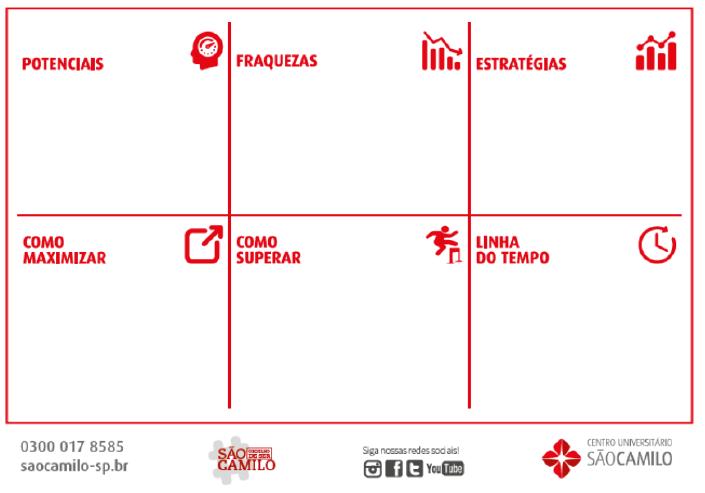
Figure 1
CANVAS model created for academic planning
Source: São Camilo University Center (2018) - adapted by the author
In the sequence we asked teachers to go to the board, read the listed potentials as well as the weaknesses and discuss whether there were overlaps, repetitions and/or synonyms that could be grouped together. Second step: Then we asked the teachers to go back to their posts and write in a green post-it how to maximize the potentials and in another green post-it how to overcome the weaknesses and paste in the Canvas frame. Once again the study of overlaps, repetitions and/or synonyms and the rearrangement of the information from the group discussion were done.
Third step: The activity manager causes a discussion about the strategies for revitalizing the teaching plan in groups of related disciplines and each wrote his suggestion in a blue post-it and in the sequence glued in the Canvas frame his suggestion. At the end of this stage, the proposals were read, the most relevant validated and the creation of a prototype still in the Canvas frame of a timeline for the implementation of the changes.
The finalization of the work had space in subsequent meetings so that the changes were inserted in each one of the discipline plans. We observed that there was a greater approximation between the disciplines with greater affinity, being possible that the plan of each one of them was redesigned with more integration of the themes and more coherent schedules with the sequence of subjects, showing to the student that there is a commitment of the faculty team in subsidizing the student body with more consistent plans. There was an alignment of teaching and assessment methodology through the use of the suggestions extracted from the group during the co-creation workshop, and it could insert active teaching methodologies in most disciplines after the discussion of the "how" and "when" to use in the group. Finally, the teachers generated a planning document for a semester, but with the commitment to extend the changes in a future reformulation of the disciplines as a whole.
Final considerations
Because Canvas is a visual representation of the design plan where the team prototype the mental model of its academic planning and Design Thinking is a problem-solving methodology that enables the construction of desirable, workable, and feasible responses, the union of these 2 methodologies generates a motivating and creative environment for the construction of a co-participative and active planning. In this space the coordinator and his team of teachers make the prototype of the mental model of his academic planning. The results show that the more motivating and creative environment enables a broader focus on the aspects of created and refined ideas, stimulates the generation of a large number of ideas in a short period of time, and helps validate ideas by reducing uncertainties, helping to identify which of the solutions thought make the most sense for the participants in relation to the proposed challenge. We were able to select disciplines titles and syllabus to be revitalized, approach related disciplines with content integration, updating of teaching and evaluation methodologies and plan to undertake a general reformulation in the subjects in 2019.
REFERENCES
BROWN, T. Design Thinking uma metodologia poderosa para decretar o fim das velhas idéias. Alta Books, 2017.
CAVALCANTI, C. C.; FILATRO, A. Design Thinking: na educação presencial, a distancia e coorporativa. Ed. Saraiva, 2016.
LIEDTKA, J.; OGILVIE, T. A magia do design thinking - um kit de ferramentas par o crescimento rapido de sua empresa. HSM, 2015.
SEBRAE. Cartilha: O quadro de modelo de negócios - um caminho para criar, recriar e inovar em modelos de negócios 2013.
VIANNA, M. et al. Design thinking - inovação em negócios. MJV press, 2011.
VINHA RICIERI, D. D.; LUCIA ANDRADE BAHIENSE, V. Canvas A visão INNOVARES do Business Model Canvas para Educação. Rede Innovares de conhecimento, 2016.
