Relatos de Experiência
THE SCHOOL EVERYDAY AND THE PERMANENT TEACHING EDUCATION IN CONTEXT: EXPERIENCE REPORT
O COTIDIANO ESCOLAR E A FORMAÇÃO CONTINUADA DOCENTE EM CONTEXTO: RELATO DE EXPERIÊNCIA
EL COTIDIANO ESCOLAR Y LA FORMACIÓN CONTINUADA DOCENTE EN CONTEXTO: RELATO DE EXPERIENCIA
 Ivan FORTUNATO ivanfrt@yahoo.com.br
THE SCHOOL EVERYDAY AND THE PERMANENT TEACHING EDUCATION IN CONTEXT: EXPERIENCE REPORT
Revista on line de Política e Gestão Educacional, vol. 24, no. 3, pp. 1666-1678, 2020
Universidade Estadual Paulista Júlio de Mesquita Filho, Faculdade de Ciências e Letras
Received: 20 May 2020
Accepted: 25 August 2020
Published: 01 September 2020
ABSTRACT: This paper reports an experience of continuous formation developed with teachers of a state school, from the regional board of Itapetininga, during an Hour of Collective Pedagogical Work (ATPC, in Portuguese). It is the description and analysis of a formative activity, focused on the perception of the daily school life experienced, with the purpose of promoting constant reflection, necessary for the development of teaching. The main objective of the article is to demonstrate, by means of an example, how the practice of a process of continuous formation by the partnership can be, but, mainly, to put in evidence fundamental questions of the own continued formation, that can never be reduced to a single activity. In the end, it is hoped that the reported experience will serve only as an initial marker for the constant assumption of training activities in schools.
KEYWORDS: Teacher education, Permanent education, Experience report.
RESUMO: Este artigo relata uma experiência de formação continuada desenvolvida com professores de uma escola estadual, da diretoria regional de Itapetininga, durante uma Aula de Trabalho Pedagógico Coletivo (ATPC). Trata-se da descrição e análise de uma atividade formativa, voltada para percepção do próprio cotidiano escolar vivido, com o propósito de promover a reflexão constante, necessária para o desenvolvimento da docência. O objetivo principal do artigo é demonstrar, por meio de um exemplo, como pode ser a prática de um processo de formação continuada pela parceria, mas, principalmente, colocar em evidências questões fundamentais da própria formação continuada, que jamais se encerra em uma única atividade. Ao final, espera-se que a experiência relatada sirva somente como um balizador inicial para o agenciamento constante de atividades formativas nas escolas.
PALAVRAS-CHAVE: Formação continuada, Formação de professores, Relato de experiência.
RESUMEN: Este artículo relata una experiencia de formación continuada desarrollada con profesores de una escuela estatal, de la dirección regional de Itapetininga, durante una Aula de Trabajo Pedagógico Colectivo (ATPC). Se trata de la descripción y análisis de una actividad formativa, orientada a la percepción del propio cotidiano escolar vivido, con el propósito de promover la reflexión constante, necesaria para el desarrollo de la docencia. El objetivo principal del artículo es demostrar, por medio de un ejemplo, cómo puede ser la práctica de un proceso de formación continuada por la asociación, pero, principalmente, poner en evidencias cuestiones fundamentales de la propia formación continuada, que jamás se encierra en una única actividad . Al final, se espera que la experiencia relatada sirva solamente como un balizador inicial para el agenciamiento constante de actividades formativas en las escuelas.
PALABRAS CLAVE: Formación continua, Formación de professores, Relato de experiencia.
Introduction
We cannot separate the formation from the work context, because we would be mistaken in our speech. In other words, everything that is explained is not for everyone and does not apply everywhere. The context will condition the training practices, as well as their repercussion on teachers, and, without a doubt, on innovation and change2 (IMBERNÓN, 2009, p. 9).
This paper aims to describe and analyze the result of a training experience carried out in a state school, in the region of Itapetininga, in the southwest of São Paulo, during a weekly period destined to the continuous training and constant teacher training named the Collective Pedagogical Work Class - ATPC, in Portuguese. Methodologically, therefore, it is an experience report which has been worked systematically as an instrument for and for educational research, composed of several elements, including: antecedents for the action, the place, the reason, the agent (s) ( s), those involved, an epistemology for action, planning, execution and analysis through a theoretical lens ( FORTUNATO , 2018a).
To develop this account, the paper was organized into four sessions. In the first, we sought to contextualize the experience, including the first five elements, namely: (1) antecedent, (2) location, (3) reason, (4) agent and (5) involved. In the following section, (6) epistemology for action was dealt with exclusively, as it is a matter of reflecting more deeply on continuing education, particularly in context, as envisaged in the epigraph. The third section deals with describing the (7) plan and (8) action carried out at the ATPC, detailing the planned strategy, its development and the developments. Finally, a (9) theoretical lens is placed, also anchored in contextual training, in order to understand the action, as well as to identify limitations and possibilities for future actions.
In the end, it is expected that the sharing of this experience report will be taken only as it essentially is: an experience, carried out in a moment, with a collective teacher, to deal with the daily life of a school. For this reason, it is not configured as an invariable proposal, which should and must be replicated often. Even so, there is hope that it will serve as a subsidy for constant reflection on continuing education for teachers in office.
Presentation and context
In the case of this experience, the development of an extension course, named “Pedagogical Knowledge: perspectives and trends”, which was offered in 2018, through a partnership between the Federal Institute of São Paulo and the Education Board, for about 40 participants, the target audience being supervisors, principals and coordinators of schools of basic education. The course was worked from an action research perspective, in which the participants were encouraged to reflect on some fundamental considerations regarding the teaching profession, relating them directly to the particularities of their lived school routine. During the course, it is possible to reflect on the concrete reality of each school unit, in addition to sharing positive knowledge and experiences, with the collaborative objective - more about the course development can be read in another experience report (FORTUNATO, 2018b) . Thus, one of the course participants, the school director, liked the approach and understood that it would be interesting to extend part of the training work to all teachers at the school under her management. Then came the invitation to attend one of the regular ATPC, with the purpose of sharing, with the collective of teachers, a little bit about the central theme of that extension course.
The place of action became this state school, from the Education Directorate of the Itapetininga region. There are some very noticeable particularities in this school, such as, for example, its location: it is in a transition neighborhood between the city and its rural area, with a large part of the students being boys and girls who live on farms and far from the classrooms. Some students, reports the school principle, travel about 40 kilometers daily between home and school. Another characteristic that makes it distinct is its size: only three classrooms, totaling six distinct classes exclusively, from the seventh year of elementary school to the third year of high school, without night classes. This obviously impacts the number of teachers, with only 13 teachers, all of whom are permanent.
The reason, although it was mentioned earlier that the board showed interest in updating the extension course in another opportunity, before the realization of training activity, presented two new arguments for this work. The first was related to the motivation of the teaching staff, who, always committed to the school and its students, would only benefit from the possibility of talking more about their own profession. Second, and more important, was the need to maintain cohesion in the group, as they were facing difficulties of indiscipline and small acts of vandalism with a specific group of teenagers, which was not common in that school. Nothing serious, it was reported. However, the difficulties in disciplinary control of this room, some damage to curtains and chairs were things that were bothering a good portion of the faculty, needing a closer look at maintaining a cohesive and cooperative collective, the result of years of investment in team management.
Having established the place and the reason for the experience, it is possible to present the human elements of the action, being the agents and those involved. I became an agent of this formative work because of my previous experience, on the occasion of the extension course offered in partnership with the Board of Education. I have some credentials that qualified me for this task of working in continuing education, since I have been a teacher for more than ten years, coordinator of the undergraduate teacher training course, and an accredited teacher in the Graduate Program in Education, at the University Federal de São Carlos, Sorocaba campus, in the line of Teacher Training and Educational Practices. Still, I have sought to put the will to learn and the constant reflection on the daily challenges of teaching as much more significant elements that the descriptors themselves that, in appearance, give credibility to that it speaks to respect the professionalism and the exercise of teaching.
As for those involved, as outlined above, they are part of the effective teaching staff of the school, who meet weekly at the ATPC to discuss matters related to the school, the classrooms, news in terms of regulations and decrees, in short, themes of the profession. Their teaching experience varied considerably, as in any group of teachers, with teachers with three years of experience and others with more than 15. The group is quite integrated, working in the school under the same direction for more than a decade, having enough time to get to know and establish fraternal ties, going beyond the coexistence of office. This description served as a basis for thinking about the form of collective work, as it was not an action to strengthen the team, but an invitation to reflect on the contingencies of daily life that would be interfering, positively and / or negatively, in the action teacher.
From the epistemology of continuing education in context
The last 30 years of the 20th century have left us with significant advances in continuing education: the strict criticism of technical-training rationality; an analysis of training models; criticism of the organization of those responsible for training; enhancing the training of process advisors; the analysis of the modalities that imply a greater or lesser change; training close to educational institutions; the processes of action research as a procedure of challenge and criticism and action-reflection for educational and social change, with a theoretical teacher-researcher; greater knowledge of reflective practice, institutional training plans, as well as greater theorizing on the issue. These are concepts that still appear mainly on papers (and, of course, some I fail to mention), and, although they pass far from many points of the training practice, they remain in the printed letter3 (IMBERNÓN, 2010, p. 8).
The quote seeks to highlight what can be called the paradox of teacher training: the production of theory and the concrete reality of places of education still seem to be unknown to each other. For, as the author stated, there is enormous development “on paper”, but stagnation in “training practice”. In a way, I cannot help agreeing with the above, having as evidence my own schooling (which is limited and arbitrary), but also diverse readings, including the intensely critical book “Beware, School!” (HARPER et al., 1987), in addition to direct contact with educational institutions as a trainer, for almost a decade. For this reason, I have tried to articulate practices like the one described in this report, because, although insufficient to eliminate the discrepancies between what was thought and what was done, they tend to lessen the training paradox. It is training in context, as recommended by Imbernón (2010) in the title.
Inforsato and Passalacqua (2018) prepared a study to review national theses and dissertations that corroborate the ideas of the evolution in teacher education listed in the title and the training proposal in context. According to the authors, there was growing concern about the initial and continuing education of teachers in the country, as a reflection of the educational policies promoted based on the Law of Guidelines and Bases of National Education, Law no. 9394/96. In the 1990s, something like 15% of the national graduate production inventoried by the authors was focused on continuing education in service (now referred to as “in practice”), and at that time, technical rationality was beginning to be overcome by reflective training and research more immersed in the field of teaching.
Throughout their systematic survey, Inforsato and Passalacqua (2018) found a consensus among the authors of the theses and dissertations that the theory should be developed with a view to reflective, cooperative practice and that values both knowledge and teaching experience, being that, they point out, “continuing education actions must be carried out within the school space, in the exercise of the teaching function and based on the needs of teachers” (p. 44). Without this context, what one has are allegorical and/or vague and/or random and/or authoritarian training practices, unable to mobilize the constant and necessary renewal of teaching action. Worse, as attested by Menezes (2003), disrespecting the knowledge and experience of the teachers to be trained.
In the same direction, explains Gatti (2003, p. 192) that “programs that aim at cognitive changes, practices, postures, are ineffective. Its centralization only on individual cognitive aspects comes up against social representations and group culture”. With that the author wants to draw attention to the training out of context, that is, one that is intended to teach something across the board to a group of teachers, without considering minimum that is, the reality in which they operate.
Thus, it is evident that to propose actions aimed at continuing education in practice, it is necessary to understand the context. This has been done through questions that help to investigate the circumstances of each location: who are the teachers? Where are? Who do you work with on a daily basis? What collective difficulties do you face at the moment? What does it matter to learn from this educational action, or rather, where should they focus the action? In this way, continuing education is understood in the same way as Menezes (2003, p. 313), that is, articulating the “commitment of educators to change and the continuous construction of their education, seeking to give meaning to the theory linked to practice”.
With that, it becomes possible to present a summary of what is understood as continuing education in context, which has marked out experiences such as the one described and analyzed here. First, the actions are developed in the school environment itself, as it is this place that should be reflected on more broadly and specifically. Second, the theory we work on must be chosen from the themes generated in, by and for everyday life; this does not mean acting in the strict solution of a problem, nor promoting training actions only when faced with an adverse situation, as its essence should not be the solution of problems, but, rather, the constant reflection caused by a critical and investigative posture. Third, it is necessary to always consider the individual and collective teaching knowledge already built by previous training and experience, evidencing them by sharing in the dialogued action, collaborating so that the group formulates hypotheses and enables methods that can be developed by the group itself. . This is because the training agent leaves the context at the end of the process, while the teachers there remain, daily, with the responsibility of educating.
Obviously, this summary does not cover all the complexity of teacher training in context. It becomes just a formula enough to promote action. It's not ready and it's over. On the contrary, it is configured metaphorically as a stopping point in the existential continuum of training, which will provide new elements for new reflections on teaching.
About the mentioned experience: from plan to action
In teacher training, multiple factors influence, such as, for example, the culture and complexity of educational institutions, communication between teachers, initial training received, the complexity of interactions in reality, school leadership styles, relationships and understanding by the school community, the relationships and support systems of the professional community, etc. In this complex scenario, the problematic situations that appear are not only instrumental, since they oblige the educator to elaborate and construct the meaning of each situation [...] The teaching profession has always been complex because it is a social phenomenon, since in an institution In an educational and classroom setting, quick decisions must be made to respond to the parts as a whole, the simplicity or the apparent linearity of what lies ahead and the complexity of the environment that concerns4 (IMBERNÓN, 2010, p. 100).
With this quote we reinforce the complexity that involves dealing with teacher training, after all, there are multiple, confluent and / or congruent elements that interfere and modify daily teaching practice, which can even be considered situational. Thus, only in possession of the information presented in the context of this experience - in which the antecedent was outlined for the action to be promoted, the school was described as a place, the generating reasons were identified and the teaching group involved - set out to the planning of what would be accomplished during the time available for training work: an ATPC that, in this school, lasts two hours / class per week, that is, one hour and forty minutes. At that time, it was necessary to realize, therefore, two fundamental things: to call attention to the problem situation experienced with indiscipline and some damage to the heritage, but, mainly, to show the collective harmony that had been established over the years of living together in school.
Must register that key parts for the proper development of the activity were previously developed by the school’s principal: signal the faculty to work agenda, with the participation of an external agent to the collective, which works directly with the teacher training, plus d and provide the data already marked as background, allowing a proposal to be elaborated in context. Thus, a dynamic activity was projected for ATPC to be carried out in three stages, named as follows: (1) individual reflection, (2) collective construction and (3) sharing.
So, on the right date and time, we meet in the room where ATPC is usually held, which is one of the school’s three classrooms. The place was organized as a semicircle, which is the disposition usually used in the collective moments of the ATPC, revealing excellent regular practice of these moments of weekly pedagogical work. In the case of our experience, after the welcome given by the director and the formal presentation of who would conduct the activity that night, we have already started on the planned work, starting with step I, individual reflection.
Despite all the previous preparation, it was necessary to start the ATPC with some guidelines for the work, quickly recovering the direct role in the initial training of teachers as a teacher for a few years ago, the role in coordinating the course and supervising specific masters’ thesis in the line teacher training. I reinforced the extension course held at the Education Directorate, during which we discussed the updating of ideas regarding “pedagogical knowledge”. Finally, I explained that there was a greater purpose for that activity, which would be to leave some elements for it to go beyond itself, that is, that our work at that ATPC was not considered finished that day, but that, in a way, it started at that meeting. For this, it was said that it was necessary to face the activity in this way, letting it echo later in the exercise of the profession.
Thus, a red card paper was given to each of the teachers present, accompanied by the following motto: “individually, invest time, something close to five minutes, to record in this this red card negative/problematic/ unwanted elements of teaching, evidenced in the daily life of the school”. It was reinforced that this stage was individual, in which each one would write down, using keywords, what he considered unsatisfactory aspects of the profession. Here, then, another green card was delivered with a very similar motto: write down keywords that represented a thought, but this time about positive / triumphant / desired aspects of the teaching routine ... that I leave a note here about that first stage, so that I can reflect more deeply on it at another time: five minutes seems to be a long time to write down the bad part of the thing, as if the focus was always directed to the red card because, in the same five minutes, most green cards remained practically intact, with only one or two records.
After the first stage was completed, we moved on to the next stage, that of collective construction. Gathered in three small groups, they were asked to read their keywords registered on the two cards, explaining the choice of each one, defining situations that highlighted each negative or positive aspect. At first, while one told about his keywords, the others should just listen, without interference (note: doing this effectively is very difficult). Then, they were asked to choose what they had in common, even if, for that, it was necessary to create new keywords. There would also be a third currency for the second stage, so we had something around 20 minutes for these moments of explanation and rework of the keywords.
We started, then, to the last activity of the second stage, in which each of the groups had as a challenge and objective to select which keyword elaborated / selected collectively would be brought for the sharing of all groups. It was not a matter of listing one of each card, as if it were creating a counterpoint between the negative and the positive, but, choosing one, it was something identified as a problem or triumph of the profession. After almost 50 minutes have passed between the initial speech of the direction, the prelude to the theme, step I and the first two phases of step II, the groups were asked not to invest more than 10 minutes in this last currency, as it would be essential to conclude the three stages within the ATPC period.
We arrived, then, in the third and last stage of the training activity, which was thought of as “sharing”, as it is the moment when the individual and the collective task are presented to everyone, with the purpose of learning collectively. The small groups were broken up, resuming the initial semicircle. The first request made at this stage was to share the keywords, so that possible convergences could be identified immediately, facilitating the subsequent dialogue. The keywords stated by the participants are listed in chart 01 below.
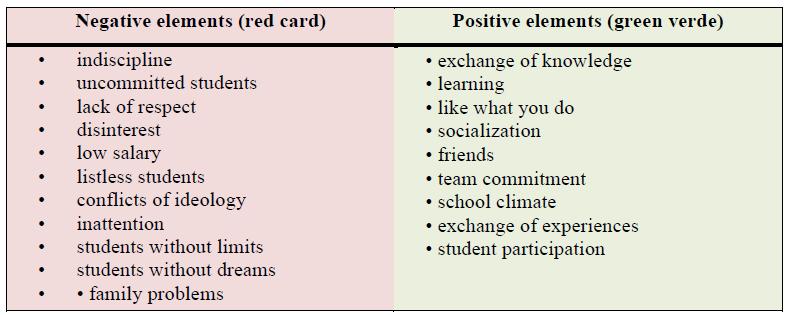
Chart 1
Keywords regarding the positive/negative elements of the teaching routine
Source: experience retrieved data
Having noted the keywords in confrontation, that is, the negative elements arranged side by side with the positive elements, we started to share what had been discerned at the end of the second stage, that is, we tried to list, in the small group, a single keyword chosen as the most substantial at that time. This sharing would become even more interesting, since everyone was seeing the constellation of possibilities that emerged from everyday life, and each of the elements listed could (and even deserved) moments of reflection about it, individually and collectively, exactly as we were doing in that ATPC. This was essential for that announced objective of echoing the activity beyond itself, resonating later in everyday practice.
In this way, we were able to start the final sharing, which was conducted based on three keywords, one word from each group, aware that the reflection started there would not be resolved at that time, nor would it be closed. After all, several elements of the daily complexity of the profession had been caught during the reflection, brought to light and, therefore, becoming focal points on which work hypotheses can be listed to try to alleviate the problems, as well as they can become encouragement for eventual moments of discouragement with teaching.
Thus, the keywords of each group were mentioned, with one group venting about their “dreamless” students and the other two groups commenting on the most positive aspects of the work, being the “team commitment” and the “climate school ”- probably inspired by the atmosphere of the collective work carried out by the group itself; Of course, not in this specific ATPC (since a meeting does not have enough power to create a sense of team), but built over the years that they meet weekly to think about teaching.
Thus, having reached the third stage of the activity, which was the moment of sharing, we were able to close our proposed activity. The group of teachers understood that we would not go into detail on the meaning of each keyword stated in the last stage, nor search the events that made it emerge in the initial moment of individual reflection, or because it would have been the word chosen in the stage of collective construction. After all, the purpose of all this would be to remain thinking about it, in a community and collaborative way, preferably, because only constant reflection can promote transformation. Not a single moment, although it can provide the necessary starting power to realize that to be a teacher is to be permanently thinking about being a teacher.
Final remarks, or the experience seen through a theoretical lens
Culture, shared meanings and the social environment permeate individual experiences, building references with which or in opposition to which people act. Knowledge is rooted in social life, expressing and structuring the identity and social conditions of those who share it. Therefore, social or educational actions that aim to create conditions for conceptual changes, attitudes and practices need to be interwoven with the socio-cultural environment in which people, professionals, who will be covered by these actions, live5 (GATTI, 2003, p. 196).
In this paper, we took the opportunity for a training activity held at a state school to explore the meaning of continuing education in service. Guided by the idea of training in context, we sought to situate the activity, developed during an ATPC, within a much larger perspective, considering the school, its students and faculty. To plan this activity, it was necessary to consider several aspects of daily life, but also historical teaching in this school. In addition, the proposal was to partially know the reality experienced, including both its present annoyances and its virtues acquired over the years of management work and the teachers themselves.
There seems to be a strong agreement regarding training in context as being fundamental to the promotion of constant reflection on the contingencies of teaching work. All of this to warn about the complexity and fluidity of everyday life, aspects intrinsic to cultural life itself, which tend to frequently change what is expected, demanded and needed in school education. Pimenta (1994, p. 44) had already expressed that “in the training of any teacher, it is necessary to take the field of action as a reference. That is, to take it as a totality in all its determinations, showing the contradictions present in it”. Ferreira (2000, p. 75) noted that “a perspective of training in context demands from everyone an active role of knowledge builders [...] So teachers are considered subjects and not objects of training”. This was reinforced by Gatti (2003, p. 203), noting that “it is necessary that programs aimed at educational innovations, improvements, updates have a concrete intertwining with the psychosocial environment in which these professionals work and live”.
As Imbernón (2010) noted, the last three decades have been marked by theoretical advances regarding continuing training in service, understanding more and more what training “in context” implies. Nevertheless, the author repeatedly reinforces that this advance seems to have been on paper, still remaining somewhat distant from the places where education happens daily.
There is no pretension to affirm that a single activity, developed over a single ATPC is the solution for the theoretical progress of training in context to become reality in schools. A single activity, developed in a single ATPC is just that: an activity. But, if it is not possible to praise it as the answer to the mismatch between theory and practice in teacher education, neither should it be dismissed as a possible path. After all, the experience described and analyzed here was planned in context and with the objective of going beyond itself, helping in the more complex perception regarding the multifaceted daily life, full of bad weather, dilemmas and problems, but also impregnated with positive aspects, opportunities and possibilities.
What was proposed, and experienced, it was a way of looking critically at the day to day, always looking for evidence that you live, so you can put the routine experiences and perspectives analis will -Las by several different points by sight. Of course, it is necessary to place the singularity of the action as a possible deficit for continuing education, after all, the work must be continuous. Even so, it is possible to qualify the experience presented here as positive, as it contained the context, the intention and the possibility of continuing to seek new knowledge from the educational place in which it operates. Thus, it is expected that the meaning of an activity is always relativized, especially if what is proposed is to take something ready, woven in the way “how one should be a teacher”, or if the proposal is to act in context, instigating constant reflection.
REFERENCES
FERREIRA, F. I. A formação e os seus efeitos: do modelo escolar à formação em contexto. In: FORMOSINHO, J. O. (org.). Associação criança: um contexto de formação em contexto. Braga: Livraria Minho, 2000. p. 63-79.
FORTUNATO, I. O relato de experiência como método de pesquisa educacional. In: FORTUNATO, I.; SHIGUNOV NETO, A. (org.). Método(s) de Pesquisa em Educação. São Paulo: Edições Hipótese, 2018. p. 37-50.
FORTUNATO, I. Um curso de formação continuada de professores como lócus de pesquisa-ação: relato de experiência. Estreiadiálogos, Braga, v. 3, n. 1, p. 90-105, 2018b.
HARPER, B; CECCON, C.; OLIVEIRA, M. D.; OLIVEIRA, R. D. Cuidado, escola!: desigualdade, domesticação e algumas saídas. 24. ed. São Paulo: Editora Brasiliense, 1987.
IMBERNÓN, F. Formação continuada de professores. Porto Alegre: Artmed, 2010.
INFORSATO, E. C.; PASSALACQUA, F. G. M. Formação continuada no espaço escolar: uma análise das dissertações e teses defendidas no estado de São Paulo. Revista Eletrônica da Educação, Jaú, v. 1, n. 1, p. 36-52, 2018.
MENEZES, C. M. A. Educação continuada de educadores: superando ambigüidades conceituais. Revista da FAEEBA - Educação e Contemporaneidade, Salvador, v. 12, n. 20, p. 311-320, jul./dez. 2003.
PIMENTA, S. G. Aspectos gerais da formação de professores para educação infantil nos programas de magistério - 2º grau. In: BRASIL. Por uma política de formação do profissional de educação infantil. Brasília: Ministério da Educação e Cultura, 1994. p. 43-50.
ROSA, M. I. F. P. S.; SCHNETZLER, R. P. A investigação-ação na formação continuada de professores de ciências. Ciência & Educação, Bauru, v. 9, n. 1, p. 27-39, 2003.
Notes