Artigos
GENDER PECULIARITIES OF THE SPOUSE'S BEHAVIOR IN FAMILY CONFLICTS
PECULIARIDADES DE GÊNERO NO COMPORTAMENTO DOS CÔNJUGES EM CONFLITOS FAMILIARES
PECULIARIDADES DE GÉNERO DEL COMPORTAMIENTO DE LOS CÓNYUGES EN CONFLICTOS FAMILIARES

GENDER PECULIARITIES OF THE SPOUSE'S BEHAVIOR IN FAMILY CONFLICTS
Revista on line de Política e Gestão Educacional, vol. 25, núm. Esp.1, pp. 451-461, 2021
Universidade Estadual Paulista Júlio de Mesquita Filho

Esta obra está bajo una Licencia Creative Commons Atribución-NoComercial-CompartirIgual 4.0 Internacional.
Recepción: 06 Noviembre 2020
Recibido del documento revisado: 18 Enero 2021
Aprobación: 23 Febrero 2021
Publicación: 03 Marzo 2021
Abstract: In this article we will identify and explore the gender particulars of behavior of married couples, the influence of a constructive learned behavior on the prevention of family conflicts. This is followed by consideration of theoretical approaches to the phenomena of “gender” and “family conflict”, and analysis of the role of emotions in family conflicts. The article studies how to build the habit of constructive patterns of behavior as a factor in preventing family conflicts. Systemic and behavioral approaches have been used to explore gender characteristics of spouses’ behavior in a family conflict. The article emphasizes the importance of working with family conflicts, the positive role of conflicts, and discusses the techniques by which they can be managed. The strategies of marriage partners’ behavior in family conflicts are analyzed depending on a family life cycle. We also suggest various ways of resolving family conflicts, including a mediation procedure, and, more specifically, the family-oriented mediation. The article concludes with our reasoning that gender-specific behaviors play an important role in family conflict and are the result of stereotype patterns in society. As a matter of fact, each conflict is individual and requires some serious consideration because the occurrence, generation and closure of a conflict depends on the situations and circumstances within which it arises and increases.
Keywords: Gender, Family conflict, Spouses, Behavior, Emotions, Constructive conflict.
Resumo: Neste artigo vamos identificar e explorar as particularidades de gênero do comportamento dos casais casados, a influência de um comportamento construtivo aprendido na prevenção de conflitos familiares. Em seguida, serão consideradas as abordagens teóricas dos fenômenos de "gênero" e "conflito familiar" e será analisado o papel das emoções nos conflitos familiares. O artigo estuda como construir o hábito de padrões construtivos de comportamento como um fator de prevenção de conflitos familiares. Abordagens sistêmicas e comportamentais têm sido utilizadas para explorar as características de gênero do comportamento dos cônjuges em um conflito familiar. O artigo enfatiza a importância de trabalhar com conflitos familiares, o papel positivo dos conflitos, e discute as técnicas pelas quais eles podem ser gerenciados. As estratégias de comportamento dos cônjuges nos conflitos familiares são analisadas dependendo de um ciclo de vida familiar. Também sugerimos várias maneiras de resolver conflitos familiares, incluindo um procedimento de mediação e, mais especificamente, a mediação orientada para a família. O artigo conclui com nosso raciocínio de que os comportamentos específicos de gênero desempenham um papel importante nos conflitos familiares e são o resultado de estereótipos presentes na sociedade. De fato, cada conflito é individual e requer séria consideração, devido ao fato de que a ocorrência, geração e encerramento de um conflito depende das situações e circunstâncias dentro das quais ele surge e aumenta.
Palavras-chave: Gênero, Conflito familiar, Cônjuges, Comportamento, Emoções, Conflito construtivo.
Resumen: En este artículo identificaremos y exploraremos las particularidades de género del comportamiento de las parejas casadas, la influencia de un comportamiento aprendido constructivo en la prevención de conflictos familiares. A esto le sigue la consideración de enfoques teóricos sobre los fenómenos de “género” y “conflicto familiar” y el análisis del papel de las emociones en los conflictos familiares. El artículo estudia las formas de formar patrones de comportamiento de hábitos constructivos como factor de prevención de conflictos familiares. Se han utilizado enfoques sistémicos y conductuales para explorar las características de género del comportamiento de los cónyuges en un conflicto familiar. El artículo enfatiza la importancia de trabajar con los conflictos familiares, el papel positivo de los conflictos y analiza las técnicas mediante las cuales se pueden manejar. Las estrategias de comportamiento de los cónyuges en los conflictos familiares se analizan en función del ciclo de vida familiar. También sugerimos varias formas de resolver los conflictos familiares, incluido un procedimiento de mediación y, más específicamente, la mediación orientada a la familia. El artículo concluye con nuestro razonamiento de que los comportamientos específicos de género juegan un papel importante en los conflictos familiares y son el resultado de la estereotipización de la sociedad. De hecho, cada conflicto es individual y requiere una seria consideración debido a que la ocurrencia, generación y cierre de un conflicto depende de las situaciones y circunstancias en las que surge y aumenta.
Palabras clave: Género, Conflicto familiar, Cónyuges, Comportamiento, Emociones, Conflicto constructivo.
Introduction
The problems of family and marriage have always been under the close attention of researchers and, in the main, society.
Many scholars, researchers, public figures believe that family in Russian society today is crisis-torn. This is evidenced by a large number of divorces (the number of marriages in 2016 was 985,836, the number of divorces was 608,336), marriage of minors, an increase in the number of so-called “civil marriages”, etc. These destructive manifestations in the family sphere come under scrutiny and in-depth study by the researchers of the causes of conflicts occurring, and the ways of their removal.
At the present stage, there is a change in sex-role norms, gender stereotypes, and ideas about how men should behave. This factor is extremely important for predicting family change. Thus, the study of the family through a lens of gender is an important and promising area in conflict management studies.
Family as the primary agent of socialization of an individual plays an important role in the formation of the individual, therefore, it is necessary to pay due attention to marital conflicts and put them on a constructive track.
Methods
From olden times, even before the use of the term “gender” in academic sources, which was first introduced into scholarly discourse by American researcher J. Scott in the middle 80s of the 20th century in order to differentiate between the biological and social understanding of the role relations of men and women in society. The interplay between men and women is always a matter of perfect indifference to people (BURN, 1955). Their dynamics of similarities, differences have been the subject of attention since antiquity. Industrial society started taking that issue more seriously in as much as social relations of production that required the sexual division of labor arose. Further, in the post-industrial society, the role of woman as a housewife was also changed. Women began to work in such areas of society as politics, economics, and business. Accordingly, the importance of man in the family as a breadwinner and earner has changed.
In this article we applied systemic and behavioral approaches as research methodology. The systematic approach provided us an opportunity to consider the phenomena of gender, family and family conflict as the systems, interdependent concepts. Its use made for identifying the specifics of the behavior of marrieds in family conflicts, explained by gender differences. The application of behavioral approach enabled to scrutinize behavior as a changing variable, depending on the type of personality and the situations in which it appears.
Results and discussion
Within the framework of the structural and functional approach in the 1940-1950s, American sociologist Parsons expressed an idea of the functionality of gender role separation (BALES; PARSONS, 2014). It laid the foundation for a gender-role approach to the study of gender relations. According to Parsons, the family of the Art Nouveau period forms a social system in which a man plays an instrumental role and a woman plays an expressive role. The expressive role, in T. Parsons’s judgment, means concern for the family, maintaining its internal balance, the role of a housewife. The instrumental role implies the regulation of relations between the family and other social institutions, the role of a breadwinner and earner. This approach was further criticized by feminist explorers, but, nevertheless, it was used to interpret the positions of men and women in society. In other words, the gender-role approach understood the roles of women and men in its natural, biological sense, attributing to them those functions and destinations that were taken in society at that time as a given.
As regards the gender characteristics of the behavior of spouses in a family conflict, one is first to determine what family is. So, family is an important component in the socialization and upbringing of the individual in society, as it is in the family that its values, views and norms of behavior are born and formed. And it is precisely because man and woman who grew up in different families with different lifestyles, having decided to live together, face many difficulties, which, unfortunately, often end in divorce.
So, Soviet sociologist Chuchalin (2017) treats the notion of family as
a historically specific system of relations between husband and wife, between parents and their children, as a small group the members of which are connected by marriage or family relations, common life and mutual moral responsibility, and the social requirement for which is determined by the society’s need for physical and spiritual reproduction of population.
The analysis of marital relationships shows that emotions play a major role in conflict. Very often it is emotions that govern our behavior in certain situations, and especially in conflict situations. They evoke a rather great outburst of emotions in spouses, which prevent them from looking at the situation fairly, and, therefore, looking for constructive ways to resolve the conflict.
A specific complexity of the analysis of emotional relationships between family members is the acuteness of the arising ethical problems. Difficulties of another type are associated with this circumstance – an immaturity of the conceptual as well as the methodological apparatus for studying such array of phenomena. Meanwhile, emotional factors play an important role in the formation of the family, and they help in large part to evaluate the existing relationships in the family, regardless of the motives of marriage.
Considering the influence of emotions on human behavior, it is necessary to distinguish their types: sthenic and asthenic emotions. Sthenic emotions are accompanied by the desire of a family member to be active, energy increase. Asthenic emotions contribute to passivity and inhibitedness of a person3.
The world of emotions is very bright and multifaceted. There is an infinitude of emotions. There have been attempts to single out basic, “fundamental” emotions, among which are: surprise, joy, anger, anguish, disgust, fear, contempt, shame. Emotional phenomena mean a great deal in people’s lives. In psychological science a theory prevails that a person under the influence of negative emotions can form the prerequisites for emerging diseases, and positive emotions can become one of the reasons for healing a person. An important function of emotions is reflective, consisting in the capacity for orienting in the environment, evaluating various objects and phenomena. Also, all emerging emotional experiences signal human need reduction. Emotional phenomena affect a person’s motivation to carry out activities, the process of learning, performing a supporting function, help gratify a need or solve a person’s problem. As we can see, emotions play a very important role in human life.
In order to avoid family conflicts, or rather constructively manage them, certain knowledge and skills are needed that would help spouses escape the destructive consequences of the conflict.
So, Grishna (2008) gives a few pointers on constructive behavior in a conflict situation:
work with conflicts when they arise; if you avoid a conflict because you consider yourself powerless or fear it, get rid of it by practicing in managing the conflicts; use your knowledge to determine which position you are in: whether you are on your side, or you change sides, or you hold to a neutral position; if you are locked into your own position, you will not be able to be perfectly honest in expressing your true feelings or you will be offended by another person and you will not be able to voice your own resentment and anger, etc.
To our opinion, these tips are quite simple and applicable in life. Avoiding or fearing a conflict is far from the most effective way to deal with them. Having gained experience in mediating and managing conflicts, a person ceases to be afraid of conflicts, to consider them anomalies, but, on the contrary, extracts experience from conflicts and directs their dynamics and development constructively.
The skills of constructive behavior in conflicts are, in our judgement, the prerogative of a young family, since two young people who previously lived in two different families decide to build their joint family. Each of them has their own store of knowledge and experience, which they put into practice. Quite often, these experiences do not fit together, they cause frequent quarrels, and, possibly, divorce. But our study has refuted these facts.
We have developed empirical research the purpose of which is to identify gender specificities of the behavior of marriage partners in a family conflict. The study was conducted using the testing method within the period from January 18 to January 24, 2018.
To carry out our investigation, we have used the theory of family life cycles proposed by our researcher Sysenko (1989) to identify gender and age characteristics of married couples: from 0 to 4 years – starter marriages; 5-9 years – young marriages; 10-19 years – average marriages; 20 years or more – older marriages.
The test is presented in two variants: male and female. Each test comprehends 17 questions. Questions are various typical conflict-based situations that may arise in every family. Each question suggests 6 possible answers. The first five answers correspond to conflict behavior strategies developed by K. Thomas and R. Kilmann 4. The sixth variant of answer is “other”, that is, the respondent could write in their possible answer if none of the above suits them. Probability (convenience) sampling was applied in testing, in which 23 men and 27 women took part. The answers are presented in the form of diagrams. Diagram 1 shows the results of the responses of men, and Diagram 2 shows the results of the responses of women.
As the test results have shown, such strategy of behavior in the conflict as adaptation is completely absent in the responses of men. In our opinion, it is related to the fact that most men are by nature dominant and patriarchal. But we would like to emphasize that to unify all men, speaking of the majority, may seem like a phenomenon of stereotyping. Therefore, we note that the results of this test cannot be applied to absolutely all men and women since the sampling was representative, but quite limited in number. The behavior strategy of “cooperation” dominates in all family life cycles. This is a positive tendency. But the largest indicator of this strategy is manifested in married couples who have lived together from 0 to 4 years. We believe that this is due to the fact that at the beginning of the construction of family life, the couple is filled with a flash of their feelings, it is a feeling of love. All this enables them to behave in conflict situations constructively, to choose such solutions that would suit both partners.
Analyzing the results of the responses of females, one can conclude as follows: the highest percentage point as a strategy of behavior in a conflict for both women and men is cooperation, but it is maximum in the periods from 0 to 4 years and more than 20 years together.
The strategy of rivalry is completely absent within the first two family life cycles: from 0 to 4 years, from 5 to 9 years. We believe that this is due the fact that a woman at the beginning of family life wants to be liked by her husband, to glaze her foibles, to please her partner.
Within the period from 5 to 9 years of marriage, indicators of such strategies as adjustment and cooperation are the same. It is interesting that the same number of respondents as in the first years of marriage chose the variant “adjustment”.
Rivalry as a strategy of behavior is present in the choices of both men and women, therefore, it is impossible to say that rivalry is not inherent in womankind.
Thus, the survey shows that in the first years of life in conflict situations, marriage partners try to be responsive to the wishes of each other. Over time, this indicator decreases, but still remains the prevailing one. The dominance of the strategy of cooperation in the answers of respondents suggests that they really use the skills of constructive behavior in conflict situations.
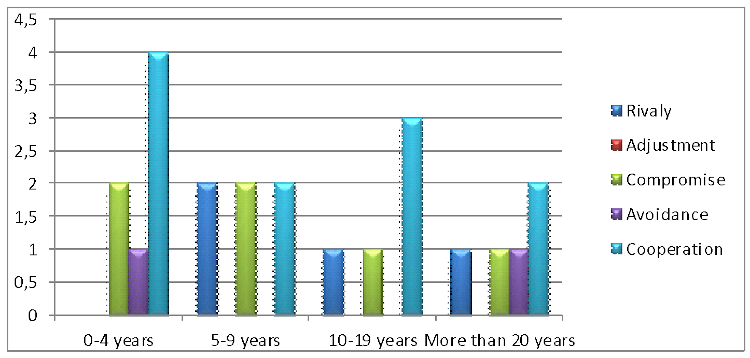
Diagram 1
Conflict situations
Source: Developed by the authors
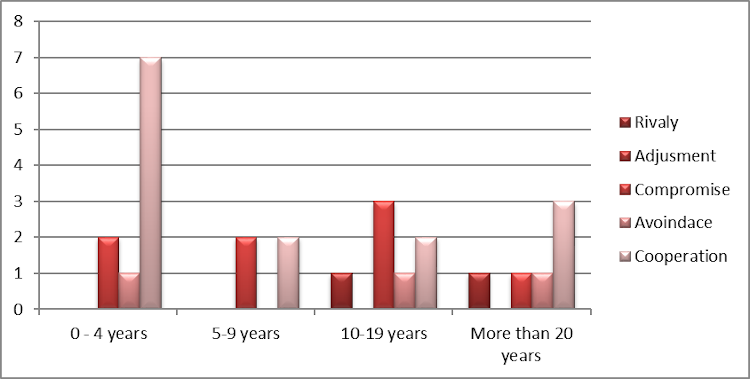
Diagram 2
Constructive behavior in conflict situations
Source: Developed by the authors
Speaking of family conflicts, it is necessary to mention the possible ways to prevent and resolve them.
According to many researchers, to find equitable solutions to emotional conflicts seems to be one of the most difficult problems in conflictology. Precisely this type of conflicts predominates in the family. As practice shows the spouses themselves fail to solve such conflicts. Therefore, the role of a mediator who is respected, confided and well regarded by both partners is great in resolving the conflict situations. They are relatives, friends, acquaintances, and sometimes strangers, specialists in this field – psychologists and conflictologists.
There are many ways to resolve other (non-emotional) family conflicts. But regardless of their choice, in any conflict it is necessary to keep one’s personal dignity and respect for an opponent, understand the opposite side, warm to an opponent’s “role” and look at oneself with the eyes of a spouse, ask the question: “What would I do if I were you?”
In marital life, principles such as reciprocity and interchangeability are significant. But if they cannot be observed and a conflict arises, then a strict division of responsibilities between the spouses is possible as a way to resolve it (DOROSHINA, 2018).
If a conflict arises over the question of who is the head of the family, then there are several alternatives: a) to agree between themselves on joint decision-making on various issues of family life; b) not to focus attention on this issue, and the head of the family will be determined in a natural way; c) to discriminate between areas of dominance.
One should not project their internal conflicts onto the family, as well as official (production) relations onto the marital relations, to focus on the imperfections, miscalculations and mistakes of the partner.
Family conflicts always require special care, correctness and accuracy. Paying attention to this, it is worth pointing out to an interesting approach to conflict resolution, developed as part of family mediation and called ecosystem (LYUDMILA, 2014). Its author is one of the founders of family mediation in the UK Lisa Parkinson. The basis of ecosystem, or family-oriented mediation, is the theory of systems. It suggests the conceptualization and understanding of the individual experience of a person and the events taking place in his/her life in the context of social and family processes. The theory provides us with an opportunity to understand various family structures, relationships, and patterns of behavior. The study of interplays and models of communication allows the mediators to move away from a simplified causal understanding of the problem, which is conductive to blame exchanging and “tunnel vision”.
If we consider a couple who have decided to participate in mediation as an interrelated and interacting system, and not as separate conflicting individuals moving in different directions, it is much easier to understand the problems with which these people come to the mediator.
A systematic approach also helps mediators to take into account the broader social and legal aspects of the situation (PARKINSON, 2010).
Summary
There are many approaches to exploring the behavior of spouses in a family conflict explained by gender differences. The analysis shows that women are more emotional and men are more rational in a family conflict. These features, in our opinion, are more determined by society and the adopted stereotypes in it. Men can also be exposed to a great emotional outburst, and women can speak intelligibly in conflict situations, not succumbing to emotions. Moreover, the manifestation of these features is individual.
Spouses’ behavioral strategies in family conflict are also variable depending on the family life cycle. An empirical study has shown an important tendency, according to which, marriage partners are more oriented towards cooperation at the beginning of the existence of their family than after several years of marriage.
Conclusions
Although the research does not confirm that there are significant differences between men and women in most qualities, we believe that they are worlds apart from each other. This is partly because men and women fulfil various social roles, including in the family, and, as a result, we believe that differences between them correspond to these roles. Our society also tells us that men and women are different and should be different from each other. In addition, an inherited mental habit of dividing everything into categories and using this separation in family life helps retain the idea that gender differences are significant and relevant. We are even more inclined to distinguish between genders, and begin to partially determine our identity based on our gender.
REFERENCES
BALES, R. F.; PARSONS, T. Family: socialization and interaction process. London: Routledge, 1955.
BURN, S. The psychology of gender. Prime Euro-mark, 2004. p. 10.
CHUCHALIN, A. I. Preparation of PhD students for pedagogical activity in higher education. Higher Education in Russia, n. 8-9, 2014.
DOROSHINA, I. G. Typology of role structures of a family. 2018. Available: http://sociosphera.com/files/conference/2011/Sociosphera_2-11/35-38_i_g_doroshina.pdf. Access: 10 dec. 2020.
GRISHINA, N. V. The psychology of conflict. Saint Petersburg: Peter, 2008. p. 494-495.
HOW to understand your emotions. 2017. Available: http://instadvices.com/how-to-understand-your-emotions/. Access: 10 dec. 2020.
KILMANN, T. Conflict mode instrument profile and interpretive report. Report prepared for Jane Sample. 2008. Available: http://www.kilmanndiagnostics.com/sites/default/files/TKI_Sample_Report.pdf. Access: 10 dec. 2020.
LYUDMILA, A.O. The functionality of mediation in family policy and the system of social work with families in the region. Humanities and Social Sciences, v. 7, n. 1, p. 136-144, 2014.
PARKINSON, L. Family mediation. Мoscow: Interregional Center of Managerial and Political Consultancy, 2010. p. 44
Notes
Notas de autor
Información adicional
How to reference this article: MANSUROV, T. Z.; RAFAILEVNA, E. S. Gender peculiarities of the spouse's behavior in family conflicts. Revista on line de Política e Gestão Educacional, Araraquara, v. 25, n. esp. 1, p. 451-461, mar. 2021. e-ISSN:1519-9029. DOI: https://doi.org/10.22633/rpge.v25iesp.1.14982