Artigos

Esta obra está bajo una Licencia Creative Commons Atribución-NoComercial-CompartirIgual 4.0 Internacional.
Recepción: 20 Enero 2021
Recibido del documento revisado: 18 Marzo 2021
Aprobación: 25 Abril 2021
Publicación: 01 Mayo 2021
DOI: https://doi.org/10.22633/rpge.v25iesp.2.15276
Abstract: The Islamic revival naturally raised the issue of Muslim education in the post-Soviet space. The growth and strengthening of the ideology of radical Islamism in the public consciousness, the designation of the dominance of adherence to religious precepts in everyday life as opposed to secular laws, destructive actions under the slogan of protecting the "purity" of the faith demanded the dissemination of religious knowledge that would not threaten the secular foundations of the Russian state. Therefore, the development of Muslim religious education in the territories of the historical spread of Islam acquired special significance, for it was intended to give to those wishing to receive religious education such knowledge that would not preach inter-religious intolerance and would not spread radical ideas in Russian society. Empirical data indicate that the surveyed population positively assesses the quality of education in the mosque school, arguing that they receive good knowledge of the basics of Islam, could learn how to read the sacred text, as well as certain ritual actions that are quite significant for the respondents in their everyday life. As secular education, religious education also has disadvantages, and to improve the state of Islamic education, according to the interviewed experts, it is necessary to hold national conferences, round tables, which will discuss issues of teacher formation, to organize training courses of teachers of maktabs, ensure a school at the mosque with unified educational and methodical literature.
Keywords: Religion, Education, Mosque school, Maktab, Muslim education.
Resumo: O renascimento islâmico naturalmente levantou a questão da educação muçulmana no espaço pós-soviético. O crescimento e fortalecimento da ideologia do islamismo radical na consciência pública, a designação do domínio da adesão aos preceitos religiosos na vida cotidiana em oposição às leis seculares, ações destrutivas sob o lema de proteger a "pureza" da fé exigiram que a disseminação de conhecimento religioso que não ameaçaria as fundações seculares do estado russo. Portanto, o desenvolvimento da educação religiosa muçulmana nos territórios de propagação histórica do Islã adquiriu um significado especial, pois pretendia dar àqueles que desejavam receber educação religiosa um conhecimento que não pregasse a intolerância inter-religiosa e não difundisse ideias radicais na Sociedade russa. Dados empíricos indicam que a população pesquisada avalia positivamente a qualidade da educação na escola-mesquita, argumentando que recebe bons conhecimentos dos fundamentos do Islã, tem a oportunidade de aprender a ler o texto sagrado, bem como certas ações rituais que são bastante significativas para os entrevistados em seu dia a dia. Assim como a educação laica, a educação religiosa também apresenta desvantagens, e para melhorar o estado da educação islâmica, segundo os especialistas entrevistados, é necessário realizar conferências nacionais, mesas redondas, que discutirão questões de formação de professores, para organizar cursos de formação de professores de maktabs, garantir na mesquita uma escola unificada em sua literatura educacional e de método.
Palavras-chave: Religião, Educação, Escola de mesquita, Maktab, Educação muçulmana, Muçulmanos.
Resumen: El renacimiento islámico naturalmente planteó el tema de la educación musulmana en el espacio postsoviético. El crecimiento y fortalecimiento de la ideología del islamismo radical en la conciencia pública, la designación del predominio de la adherencia a los preceptos religiosos en la vida cotidiana en contraposición a las leyes seculares, acciones destructivas bajo el lema de proteger la "pureza" de la fe requirieron la Difusión de conocimientos religiosos que no amenacen los cimientos seculares del Estado ruso. Por lo tanto, el desarrollo de la educación religiosa musulmana en los territorios de la expansión histórica del Islam adquirió un significado especial, ya que estaba destinado a dar a quienes deseaban recibir educación religiosa un conocimiento que no predicara la intolerancia interreligiosa y no difundiera ideas radicales en el país. Sociedad rusa. Los datos empíricos indican que la población encuestada valora positivamente la calidad de la educación en la escuela de la mezquita, argumentando que reciben un buen conocimiento de los fundamentos del Islam, tienen la oportunidad de aprender a leer el texto sagrado, así como ciertas acciones rituales que son bastante significativo para los encuestados en su vida diaria. Como educación laica, la educación religiosa también tiene desventajas, y para mejorar el estado de la educación islámica, según los expertos entrevistados, es necesario realizar conferencias nacionales, mesas redondas, que discutirán temas de formación docente, organizar cursos de formación de maestros de maktabs, asegurar una escuela en la mezquita unificada literatura educativa y metódica.
Palabras clave: Religión, Educación, Escuela mezquita, Maktab, Educación musulmana.
Introduction
The problem of Muslim religious education actualized in modern Russian society, because, firstly, it (Islamic education) has become widespread, and secondly, followers of Islam are willing to receive religious education, thirdly, these two factors contribute to the emergence of the need preparing qualified teaching staff not only for mosque schools, but also for other Islamic educational institutions. The need of the population to acquire religious knowledge in the Muslim faith, and their desire to study have intensified the issue of religious education in the educational space of Russian society. However, it should be noted that the existence of the mosque school (maktabs) has a long history: they functioned in the Muslim regions of the Russian Empire in the pre-revolutionary period, were widespread, and within them their own system of vision of education was established. Education in schools at the mosques in the republics of the North Caucasus is well covered in the works of A.R. Bagatyradaeva (2013), Gadjiyeva, Tagirova, and Shihsaidov (2001), Omarov (1868), Temirova (2008), Yarlykapov et al. (2003). Also, the issue of Islamic education is considered in the works of Western scholars (HASSEN, 2013; BERGLUND; GENT, s/a; HILLS, s/a; MEER, s/a). No less important is the study of Islamic education and its role in strengthening Islamic identity, and this issue is considered in the works of Shakhbanova (2009).
Thus, the increased role of religion in Russian society was accompanied by an increase in the interest of the population in the history of Islam and its teachings, therefore, the scientific community, along with clergy, pay great attention to this issue. Thus, the All-Russian Scientific and Educational Conference "Theological Education: Problems and Development Prospects" (MAKHACHKALA, 2018) was devoted to the problem of religious education. In their work about the organizers of the conference, the following areas were identified as important: to show the role and importance of academic theology in the system of Islamic education in Russia, to consider the most important aspects of training qualified personnel in the interests of Muslim religious and educational organizations, the directions of activities of Islamic educational institutions in the formation of spiritual and moral potential of the younger generation, most of all exposed to the influence of extremist organizations (KASHAF, 2018, p. 908). The participant of this conference I.A. Asadulaev (assistant to the mufti of Dagestan Akhmad Afandi Abdulaev) in his speech drew attention to the fact that "the relevance of theological education in modern Russia is due to the need for the spiritual and moral development of society, counteraction and prevention of extremism, which poses a global threat to the peaceful life of society, puts barriers on the path of state development, undermines the foundations of domestic and international stability (KASHAF, 2018, p. 911). Moreover, he considers the illiteracy of the population in matters of religion, immorality and immorality, which give rise to antisocial phenomena, as the basis for strengthening the positions of radicals. Therefore, religious education acts as a barrier to the spread of radical religious ideology plays a key role in the process of building a multicultural and inter-religious dialogue, especially in multi-ethnic and multi-confessional environment, in addition, allows protecting the spiritual and traditional values.
Consideration of the issue of motivation for studying in maktabs, identifying further plans of parents and students to continue their studies, in general, the attitude towards religious education in general raises a number of questions for various reasons, for example, "the restoration of professional Islamic education in Russia in the early 90s of the last century took place practically without any preliminary methodological and organizational training. This was a period of spontaneous emergence of Muslim educational institutions, which did not fully fit into the legal and educational space of Russia, did not have permanent sources of funding" (SHANGARAEV, 2011, p. 7). In addition, the lack of transparency in the educational sphere, especially at the level of the elementary segment of Muslim education, further complicates the task: this is the question of paying the teacher's work, attracting teachers to work on these courses without even a minimum wage. They do not have a fixed amount of payment and teachers receive the remuneration that the local clergy can pay them, i.e. imam of the mosque, and from funds collected, as a rule, for charitable purposes. Therefore, the question arises "How to consider teaching activities - work that must be paid or work that can be characterized as a "special form of religious asceticism?"
The psychological factor is also of great importance, as a rule, teachers do not always have experience in pedagogical work, do not know the teaching method, sometimes they cannot find a common language with children. They work with adults who consciously came to learn how to read the Koran, or want to improve their existing knowledge of Islam, and children, as a rule, very rarely express their own desire to go to maktabs. As practice shows, they are sent there by their parents so that in the summer they are supervised, and at the same time receive basic knowledge of Islam.
Along with religious subjects, in maktabs, children are taught the basics of Islamic ethics, which may be useful to them, although many questions also arise here: "To what extent does a person who has received Islamic knowledge in everyday life adhere to them?", "Is it possible to link attitudes toward religion (believer and non-believer) with the moral behavior and attitudes of a person?", "And what about a person who identifies himself as an unbeliever - to consider him immoral?" etc. Such questions arise because in the public consciousness of Dagestanis there is a rather critical attitude towards the activities of the Muftiate of Dagestan, as well as personally towards those people who, while declaring the ideas of social justice, demonstrate behavior in real life that, to put it mildly, does not correspond to the fact that clergymen preach within the walls of religious buildings.
Thus, this article examines the quality of teaching in the mosque school, the relationship between the student and the teacher, the overall assessment of the activities of the maktabs. To obtain information on these questions, a sociological study was carried out and it should be noted that it is the first; therefore, there were certain difficulties during the survey.
Empirical base of research
Opinion poll on the state of the educational process in schools at the mosques of Daghestan was held in 2020 in the cities of Dagestan (Makhachkala, Khasavyurt, Derbent) and rural areas (Botlikh, Buynaksk Kazbekovsky, Khasavyurt) of the republic. Parents - 255 people, students - 444 people, experts - 59 people.
Discussion of research results
In the survey on the study of maktabs, questions were asked showing the prevailing public opinion towards the teacher, as well as towards the very system of teaching in the mosque school. For example, survey data show that in the designation of an emotional attitude to the teacher, 97,4% of surveyed parents like their children to the teacher of a school at the mosque, 2,1% were undecided and insignificant part of them selected the answer "do not like" (0,5%). In the affirmative to the question "Do you like your teacher in the mosque school?" answered 98,8% of pupils, among them 98,6% with secondary, 100% with secondary specialized, 98,2% higher education, 98.5% "0 - 20 years old", 98,8% "21 - 39 years old and 100 % "40 years and above". The option "no" was emphasized by 1.2% of the surveyed students, by education and age the answers were distributed as follows: 1,4% with secondary education, 1,8% with higher education, 1,5% "0-20 years old" and 1.2% "21 - 39 years old".
The quality of education in maktabs is important, so the parents and students were asked the following questions: "How do you assess the quality of teaching your children in the mosque school?" and "How do you assess the quality of your education in the mosque school?". Thus, 52,1% of parents assess the quality of teaching their children in the mosque's school as "very good", 35,6% consider it good, 12.4% as satisfactory. The answer option "very good" was noted by 52,8% of the students, the answer option was well emphasized by 38,7%, 8,3% of the students called it satisfactory, and 0,2% characterizes the teaching as poor. If you look at the survey data in the context of pupils' education, then 50,9% of those with secondary education, 56,3% of secondary specialized and 52.6% of higher education consider education very good, 51,5% by age - in the context of "0 - 20 years", 60,7% "21 - 39 years old" and 52,9% "40 years and above". How good learning is estimated by 50,9% of students with secondary, 56,3% of secondary specialized and 52,6% of higher education, by age – 51,5% "0 - 20 years old", 60,7% "21 - 39 years old" and 52,9% "40 years and above". The answer option satisfactory was chosen by 7,3% of pupils with secondary, 14,1% of secondary specialized and 7,0% of higher education, as well as 6.8% in the age range "0 - 20 years", 10.7% "21 - 39 years" and 11,8% "40 years and above". Poor and very poor options were not noted by the respondents' parents, in contrast to the pupils, although their share is very insignificant – 0,5%.
The question "How do you assess the quality of education in the mosque school?" was also asked to experts: 83,1% of experts rated the quality of training in the maktab positively, 15,3% found it difficult to answer, and a very insignificant part of the experts chose the answer option - negative (1,7%). If you look at the results of the study in the context of the education of experts, then the quality of education is positively characterized by 8,7% of respondents with secondary, 21,7% with secondary specialized and 69,6% with higher education. Such a high percentage of positively evaluating the quality of education due to the fact that in our survey experts generally were teachers themselves maktabs and secular experts categorically refused to take part in the study, and those of them who took part - or not completely filled in application forms or marked conflicting answer options.
Further, within the framework of the study, the parents were asked the question "How does the teacher of the mosque school treat your children?". Empirical data show that 58,2% of parents characterize the attitude of the maktab teacher to their children as very good, 27,3% - good, 12.9% satisfactory and 1,5% found it difficult to answer. In this question, the parents interviewed also did not indicate the answer options badly and very badly. The pupils themselves to the question "What is the attitude of the teacher of the mosque school to you?" answered as follows: 60,4% of pupils consider him very good, among them 57,9% with secondary, 62,5% with specialized secondary, 68,4% with higher education, 58.4% "0 - 20 years old", 67, 1% "21 - 39 years old" and 63,5% "40 years old and above". The attitude is considered good by 31,1% of pupils, by education and age the answers look like this: 34,6% with secondary, 23,4% with specialized secondary, 21,1% with higher education, 34,6% "0 - 20 years old", 22,4% "21 - 39 years old" and 21,2% "40 years old and above". The answer option satisfactory was emphasized by 7,3% of pupils, 6,2% of them with secondary, 12,5% with specialized secondary, 8,8% with higher education, 5,6% "0 - 20 years old", 9,4% "21 - 39 years old” and 13,5% "40 years and above". The whole array of the teacher to his poor attitude is considered so -significant part of the students (0,2%), including 1,2% with higher education, and the same percentage of the age "21- 39 years"; 1,1% found it difficult to express their opinion.
H and the initial stage of learning in maktabs proceeded in the absence of a unified system programs and training plans, so each school at mosque is functioning according to its own representations of Islamic institution. Apparently, for this reason, the teachers were forced to focus on the previously existing historical experience or, according to their ideas, tried to establish education not only in maktabs, but also in other Islamic educational institutions (madrasah, university, institute). Very often, the organization of the educational process was carried out by people far from pedagogical activity, who did not, however, and currently have no experience of working in an educational institution, but who themselves were trained in an Islamic educational institution and possess the necessary knowledge. Apparently, during the period of a large-scale Muslim revival, the main task was to return Islamic teachings to the consciousness of the population, proceeding from the conviction that any knowledge about the doctrine is preferable to the dominant atheistic ideology. One can agree with the opinion of Pateev (2008, p. 152), that today there is no clear concept of the development of the Muslim education system in Russia. Lack of uniform curricula and methodological plans, a system for assessing university graduates, requirements for ensuring the educational process, financial difficulties, etc. lead to the fact that the level of education in most Islamic higher educational institutions in Russia does not correspond to the level of higher education and does not differ much from the average level - madrasah. Therefore, study in foreign centers is often considered preferable.
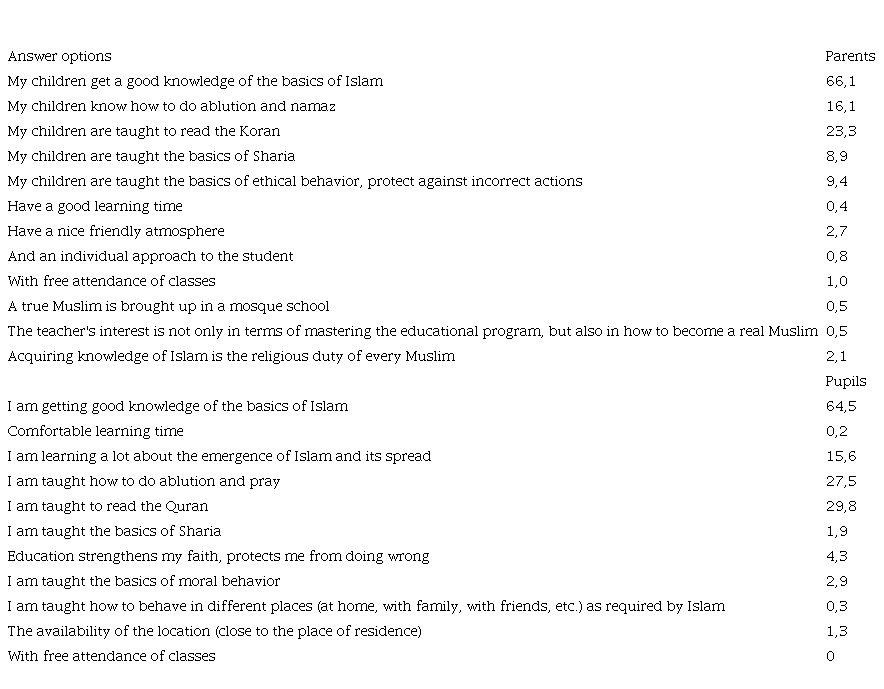
Establishing the teacher's attitude to the student, as well as assessing the quality of teaching in the maktab, requires identifying the factors on the basis of which the respondents positively or negatively characterize teaching in the mosque school (Table 1).
Distribution of answers to the question: "How do you like studying in a mosque school?" (%)
Source: Prepared by the authors
The results of the survey show that the amount of knowledge on Islam acquired by their children in the maktab is of great importance for parents (more than half of the respondents): by education and age, this thesis is shared by 11,5% of parents with a secondary education, 42,3% with a secondary special, 46,2 % higher education. Further, 25,0% of parents with secondary education and 75,0% of higher education like teaching children to read the Koran. One of the parameters of measuring the attitude to the mosque school for 50,0% of parents with a secondary education, 25,0% each with a specialized secondary and higher education is that their children are taught the basics of moral behavior and are protected from wrong actions. The answer option for many reasons was noted by 35,4% of parents with secondary education, 24,8% with specialized secondary education, 38,9% with higher education, and teaching the basics of Sharia is also important. It should be noted that maktab teachers play an important role in the process of introducing both children and the adult generation of people to the basics of Islam, performing certain ritual actions, correctly performing ablution, reading the text of the prayer (namaz), correctly pronouncing the sounds and words of namaz, etc. In addition, teaching Islamic ethics is an important point in learning in maktab, because a person is taught Muslim prescriptions for forming relationships with loved ones, employers, colleagues, as well as in other social spheres. In addition, these answers as a convenient training time free attendance, the presence of a friendly atmosphere, an individual approach to pupils were pointed by second part of the parents.
If you look at the answers of the students, the most important parameters of a positive assessment of the work of the maktabs are the acquisition of high-quality basic knowledge of Islam (more than half of the respondents), the history of Islam (one-sixth), the correct procedure for washing and performing namaz (one in four) and learning to read the Koran (one third). At the same time, for the students, the answer options are not of particular importance: a convenient time of study, instilling moral attitudes and other provisions proposed in the question "How do you like learning in a mosque school?". If you look at the results of the answers on education, then the option "I get good knowledge of the basics of Islam" was emphasized by 66,8% of pupils with secondary, 70,3% secondary specialized, 58,3% higher education, 61,3% "0 - 20 years old", 70.6% "21 - 39 years old" and 71,2% "40 years and above"; the thesis "I learn a lot about the emergence of Islam and its spread" is shared by 17,5% of pupils with secondary, 9,4% of secondary specialized, 10,0% of higher education, 19,9% of "0 - 20 years old", 7,1 % "21 - 39 years old" and 7,7% "40 years old and above". The judgment "I am taught to do ablution and perform namaz correctly" is shared by 11,2% of pupils with secondary, 12,5% of specialized secondary, 15,0% of higher education, 12,8% of "0 - 20 years old", 9,4% "21 - 39 years old" and 11,5% "40 years and above". The option "I'm being taught to read the Koran" was noted by 3.1% of students with secondary, 6.3% of secondary specialized, 15.1% of higher education, 4,5% "0 - 20 years old", 11.8% "21 - 39 years" and 7,7% "40 years and above".
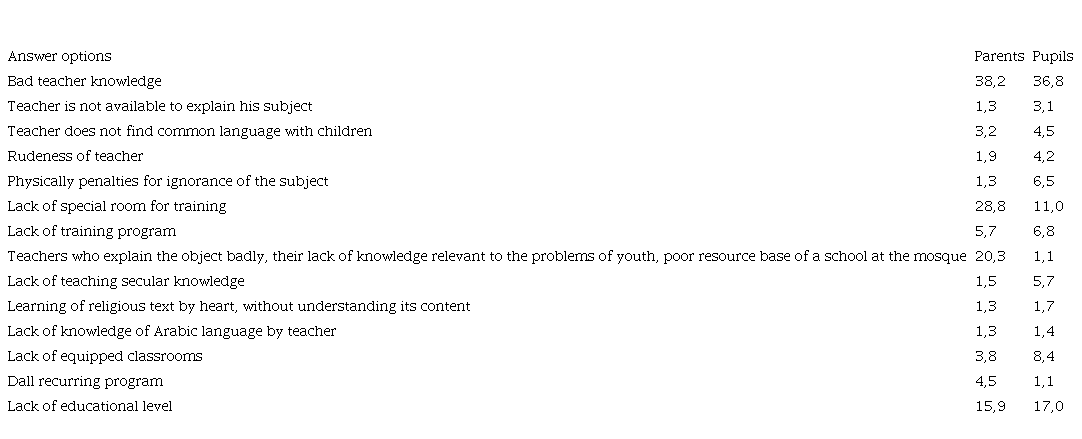
Along with a positive attitude, there is also a negative attitude towards the maktabs and their work, which is reflected in the following table (see Table 2).
Distribution of answers to the question: "What do you dislike about the mosque school?" (%)
Source: Prepared by the authors
Of course, along with the advantages, maktabs also have certain disadvantages, which were pointed out by the parents. Most of all, parents are worried about the lack of equipped classrooms, the data in terms of education are as follows: 14,3% with secondary, 26,5% with secondary specialized and 47,5% with higher education. 8,8% of parents with specialized secondary education and 2,5% with higher education pointed to poor knowledge of teachers. Answer options: the teacher's inability to explain their subject in an accessible way and the teacher's inability to find a common language with their children was emphasized by 2,9% of parents with secondary and secondary specialized education; also parents with higher education indicated the teacher's rudeness and physical punishment for ignorance of the subject indicated (2,5% each). The absence of a special room for conducting classes was indicated by 31,4% of parents with secondary, 17.6% of secondary specialized and 15,0% of higher education, however, the absence of a training program: 8,6% of parents with secondary, 5,9% of secondary specialized and 2,5% higher education; Parents with secondary education are also worried about the lack of training in secular knowledge (5,7%), and 5,9% of those with secondary specialized education are not satisfied with memorizing a religious text without understanding its content.
If you look at the survey data for students, 39,3% with secondary, 30,6% with secondary specialized and 3,3% with higher education, 40,7% "0 - 20 years old", 39,7% "21 - 39 years old" and 19,5% "40 years and above" indicate poor teacher knowledge. Further, 1,7% of pupils with secondary and 2,1% of higher education do not like memorizing a religious text without understanding its content, 2,3% in the interval "0 - 20 years old " and 1,5% "21 - 39 years old". Lack of knowledge of the Arabic language teachers emphasized 1.7 % of students with an average of 2,0% and specialized secondary education, and 2,3% at the age of "0 - 20 years". Then 2,9% of students with secondary, 4,1% of specialized secondary and 2,1% of higher education, 3,2% "0 - 20 years old", 1.5% "21 - 39 years old" and 2,4% "40 years and above” indicate the inability of the teacher to explain his subject in an accessible way. The teacher's inability to find a common language as a disadvantage in the mosque school was indicated by 5,0% of pupils with secondary, 2,0% secondary specialized and 4.2% higher education, 5,1% "0 - 20 years old" and 2,4% "40 years and above". The rudeness of the teacher is not satisfied with 6,3% of students with secondary education, as well as in the age section "0 - 20 years" (6,5%) and "40 years and above" (2,4%). Variant of answer physical punishments for ignorance of the subject do not like 7,1% of students with secondary, 4,1% of secondary specialized and 4,2 % of higher education, 7,4% "0 - 20 years old" and 2,3% "40 years old and higher", and 10,9% with secondary, 4,1% secondary specialized and 16.7% higher education, 9,3% "0 - 20 years", 10,3% "21 - 39 years" and 24,4 % "40 years and above" indicated the absence of a special room for conducting classes. The absence of a training program was indicated by 5,4% of students with secondary, 16,3% secondary specialized and 4,2% higher education, 5,6% "0 - 20 years old", 11,8% "21 - 39 years old" and 7,3% "40 years and above". Also, students do not like the fact that older teachers teach in the Maktab, who explain the subject poorly, their ignorance of the problems that are urgent for young people – 1,7% with an average, 1,4% "0 - 20 years old", 1,5% "21 - 39 years old". The lack of a mosque school is 4,2% of students with secondary, 10,2% of specialized secondary, 10,4% of higher education, as well as 3.2% at the age of "0 - 20 years", 10,3% of "21 - 39 years old" and 14,6% "40 years of age and above" indicated a lack of training in secular knowledge. At the same time, on the whole, across the array of students, the free answer "I like everything" is closer, and it was indicated by 13,0% of students in the context of "0 - 20 years old", 23,5% "21 - 39 years old", 24,4% "40 years and above", 13,8% with secondary, 26,5% with specialized secondary and 22,9% with higher education. The choice of the free answer "I like everything" shows the attitude of the students towards the maktab and the teacher, in general, and it is more positive than negative.
When organizing maktabs, it is important to provide them with classrooms that are suitable for conducting classes. During the survey, it was clear that the students are engaged at desks placed in a row or at low desks, sitting on the floor. Moreover, there was no separate room for them - the training was conducted in halls in which the collective prayer of believers (rusman) is held on Fridays. Modern teaching aids (interactive whiteboard, electronic teaching aids, etc.) were absent, at least in those localities where the author conducted the survey. Apparently, for this reason, the parents identified the lack of special and equipped rooms as one of the shortcomings of the Maktab. Also, it can be argued that the main objective Maktabs is not only learning the basics of Islam, Muslim ethics, etc., and weak involvement of unbelieving people in the Muslim community, to orient them to follow and respect the basic principles of doctrine that man is a follower.
The study of the issue of the relationship between the student and the teacher shows that the answer option "teacher rudeness" was noted mainly by students, however, as well as the teacher's lack of ability to establish communication with students, as well as the use of punishments for academic failure. Unlike students, parents see the main disadvantage of maktabs in the fact that teachers are elderly teachers who explain the subject poorly and are not interested in the problems of the younger generation. Therefore, it is important that the teacher is able to find a common language with the student, regardless of his age. This fact is paid attention to by researchers who deal with issues of Islamic ethics and empathy. So, according to Bilyalova and Sedankinoy (2018, p. 32), "empathy is the most important professional quality of the Imam - the minister of worship since empathy is a person's emotional response to the experiences of other people, manifested both in empathy and sympathy".
Further, in our survey, a question was asked, the purpose of which is to identify means of improving the quality of education and teaching in maktabs (Table 3).
Distribution of answers to the question: "What do you think should be done to improve the quality of education in a mosque school?" (%)

Source: Prepared by the authors
When studying the initial segment of Muslim education, of course, one has to take into account the fact that this phenomenon has a certain set of disadvantages. Therefore, the experts were asked the question "What do you think should be done to improve the quality of education in the mosque school?" and the answers received to it show that it is possible to optimize the state in this segment through, firstly, organizing advanced training courses for teachers in mosque schools (29,8%), by age and education 58,8% in the context of "20 - 30 years old", 28,0% "31 - 40 years old", 45,5% "41 - 50 years old" and 50,0% "50 years old and above", 40,0% with an average, 80,0% with a secondary special, 35,9% higher education. Secondly, the provision of mosque schools with a unified educational and methodological literature (curricula, workbooks, teaching aids, etc.) was noted by 11,8% of experts aged "20 - 30", 24,0% "31 - 40 years", 27,3% "41 - 50 years old", 16,7% "50 years and above", 20,0% with secondary, 10,0% secondary specialized, 23,1% higher education, 25,0 % with primary and higher education, 50,0% secondary Muslim education. The importance of holding republican conferences, round tables, at which they will discuss the issues of improving the qualifications of teachers in order to improve learning in maktabs, is suggested by 29,4% of experts aged "20 - 30", 40,0% "31 - 40 years old", 9,1% "41 - 50 years old", as well as 20,0% with secondary, 10,0% with secondary specialized and 30,8% with higher education.
One of the most important problems of religious education is the provision of religious educational institutions with teaching staff. Moreover, this problem is of a two-sided nature: on the one hand, teachers who have a good command of religious knowledge do not always know the methodology and methodology of the educational process. On the other hand, to the organization of educational process in religious schools teachers are involved and they are fluent in the methods of teaching, but they do not represent the specificity and nature of religious education. Consequently, in order to solve the problems of personnel training for leaders and teachers of Islamic educational institutions, seminars and advanced training courses are held annually, which contributes to the improvement of the quality of professional religious education and allows raising the level of Islamic religious education and enlightenment in Russia (SEDANKINA, 2013, p. 41). At the same time, such an important factor as conducting conversations with teachers of mosques' schools was noted by 8,0% of experts at the age of "31 - 40 years old" and 18,2% "41 - 50 years old", 20,0% with an average and 10.3% of higher education to ensure the acquisition of a Muslim education that does not contradict the secular nature of the Russian state.
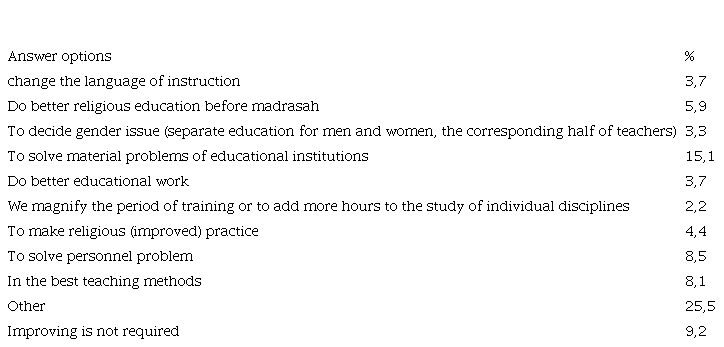
One of the priority areas in the work of Muslim educational institutions is considered to be the training of religious personnel, the education of clergymen who are ready to serve the Russian Ummah, taking into account the age-old traditions of Russian Islam. Training a new generation of Muslim intelligentsia capable of actively participating in the formation of a highly moral society is recognized as an equally important goal. However, in this area there are still many unresolved problems associated with both the content of Islamic education and the organization of the educational process, financing of educational institutions, employment of graduates, etc. In this regard, in October-December 2008, the Russian Islamic University and the Tatar State Humanitarian pedagogical university, with the support of the Spiritual Administration of Muslims of the Republic of Tatarstan, conducted a study in Muslim educational institutions of the republic. Within its framework, a sociological survey was held to study the views and assessments of leaders, teachers and students of madrasahs regarding the current state and prospects of development of religious education (NURULLINA, 2012, p. 46-48). Although R. Nurullina 's survey touched upon the process of education in madrasahs, it has a direct bearing on the general system of Islamic education, therefore it seems necessary to show the opinion that exists in another Muslim republic, in which, without exaggeration, this form of education is well established and systematized (see Table 4).
Distribution of answers to the question: "What, in your opinion, can be improved in the system of religious education?" (%)
Source: Prepared by the authors
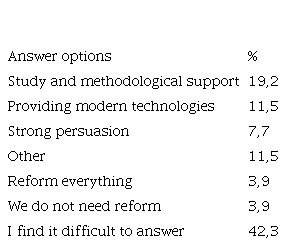
The following table shows the opinion of the shakirds on the ways to optimize the system of religious education (see Table 5).
Distribution of answers to the question: “What aspects of modern religious education, in your opinion, need to be reformed? In which direction?" (%)
Source: Prepared by the authors
According to the results of the research by Nurullina (2012, p. 50), it was concluded that "private participants in the educational process of various levels are unanimous in the opinion that the system of religious education in our country requires optimization. The main directions for improving this area can include: improving the material and technical base of the madrasah, increasing the level of teaching and qualifications of teachers, providing the madrasah with educational literature, improving educational work, etc.
The survey data show that the quality of education and training system available in a school at the mosque are far from perfect and, despite on, in general, positive characteristic of maktabs by pupils and by parents, there is a problem that must be addressed in this area. But on the other hand, as the results of the study show, both students and parents are generally satisfied with the quality of the knowledge provided by mosque schools, therefore, in the author's opinion, their existence is quite justified, because in them teachers receive basic knowledge of Muslim teaching, they can to be an obstacle to the spread of ideas of religious extremism, but at the same time, the lack of any control over their activities by the official authorities is alarming.
The determinants of educational management in the projection on communication have been clarified; - the interrelations between the components have been established and the possibilities for realization of tolerance in different directions of communicative culture have been revealed (SOKOL et al., 2021)
Conclusion
Analysis of the quality of teaching in maktab shows that both parents themselves and children like their teacher. At the same time, parents and students assess the teacher's attitude to themselves as "very good" and "good". A positive attitude towards the teacher is also reflected in the quality of teaching, which parents and students describe as "very good". An important factor in a positive assessment of learning in maktab is getting a good knowledge of the basics of Islam. In addition, the students noted other answer options that allow them to positively evaluate the education in the mosque school, in particular, new knowledge about the history of the emergence of Islam and its spread, learning how to properly bathe and perform namaz, as well as reading the Korana. Also, the benefits of training are convenient learning, the desire of the teacher to consider the interests of the students, especially the older generation, their work not only on weekdays but also on weekends. In addition, students in maktabs like the friendly atmosphere, the individual approach of the teacher. Along with those meters, the students noted certain drawbacks that exist in school for the most part - it is impolite behavior of the teacher, as well as the application of penalties for poor performance, rather, for misreading the Koran. In this case, the full functioning maktabs show lack of well- equipped, special classrooms and students pointed to poor knowledge of the teacher, but one-sixth of respondents wrote, that they are satisfied in school. Thus, the survey data allow us to assert that the mosque schools fully satisfy the basic needs of the student in obtaining fundamental knowledge of Islam, Islamic ethics and teaching. But at the same time, apparently, it is not worth considering the maktabs as a kind of step, or rather, as a place of "delivery" of students to madrasahs and Islamic universities. As the results of the study show, a small part of students, as well as their parents, strive to give their children only religious education, but on the contrary, want to equally give them both types of education (secular and theological). In plans of pupils there is a focus to get a quality secular education, because they are satisfied with the amount of knowledge that they have already received in schools at the mosques.
The survey shows that the existence of a certain negative attitude towards teaching in the mosque school raises the question of what measures should be taken to improve the quality of teaching in maktabs. Experts believe that in order to improve the quality of teaching in the mosque school it is necessary: a) to hold republican conferences, round tables, at which they will discuss the issues of improving the qualifications of teachers; b) conduct conversations with teachers of mosque schools in order to provide Muslim education that does not contradict the secular nature of the Russian state; c) organize refresher courses for teachers of mosque schools; d) provide mosque schools with a unified educational and methodological literature (curricula, workbooks, teaching aids, etc.); e) contribute to the improvement of the qualifications of teachers, provide with methods.
REFERENCES
BAGATYRADAEVA, A. R. Formation and development of cultural and educational institutions in the process of becoming a cultural and educational space in Dagestan in the II half of the XIX century. Psychological and Pedagogical Sciences, v. 2, n. 23, p. 37-41, 2013.
BERGLUND J.; GENT, B. Believing, belonging and behaving: some considerations when teaching about islam. Available: https://www.su.se/polopoly_fs/1.385561.1526389353!/menu/standard/file/. Access: 08 Feb. 2019.
BILYALOV, V. R.; SEDANKINA, T. E. Problems of empathy of imams in the learning process in the Azov madrasah. Islamic studies, v. 8, n. 1, p. 27- 33, 2015.
HASSEN, Y. Making muslims: the politics of religious identity construction and victoria's islamic schools. Islam and Christian – Muslim Relations, v. 24, n. 4, p. 501- 517, 2013.
HILLS, P. a normative approach to the legitimacy of muslim schools in multicultural britain. Available: https: //schoolsweek.co.uk/a-normative-approach-to-the-legitimacy-of-muslim-schools-in-multicultural-britain. Access: 08 Feb. 2019.
KASHAF, S. R. Constructive dialogue in Makhachkala on the problems and prospects for the development of theological education in Russia. Islamic Studies, v. 11, n. 4, p. 907-931, 2018. DOI: 10.31162 / 2618-9569-2018-11-4-907-931
MEER, N. Muslim schools in britain: challenging mobilisations or logical developments? Available: https: // scholar . google . ru / citations ? user. Access: 08 Feb. 2019.
NURULLINA, R. Optimization of the Muslim education system in the Republic of Tatarstan: opinions and assessments of teachers and students of madrasah. Islamic Studies, v. 1, n. 8, p. 46-50, 2012.
OMAROV, A. Memories of a mutalim. Collection of information about the Caucasian highlanders. Tiflis, n. 1, p. 15- 31, 1868.
PATEEV, R. Russia: problems of co-optation of graduates of islamic universities into the official muslim clergy (on the example of dagestan). The Caucasus & Globalization, v. 2. n. 3, p. 150-160, 2008.
SEDANKINA, T. E. Modern problems of education in the religious and moral sphere. Islamic Studies, v. 6, n. 1, p. 37-44, 2013.
SHAKHBANOVA, M. M. The place of religion in the process of forming a culture of interethnic communication. Actual problems of the humanities – 2009. Makhachkala, 2009. p. 15-24 (Collection of scientific papers)
SHANGARAEV, R. Problems of religious education: the state of educational and methodological support of Muslim religious educational institutions (madrasah) of the Republic of Tatarstan. Islamic Studies, v. 2, n. 8, p. 4-16, 2011.
SHIKHSAIDOV, A. R.; TAGIROVA, N. A.; GADZHIEVA, D. K. Arabic handwritten book in dagestan. Makhachkala, 2001. 256 p.
SOKOL, M. et al. Tolerance in the communicative culture of modern educational manager. Propósitos y Representaciones, v. 9, n. esp. 3, e1171, 2021.
TEMIROV, A. M. The state of muslim confessional education in dagestan in the 20s of the XX century. Ethnosocium and Interethnic Culture, v. 3, n. 11, p. 67-71, 2008.
YARLYKAPOV, A. A. Islamic education in the north caucasus in the past and in the present. Bulletin of Eurasia, n. 2, p. 5-31, 2003.
Notas de autor
Información adicional
How to reference this article: RAMAZANOV, R.; MALAMAGOMEDOV, J. M.; NAGIEVA, M. K.; UMAKHANOV, R. M.; SHAMKHALOV, S. S. A school at mosque in the structure of muslim religious education: status and evaluation. Revista on line de Política e Gestão Educacional, Araraquara, v. 25, n. esp. 2, p. 910-927, May 2021. e-ISSN:1519-9029. DOI: https://doi.org/10.22633/rpge.v25iesp.2.15276
