Artigos

Esta obra está bajo una Licencia Creative Commons Atribución-NoComercial-CompartirIgual 4.0 Internacional.
Recepción: 20 Enero 2021
Recibido del documento revisado: 18 Marzo 2021
Aprobación: 25 Abril 2021
Publicación: 01 Mayo 2021
DOI: https://doi.org/10.22633/rpge.v25iesp.2.15281
Abstract: Psycho-emotional state of youth in the COVID-19 pandemic can become an indicator of various positive or negative social transformations and trends. The purpose of the study is to determine the influence of socio-demographic factors (gender, age, year of study, the direction of professional training at university, combining study and work, living in a rural area or a city, in a private house or an apartment, with parents or independently) in conditions of self-isolation on assessment of the main components of the psycho-emotional state of the students: well-being, activity, and mood. We used the method of rapid well-being, activity, and mood assessment. The test was conducted online; the relevant materials were posted on eCampus of North Caucasus Federal University educational portal. The research results analysis was based on Kruskal Wallice H-test, the primary frequency analysis, analysis of average scale values and standard deviations for the comparison groups. The study was conducted from 13 of April to 22 of May 2020, and involved 1,173 students aged 17 to 36 years, enrolled in 1-5 years. The study suggests that the psycho-emotional state of students in the self-isolation period depends on their age: the younger the students are, the more likely they are to experience fatigue and decline in well-being, activity, mood. The study provided new data on the features of integrated assessments of students’ well-being, activity, and mood in conditions of forced self-isolation due to the COVID-19 pandemic.
Keywords: Psycho-emotional state, Socio-demographic factors, COVID-19 pandemic, Students, Self-isolation.
Resumo: O estado psicoemocional dos jovens na pandemia COVID-19 pode se tornar um indicador de várias transformações e tendências sociais positivas ou negativas. O objetivo do estudo é verificar a influência de fatores sociodemográficos (sexo, idade, ano de estudo, direção da formação profissional na universidade, conciliar estudo e trabalho, residir em área rural ou na cidade, em residência particular ou um apartamento, com os pais ou independentemente) em condições de autoisolamento na avaliação dos principais componentes do estado psicoemocional dos alunos: bem-estar, atividade e humor. Usamos o método de avaliação rápida de bem-estar, atividade e humor. O teste foi realizado online; os materiais relevantes foram postados no portal educacional eCampus da Universidade Federal do Norte do Cáucaso. A análise dos resultados da pesquisa foi baseada no teste H de Kruskal Wallice, análise de frequência primária, análise dos valores médios da escala e desvios-padrão para os grupos de comparação. O estudo foi realizado de 13 de abril a 22 de maio de 2020, e envolveu 1.173 alunos com idades entre 17 e 36 anos, matriculados em 1-5 anos. O estudo sugere que o estado psicoemocional dos alunos no período de autoisolamento depende da idade: quanto mais jovens são os alunos, maior é a probabilidade de sofrerem de fadiga e declínio no bem-estar, atividade, humor. O estudo forneceu novos dados sobre as características das avaliações integradas do bem-estar, atividade e humor dos alunos em condições de autoisolamento forçado devido à pandemia COVID-19.
Palavras-chave: Estado psicoemocional, Fatores sociodemográficos, Pandemia de COVID-19, Estudantes, Autoisolamento.
Resumen: El estado psicoemocional de los jóvenes en la pandemia de COVID-19 puede convertirse en un indicador de diversas transformaciones y tendencias sociales positivas o negativas. El propósito del estudio es determinar la influencia de factores sociodemográficos (género, edad, año de estudio, dirección de la formación profesional en la universidad, compaginación de estudio y trabajo, vivir en una zona rural o en una ciudad, en una casa particular). o un apartamento, con los padres o de forma independiente) en condiciones de autoaislamiento al evaluar los principales componentes del estado psicoemocional de los estudiantes: bienestar, actividad y estado de ánimo. Usamos el método de evaluación rápida del bienestar, la actividad y el estado de ánimo. La prueba se realizó en línea; los materiales pertinentes se publicaron en el portal educativo eCampus of North Caucasus Federal University. El análisis de los resultados de la investigación se basó en la prueba H de Kruskal Wallice, el análisis de frecuencia principal, el análisis de los valores de escala promedio y las desviaciones estándar para los grupos de comparación. El estudio se realizó del 13 de abril al 22 de mayo de 2020 e involucró a 1,173 estudiantes de 17 a 36 años, matriculados en 1-5 años. El estudio sugiere que el estado psicoemocional de los estudiantes en el período de autoaislamiento depende de su edad: cuanto más jóvenes son los estudiantes, es más probable que experimenten fatiga y deterioro del bienestar, la actividad y el estado de ánimo. El estudio proporcionó nuevos datos sobre las características de las evaluaciones integradas del bienestar, la actividad y el estado de ánimo de los estudiantes en condiciones de autoaislamiento forzado debido a la pandemia COVID-19.
Palabras clave: Estado psicoemocional, Factores sociodemográficos, Pandemia COVID-19, Estudiantes, Autoislamiento.
Introduction
In the context of COVID-19 pandemic, which has led us to physical and social distancing and isolation, transfer of educational institutions, enterprises and services to remote work, there have occurred changes in ordinary life of every person. We are faced with a new reality: the threats to life and health, uncertainty, compounded by invisibility of the source of stress; restrictions of movement and social isolation had an impact on psychological state of many people. Their problems and deep, existential fears were actualized. Especially sharp changes in the format of life activity are experienced by the young people focused on free expression of their activity. In closed educational institutions their lives become less orderly and devoid of incentives of educational environment. There are fewer opportunities to spend time in direct contact with friends and get "live" social support.
The pandemic consequences are dangerous psychological effects that can become a greater threat to safety, life and health than the disease itself (DONTSOV et al., 2019). The conditions of formation and functioning of these psychological effects among the youth should be researched. They need a special socio-psychological analysis based on the study of the impact of COVID-19 pandemic (we treat the COVID-19 pandemic as a stress factor/trigger) on the change of emotional state of students in the context of several socio-demographic factors such as age, gender, conditions and place of residence, marital status, involvement in work and etc.
Literature Review
We conducted an analysis of research on the following problems:
-
- mental and psychological health, negative psycho-emotional consequences, psychological crisis intervention in the context of COVID-19 pandemic;
-
- features of development, organization and regulation of mental states in different situations;
-
- the influence of certain socio-demographic factors on characteristics of neuropsychiatric response and well-being.
In the studies of Kolosnitsyna and Sitdikov (2012) the socio-demographic determinants of psycho-emotional state are treated as a set of dynamic parameters that determine the quality of life and affect socio-psychological well-being of the population. It acts at the individual level and on the scale of society, forming behavioral norms and stereotypes. Among these parameters, the authors include: age, gender, education, communication intensity, behavior of the immediate environment, family factors, income level and working conditions.
In the studies of Eliseeva, Sidorina and Pepelyaeva (2014), Shirokova and Zinyakova (2006) and Gurvich (1999) age, gender, conditions and place of residence are treated as socio-demographic factors. Gurvich (1999) identifies at least three explanatory models of gender differences in the context of neuropsychiatric health of the population. According to the psycho-physiological model, the functional features of a woman body are related to greater predisposition to neuropsychiatric diseases. The model of multiple roles focuses on the role overload of women in modern society (as a factor of neuropsychiatric pathology). The model of social-role stereotypes described in the studies of Aleshina and Lektorskaya (1989) is based on culturally determined norms of behavior that prescribe a woman to seek medical help and pharmaceutical support (and it occurs), while the male stereotype corresponds to aggression and excessive alcohol consumption. They also identified a gender-mediated stable relationship between mental health and marital status (ALESHINA; LEKTORSKAYA, 1989).
Zharikov (1990) describes the influence of age on health and psycho-emotional functional states through the social environment in the form of a life cycle, a regular change in the phases of life during age-related transitions (psycho-social transitions) of an individual. He analyzed studies on the influence of involvement in work on psychological well-being and identified two areas: the study of the impact of unemployment on neuropsychiatric state (more often manifested by mild and quickly compensating disorders) and the study of the impact of forced retirement on mental health (more often not accompanied by pathological effects).
Many researchers (FARRELL; SHIELDS, 2002; GURVICH, 1999; LEONARD; MUDAR, 2003) highlight the special role of family factors in mental health disorders (FARRELL; SHIELDS, 2002; GURVICH, 1999; LEONARD; MUDAR, 2003). Education as a factor of healthy behavior is studied in the works of Denisova (2010), Cutler and Lleras-Money (2010).
Thus, studies confirm the influence of socio-demographic factors on parameters of mental health, well-being, formation and dynamics of psycho-emotional states.
From the point of view of Leonova (1984), the state is a qualitatively peculiar response of functional systems of different levels to external and internal influences that arise when performing activities that are significant for us. Different states are characterized by certain shifts in the course of the main mental processes, changes in emotional and volitional spheres, accompanying complexes of clearly expressed subjective experiences.
Prokhorov (2011) proposed the model of structural and functional organization of mental state regulation, based on generalization of studies of relationships between the structures of consciousness and mental states. He identifies the following elements of the model: mental (subjective) experience, semantic structures, reflection, experiences, mental representations, target characteristics, situations, cultural space, lifestyle, regulatory actions, feedback, time factors. Prokhorov (2011) states, that regulation of mental state is affected by the lifestyle through a set of relevant situations, which is an important point in the context of setting objectives of our study.
In the studies of Prokhorov and Fakhrutdinova (2008), they show that the need for regulation of one's own state arises, as a rule, in the case of inadequacy of this state to life circumstances and situations.
According to Dikaya (2003), mental self-regulation of functional states should be treated as a specific type of subject’s activity which is characterized by certain relationships with professional activity. Its development determines formation of adaptive personal properties of the subject that ensure efficiency, reliability and other characteristics of professional activity.
The conceptual positions of self-regulation of functional states (LEONOVA, 1984) (structural-integrative approach) are based on activity paradigm. Self-regulation is considered at the levels of operational and technical support of activity (operation); changes in the target structure of activity (action); changes in the dominant motivational orientation of the subject of work (activity as a whole). Accordingly, each level is characterized by specifics of self-regulation. Leonova (1984) states, that this scheme is convenient for analyzing mechanisms of activity regulation ("situation — loads — conditions — current adaptive adjustments") within each of these hierarchical levels.
Some authors (COOPER; MARSHALL, 1978; LEONOVA, 1984; SELYE, 1976; ZINCHENKO, 1974) study the states as formed reactions determined by a complex of reasons that determine the specificity of a state in a particular situation (Introduction to Ergonomics, 1974; Cooper & Marshall, 1978; Selye, 1976). Thus, for fatigue conditions, the factors of load duration, the type of load and its organization over time are of primary importance (CAMERON, 1974; ROSENBLAT, 1975). Development of states of emotional tension is mainly determined by the increased significance of performed activity, its responsibility and complexity, the degree of readiness and other socio-psychological factors (COOPER; MARSHALL, 1978; NAYENKO, 1976).
Thus, our analysis (of research on conditions of formation, dynamics and regulation of mental states) allows to treat the situation of the COVID-19 outbreak and the self-isolation associated with it as a powerful factor in changing the psycho-emotional state of a person.
An analysis of psychological and socio-psychological studies of response and state of the population in the context of COVID-19 pandemic showed that at the initial stage of COVID-19 outbreak in China, more than half of the respondents rated their mental state in the range from moderate to severe, and about a third of the respondents reported moderate to severe depression and anxiety (CHEN et al., 2020; LI et al., 2020; LI et al., 2020; LI; YANG; LIU, 2020; LIU et al., 2020). No significant effects of gender, age, marriage, work experience, occupation, education level, and economic income on anxiety and depression were found in this study.
The analysis of publications on the topic of anxiety, worry and experiencing uncertainty in conditions of COVID-19 showed that population of different countries has a significant increase in the level of anxiety, depression, confusion, and hopelessness, while the level of anxiety causes disorganization of behavior, panic, suicidal thoughts, and other destructive effects, so it becomes dangerous in itself (KHARLAMENKOVA et al., 2020). Some scientists have noted the impact of increase in the number of media reports on morbidity, new cases of the disease and information about deaths on public anxiety (LIMA et al., 2019; WENJUN et al., 2020).
Rasskazova, Leontiev and Lebedeva (2020), Emelin and Thostov (2020), Thostov and Rasskazova (2020), Thostov et al. (2020) found that purposeful control of information flow and untested variants of protective behavior can reduce anxiety in a pandemic situation while maintaining psychological protective actions, the effectiveness of which is proven. When anxiety is associated with an acute and imminent risk of infection, concentration on emotions and their acceptance are not associated with deterioration in subjective well-being. Attempts to cope with anxiety in the context of a pandemic through mental withdrawal from the problem, the use of sedative drugs or denial are associated with a lower level of life satisfaction.
The study of healthcare professionals working with coronavirus patients found signs of anxiety and depression in most of them (DAS, 2020; KANG et al., 2020; TIAN et al., 2020). Stress and negative emotions experienced by medical personnel have been characterized as trigger events leading to errors and delays in providing care to infected patients (SON; LEE; KIM, 2019). At the same time, prevalence of anxiety is higher among non-medical employees (20.7%) than among medical personnel (10.8%) (BENJAMIN et al., 2020).
Yeen and Ning (2020) conducted a web-based survey on emotional and mental health from February 3 to 17, 2020, which revealed that the age and time spent thinking about the outbreak are potential risk factors for psychological problems in the population (JIANG et al., 2020).
An online survey of the population conducted by Karpova and Nikolaeva (2000) in social networks revealed that commitment to self-isolation is not related to the respondents' belonging to the health risk group. Despite the found association between belonging to the risk group and the fear of coronavirus infection, psycho-emotional disorders are more often diagnosed in the "health group" (45%, and 26% – in the risk group). The most vulnerable part of the population was the most active one, as that situation was frustrating its usual needs (KARPOVA; NIKOLAEVA, 2020).
The scientific review conducted by Brooks et al. (2020) determined that if people are informed about what and why is going on, how long it will last and allowed to do their meaningful activities during quarantine, provided with clear communication and basic supplies (such as food, water, and medical supplies), the negative impact of quarantine on psycho-emotional state of population is significantly reduced.
They studied the impact of working from home during forced self-isolation in India that resulted in an increase in working hours and stress levels, significant changes in professional functions and decrease in productivity. But independent creative initiatives aimed either at professional career growth or at solving long-overdue organizational issues were also found (JAISWAL; ARUN, 2020). In Iran they also studied the impact of social capital and its support on mental health of the population in a pandemic situation (the positive effect was proved) (ZANDIFAR; BADRFAM, 2020).
Zinchenko et al. (2020) conducted an online survey of self-organization and life in isolation. It showed that the majority of respondents rated their level of self-organization as average (67.6%) or high (17.3%). The ability to cope with and accept uncertainty depends primarily on flexibility, perseverance, planning goals and modeling conditions, overcoming the difficulties of self-organization (depended on the same indicators with additional contributions to reliability and programming of actions). It is noteworthy that young people experienced more difficulties in organizing their lives in conditions of self-isolation and showed a significantly lower level of self-regulation than elderly people.
The study of psychological state of youth is of particular interest in situation of forced self-isolation, since the restriction of freedom of movement and quarantine measures have become factors of possible increase in psychopathological symptoms themselves. In COVID-19 pandemic, which has a high stress potential due to the threat to health and life, the level of their destructive impact significantly increases. Cross-cultural studies of young people (students) from Russia and Israel in self-isolation during the period of coronavirus spread have shown that there are no significant differences in the level of resilience of young people living in Russia and Israel. The residents of Israel do not have much higher components of "involvement", "control" or the overall level of resilience and significantly higher component of "risk acceptance" (VINICHUK, 2020). In Bangladesh, they studied prevalence of situational depression and anxiety among university students, which was 74.1% and 61.9%, respectively (HOSSAIN et al., 2019). Wenjun et al. (2020) conducted a mental health study of 7,143 Changzhi Medical College students during the COVID-19 outbreak. The results showed that living in urban areas with parents and stable family income were stabilizing factors for the students with anxiety conditions (QIU et al., 2020; WENJUN et al., 2020).
The socio-demographic factors act as conditions for states and psycho-social reactions of youth to isolation and security threats (risk of infection). Determining the psycho-emotional state of students in coronavirus pandemic is the most constructive from the point of view of analyzing the influence of socio-demographic factors (gender, age, year of study, direction of professional training at a university, combining study and work, living in a rural area or in a city, in a private house or in an apartment, with parents or independently) - that was the purpose of our research (VODENKO et al., 2018).
Materials and Methods
The assessment of students' psycho-emotional state was carried out by the method of rapid diagnostics of well — being, activity and mood (abbreviated as WAM) (DOSKIN; LAVRENTIEVA; MIROSHNIKOV, 1973), reflecting mobility, speed and pace of functions, degree of fatigue and emotional state.
The survey included the following parameters: gender, age, year of study, direction of training, combining study and work, living in a rural area or in a city, in a private house or in an apartment, with parents or independently.
The analysis of research results was based on Kruskal Wallice H-test, the primary frequency analysis, analysis of average scale values and standard deviations for the comparison groups. The relevant materials were posted on the educational portal "eCampus of NCFU " (North Caucasus Federal University).
The study was conducted in the period from 13 of April to 22 of May, 2020, when the Stavropol Territory of the Russian Federation had a strict regime of self-isolation (Resolution of the Governor of the Stavropol Territory of 26 March 2020, n. 119).
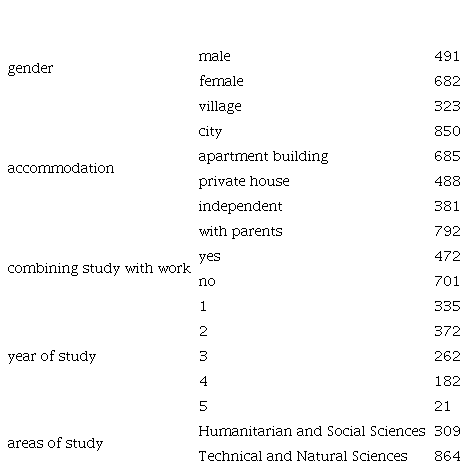
The study involved 1,173 students aged 17 to 36 years, studying in 1-5 years. Their training areas were as follows: the Institute of Humanities, the Institute of Life Science, the Institute of Law, the Institute of Economics and Management, the Institute of Education and Social Sciences, the Institute of Oil and Gas, the Institute of Mathematics and Natural Sciences, the Institute of Mathematics and Information Technologies, the Engineering Institute of the North Caucasus Federal University. The socio-demographic characteristics of the sample are presented in Table 1.
Socio-demographic Characteristics of Respondents
Source: Prepared by the authors
Results and Discussion
The frequency analysis of low, medium and high indicators of integral assessments of functional psycho-emotional state of the sample showed a high incidence of poor health, reduced activity and mood among students in self-isolation (Figure 1). At the same time, students often have reduced activity indicators, which are manifested by low efficiency of activity, a decrease in the need for interaction with the external environment, predominance of external initiation of mental activity, predominance of passivity in all spheres of life.
Figure 1
Frequency analysis of indicators of functional psycho-emotional state of students in conditions of self-isolation
Prepared by the authors
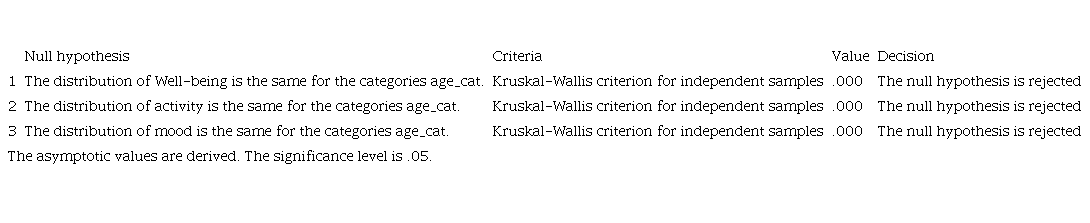
Analysis of the results of diagnostics of well-being, activity and mood were distributed by age of the students: group 1 – students under 18 years, group 2 – 19-21 years, group 3 – 22 years and older. There were statistically significant differences (Kruskal-Wallis H-criterion) between the groups on all three of the discussed indicators (Table 2).
The Values of Kruskal-Wallis H-test for Indicators of Well-being, Activity and Mood in 3 Student Groups of Different Age
Source: Prepared by the authors
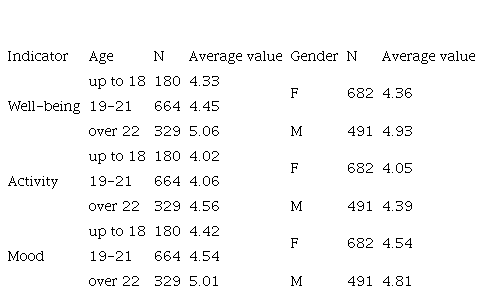
Since Kruskal-Wallis H-test is designed to identify differences between the groups, but does not determine direction of these differences, we conducted a comparative analysis of the average values, standard deviation and root-mean-square error of the average indicators of well-being, activity, and mood in 3 student groups that differ in age (Table 3). Attention is drawn to the increase in the average values of indicators of well-being and mood among the students from the younger age group to the older one. The average values of activity index in groups 2 and 3 (19-21 years old and over 22 years old, respectively) are almost equal and higher than in group 1 (students under 18).
Average Values of Well-being, Activity and Mood Indicators of the Students, Depending on their Age and Gender
Source: Prepared by the authors
Frequency analysis of low values of integral assessments of functional emotional state in the three compared groups revealed that in the first group (under 18) there are more common low values of well-being index; in the second group (19-21 years) - low values of activity and mood; in the third group (over 22 years) low values of the discussed indicators are less common (Figure 2).
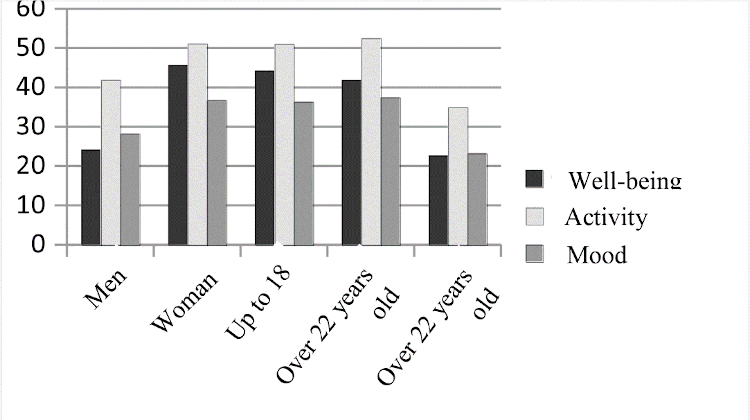
Figure 2
Frequency Analysis of Low Values of Well-being, Activity and Mood Indicators in Student Groups (Differed by Age and Gender)
Source: Prepared by the authors
Thus, the age of students in self-isolation due to the spread of coronavirus infection affects their psycho-emotional state: the younger are the students, the more likely they are to have decreased indicators of well-being, activity and mood; students over 22 years of age have a more stable psycho-emotional state in current conditions.
Analysis of the values of Kruskal-Wallis H-test for indicators of well-being, activity and mood, depending on gender of students, revealed significant differences in the discussed indicators between woman and men (Table 4).
Values of the Kruskal-Wallis H-test for Indicators of Well-being, Activity and Mood, (Depending on Gender of the Students)
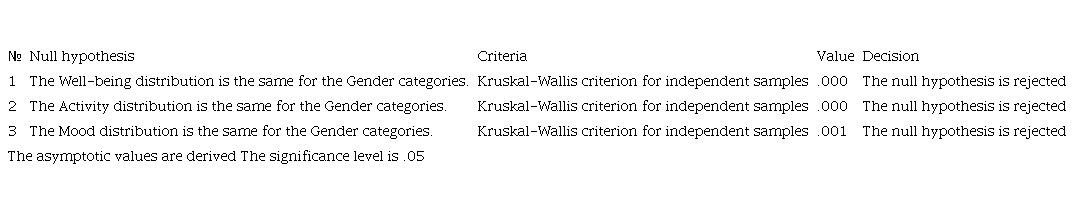
Source: Prepared by the authors
In comparative analysis of mean values, standard deviations and standard error of the mean parameters of well-being, activity and mood there were revealed higher values of the discussed indicators of men emotional states (Table 3).
The results of frequency analysis show a higher occurrence of the lowest ratings of well-being, activity and mood in women when compared to men (Figure 2).
Thus, woman are more sensitive to the situation of forced self-isolation and restrictions associated with it, as well as to the threat of COVID-19 infection. In their subjective state there are more often observed: fatigue, physical discomfort, decreased physical and mental performance, inhibition of mental and mnemic activity, difficulties in concentration and switching attention, decreased activation of behavior and activity, predominance of negative emotions, apathy, sadness, excessive sensitivity and tearfulness, reduced mood background, asthenic intemperance in manifestation of emotions.
Values of Kruskal-Wallis H-test for Indicators of Well-being, Activity and Mood, Depending on the Field of Professional Training
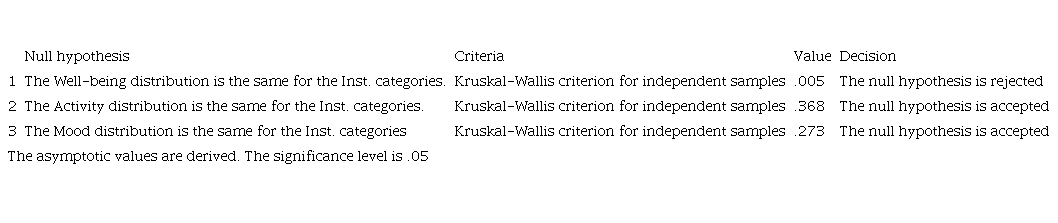
Source: Prepared by the authors
Our analysis of the differences in manifestations of well-being, activity and mood of the students who have chosen Humanities and social Sciences, and students who have chosen Natural or Technical Sciences, confirmed the significance of differences only for the estimated well-being (Table 5). At the same time, the average values of well-being ratings for the students studying in Natural Science and Technical areas are higher than for the students studying in Humanities and Social areas (Table 6).
Average Values of Indicators of Well-being, Activity and Mood in Students Studying in Different Years and Areas of Professional Training (combining / not combining study and work)
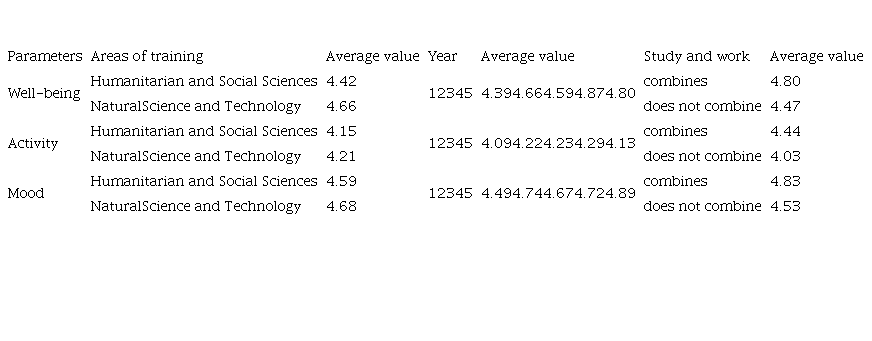
Source: Prepared by the authors
The incidence of low well-being scores is higher among the students studying in Humanities and Social Sciences (Figure 3).
Figure 3
Frequency Analysis of Low Values of Well-being, Activity and Mood Indicators of Students Studying in Different Years and Areas*
HAS: Humanities and Social Sciences; NaTS: Natural and Technical Sciences
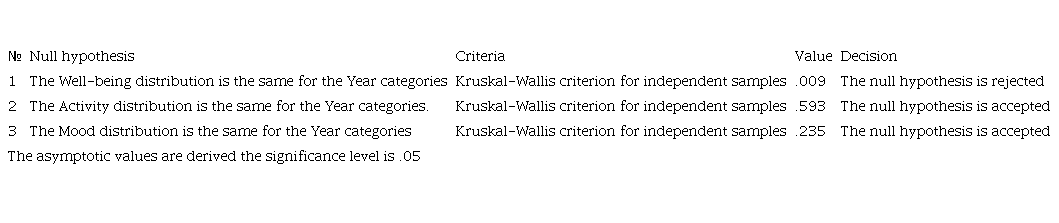
Source: Prepared by the authorsThe analysis of differences in the manifestations of well-being, activity and mood among students studying in different years also showed significant differences only in well-being assessment (Table 7).
Values of Kruskal-Wallis H-test for Indicators of Well-being, Activity and Mood, Depending on the Year of Study
Source: Prepared by the authors
The analysis of the average values of well-being ratings in different years (Table 6) determined that undergraduate students (4-5 years) are more likely to assess their well-being as physically and psychologically comfortable. At the same time, the low well-being scores are more common in 1st and 3rd year (Figure 3).
The study revealed the influence of ability to combine study with work on functional psycho-emotional state of students during the period of self-isolation due to COVID-19 (Table 8).
Values of kruskal-wallis h-test for indicators of well-being, activity and mood (students who combine/not combine study with work)

Source: Prepared by the authors
Working students assess their well-being, activity and mood higher than the students who do not combine study with work (table 6).
Some factors such as accommodation (apartment building or private house), living in a village or in a city, with parents or not, have no significant effect on functional emotional state of self-isolated students under the influence of restrictive measures.
Conclusion
The analysis of mental and emotional state diagnosis results showed that the students in conditions of social isolation, experience a more intense decrease in activity (compared to the well-being and mood), manifested by a reduced need for interaction with the environment, predominance of "external" initiation of mental activity, prevalence of inactivity in all spheres of life.
The study showed that the younger are the students, the more they are likely to have reduced indicators of well-being, activity, mood and fatigue, i.e., they are more susceptible to the stress factors of isolation and the threat of infection. Students over the age of 22 have a more stable psycho-emotional state in the current conditions. Lower values of integral indicator of well-being, typical for junior students, further confirm the significance of the age factor.
The study found that women are psychologically more vulnerable to the COVID-19 pandemic and related restrictive measures (compared to men). They are more likely to assess their well-being as unsatisfactory and give negative emotional reactions to conditions of self-isolation and the threat of possible infection.
It is also quite reliable to conclude that assessment of well-being of students studying in Natural and Technical Sciences areas is higher than one of students studying Humanities and Social Sciences. The choice of the future profession and corresponding direction of study somehow reflects certain personal predispositions. Humanities and Social Sciences are more focused on interpersonal communication, for which conditions of self-isolation act as restrictive. Consequently, self-isolation will be perceived more acutely, reducing the well-being of students in the relevant areas of training.
The study revealed higher scores of well-being, activity and mood among the students who combine study with work but did not find significant relationships between functional psycho-emotional state of the subjects in a situation of isolation and possible COVID-19 infection and such socio-demographic factors as place and living conditions.
Thus, inclusion of socio-demographic factors in analysis of psycho-emotional state of students in conditions of coronavirus pandemic self-isolation allows us to determine the features of emotional response and experiences of young people more accurately in current situation, identifying the factors that increase or decrease neuropsychiatric resistance of young people in relation to the restrictions and threat of infection.
The results determine additional research tasks on the influence of perceptual measures of prevention and control of COVID-19 on psycho-emotional state, the role of socio-economic factors in development of negative emotional states, developing programs and technologies to reduce the destructive impact of the pandemic on psychological well-being of students.
REFERENCES
ALESHINA, E.; LEKTORSKAYA, E. V. Role Conflict of a Working Woman. Voprosy Psihologii, v. 5, p. 80-88, 1989.
BENJAMIN, Y. Q. et al. Psychological Impact of the COVID-19 Pandemic on Health Care Workers in Singapore. Ann Intern Med., 2020. DOI: https://dx.doi.org/10.7326%2FM20-1083
BROOKS, S. K. et al. The psychological impact of quarantine and how to reduce it: rapid review of the evidence. The Lancet, v. 395, n. 10227, p. 912-920, 2020.
CAMERON, С. A theory of fatigue. Man Under Stress, v. 8, n. 2, p. 67-82, 1974.
CHEN, Y. et al. Prevalence of self-reported depression and anxiety among pediatric medical staff members during the COVID-19 outbreak in Guiyang. Psychiatry Res., v. 288, 2020. DOI: https://doi.org/10.1016/j.psychres.2020.113005
COOPER, С. L.; MARSHALL, J. Sources of managerial and white collar stress. Stress at work. New York: John Wiley. 1978.
CUTLER, D.; LLERAS-MUNEY, A. Understanding differences in health behaviors by education. Journal of Health Economics, v. 29, p. 1–28, 2010.
DAS, N. Psychiatrist in post-COVID-19 era - Are we prepared? Asian J Psychiatr, v. 51, 2020. DOI: https://doi.org/10.1016/j.ajp.2020.102082
DENISOVA, I. Adult Mortality in Russia. Economics of Transition, v. 18, n. 2, p. 333-364, 2010.
DIKAYA, L. G. Mental self-regulation of the functional state of a person (system-activity approach). Moscow: IP RAN, 2003.
DONTSOV, A. I. et al. The relationship between vectors of psychological security and identity continuity. Donskaya. European Proceedings of Social and Behavioural Sciences, v. 64, p. 123–129, 2019.
DOSKIN, V. A.; LAVRENTIEVA, N. A.; MIROSHNIKOV, M. N. Test of Differentiated Self-assessment of the Functional State. Vopr. Psikhol, v. 6, p. 141-145, 1973.
ELISEEVA, N. I.; SIDORINA, E. V.; PEPELYAEVA, S. V. Comparative Study of Value Orientations of Rural and Urban Schoolchildren of the Volga Region. Sovremennye problemy nauki i obrazovanija, 2014. Available: http://www.scienceeducation.ru/pdf/2014/6/1764.pdf. Access: 10 Oct. 2020.
EMELIN, V. A.; THOSTOV, A. Categorical Ideas about the Causes, Manifestations and Consequences of Coronavirus: Psychological Content and Relationship with Behavior. Vestnik Moskovskogo Universiteta, v. 14, n. 2, p. 62-82, 2020.
FARRELL, L.; SHIELDS, M. Investigating the Economic and Demographic Determinants of Sporting Participation in England. Journal of the Royal Statistical Society, v. 165, p. 335–348, 2002.
GURVICH, I. N. Social psychology of health. St.Petersburg: Izd-vo Sankt-Peterburgskogo Universiteta, 1999.
HOSSAIN, S. et al. Impacts of socio-cultural environment and lifestyle factors on the psychological health of university students in Bangladesh: A longitudinal study. Journal of Affective Disorders, v. 2561, p. 393-403, 2019.
JAISWAL, A.; ARUN, C. J. Unlocking the COVID-19 lockdown: work from home and its impact on employees. 2020. URL: https://doi.org/10.21203/rs.3.rs-34556/v1
JIANG, X. et al. Psychological crisis intervention during the outbreak period of new coronavirus pneumonia from experience in Shanghai. Psychiatry Research, 286, 2020. DOI: https://dx.doi.org/10.1016%2Fj.psychres.2020.112903
KANG, L. et al. Impact on mental health and perceptions of psychological care among medical and nursing staff in Wuhan during the 2019 novel coronavirus disease outbreak: A cross-sectional study. Brain, Behavior, and Immunity, v. 87, p. 11–17, 2020.
KARPOVA, E. B.; NIKOLAEVA, E. A. Negative Psycho-emotional Consequences of the COVID-19 Pandemic in the Risk Group. Nacional'nyj psihologicheskij zhurnal, v. 3, n. 39, p. 66-74, 2020.
KHARLAMENKOVA, N. E et al. Experiencing Uncertainty, Anxiety, and Worry in Conditions of COVID-19. In: INTERNATIONAL YOUNG SCIENTISTS CONFERENCE "PSYCHOLOGY-THE SCIENCE OF THE FUTURE, 8., 2020, Moscow. Proceedings […]. Moscow: IP RAS, 2020.
KOLOSNITSYNA, M. G.; SITDIKOV, M. T. Macrodeterminants of a Healthy Lifestyle. Mirovaja jekonomika i mezhdunarodnye otnoshenija, v. 2, p. 27-37, 2012.
LEONARD, K.; MUDAR, P. Peer and Partner Drinking and the Transition to Marriage: a Longitudinal Examination of Selection and Influence Processes. Psychology of Addictive Behaviors, v. 17, p. 115-125, 2003.
LEONOVA, A. B. Psychodiagnostics of human functional states. Moscow: Izd-vo Mosk, Un-ta, 1984.
LI, W.; YANG, Y.; LIU, Z. H. Progression of Mental Health Services during the COVID-19 Outbreak in China. Int J Biol Sci., v. 16, n. 10, p. 1732‐1738, 2020.
LI, Z. et al. The Impact of COVID-19 Epidemic declaration on psychological consequences: a study on active weibo users. International Journal of Environmental Research and Public Health, v. 17, n. 6, 2020. DOI: 10.3390/ijerph17062032
LI, Z. et al. Vicarious traumatization in the general public, members, and non-members of medical teams aiding in COVID-19 control. Brain Behav. Immun, v. 10, n. 20, p. 916-919, 2020.
LIMA, C. et al. The emotional impact of Coronavirus 2019-nCoV (new Coronavirus disease). Psychiatry research, v. 287, 112915, 2020. DOI: https://doi.org/10.1016/j.psychres.2020.112915
LIU, S. et al. Online mental health services in China during the COVID-19 outbreak. Lancet Psychiatry, v. 7, n. 4, p. 17-18, 2020.
NAYENKO, N. I. Mental tension. Moscow: MSU, 1976.
PROKHOROV, A. O.; FAKHRUTDINOVA, L. R. On Connection of Experiences and Mental States. Uchenye zapiski Kazanskogo gosudarstvennogo universiteta, humanities series, v. 150, p. 50-56, 2008.
PROKHOROV, A. O. The image of mental state: phenomenological features and personal correlates. Psihologicheskie issledovanija: jelektron. nauch. Zhurn, v. 3, n. 17, 2011.
QIU, J. et al. A nationwide survey of psychological distress among Chinese people in the COVID-19 epidemic: implications and policy recommendations. General Psychiatry, v. 33, n. 2, e100213, 2020.
RASSKAZOVA, E. I.; LEONTIEV, D. A.; LEBEDEVA, A. A. Pandemic as a Challenge to Subjective Well-being: Anxiety and Coping. Konsul'tativnaja psihologija i psihoterapija, v. 28, n. 2, p. 90-108, 2020.
ROSENBLAT, V. V. The problem of fatigue. Moscow: Medicine, 1975.
SELYE, H. Stress in health and disease. Boston: Butterworths, 1976.
SHIROKOVA, T. S.; ZINYAKOVA, M. M. Realities of the russian village. Sotsiologicheskie issledovaniya, v. 7, p. 70-78, 2006.
SON, H.; LEE, W. J.; KIM, H. S. Examination of hospital workers’ emotional responses to an infectious disease outbreak: lessons from the 205 MERS Co-V outbreak in South Korea. Disaster Med Public Health Prep, v. 13, p. 504-510, 2019.
THOSTOV, A. et al. Psychodiagnostics of the readiness for extreme behavior in the general population. European Psychiatry, v. 63, p. 205–205, 2020.
THOSTOV, A.; RASSKAZOVA, E. I. Psychological content of anxiety and prevention in situation of infodemia: protection from coronavirus or a vicious circle of anxiety. Konsul'tativnaja psihologija i psihoterapija, v. 28, n. 2, p. 70-89, 2020.
TIAN, F. et al. Psychological Symptoms of ordinary chinese citizens based on scl-90 during the level I emergency response to COVID-19. Psychiatry Research, v. 288, 112992, 2020. DOI: 10.1016/j.psychres.2020.112992
VINICHUK, N.V. The Severity of Resilience in Young People in Russia and Israel in a Situation of Self-isolation During the Spread of Coronavirus. Nacional'nyj psihologicheskij zhurnal, v. 3, n. 39, p. 22-29, 2020.
VODENKO, K. V. et al. University as Center of Regional Social-Economic and Scientific-Innovative Development. Modern Journal of Language Teaching Methods, v. 8, n. 3, p. 76-86, 2018.
WENJUN, C. et al. The psychological impact of the COVID-19 epidemic on college students in China. Psychiatry Research, v. 287, 112934, 2020. DOI: https://doi.org/10.1016/j.psychres.2020.112934
YEEN, H.; NING, Z. Generalized anxiety disorder, depressive symptoms and sleep quality during COVID-19 outbreak in China: a web-based cross-sectional survey. Psychiatry Research, v. 288, 112954, 2020. DOI: https://doi.org/10.1016/j.psychres.2020.112954
ZANDIFAR, A.; BADRFAM, R. Iranian mental health during the COVID-19 epidemic. Asian Journal of Psychiatry, v. 51. 2020. DOI: 10.1016/j.ajp.2020.101990
ZHARIKOV, N.M. The role of socio-cultural and environmental factors in the polymorphism of endogenous mental disorders (eeview). Zhurnal nevropatologii i psihiatrii im. S.S. Korsakova, v. 90, n. 12, p. 426-434, 1990.
ZINCHENKO, Y.P. Introduction to ergonomics. Moscow: Academia, 1974.
ZINCHENKO, Y. P. et al. Conscious Self-Regulation and Self-organization of Life during the COVID-19 Pandemic. Psychology in Russia: State of the Art, v. 13, n. 4, p. 168-182, 2020.
Notas de autor
Información adicional
How to reference this article: BELASHEVA, I. V.; GAPICH, A. E.; YESAYAN, M. L.; POLSHAKOVA, I. N.; SOLOVEVA, E. V. Psycho-emotional state of students during COVID-19 pandemic self-isolation period in the context of socio-demographic factors. Revista on line de Política e Gestão Educacional, Araraquara, v. 25, n. esp. 2, p. 981-1000, May 2021. e-ISSN:1519-9029. DOI: https://doi.org/10.22633/rpge.v25iesp.2.15281
