Artigos
DEVELOPMENT OF DISTANT ONLINE LEARNING IN UNIVERSITIES OF YAKUTIA DURING THE COVID-19 PANDEMIC
DESENVOLVIMENTO DO ENSINO REMOTO NAS UNIVERSIDADES DA YAKUTIA DURANTE A PANDEMIA DE COVID-19
DESARROLLO DEL APRENDIZAJE EN LÍNEA EN LAS UNIVERSIDADES DE YAKUTIA DURANTE LA PANDEMIA DE COVID-19

DEVELOPMENT OF DISTANT ONLINE LEARNING IN UNIVERSITIES OF YAKUTIA DURING THE COVID-19 PANDEMIC
Revista on line de Política e Gestão Educacional, vol. 25, núm. 2, pp. 1071-1083, 2021
Universidade Estadual Paulista Júlio de Mesquita Filho

Esta obra está bajo una Licencia Creative Commons Atribución-NoComercial-CompartirIgual 4.0 Internacional.
Recepción: 10 Mayo 2021
Recibido del documento revisado: 25 Junio 2021
Aprobación: 20 Julio 2021
Publicación: 01 Agosto 2021
Abstract: The manuscript presents the organization of online distance learning for students of the three universities by means of digital education technologies at worldwide quarantine period due to COVID-19. The purpose of the study is to increase the level of subject competence among students in the context of organizing distance online education during a pandemic, considering the specifics of regional education. A study involved the survey method considering the specifics of the organization of online learning in the regional education system with statistical processing of data from the research results. The results allowed for increasing the efficiency of work with students in conducting classes in the disciplines of the information block during a pandemic using the Moodle platform, which reasonably indicates the need to consider the peculiarities of the educational environment in the development of subject competence among students of three universities of the Republic of Sakha (Yakutia).
Keywords: Distance learning, E-learning, Subject competence, Regional education, Pandemics.
Resumo: O manuscrito apresenta a organização do ensino a distância online para estudantes das três universidades por meio de tecnologias digitais de educação no período de quarentena mundial devido ao COVID-19. O objetivo do estudo é aumentar o nível de competência disciplinar entre os estudantes no contexto da organização do ensino a distância on-line durante uma pandemia, levando em conta as especificidades do ensino regional. Um estudo envolveu o método de levantamento considerando as especificidades da organização da aprendizagem on-line no sistema educacional regional com processamento estatístico dos dados dos resultados da pesquisa. Os resultados permitiram aumentar a eficiência do trabalho com estudantes na condução de aulas nas disciplinas do bloco de informações durante uma pandemia usando a plataforma Moodle, o que, até certo ponto, indica a necessidade de considerar as peculiaridades do ambiente educacional no desenvolvimento da competência disciplinar entre estudantes de três universidades da República de Sakha (Yakutia).
Palavras-chave: Ensino a distância, E-learning, Competência do sujeito, Educação regional, Pandemias.
Resumen: El manuscrito presenta la organización de la educación a distancia en línea para los estudiantes de las tres universidades por medio de tecnologías educativas digitales en el período de cuarentena mundial debido a la COVID-19. El propósito del estudio es aumentar el nivel de competencia de las asignaturas entre los estudiantes en el contexto de la organización de la educación a distancia en línea durante una pandemia, teniendo en cuenta las especificidades de la educación regional. En el estudio se utilizó el método de la encuesta teniendo en cuenta las especificidades de la organización de la enseñanza en línea en el sistema educativo regional con el tratamiento estadístico de los datos de los resultados de la investigación. Los resultados permitieron aumentar la eficiencia del trabajo con los estudiantes en la realización de clases en las disciplinas del bloque de información durante una pandemia utilizando la plataforma Moodle, lo que indica razonablemente la necesidad de considerar las peculiaridades del entorno educativo en el desarrollo de la competencia de la materia entre los estudiantes de tres universidades de la República de Saja (Yakutia).
Palabras clave: Formación a distancia, E-learning, Competencia del sujeto, Educación regional, Pandemias.
Introduction
The development of digital technologies receives a new impetus through the introduction of the Russian National Project “Education” for the organization and training of pedagogical personnel in online courses (LAPCHIK, 2013). The need to develop distance online education in the northern territories of Russia during a pandemic, in our opinion, is especially urgent. This is primarily due to the territorial, and indirectly, the climatic, demographic, and national characteristics of the region (NEUSTROEV; NEUSTROEVA, 2015).
The solution of urgent problems of a modern school based on the training and retraining of teachers of foreign languages from the specifics of the region is reflected in Bulankina et al. (2019).
The regional feature in the study means the phenomenon of a bilingual learning environment. In the universities of Yakutia, the educational process is conducted in Russian, however, many students “native speakers of the Yakut language” who came from rural areas do not speak Russian well enough, which causes some difficulties in conducting classroom studies and adversely affects the quality of assimilation of educational material (VARLAMOVA; BARAKHSANOVA, 2015). Moreover, the proportion of students experiencing language difficulties in some training groups can be over 40%, which hinders or affect the methodology of teaching a block of information disciplines in an online format. The specificity of students with bilingual problems (language barrier) is a reduced speed of comprehension of the material since it takes time to translate concepts from the language of instruction (Russian) to their native (Yakut language) (ZHIRKOVA; ILAKAVICHUS; YAKUSHKINA, 2019). Nevertheless, the use of traditional teaching methods, in this case, will not give an effective result, since when the pace of learning is oriented towards students with bilingual problems, it can have a detrimental effect on students who do not have a language barrier (BARAKHSANOV; DANILOVA, 2020).
Literature review
The theoretical foundations of the study in the aspect of providing educational activities and managing them in a pandemic based on the organization of distance online learning were the work of teachers from NEFU and the Herzen Russian State Pedagogical University, published as a result of the international conference “Improving teaching methods for university students in the context of quarantine measures during pandemics: analysis of international experience and search for best practices” in a journal indexed in the Web of Science (2020) that work in the context of digitalization in education requires complex transformations both in the school system and in the pedagogical education system under the influence of progressive digital technologies. Its practical implementation requires a change in the goals, organizational forms, and technologies of educational activities based on digital technologies, taking into account the specifics of regional education, the development of productive strategies aimed at integrating the created innovations into the traditional educational process, as well as the possibilities of online learning and the analysis of educational and methodological material and choosing a training platform during a pandemic (BARAKHSANOVA et al., 2020; KOSTIKOVA et al., 2020; PROKOPIEV et al., 2020; SOLOVIEVA et al., 2020; TRETYAKOVA et al., 2020; VLASOVA et al., 2020). The construction of intercultural educational dialogue by creating conditions in the CIS for the formation of information Internet networks and the interaction of real events are reflected in the article by Yakushkina, Ilakavichus and Zhirkova (2019)
Studies by foreign authors (OLSSON; MOZELIUS; COLLIN, 2015) have shown that student control and motivation are crucial in online education, designed to improve student management and understanding of programming concepts to increase research motivation in virtual learning. Although students, who are often equipped with the proper knowledge, need to pay attention to the study of the problem of ensuring digital electronic security (ALMPANIS, 2016). The importance of creating conditions for ensuring open access to educational resources and applications in the framework of distance education is discussed in the article by Hatzipanagos and Gregson (2015).
Volkova and Yakovleva (2017), note that the professors at the Wharton School of Business R. Adner and R. Kapoor, having considered the application to business technologies and business ecosystems, concluded that “the strength and maturity of the elements that make up ecosystem” are simultaneously determined by two parallel processes: the success of new technologies and the demand for old ones. Moreover, this was a very important methodologically conclusion about the development of other types of social interactions, which will contribute to their successful transformation (modernization).
In recent years, digital technologies have been rapidly developing in the field of higher education, which offer greater freedom of choice of educational programs, reduce the time and financial costs of students, and increase the speed of information transfer. In the context of the COVID-19 pandemic, interest in e-learning has forcedly increased, since classes in the usual form for a while have become impossible (PRATIWI, 2020). The authors draw attention to the ecosystem approach and highlight the key concepts of the innovative ecosystem of vocational education, determine the role and significance of each of them, and give specific examples. Karanatova and Kulev (2020) note that the transformation of the ecosystem of additional professional education is carried out under the influence of innovative technologies. According to the conceptual model of innovation of the “Triple Helix”, we are talking about the network interaction of universities, government, and business (ITZKOWITZ; LEYDESDORFF, 1995). Itzkowitz (2008), clearly, states that the university has evolved from a secondary institution to a primary institution of economic growth in a knowledge-based society. This role of higher education as an “innovation engine” highlights the long-term economic effects of university participation in society, such as improving the quality of the local workforce, transferring technology to industry, and increasing the attractiveness of the local environment for entrepreneurs (ITZKOWITZ, 2008, p. 164). The role of universities, implementing both core and complementary professional programs, participating in scientific research in the context of innovation ecosystems, is constantly changing. In a recent report published by the European University Association (EUA), the four roles of universities in regional innovation systems are defined as follows: Education: Building Human Capital for Innovation, Research: Co-production of Knowledge to Create Private and Public Value, Knowledge Sharing for innovation systems: from technology transfer to co-creation of several participants “and” Strategic transformation: innovation” (REICHERT, 2019).
The analysis of educational and methodological literature of domestic authors, on technological and methodological support of the educational process in the context of informatization of education over the past five years, made it possible to identify two torn aspects of the educational process: the theoretical presentation of the material and the practical assimilation of information technologies. At the same time, as a rule, these two aspects are studied in separate disciplines (informatics, ICT technologies in education, multimedia in education), which leads to the problem of “forgetting” the studied material by students when studying in special disciplines, leading to a repeated study of the material. Moreover, the practical study of information technologies has a passive position, that is, only the technology itself is studied, but not its possibilities of practical application. Lapchik (2013) considered the informatization of education, considering regional characteristics, while Olesov (2020) did that in the aspect of education based on ethnocultural traditions.
We believe that the need to organize online distance learning during a pandemic is because the educational process is focused on strictly limited interrelationships of academic disciplines following the state standard, which leads to restraining the process of formation and development of interdisciplinary connections and training of a modern specialist.
Materials and methods
During the study, an interdisciplinary approach to the analysis of ideas about the development of online distance learning was chosen, using the works of Vlasova and Barakhsanov (2019). The authors have analyzed technologies, software, and methods using those as elements of e-learning. The elements of e-learning are considered in three aspects: electronic environments (EE), teaching software, software for assessment and control. The authors see electronic environments (EE) as various cloud technologies that create a student-student-teacher interaction environment, through which the interaction between the subjects of the educational process takes place. Teaching software is a set of software tools designed to study and develop various materials on the current topics of the block of information disciplines and their subsequent protection. Software tools for assessment and control are applied software that allows you to create control material to track the assimilation of knowledge and the degree of competencies' development.
We believe that the online educational environment will contribute to the formation of subject competence, considering the national regional component; assessment of the effectiveness of training on the grade-rating system; the use of active and interactive learning technologies. The objectives of the research are to analyze research in the field of the formation of subject competence by means in the context of organizing online learning from April 2020 to April 2021.
The experiment involved more than 350 students from the training group of NEFU IPCS, ChIPCS, and ASICA and more than 45 teachers. The pedagogical experiment includes two stages: preparatory, experimental.
The pedagogical experiment includes the following two stages: preparatory and comparative ascertaining.
The first stage is a preparatory one, at which a platform for conducting pedagogical experiments is determined and criteria for evaluating software tools used in the educational process of the above three universities in Yakutia are determined.
At the second stage, there is a comparative-stating stage, which includes an assessment of the level of formation of subject competence in the organization of online education during a pandemic (from April 2020 to April 2021) as part of the online study of the information courses among students of NEFU IPCS, ChIPCS, and ASICA during the pandemic, which also includes processing and comparative analysis of research results.
To assess the level of subject competence, we have developed an interactive test containing various tasks related to the search, processing, and presentation of information. The main criteria for choosing all software environments and tools are openness, accessibility, user-friendly interface, joint activities during the entire learning process (Table 1).
| Criteria | Characteristics |
| openness | using environments and tools that are open to all users regardless of their category |
| availability | simply search and find the necessary software resource |
| user-friendly interface | the software environment or resource must be suitable for the user |
| collective activity | a set of software environments and platforms for organizing the entire educational process |
Students of the 2nd year of NEFU IPCS, ChIPCS, and ASICA, who have already mastered the discipline of the information cycle to determine the level of general cultural competencies (CC), professional competencies (PC), and professional and specialized competencies (PSC), were subjected to comparative diagnostics, which made it possible to determine the dynamics of changes in components.
Results
The organization of online education during a pandemic has actualized the problem of preparing a future bachelor for new conditions based on the formation of their subject competence. At the first stage of the study, assuming that one of the strong foundations of a person's self-identification in the process of national self-assertion is the native language. Each thought, being a product of the mental activity, is presented through speech and identifies its carrier (ZHIRKOVA, 2010). In the development of the speech aspect within the disciplines of the regional component (the Yakut language, the Yakut language for beginners) among students of 3 universities (NEFU IPCS, ChIPCS, and ASICA), based on a survey, active teaching methods were used, where the speech aspect at the beginning of training was 3.64%, by the end of the academic year it increased to 4.5%, the average score on the grade-rating system in the groups also increased to 84.33%.
Next, we present the results of the application of various teaching methods in teaching for all groups. The average language barrier at the time of admission was 41.64%. Audience fear was just over two percent. The average score on the grade-rating system for the first control section showed in the region of 23.34%.
In the development of the speech aspect, active teaching methods were used, where the speech aspect at the beginning of training was 3.64%, by the end of the academic year it increased to 4.5%, and the average score on the grade-rating system in the groups increased to 84.33%.
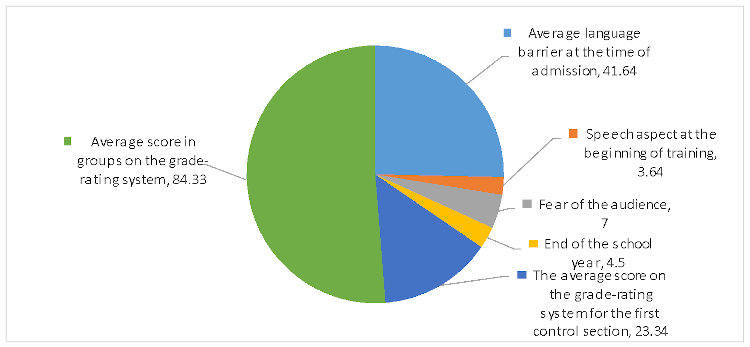
Diagram 1
Lowering the level of the language barrier is shown in %
Source: Prepared by the authors
At the second stage of the study, the formation of subject competence was determined within the framework of the study of the block of information discipline of students of NEFU IPCS, ChIPCS, and ASICA.
The following results were obtained, which are reflected in the diagrams for 3 competencies.
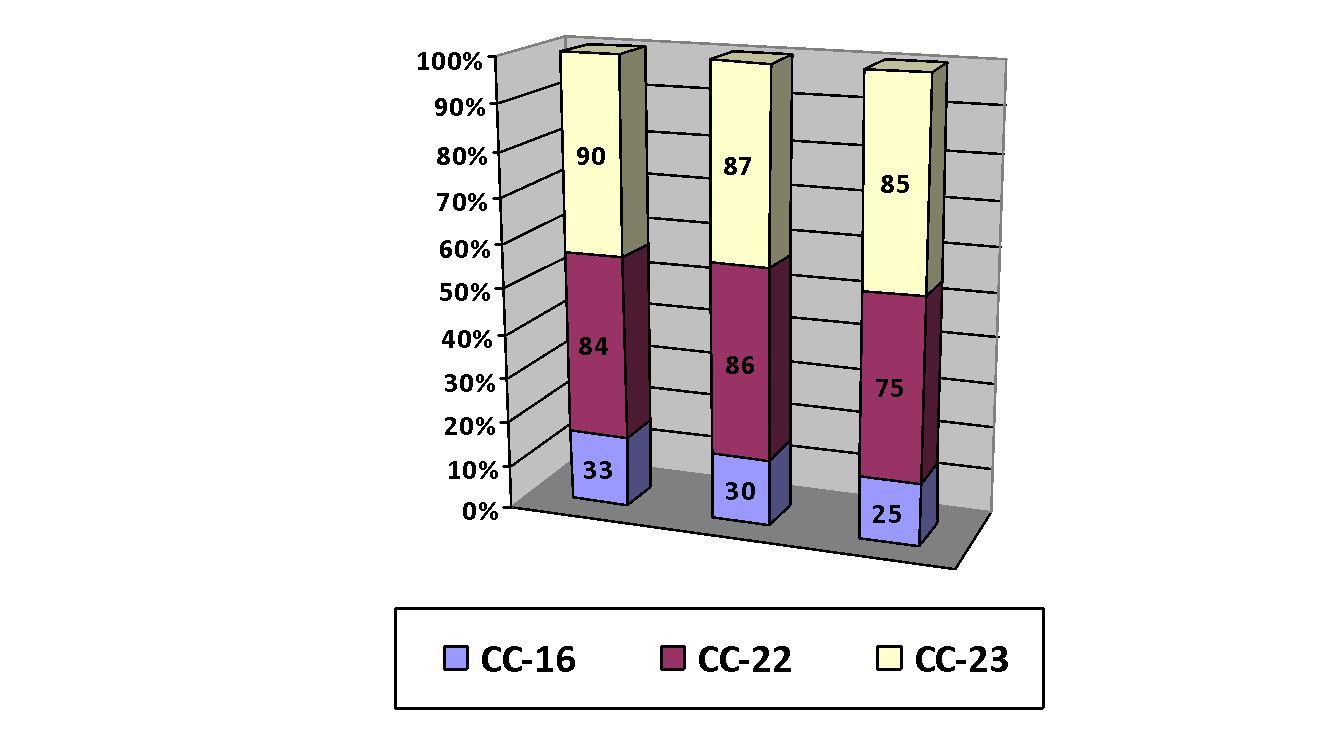
Diagram 2
Source: Prepared by the authors
CC-16 with the ability to identify the natural science essence of problems arising in the course of professional and pedagogical activities;
CC-22 with the ability to prepare and edit texts reflecting the issues of professional and pedagogical activity;
CC-23 with the ability to independently work on a computer (elementary skills).
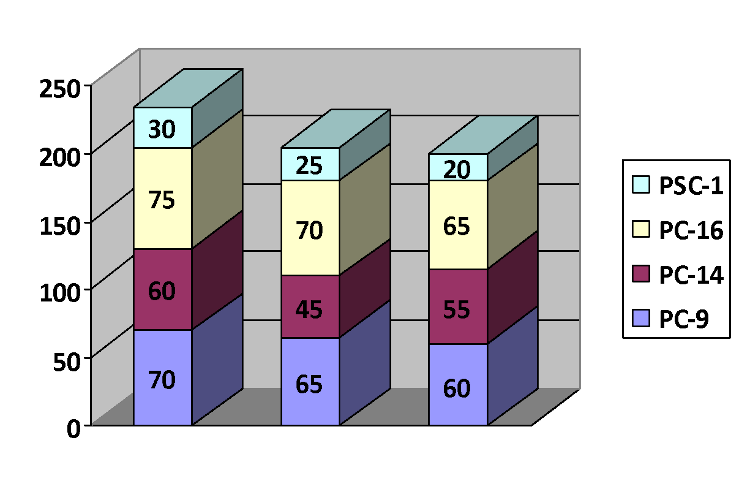
Diagram 3
Source: Prepared by the authors
PC-14 readiness to use technologies for the formation of creative abilities in the preparation of blue-collar occupations;
PC-16 with the ability to design and equip an educational and spatial environment for practical training;
PC-9 readiness to form students' professional competence;
PSC-1 can set up and maintain a computer network in a working state in his computer.
Discussion
The authors determined components of the methodological system, considering the regional component, which allows the formation of subject competence.
It has been established that the methodological system, considering the regional component, significantly contributes to an increase in the level of formation of subject competence.
The methodological material has been identified to improve the quality of online distance learning during a pandemic.
The peculiarity of the methodological system based on interactive software and pedagogical teaching technologies is highlighted. Which, taken together with the application, provides the generation of an active position of students, which helps to lower the level of the language barrier.
Each module of the block of information disciplines in the educational plans of the aforementioned universities in Yakutia contains information, educational, and control materials presented in various forms (text and interactive lectures, presentations, video lectures, questionnaires, SCORM packages, assignments, etc.). Online courses for students and teachers based on the Moodle platform have been developed for the study of modules.
A methodological system was developed considering the regional component in an online format, based on the principles of an interdisciplinary approach; it was possible to increase the level of subject competence among students of NEFU IPCS, ChIPCS, and ASICA for the period of a pandemic.
Conclusion
According to the data obtained, we conclude that the subject competence of the students of NEFU IPCS is at the average level, slightly higher compared to the average results at ChIPCS and ASICA, as evidenced by the research results. In addition, the experience gained in the online format during the pandemic determined the idea of developing the speech culture of students in solving professional problems using the developed electronic educational resource of a practical and professional orientation on the Moodle platform.
The evidence of the success of organizing distance online education during the pandemic was the increased interest and further use of online learning technology by students in their educational activities. The active activity of students also increased, expressed in participation in scientific and practical conferences and seminars using the Moodle platform.
It should be noted that the study was carried out by a team of authors who are representatives of various educational organizations of the Republic of Sakha (Yakutia). This allows us to better comprehend the problems and tasks of effective training of education specialists and their adaptation to working in a pandemic, to identify and develop the necessary general, specific and relevant educational technologies adapted to regional characteristics and possible risks.
REFERENCES
ALMPANIS, T. using a mixed methods research design in a study investigating the ‘heads of e-learning’ perspective towards technology enhanced learning. Ejel, v. 14, n. 5, p. 301-311, 2016.
BARAKHSANOV, V. P.; DANILOVA, A. I. Organization of the educational process through new information technologies in conditions of self-isolation. Problems of Modern Pedagogical Education, n. 68-1, p. 17-20, 2020.
BARAKHSANOVA, E. A. et al. Transdisciplinary approach to training future managers for digital education in Yakutia. Propositos y Representaciones, v. 8, n. 3, p. е702, 2020.
BELITSKI, M.; HERON, K. Expanding entrepreneurship education ecosystems. Journal of Management Development, v. 2, n. 36, p. 163-177, 2017.
BULANKINA, N. et al. Axiological component of professional readiness of a modern teacher to work in the aspect of the cross-border region. Trends in the Development of Psycho-Pedagogical Education in the Conditions of Transitional Society (ICTDPP-2019), v. 70, 2019. DOI: doi.org/10.1051/shsconf/20197002002
HATZIPANAGOS, S.; GREGSON, J. The role of open access and open educational resources: a distance learning perspective. Ejel, v. 13, n. 2, p. 97-105, 2015.
ITZKOWITZ, H. The Triple Helix: University-Industry-Government Innovation in Action. New York, US: Routledge, 2008.
ITZKOWITZ, H.; LEYDESDORFF, L. The Triple Helix: University-Industry-Government Relations: A Laboratory for Knowledge-Based Economic Development. EASST Review, v. 14, n. 1, p. 14-19, 1995.
KARANATOVA, L. G.; KULEV, A. Transformation of the ecosystem of additional professional education under the influence of innovative technologies. Management Consulting, n. 12, p. 120-129, 2020.
KOSTIKOVA, N. A. et al. The didactic potential of university electronic information and educational environment in the context of a pandemic. Propósitos y Representaciones, v. 8, n. 3, e707, 2020. DOI: dx.doi.org/10.20511/pyr2020.v8nSPE2.707
LAPCHIK, M. P. Training of pedagogical personnel in the conditions of informatization of education. Moscow, Russia: BINOM Knowledge laboratory, 2013.
NEUSTROEV, N. D.; NEUSTROEVA, A. N. Ethnocultural education of future teachers for schools of indigenous peoples of the North. Yakutsk, Russia: Media-holding “Yakutia”, 2015.
OLESOV, N. P. The problem of education based on ethnocultural values in the context of globalization processes. Modern Pedagogical Education, n. 3, p. 17-19, 2020.
OLSSON, M. MOZELIUS, P.; COLLIN, J. Visualisation and gamification of e-learning and programming education. Ejel, v. 13, n. 6, 2015. p. 452-465.
OSIPOVA, S. I.; PRIKHODKA, O. V.; BOGDANOVA, A. I. Speech culture in preserving the national identity of the individual. Perspectives of Science and Education, n. 6, p. 78-90, 2019.
PRATIWI, W. R. The practice of digital learning (D-Learning) in the study from home (SFH) policy: teachers' perceptions. Journal of Southwest Jiaotong University, v. 55, n. 4, 2020. DOI: 10.35741/issn.0258-2724.55.4.17
PROKOPIEV, M. S. et al. Development of a programming course for students of a teacher training higher education institution using the programming language Python. Propositos y Representaciones, v. 8, n. 3, e484, 2020.
PROKOPIEV, M. S. Formation of information and communication competence among students of a pedagogical institute. Bulletin d'EUROTALENT-FIDJIP, n. 4, p. 37-40, 2013.
REICHERT, S. The role of universities in regional innovation ecosystems. US: Brussels, Belgium, 2019.
SOLOVIEVA, R. A. et al. The internet and prospective engineers: results analysis for studies conducted during the pandemic. Propositos y Representaciones, v. 8, n. 3, 2020.
TRETYAKOVA, T. V. The concept of development of teacher education at the North-Eastern Federal University. Yakutsk, Russia: LLC Company “Dani-Almas”, 2019.
TRETYAKOVA, T. V. et al. Digital education as a new vector of development of education in the northern regions. In: ANIKINA, Z. (Ed.). Integrating engineering education and humanities for global intercultural perspectives. Springer Nature, 2020. v. 131, р. 864-870.
VARLAMOVA V. A. Bilingual educational environment in pedagogical research. The Azimuth of Scientific Research: Pedagogy and Psychology, v. 7, n. 4, p. 56-58, 2018.
VARLAMOVA V. A.; BARAKHSANOVA E. A. Formation of information competence of future teachers in a bilingual environment. In: International Scientific and Educational Forum “Education, forward!” Forum materials. 2015. p. 102-105.
VLASOVA, E. Z. et al. Teacher education in higher education systems during the pandemic and the synergy of digital technology. Propositos y Representaciones, v. 8, n. 3, e719, 2020.
VLASOVA, E. Z.; BARAKHSANOVA, E. A. Innovative solutions for training teachers for the regions of the North for the use of e-learning. Letters to Emission. Offline. 2019. n. 9, p. 2762.
VOLKOVA, I. O.; YAKOVLEVA, A. Diagnostics of the conditions for the development of innovative ecosystems in the energy sector. Innovative Economics, v. 10, n. 228, p. 52-60, 2017.
YAKUSHKINA, M. S.; ILAKAVICHUS, M. R.; ZHIRKOVA, Z. S. Intercultural enlightenment dialogue in the context of the internet and event-based interactions in the cis countries. In: THE ANNUAL INTERNATIONAL CONFERENCE ON COGNITIVE - SOCIAL, AND BEHAVIOURAL SCIENCES, 7., 2018, Moscow. Proceedings […]. Moscow, Russia, 2019. p. 204-216. DOI: doi.org/10.15405/epsbs.2019.02.02.24
ZHIRKOVA Z. S. A model for managing innovation in rural schools in the Arctic. Education and Science. Bulletin of the Ural Branch of the Russian Academy of Science, v. 5, n. 73, p. 92-108, 2010.
Notas de autor
Información adicional
How to reference this article: BARAKHSANOV, V. P.; GOTOVTSEVA, O. G.; DANILOVA, A. I.; PETROVA, T. A.; SMETANINA, T. A. Development of distant online learning in universities of Yakutia during the COVID-19 pandemic. Revista on line de Política e Gestão Educacional, Araraquara, v. 25, n. 2, p. 1071-1083, May/Aug. 2020. e-ISSN:1519-9029. DOI: https://doi.org/10.22633/rpge.v25i2.15314