Artigos
THE STUDY OF THE GROUNDS AND DEVELOPMENT OF A TYPOLOGY OF FOSTER FAMILIES RAISING DIFFERENT CATEGORIES OF CHILDREN WITH SPECIAL NEEDS
O ESTUDO DA FUNDAMENTAÇÃO E DO DESENVOLVIMENTO DE UMA TIPOLOGIA DE FAMÍLIAS ADOTIVAS QUE CRIAM DIFERENTES CATEGORIAS DE CRIANÇAS COM NECESSIDADES ESPECIAIS
EL ESTUDIO DE LOS FUNDAMENTOS Y EL DESARROLLO DE UNA TIPOLOGÍA DE FAMILIAS DE ACOGIDA QUE CRÍAN DIFERENTES CATEGORÍAS DE NIÑOS CON NECESIDADES ESPECIALES

THE STUDY OF THE GROUNDS AND DEVELOPMENT OF A TYPOLOGY OF FOSTER FAMILIES RAISING DIFFERENT CATEGORIES OF CHILDREN WITH SPECIAL NEEDS
Revista on line de Política e Gestão Educacional, vol. 25, núm. 2, pp. 1222-1238, 2021
Universidade Estadual Paulista Júlio de Mesquita Filho

Esta obra está bajo una Licencia Creative Commons Atribución-NoComercial-CompartirIgual 4.0 Internacional.
Recepción: 16 Mayo 2021
Aprobación: 11 Junio 2021
Publicación: 01 Agosto 2021
Abstract: The article presents a theoretical analysis of scientific literature on the problems of foster families raising children with disabilities, identifies the difficulties of parents in effectively solving the health problems of a child with disabilities caused by weak motivation, stress, and lack of experience, competencies, and relevant knowledge. This work investigated and identified the grounds for developing a typology of foster families raising children with disabilities and proposed a typology according to them. To achieve the research objective, the methods of interviews, expert assessments, and classification were used. The conclusion is that the developed typology can serve as the basis for representatives of the guardianship and wardship authorities when selecting an appropriate foster family for a child, and foster parents will be able to provide an appropriate training and education model for effective rehabilitation, correction, and health recovery of this category of children.
Keywords: Foster family, Children with disabilities, Typology of foster families for children with disabilities.
Resumo: O artigo apresenta uma análise teórica da literatura científica sobre os problemas de famílias adotivas que criam filhos com deficiência, identifica as dificuldades dos pais em resolver eficazmente os problemas de saúde de uma criança com deficiência causados por falta de motivação, estresse e falta de experiência, competências e conhecimento relevante. Este trabalho investigou e identificou as bases para o desenvolvimento de uma tipologia de famílias adotivas que criam filhos com deficiência e propôs uma tipologia de acordo com elas. Para atingir o objetivo da pesquisa, foram utilizados os métodos de entrevistas, avaliação de especialistas e classificação. A conclusão é que a tipologia desenvolvida pode servir como base para os representantes das autoridades de tutela ao selecionar uma família adotiva apropriada para uma criança, e os pais adotivos serão capazes de fornecer um treinamento adequado e modelo de educação para a eficaz reabilitação, correção e recuperação da saúde dessa categoria de crianças.
Palavras-chave: Família adotiva, Crianças com deficiência, Tipologia de famílias adotivas para crianças com deficiência.
Resumen: El artículo presenta un análisis teórico de la literatura científica sobre los problemas de las familias de acogida que crían niños con discapacidades, identifica las dificultades de los padres para resolver eficazmente los problemas de salud de un niño con discapacidades causados por una motivación débil, estrés y falta de experiencia, competencias, y conocimiento relevante. Este trabajo investigó e identificó las bases para desarrollar una tipología de familias de acogida que crían niños con discapacidad y propuso una tipología acorde a ellas. Para lograr el objetivo de la investigación, se utilizaron los métodos de entrevistas, evaluaciones de expertos y clasificación. La conclusión es que la tipología desarrollada puede servir como base para los representantes de las autoridades de tutela y tutela al seleccionar una familia de crianza adecuada para un niño, y los padres de crianza podrán proporcionar un modelo apropiado de capacitación y educación para una rehabilitación, corrección, y recuperación de la salud de esta categoría de niños.
Palabras clave: Familia adoptiva, Niños con discapacidad, Tipología de familias de acogida para niños con discapacidad.
Introduction
The problem of a foster family is urgent both for Russia and abroad. Statistics demonstrate that in 2020, 33,000 orphans were placed in foster families in Russia (FEDERAL STATISTICAL OBSERVATION, 2020), almost 70,000 children live in foster families in Germany (GABLER et al., 2018), ninety-two percent of children under state’s guardianship are placed in foster families in Ireland (this is one of the highest rates of family placement in care systems worldwide) (GILLIGAN, 2019), 67,000 children are under state’s guardianship in England, 50,000 of whom live in foster families (CAMERON et al., 2020). Every year the number of children with health problems left without parental care, having numerous problems and disorders of a physiological, mental, emotional, and physical nature (children with fragile X syndrome, children with cerebral palsy, children with spinal muscular atrophy etc.) is increasing, hence, important and open issues are the inability of foster parents to solve these problems and the ineffective procedure for selecting and training foster families to accompany various categories of children with disabilities.
The results of recent studies have shown that there are the following problems that need to be addressed in the practice of foster parenting and in the work of the guardianship and wardship authorities:
- Many foster families mainly exercise the right to choose children with a developmental norm, without anomalies and problems, mainly at a younger age;
- Many parents refuse to accept a child with disabilities into the family due to external and internal motives (BAER; DIEHL, 2019; DANIEL, 2011), including the lack of formation of internal motive for fostering, due to the foster parents’ personal immaturity (MARKOVA; EMELYANOVA, 2016), foster parents’ stress (MILLER; GREEN; LAMBROS, 2019), peculiarities of a foster child’s behavior (MORGAN; FARINEAUB; MULLIS, 2015) and, lack of experience in raising children with disabilities (LEATHERS et al., 2019);
- A typology of foster families has not been developed, and the selection of foster parents is carried out according to formal requirements (availability of a medical certificate, living conditions, parents’ material support etc.) (COMBS-ORME; ORME, 2014; VANSCHOONLANDT et al. 2013).
The fundamental scientific problem is the need to study the grounds according to which a typology of professional foster parents raising children with various disabilities will be developed. This will improve the accuracy of the selection procedure and preparation of the appropriate type of family for children with specific problems and features.
The research purpose is to develop a typology of foster families for children with disabilities. The study tasks are: 1) to identify the parameters of foster families (parents) that are most significant for the upbringing and support of children with disabilities; 2) to develop the grounds of a typology of a foster family raising children with different disabilities; 3) analysis of the grounds for a typology of foster families for children with disabilities and the development of a typology on various grounds.
Literature review
The problems of studying foster families with various categories of children have become widespread in Russia and abroad. In domestic science, various socio-psychological characteristics and foster parents’ features have been studied:
- Social factors, psychological characteristics, and value orientations of foster parents, contributing to fostering of a problem child (YAPAROVA, 2009; SHCHERBINA, 2016);
- The socio-psychological maturity of the foster parent’s “ideal image” (ALDASHEVA; ZELENOVA, 2017);
- Parent-child relations in foster families raising children with disabilities (ASLAMAZOVA, 2012).
It was revealed that very few foster parents abroad actually prefer to raise a large number of children with special needs (ORME; CHERRY, 2015).
A study of domestic scientific periodicals and books has shown that the development of scientific directions in the study of the grounds for typologization of professional foster parents (families) accompanying children with various categories of health disorders is insufficient. Thus, conducting research on the stated topic will give an impetus to the further development of this scientific direction.
The analysis of foreign scientific works made it possible to identify the following kinds and types of foster families accompanying various categories of children with disabilities:
- Families providing support for children with disabilities of varying complexity (one or more emotional and behavioral disorders) (CHEATHAM; RANDOLPH; BOLTZ, 2020);
- Families raising children with inappropriate behavior (WHITE et al., 2019);
- Families raising children with mental disorders, comorbidities, and risk factors (HASELGRUBER; SÖLVA; LUEGER-SCHUSTER, 2020);
- Therapeutic foster families providing treatment and therapeutic services for children with health problems (ORME; CHERRY, 2015; TULLBERG et al., 2019).
Research methodology and methods
The study involved 236 foster parents raising children with disabilities (120 foster families) and experts who were 60 foster parents having experience in raising children with disabilities and 50 workers of the guardianship and wardship authorities in the Lipetsk region.
The following research methods were used in the work:
1. Theoretical research methods: theoretical analysis of domestic and foreign scientific literature on the most significant problems of foster families raising children with disabilities, the peculiarities and characteristics of foster parents accompanying children with disabilities, and classification of foster families for children with disabilities.
2. Methods of pedagogical diagnostics:
- An interview with representatives of the guardianship and wardship authorities, with foster parents to identify the most significant parameters of foster parents, providing positive effects of rehabilitation and overcoming health problems in children with disabilities. During the interview, the following questions were asked: 1. What characteristics of foster parents influence the overcoming of impairments in children with disabilities? What difficulties are faced by foster parents raising children with disabilities? What factors determine the overcoming of these difficulties in foster parents? Does the number of children with disabilities, the type of impairment in children with disabilities, the experience of foster parents in raising children with disabilities matter for foster parents?
- Expert assessment method. In our study, this method was an individual assessment by selected experts of the most significant parameters of foster families (parents) for children with disabilities. The experts were representatives of the guardianship and wardship authorities and parents who have many years of positive experience in the rehabilitation of foster children with various health disorders. The way of measuring the parameters of foster parents in the expert assessment method was the ranking of all characteristics and parameters proposed by experts in the order of their importance (from the most significant to the least significant).
3. The typological method was used to group foster parents on the most essential grounds necessary to perform professional functions in relation to children with different types of disabilities.
The research was carried out in three stages: at the first stage, an interview was held with representatives of the guardianship and wardship authorities, foster parents of children with disabilities, and the documentation was studied; at the second stage, the expert assessment method was applied using ranking to study the significant characteristics of foster parents accompanying children with health disorders; at the third stage, a description was carried out, and a typology of foster families for raising children with disabilities was proposed.
Research results
At the first stage, we studied the parameters of foster parents raising children with disabilities. Experts were 60 foster parents in accordance with the requirements for their competence (higher education, 5-8 years of experience in raising foster children with disabilities), 50 representatives (employees) of the guardianship and wardship authorities according to the demands (higher education; 5 year experience in working with foster parents raising children with disabilities, professional knowledge, and advanced training in the choice and support for foster families having children with disabilities).
The main research method was an interview with representatives of the guardianship and wardship authorities and foster parents, who were selected as experts. During the interview, various parameters of parents were identified, which are necessary for raising children with disabilities in a foster family.
After collecting and processing the results of the interview, the following foster parents’ parameters were identified as necessary for the upbringing of children with health disorders:
1) the level of education; 2) the parents’ age; 3) personal qualities; 4) experience of foster parenting in raising children with disabilities; 5) the number of children with disabilities in the foster family; 6) knowledge and skills in performing medical functions; 7) knowledge and skills in performing the rehabilitation of health disorders; 8) knowledge and skills in raising children with disabilities; 9) the age of children with disabilities; 10) the specificity of children’s health disorders.
At the next stage, using the expert assessment method, the experts were asked to evaluate and rank the parameters related to the foster family (parents) raising children with disabilities according to the degree of their significance. The following results were obtained by the expert assessment method and rank order technique.
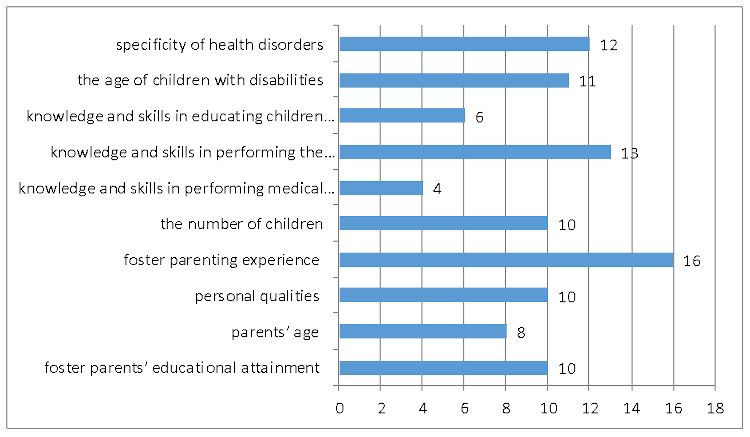
Figure 1
Ranking according to the degree of significance of the foster family’s (parents’) main parameters to raise children with disabilities left without parental care (%)
Source: Prepared by the authors
According to the ranking results, number one is the foster parenting experience regarding upbringing of children with disabilities (16%), number two is knowledge and skills in performing the functions of rehabilitation of health disorders (13%), number three is the specificity of children’s health disorders (12%), number four is the children’s age (11%), number five is education (10%), the number of children (10%), and personal qualities (10%) in equal proportions. Less significant, according to experts, are the foster parents’ age (8%), knowledge and skills in raising children with disabilities (6%), and knowledge and skills in performing medical functions (4%).
For a more thorough analysis and description of the characteristics of the identified parameters, 120 foster families raising children with disabilities (N = 120) were studied.
According to the parameter “foster parenting experience in raising children with disabilities”, the following types of families were identified out of 120 foster families with the most positive experience in raising this category of children: 1) having 5-8-year experience (38%), 2) having 3-5-year experience (46%). According to experts, in foster families with the specified experience and the period of residence of children with disabilities, results are achieved such as restoration of some functions that children with disabilities lack (speech, motor skills, self-service skills, advancement in development, overcoming emotional disorders etc.). The remaining 16% of foster families have 1-3-year experience in accompanying children with disabilities who are in the process of children’s adaptation to the family and parents’ adaptation to the children’s health peculiarities (Diagram 1).
According to the parameter “knowledge and skills to perform the functions of rehabilitation of children’s health disorders”, 68% of parents out of 120 foster families have such knowledge and skills obtained at special training and retraining courses, have long-term experience and positive results in the rehabilitation of foster children with disabilities. Thirty-two percent of foster parents have knowledge of rehabilitation issues, but insufficiently developed skills for their use in the process of raising children with disabilities (Diagram 2).
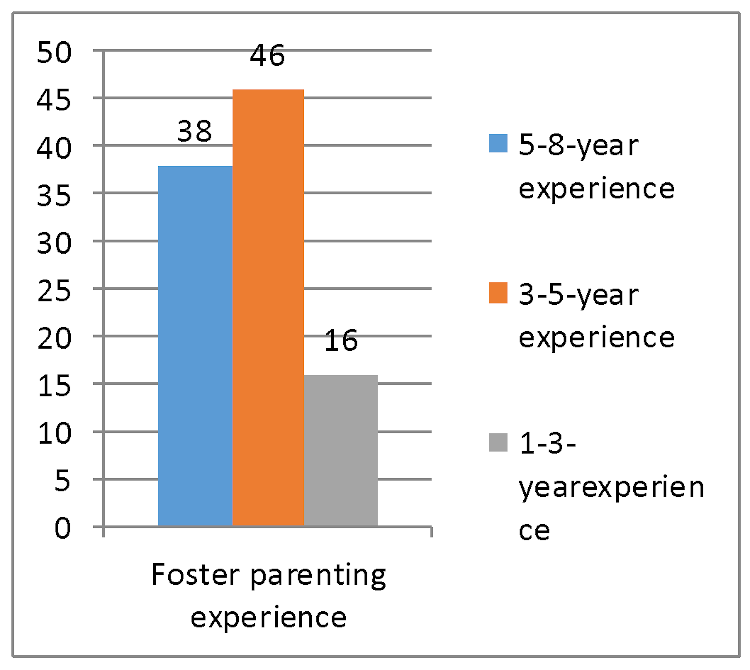
Diagram 1
Percentage of foster families of the general population (N = 120) according to the parameter “foster parenting experience” (%)
Source: Prepared by the authors
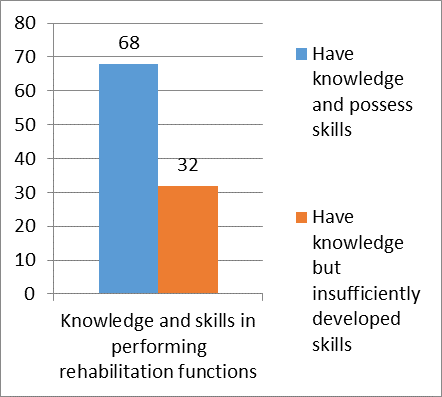
Diagram 2
Percentage of foster families of the general population (N = 120) according to the parameter “knowledge and skills in performing the functions of rehabilitation of children’s health disorders” (%)
Source: Prepared by the authors
Following the parameter “specificity of children’s health disorders”, foster families can be categorized into these types: 1) those raising children with one type of health disorders and disabilities (cerebral palsy, fragile X syndrome, speech disorders, intellectual disabilities, autism etc.) – 34%; 2) those raising children with several (multiple) types of disorders (cerebral palsy and intellectual disability, intellectual incapacity and emotional disorders) – 20%; 3) those raising children with complex impairments – 10%; and 4) those raising children with secondary uncomplicated impairments (mild speech impairments, mild cerebral palsy, fragile X syndrome) – 26%. The specificity of the of the foster family’s (parents’) functions in overcoming health disorders depends on the number and complexity of impairments (Diagram 3).
According to the parameter “children’s age”, we identified the following types of families out of 120 foster families with experience in raising children with disabilities: 1) those performing only early childhood care (25%), 2) those raising only preschoolers with disabilities (46 %), 3) those raising only adolescents with disabilities (15%), 4) those raising children with disabilities of different ages (14%) (Diagram 4). Out of the foster families sample corresponding to this parameter, the greatest complexity in upbringing and rehabilitation is represented by families raising adolescents and children with disabilities of different ages, since, on the one hand, adolescence is a complicated period of personal development and it is accompanied by health problems, on the other hand, different ages of children, the presence of developmental disorders in them require from foster parents having integrative knowledge of age characteristics, the specifics of raising children of a particular age, and the simultaneous knowledge of methods and techniques for overcoming impairments.
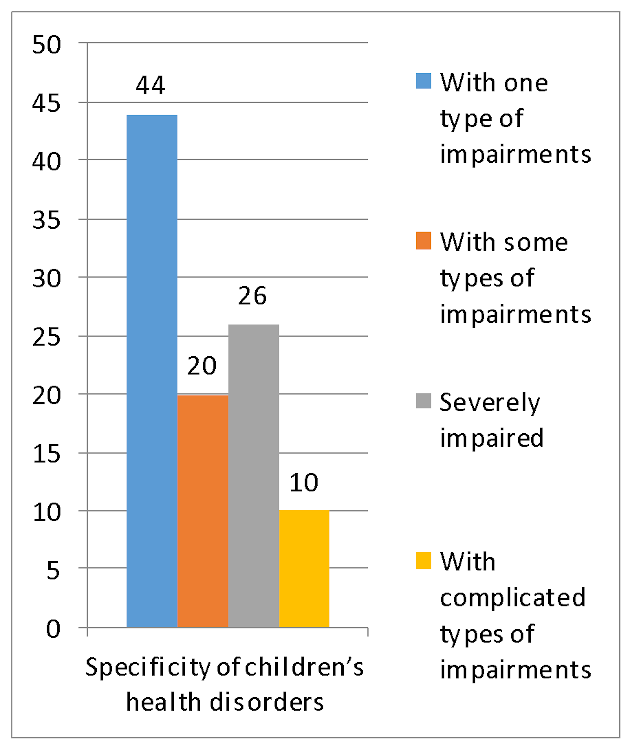
Diagram 3
Percentage of foster families of the general population (N = 120) according to the parameter “specificity of children’s health disorders” (%)
Source: Prepared by the authors
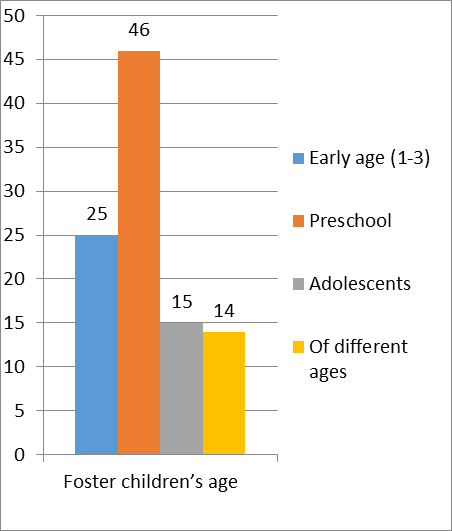
Diagram 4
Percentage of foster families of the general population (N = 120) according to the parameter “foster children’s age (%)
Source: Prepared by the authors
Analysis of 120 foster families by the parameter “foster parents’ educational attainment” revealed: foster families in which both parents have higher education (35%), both parents have secondary education (24%), one of the parents has higher education, the other has secondary education (41%). According to the results of the survey of representatives of the guardianship and wardship authorities, foster parents’ educational level is not associated with an effective solution to the problems of upbringing and rehabilitation of children with disabilities. The necessary additional knowledge and skills to solve the problems of children with health problems can be obtained through training foster parents at school and taking special refresher courses.
In accordance with the parameter “the number of foster children”, we have defined foster families raising one child (28%), two children (32%), three children (22%), and four or five children (18%) with health disorders.
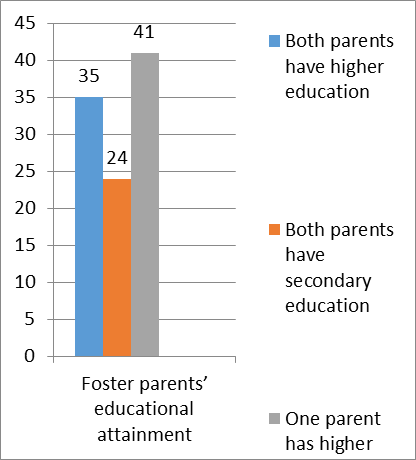
Diagram 5
Percentage of foster families of the general population (N = 120) according to the parameter “foster parents’ educational attainment” (%)
Source: Prepared by the authors
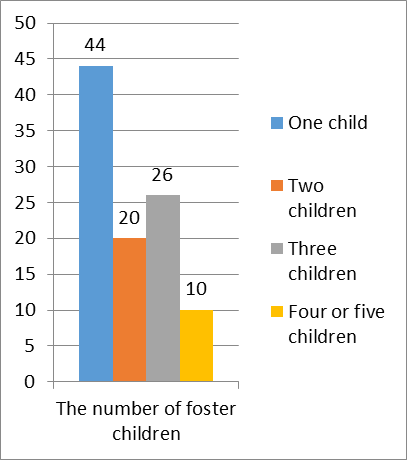
Diagram 6
Percentage of foster families of the general population (N = 120) according to the parameter “the number of foster children” (%)
Source: Prepared by the authors
The basis for the typology of foster families is the most significant feature, a parameter according to which foster families can be divided into different types. The typology of foster families raising children with disabilities is the division of foster families according to the grounds that will allow making a qualified choice (selection) of a family for a child with disabilities, predicting the effectiveness of functions to overcome children’s health disorders in the context of foster parenting.
We have proposed a typology of foster families according to certain grounds:
- The number of foster children: families raising one, two or several children with disabilities;
- The age of children with disabilities: families raising children of preschool or primary school age, adolescents, and children of different ages;
- Experience in foster parenting in the upbringing of children with disabilities: adaptive (1-2 years), professional (3-5 years);
- The functions and types of help to foster parents having children with disabilities for their performance of educational, medical, therapeutic, rehabilitation, correctional, and comprehensive assistance;
- Foster parents’ educational attainment: both parents have secondary education; both parents have higher education; one parent has secondary education, the other has higher education;
- The specifics of children’s health disorders: raising children with mild health disorders, raising children with severe health disorders. In each type, one can also distinguish the upbringing of children by the number of existing impairments – with one, two or more impairments;
- The competence of the implementation of the rehabilitation functions by foster parents in the upbringing of children with disabilities: incompetent, insufficient, and with sufficient competence.
Discussion
This study systematizes, expands, and specifies domestic and foreign works, in which certain types and kinds, and their combinations, of foster families raising children with disabilities have been identified. The advantages and positive results of our experiment, and aspects requiring discussion have been revealed. The research novelty is the developed typology of foster families, which in domestic and foreign scientific works is presented by the study of only some grounds related to our typology. For instance, as for the ground “the foster parenting experience in raising children with disabilities,” our work is consistent with the study, where it is proved that many foster parents, due to lack of experience, are poorly prepared to meet the needs of children with disabilities (KAZDIN et al. 2018). At the same time, our study, based on this ground, identifies specific types of these families – adaptive and professional, which expands the previous scientific and practical data.
As for the ground “specificity of children’s health disorders”, we confirmed the classification of types of foster families according to seven studied types of foster children’s special needs – criteria for one or more DSM-IV disorders, with emotional disorders (24.0%), ADHD (19.0%), and behavioral disorders (21.5%). The article presents examples of the classification of foster families, identifies data, confirming the other scientific works, that only some foster parents raise children with different and complex disorders (VURAL et al., 2014); and a higher percentage of foster parents raise children with one out of seven types of special needs (ORME; CHERRY, 2015).
According to the parameter “children’s age”, we have specified the types of foster parents by age criteria. We share foreign researchers’ opinion that there are certain barriers keeping people from raising adolescents (lack of experience, fear, and stereotypes) (BAER; DIEHL, 2019).
We agree with the studies stating that foster parents’ insufficient education is an unfavorable factor associated with children’s psychological characteristics and the success of their professional activities in raising orphans (USHAKOVA, 2003; YAKOH; CHONGRUKASA; PRINYAPOL, 2015). However, in the works presented, the object of study was foster parents raising children with a developmental norm.
According to the parameter “the number of children”, we have identified foster families with one-two children with disabilities, foster families with many children, raising three-five children with disabilities. The previous studies revealed that the upbringing of 2 children with disabilities is optimal for effective rehabilitation and care, as well as solving the problems of such categories of children (TULLBERG et al., 2019).
The disadvantage of our work is the use of marginally formalized diagnostic techniques, which should be supplemented with formalized ones, allowing the acquisition of more accurate results.
So, we have studied only some of the external grounds of the typology of foster families raising children with disabilities. There is a need to identify the internal socio-psychological characteristics of foster parents raising children with health disorders, such as personal maturity, frustration, responsibility, and motivation, and to study the relationship of these characteristics with the effectiveness of solving health problems of foster children with disabilities. Carrying out such research would allow applying formalized research methods and supplement our typology with new grounds and types.
Conclusions
The developed typology of foster parents with children of various categories of disabilities will improve the accuracy of the selection procedure, apply a specific model for choosing the appropriate type of families for children with specific health problems, and ensure the effectiveness of solving various problems of children through high-quality professional training of the foster family to perform various functions (educational, correctional, medical, and related to rehabilitation). The development of a typology of foster families raising children with disabilities will provide a high standard solution to the physiological, rehabilitation, psychological, social, and pedagogical problems of children of various categories of disabilities, and in some cases even replace specialists of various profiles necessary for children and increase the efficiency of the guardianship and wardship authorities in these directions.
The developed typology of professional foster families will be the basis for the enlargement of a database of professional foster families for various categories of children with disabilities and will allow the guardianship and wardship authorities and social employment centers to properly train professional foster parents to perform complex or specific professional functions in accompanying children with various categories of health disorders.
REFERENCES
ALDASHEVA, A. A.; ZELENOVA. M. E. Foster parents’ professional mindset as a factor in the foster family’s success. Bulletin of the University of the Russian Academy of Education, v. 5, p. 23-28, 2017.
ASLAMAZOVA, L. A. Child-parent relations in foster families raising children with disabilities: author’s abstract. St. Petersburg, 2012.
BAER, L.; DIEHL, D. K. Foster care for teenagers: Motivators, barriers, and strategies to overcome barriers. Children and Youth Services Review, v. 103, p. 264-277, 2019. DOI: https://doi.org/10.1016/j.childyouth.2019.06.004
CAMERON, C. et al. Security-first thinking and educational practices for young children in foster care in Sweden and England: A think piece. Children and Youth Services Review, v. 119, p. 105523, 2020. DOI: https://doi.org/10.1016/j.childyouth.2020.105523
CHEATHAM, L. P.; RANDOLPH, K. A.; BOLTZ, L. D. Youth with disabilities transitioning from foster care: Examining prevalence and predicting positive outcomes. Children and Youth Services Review, v. 110, p. 104777, 2020. DOI: https://doi.org/10.1016/j.childyouth.2020.104777
COMBS-ORME, T.; ORME, J. G. Foster parenting together: Assessing foster parent applicant couples. Children and Youth Services Review, v. 36, p. 70-80, 2014. DOI: https://doi.org/10.1016/j.childyouth.2013.10.017
COOLEYA, M. E.; FARINEAUB, H. M.; MULLIS, A. K. Child behaviors as a moderator: Examining the relationship between foster parent supports, satisfaction, and intent to continue fostering. Child Abuse & Neglect, v. 45, p. 46-56, 2015. DOI: https://doi.org/10.1016/j.chiabu.2015.05.007
DANIEL, E. Gentle iron will: foster parents' perspectives. Children and Youth Services Review, v. 33, n. 6, p. 910-917, 2011. DOI: https://doi.org/10.1016/j.childyouth.2010.12.009
FEDERAL STATISTIC OBSERVATION. Summary reports according to the federal statistical observation No. 103-rik form for Russia as a whole and the constituent entities of the Russian Federation “Information on the identification and placement of orphans and children left without parental care” for 2020. Available: https://docs.edu.gov.ru/document/17bc19963749a7f29e59d09c0c7e6faa/. Access: 01 Mar. 2021.
GABLER, S. et al. Predictors of foster parents’ stress and associations to sensitivity in the first year after placement. Child Abuse & Neglect, v. 79, p. 325-338, 2018. DOI: https://doi.org/10.1016/j.chiabu.2018.02.009
GILLIGAN, R. The family foster care system in Ireland – Advances and challenges. Children and Youth Services Review, v. 100, p. 221-228, 2019. DOI: https://doi.org/10.1016/j.childyouth.2019.02.008
HASELGRUBER, A.; SÖLVA, K.; LUEGER-SCHUSTER, B. Perspective matters: Differences between child- and caregiver-reports of emotion regulation mediating the relationship between cumulative childhood trauma and mental health problems in foster children. Child Abuse & Neglect, v. 107, p. 104558, 2020. DOI: https://doi.org/10.1016/j.chiabu.2020.104558
KAZDIN, A.E., GLICK, A., POPE, J., KAPTCHUK, T.J., LECZA, B., CARRUBBA, E., MCWHINNEY, E., HAMILTON, N. Parent management training for conduct problems in children: enhancing treatment to improve therapeutic change. International Journal of Clinical and Health Psychology, v. 18, n. 2, p. 91-101, 2018. DOI: https://doi.org/10.1016/j.ijchp.2017.12.002
LEATHERS, S. J. et al. Placement disruption in foster care: children’s behavior, foster parent support, and parenting experiences. Child Abuse & Neglect, v. 91, p. 147-159, 2019. DOI: https://doi.org/10.1016/j.chiabu.2019.03.012
MARKOVA, S. A.; EMELYANOVA, I. D. Personal maturity of adopting parents as a condition for preventing social orphanage. International Journal of Environmental and Science Education, v. 11, n. 17, p. 10045-10055, 2016.
MILLER, A. E.; GREEN, T. D.; LAMBROS, K. M. Foster parent self-care: a conceptual model. Children and Youth Services Review, v. 99, p. 107-114, 2019. DOI: https://doi.org/10.1016/j.childyouth.2019.01.014.
ORME, J. G.; CHERRY, D. J. The vital few foster parents: replication and extension. Children and Youth Services Review, v. 56, p. 33-41, 2015. DOI: https://doi.org/10.1016/j.childyouth.2015.05.019
SHCHERBINA, S. M. Features of the foster mother’s attitude to a child that determine the success of his upbringing in a foster family. South Russian Journal of Social Sciences, v. 17, n. 1, p. 41-53, 2016.
TULLBERG, E. et al. Unpacking “support”: understanding the complex needs of therapeutic foster parents. Children and Youth Services Review, v. 105, p. 104420, 2019. DOI: https://doi.org/10.1016/j.childyouth.2019.104420
USHAKOVA, E. V. Socio-psychological capabilities of a foster family as a rehabilitation structure for orphans: author’s abstract. Moscow, 2003.
VANSCHOONLANDT, F. et al. Parenting stress and parenting behavior among foster mothers of foster children with externalizing problems. Children and Youth Services Review, v. 35, n. 10, p. 1742-1750, 2013. DOI: https://doi.org/10.1016/j.childyouth.2013.07.012
VURAL, B.K. et al. An investigation of empathic skills of foster families, Turkey running title: empathic skills of foster families, Turkey. Procedia - Social and Behavioral Sciences, v. 159, p. 570-576, 2014. DOI: https://doi.org/10.1016/j.sbspro.2014.12.427
WHITE, L. et al. Understanding and parenting children's noncompliant behavior: the efficacy of an online training workshop for resource parents. Children and Youth Services Review, v. 99, p. 246-256, 2019. DOI: https://doi.org/10.1016/j.childyouth.2019.01.045.
YAKOH, M.; CHONGRUKASA, D.; PRINYAPOL, P. Parenting styles and adversity quotient of youth at pattani foster home. Procedia - Social and Behavioral Sciences, v. 205, p. 282-286, 2015.
YAPAROVA, O. G. Social factors and parents’ psychological characteristics that predetermine the formation of an effective foster family: author’s abstract. Moscow, 2009.
Notas de autor
Información adicional
How to reference this article: PRONINA, A. N. The study of the grounds and development of a typology of foster families raising different categories of children with special needs. Revista on line de Política e Gestão Educacional, Araraquara, v. 25, n. 2, p. 1222-1238, May/Aug. 2021. e-ISSN:1519-9029. DOI: https://doi.org/10.22633/rpge.v25i2.15185