2021
252
10052021
20072021
Abstract: The aim of this study is to reveal the relationship between Multiple Intelligences and internet addiction levels of students at Mardin Artuklu University. The sample of the study consists of 162 students at the School of Physical Education and Sports of Mardin Artuklu University. Internet addiction scale and Multiple Intelligences Self Evaluation Scale were used as data collection tools in the study. SPSS 20.0 package program was used in the analysis of the data obtained in the study. It was observed that data is normally distributed. Descriptive statistical analysis and correlation analysis were applied in the analysis of the data. At the end of the study, it was determined that there was a positive relationship between verbal intelligence and loss of control, and a negative relationship between the desire to be more online and the dimensions of negativity in social relations.
Keywords:Multiple intelligenceMultiple intelligence,Internet addictionInternet addiction,University studentUniversity student.
Resumo: O objetivo deste estudo é revelar a relação entre Inteligências Múltiplas e níveis de dependência de internet de alunos da Universidade Mardin Artuklu. A amostra do estudo é composta por 162 alunos da Escola de Educação Física e Esportes da Universidade Mardin Artuklu. A escala de dependência de Internet e a Escala de Autoavaliação de Inteligências Múltiplas foram utilizadas como ferramentas de coleta de dados no estudo. O pacote de programas SPSS 20.0 foi utilizado na análise dos dados obtidos no estudo. Observou-se que os dados são normalmente distribuídos. A análise estatística descritiva e a análise de correlação foram aplicadas na análise dos dados. Ao final do estudo, determinou-se que existia uma relação positiva entre a inteligência verbal e a perda de controle, e uma relação negativa entre o desejo de estar mais online e as dimensões da negatividade nas relações sociais.
Palavras-chave: Inteligência múltipla, Dependência de internet, Universidade estudante.
Resumen: El objetivo de este estudio es revelar la relación entre las inteligencias múltiples y los niveles de adicción a Internet de los estudiantes de la Universidad Mardin Artuklu. La muestra del estudio está formada por 162 estudiantes de la Escuela de Educación Física y Deportes de la Universidad Mardin Artuklu. La escala de adicción a Internet y la escala de autoevaluación de inteligencias múltiples se utilizaron como herramientas de recopilación de datos en el estudio. En el análisis de los datos obtenidos en el estudio se utilizó el programa paquete SPSS 20.0. Se observó que los datos se distribuyen normalmente. En el análisis de los datos se aplicó análisis estadístico descriptivo y análisis de correlación. Al final del estudio, se determinó que existía una relación positiva entre la inteligencia verbal y la pérdida de control, y una relación negativa entre el deseo de estar más en línea y las dimensiones de la negatividad en las relaciones sociales.
Palabras clave: Inteligencia múltiple, Adicción a internet, Universidad estudiante.
Artigos
AN INVESTIGATION OF THE RELATION BETWEEN UNIVERSITY STUDENTS’ LEVELS OF INTERNET ADDICTION AND MULTİPLE INTELLİGENCES
UMA PESQUISA SOBRE A RELAÇÃO ENTRE OS NÍVEIS DE VÍCIO EM INTERNET DOS ESTUDANTES UNIVERSITÁRIOS E INTELIGÊNCIAS MÚLTIPLAS
UNA INVESTIGACIÓN DE LA RELACIÓN ENTRE LOS NIVELES DE ADICCIÓN A INTERNET DE LOS ESTUDIANTES UNIVERSITARIOS Y LAS INTELIGENCIAS MÚLTIPLES

Recepción: 10 Mayo 2021
Recibido del documento revisado: 25 Junio 2021
Aprobación: 20 Julio 2021
Publicación: 01 Agosto 2021
Internet addiction, as a new type of addiction, has become an important field of study in recent years, attracting the attention of researchers from different disciplines, especially sociology, psychology, and communication. Although there is no standard definition of internet addiction, the existence of such a phenomenon is accepted among researchers (CHOU et al., 2009). The term "Internet addiction" was first used by psychiatrist Dr. Ivan Goldberg to describe pathological Internet use. Goldberg (1996) defines “Internet Addiction Disorder” with multiple basic diagnostic criteria. These include a desire to increase time spent on the network, daydreaming about the network, staying online longer than planned, having persistent physical, social, or psychological problems, and the like. According to Griffiths (1998), excessive internet use may not be a problem in many cases, but limited case studies show that some individuals’ excessive internet use is a real addiction and a real source of anxiety transmitted by Balci and Gülnar (2009). The author also states that internet use is a type of technology addiction (such as computer addiction) and a subtype of behavioral addictions (such as obsessive gambling) (CHOU; HSİAO, 2000). YOUNG (1998), on the other hand, defines addicted internet use as "an impulse control disorder that does not involve the intake of an intoxicating substance" and likens it to "pathological gambling". According to the author, Internet addicts are anxious about the Internet (for example, thinking about previous online activities or anticipating the next online time); uses the Internet for increasing amounts of time to get satisfaction; making unsuccessful and repeated attempts to control, interrupt or stop internet use; experiences discomfort, mood swings, depression or restlessness when trying to reduce internet use; stays online longer than the original intention; risks jeopardizing or losing important relationships, jobs, educational or career opportunities through internet use; It exhibits patterns such as lying to family members, therapists or other people to hide the extent of the connection with the Internet, and using the Internet to escape from problems or to get rid of an unpleasant mood (for example, feelings of hopelessness, guilt, anxiety and depression) transmitted by Balci and Gülnar (2009).
There have been many years of research on the meaning of intelligence. In the process of these studies, many different definitions were made by the researchers. Some psychologists have expressed different views on the definition of intelligence. Some believe that intelligence consists of many special abilities. Trying to measure intelligence for the first time, Galton considered intelligence as the construction and use of information (DEMIREL, 2016). According to Binet, the concept of intelligence is reasoning, good judgment and self-criticism (BULGURCUOĞLU, 2021). Early theories about the basic nature of intelligence were concerned with three main points: learning capacity, the total knowledge gained by the individual, and the ability to adapt successfully to new situations and the environment (SENEMOĞLU, 2007).
Intelligence is a general mental power. This power manifests itself equally in any field of man. It is also claimed that intelligence is independent of environmental conditions. However, recent studies have revealed that environmental conditions do affect intelligence to some extent. Until the theory of multiple intelligences emerged, many opinions on intelligence were put forward in the history of education. For many years, the opinion that people have a certain intelligence area and that they live with this intelligence area was dominant, but today the limits of intelligence have started to be determined again with the research. While all these developments have taken the world education history to a different point, it has made it necessary to reevaluate human intelligence in the light of new developments. Over time, the view that intelligence consists of many factors has become dominant. Although it was accepted that intelligence consisted of many factors, it continued to be determined by a single measurement as a unique combination of these factors. In this process, Gardner approached intelligence in a different way and stated that intelligence should not be handled in one dimension, but in many different dimensions. Based on this understanding, he developed the theory of multiple intelligences. According to the theory of multiple intelligences, there are different intelligence areas such as verbal intelligence, mathematical intelligence, social intelligence, musical intelligence, visual intelligence, bodily intelligence, intrapersonal intelligence, and naturalistic intelligence. Gardner (1993) stated that the development of these intelligence areas, as well as heredity, has a supportive or inhibiting role in the development of environmental conditions (BULGURCUOĞLU, 2021).
The Theory of Multiple Intelligences was defined by Gardner in 1983 (KÖKSAL, 2006). This theory is an approach that opposes the IQ intelligence perspective in the individual, asserts that intelligence is multi-part, and emphasizes that individuals come to the learning environment with different learning styles (GARDNER, 1993). According to Gardner, intelligence is the ability to create products and solve problems that find value in one or more cultures (transmitted by BULGURCUOĞLU, 2021).
1. Linguistic Intelligence: This type of intelligence includes the ability to use and produce language EFFECTIVELY (ARMSTRONG, 2003, p. 13; ARMSTRONG, 2009, p. 6; MORAN; KORNHABER; GARDNER, 2006: 27).
2. Kinesthetic Intelligence: Individuals who develop kinesthetic intelligence can control their body movements at a good level and can use their brain and body coordination effectively. This includes skills such as intelligence, balance, strength, flexibility, speed, handcraft, and coordination (BABACAN; DILCI, 2012; NOLEN, 2003, p. 117).
3. Visual Intelligence: Individuals with developed visual intelligence have features such as being able to perceive visual elements fully and transforming things into different forms (ELIK; TAZEGÜL, 2018).
4. Musical Intelligence: Individuals who are dominant in this intelligence area are sensitive to the rhythm, melody, timbre and tone of a piece of music (ARMSTRONG, 2003, p. 13; ARMSTRONG, 2009, p. 7; MORAN; KORNHABER; GARDNER, 2006).
5. Logical Intelligence: Individuals who are dominant in this intelligence area use numbers very well and reason (ARMSTRONG, 2003, p. 13; ARMSTRONG, 2009, p. 6; MORAN; KORNHABER; GARDNER, 2006, p. 27).
6. Intrapersonal Intelligence: It includes recognizing the characteristics such as personality, potential, pleasures, talent and ambition, symbolizing the experiences he/she has in her inner world, and helping others with what he/she has gained from this field. (ARMSTRONG, 2003, p. 13).
7. Interpersonal Intelligence: Individuals who can see the differences between them by being aware of the characteristics they have, and to guide for the benefit of others in this direction, are included in this intelligence field (ARMSTRONG, 2003, p. 13; ARMSTRONG, 2009, p. 7; MORAN; KORNHABER; GARDNER, 2006, p. 27).
8. Naturalist Intelligence: People who are dominant in the field of naturalist intelligence are sensitive individuals who create an awareness of nature and the environment (GREEN et al., 2005, p. 355). This intelligence area covers the individual’s ability to recognize the animal and plant community around him, to take care of them or to communicate with them in a beautiful way. It is the ability to recognize all living things in nature, to research and to think about the creation of living things (ARMSTRONG, 2003, p. 13; ARMSTRONG, 2009, p. 7; MORAN; KORNHABER; GARDNER, 2006, p. 27).
9. Existential Intelligence: Existential intelligence is not a field of intelligence peculiar to individuals who have positive or negative ideas about the end of life and form moral values, on the contrary, it is an intelligence field that can be developed by everyone who can think skillfully and deeply on some issues (BULGURCUOĞLU, 2021).
The aim of this study is to reveal the relationship between Multiple Intelligences and internet addiction levels of students at Mardin Artuklu University.
In this study, relational data model, which is included in the quantitative research method, was used as a method.
The universe of the study consists of students studying at Mardin Artuklu University, while the sample of the study consists of 162 students, who are selected by random sampling method, at the School of Physical Education and Sports of Mardin Artuklu University.
“Multiple Intelligences Self Evaluation Scale” designed by Howard Gardner and adapted to Turkish culture by Şahin and Korkmaz (2002) for validity and reliability (α=0.93) was applied to determine the distribution levels in multiple intelligence. The inventory consists of 80 questions. There are 8 intelligence theories and 10 questions from each type of intelligence. Questions were asked about verbal-linguistic intelligence, logical-mathematical intelligence, visuospatial intelligence, musical-rhythmic intelligence, naturalist intelligence, intrapersonal intelligence, bodily-kinesthetic intelligence and intrapersonal intelligence.
The Internet Addiction Scale, adapted to Turkish culture by Şahin and Korkmaz, was used. The scale was designed by Hahn and Jerusalem (2001) and was originally called “Skala zur Erfassung der Internetsucht”.
SPSS 20.0 package program was used in the analysis of the data obtained in the study. In the analysis of the data, the data set was primarily examined in terms of false value, outlier and multiple correlations. It was observed that there were no incorrectly entered data in this process. The Shapiro–Wilk test are most widely used methods to test the normality of the data. It was observed that data is normally distributed. Descriptive statistical analysis and correlation analysis were applied in the analysis of the data. A p-value of less than 0.05 was considered significant.
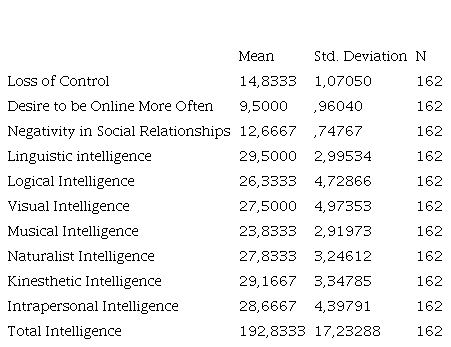
In the table above, the scores that the students received from the scales are given.
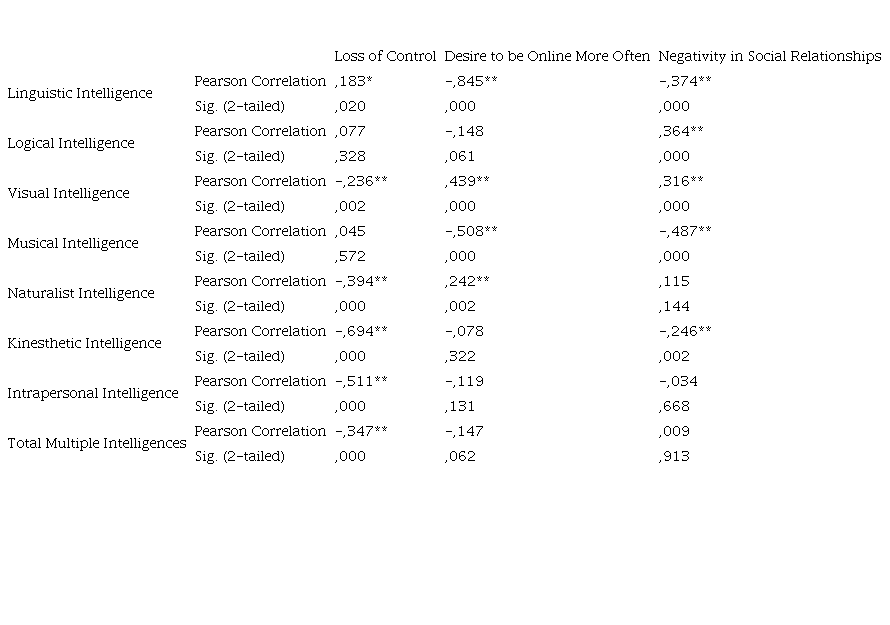
Because of the correlation analysis, it was determined that there was a positive relationship between linguistic intelligence and loss of control, and a negative relationship between the desire to be online more and the dimensions of negativity in social relations. It has been determined that there is a positive relationship between Logical Intelligence and the dimension of negativity in social relations. It has been determined that there is a positive relationship between Visual Intelligence and loss of control, and a negative relationship between the desire to be more online and the dimensions of negativity in social relations. It has been determined that there is a positive relationship between Musical Intelligence and the desire to be more online and the dimensions of negativity in social relations. It has been determined that there is a negative relationship between Naturalist Intelligence and the dimension of negativity in social relations. It has been determined that there is a negative relationship between Kinesthetic Intelligence and the dimensions of negativity in social relations, loss of control and the desire to be more online.
As a result of the descriptive statistical analysis, it was determined that the dimension of Negativity in Social Relations of the students in the sample group was higher than the other dimensions of internet addiction. Based on this result, it can be said that the students in the sample have problems in their social relationships and relationships with their immediate surroundings. According to Akdağ et al. (2014), it was determined that female students had a higher level of internet addiction. Again, in this study, it is understood that there is an increase in levels of internet addiction as daily time spent on the internet increases. Addiction scores of students who spend time on the internet for less than 60 minutes are lower than those who spend time on the internet for more than 60 minutes. In their study, Üneri and Tanıdır (2011) concluded that there was no significant relationship between internet addiction according to whether there is internet at home and whether there is a computer in the student’s room.
In the studies conducted by Kır and Sulak (2014), and Çakır, Ayas and Horzum (2011) on university students, they found that male students’ mean scores of internet addiction were higher than women’s mean scores.
As a result of the descriptive statistical analysis, it was determined that the level of verbal intelligence of the students in the sample group was the highest. Based on this result, it can be said that they use their language skills better, they are better at thinking and expressing with words, evaluating complex meanings in language, telling and explaining. It was determined that the physical intelligence level of the students in the sample was in the second rank. Based on this result, it can be said that the students in the sample group control their body movements at a good level and use their brain and body coordination effectively. In the study conducted by Aygül and Koç (2016), mean scores of visual-spatial and musical-rhythmic intelligences of female students were found to be higher than mean scores of male students. In the studies conducted by Altınok (2008) on physical education students and Demir (2010) on ninth grade students, the musical-rhythmic and visual-spatial intelligence scores of female students were found to be higher than the scores of male students. McClellan and Conti (2008), on the other hand, developed a scale to determine the dominant intelligence areas of university students in his study. In his study conducted on 874 university students, the musical-rhythmic intelligence field ranks second with 18.8%. Müderrisgil (2012), in a sample of 210 students, revealed that musical-rhythmic intelligence has the highest rate among the eight intelligence areas in terms of the number of students in percentile order.
Taşkın and Korucuk (2019) determined the intelligence dimensions of university students as follows in their study. Verbal Intelligence 24.13, Logical - Mathematical Intelligence 24.43, Visual - Spatial Intelligence 22.02, Musical - Rhythmic Intelligence 24.30, Bodily Kinesthetic Intelligence 23.04, Intrapersonal Intelligence 24.57, Naturalist Intelligence 21.96, Social Intelligence 35.82.
As a result of the correlation analysis, it was determined that there was a negative relationship between verbal intelligence and the desire to be online more often and the dimensions of negativity in social relations. When these data are evaluated according to the characteristics of the scale, students with developed verbal intelligence can communicate effectively with people, because they use words well. Studies have shown that students with a high level of internet addiction have problems in human relations. As a result of the correlation analysis, it was determined that there is a negative relationship between intelligence levels and internet addiction.
As a result, it was determined that as the internet addiction levels of the students increased, there was a decrease in their intelligence level; and the verbal intelligence level of the students was higher than the other intelligence levels.
How to reference this article: ALTUNHAN, A.; TAZEGÜL, Ü. An investigation of the relationship between university students’ levels of internet addiction and multiple intelligences. Revista online de Política e Gestão Educacional, Araraquara, v. 25, n. 2, p. 1251-1263, May/Aug. 2021. e-ISSN: 1519-9029. DOI: https://doi.org/10.22633/rpge.v25i2.15496

