Artigos
THE ROLE AND PLACE OF ETHNOPEDAGOGY IN THE EDUCATIONAL ECOSYSTEM
O PAPEL E O LUGAR DA ETNOPEDAGOGIA NO ECOSSISTEMA EDUCACIONAL
EL PAPEL Y EL LUGAR DE LA ETNOPEDAGOGÍA EN EL ECOSISTEMA EDUCATIVO

THE ROLE AND PLACE OF ETHNOPEDAGOGY IN THE EDUCATIONAL ECOSYSTEM
Revista on line de Política e Gestão Educacional, vol. 25, núm. 2, pp. 1364-1376, 2021
Universidade Estadual Paulista Júlio de Mesquita Filho

Esta obra está bajo una Licencia Creative Commons Atribución-NoComercial-CompartirIgual 4.0 Internacional.
Recepción: 10 Mayo 2021
Recibido del documento revisado: 25 Junio 2021
Aprobación: 20 Julio 2021
Publicación: 01 Agosto 2021
Abstract: This article addresses various educational systems that have led to the transition to the educational ecosystem. Application of ethno-pedagogical bases in the modern innovative educational process expands frontiers of knowledge on the way of comprehension of this environment, provides the formation of ecological consciousness and forms world outlook structures, a priori providing coevolution of the person and society, the individual and nature, the person and the world. The process of transition from the educational environment to the educational ecosystem, focuses on learning throughout a lifetime and continuous professional development, adapting the person to the new challenges of our time. The relevance of the transition is due to the progressive development of the human community, which tirelessly modernizes the essence and place of the educational system in the sociocultural environment. Not the lowest of the roles should be given to traditional folk pedagogical methods, mechanisms, and ways of education and training.
Keywords: Education, Educational ecosystem, Peoples of the arctic and the north, Digitalization, Ethnopedagogy.
Resumo: Este artigo aborda vários sistemas educacionais que levaram a transição para o ecossistema educacional. A aplicação de bases etnopedagógicas no moderno processo educacional inovador expande as fronteiras do conhecimento sobre o modo de compreensão do meio ambiente educacional, proporciona a formação da consciência ecológica e forma estruturas de visão do mundo, a priori proporcionando a coevolução da pessoa e da sociedade, do indivíduo e da natureza, da pessoa e do mundo. O processo de transição do ambiente educacional para o ecossistema educacional, concentra-se na aprendizagem ao longo da vida e no desenvolvimento profissional contínuo, adaptando a pessoa aos novos desafios de nosso tempo. A relevância da transição deve-se ao desenvolvimento progressivo da comunidade humana, que incansavelmente moderniza a essência e o lugar do sistema educacional no ambiente sociocultural. Não menos importante é o papel que deve ser dado aos métodos, mecanismos e formas tradicionais de educação e treinamento pedagógico popular.
Palavras-chave: Educação, Ecossistema educacional, Povos do ártico e do norte, Digitalização, Etnopedagogia.
Resumen: Este artículo aborda diversos sistemas educativos que han llevado a la transición al ecosistema educativo. La aplicación de las bases etnopedagógicas en el proceso educativo moderno e innovador amplía las fronteras del conocimiento en la forma de comprensión del medio ambiente, proporciona la formación de la conciencia ecológica y forma estructuras de visión del mundo, proporcionando a priori la coevolución de la persona y la sociedad, el individuo y la naturaleza, la persona y el mundo. El proceso de transición del entorno educativo al ecosistema educativo, se centra en el aprendizaje a lo largo de la vida y el desarrollo profesional continuo, adaptando a la persona a los nuevos retos de nuestro tiempo. La relevancia de la transición se debe al desarrollo progresivo de la comunidad humana, que moderniza incansablemente la esencia y el lugar del sistema educativo en el entorno sociocultural. No hay que olvidar los métodos, mecanismos y formas de educación y formación tradicionales de la pedagogía popular.
Palabras clave: La educación, Ecosistema educativo, Pueblos del ártico y del norte, Digitalización, Etnopedagogía.
Introduction
Digitalization in the modern world occupies a special place – almost everything that previously could not be done without human supervision is moving into electronic space. The concepts like e-government, unified state exam, distance learning, etc., are becoming quite common. The events of 2020, which was marked by a worldwide pandemic of coronavirus, became a catalyst for the transition to the information format of a large number of not only the services provided but also the complete or partial transition of training with the use of distance technologies. In the industrial sphere, the creation and transition to a global electronic economic space appear as a natural progression of post-industrial society, known as the Fourth Industrial Revolution, which happened much earlier and was not at all associated with a viral cataclysm. Back in 2019, economists connected by the World Economic Forum platform were embarking on a unique learning journey that would benefit the manufacturing environment. Manufacturing has endured a decade of productivity stagnation and demand fragmentation, so innovation is long overdue. Organizations that used the innovations of the Fourth Industrial Revolution to scale beyond the pilot phase have experienced unprecedented efficiency gains at low cost (ZHIRKOVA, 2010). That is why the process of transition from the educational environment to the educational ecosystem is natural: when the basic factors of social development change, the transformation of all superstructural social structures and social relations also happens dialectically.
The goal set is to study the ways of development of ethno-national principles of education and training, its determinism with technological innovations in modern society (RAVEN, 2002). It is necessary to consider how it is possible to integrate the mechanisms of socialization of the peoples of Russia into information innovations.
It is worth noting that for Yakutia, the transition to a digital ecosystem is a task that has been purposefully developed since the beginning of the new century. The region was the flagship in the introduction of the unified state exam, which today appears as a large-scale experiment in the transition to the electronic system of exit examinations, which made it possible to join the unified requirements for the quality of education in a single educational space (VOLKOV, 1999). The Republic of Sakha (Yakutia) was one of the first to introduce elements of e-government in the provision of public services, which greatly facilitated the conditions for remote service, dictated by the development of the Covid-19 pandemic.
Literature review
When conducting the study, it was interesting to find out to what extent modern information and technological innovations are combined with national pedagogical features that form the basis of ethnopedagogy (VOLKOV, 1999). Are not these features, given the current processes of globalization (NEUSTROEV, 2012) in the educational sphere, a brake on the development of education? Domestic philosophers (RUSSIA, 1983) and sociologists have seen the global threats that are becoming increasingly apparent as a result of environmental crisis, social and biological experiments, and leading to a loss of human identity - national, cultural, sexual, and so on. In all cases, global threats come not only from the fact that the integrity of the world has become clearer than before but also from the fact that the limits of the planet's ecosystem development have become apparent (ZHIRKOVA, 2020, p. 3). Outstanding Soviet and Russian philosopher and methodologist Shchedrovitsky (1993, p. 28), determined that for a person is central the natural and social environment, in interaction with which his/her formation and building as a person are taking place. However, in the relationship with the environment, the subject is primary and initial, that is, the environment is a priori set to the person and opposes him as a subject, and the person socialization is possible only by creating a certain social and educational environment for a particular person’s development with its various possible trajectories within this environment. His/her formation as a member of the relevant society takes place in the interaction with the environment as a complex of physical, biological, chemical, and socio-anthropogenic factors.
Sociologist Markovich (1991, p. 53), believes that "social (public) behavior arises as a consequence of the fact that one person is important to another as part of his/her environment”. For this reason, special attention, from his point of view, should be given precisely to the influence of the social environment on human behavior with mutual impact.
Yasvin (2001, p. 263) more extensively considers the concept of the educational environment, including those elements of the educational process that are often viewed only as an appendix to the system. For example, he describes a situation with which many people are familiar: children stand by a closed door of a gym until it is unlocked by a cleaner or a physical education teacher. Overflowing with energy, movement, and anticipation, they find no place. Not being functionally engaged, neither a gym, nor a library, nor a lecture hall that is a spatial-natural environment do not exist without athletes, readers, and listeners.
The concept "environment" in the Russian language has many meanings, ranging from the middle designation of the center, week, or the substance filling the space, but only one meaning will be adopted - a set of conditions in which human activity and society proceeds (OZHEGOV; SHVEDOVA, 2003, p. 759). It is also important here the philosophical designation of an environment as the social, material, and spiritual conditions surrounding a person, which have a decisive impact on his/her formation (SHCHEDROVITSKY, 1993, p. 651).
Since the 2000s, the notion of the Learning Ecosystem, which is considered as a concept of education that rethinks the educational process, starts to enter science (OLEYNIKOV; PODLESNYI, 2013).
At the end of the 20th century, the system was already perceived as a whole, consisting of interconnected and ordered parts, as a totality, being in dialectical determinations with each other. In modern scientific and technical terminology, it becomes a leading elaboration is carried out within the framework of the system approach.
A complete educational ecosystem, behind which is the future, should include an integrated portal that includes not only "knowledge–ability–skills", but also all human resources: medical factors, needs, and personal career opportunities, and so on, integrating all processes and contexts. This concept is a sociocultural theory used to design its activities for the entire ecosystem (SHAPOVALENKO, 2005, p. 117).
The educational environment, promoting a person as a member of society, always has a psychological (personal) nature and begins to affect him or her at a very early age. The child's environment is of tremendous importance for his/her formation, and Sigmund Freud viewed it from the unconscious level of the psyche – a kind of reservoir of instinctive and biological needs, desires, and drives of the body. Subsequently, it is this formed unconscious that will become the basis of human life in society, adapting the individual to the environment (SHCHEDROVITSKY, 1993, p. 57).
Therefore, the environment plays an exceptional role in the perception and mastering of the surrounding world. Considering the views of the Leipzig school, which paid special attention to primary childhood perceptions, Vygodsky (1984, p. 343) writes that the child at a very early age begins to master his/her environment, perceiving it in an affective and syncretic form. The environment is not yet differentiated, not separated, and the sensual tone of perception will accompany every representation of someone in the future. This period of development is characterized by its peculiarity when "... the perception is directly connected with the action". One may say that a child's consciousness is a unity of affective perception, affect, and action.
In the severe conditions of living and activity, small peoples of the North proved to be quite a vulnerable part of the human community. In modern conditions of post-industrial society, the preservation of habitat, traditional crafts, and authentic ethical culture are essential conditions for survival in a constantly globalizing world regarding the possibility of sustainable development of peoples training, education, and training of children of indigenous peoples of the North (BARAKHSANOVA et al., 2019, p. 51). Domestic scientists are actively searching for the development and testing of appropriate models for the traditional gradual adaptation of children in the North to the educational ecosystem, which would be more adequate and authentic for them (BARAKHSANOVA et al., 2020, p. 108).
The Dictionary of Modern General Education defines the educational environment as a special, very important type of environment for the socialization of the person, which is interpreted not only as a factor denoting the educational nature but also the totality of all educational components, which are organized based on the environmental principle of environmentalism (section of general ecology) (OZHEGOV; SHVEDOVA, 2003, p. 212).
Environmental culture and responsibility become in the 21st century the most important sections of education and training. Caring for nature develops in the person the highest and subtlest manifestations of the human personality, allows him/her to feel and perceive the universality of being. These provisions were peculiar to folk pedagogy in old times. It is ethnopedagogy, which is the closest to understanding the educational ecosystem, no matter how paradoxical it may initially seem. At the same time, in our country, there was a certain wrong attitude toward traditional educational methods and techniques inherited from the Soviet period of educational development: everything in the past seemed backward and rigid for the formation of the human being of a communist future and "Loyalty to antiquity was seen almost as a movement backward" (LEURENT; BOER, 2019, p. 26). Although it is fair to admit that it was in the Soviet period that the school was closest to nature: local history, tourism, environmental studies, films, photos of the natural environment, and museum activities were very widely developed at all levels of education.
Research methods
In this paper, the questionnaire method to reveal the understanding of the role of pedagogical factors of using ethnopedagogy in the educational process was used. For the questionnaire formation, transdisciplinarity was used to address different aspects of the traditions of the peoples of the North, social sphere, and features due to climatic, territorial, and geographical conditions that contribute to the autochthonous residence in the settlements of the Arctic and the North. The study involves 16 settlements located in the Arctic and Northern zones of the Republic of Sakha (Yakutia); also, representatives of small peoples live almost in all 35 settlements of the republic. This makes it possible to claim that the problems studied in the study are required for the republic and similar Russian regions as a whole. Diagram 1 shows the ratio of settlements by territorial groups.
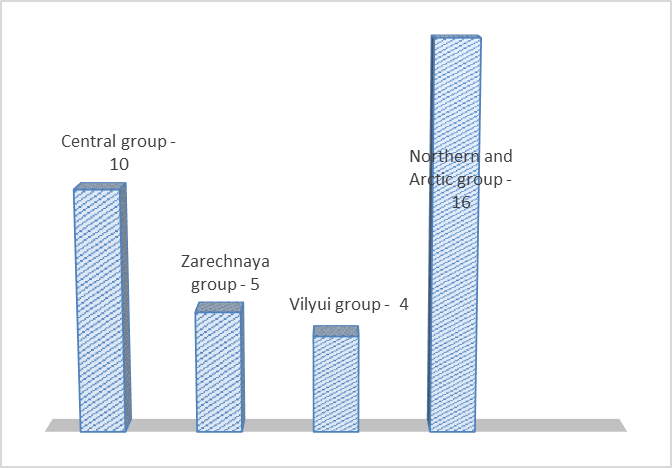
Diagram 1
Distribution of settlements of the Republic of Sakha (Yakutia) by areas
Source: Prepared by the authors
The application of transdisciplinarity more widely reveals the prospects of scientific knowledge of objects and phenomena (BARAKHSANOVA et al., 2020). These methods help not only expand the range of problems under consideration but also make it possible to consider the question of the place of ethnopedagogy in the modern digital educational space.
This study followed the method of theoretical analysis of scientific literature, from which it was concluded that the system approach is more promising (ZHIRKOVA, 2020). It helps to implement a common system model and use different digital tools when considering the role of ethnopedagogy in the modern system of education. The system approach makes it possible to combine four functional subsystems into a single whole: worldview, natural, managerial, and technological. In this case, four levels of complexity of the system are in a single bundle: social, biological, physical, and symbolic (Table 1).
| No. | Components | Content | Authors |
| 1. | Worldview | A study of the theoretical foundations and methods of the practical application of various ethnopedagogical systems for the development of value orientations. | Nazarchuk A.V. Grigorieva A.A. Barakhsanova E.A. Danilova A.I. Barakhsanov V.P. Nikitina A.V.Solovieva R.A. |
| 2. | Natural | Building generalized models of biosystems and models of different classes and properties of systems, including models of systems dynamics, their purposeful impact, and development in the period of climate change. | Oleynikov B.V. Podlesnyi S.A. |
| 3. | Managerial | Development of conceptual means of presenting the objects under study as systems for making preventive management decisions. | Zhirkova Z.S. |
| 4. | Technological | Understanding how the objective world and all of its components are in continuous and regular change and require constant technological renewal. | TretyakovaT.V. BarakhsanovaE.A. ProkopyevM.S. SorochinskyM.A. Vlasova E.Z. |
Results
The study has shown that contemporary upgrading and development of education requires the inclusion of folk pedagogy elements in the system of personal formation and the educational process. It is important to continue the traditional ethnic trajectories of love for the motherland, native nature, and education of citizenship in spiritual formation. Such an expansive interpretation of education does not diminish the innovative role of the transition to the educational ecosystem since the digitalization and visual transformation of folk epic content and ethnos historical experience will only enrich and enhance the efficiency of the socialization process. It is important to preserve the deepest original roots of spirituality, which is understood as a way of human life based on moral values.
The experimental survey involved 250 students each from two institutions of higher education – North-Eastern Federal University (NEFU) and the Arctic State Agrotechnological University (ASAU). Table 2 below presents the results.
| Factors influencing the formation of the educational process, considering ethnopedagogy | NEFU (%) | ASAU (%) |
| 1. The need to include elements of traditional pedagogy in the educational process | 72.8 | 82.1 |
| 2. The role of digitalization in preserving folk traditions used in the educational process | 63.2 | 74.3 |
| 3. Ability to present multimedia information in a synchronized way (in the context of a unified digital educational ecosystem) | 82 | 68.3 |
| 4. Ethnic trajectories of love for the fatherland, native nature, education in nature conservation | 68.2 | 73 |
| 5. Education for citizenship and moral qualities of personality based on folk pedagogy | 89.3 | 91 |
| 6. Traditional roots of spirituality based on moral values: love, respect, mutual understanding, creative development | 78.5 | 89.6 |
| 7. Social and intercultural communication with representatives of other ethnic groups | 80.3 | 75.1 |
| 8. Conservation of habitat, traditional handicraft production, and authentic ethical culture for survival in the modern world | 62.3 | 92.5 |
| 9. Environmental culture and environmental responsibility in a changing climate | 68.9 | 86 |
| 10. Knowledge of the specifics of regional education, considering climatic, territorial, and geographical features of the Arctic | 78 | 92.7 |
In general, ASAU outcomes are noticeably higher in pos. 1, 2, 6, 8, 9, and 10, which can be explained by the fact that the main contingent of ASAU students is represented by residents of rural northern and arctic settlements, where representatives of small Northern peoples (the Yakuts, Evenks, Even and Yukagirs) traditionally reside. The most important factors mentioned by students of both universities were the education of citizenship and the need for intercultural communication between different ethnic groups. It is encouraging that students understand the importance of digitalization in preserving folk traditions.
As part of the experiment, the knowledge level of students on the elements of ethnopedagogy introduced in separate academic disciplines was determined. The table 3 below shows the grades according to the results of the examination session according to the grade-rating system. The disciplines are ordered according to the established components of the system approach.
| No. | Components | Academic disciplines | ASAU | NEFU |
| 1 | Worldview | Philosophy Culture of the Peoples of Yakutia Ethics and aesthetics | 657667 | 787282 |
| 2 | Natural | Biology, ecology | 62 | |
| 3 | Managerial | Education managementManagement in zootechnics | 78 | 76 |
| 4 | Technological | Computer science and engineering Computer modeling | 6269 | 6872 |
Discussion
This study examines the current problems of training educators to work in the Arctic and the North, who would be able to create and effectively use advanced educational technologies, considering the specific conditions of life of the northerners, their national and cultural traditions.
The authors – theorists and practitioners – believe in their works that digitalization will require great efforts, including material ones, for comprehensive transformations in the system of training highly qualified staff with high competence in the field of information technology (NEUSTROEV; NEUSTROEVA; SHERGINA, 2018, p. 865). Perhaps it is the investment component that is the main problem area.
Unfortunately, many regions and areas, especially in the northern regions, clearly will not be able to provide all the innovations, relying only on their own forces. Networking and digital cooperation will only be effective if each network member has a quality resource, a voluntary distribution of areas among all network members for in-depth study (BARAKHSANOVA et al., 2019, p. 747).
A study of the phenomenon of informatization of the educational system conducted at NEFU found that faculty and students interacted effectively online using the unique capabilities of the Internet. The study focused on the practical application of ethno-pedagogical methods in professional and pedagogical training and turned to the experience of NEFU in mastering core competencies of students on the Moodle platform (UDEN; WANGSA; DAMIANI, 2007, p. 722) to form an electronic information educational system that includes maximum information support and electronic resources: new-generation educational and methodological complexes, 3-dimensional graphical mathematical models for practical work and student's independent work performance, design, modeling and instrumentation tools. Under the Covid-19 pandemic quarantine, the information environment has become the most practice-oriented component of learning and education for students and trainees living in the Arctic zone and hard-to-reach sparsely populated areas. It promotes changes in the technology and practice of solving new tasks and attitudes, strategies for the development of the educational system associated with the development of information processes, and the globalization of modern society (NAZARCHUK, 2002). The creation and implementation of a digital educational ecosystem in the conditions of our republic have an important practical value: the introduction of online education joins indirect connections and contacts, which expands the range of interaction between the professional community and society as a whole. Innovative models of education unite economics and policy of educational activity, management of educational process and different spheres of digital education, and so on (BARAKHSANOVA et al., 2017, p. 18). This kind of interaction only strengthens the social ties within the societies of national-ethnic communities. Incorporating ethno-national ways and forms of education and training that deepens connections and relationships between people of different nationalities and different generations, helps to solve life's problems and issues in training and education.
A modern educational ecosystem (OLEYNIKOV; PODLESNYI, 2013) can include a variety of spaces and parameters: learning in the classroom and living in a hostel, classes in the gym and vocal and dance ensemble, hobby clubs, and scientific circles. It can also function during laboratory and practical works, including within library walls and intellectual centers, can provide along with intramural, extramural, and distance learning, acquiring knowledge and skills using videoconferences and webinars (TRETYAKOVA, 2019). The ecosystem of education involves the creation of growing new opportunities and ways for learning, facilitating cooperation between teachers and students, and becoming the ideal environment for the implementation of the most creative learning paradigms, using information technology and resources (BRODO, 2006, p. 84-85).
Conclusion
A deeper comprehension of the case for educational ecosystem implementation in modern society, evaluation of the role, and search for the place of ethnopedagogy in it has deeper roots and need their justification and protection. Hopefully, joint research projects in this area will not only enrich the scientific annals but also contribute to a better understanding of the society in the information period of its development. It is necessary to make efforts for the early transition from the educational environment to the educational ecosystem, which is dictated by the natural development of the human community. These innovations are by no means at odds with the folkways and mechanisms of education and training. Therefore, it is necessary not to oppose but enrich and cooperate.
REFERENCES
BARAKHSANOVA, E. A. et al. Peculiarities of quality management of teachers' e-learning training in the Arctic regions. Spaces, v. 38, n. 55, 2017.
BARAKHSANOVA, E. A. et al. Current trends in digital education development in the Republic of Sakha (Yakutia). Espacos, v. 40, n. 22, p. 18, 2019.
BARAKHSANOVA, E. A. et al. Transdisciplinary approach to training future managers for digital education in Yakutia. Propósitos y Representaciones, v. 8, n. esp. 3, e702, 2020.
BRODO, J. A. Today’s ecosystem of e-learning. Trainer Talk, v. 3, n. 4, 2006. Available: http://enewsbuilder.net/salesmarketing/e_article000615779.cfm. Access: 10 Dec. 2020.
LEURENT, H.; BOER, E. D. Fourth industrial revolution beacons of technology and innovation in manufacturing. The world economic forum. Geneva, Switzerland, 2019.
MARKOVICH, D. J. Social ecology: a book for the teacher. Moscow: Prosveshcheniye, 1991. 173 p.
NAZARCHUK, A. V. Ethics of a globalizing society. Moscow: Direct Media Publishing, 2002. 381 p.
NEUSTROEV, N. D. Pedagogical aspect of globalization and ethnic mentality. Philosophy of Education, n. 2, n. 41, p. 30-36, 2012.
NEUSTROEV, N. D.; NEUSTROEVA, A. N.; SHERGINA, T. A. Individualization and ethnopedagogy at small elementary schools components of vocational training for university tutors. Sibirica: Interdisciplinary Journal of Siberian Studies, v. 17, n. 3, p. 92-115, 2018.
OLEYNIKOV, B. V.; PODLESNYI, S. A. On the concept of "ecosystem of learning" and directions for the development of computerization of education. Knowledge, Understanding, Skill, n. 4, p. 84-91, 2013.
OZHEGOV, S. I.; SHVEDOVA, N.Y. Dictionary of the Russian language. Moscow: ITI Technologies LLC, 2003. 944 p.
RAVEN, J. Competence in modern society. Identification, development and release. Moscow: Kogito Center Publ., 2002. 400 p.
RUSSIA. Philosophical encyclopedic dictionary. Moscow: Soviet Encyclopedia, 1983. 840 p.
SHAPOVALENKO, I. V. Developmental psychology (Evolutionary psychology and developmental psychology). Moscow: Gardariki, 2005. 349 p.
SHCHEDROVITSKY, G. P. System of pedagogical studies (methodological analysis). In: Pedagogics and logic. Moscow: Castal Publishing House, 1993. p. 16200.
TRETYAKOVA, T. V. Concept of pedagogical education development in North-Eastern Federal University. Yakutsk: Printing House of Company Dani-Almas LLC, 2019. 36 p.
UDEN, L.; WANGSA, I. T.; DAMIANI, E. The Future of e-learning: e-learning ecosystem. In: INAUGURAL IEEE INTERNATIONAL CONFERENCE ON DIGITAL ECOSYSTEMS AND TECHNOLOGIES, 2007, Cairns. Proceedings […]. Cairn, Australia: IEEE, 2007. p. 113-117.
VOLKOV, G. N. Ethnopedagogy: textbook for students of secondary and higher pedagogical educational institutions. Moscow, 1999. 168 p.
VYGOTSKY, L. S. Collected works in 6 volumes. In: ELKONIN, D. B. (Ed.). Child psychology. Moscow: Pedagogy, 1984. v. 4, 432 p.
YASVIN, V. A. Educational environment: from modeling to designing. Moscow: Sense, 2001. 365 p.
ZHIRKOVA, Z. S. Management of educational systems: textbook for students of higher educational institutions. St. Petersburg: Science-Intensive Technologies, 2020. 122 p.
ZHIRKOVA, Z. S. The management model of innovation activity in rural schools of the Polar Region. Education and Science. Proceedings of the Ural Branch of the Russian Academy of Education, v. 5, n. 73, p. 92-108, 2010.
Notas de autor
Información adicional
How to reference this article: TRETYAKOVA, T. V.; BURYANINA, N. S.; STAROSTIN, V. P.; OLESOV, N. P.; SHADRIN, V. I. The role and place of ethnopedagogy in the educational ecosystem. Revista on line de Política e Gestão Educacional, Araraquara, v. 25, n. 2, p. 1364-1376, May/Aug. 2020. e-ISSN:1519-9029. DOI: https://doi.org/10.22633/rpge.v25i2.15317