Artigos
PARTICULARITIES OF VOCATIONAL EDUCATION MANAGEMENT IN THE CONDITIONS OF THE MODERN LABOR MARKET
PARTICULARIDADES DA GESTÃO DA EDUCAÇÃO PROFISSIONAL NAS CONDIÇÕES DO MERCADO DE TRABALHO MODERNO
PARTICULARIDADES DE LA GESTIÓN DE LA EDUCACIÓN PROFESIONAL EN LAS CONDICIONES DEL MERCADO DE TRABAJO MODERNO

PARTICULARITIES OF VOCATIONAL EDUCATION MANAGEMENT IN THE CONDITIONS OF THE MODERN LABOR MARKET
Revista on line de Política e Gestão Educacional, vol. 25, núm. 3, Esp., pp. 1745-1761, 2021
Universidade Estadual Paulista Júlio de Mesquita Filho

Esta obra está bajo una Licencia Creative Commons Atribución-NoComercial-CompartirIgual 4.0 Internacional.
Recepción: 20 Marzo 2021
Recibido del documento revisado: 05 Junio 2021
Aprobación: 12 Julio 2021
Publicación: 01 Agosto 2021
Abstract: Research on the modern labor market was made in the article. The development indicators of its components in dynamics both at the general, and at regional levels were considered and analyzed. Aspects of management of functioning of establishments in professional (vocational-technical) education according to economic inquiries were outlined, during which a decrease of quantitative indicators was revealed, it indicates the weakness of relations between market participants. The factors contributing to the worsening of imbalances between supply and demand were identified. The structural analysis of educational and practical centers as modern regulators of the situation in regional markets is carried out. Mechanisms for managing the balance between vocational (vocational-technical) education and labor market indicators were proposed, which are used to implement a system of measures: forecasting the needs of workers for the medium and long term, developing key performance indicators, creating an information system, implementing a procedure for recognizing professional qualifications, flexible and short-term training programs.
Keywords: Vocational education, Educational institutions, Management, Labor market.
Resumo: Pesquisa sobre mercado de trabalho moderno foi feita no artigo. Foram considerados e analisados os indicadores de desenvolvimento de seus componentes em dinâmica tanto em nível geral como regional. Foram delineados aspectos da gestão do funcionamento dos estabelecimentos de ensino profissional (técnico-profissional) segundo inquéritos econômicos, durante os quais se revelou uma diminuição dos indicadores quantitativos, que indica a fragilidade das relações entre os participantes no mercado. Foram identificados os fatores que contribuem para o agravamento dos desequilíbrios entre oferta e demanda. É realizada a análise estrutural dos centros educacionais e práticos como reguladores modernos da situação nos mercados regionais. Foram propostos mecanismos de gestão do equilíbrio entre o ensino profissional (técnico-profissional) e os indicadores do mercado de trabalho, no intuito de implementar um sistema de medidas: previsão das necessidades dos trabalhadores a médio e longo prazo, desenvolvimento de indicadores-chave de desempenho, criação de um sistema de informação, implementando um procedimento de reconhecimento de qualificações profissionais, programas de formação flexíveis e de curta duração.
Palavras-chave: Educação profissional, Instituições de ensino, Gestão, Mercado de trabalho.
Resumen: La investigación del mercado laboral moderno se realizó en el artículo. Se consideraron y analizaron los indicadores de desarrollo de sus componentes en dinámica tanto a nivel general como regional. Se delinearon aspectos de la gestión del funcionamiento de los establecimientos en la educación profesional (técnico-profesional) de acuerdo a las indagaciones económicas, durante los cuales se reveló una disminución de los indicadores cuantitativos, que indica la debilidad de las relaciones entre los participantes del mercado. Se identificaron los factores que contribuyen al agravamiento de los desequilibrios entre oferta y demanda. Se realiza el análisis estructural de los centros educativos y prácticos como modernos reguladores de la situación en los mercados regionales. Se propusieron mecanismos para gestionar el equilibrio entre la educación vocacional (vocacional-técnica) y los indicadores del mercado laboral, los cuales son para implementar un sistema de medidas: prever las necesidades de los trabajadores a mediano y largo plazo, desarrollar indicadores clave de desempeño, crear un sistema de información, implantando un procedimiento de reconocimiento de cualificaciones profesionales, programas de formación flexibles y de corta duración.
Palabras clave: Educación professional, Instituciones educativas, Gestión, Mercado labora.
Introduction
Ukraine as a sovereign state is at the stage of deep economic reforms in order to build a socially oriented market economy, which is formed and developed as an organic unity of many markets: land, capital, housing, goods, services, labor and more. The labor market is an integral part of the general economic market mechanism. It is characterized as one of the most complex socio-economic phenomena of society, where are all the diversity of its interests and contradictions. Therefore, the process of its functioning is constantly in the field of the state’s view because the reproduction of such goods as labor − is the reproduction of labor resources and in general the productive forces of society.
Our scientists characterize the transition to a market economy in Ukraine by the emergence and strengthening of a number of negative trends and, in particular, the growth of unemployment and inefficient employment, it is causing a decline in labor productivity. Therefore, there is a need for an active employment policy, which includes social protection of the population from unemployment based on employment growth and increase, due to this, of the population’s standard living (PAVLYUK et al., 2015).
Here the interests of the worker and the employer are intertwined in determining the price of labor and the conditions of its operation. The demand for labor and its supply, and consequently the level of unemployment, depend on how well the economy functions, in which phase of the economic cycle it is. The inflation rate and the interest rate determine the investment activity, it shapes the movement of the job system: their number increases or decreases, high-tech jobs are created or reproduced at the old technical level (KVACH et al., 2020). The level of work activities depends on the level of the population’s income: the lower the income, the more people are forced to work, and the tension increases in the labor market. Traditions in the labor sphere and national characteristics of behavior have a significant impact on the behavior of individuals in the labor market.
Literature review
In research Petrenko et al. (2015) identified the factors that have a decisive influence on the development of the world labor market, they are: the international division of labor and specialization; scientific and technological progress, informatization and communication; development of international transport infrastructure; international competition; international capital mobility; structural changes in the economy; price liberalization; international migration.
An important factor is an international competition, it was developed mainly through overcoming national isolation. It has led to a struggle in the market between countries for influence over the information space, which has extraordinary power, and over the use and redistribution of resources. Now countries need to actively develop high-tech industries, technologies to maintain their competitiveness at a high level, because the well-being, living standards and wages of the entire population depends on it (HAJDUOVA et al., 2019; ARSAWAN et al., 2020; KOROLCHUK et al., 2021). The dynamism of the labor market is influenced by the flexibility of the labor force, which leads to migration processes, as well as the flexibility of capital, the result of which is outsourcing (use of external sources). Modern migration flows consist of two directions, it means that one country can accept migrants from other countries, and citizens of this country can move to other countries.
Of course, for Ukraine, active labor migration brings negative aspects, which are as follows: the loss of the country's most active part of the labor potential; rapid population decline; mass outflow of intellectual personnel; breaking family ties etc.
Youth is the main component of the labor market; "… It has the necessary potential, its realization in the near future can significantly improve the economic and social situation of society and revive the national and spiritual heritage of the Ukrainian people" (IVANYTSKA et al., 2015) researchers emphasize in their study. Unemployed youth is a special social group that at some point does not have work associated with prestige, material well-being and general recognition. This significantly affects the general motivation of young people's behavior, motives for choosing and mastering a profession or retraining. In Ukraine, a significant part of the unemployed youth is a contingent of young people - institution of vocational (vocational) education (hereinafter − IP(VT)E), they have acquired a profession (specialty) and enter the labor market for the first time. According to Ivanytska et al. (2015), "the tendency to increase the number of educated young people in the labor market will deepen in the near future".
The role of state policy in the field of training workers is also significant, today it is characterized by imperfect legislative and monitoring systems and mostly it is based on the implementation of long-term educational programs, partial regulatory influence against employers' requirements and economic trends (PROKOPENKO; SHKOLA, 2012). As a result, there is an excess of labor supply over demand, low labor costs, mismatch between real value, declining employment in social production, rising unemployment, low share of officially registered unemployed with large-scale growth of hidden unemployment, the presence of significant irregularities, rising youth unemployment, regional disparities between the availability and need for labor, low professional and territorial mobility of labor resources (HETMAN, 2013).
In view of the above, the purpose of the article is the analysis of the current state of the labor market and the system of profession (vocational-technical) education (hereinafter - P(VT)E) to identify factors in the management of P(VT)E that affect their integration. In accordance with the purpose, general scientific, special, economic and mathematical research methods were used: analysis and synthesis methods - to determine the dynamics and composition of labor market indicators, the influence of certain factors on stochastic results; correlation analysis - to establish the relationship between the indicators of the unemployed population and the activities of IP(VT)E; statistical grouping - distribution and generalization of individual data on the development of regional labor markets in order to establish typical features and patterns of the statistical population.
Results and discussion
In order to study the situation on the labor market, a comparative analysis of the number of vacancies and registered unemployed by occupational groups and types of economic activity in 2019, 2020, 2021 was made. The analysis identified that compared to 2019 the number of registered unemployed in 2020 is decreased by 19%, in 2021 - 69%, and the number of vacancies in 2020 is increased - 26%, in 2021 is decreased - 40%. In accordance with the above, there is an increase of the coefficients of workload per workplace from 0.7 to 1 and 2, which indicates the transition from natural to cyclical unemployment in a relatively short time (Fig. 1). That is, in fact, the possibility of employment is significantly reduced due to the excess of supply over demand for labor (DROBNIC, 2019), as a result there is a need to retrain of labor potential, to raise the professional level and the introduction of flexible training programs.
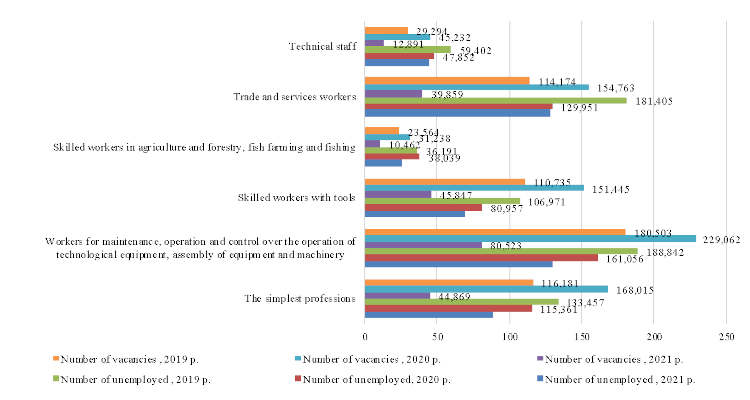
Figure 1
Dynamics of the number of unemployed registered citizens and the number of vacancies by professional groups (2019, 2020, 2021)
Source: Compiled by the author based on State Employment Service (2021)
Analyzing the situation on the labor market by type of economic activity a significant decline in demand for manufacturing, wholesale and retail trade, repair of motor vehicles and motorcycles, agriculture, forestry, and fisheries was revealed in 2021. The increase of the level of registered unemployed citizens was recorded in almost all types of economic activity. At the same time, the indicators of workload coefficients per workplace in the field of information and telecommunication technologies remained the highest (2019 − 3, 2020 − 1, 2021 − 6).
The reasons for unemployment of the population according to the methodology of the International Labor Organization in the period from 2016-2020 are mostly dismissals for economic reasons, voluntary resignation and dismissals by agreement of the parties (Fig. 2) (European Training Foundation, 2019; UNESCO-UNEVOC International Centre, 2021). It is also worth noting the positive trends in reducing the percentage of unemployed people in educational institutions (PROKOPENKO et al., 2011), which decreased by an average of 2 times during this period.
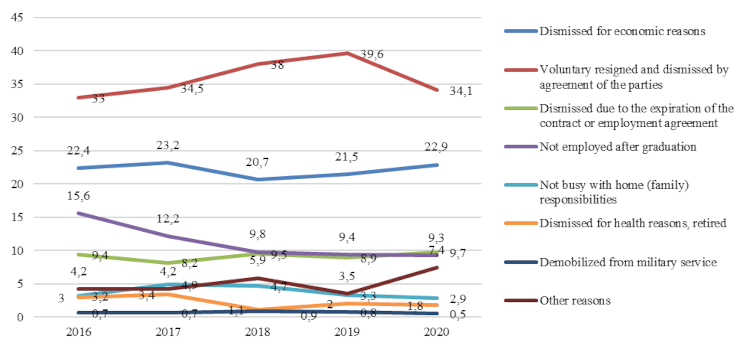
Figure 2
Causes of unemployment of the unemployed (according to the methodology of the International Labor Organization)
Source: Compiled by the author based on State Employment Service (2020)
Demographers forecast that the shortage of skilled workers for certain industries will last up to 2030, when the latest technology will allow less dependence on people. At the same time, according to the forecast of the Ministry of Economic Development of Ukraine, employment growth is expected to increase by 7.7% from 2025 onwards. Sustainable growth is expected in agriculture, forestry and fisheries (+ 30.6%), information technology, transportation and warehousing (+ 19%) (STATE EMPLOYMENT SERVICE, 2021).
The regional labor market, as well as the labor market of Ukraine as a whole, operates in an unbalanced demand for labor and its supply (KOVAL; POLYEZHAYEV; BEZKHLIBNA, 2018). In the regions there is a significant disparity in employment, averaging 9% (Fig. 3). The reason is the different level of development and economic activity of the regions, as well as the return of the share of immigration labor potential. According to statistics, despite the significant imbalance of supply and demand in Dnipropetrovsk, Kharkiv regions and Kyiv, the level of employed population in 2020 is quite high (Kyiv - 1186.1, Dnipropetrovsk region - 750.2, Kharkiv region - 550.6). It is worth noting that in terms of population in 2020, the Donetsk region is in the first place in Ukraine (4,100,280), Dnipropetrovsk region – the second (3,132,385), Kyiv - the third (2,662,180 ), Kharkiv - the fourth (2,626,227).
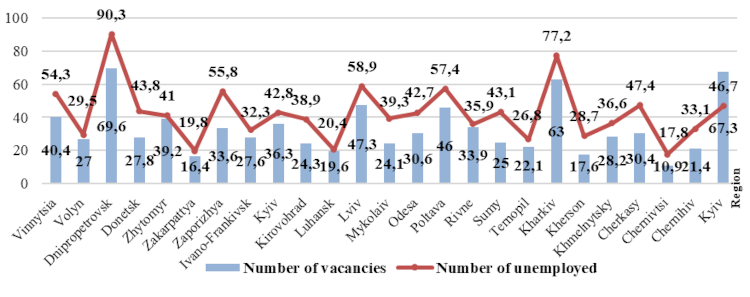
Figure 3
Analysis of the labor market situation in the regional context (2020)
Source: Compiled by the author based on State Employment Service (2020)
Compared to 2020, this year the number of people per vacancy on average in the regions of Ukraine decreased by 28%. The situation in Mykolayiv, Odesa, Ternopil regions and Kyiv city is remained unchanged, this is mainly due to immigration processes and to a decrease in the share of planned mass layoffs due to changes in the production and labor organization. As noted in the research "Analysis of the correspondence of supply and demand in the labor market in Ukraine" O. Teryanyk (2015): "The impact on labor demand is explained by the fact that the more developed society and economy, the greater their need for skilled labor. The impact on supply is due to the constant development of society and population growth, which directly affects the supply of labor. And economic growth affects the amount of wages, which in turn depends on supply in the labor market" (TERYANYK, 2016).
Many scientists argue that regional labor markets in different areas are characterized by similar trends such as: reduction of economically active population, unregulated employment, reduction of staff, labor migration, crisis demographic processes, natural population decline (CHVERTKO, 2012; SHVYDKA, 2010).
Turning to the search for solutions of problems in the modern labor market, it should be noted that today the priority role in this aspect belongs to the development of vocational (vocational-technical) education. However, at the present stage the sphere of P(VT)E is characterized by rather weak integration to the requirements of the market environment. According to the analysis of indicators in distribution of professional groups, which were used to train labor potential in 2020, IP(VT)E it was revealed a significant discrepancy between meeting the real needs of employers with a view of the steady trends to reduce vacancies (Fig. 4). With the view of the difference in the number of unemployed registered citizens, vacancies and applicants for education IP(VT)E in terms of occupations, it was found: lack of workers for maintenance, operation and control of technological equipment, assembly of equipment and machinery (22,809 people); excess supply in skilled personnel in the areas of workers with tools (17%), agriculture and forestry, fish farming and fishing (0.03%), workers in trade and services (13%), technical staff (45%).
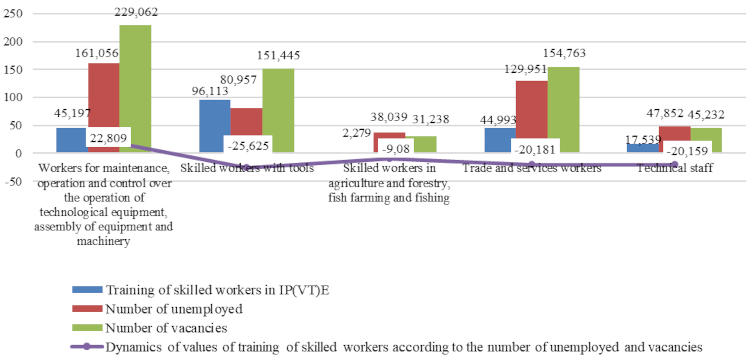
Figure 4
Analysis of the distribution of professional groups for which skilled workers are trained in IP(VT)E in accordance with the situation on the labor market in 2020.
Source: Compiled by the author based on State Statistics Service of Ukraine (2020)
To resolve the outlined situation, the state policy is mainly focused on the optimization of the IP(VT)E network. Thus, only for the period of 2018-2020 the network of IP(VT)E was reduced by 3% (in general since 2010 - by 27%). Typically, these are mainly professional lyceums and training centers at penitentiary institutions. It should be noted that the significant changes in accreditation levels were not observed during this period (Table 1).
| Type IP(VT)E | Period | |||||||||
| 2018 | 2019 | 2020 | ||||||||
| Quantity | Accreditation level | Quantity | Accreditation level | Quantity | Accreditation level | |||||
| ІІ | ІІІ | ІІ | ІІІ | ІІ | ІІІ | |||||
| Higher vocational schools | 159 | 159 | 158 | 158 | 157 | 157 | ||||
| Higher art vocational- technical schools | 7 | 7 | 7 | 7 | 7 | 7 | ||||
| Higher commercial vocational schools | 1 | 1 | 1 | 1 | 1 | 1 | ||||
| Vocational education centers | 89 | 17 | 71 | 90 | 21 | 69 | 90 | 19 | 71 | |
| Vocational schools | 69 | 69 | 66 | 66 | 66 | 66 | ||||
| Professional lyceums | 327 | 327 | 318 | 318 | 312 | 312 | ||||
| Professional lyceums of art profile | 1 | 1 | 1 | 1 | 1 | 1 | ||||
| Art vocational schools | 1 | 1 | 1 | 1 | 1 | 1 | ||||
| Colleges | 3 | 3 | 3 | 3 | 3 | 3 | ||||
| Institutions that are structural subdivisions of higher education institutions | 15 | 7 | 8 | 15 | 7 | 8 | 13 | 7 | 6 | |
| Training centers at penitentiary institutions | 64 | 64 | 63 | 63 | 60 | 60 | ||||
| Total: | 736 | 487 | 249 | 723 | 477 | 246 | 711 | 466 | 245 | |
The highest concentration of IP(VT)E is concentrated in Dnipropetrovsk (58 institutions), Lviv (56 institutions), Donetsk (43 institutions) regions, the lowest concentration of IP(VT)E is concentrated in Chernivtsi (16) and Chernihiv (14). The proportion of institutions on a sectoral direction is focused on industry (Fig. 5), but this distribution is quite relative, because in modern conditions, most IP(VT)E are multidisciplinary.
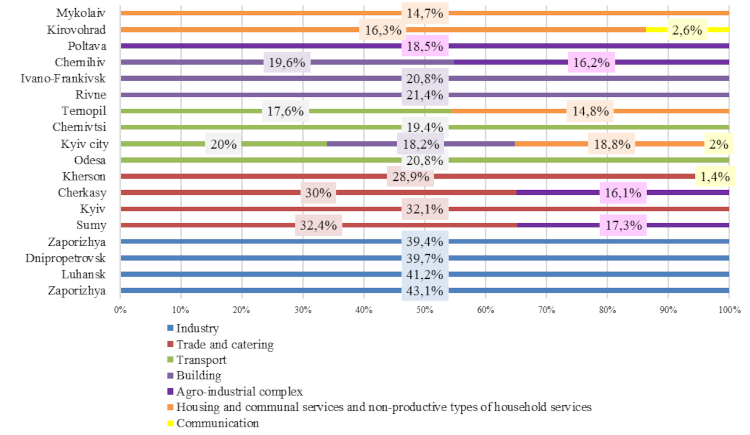
Figure 5
Network of IP(VT)E on a sectoral direction, 2020
Source: Compiled by the author based on Ministry of Education and Science of Ukraine (2020)
When the economic situation for recent years in Ukraine was considered, it was found out a fact of reducing the contingent of admission from 2018 by 7% and graduating - 15% (Fig. 6). When the discrepancy between admission and graduating was analyzed, it was found out that the highest level was reached in 2020, compared to 2019, this figure increased by 18%.
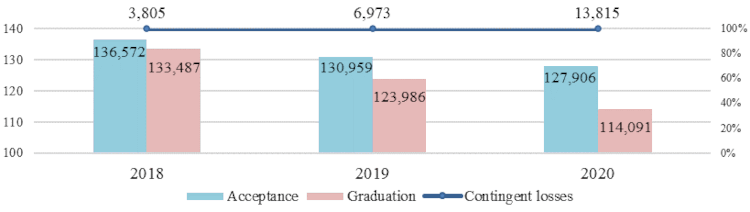
Figure 6
Dynamics of admission, graduating and losing of the contingent of IP(VT)E, 2018-2019.
Source: compiled by the author based on State Statistics Service of Ukraine (2020)
When the monitoring of the management activities of IP(VT)E as for the organization of vocational training was made, it was found the low rates of training of the unemployed and also it was found advanced training based on the trends of the labor market (Fig. 7, Fig. 8). One of the reasons for this state as for these indicators is the unsatisfactory state of material and technical base and weak interaction between labor market persons, it means between students, employers and public authorities and local governments. They form quantitative and qualitative characteristics of human and labor potential of the country, regions, cities, villages and settlements; means of making joint decisions are aimed at identifying the most promising areas for achieving balance in the labor market, as well as – improving the quantitative and qualitative characteristics of the labor potential of the labor market (BODNAR; MIRKOVICH; KOVAL, 2019; BANTASH et al., 2020).
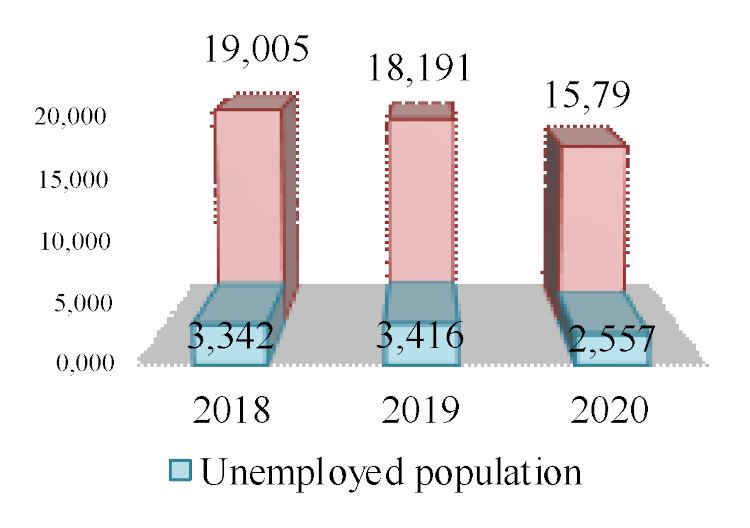
Figure 7
Dynamics of training specialists in IP(VT)E in the branch of vocational training
Source: compiled by the author based on State Statistics Service of Ukraine (2020)
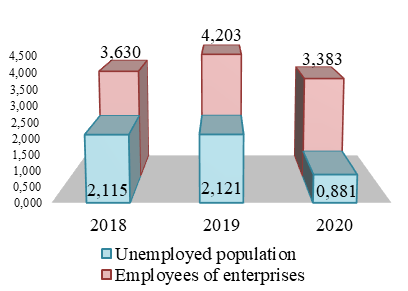
Figure 8
Dynamics of training in IP(VT)E in the branch of advanced training
Source: compiled by the author based on State Statistics Service of Ukraine (2020)
One of the mechanisms of state regulation of the labor market which aimed at overcoming its crisis in the field of IP(VT)E are areas to create training and practice centers (hereinafter ― TPCs), a modern educational space based on IP(VT)E (European Training Foundation, 2020). During the period 2016-2020, 198 centers were established for co-financing from the state budget, IP(VT)E and stakeholders, according to the classification group, most of them are: skilled workers with tools - 82.32%, service, operation and control workers of technological equipment, assembly of equipment and machinery – 13.13%, trade and service workers – 4%, technical staff – 0.5% (Educational-methodical center in the Rivne region, 2021). According to the training profile, about 32% of the TPCs are aimed at training specialists for the electrical engineering industry (63% created in 2018, 16% in 2019, 13% in 2020), 31% in the sewing industry (45% in 2016, 42 % – 2017). Labor market research for the period shows that the largest number of vacancies were observed in the processing and mining industries, in the professions of sewer, electrician and electric/gas welder.
In the framework of the TPC in Kyiv region in 2020 574 people had got primary vocational training, vocational-technical - 19 people (Educational-methodical center in the Kiev region, 2020); in Chernivtsi region (2019), advanced training - 9 pedagogical workers, vocational training - 8 people (Educational-methodical center in the Chernivtsi region, 2019); in Chernihiv region (2019) professional training - 253 people, advanced training - 52 people; vocational-technical - 128 people (EDUCATIONAL-METHODICAL CENTER IN THE OF CHERNIHIV REGION, 2019).
According to the Ministry of Education and Science of Ukraine, for the beginning of 2021, 180 TPCs have been created and updated by the social partners, but statistical information about their sectoral orientation and activities is not publicly available (MINISTRY OF EDUCATION AND SCIENCE OF UKRAINE, 2021).
Conclusions
The labor market as a subsystem of the economy is in a state of continuous development, during which some of its elements are transformed into others with the gradual destruction of components. These components do not ensure the effective functioning of the system and the formation of new institutions capable of maintaining sustainable model.
The main challenges of the modern labor market are the mismatch of supply and demand, the level of competencies of the unemployed to the requirements of employers, the reduction of vacancies due to the worsening of the economic crisis in 2021 and therefore is an increasing of the unemployed. According to statistics, for a long time the increase in unemployment in most cases is due to economic factors, they are: changes in production technologies and labor organization.
In the conditions of the slowdown in the pace of reforms of the P(VT)E system to regulate labor flows, its integration into the labor market is significantly slowing down. As a result, there is an oversaturation of specialists in unclaimed professions, respectively, the processes of optimization of IP(VT)E are intensified.
The focus of public policy to implement a new philosophy of labor training in the introduction of funding for the creation of TPCs on the basis of IP(VT)E did not help to balance the demand of employers, because the replacement of training for more necessary competencies in the market creates a certain illusion of a positive result. A key factor in the implementation of the above is the lack of forecasting system for the needs of workers in the IP(VT)E management system, it is related to the collection of data on medium and long-term needs of workers due to economic instability in the country. The worsening of this situation is facilitated by the lack of flexible and short-term training programs, key performance indicators, the weakness of the information system of training, retraining, advanced training of the unemployed, the recognition system of professional qualifications.
The supply and demand in the dynamics have been studied. It is allowed to identify the factors that determine their imbalance. Prospects for further exploration in this direction are seen in the study and in-depth analysis of the impact of the management of the NPC on regional labor markets.
REFERENCES
ARSAWAN, I.W.E.; KOVAL, V.; RAJIANI, I.; RUSTIARINI, N.W.; SUPARTHA, W.G.; SURYANTINI, N.P.S. Leveraging knowledge sharing and innovation culture into SMEs sustainable competitive advantage. International Journal of Productivity and Performance Management, Vol. ahead-of-print No. ahead-of-print. 2010. DOI: https://doi.org/10.1108/IJPPM-04-2020-0192
BANTASH, A.; KOVAL, V., BASHYNSKA, M.; KOZLOVTSEVA, V. Balanced territorial economic development in the conditions of providing stability of human resources management. Economics. Ecology. Socium, 4(3), 58-66. 2020. DOI: https://doi.org/10.31520/2616-7107/2020.4.3-6
BODNAR, S.; MIRKOVICH, I.; KOVAL, V. Human capital development in Ukrainian education system by means of language integrated teaching. Dilemas contemporaneos-educacion politica y valores, 7 (SI), 14. 2019.
CHVERTKO, L. Modern trends in supply and demand in the labor market of Cherkasy region. Ukraine: aspects of work, 3, 3–9. 2012.
DROBNIC, J.. The key innovations in career guidance on labour market. Economics Ecology Socium, 3(2), 12–22. 2019. DOI: https://doi.org/10.31520/2616-7107/2019.3.2-2
Educational-methodical center in the Chernivtsi region. Information on the activities of educational and practical centers in 2019, operating on the basis of institutions of professional (vocational and technical) education. 2019. Available: http://nmcpto.com.ua
Educational-methodical center in the Kiev region. Training and practice centers (information reference for 2016-2020). 2020. Available: http://oblpto.in.ua
Educational-methodical center in the of Chernihiv region. Collection of information and analytical materials on the results of professional (vocational and technical) educational institutions of Chernihiv region in 2019. 2019. Available: https://drive.google.com/file/d/13CwliERxW4W88CKIxLOTXJYUttOHLe9h/view
Educational-methodical center in the Rivne region. Training and practice centers. 2021. Available: https://wp.nmc-pto.rv.ua/navch-pract-centers/
European Training Foundation. Ukraine, Education, Training and Employment Developments. 2019. Available: https://www.etf.europa.eu/
European Training Foundation. Centres of Vocational Excellence: An engine for vocational education and training development. 2020. Available: https://www.etf.europa.eu
HAJDUOVA, Z.; KLIMEK, M.; DANESHJO, N.; PROKOPENKO, O. Competitiveness of Franklin Templeton Fund Managers: Do the Fund Managers Exceed the Benchmark? Journal of Competitiveness, 3, 70-80. 2019. DOI: https://doi.org/10.7441/joc.2019.03.05
HETMAN, E. Youth unemployment: a lost generation. Economic truth. 2013. Available: https://www.epravda.com.ua/rus/publications/2013/10/2/397038/
IVANYTSKA, S.B.; MOROKHOVETS, I.O. The problem of youth unemployment in Ukraine. Efficient economy, 9. 2015. Available: http://www.economy.nayka.com.ua/?op =1&/ z = 4325
KOROLCHUK, M.; KOROLCHUK, V.; MYRONETS, S.; BOLTIVETS, S.; MOSTOVA, I.; KOVAL, V. Competitive Properties of Trading Companies Managers. Revista Geintec-Gestao Inovacao e Tecnologias, 11(2), 941-954. 2021.
KOVAL, V.; POLYEZHAYEV, Y.; BEZKHLIBNA, A. Communicative competences in enhancing of regional competitiveness in the labour market. Baltic Journal of Economic Studies, 4(5), 105-113. 2018. DOI:10.30525/2256-0742/2018-4-5-105-113
KVACH, Y.; PIATKA, N.; KOVAL, V. Management of sustainable entrepreneurship adaptation to tax changes in environmental investment. Baltic Journal of Economic Studies, 6(5), 96-105. 2020. DOI: https://doi.org/10.30525/2256-0742/2020-6-5-96-105
Ministry of Education and Science of Ukraine. Education in Ukraine: challenges and prospects: information-analytical collection Institute of Educational Analytics. 2020. Available: https://mon.gov.ua
Ministry of Education and Science of Ukraine. Educational and practical centers. 2021. Available: https://mon.gov.ua/ua/osvita/profesijno-tehnichna-osvita/derzhavno-privatne-partnerstvo/navchalno-praktichni-centri
PAVLYUK, T.I.; KOVALEVA, A.A.; NIKOLAYCHUK, N.P. Features of the labor market in Ukraine. Global and national economic problems, 8, 876–881. 2015.
PETRENKO, K.V.; PIGUL, V.V. Features of formation and development of the world labor market. Business Inform, 12, 37–42. 2015.
PROKOPENKO, O.V.; KARMINSKY, A.M.; KLYMENKO, O.V. The role of ratings in the educational process of higher education institutions. Marketing and Management of Innovations, 4(2), 141–146. 2011.
PROKOPENKO, O.V.; SHKOLA, V.Y. Controlling of the ecological and economic enterprise security on the bases of ecomarketing. Marketing and Management of Innovation, 4, 337–346. 2012.
SHVYDKA, G.Y. Regional features of the labor market of Ukraine. Demography and social economy, 2 (14), 160–167. 2010.
State Employment Service. Unemployed population (according to the ILO methodology) due to unemployment in 2010-2020. 2020. Available: http://www.ukrstat.gov.ua/operativ/menu/menu_u/rp.htm
State Employment Service. Data on the number of registered unemployed and the provision of services, as well as the number of registered vacancies. 2021. Available: https://www.dcz.gov.ua
State Employment Service. The situation on the registered labor market and the activities of the State Employment Service 2019, 2020, 2021. 2021. Available: https://www.dcz.gov.ua/analitics/68
State Statistics Service of Ukraine. General secondary and professional (vocational and technical) education in Ukraine in 2018, 2019, 2020. 2020. Available: http://www.ukrstat.gov.ua/druk/publicat/kat_u/publosvita_u.htm
State Statistics Service. The number of registered unployed by occupation in 2020. 2020. Available: http://www.ukrstat.gov.ua/operativ/operativ2017/ rp/eans/eans_u/arch_enansmv_u.htm
TERYANYK, O.A. Analysis of the correspondence of supply and demand in the labor market in Ukraine. State and regions. Ser. Economics and entrepreneurship, 1 (82), 62–64. 2015.
UNESCO-UNEVOC International Centre. TVET Country Profiles. Ukraine. 2021. Available: https://unevoc.unesco.org/home/Dynamic+TVET+ Country+Profiles/country=UKR
Notas de autor
Información adicional
How to reference this article: STOYCHIK, T.; SERHEIEVA, L.; KRAVCHENKO, L.; BEREZINSKY, V.; SYCHENKO, V. Particularities of vocational education management in the conditions of the modern labor market. Revista on line de Política e Gestão Educacional, Araraquara, v. 25, n. esp. 3, p. 1745-1761, Sep. 2021. e-ISSN: 1519-9029. DOI: https://doi.org/10.22633/rpge.v25iesp.3.15589