Artigos
THE INFLUENCE OF VIRTUALIZATION AND MUNICIPAL MUSEUMS IN THE ACTIVITIES ON THE HISTORICAL EDUCATION OF CITIZENS
A INFLUÊNCIA DA VIRTUALIZAÇÃO E DOS MUSEUS MUNICIPAIS NAS ATIVIDADES DE EDUCAÇÃO HISTÓRICA DE CIDADÃOS
LA INFLUENCIA DE LA VIRTUALIZACIÓN Y LOS MUSEOS MUNICIPALES EN LAS ACTIVIDADES DE EDUCACIÓN HISTÓRICA DE LOS CIUDADANOS

THE INFLUENCE OF VIRTUALIZATION AND MUNICIPAL MUSEUMS IN THE ACTIVITIES ON THE HISTORICAL EDUCATION OF CITIZENS
Revista on line de Política e Gestão Educacional, vol. 25, núm. 3, Esp., pp. 1826-1843, 2021
Universidade Estadual Paulista Júlio de Mesquita Filho

Esta obra está bajo una Licencia Creative Commons Atribución-NoComercial-CompartirIgual 4.0 Internacional.
Recepción: 20 Marzo 2021
Recibido del documento revisado: 05 Junio 2021
Aprobación: 12 Julio 2021
Publicación: 01 Agosto 2021
Abstract: The purpose of the study is to reveal the influence of virtualization on the role and contribution of municipal museums to the activities of the historical education of citizens and the development of cultural tourism. Based on the analysis of scientific literature, the study examines the features of the functioning of municipal museums and analyzes the phenomenon of its virtualization. The study deals with the transformation of municipal museums into territorial socio-cultural centers. Based on the analysis of the work of the Museum Association "Museums of the Korolev science city", the contribution of municipal museums to the historical education of the population has been analyzed, recommendations for the creation of virtual exhibitions based on the website of the said Museum Association have been proposed. In the end, it was concluded that virtualization of municipal museums is a modern advertising tool that informs about the tourist benefits of the city and the region, increases the possibilities of museums for the historical education of citizens, and forms a new type of motivation for cultural tourism.
Keywords: Municipal museum, Virtual museum, Virtualization, Education, History, Tourist and local history expeditions.
Resumo: O objetivo do estudo é revelar a influência da virtualização no papel e contribuição dos museus municipais nas atividades de formação histórica dos cidadãos e no desenvolvimento do turismo cultural. Com base na análise da literatura científica, o estudo examina as características de funcionamento dos museus municipais e analisa o fenômeno de sua virtualização. O estudo trata da transformação de museus municipais em centros socioculturais territoriais. Com base na análise do trabalho da Associação de Museus "Museus da cidade da ciência Korolev", foi analisada a contribuição dos museus municipais para a formação histórica da população, e recomendações para a criação de exposições virtuais com base no site do referido Associação de Museus foram propostas. Ao final, concluiu-se que a virtualização de museus municipais é uma moderna ferramenta publicitária que informa sobre os benefícios turísticos da cidade e da região, amplia as possibilidades dos museus para a formação histórica dos cidadãos e constitui um novo tipo de motivação para Turismo cultural.
Palavras-chave: Museu municipal, Museu virtual, Virtualização, Expedições de educação, História, Turismo e história local.
Resumen: El propósito del estudio es revelar la influencia de la virtualización en el papel y la contribución de los museos municipales a las actividades de educación histórica de los ciudadanos y al desarrollo del turismo cultural. A partir del análisis de la literatura científica, el estudio examina las características del funcionamiento de los museos municipales y analiza el fenómeno de su virtualización. El estudio aborda la transformación de los museos municipales en centros socioculturales territoriales. A partir del análisis del trabajo de la Asociación de Museos "Museos de la ciudad de la ciencia de Korolev", se ha analizado la contribución de los museos municipales a la educación histórica de la población, recomendaciones para la creación de exposiciones virtuales basadas en el sitio web de dicho Se han propuesto asociaciones de museos. Al final, se concluyó que la virtualización de los museos municipales es una moderna herramienta publicitaria que informa sobre los beneficios turísticos de la ciudad y la región, aumenta las posibilidades de los museos para la educación histórica de los ciudadanos y configura un nuevo tipo de motivación para Turismo cultural.
Palabras clave: Museo municipal, Museo virtual, Virtualización, Educación, Historia, Expediciones turísticas e históricas locales.
Introduction
The development of computer technology has caused the emergence of many different phenomena, one of which is "virtual museums". Its attraction lies in the free mass access of visitors to cultural heritage and world artistic achievements.
However, there is another side of the issue: not only the visitor is interested in finding and receiving impressions from cultural objects (the consumer goes to the museum) but cultural organizations, including municipal museums, having access to the Internet, as well as using the potential of mobile communications, new gadgets and social networks, also realize the opportunity of expanding the communication with visitors.
Currently, municipal museums practices provide a wide variety of educational events, such as educational tour cycles; museum public lectures; clubs for schoolchildren and preschoolers; educational projects, including engaging a wide range of participants; competitions; museums festivals, the off days of the museum; concerts, workshops, evening meetings, and performances; round tables, conferences, seminars, consultations, and symposiums; film, video screenings; presentations, etc.
Features the history and development of municipal museums, the composition and structure of their museum collections in a variety of types of the above activities increase the importance of historical education for both local people and tourists, holidaymakers residing in other municipalities. This is largely facilitated by the transformation of the municipal museum into the territorial socio-cultural center, which can be greatly facilitated by the virtualization of the museum space since the boundaries between the distant original exhibits and their exact digital counterparts in the screen image are blurring. As a result, especially due to restrictions, for example, caused by the COVID-19 pandemic, the visitor gets the opportunity to engage the cultural and historical heritage. The museum also benefits from a convenient service of access to collections, increasing the interest of the audience in its activities.
Another issue of traditional municipal museums, as territorial socio-cultural centers, is that most of their collections in terms of accessibility are out of the reach of visitors due to the spatial limitations of the exhibition space. Therefore, traditional museums often have to turn to temporary exhibitions. Compared to it, virtual space appears as a living imitation of reality, in which a long (not limited in time) and indestructible life of virtual copies of real life artifacts placed in archives that are in digital form on the Internet is possible.
Literature Review
The perception of the museum as such has undergone several changes in recent years. One of the large-scale studies (ARISTARKHOV et al., 2019) has shown that the significance of the main values that the museum brought to society has transformed, the very concept of the museum has blurred in the perception of visitors. At the same time, the museum remains an integral part of the algorithms or stereotypes of consumer behavior or life scenarios of Russians.
In general, the educational activities of municipal museums are considered by many scientists (KARASEV, 2019; RYGALOVA, 2019b; MERCIU et al., 2018). The analysis of these works and several others shows that the municipal museum and its partners see a significant difference between educational and enlightenment activities in domestic practice. Thus, within the framework of educational activities, the content of programs must correspond to the educational programs implemented in the relevant educational institutions.
Therefore, much attention in the study of educational activities is paid to the interaction of the municipal museum and the education sector, as well as higher education in general (MELNIK, 2019; MERTENS, 2019). Certainly, the role of museums in the formation of the historical consciousness of the population is recognized as key (KOLESNIKOVA, 2015; OVCHINNIKOVA, 2018; SHERESHEVA, KOLKOV, 2018). Practices of educational and enlightenment work of municipal museums together with schools or higher educational institutions are well known.
Another research area is the study of the socio-cultural phenomenon of the municipal museum. The municipal museum appears as a space of social pedagogy, a direct participant, and more often an organizer of social partnership, a platform for social projects, building network interaction of various communities and structures (KRIVOSHEEVA, 2016; RYGALOVA, 2019a; BELYAEVA; POLYANSKOVA, 2016; NUYKINA et al., 2016). Researchers talk about multiplication of the functions and tasks of the municipal museum as a socio-cultural center.
This is related to the accelerated integration of municipal museums and the tourism industry over the past few years, which has stimulated the search for their place in this industry. One can often find a tourist product on the market, whose program includes a visit to the municipal museum. Therefore, searching and analyzing the attractiveness of museum collections and their interpretation for tourists, studying the role and functions of municipal museums as attraction sites of tourist demand in small towns and rural areas should be constantly updated (BERDYUGINA, 2019; LESOVSKAYA, 2018; MARTYNOV, 2018; MERCIU et al., 2018). This, in turn, has stimulated the search for uniqueness, authenticity, and originality directly in the collections of municipal museums (AGARKOVA, 2019; IVANOVA, 2018), which many see in local, regional history, connections with local dynasties, events, and phenomena (RYGALOV, 2019c; YUTINA, 2019; MERCIU et al., 2018). Thus, the municipal museum becomes attractive to visit for various target audiences –residents, residents of nearby areas, tourists, professionals, schoolchildren and students, local historians etc.
The phenomenon of virtual museums as an independent object of scientific research has not yet received wide coverage, and the existing individual studies are of a general nature. This is because there is no clear definition of this concept; therefore, there are two ways to interpret it:
– a virtual museum is a museum that exists only in the virtual space and does not have representative offices of real-life museums (PESCARIN, 2014; HERMON; HAZAN, 2013);
– a virtual museum is a digital analog of the corresponding museum, which is presented on the institution's website, for example, using a virtual tour (SYLAIOU et al., 2008; KOSTAS et al., 2009).
In accordance with the second definition, the peculiarities of the creation and support of museum representations in the virtual space, modern forms of museum communication, the role of Internet technologies in the preservation of cultural heritage, the issues of using museum Internet projects as a source in historical research are considered. Researchers point to difficulties in the study, largely due to the dynamic development of the Internet.
Thus, in articles (LEBEDEV, 2006; TARANOVA, 2020) new ways of presenting exhibits on the Internet are considered. The characteristics of the software that is used to create virtual exhibitions, collections, excursions, the reconstruction of individual monuments or entire complexes, and the reconstruction of already lost objects and objects are partially given, the features of the implementation of the main functions carried out by virtual museums are highlighted, namely: educational, communicative and security (preservation of cultural heritage).
According to researchers (SAVAŞ; DUMAN; ŞAHIN, 2016), the use of Internet technologies in exhibition and exposition activities will allow museums to ensure the safety of museum collections, expand access for people who are physically unable to familiarize themselves with them, and provide its information support.
The issues that scientists focus on in studying the state of the "information presence" of museums on the Internet is the issue of clearly setting goals (why create an Internet resource) (ANDERSON, 2008); the issue of selection of museum information that is posted on the Internet (HUHTAMO, 2002); the issue of choosing the form of representation of museums in the virtual space (website, blog, forum, social networks) (MARTY, 2007); the issue of the professionalism of the development team (BENHAMOU, 2016); definition of the concept of a virtual museum and its main characteristics (NEGRI, 2012).
Despite the large number of publications related to the educational activities of the municipal museums themselves, their participation in educational projects and events, scientific ideas about the impact of virtualization on the role and contribution of municipal museums to the historical education of citizens and the development of cultural tourism have not acquired a comprehensive and systemic nature.
The hypothesis of the study: virtualization of municipal museums is a modern advertising tool that informs about the tourist benefits of the city and the region, increases the possibilities of museums for the historical education of citizens, and forms a new type of motivation for cultural tourism.
The objectives of the study:
1. to consider the transformation of municipal museums into territorial socio-cultural centers and the possibilities of virtualization in this process;
2. to analyze the contribution of municipal museums to the historical education of the population and the possibilities of virtualization in this process.
Methods
The study used the following methods:
• source research and analysis of documents on the topic using methods of analysis, synthesis, and generalization to determine the state of development of a scientific problem;
• information analysis method was used during the analysis of the information content and structure of museum Internet resources identified using the search engines, Google and Yandex, which allowed to study their content online;
• comparative method to compare different virtualization options for use by museums.
At the first stage of the research, the sources of information necessary to prove the hypothesis and solve the research problems were selected:
• the first group of sources: articles published in the indexed journals Scopus and Web of Science, and speeches at conferences of researchers, containing conceptual provisions on the role and contribution of museums in the activities of historical education of citizens and the development of cultural tourism;
• the second group of sources: articles published in the indexed journals Scopus and Web of Science, and speeches at conferences of researchers dedicated to the virtualization of the museum space.
At the second stage of the study, considering the existing limitations in the application of the document analysis method (the quality of the selected sources, their completeness, and the subjective positions of the authors), we conducted an expert survey (by e-mail) to assess the reliability of the selected sources.
The selection criteria for experts (23 people) were the presence of at least 3 articles on this topic published in journals included in the Scopus or Web of Science citation bases or at least 10 years of experience in municipal museums.
The experts assessed the list of sources on the Harrington scale and rated the selected documents as high on average (0.64-0.8).
At the third stage of the study, the analysis of the collected information was carried out, with the interpretation of the results.
Thus, the methods of scientific research and the research model used in the study allowed to not only consistently and logically present the material, but also to objectively reflect the features of virtualization in the practice of municipal museums.
Results and discussion
In scientific and practical publications, one can find a widespread perception and understanding of the development model of the museum in the 21st century as a multifunctional cultural and scientific complex. At that, its role is reduced to forming a socio-cultural center of the region, which protects and uses the historical and cultural heritage through the study, design, restoration, and museumification of objects; developing scientific, educational, and enlightenment programs; restoring the system of traditional economy and crafts; implementing museum marketing and providing tourist and other services. Such a complex representation of the museum has a more modest scale for municipal institutions compared to regional or federal ones. However, it is noteworthy that the described concept is now being extended to municipal museums.
The historical heritage and social environment of the territory, as well as the implemented socio-cultural practices, become conditions for preserving and developing cultural and educational space. The identification, formation, support, and translation of history are concentrated in the activities of the municipal museum, which thereby turns into a tool for organizing and implementing socio-cultural processes and becomes a socio-cultural center within the boundaries of a certain territory.
The activity of the municipal museum on historical education reflects the attitude of society towards the natural and cultural heritage, so it becomes part of local cultural processes that have different areas, such as education, entertainment etc.
Municipal museums play an increasingly important role in the cultural revival, unity, and formation of civil society, taking on the functions and tasks of the socio-cultural institute. For the municipal museum, the fulfillment of the tasks of the socio-cultural center is expressed in the organization of a platform to investigate various social and cultural functions, of which the most important is historical education, which organically complements the main components of museum activities.
The activity of the municipal museum on historical education is associated with several functions of the municipal museum as a socio-cultural institution, and often is a driver of these functions, namely:
• socialization of museum relations (preservation of socio-cultural heritage, control over the formation, use, and storage of exhibits); historical education becomes one of the basic areas of use of museum objects and collections;
• coordination of research, educational, enlightenment, local history, and publication activities introduces historical education to the main tasks of the municipal museum;
• developed marketing activities, which are integral to the socio-cultural institute, encourage the municipal museum to more actively use the tools of tourist interpretation, introduce deeper segmentation of target audiences, implement a policy of personalization when receiving, serving, and building communications;
• integration of museum practices into the social medium through specific social groups emphasizes the search for various forms of educational work, including the new ones, the introduction of work elements outside the museum, and the encouragement of on-site activities for historical enlightenment.
Thus, the transformation of municipal museums into socio-cultural centers of territories actualizes the role of these institutions and increases the importance of their activities not only in the formation and support of historical memory but also in its translation. The study and preservation of historical and cultural heritage become the basis for solving the most important task of attractively presenting the history and culture of the municipality, and attracting the human in the cultural space, involving residents in creative activities. The museum starts to do the job, not just for residents’ leisure and rendering tourist services, but solves the critical task of historical education, preservation, and interpretation of historical truth, reducing the destructive information impacts associated with the distortion of history.
An example of a municipal museum as a territorial socio-cultural center is the Salvador Dali Theater-Museum, Figueres, Spain. It provides opportunities for autonomous movement across the vastness of this unique institution. The virtual visitor has the opportunity to get acquainted with the layout of the museum and move from floor to floor. There is also a distance measurement option.
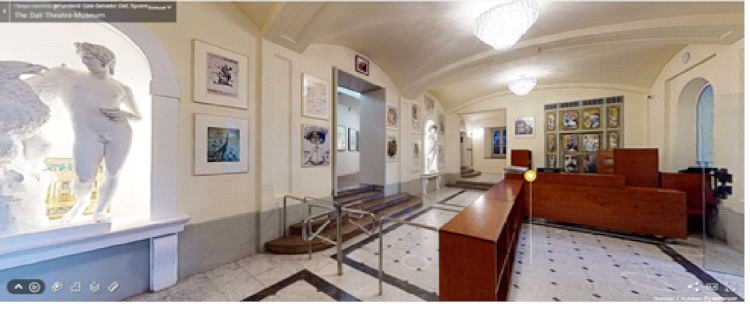
Figure 1
Fragment of the Salvador Dali Virtual Theater-Museum
Source: Author's collection
The space is organized as a huge stage with many decorations, images for hallucinations and illusions. Moving virtually through the space of the theater-museum, viewers can also visit its courtyard. The reception of virtual exhibits is largely based on allusion – one of the leading principles of the functioning of contemporary art.
The theater component plays a significant role in the functioning of the museum, which to a certain extent influences the interaction with visitors. Theatrical communication manifests itself as a multi-level process, involving the participation of curators of museum expositions and visitors.
In Russia, a municipal museum is usually the guardian of the historical memory of the local territory since it reflects various aspects in its collection, which contributes to their diversity. Many types of municipal museums are known. For example, in the Moscow Region, there are museum preserves, historical and art museums, local history museums, historical and literary museums, local history museums, memorial houses, house-museums, city museums, military history museums, museum associations, and museum and exhibition centers/complexes. However, regardless of what kind of institution the museum belongs to, it is quite difficult to identify a single specialization or direction for scientific research in museum collections. Museum collections reflect a diverse heritage, which creates prerequisites for the use of various options in the development of museum programs, their interpretation, and publication, including issues beyond the territory of the very museum.
The contribution of the municipal museum to historical education can be most significantly represented by the next example. For example, consider G.O. Korolev Municipal Budget Cultural Institution located in the Moscow Region – "Museum Association of Korolev Science City Museums" (n.d.) and its work on the preservation and transmission of memory about the Great Patriotic War (1941-1945).
The museums of Korolev science city are known for combining five authentic museum sites, where guests can get acquainted with the material and intangible cultural and historical heritage of the city. The broad semantic content of the exhibition space allows tourists and holidaymakers to learn about the history of literature and theater, everyday life, scientific achievements, space exploration, and much more.
The heritage of the Great Patriotic War (1941-1945) is represented in various artifacts, information, and programs at almost all sites of the Museum Association. Visitors can see original military equipment, expositions of household items that were used by soldiers and officers, learn the history of creating unique design solutions for famous artillery pieces. The Museum Association presents personal household items of Soviet soldiers and home front workers. Anti-fascist playing cards, the book "Satellite of the partisan" and other Museum items are exhibited in the Hall of Military Glory of the modern history sector of the urban Yubileyny microdistrict.
The topic of the Second World War is covered in the program "Nineteen-year-old forever" in the Memorial House-Museum of Marina Tsvetaeva in Bolshev.
The memorial House-Museum of Sergei Durylin, writer, poet, theater and literature theorist, religious thinker, Professor of the Russian University of Theatre Arts (GITIS), Doctor of Philology, priest of the Russian Orthodox Church, is a symbol of the 20th century. The house itself was built from the remains of the Strastnoy Monastery destroyed in Moscow. Durylin’s book "Pen and Sword: Russian writers in the war of 1812" became the basis for the exhibition "Pen and sword", a joint project with the Moscow Panorama Museum "The Battle of Borodino". Interestingly, the book was published 77 years ago during the Great Patriotic War, when comparisons with the battles of 1812 were very important.
The destinies of people and the city are closely intertwined, so the excursion programs dedicated to the Great Patriotic War are not limited to the Museum space but go out to the streets of today’s Korolev. These include the lectures "Heroes in our city", and the educational campaign "The history of one exhibit", implemented by the Museum Association "Museums of the Korolev science city". The Museum has restored and made available stories about the heroes of the Great Patriotic War, whose names were given to the streets of contemporary science city, some of these heroes lived or worked in the territory of today’s Korolev.
Visitors can get a variety of information from videos about the engineering achievements of Soviet designers, their contribution to the Great Victory, including the legendary 45-mm anti-tank gun of the 1937 model (factory index 53-K), the 37-mm gun of the 1939 model, and the ZIS-3 gun. It touches on the industrial history of the city, the history of plant No. 8 named after M. I. Kalinin, the works of M.N. Loginov, V.G. Grabin, and other designers who have worked in the Central Artillery Design Bureau from 1942 to 1945. Due to the efforts of the Museum Association, the exposition of the Memorial Cabinet of Vasily Grabin was created where the ZIS-3 gun and the 61-K anti-aircraft gun are exhibited.
The municipal museum, due to the specifics of its activities and the composition of its collections, has significant potential and greater impact on the visitor's impressions. Often, the emotions of a visitor to a municipal museum are deeper than when visiting the exposition or excursions of regional or federal museums. The main factor is the association with a specific area, famous people, events that residents of the municipality or their descendants remember. Besides, the "distance" between the museum object and the visitor in a municipal museum is much smaller than in large institutions. It is obvious, however, that such a strong impact will primarily be exerted on the quasi-tourist flow, i.e., on the residents of this municipality or the nearest populated localities.
The Museum Association "Museums of the Korolev science city" is currently represented on the Internet by a website (http://museumkorolev.ru/); there are the following sections: "Home", "About the Museum", "Current Events", "News", "Information for the Visitors", "Collections (About Funds)", "Media", "Science (Editions)", "Editions and Publications".
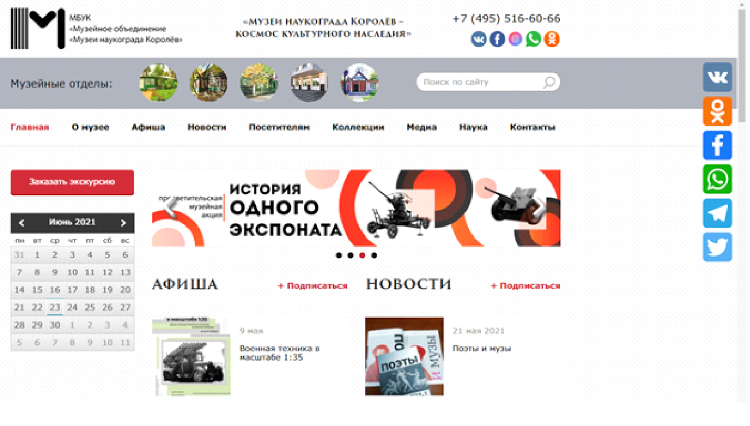
Figure 2
Home page of the "Museums of the Korolev science city" site
Source: Author's collection
At the same time, to attract a larger number of visitors, including Russian citizens who are not residents of the city, as well as foreign citizens, based on the website of the Museum Association "Museums of the Korolev science city" it is possible to create an electronic museum exhibition on any topic related to the historical education of the population.
On many websites of Russian museums, one can find photographic materials that are positioned by the organizers as electronic exhibitions, and in most cases, this is an ordinary photo gallery in which photographs of exhibits are collected chaotically, without any logic (LEBEDEV, 2006). Often, on the websites of Russian museums, the materials presented do not have the characteristics that are inherent in electronic exhibitions. The most significant characteristics of electronic exhibitions are interactivity and multimedia aspects – the combination of various types of information, such as text, graphics, sound, video, and animation.
According to the authors, considering the possibilities of modern communication in consumers (SHUBTSOVA et al., 2020; TROSHIN et al., 2020), an electronic exhibition on the website of the museum association "Museums of the Korolev science city" will be able to provide additional opportunities:
– more opportunities for perception: demonstrating exhibits in the form of slide shows, photo tours, using all the possibilities of computer graphics to demonstrate digitized copies of museum items (SAVAŞ et al., 2016); quickly replacing the image of the exhibits and their location (MARTY, 2007);
– wide audience: exhibitions on the museum's website can be viewed by everyone who is connected to the Internet;
– expanded opportunities for the demonstration of exhibits: a larger number of exhibits can be presented, historical information is provided as well;
– expansion of interaction with the consumer: a visitor can express their attitude to the exhibition in different ways, increase interest in exhibits, and get acquainted with historical objects by remote means (TARANOVA, 2020);
– there are no geographical and time restrictions: any electronic exhibition is open, relatively speaking, 24 hours a day, 365 days a year and is accessible from anywhere in the world, unlike a real exhibition, which is held for a certain time and is strictly localized (ANDERSON, 2008; PONKRATOVA et al., 2021).
Conclusion
The work of municipal museums focused on the history education of citizens is implemented in tourism, quasi-tourism, as well as in communication with the local population. The role of municipal museums in the course of historical education involves intense activities towards the formation, support, and transmission of historical memory, which in turn affects the historical consciousness of the individual. Municipal museums, by identifying and exhibiting artifacts of material and intangible heritage that are translators of history, support the processes of cultural diversity, including globalization, that is, identification of an increasing number of features of local cultures.
The role of municipal museums in historical education among children and young people is extremely relevant and important. The established practice of preferences of large (regional and federal) museums in the organization of tourist and excursion trips, expanding the general outlook, impoverishes knowledge of the history of the small homeland. Knowledge about great events, such as the Great Patriotic War, is often not associated with a place of permanent residence. The general information that is repeatedly reflected in learning materials, excursions, and television programs, supports a certain superficial representation that does not touch the emotions of today’s youth. The municipal museum has higher potential for embedding its content in educational programs of educational institutions, increasing the effectiveness of tourist interpretation of historical heritage. The attributes of museum objects and collections associated with a specific territory allow creating an extremely clear association of historical events and those cultural spaces that are relevant for young people.
Thus, the results of the study confirmed its hypothesis that virtualization of municipal museums is a modern advertising tool that informs about the tourist benefits of the city and the region, increases the possibilities of museums for the historical education of citizens, and forms a new type of motivation for cultural tourism.
FUNDING: The present article was prepared within the framework of a grant from the Ministry of Science and Higher Education of the Russian Federation aimed at carrying out activities to promote the patriotic upbringing of Russian citizens.
Acknowledgments
The authors are grateful for materials kindly provided by Municipal Budget Cultural Institution of the city of Korolev of the Moscow Region "Museum Association of Korolev Science City Museums", which is a partner of organizing and conducting tourism and local history expeditions "Things with memory" to the municipal formations of the Moscow Region.
REFERENCES
AGARKOVA, A.B. Arheologicheskie kollekcii muzeev YUgry: istoriya komplektovaniya i voprosy sovremennogo ucheta [Archaeological collections of Ugra museums: The history of acquisition and issues of contemporary accounting]. Archeology of the Eurasian Steppes, v. 5, p. 30-40, 2019.
ANDERSON, M.L. The Future of Museums in the Information Age. In: Marty, P.F. and K. Burton Jones (eds.). Museum Informatics. People, Information, and Technology in Museums. New York: Routledge. 2008.
ARISTARKHOV, V.V.; VOLOSATOVA, T.B.ç GRACHEVA, S.M.ç KOCHARINA, O.A.ç NESTERTSEVA, O.V.; OKULEVICH, I.M. eds. O problemah i perspektivah razvitiya muzejnogo dela v Rossijskoj Federacii: rezul'taty kompleksnogo sociologicheskogo issledovaniya: analiz mnenij muzejnogo soobshchestva i naseleniya RF (real'nyh i potencial'nyh posetitelej). 2019. [On the challenges and prospects of museum development in the Russian Federation: Results of a comprehensive case study: an analysis of the views of the museum community and the Russian population (actual and potential visitors)]. Moscow: Institute of Heritage. 2019. DOI: https://doi.org/10.34685/HI.2019.42.57.001
BELYAEVA, G.I.; POLYANSKOVA, N.V. The mechanism of activation of communications of municipal museums with youth communities and local authorities. Regional Development, v. 5, p. 8. 2016.
BENHAMOU, Y. Copyright and Museums in the Digital Age. WIPO Magazine, v. 3, p. 25-28, 2016.
BERDYUGINA, N.A. Integraciya muzejnogo dela i turizma (na primere Kopejskogo gorodskogo okruga CHelyabinskoj oblasti) [Integration of museum business and tourism (on the example of the Kopeysky city district of the Chelyabinsk Region)]. In: A.A. Sukiasyan (ed.), Proceedings of the International science-to-practice conference “Information as an engine of scientific progress”, January 25, 2019, Volgograd, Russia. Ufa: Aeterna.
Federal law of the Russian Federation No. 54-FZ. (May 26,1996). "On the Museum Fund of the Russian Federation and museums in the Russian Federation". (latest edition). Available: http://www.kremlin.ru/acts/bank/9425
HERMON, S.; HAZAN, S. Rethinking the virtual museum. Digital Heritage International Congress, v. 2, p. 625-632, 2013.
HUHTAMO, E. On the origins of the virtual museum. In: Ross P. (ed.). Museums in a digital age. London: Routledge. 2002.
IVANOVA, A.Yu. Unikal'nye predmety v sobranii sel'skih muzeev [Unique objects in the collection of rural museums]. Chuvash National Museum: People, Events, Facts, v. 13, p. 14-18, 2018.
KARASEV, I.E. Deyatel'nost' istoriko-kul'turnogo muzeya-zapovednika "Starina Sibirskaya" Bol'sherechenskogo municipal'nogo rajona Omskoj oblasti v ramkah sohraneniya i prodvizheniya tradicionnoj narodnoj kul'tury [Activity of the historical and cultural museum-reserve "Siberian olden time" of the Omsk Region within the framework of preserving and promoting traditional folk culture]. In: P.P. Terekhov, D.V. Shamsutdinov (eds.), Proceedings of the International on-line science-to-practice conference dedicated to the 50th anniversary of the Kazan State Institute of Culture “Socio-cultural activity: Vectors of research and practical prospects”, May 24, 2019, Kazan, Russia. Kazan: Kazan State Institute of Culture.
KOLESNIKOVA, A.G. Rol' muzeya v formirovanii istoricheskogo soznaniya rossiyan [The role of the museum in the formation of the historical consciousness of Russians]. Istoricheskaya i sotsial'no-obrazovatel'naya mysl' [Historical and socio-educational thought], v. 7, n. 1, p. 55-60, 2015.
KOSTAS, K.; PETROS, P.; STYLIANI, S.; FOTIS, L. Virtual museums, a survey and some issues for consideration. Journal of Cultural Heritage, v. 10, p. 520-528, 2009.
KRIVOSHEEVA, T.M. Suvenirnaya produkciya v muzeyah – instrumenty emocional'noj kommunikacii s posetitelyami [Souvenir products in museums: tools of emotional communication with visitors]. Contemporary Problems of Service and Tourism, v. 10, n. 2, p. 29-37, 2016.
LEBEDEV, A. Virtualnye eksponaty: Sovremennye sredstva otobrazheniia informatsii v muzeinoi ekspozitsii [Virtual Exhibits: Modern Means of Displaying Information in the Museum Exposition]. Spravochnik rukovoditelia uchrezhdeniia kultury, v. 7, p. 50-55, 2006.
LESOVSKAYA, M.I. Municipal'nyj muzej kak prostranstvo social'noj pedagogiki na platforme social'nogo partnyorstva [Municipal museum as a space of social pedagogy on the platform of social partnership]. Electronic scientific and educational bulletin “Health and Education in the 21st Century”, v. 20, n. 3, p. 23-30, 2018.
MARTY, P.F. Websites and Museum Visitors. Journal of Museum Management and Curatorship, v. 22, n. 4, p. 337-360, 2007.
MARTYNOV, A.I. Nedvizhimoe istoriko-kul'turnoe nasledie Sibiri, muzei i turizm [Immovable historical and cultural heritage of Siberia, museums, and tourism]. Bulletin of the Kemerovo State University of Culture and Arts, v. 45-2, p. 203-206, 2018.
MBCI "Museum Association of Korolev Science City Museums". (n.d). Available: http://museumkorolev.ru/
MELNIK, I.V. (2019). Opyt vzaimodejstviya kstovskogo istoriko-kraevedcheskogo municipal'nogo muzeya s muzeyami obrazovatel'nyh organizacij [Experience of the interaction of the Kstovsky historical and local history municipal museum with museums of educational organizations]. In: D.V. Smirnov, G.A. Gorbunov (eds.), Proceedings of the 5th International science-to-practice forum on Museum pedagogy “Educational environment of Museum pedagogy: Innovations, content, forms, and methods of work”, April 18-20, 2019, Nizhny Novgorod, Russia. Kirov: Raduga-Press.
MERCIU, F.C.; MERCIU, G.L.; CERCLEUX, A.L. The role of museums in the development of cultural tourism. Case study: Bucharest Municipality. In: R. Orăștean, C. Ogrean, S. Mărginean (eds.), Innovative Business Development—A Global Perspective. IECS 2018. Springer Proceedings in Business and Economics. Cham: Springer, pp. 173-186, 2018. DOI: https://doi.org/10.1007/978-3-030-01878-8_15
MERCIU, FL.-CR. The Role of Museums in the Development of Cultural Tourism. Case Study: Bucharest Municipality: 25th International Economic Conference of Sibiu (IECS 2018). Innovative Business Development – A Global Perspective, pp. 173-186, 2018. DOI: https://doi.org/10.1007/978-3-030-01878-8_15
MERTENS, E.S. Rol' proektnoj deyatel'nosti vuzov i muzeev v razvitii kul'turnogo turizma (na primere Smolenskogo regiona) [The role of project activities of universities and museums in the development of cultural tourism (on the example of the Smolensk Region). In: E.I. Messina (ed.), Proceedings of the 6th Interregional science-to-practice conference with international participation “Development trends and problems in the tourism and hospitality industry”, October 22, 2019, Ryazan, Russia. Ryazan: Ryazan State University named after S.A. Yesenin.
NEGRI, M. The Virtual Museum, a shift in meaning, in Nicholls, A., M. Pereira, and M. Sani (eds.). The Virtual Museum. The Learning Museum Network Project. Report, v. 1, p. 12-19, 2012.
NUYKINA, E.Y.; POLYANSKOVA, N.V.; SNEGIREVA, M.V. Efficiency analysis and productivity of socioeconomic activities of the municipal museums based on factorial communications. The International Journal of Environmental & Science Education, v. 11, n. 15, p. 7637-7648, 2016.
OVCHINNIKOVA, Z.A. Rol' muzeev v formirovanii, podderzhke i translyacii istoricheskoj i kul'turnoj pamyati [The role of museums in the formation, support, and translation of historical and cultural memory]. Bulletin of Chelyabinsk State Academy of Culture and Arts, v. 1, n. 53, p. 82-89, 2018.
PESCARIN, S. Museums and virtual museums in Europe: Reaching expectations. SCIRES, v. 4, n. 1, p. 131-140, 2014.
PONKRATOVA, L.A.; FEOKTISTOV, S.V.; ADASHOVA, T.A.; NIKOLSKAYA, E.Y.; LIVSON, M.V. Tourism Development Prospects in the Context of Global Socio-Economic Trends. Journal of Environmental Management and Tourism, v. 11, n. 8, p. 1988-1993, 2021.
Resolution of the Inter-Parliamentary Assembly of the States Parties Commonwealth of Independent States No. 20-15. Model law "On educational activities. Model". Information Bulletin of the Interparliamentary Assembly of the CIS Member States, 2003, No. 30, Part 2, December 7, 2002.
RYGALOVA, M.V. Municipal'nye muzei v sociokul'turnom prostranstve regiona (na primere muzeev Altajskogo kraya (Rossiya) [Municipal museums in the socio-cultural space of the region (on the example of museums of the Altai Territory (Russia)]. In: A.A. Korbut, Yu.N. Galkovskaya, S.V. Zygmantovoch, E.Yu. Kozlenko, S.A. Pavlova, E.M. Pisarenko, V.I. Saitova (eds.), Proceedings of the International science-to-practice conference dedicated to the 75th anniversary of the faculty of information and document communications of the Belarusian State University of Culture and Arts “Libraries and museums in the modern educational and socio-cultural environment: Preservation of traditions and prospects for development”, September 24-26, 2019a, Minsk, Belarus. Minsk: Belarusian State University of Culture and Arts.
RYGALOVA, M.V. (2019b). Rol' muzeev v sohranenii i populyarizacii istoricheskoj i kul'turnoj pamyati (na primere municipal'nyh muzeev Altajskogo kraya) [The role of museums in the preservation and popularization of historical and cultural memory (on the example of municipal museums of the Altai Territory)]. In: B.L. Shinchuk, E.I. Ushakova, I.V. Potekhina, G.I. Kiksova (eds.), Proceedings of the international science-to-practice conference, November 14, 2019b, Saratov, Russia. Saratov: Amirit.
RYGALOVA, M.V. (2019c). Sobraniya municipal'nyh muzeev Altajskogo kraya kak istochnik po regional'noj istorii [Collections of municipal museums of the Altai Territory as a source for regional history]. In: E.Yu. Stepanova (ed.), Proceedings of the 9th International Museum readings "Modern problems of museology", May 15-16, 2019c, Oryel, Russia. Oryel: Oryel State Institute of Culture.
SAVAŞ, B.K.; DUMAN, O.; ŞAHIN, S. Smart Devices’ Contribution to the Development of Virtual Museology in Turkey. International Journal of Computer Applications, v. 6, p. 21-24, 2016.
SHERESHEVA, M.YU.; KOLKOV, M.YU. Rol' muzeev v razvitii turizma s uchastiem malyh gorodov (na primere Vladimirskoj oblasti) [The role of museums in the development of tourism involving small towns (on the example of the Vladimir Region)]. Contemporary Problems of Service and Tourism, v. 12, n. 1, p. 120-133, 2018.
SHUBTSOVA, L.V.; KOSTROMINA, E.A.; CHELYAPINA, O.I.; GRIGORIEVA, N.A.; TRIFONOV, P.V. Supporting the Tourism Industry in the Context of the Coronavirus Pandemic and Economic Crisis: Social Tourism and Public-Private Partnership. Journal of Environmental Management and Tourism, v. 11, n. 6, p. 1427-1434, 2020.
SYLAIOU, S.; SECHIDIS, L.; GEORGOULA, O.; PATIAS, P. Emerging Digital Image Formats for Virtual Museums on the Internet. Museum and the Internet: Presenting Cultural Heritage Resources On-line. 2008.
TARANOVA, T.N. Virtual Museum Technologies and the Modern Educational Process. VI International Forum on Teacher Education Proceedings, pp. 2513-2521, 2020.
The State Hermitage Museum. Strategy for the development of the activities of museums in the Russian Federation for the period up to 2030. 2018. Available: https://www.hermitagemuseum.org/wps/portal/hermitage/news/news-item/!ut/p/z0/fYwxC4MwEEZ_jfOdCsE1SAlYikOH2lvCIcFeG2O1R-nPb3Do2OnxPT4eEAxAid8yscqSOOZ9JeN7a01Zt9i5Ixq0DqvenqraHQycQ4IO6P8pV-S-rmSBxiVp-CgMt7DNojyFAneXtEDeVMYYXllFlvlH3_iygefDXb7i6suo/?lng=en
TROSHIN, A.S.; SOKOLOVA, A.P.; ERMOLAEVA, E.O.; MAGOMEDOV, R.M.; FOMICHEVA, T.L. Information Technology in Tourism: Effective Strategies for Communication with Consumers. Journal of Environmental Management and Tourism, v. 11, n. 2, 322-330, 2020.
YUTINA, T.K. Alnashskij istoriko-literaturnyj muzej: k voprosu o neobhodimosti sohraneniya istoriko-kul'turnogo naslediya narodov Udmurtii [Alnash historical and literary museum: to the issue of the need to preserve the historical and cultural heritage of the peoples of Udmurtia]. In: L.N. Bekhtereva (ed.), Proceedings of the 3rd All-Russia open science-to-practice forum “Prikamskoe Sobranie”, Septemer 27-28, 2019, Sarapul, Russia. Sarapul: Sarapul printing company, pp. 150-154.
Notas de autor
Información adicional
How to reference this article: VAPNYARSKAYA, O. I. The influence of virtualization and the municipal museums in the activities on the historical education of citizens. Revista on line de Política e Gestão Educacional, Araraquara, v. 25, n. esp. 3, p. 1826-1843, Sep. 2021. e-ISSN: 1519-9029. DOI: https://doi.org/10.22633/rpge.v25iesp.3.15595