Artigos

Esta obra está bajo una Licencia Creative Commons Atribución-NoComercial-CompartirIgual 4.0 Internacional.
Recepción: 03 Septiembre 2021
Recibido del documento revisado: 07 Octubre 2021
Aprobación: 05 Noviembre 2021
Publicación: 08 Diciembre 2021
DOI: https://doi.org/10.22633/rpge.v25i3.15923
Abstract: This paper aims to present a universal model applicable at all levels of distance learning, in a region and particular educational organization. The authors applied a systematic approach to consider the introduction of distance education as an activity, which result depends on the current sociocultural conditions in the region, including the specifics of the population, the labor market, the socioeconomic and political situation, and the quality of teaching in educational organizations. The scientific novelty of the research includes the theoretical and methodological substantiation of a universal model for implementing distance education. It involves mandatory monitoring and support measures at all levels of administration: the micro- (an educational organization), meso- (regional and municipal administration), and macroadministration (the State). Exploring the research problem, the authors revealed that distance learning effectiveness is directly connected with the quality of the regional analysis of sociocultural factors at the planning and forecasting stage.
Keywords: Digital transformation, Sociocultural factors, Macrolevel administration.
Resumo: Este documento visa apresentar um modelo universal aplicável a todos os níveis de ensino à distância, em uma região e organização educacional particular. Os autores aplicaram uma abordagem sistemática para considerar a introdução da educação à distância como uma atividade, cujo resultado depende das condições socioculturais atuais na região, incluindo as especificidades da população, do mercado de trabalho, da situação socioeconômica e política, e da qualidade do ensino nas organizações educacionais. A novidade científica da pesquisa inclui fundamentação teórica e metodológica de um modelo universal de implementação da educação à distância. Ela envolve medidas obrigatórias de monitoramento e apoio em todos os níveis de administração: micro- (uma organização educacional), meso- (administração regional e municipal) e macroadministração (o Estado). Explorando o problema da pesquisa, os autores revelaram que a eficácia do ensino à distância está diretamente ligada à qualidade da análise regional dos fatores socioculturais na fase de planejamento e previsão.
Palavras-chave: Transformação digital, Fatores socioculturais, Nível macro de administração.
Resumen: Este trabajo presenta un modelo universal aplicable a todos los niveles de la educación a distancia, en una región y en una organización educativa, con enfoque sistemático para considerar la introducción de la educación a distancia como una actividad, cuyo resultado depende de las condiciones socioculturales actuales de la región, incluyendo las especificidades de la población, el mercado laboral, la situación socioeconómica y política, y la calidad de la enseñanza en las organizaciones educativas. La novedad científica de la investigación incluye la fundamentación teórica y metodológica de un modelo universal de implantación de la educación a distancia. Implica medidas obligatorias de seguimiento y apoyo en todos los niveles de la administración: micro- (organización educativa), meso (administración regional y municipal) y macro (el Estado). La eficacia de la educación a distancia está directamente relacionada con la calidad del análisis regional de los factores socioculturales en la fase de planificación y previsión.
Palabras clave: Transformación digital, Factores socioculturales, Macroescala de la administración.
Introduction
Distance learning has become an indispensable element of the global education system. However, the pandemic revealed a range of drawbacks in various educational technologies connected with distance learning. This increased the consumers’ interest in studying the problems of distance learning introduction, its further development and application. For instance, we analyzed the results of implementing distance learning in Russian regions (LARIONOVA et al., 2021; PETRAKOVA et al., 2021; ROGACHEVA; SEMERGEY, 2020; SAPRYKINA; VOLOKHOVICH, 2020; ZVYAGINTSEV; KERSHA; PINSKAYA, 2021) and found out that the main problems reducing its effectiveness were unequal social and economic conditions in the regions, as well as the fact that families and teachers were not prepared for it. Zvyagintsev, Kersha and Pinskaya (2021) carried out a more detailed study of the readiness of groups with different socioeconomic status to distance learning in a specific region. They established that its sudden introduction aggravated the phenomenon of “educational poverty […], a situation when children had limited or no access to education and the development of skills necessary for life in society” (p. 18, our translation).
Having analyzed the international research publications on the application of distance learning during the pandemic, we revealed that the main problems teachers faced were not having enough time to prepare for classes, insufficient knowledge of digital technologies (APRIYANTI, 2020; BASILAIA; KVAVADZE, 2020; BERTIZ; KOCAMAN-KAROĞLU, 2020; BONK, 2020; BROM et al., 2020; FAUZI; KHUSUMA, 2020), communication problems (KARAKAYA, 2021; LEE, 2020; ÖZÜDOĞRU, 2021), low quality of connection, which affected the mastery of the educational content (ORGILÉS et al., 2020; RASMITADILA et al., 2020; VINER et al., 2020), and the lack of specialists who could provide technical support of learning.
The challenges of distance education that Russian researchers indicated are a bit different from the global ones. This is because Russia has a centralized management of education. International researchers often mention problems related to communication, connection, and didactic aspects of the introduction of distance learning, while Russian experts also negatively assessed its general organization. Deryabin et al. (2021) attempted to generalize the challenges related to the introduction of distance education during the pandemic. They mentioned the problems connected with equipment (schools did not have proper equipment and necessary information and technical resources), methodology (lack of skills), and opinions (unwillingness to adopt digital technologies to improve the quality of education). Here, we would like to add the management issues: at the end of the 20th and the beginning of the 21st centuries, the society actively discussed the development and implementation of remote and digital technologies. However, the pandemic demonstrated that its thoughtful implementation remained an urgent problem. It should involve a comprehensive study of the sociocultural conditions in Russian regions. That is, the focus should be shifted from organizing distance learning in a particular educational organization to its systemic design, that is, to the study of the potential and efforts of a particular region and the effectiveness of the federal administration.
Therefore, there is a contradiction: it is necessary to implement distance education, and there are technologies and content of distance learning; however, there is no reliable model for its implementation that would ensure the required coordination of managers and executors and their effective interaction with the consumer. This contradiction demonstrates that the system of distance education should be improved, and it is necessary to identify factors that would increase the effectiveness of the applied distance learning technologies. We assumed that one of the ways to eliminate this contradiction was to develop a model for introducing distance education in educational organizations of all levels according to the principles of continuity and communication between subsequent levels, as well as flexibility and modularity. This approach will create conditions fully reflecting the socioeconomic situation in the region and will ensure the flexibility of the implemented distance learning technologies depending on the needs of its actors: educational organizations, students, employers, and the level of their preparation.
Literature review
As a rule, researchers assess the impact of digitalization on modern society from the perspective of transformation processes. In this context, digitalization of social institutions, including education, is part of a systemic impact which may have certain consequences (AGASISTI et al., 2020; FROLOVA; ROGACH; RYABOVA, 2020; SAYKILI, 2018; ZIZIKOVA; SHIKHOVTSOV; MATASOVA, 2021). When digital technologies emerged, these consequences were mostly viewed as positive. However, in recent decades, researchers have claimed that they should be used in a sensible way. For instance, experts raise the issue of well-being (BOARINI et al., 2012; GLUCKMAN; ALLEN, 2018), inequality (EUBANKS, 2018; RABOSSI; GUAGLIANONE, 2020), and regional problems in the context of digital development (LITVINTSEVA et al., 2019; LITVINTSEVA; GLINSKIY; STUKALENKO, 2017; SCHMIDT et al., 2019).
The research into the negative consequences of the introduction of digital technologies stimulated the study of digital regional inequality in the same country (AGASISTI et al., 2020; CIFFOLILLI; MUSCIO, 2018; HEWITT-DUNDAS, 2012; JARZABKOWSKI; SILLINCE; SHAW, 2010). Some Russian researchers also explored this problem (ABRAMOVA; FARNIKA, 2019; ARKHIPOVA; SIROTIN, 2019). The findings demonstrate that in the conditions of the centralized state administration, one should not only discuss the relevance of the introduction of digital technologies, but also study the sociocultural conditions of the regions where they are to be introduced (GROSHEV; KRASNOSLOBODTSEV, 2020; KAMENEV; ABRAMOVA; KRASHENINNIKOV, 2021; LARIONOVA et al., 2021; SAPRYKINA; VOLOKHOVICH, 2020; ZVYAGINTSEV; KERSHA; PINSKAYA, 2021).
Another reason to examine distance learning at the federal level and consider the results of a preliminary analysis of sociocultural background was the fact that during the unexpected introduction of distance education, some state officials claimed that it could completely replace the traditional mode (NARKHOV; NARKHOVA; SHKURIN; 2021). However, one of the consequences of the forced transition to distance learning during the pandemic was the fact that the parties of the learning process were not emotionally ready for it. For instance, according to the study conducted by the Higher School of Economics and Tomsk State University, which involved more than 35,000 students from 400 Russian universities (GUBERNATOROV, 2020), more than 75% of the respondents noted that by the beginning of the summer most of them had faced various difficulties associated with online learning (this figure increased from 75% in the spring of 2020 up to 86% by June 1 of the same year). The students experienced fatigue from this study mode, lack of communication, and almost 65% called distance learning less effective than the traditional one.
In this regard, we believe it was viable to consider the possible scenarios during the forced (emphasis added) transition to distance learning according to the World Bank (IQBAL et al., 2020). They predict various negative consequences for education: decreasing quality, a growing gap between students with different socioeconomic status, and greater number of those who could not finish school at all. Murphy (2020) studied the problems of the transformation of traditional education triggered by the pandemic. The researcher believes that a sudden transition to distance learning is just another stage in the destruction of the traditional education system.
Having considered the results obtained, we concluded that the expected economic efficiency of replacing offline with online education was lower than expected. This is confirmed both by the assessment of education during the pandemic and model simulation of social consequences (IQBAL et al., 2020; NARKHOV; NARKHOVA; SHKURIN; 2021; MURPHY, 2020).
However, in this context, the mixed mode may be more efficient, when some learning takes place remotely, but traditional educational methods remain the basic ones, so pupils and students can directly communicate with their teachers. Narkhov, Narkhova and Shkurin (2021) drew the same conclusion after studying the dynamics of students’ learning activity under the impact of digitalization. The researchers claim that students are willing to return to the mixed mode of education, as they perceive the contradiction between the classic university and everyday digital culture of education, which negatively affects the quality of learning.
Means et al. (2013) also proved that mixing online and offline modes is more effective than just studying with a present teacher or remotely. Analyzing the risks associated with the digitalization of education, Zierer (2019) noted that the person should remain the central element of education, and digital technologies cannot replace the pedagogical component. Leahy, Holland and Ward (2019) and Elliston (2020) seek to find compromise in the application of digital technologies.
Ustyuzhanina and Evsukov (2018) demonstrated that when online education replaces the offline mode, the following occurs: there is an imitation of full-time learning, with lower quality; there is less control over the quality of educational products and interaction; and competencies do not develop properly. Here, we must also mention the socializing function of education, which is highlighted in both classic and modern papers on pedagogy (ORGILÉS et al., 2020; PETRAKOVA et al., 2021). The respondents noted that the psychological problems arising due to the sudden transition to distance learning were associated with a threat to their psychological well-being and health in general (BROM et al., 2020).
We would like to note that most research papers focus on the outcomes of the current distance education and hardly ever consider the specifics of its implementation. In other words, they ignore its background, goals, and the objectives of its introduction. Didactic works examining the main types of distance education describe the process of its implementation (asynchronous, hybrid, or synchronous). Therefore, it is viable to compare the identified problems of distance education during the pandemic and the needs for its further development, as well as to devise a universal model for the introduction of distance learning at the macrolevel of administration. The model we propose can be applied at any level of education, and it reflects the specifics of the state with centralized administration, since Russia is one of such countries.
Materials and methods
In this research, we applied a systematic approach, which allowed us to consider the process of introducing distance education as an activity, the result of which depends on the sociocultural conditions in the regions. What is more, this process will transform all components of the education system (the synergistic effect). We also relied on the basic provisions of F. Heider’s theory of cognitive (structural) balance (MUNROE, 2019). Therefore, the main factor in the development of a universal model for introducing distance education is its balance for all the participants of the process, as well as its compliance with their needs.
In the course of the research, we analyzed the practices of distance learning in educational organizations of all levels in various Russian regions in 2021 (Leningrad, Irkutsk, Novosibirsk, and Stavropol regions, as well as the republics of Chechnya, Tatarstan, and Bashkortostan). We studied the results of online surveys of schoolchildren, their teachers, school administration, parents, university students, lecturers, and heads of educational organizations. In total, we interviewed 4,215 respondents. The survey included questions about their opinion of distance learning, its quality and prospects, success factors, and difficulties encountered. In addition to this, we performed a preliminary comparative analysis of the tools used to assess the level of digitalization on the example of the methods for calculating the Skolkovo Digital Russia index (SKOLKOVO…, 2018) and the index of regions digitalization developed by Groshev and Krasnoslobodtsev (2020).
Results
Previously, we analyzed the models of distance learning implemented in regions at the micro-, meso- and macrolevels of the education system and presented the findings in the article Distance education: Models, levels of implementation, and implementation problems (KAMENEV; ABRAMOVA; KRASHENINNIKOV, 2021).
We studied the problems connected with the distance learning in 2020–2021 during the pandemic in the Leningrad, Irkutsk, Novosibirsk, and Stavropol regions, as well as in the republics of Chechnya, Tatarstan, and Bashkortostan. According to the results of online surveys, we established that low efficiency of its implementation was due to the bad analysis of regional sociocultural factors at the planning and forecasting stage. In our opinion, this problem should be fixed at the macrolevel of distance learning administration. More than 60% of the respondents noted insufficient technical equipment and connection problems. This conclusion correlates with the results obtained by other researchers (LARIONOVA et al., 2021; PETRAKOVA et al., 2021; ROGACHEVA; SEMERGEY, 2020; SAPRYKINA; VOLOKHOVICH, 2020; ZVYAGINTSEV; KERSHA; PINSKAYA, 2021). However, in our case, the respondents’ answers about the factors negatively affecting the quality of education were more informative. More than 30% of the respondents mentioned the fact that parents went to work, but had to ensure their children could connect to online lessons. However, the worst situation was in families that, working from home, had to communicate with the outside world and at the same time monitor their children’s learning. It also refers to the families of teachers who had to conduct lessons and simultaneously create conditions for their children to learn from other teachers. The second most important reason after ineffective organization of distance learning was the financial one. Teachers, administration, students, and parents mentioned that due to insufficient funding, educational institutions do not have the necessary equipment and fast Internet connection. In addition to the funding problems of educational institutions, families with low income and more than one schoolchild faced difficulties, as each learner needed a computer and a separate room for study. Many families could not solve this problem.
The obtained results of online surveys confirmed our earlier conclusion based on the detailed analysis of the tools used for assessing the level of digitalization on the example of the Skolkovo Digital Russia index and the index of regions digitalization devised by Groshev and Krasnoslobodtsev (2020). We established that these methods do not give enough information to understand the factors leading to the digital inequality of the regions. We compared these two methods, as well as the results obtained with them for the five republics of Altai, Buryatia, Sakha (Yakutia), Khakassia, and Tyva. We found out that there were discrepancies in the assessment of the digitalization of these regions and they did not explain what caused them (ABRAMOVA, 2021).
We conducted the survey and compared its results with those obtained earlier (ABRAMOVA, 2021; KAMENEV; ABRAMOVA; KRASHENINNIKOV, 2021). This allowed us to substantiate the criteria for assessing the implementation of distance education in the regions. The Federal Program for the Digital Transformation of the Russian Economy and Society registers how many digital services were provided to people, the area of broadband Internet coverage, and the increase in the number of access points, computers, and other digital technologies used. However, we focused on the preservation of human capital in the regions. In this context, the criteria of the federal program do not closely correlate with the assessment of human resources in the region, as well as with the opportunities for the graduates of educational organizations to apply their digital skills. As our findings demonstrated, thoughtless implementation to the idea of digital transformation without a coherent strategy and consideration of sociocultural conditions of the region may turn a good idea into a hindrance.
To coordinate the actions of managers and executive bodies and to ensure their effective interaction with consumers, educational organizations should apply the systematic approach when introducing distance learning. This process should imply the unity in the perception of goals at macro- (public administration), meso- (regional and municipal administration), and microlevels (an educational organization). For example, the state administration should have a strategic vision of the development based on global international practices (subsystems and their support). What is more, there should be comprehensive understanding of what is happening at lower (meso- and micro-) levels.
Another crucial point is the principle of continuity and connection between subsequent levels. This principle not only underlies distance education at the design stage, but it is applied during the implementation of distance learning as this principle ensures the continuity between programs and levels of training in educational organizations.
An equally important principle of the organization and implementation of distance education is flexibility and modularity. This allows creating conditions reflecting the socioeconomic situation in the region. It also ensures the variability of its implementation, depending on the readiness and needs of educational organizations and students.
Considering the implementation of distance education, let us highlight the stage crucial for its efficiency—the forecasting stage. Pedagogical publications tend to consider it only as the design of a distance learning system, which implies solving didactic problems. However, in our research, we did not use the term pedagogical forecasting, since we mainly explored sociocultural background for the introduction of distance education. This means that to provide accurate forecast and to make an informed choice of this or that distance learning technology, one should conduct a sociological study, including the examination of such basic features of the region as:
-
Socioeconomic and sociodemographic characteristics of the region (including poverty rate, average wages, and unemployment rate);
-
Traditional types of business (demand for digital technologies in the predominant type of business) and characteristics of the labor market (demand for highly qualified personnel);
-
Remoteness/proximity to the center and access to broadband Internet;
-
The implementation of distance technologies in higher, secondary vocational, general, and additional education (material, technical, educational, and methodological support, as well as the professionalism of teachers);
-
Programs for the digitalization of education adopted and implemented at the regional and municipal levels;
-
The demand from students, teachers, administration, and parents for the education system to introduce distance technologies into the learning process;
-
Prospects for the development of individual strategies for obtaining education in the region.
Producing a forecast is not a one-time event: it is similar to monitoring; therefore, it allows tracking changes in the characteristics of the region and during the implementation of distance education. Such a detailed analysis will provide an accurate forecast about the possibilities and measures required for introducing distance learning in educational organizations of all levels.
A generalized model for introducing distance learning in educational organizations that can be used at all levels (macro-, meso-, and micro-) and types of educational organizations should include the following stages: (i) preparatory (forecasting, design, and selection of assessment criteria), (ii) main (introduction, implementation, analysis, and adjustment), and (iii) final (analysis and forecasting). Since technology and software are constantly developing, it is important to support the operation of the distance education system at all levels during and after the completion of the main stages of its implementation, which should involve monitoring and improving the system. Moreover, at each of the stages, one should organize the process, prepare the equipment, personnel, software, as well as didactic, methodological, regulatory, technological, corrective and financial resources. This should reflect the monitoring results reflecting the condition and prospects of further implementation of distance education. We graphically presented this model in Figure 1.
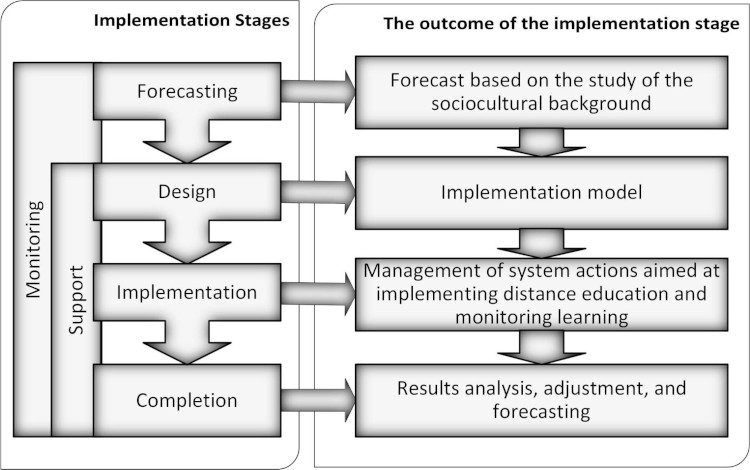
Figure 1
Model of distance learning implementation
Source: Prepared by the authors
Figure 1 is a graphic representation of the model of implementing distance education, and it consists of two blocks: the stages of its implementation and the results of the implementation stages. The stages of implementation include forecasting, design, implementation, and completion, as well as midline: monitoring and support. Implementation results are the forecast based on the study of the sociocultural background, the implementation model, the management of the systemic events of distance learning and outcomes control, the analysis of outcomes, adjustment, and forecasting.
Discussion
This model presents the details at the matrix level (the list of necessary actions). Thus, one can immediately see which of the actions during the implementation of distance education are most relevant. For example, when one assesses the digital competence of the personnel and reveals that they have insufficient preparation in this field, then before introducing distance learning, one should allocate funds, time, and courses that would increase it. If one assesses the needs for the implementation of distance learning at some level of education and discovers that there is none, then the digital transformation of education will stimulate teachers and students to move to educational organizations that use digital technologies less actively (IBRAHIM, 2021). If the assessment of the labor market in the region demonstrates that there is no need for highly qualified personnel, then the development of digital training without creating jobs and increasing demand for competent specialists who want to get fair wages will create preconditions for the outflow of young professionals to more successful regions. If the assessment of the Internet access in educational organizations of various levels and households reveals that it is not sufficient for the implementation of distance education, then the introduction of case technologies will be the best option in case the pandemic persists. Here we considered only some examples of detailed actions and adequate management decisions taken during the introduction of distance education based on the results of the forecasting stage. Such an approach enables a more competent and systematic design and organization of the process.
Before choosing the mode of distance learning (mixed, network, or electronic), one should assess the financial costs required for its implementation. For instance, the research papers (BARANNIKOV et al., 2020; LARIONOVA et al., 2021) confirmed the assumption that the expenditures of educational organizations on the learning process increased during the pandemic. For instance, it was concluded that the introduction of distance education in universities with “low digitalization before the spread of COVID-19 and a small number of students” (LARIONOVA et al., 2021, p. 156, our translation) should be carried out with great care.
According to some educators (ANDREEV, 2014; KHUTORSKOY, 2000;POLAT, 2006; SHCHENNIKOV, 2002), the quality of distance education within the system of lifelong learning largely depends on the didactic component: the professionalism of teachers, the quality of didactic support materials and software, and the readiness of students to use digital technologies in the learning process. However, in the model that we developed, the most important element is the prognostic stage, which allowed us to choose a distance learning technology most accurately matching the socioeconomic characteristics of the region (an educational organization), the needs of the actors of distance learning, the competence of teachers, students, and their parents as early as at the stage of making a decision on its implementation. In fact, the insufficient consideration of these factors, as the survey results demonstrated (GROSHEV; KRASNOSLOBODTSEV, 2020; KAMENEV; ABRAMOVA; KRASHENINNIKOV, 2021; LARIONOVA et al., 2021; SAPRYKINA; VOLOKHOVICH, 2020; ZVYAGINTSEV; KERSHA; PINSKAYA, 2021), negatively affected the implementation of distance education during the pandemic. The analysis of official documents (RUSSIA, 2012, 2017) showed that currently Russian educational organizations lack the unified approach to distance learning and a comprehensive management system for it. In addition, its management is erratic, despite the attempts to make this area less chaotic.
The most important factor in the implementation of the model proposed is uniting the efforts of sociologists, teachers, parents, and government officials. The outcome of this process depends on how well their actions are coordinated. Chernyshov (2021) concluded that it is necessary to monitor teachers’ opinions and practices by generalizing the results of surveys of the participants in the educational program Digitalization of the Learning Process in Novosibirsk. However, unlike us, he focused on “the methodological generalization of advanced pedagogical and organizational practices and investments in the development of human capital in the pedagogical environment” (CHERNYSHOV, 2021, p. 148, our translation).
The model we developed was tested by the employees of the Department of Social and Legal Research of the Institute of Philosophy and Social Sciences of the Siberian Branch of the Russian Academy of Sciences (SB RAS), teachers, and the administration of educational organizations participating in the sociological survey on the problems of distance learning. The model was presented at the all-Russian conference “From Idea to Practice: Social and Humanitarian Knowledge in the digital Environment”, in Novosibirsk, on March 24–25, 2021. Novosibirsk State University and the Institute of Philosophy and Law of the SB RAS held the event. The model was also presented at the international forum “High Technologies, Artificial Intelligence, and Robotic Systems in Education” (November 2021, Novosibirsk) and at refresher courses “Methodological Support of Distance Education” (2021).
Conclusions
From the perspective of social transformation, digitalization of education is a factor that has a systemic impact on society. It has certain consequences that may be forecasted with a detailed study of the sociocultural background. Having analyzed the results of implementing distance learning in different Russian regions as well as the research into negative factors that reduced the efficiency of its implementation, we found out that these problems were due to the absence of a preliminary regional analysis of sociocultural factors at the planning and forecasting stage. We attributed to the macrolevel of distance learning administration. In this regard, we would like to note that the identified management gap is typical only for countries with a centralized management system, Russia being one of them.
We demonstrated that effective implementation of distance learning at the micro- (an educational organization), meso- (regional and municipal administration), and macrolevels (public administration) of the education system requires the development of a universal model. The latter should include monitoring and support for any level of application (both in a region and in an educational organization). The presented model for the introduction of distance education reflects promising digital technologies in educational organizations of all levels and is based on the principles of the unity of goals, continuity, connection with subsequent levels, flexibility, and modularity. This creates the conditions that are most adequate for the socioeconomic situation in the region and ensures the variability of implemented distance learning technologies depending on the needs of the region, educational organizations, students, employers, and their competence.
The generalized model for the introduction of distance learning as part of the digital transformation of education can be used at all levels of administration and in various types of educational organizations.
Research limitations and perspectives
Since we realize that the model presented requires further practical implementation, it may rather be called theoretical. Despite the fact that we developed it for the countries with a centralized management system, it may be applied in a particular region or educational organization, which would remove this limitation.
We believe that the main directions of further research into the effectiveness of the proposed model include accumulation, analysis, and systematization of empirical data in order to form an empirical base for its improvement.
Acknowledgments
The study was carried out with the support of the Ministry of Education of the Russian Federation as part of state assignment No. 073-00072-21-01 under the project “Digital transformation of education: Development and testing the models for the implementation of distance learning in educational institutions of all levels of education.”
REFERENCES
ABRAMOVA, M. A. Cifrovaja transformacija v regionah Rossii: Ocenki i realʹnostʹ [Digital transformation in the regions of Russia: Estimates and reality]. Professionalʹnoe Obrazovanie v Sovremennom Mire [Professional Education in the Modern World], Novosibirsk, v. 11, n. 3, p. 11-22, 2021. DOI: https://doi.org/10.20913/2224-1841-2021-3-02
ABRAMOVA, M. A.; FARNIKA, M. Cifrovizacija obrazovanija v uslovijah cifrovogo neravenstva [Digitalization of education in the context of digital inequality]. Professionalʹnoe Obrazovanie v Sovremennom Mire [Professional Education in the Modern World], Novosibirsk, v. 9, n. 4, p. 3167-3175, 2019. DOI: https://doi.org/10.15372/PEMW20190403
AGASISTI, T. et al. Efficiency of regional higher education systems and regional economic short-run growth: empirical evidence from Russia. Industry and Innovation, Frederiksberg, v. 28, n. 4, p. 507-534, 2020. DOI: https://doi.org/10.1080/13662716.2020.1738914
ANDREEV, A. A. Očerki distancionnogo obučenija v Rossii [Essays on distance education in Russia]. Upravlenie Obrazovaniem: Teorija i Praktika [Education Management: Theory and Practice], Moscow, n. 1(13), p. 16-31, 2014.
APRIYANTI, C. Distance learning and obstacles during COVID-19 outbreak. Jurnal Ilmiah Pendidikan Dasar, Semarang, v. 7, n. 2, p. 68-83, 2020. DOI: https://doi.org/10.30659/pendas.7.2.68-83
ARKHIPOVA, M. Y.; SIROTIN, V. P. Regionalʹnye Aspekty Razvitija Informacionnokommunikacionnyh I Cifrovyh Tehnologij V Rossii [Regional aspects of the development of information, communication, and digital technologies in Russia]. Economy of the Regions, Ekaterinburg, v. 15, n. 3, p. 670-683, 2019. DOI: https://doi.org/10.17059/2019-3-4
BARANNIKOV, K. A. et al. Uroki stress-testa: Vuzy v uslovijah pandemii i posle nee [Lessons of the stress test: Universities during the pandemic and after it]. 2020. Available: https://www.tsu.ru/news/uroki-stress-testa-vuzy-v-usloviyakh-pandemii-i-po/. Access: 4 Oct. 2021.
BASILAIA, G.; KVAVADZE, D. Transition to Online Education in Schools during a SARS-CoV-2 Coronavirus (COVID-19) Pandemic in Georgia. Pedagogical Research, Outumaoro, v. 5, n. 4, em0060, 2020. DOI: https://doi.org/10.29333/pr/7937
BERTIZ, Y.; KOCAMAN-KAROĞLU, A. Distance Education Students’ Cognitive Flexibility Levels and Distance Education Motivations. International Journal of Research in Education and Science, Leiden, v. 6, n. 4, p. 638-648, 2020. DOI: https://doi.org/10.46328/ijres.v6i4.1022
BOARINI, R. et al. What Makes for a Better Life? The Determinants of Subjective Well-Being in OECD Countries: Evidence from the Gallup World Poll. OECD Statistics Working Papers, No. 2012/03. Paris: OECD, 2012. DOI: https://doi.org/10.1787/5k9b9ltjm937-en
BONK, C. J. Pandemic ponderings, 30 years to today: Synchronous signals, saviors, or survivors? Distance Education, Ottawa, v. 41, n. 4, p. 589-599, 2020. DOI: https://doi.org/10.1080/01587919.2020.1821610
BROM, C. et al. Mandatory Home Education During the COVID-19 Lockdown in the Czech Republic: A Rapid Survey of 1st-9th Graders’ Parents. Frontiers in Education, Orange, v. 5, p. 103, 2020. DOI: https://doi.org/10.3389/feduc.2020.00103
CHERNYSHOV, S. A. Massovyj perehod školy na distancionnoe obučenie v ocenkah lokalʹnogo pedagogičeskogo soobŝestva [Massive shift of schools towards distance learning in the estimates of a local pedagogical community]. Obrazovanie I Nauka [The Education and Science Journal], Yekaterinburg, v. 23, n. 3, p. 131-155, 2021. DOI: https://doi.org/10.17853/1994-5639-2021-3-131-155
CIFFOLILLI, A.; MUSCIO, A. Industry 4.0: National and regional comparative advantages in key enabling technologies. European Planning Studies, Bergen, v. 26, n. 12, p. 2323-2343, 2018. DOI: https://doi.org/10.1080/09654313.2018.1529145
DERYABIN, A. A. et al. Issledovanie predstavlenij direktorov rossijskih škol o cifrovyh kompetencijah učastnikov obrazovatelʹnoj sistemy [Russian School Principals’ Beliefs about Digital Competences of Educational Process’ Participants]. Voprosy Obrazovanija [Educational Studies], Moscow, n. 3, p. 212-236, 2021. DOI: https://doi.org/10.17323/1814-9545-2021-3-212-236
ELLISTON, Z. A. A position paper on the implementation of learning technology tools: Uncovering faculty perceptions. International Journal on Studies in Education, Leiden, v. 2, n. 1, p. 58-65, 2020. DOI: https://doi.org/10.46328/ijonse.11
EUBANKS, V. Automating inequality: How high-tech tools profile, police, and punish the poor. New York: St. Martin’s Press, 2018.
FAUZI, I.; KHUSUMA, I. H. S. Teachers’ Elementary School in Online Learning of COVID-19 Pandemic Conditions. Jurnal Iqra’: Kajian Ilmu Pendidikan, v. 5, n. 1, p. 58-70, 2020. DOI: https://doi.org/10.25217/ji.v5i1.914
FROLOVA, E. V.; ROGACH, O. V.; RYABOVA, T. M. Digitalization of Education in Modern Scientific Discourse: New Trends and Risks Analysis. European Journal of Contemporary Education, Sochi, v. 9, n. 2, p. 331-336, 2020. DOI: https://doi.org/10.13187/ejced.2020.2.313
GLUCKMAN, P.; ALLEN, K. Understanding Wellbeing in the Context of Rapid Digital and Associated Transformations: Implications for Research, Policy and Measurement. Auckland: The International Network for Government Science Advice, 2018. Available: http://www.ingsa.org/wp-content/uploads/2018/10/INGSA-Digital-Wellbeing-Sept18.pdf. Access: 10 Sept. 2021.
GROSHEV, I. V.; KRASNOSLOBODTSEV, A. A. Cifrovizacija i kreativnostʹ rossijskih regionov [Digitization and creativity of Russian regions]. Sotsiologicheskie Issledovaniya [Sotsiological Research], Moscow, n. 5, p. 66-78, 2020. DOI: https://doi.org/10.31857/S013216250009390-2
GUBERNATOROV, Y. Studenty nazvali osnovnye problemy onlajn-obučenija: Im ne hvataet obŝenija s prepodavateljami i podvodit tehnika [Students named the main problems of online learning: They lack communication with teachers and the technique fails]. RBK, 2020. Available: https://www.rbc.ru/society/19/08/2020/5f3bbdae9a7947d167de1a41. Access: 4 Sept. 2021.
HEWITT-DUNDAS, N. Research intensity and knowledge transfer activity in UK universities. Research Policy, Brington, v. 41, n. 2, p. 262-275, 2012. DOI: https://doi.org/10.1016/j.respol.2011.10.010
IBRAHIM, S. A. E.-S. Educational Platforms and Digital Transformation in Raising Awareness about Remote Education in Light of the Corona Epidemic Spread Among Secondary School Students. Journal of Southwest Jiaotong University, Chengdu, v. 56, n. 1, p. 358-376, 2021. DOI: https://doi.org/10.35741/issn.0258-2724.56.1.33
IQBAL, S. A. et al. We should avoid flattening the curve in education – Possible scenarios for learning loss during the school lockdowns. Education for Global Development, 2020. Available: https://blogs.worldbank.org/education/we-should-avoid-flattening-curve-education-possible-scenarios-learning-loss-during-school. Access: 4 Sept. 2021.
JARZABKOWSKI, P.; SILLINCE, J. A. A.; SHAW, D. Strategic ambiguity as a rhetorical resource for enabling multiple interests. Human Relations, Durham, v. 63, n. 2, p. 219-248, 2010. DOI: https://doi.org/10.1177/0018726709337040
KAMENEV, R. V.; ABRAMOVA, M. A.; KRASHENINNIKOV, V. V. Distancionnoe obrazovanie: modeli, urovni vnedrenija i problemy realizacii [Distance education: Models, implementation levels, and implementation problems]. Vestnik Pedagogičeskih Innovacij [Bulletin of Pedagogical Innovations], Novosibirsk, n. 3, p. 54-64, 2021. DOI: https://doi.org/10.15293/1812-9463.2103.05
KARAKAYA, K. Design considerations in emergency remote teaching during the COVID-19 pandemic: A human-centered approach. Educational Technology Research and Development, Chestnut Hill, v. 69, p. 295-299, 2021. DOI: https://doi.org/10.1007/s11423-020-09884-0
KHUTORSKOY, A. V. Osobennosti razvitija distancionnogo obučenija v rossijskih školah [Peculiarities of distance learning development in Russian schools]. 2000. Available: https://cyberleninka.ru/article/n/osobennosti-razvitiya-distantsionnogo-obucheniya-v-rossiyskih-shkolah. Access: 4 Sept. 2021.
LARIONOVA, V. A. et al. Èkonomičeskie aspekty vynuždennogo perehoda na distancionnoe obučenie, ili Kakuju cenu zaplatili vuzy za distant [Economic aspects of emergency transition to distance education, or the price of going online in higher education]. Voprosy Obrazovanija [Educational Studies], Moscow, n. 1, p. 138-157, 2021. DOI: https://doi.org/10.17323/1814-9545-2021-1-138-157
LEAHY, S. M.; HOLLAND, C.; WARD, F. The digital frontier: Envisioning future technologies impact on the classroom. Futures, Bristol, v. 113, 102422, 2019. DOI: https://doi.org/10.1016/j.futures.2019.04.009
LEE, J. Mental health effects of school closures during COVID‐19. The Lancet Child & Adolescent Health, London, v. 4, n. 6, 421, 2020. DOI: https://doi.org/10.1016/S2352-4642(20)30109-7
LITVINTSEVA, G. P.; GLINSKIY, V. V.; STUKALENKO, E. A. Interregional differentiation of population incomes in Russian Federation in the post-crisis period. Academy of Strategic Management Journal, Richardson, v. 16, n. 4, 151, 2017. Available: https://www.abacademies.org/articles/Interregional-differentiation-of-population-incomes-1939-6104-16-4-151.pdf. Access: 10 Sept. 2021.
LITVINTSEVA, G. P. et al. Ocenka cifrovoj sostavljajuŝej kačestva žizni naselenija v regionah Rossijskoj Federacii1 [Digital component of people’s quality of life assessment in the regions of the Russian Federation]. Terra Economicus, Rostov-on-Don, v. 17, n. 3, p. 107-127, 2019. DOI: https://doi.org/10.23683/2073-6606-2019-17-3-107-127
MEANS, B. et al. The effectiveness of online and blended learning: A meta-analysis of the empirical literature. Teachers College Record, New York, v. 115, n. 3, p. 1-47, 2013. Available: https://learnonline.ecampusontario.ca/App_Content/Resource/docs/7b0981b7-dbd6-41d2-83b9-67878a0ed052/The%20effectiveness%20of%20online%20and%20blended%20learning_%20A%20meta-analysis%20of%20the%20empirical%20literature.pdf. Access: 10 Sept. 2021.
MUNROE, P. T. Cognitive balance theory (Heider). In: The Blackwell Encyclopedia of Sociology. Hoboken: John Wiley & Sons, 2019. DOI: https://doi.org/10.1002/9781405165518.wbeosc057.pub2
MURPHY, M. P. A. COVID-19 and emergency eLearning: Consequences of the securitization of higher education for post-pandemic pedagogy. Contemporary Security Policy, Maastricht, v. 41, n. 3, p. 492-505, 2020. DOI: https://doi.org/10.1080/13523260.2020.1761749
NARKHOV, D. Y.; NARKHOVA, E. N.; SHKURIN, D. V. Dinamika obrazovatelʹnoj aktivnosti studenčestva pod vozdejstviem cifrovizacii [Dynamics of educational activity of students under the influence of digitalisation]. Obrazovanie I Nauka [The Education and Science Journal], Yekaterinburg, v. 23, n. 8, p. 147-188, 2021. DOI: https://doi.org/10.17853/1994-5639-2021-8-147-188
ORGILÉS, M. et al. Immediate psychological effects of the COVID-19 quarantine in youth from Italy and Spain. Frontiers in Psychology, Lausanne, n. 11, 579038, 2020. DOI: https://doi.org/10.3389/fpsyg.2020.579038
ÖZÜDOĞRU, G. Problems faced in distance education during Covid-19 Pandemic. Participatory Educational Research, Ankara, v. 8, n. 4, p. 321-333, 2021. DOI: https://doi.org/10.17275/per.21.92.8.4
PETRAKOVA, A. V. et al. Osobennosti psihologičeskogo stressa u učitelej v uslovijah distancionnogo prepodavanija vo vremja pandemii COVID-19 [Characteristics of Teacher Stress during Distance Learning Imposed by the COVID-19 Pandemic]. Voprosy obrazovanija [Educational Studies], Moscow, n. 1, p. 93-114, 2021. DOI: https://doi.org/10.17323/1814-9545-2021-1-93-114
POLAT, E. S. Educational Technology of Distance Learning. Moscow: Academia, 2006.
RABOSSI, M.; GUAGLIANONE, A. Las políticas de internacionalización universitaria en la Argentina: movilidad estudiantil y producción científica. Revista Ibero-Americana de Estudos em Educação, Araraquara, v. 15, n. esp4, p. 2556-2576, 2020. DOI: https://doi.org/10.21723/riaee.v15iesp4.14504
RASMITADILA, R. et al. The Perceptions of Primary School Teachers of Online Learning during the COVID-19 Pandemic Period: A Case Study in Indonesia. Journal of Ethnic and Cultural Studies, Fort Myers, v. 7, n. 2, p. 90-109, 2020. DOI: https://doi.org/10.29333/ejecs/388
ROGACHEVA, P. S.; SEMERGEY, S. V. Problems of distance education during the pandemic. Vestnik Majkopskogo Gosudarstvennogo Tehnologiceskogo Universiteta, v. 12, n. 4, p. 85-93, 2020. DOI: https://doi.org/10.47370/2078-1024-2020-12-4-85-93
RUSSIA. Article 16, Law No. 273-FZ, from 29 December, 2012. Implementation of educational programs using e-learning and distance learning technologies. Moscow: Ministry of Education, 2012. Available: http://www.consultant.ru/document/cons_doc_LAW_140174/9ab9b85e5291f25d6986b5301ab79c23f0055ca4/. Access: 4 Oct. 2021.
RUSSIA. Ministry of Education and Science. Order No. 816. On Approval of the Procedure for the Application of E-Learning, Distance Learning Technologies by Organizations Carrying Out Educational Activities in the Implementation of Educational Programs. Moscow: Ministry of Education and Science, 23 Aug. 2017. Available: http://www.consultant.ru/document/cons_doc_LAW_278297/. Access: 10 Sept. 2021.
SAPRYKINA, D. I.; VOLOKHOVICH, A. A. Problemy perehoda na distancionnoe obučenie v Rossijskoj Federacii glazami učitelej [Problems of Transition to Distance Learning in the Russian Federation through the Eyes of Teachers]. Institut obrazovanija [Institute of Education]. 2020. Available: https://ioe.hse.ru/fao_distant. Access: 2 Sept. 2021.
SAYKILI, A. Distance education: Definitions, generations, key concepts and future directions. International Journal of Contemporary Educational Research, Elazığ, v. 5, n. 1, p. 2-17, 2018. Available: http://ijcer.net/en/pub/issue/38043/416321. Access: 10 Sept. 2021.
SCHMIDT, K. et al. Key landscape features in the provision of ecosystem services: Insights for management. Land Use Policy, Enschede, v. 82, p. 353-366, 2019. DOI: https://doi.org/10.1016/j.landusepol.2018.12.022
SHCHENNIKOV, S. A. Open Distance Education: Monograph. Moscow: Nauka, 2002.
SKOLKOVO MOSCOW SCHOOL OF MANAGEMENT. Methodology for Calculating the Digital Russia Index of the Subjects of the Russian Federation. Moscow: Skolkovo, 2018. Available: https://finance.skolkovo.ru/downloads/documents/FinChair/Research_Reports/SKOLKOVO_Digital_Russia_Methodology_2019-04_ru.pdf. Access: 2 Sept. 2021.
USTYUZHANINA, E. V.; EVSUKOV, S. G. Digitalization of the educational environment: perspectives and threats. Vestnik of the Plekhanov Russian University of Economics, Moscow, n. 1, p. 3-12, 2018. DOI: https://doi.org/10.21686/2413-2829-2018-1-3-12
VINER, R. M. et al. School closure and management practices during coronavirus outbreaks including COVID-19: a rapid systematic review. The Lancet Child & Adolescent Health, London, v. 4, n. 5, p. 397-404, 2020. DOI: https://doi.org/10.1016/S2352-4642(20)30095-X
ZIERER, K. Putting Learning before Technology! The Possibilities and Limits of Digitalization. New York: Routledge, 2019.
ZIZIKOVA, S. I.; SHIKHOVTSOV, Y. V.; MATASOVA, I. L. Transformation of education in the context of digitalization. In: GLOBAL CHALLENGES AND PROSPECTS OF THE MODERN ECONOMIC DEVELOPMENT, 2020, Samara. Proceedings [...]. London: The European Proceedings of Social and Behavioural Sciences, 2021. p. 1074-1081. DOI: https://doi.org/10.15405/epsbs.2021.04.02.128
ZVYAGINTSEV, R. S.; KERSHA, Y. D.; PINSKAYA, M. A. Perehod na distancionnoe obrazovanie: Detalʹnyj razbor municipalʹnogo kejsa [Transition to distance education: A detailed analysis of the municipal case]. Vysšaja Škola Èkonomiki, Institut Obrazovanija [Higher School of Economics, Institute of Education]. 2021. Available: https://ioe.hse.ru/sao_region. Access: 2 Sept. 2021.
Notas de autor
Información adicional
How to reference this article: KAMENEV, R. V.; ABRAMOVA, M. A.; KRASHENINNIKOV, V. V. Development and testing of a model of distance education. Revista online de Política e Gestão Educacional, Araraquara, v. 25, n. 3, p. 2408-2427, Sep./Dec. 2021. e-ISSN: 1982-5587. DOI: https://doi.org/10.22633/rpge.v25i3.15923
