GENERAL
Gender-Concealed Concepts in Conceptual Space Languages of Dagestan
Conceptos ocultos de género en lenguajes espaciales conceptuales de Daguestán
Gender-Concealed Concepts in Conceptual Space Languages of Dagestan
RELIGACIÓN. Revista de Ciencias Sociales y Humanidades, vol. 4, núm. 13, pp. 209-213, 2019
Centro de Investigaciones en Ciencias Sociales y Humanidades

Esta obra está bajo una Licencia Creative Commons Atribución-NoComercial 4.0 Internacional.
Recepción: 03 Enero 2019
Aprobación: 26 Marzo 2019
Abstract: The present paper analyzes definitions of the languages of Dagestan with the scope of notions of “the language of men/the language of women”. Many meaningful units of gender are updated within the framework of this classification. The material with a multitude of gender units was dispersed in the conceptual space of Russian and Dagestan languages; however, it was restored by the representation of stereotypes “noun ± adjective”. This allows justifiably to streamline the conceptual space of languages of Dagestan with many interpretations of the surrounding reality. The preference given to the aforementioned classification is because the connotative aspect of nominative units allows for the elimination of overlays, i.e. cases of reference of the same interpretations to different terminological headings simultaneously.
Keywords: MetaphorizationMetaphorization, TermTerm, Definitions of National Dagestan TextsDefinitions of National Dagestan Texts, Gender MarkersGender Markers, Caucasian Languages.
Resumen: El presente trabajo analiza las definiciones de las lenguas de Daguestán con el alcance de las nociones de “la lengua de los hombres/la lengua de las mujeres”. Muchas unidades significativas de género se actualizan en el marco de esta clasificación. El material con una multitud de unidades de género se dispersó en el espacio conceptual de los idiomas ruso y de Daguestán; sin embargo, fue restaurado por la representación de estereotipos “sustantivo ± adjetivo”. Esto permite racionalizar de manera justificada el espacio conceptual de los lenguajes de Daguestán con muchas interpretaciones de la realidad circundante. La preferencia dada a la clasificación antes mencionada se debe a que el aspecto connotativo de las unidades nominativas permite la eliminación de superposiciones, es decir, casos de referencia de las mismas interpretaciones a diferentes títulos terminológicos simultáneamente.
Palabras clave: metaforización, términotérmino, definiciones de textos nacionales de Daguestándefiniciones de textos nacionales de Daguestán, marcadores de géneromarcadores de género, lenguas caucásicaslenguascaucásicas.
1. INTRODUCTION
As individual forms of lexical information, some properties of the naive picture of the world are represented by oppositions of various descriptors of the conceptual structure of language [Boldyrev, 2008]. Since each area of the language device includes a rich material for studying lexical information, we will consider diverse nominative units in the so-called “historical-ethnographic” interpretations [Narochnickij, 1988, p. 121].
According to the historical and ethnographic reference, the simplest form of cooperation in Dagestan led to the preservation of natural labor [5, p. 123], allowing justifiably streamline some properties of the naive model of the world with a variety of interpretations and a subset of meaningful forms of the surrounding reality. The space of meanings with a subset of linguistic nominations of sociopolitical terms is, above all, a real taxonomic reflection of public consciousness in the conceptual space of gender interpretations. The material of socio-political terms with a subset of figurative meanings and meaningful interpretations turned out to be dispersed in the conceptual space of the gender of Russian and Dagestan languages, however restored by means of similarity and contiguity.
2. MAIN PART
The first and basic principles of the study of social metaphor terms are based on the methodological foundations of Russian language [Balashova, 2014, p. 193]. The juxtaposition of the initial oppositions of social metaphor in the system of synonymous associations between Russian and Dagestan languages allowed us to reveal the semantic field of socio-political terms, or their clusters.
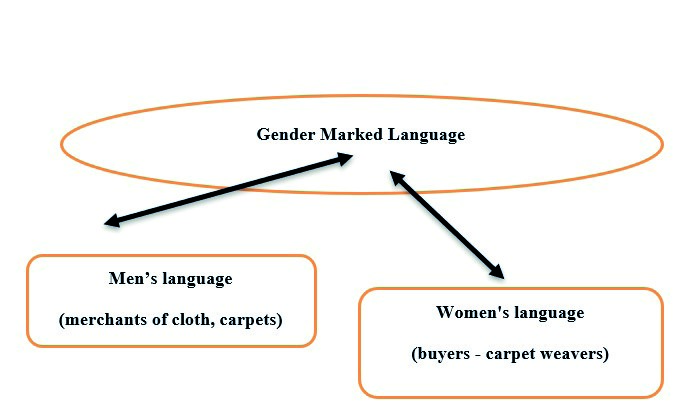
Image 1
Image 1
Here, we rely on the structure of the subject interpretations of social metaphors with the correlates of the figurative meanings of woolen craft (see Table 1):
Table 1
| Socio-political terms in the semantic structure of Russian and Dagestan languages | |
| Russian language | Tabasaran language |
| wooden spinning wheel | chuhra |
| wooden loom | durkar |
| wood churning machine | dezgehar |
| wooden spoke spinning machine | rib |
| wooden machine roller (woven cloth is wound on it); | sam |
| bobbin | kint |
| shuttle loom | unuh |
| spine spinning machine | rigi |
| belt wheel for winding thread | zin |
| wooden spindle | tibich |
| wooden comb for wool | rag |
| spinning needle | rub |
| wedge | sinich |
| embroidery | cheshne |
It is known that our scientific ideas about the naive picture of the world are realized in the linguistic signs of the centrifugal and centripetal substitute [Baranov, 2014, p. 44]. The task of the cognitologist is consistently describing the substitute for social connections and systematizing the model of the behavior of the centrifugal and centripetal semiotics signs [Sakhno, 1991, p. 21]. Analysis of the research of semiotics signs shows that the “social” metaphors of the Russian language of the 11th-15th centuries delimit the characteristics of the basic metaphorization models (see Table 2):It is known that our scientific ideas about the naive picture of the world are realized in the linguistic signs of the centrifugal and centripetal substitute [Baranov, 2014, p. 44]. The task of the cognitologist is consistently describing the substitute for social connections and systematizing the model of the behavior of the centrifugal and centripetal semiotics signs [Sakhno, 1991, p. 21]. Analysis of the research of semiotics signs shows that the “social” metaphors of the Russian language of the 11th-15th centuries delimit the characteristics of the basic metaphorization models (see Table 2):
| Precedent Conventional Predicate “Noun, Adjective, Participle” | |
| Intentional semiotics with the names of cloth production | Extensive semiotics as a way to replenish social and political terminology |
| ir cloth | wool (cleaned) |
| ha wool | yarn |
| marchlin hаsheep wool | wool rope |
| rachal hank of wool | Wool (animal) |
| chich wool comb | wool cutting |
| chir a shred of wool | loop of textile, embroidery, knitting |
| bashkul a ball of wool | felt |
| kup wool dyeing | textile stitch, embroidery, knitting |
The considered semantic primitives explain the interpretation of socio-political terms [8, p. four]. Semantic primitives with oppositions of sociopolitical terms group various lexemes of cloth production: dyeing wool yarn; make the basis for woven products; dissolve (about knitted / embroidered things) [Shikhalieva, 2016]. These numerous oppositions of the diverse tokens of cloth production form the semantic area of social relations in the system of socio-political terms of Russian and Dagestan languages [Shikhalieva, 2016] (see Table 3).
| Socio-political terms with differentiation of gender correlates | |||
| Gender opposition | Relative frequency | Absolute frequency | Different tokens |
| attributes and women’s jewelery | Shal handkerchief; Katan homespun cloth; Leef blanket | Zhimzhim wool rug (goat wool) | Irin chuha cloth caftan; Irzhalcloth bag |
| Gapar wool socks; Turba carpet bag | Atnar woolen stockings; Chul carpet tape for carrying jugs | Elzhegwool mittens; Gatal woolen laces for charms | |
| men’s clothes | Raf crown caps; Ragar visor at the cap (local production) | Urchburka; Hav fur coat collar; un hem; meadow sleeve; | Chil bachuk gray hat (about fur caps); Hunk cap; sur bachuk broadtail |
| Urggamfelt coat; Japunzhiburka | Kaval long-sleeved wool coat | Buhara papakha (made of goat wool); Bakka hat | |
For this semantic domain of social and political terms, the source of their replenishment is urgent, i.e. the context of the subject index used in social relations and those between “male traders and female carpet weavers”. If in the frequency of the use of social and political terms to systematize the source of replenishment of the social context, then the demarcation of the grouping of terms is clearly revealed in the cluster of Russian metaphors [Balashova, 2014, p. 12].
The next stage of the semantic grouping of terms revealed the characteristics of numerous lexemes in the genetic commonality of Dagestan languages: fiber murslar, carpet barhal, lint free carpet sumah, pile carpet from seamy side halav, carpet fleece wool halachi, and pile carpet bisihalachi [Shikhalieva2015]. The analysis of the above lexemes allowed us to simplify the opposition of the terms of Russian language in the hierarchy of form understanding [Telia, 1986, p. 104]. Systematic meanings of the Russian language reveal a generalization of nominations in the genetic commonness of Dagestan languages.
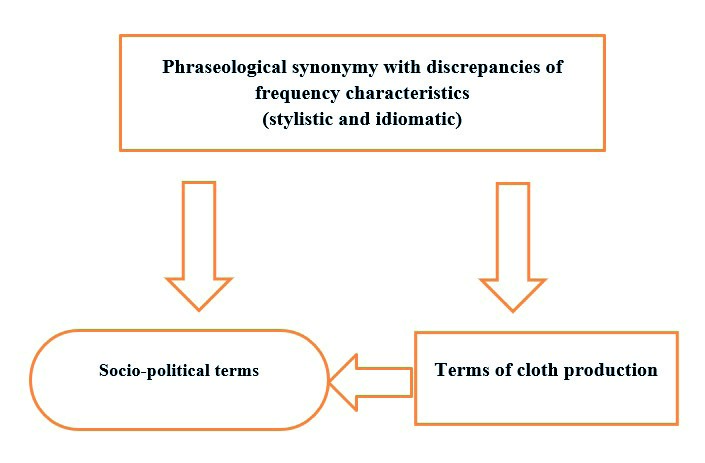
Among the generalized nominations of Russian and Dagestan languages, models of a historical product are regularly recorded: workshop // manufactory // place where dyed yarn is artil // karhana. Contrasting models of Russian metaphor allows specifying the historical information of the product [1, c. 12]. This semantic area reflects the hierarchy of social relations, i.e. understanding of the forms and values of social and political terms by developing a conceptual model of the Russian language. Occasional significance of social metaphors reflects the possibility of further development of the hierarchical model of the Russian language. In the meantime, not all conceptually significant characteristics of the Russian metaphor develop the conceptual and linguistic form of gender models of the Dagestan languages.
In order to correctly simplify the semantics of nominative units of socio-political terms, consider the forms and meanings through a logical approach:
3. CONCLUSIONS
The preference given to this classification is since the connotative aspect of the semantics of nominative units allows the elimination of overlays, i.e. cases of attribution of the same names to different terminology headings at the same time, as well as the division of the scope of concepts in inter-language definitions “the language of men vs. the language of women”. The method of streamlining sociopolitical terms considers the anthropometric gradation of social ties and relations “the language of men ↕ the language of women”. Among the generalized nominations of the Russian and Dagestan languages, historical product models are regularly recorded: workshop // manufactory // place where the yarn is dyed. On the contrary, the models of the Russian metaphor allow us to concretize the information of the historical product. This semantic area reflects the hierarchy of social relations, that is, understanding of the forms and values of social and political terms by developing a conceptual model of Russian language. Occasional significance of social metaphors reflects the possibility of further development of the hierarchical model of the Russian language. While not all conceptually significant characteristics of the Russian metaphor develop the conceptual and linguistic form of gender models of the Dagestan languages.
REFERENCIAS
Aslanov G.N. (1990). Eastern Turkic Vocabulary in Dictionaries of the Russian Language (end of XVIII-first half of XIX centuries), Baku
Balashova L.V. (2014). Russian Metaphor, Past, Present, Future, M.
Baranov A. N. (2014). Descriptors Metaphor Theory, M.:
Boldyrev N.N. (2008). International Congress on Cognitive Linguistics: Sat. mat / editor, Tambow: TGU, pp. 234-239
Kharchenko V.K. (2009). Portable Meaning, Metaphor Words in Poetry and Prose, M.: Librokom
Narochnickij A.L. (1988). History of Peoples of North Caucasus Late 18th Century-1917, M.: Nauka
Sakhno S.L. (1991). Your and Other People’s in Conceptual Structures. Logical Analysis of Language. Cultural Concepts, M.: Science. pp. 95-102
Shikhalieva S. Kh. (2016). The Term Nature in the Context of the Professional Translator (To a Question of the Bible Linguistic Map), Journal of Language and Literature, Vol. 7, Issue 2, pp. 234-242.
Shikhalieva S.Kh. (2015). Cult and Culture of the Caucasus in the Palestinian Context: Speech Segment and
Substrate Anomaly. The Social Sciences (Pakistan), .. 10, Issue 3, pp. 226-229
Telia V.N. (1986). Connotative Aspect of the Semantics of the Nomination, M.: Nauka
Información adicional
CITAR COMO: Shikhalieva, S. K., DibirovI. А., Ibragimova, M. O., Sulaeva, Z. A., & Khalidova, R. S. (2019). Gender-Concealed Concepts in Conceptual Space Languages of Dagestan. Religación. Revista De Ciencias Sociales Y Humanidades, 4(13), 209-213. https://revista.religacion.com/index.php/religacion/article/view/211Shikhalieva, S. K., DibirovI. А.,Ibragimova, M. O., Sulaeva, Z.A., & Khalidova, R.S.(2019). Gender-Concealed Concepts in Conceptual Space Languages of Dagestan. Religación. Revista De Ciencias Sociales Y Humanidades, 4(13), 209-213. https://revista.religacion.com/index.php/religacion/article/view/211
Enlace alternativo
https://revista.religacion.com/index.php/religacion/article/view/211 (html)