SUR-SUR
The use of a structural-institutional approach to the analysis of the development of a regional economic complex
El uso de un enfoque estructural-institucional para el análisis del desarrollo de un complejo económico regional
The use of a structural-institutional approach to the analysis of the development of a regional economic complex
RELIGACIÓN. Revista de Ciencias Sociales y Humanidades, vol. 4, núm. 15, Esp., pp. 166-171, 2019
Centro de Investigaciones en Ciencias Sociales y Humanidades

Esta obra está bajo una Licencia Creative Commons Atribución-NoComercial-SinDerivar 4.0 Internacional.
Recepción: 17 Enero 2019
Aprobación: 30 Abril 2019
Abstract: Enhancement of efficiency and competitiveness of the industrial complex requires changing the existing methods and improving the used methods for forming and implementing industrial policy. Particularly acute is the task of ridding the industrial enterprises of the dependence on foreign technologies and components and the transition to total import substitution under the sanctions of the Western powers and the United States of America.
Keywords: Regional industrial complex, economic crisis, industrial complex, industrial policy, managemental relations, institutional factors, structural shift, competition.
Resumen: La mejora de la eficiencia y la competitividad del complejo industrial requiere cambiar los métodos existentes y mejorar los métodos utilizados para formar e implementar políticas industriales. Particularmente aguda es la tarea de librar a las empresas industriales de la dependencia de tecnologías y componentes extranjeros y la transición a la sustitución total de importaciones bajo las sanciones de las potencias occidentales y los Estados Unidos de América.
Palabras clave: complejo industrial regional, crisis económica, complejo industrial, política industrial, relaciones gerenciales, factores institucionales, cambio estructural, competencia.
Introduction
Industry serves as the foundation of the economy of any industrialized state, since the level of its development ultimately determines income, level and quality of life of the population.
Theoretically, the development of industry on a state scale can be in the following areas.
1. Deindustrialization. In accordance with this mainstream, two approaches can be distinguished.
In terms of the first approach, deindustrialization is viewed as a process of transition to a post-industrial society, reduction of the position of industry in GDP [3,5,14,15].
Within the second approach, deindustrialization is a reverse process of industrialization. Hence, if industrialization is getting the country’s economy headed to industrial direction, the formation of large-scale machine production, then industrialization means the decrease in industrial production, deterioration in the quality of resource use, simplification of labor, decrease in its complexity, etc.
As can be seen from the above, deindustrialization is accompanied by the decline in industrial production, the destruction of its foundations, etc. All this, undoubtedly, leads to the recession of the competitiveness of industrial products, to the degradation of an industrial sector.
Thus, deindustrialization and disqualification of the industrial economy cause the so-called “2-D” effect.
The site of the Federal State Statistics Service of the Russian Federation provides a group of indicators that are, at first glance, advisable to be applied in the course of analyzing the level of technological development of the sector or the economics of national economy on the whole. At the same time, their use practically does not allow comparing industries with each other. Under these conditions, the necessity arises voluntarily or unwittingly to seek for a special universal indicator with which one can characterize the technological level. One of those can be a result obtained as the ratio of gross value added to the processed resources. It is unequivocal that this is a conditional and very approximate estimate, but it is also unequivocal that a further increase in manufacturability will also affect both the growth of value added and the decrease in the amount of resources used [1,12].
Methods of Research
The basis of the study was the theoretical and methodological settings and practical recommendations of foreign and Russian scientists on the issues under consideration, on the issues of industrial policy measures.
The paper uses general scientific methods and research techniques. The use of a structural-institutional approach made it possible to empirically assess the level of manufacturability of industrial sectors and point to a relative level of their risk.
Results of Research
By the beginning of the 21st century, the industrial complex of Russia has been characterized by rather low growth rates. One of the main reasons for this position was the inefficient structure of industrial production – an explicit predominance of the extractive industries. So, if in 1990 the specific weight of the fuel industry was less than 7% in the structure under analysis, then in 2015 it already amounted to 37%, while the share of machine-building during the same time decreased by almost 2 times – from 28% to 12,4% [4].
Moreover, this process of changing the share in the structure was aggravated by a drop in profitability in the manufacturing industries – from 12.4% in 2003 to 9.6% in 2015. Besides, when comparing this indicator even with the lowest value of the key rate indicator of the Central Bank of Russia (7.5%), all real sectors turned out to have a value of profitability below this (minimum) value. And the loans were available only to certain industries (metallurgical production, chemical production) with a key rate of 15%. It is definitely that having this state of things any investor will consider it possible to invest only in the mining sectors ...
To analyze a general condition of the industrial complex of the Russian Federation, it is advisable to use the method of structural changes [9]. As an object of analysis, we take the three leading sectors of the industry – mining, processing and production and distribution of electrical power, gas and water. For the analysis, we choose the three most important parameters – the volume of output (services), the cost of basic production assets and the volume of investments in fixed assets. The assessment of structural shifts in the volume of output is based on the study of the dynamics of mass, index and rate of structural shift [8,9]. Nikolai S. Kokov, et al.
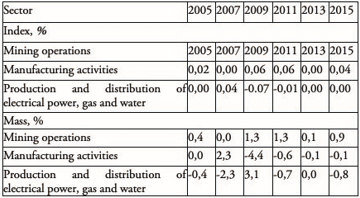
Table 1 illustrates the calculated values of the three considered indicators characterizing the structural shift regarding industrial production
Table 1. The Main Indicators of Structural Changes in the Value of Products
Source: Compiled by the authors according to the FSSS of the RF.The obtained estimate structural indicators confirm that the structure has remained almost unchanged for the last (analyzed) 12 years, in particular, if in 2004 the share of the mining industry was 22.1%, in 2015 – 23.7%, in the manufacturing sectors in 2004 65% and 60.6%, respectively, in the sector of production and distribution of electricity, gas and water – from 12.8% in 2004 to 9.6% in 2015.
The most significant changes in the index of structural shift in industrial output can be observed in 2007 – a decline to 0.18% and in 2009 – an increase to 0.24%. This is mainly due to a decrease in production volumes in the mining and manufacturing sectors of the industry (by 180,765 million rubles and 2,511,635 million rubles, respectively).
In the case of the mass of the structural shift in production, the highest value (growth) was observed in the sector of production and distribution of electricity, gas and water – 3.1% in 2009 (Table 2.). Conversely, the smallest value for the analyzed period was shown by the manufacturing sectors of the industry – in our case, the mass of shift of the sector under consideration amounted to minus 4.4%.
All this above-stated, obtained from certain values of the structural shift mass index, convincingly confirms the conclusion we have set forth at the beginning of this article about the almost stagnant structure in terms of industrial production volumes.
As regards to the rate of structural change in the mining and manufacturing sectors of the industry, it can also be argued that it is almost unchanged during this period – its average value in the mining sector was only 0.1%, and it was 0% in the processing sector.
When considering the rate of structural shift in the production and distribution of electrical power, gas and water, its maximum value (minus 0.18%) was observed in 2007, and the maximum in 2009 – 0.3%. In general, the average rate in the studied sector over all these investigated years was only minus 0.02% [9,10].
All this once again convincingly shows that during the considered twelve-year period there was no significant change in the structure of the industry in terms of output, and the dominance of the fuel industry over the engineering sector that was formed in the zero years remained virtually unchanged over the years.
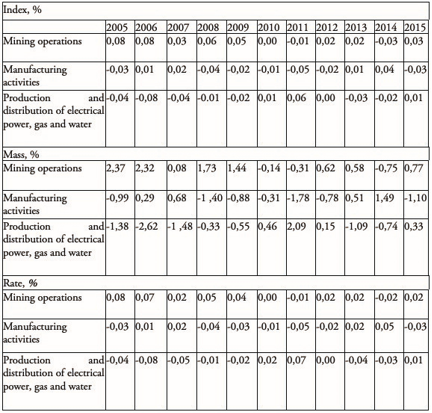
Table 2. The Main Indicators of Structural Changes in Fixed Assets
Source: Compiled by the authors according to the FSSS of the RF.
Estimates of the index, mass and rate of structural shift in accordance with the actual values of the basic production assets show a change in the structure of the TFP in the industry towards an increase in mineral production, where, indeed, if the share of this sector was 29.6% in 2004, it had grown to 40% by the end of 2015.
And, of course, for the period under review there was a decrease in the share of manufacturing and the production and distribution of electrical power, gas and water from 36% to 31% and from 34% to 29%, respectively.
The maximum size concerning the structural shift index for the basic production assets (0.08%) was shown by mining companies in 2005. Specifically, in the same year, enterprises producing and distributing electrical power, gas and water showed the minimum value for this index and minus 0.01%.
Calculations showed that the values of the manufacturing industries fell at an average rate of minus 0.01% in the analyzed period, while in 2011 it even amounted to 0.05%.
At the same time, at first it seems that the share of the sector for the production and distribution of gas and water is increasing. But one can see upon close look that this is a would-be growth, because it was obtained in the course of a relative decline in the share of the processing and extractive industries.
As concerns the changes in the main indicators of structural shifts in terms of the amount of investments, here the most tangible changes in the structure occurred in the investments in fixed assets in 2015. In 2004-2014 the structure had a pronounced downward trend in the share of the manufacturing sector. So, if the parameters of this indicator were 42% in 2004, their share had decreased to 37% by 2015.
The other two remaining sectors tended to creep up – the mining sector increased by 0.7% and amounted to 40.5%, and the production and distribution of electrical power, gas and water increased from 17% in 2004 to 21% in 2015, respectively.
To analyze the effectiveness of the plan for development of sectors and activities, we will consider the mechanism for implementing the federal target program. The federal target program can be regarded as an interconnected and coordinated (according to goal, objectives, resources and time) complex of research, organizational, economic, social, environmental, economic and other similar activities that will ensure the effective solution of many problems Nikolai S. Kokov, et al.
of social ecological economic and cultural development of the Russian Federation.
All federal programs are mandatorily placed on the official website of the Ministry of Economic Development of the Russian Federation so that persons wishing to familiarize themselves with our programs and submit applications for a free competition in an appropriate form could have such an opportunity. In 2011, for example, there were twenty federal programs, in 2016 – eight programs.
Directions and topics of programs are multifarious – ranging from destroying chemical weapons stockpiles to developing pharmaceuticals (total funding – 24814,8703 million rubles.)
Conclusions and Propositions
Based on the foregoing, we can conclude that the technical and economic situation of the industrial complex of the Russian Federation for the last 20 years can be defined by the term “deindustrialization”, as the share of products produced by the real sector is decreasing unambiguously while the volume of the services sector is simultaneously increasing. It also reduces the complexity of industrial products, increasing the time to develop new products.
It is clearly seen from the materials of FSSS of the RF that the structure of industrial production has been changing asymmetrically. So, for example, if in 1990 the proportion of the products of the fuel complex barely reached 10%, and the proportion of engineering products was not less than 30%, then in 2001-2002 the shares of these sectors were equalized, and since 2005 the share of the fuel complex has exceeded 32%, while the share of engineering has fallen to 12%. It should be noted that this situation has not immediately arisen, but for a decade and a half and we have to establish a fact that the loudly-announced events have never improved the structure of the industry.
Definitely, this process was also accompanied by a significant outflow of labor from the real sector of the national economy in general, and in manufacturing industries compared with extractive industries, in particular, the main reason was the lack of work front and cut in wages of those employed in manufacturing [6].
The same situation can be traced in the course of analyzing the effectiveness of the use of basic production assets – there is a stable growth of structural indicators in the extractive industries with a decrease in similar indicators of the manufacturing industries. At the same time, it should also be noted a significant amount of physical depreciation of fixed production assets (50-80%), not to mention the functional moral deterioration, especially of the second form.
All this has led to the fact that in many industrial enterprises functioning machinery and technological equipment in fact have such technical indicators that do not at all meet the requirements of the current technological level. The specialists also note that the human capital in these industries is very worn out – young people do not display great eagerness to go to work in old workshops [7,11].
Federal target programs have not yet become an effective instrument of institutional influence on the industrial complex; moreover, there in common practice is a redistribution of targeted funds, which not only reduces funding, but undermines the effectiveness of state participation.
All this, undoubtedly, requires the concentration of efforts of state structures, executive authorities, politicians, representatives of business structures, scientists, workers and students.
REFERENCIAS
Aivazyan S. А. (1998). Applied Statistics and The Basics of Econometrics. М. YUNITY. 1998. 650.
Vechkanov G.S. (2012). Neoindustrialization and Modernization. Economist. 2012. N9. P. 39-47.
Galbraith J. (2007). Modern Industrial Society. М. The AST Press. 2007. 602 p.
Kuznetsov V. V. (2014). Evolution of State Industrial Policy in Russia. The Journal of New Economic Association. 2014. P. 152-178.
Macmillan Ch. (1998). The Japanese Industrial System: Translated from English. М. Progress. 1988. 400 p.
Misakov A. V., Molamusov Z. Kh., Misakov V. S. (2016). Some Methods For Modelling of Investing Activities of Manufacturing Enterprises Under Uncertainty. Economics and Entrepreneurship. 2016. (66). P. 606-610.
Mazhigova .. .., Misakov V. S., Goova R. Kh. (2007). Systematization of the Principles of Strategic Enterprise Management. Economics Bulletin of Rostov State University. 2007. Vol. 5. P. 152-155.
Nogmova L. .., .isakov V. S. (2016). Economic Potential Formation Within the Context of Balanced Regional Development. Proceedings of Kabardino-Balkaria Research Center of the RAS. 2016. (71). P. 143-148.
Sukharev О. S. (2014) New Industrialization. The Way to Better Performance in Industry. Economist. 2014. P. 6-8.
Tatarkin А. I. (2016). Industrial Policy: Genesis, Regional Peculiarities. Regional Economics. 2014. P. 9-21.
Misakov V.S., Kuyantsev A.I., Dikinov A.H., Kazancheva H.K., Misakov A.V. National agriculture modernization on the basis of import substitution.International Business Management. 2016. Т. 10. С. 1946-1951
Misakov V.S., Misakov A.V., Tsurova L.A., Adzhieva A.Yu., Eskiev M.A. (2017). Ways of improving the economic mechanism for the social development of rural settlements of mountainous areas.International Journal of Advanced Biotechnology and Research. 2017. Т. 8. С. 964-972.
Misakov V.S., Khamzatov V.A., Temrokova A.Kh., Misakov A.V., Dikareva I.A. (2018). Strategic management of innovative agro-industrial projects.
Amazonia Investiga. 2018. Т. 7. N 14. С. 16-23
Rodrick D. (2004). Industrial policy for the twenty-first century. Cambridge: Harvard University. 2004. 58 p.
Sachs, J.D. (1999). Natural resource abundance and economic growth. J.D. Sachs . Journal of Development Economics. 1999. p.p. 43-76.