GENERAL
Social Entrepreneurship: Bumiputera’s Women in SMEs Breaking through the Challenges
Emprendimiento social: las mujeres de Bumiputera en las PYMES rompiendo los desafíos
Social Entrepreneurship: Bumiputera’s Women in SMEs Breaking through the Challenges
RELIGACIÓN. Revista de Ciencias Sociales y Humanidades, vol. 4, núm. 15, Esp., pp. 89-95, 2019
Centro de Investigaciones en Ciencias Sociales y Humanidades

Esta obra está bajo una Licencia Creative Commons Atribución-NoComercial-SinDerivar 4.0 Internacional.
Recepción: 13 Febrero 2019
Aprobación: 12 Mayo 2019
Resumen: El objetivo de este artículo es explorar los desafíos a los que se enfrentan las mujeres de Bumiputera en las actividades empresariales, adaptando el concepto de emprendedoras sociales relacionadas con la oportunidad empresarial que Reynolds destacó. El marco identificó cuatro desafíos como la experiencia de vida, el medio ambiente, la economía y las redes sociales. Se distribuyeron cuestionarios para el estudio preliminar a 30 mujeres empresarias de Bumiputera. Los hallazgos del estudio indicaron que los desafíos que solían ser una restricción para las empresarias ya no son un obstáculo para tener más éxito en el mundo de los negocios. Han construido confianza en sí mismos y utilizan las instalaciones y la creación de redes para crear un valor social para la sociedad. El concepto de emprendimiento social refleja la participación de mujeres empresarias en Malasia.
Palabras clave: Bumiputera, mujeres, emprendimiento social.
Abstract: This paper aim to explore the challenges that Bumiputera’s women faced in entrepreneur activities by adapting the concept of social entrepreneurs related to entrepreneurial opportunity highlighted by Reynolds. The framework identified four challenges like life experience, environment, economy and social network. Questionnaires were distributed for preliminary study to 30 Bumiputera’s women entrepreneurs. The findings of the study indicated that the challenges that used to be a constraint for the women entrepreneurs are no longer a hindrance to further succeed in the business world. They have built self-confidence and use the facilities and networking to create social value to the society. The concept of social entrepreneurship is reflective in the involvement of women entrepreneurs in Malaysia.
Keywords: Bumiputera, women, social entrepreneurship.
Introduction
Social entrepreneurship was introduced with varies meanings and definitions that lead to a vague sense of definition (Abu-Saifan 2012). However, in this paper, the social entrepreneurship’s concept is defined as the entrepreneurs whose tailor their activities to be directly tied with the main goal in creating the social value specifically and indirectly could give a positive impact towards their participation in entrepreneur field.
In general, the contribution of women in various aspects is undeniable has brought much benefit mainly to the development of the Malaysian economy. One of the economic activities that are highly attentive to women is the field of entrepreneurship. Gender equality issues have been widely discussed in previous studies that focusing on developing women, particularly in the employment sector (Jensen 2017; Hirschman 2016; Othman & Othman, 2015).
The reality is that women are more likely to make jobs more flexible than jobs in offices that demand a lot of their time. In fact, the motherhood of a married woman leads to the tendency of women to engage in the entrepreneur world (Zainuddin, Ahmad, Puteh, Chandran, Hassim & Ismail, 2017). In line with the diverse roles of women and their difficulty in maintaining themselves in the pursuit of a virtuous employment sector, most of them are involved in more flexible entrepreneurial activities and match the situation they face. Unfortunately, most studies show that their participation in this sector is still far behind. Among the key factors that triggered their low participation based on the past studies are capital, entrepreneurial networking and skills.
The expectation to put women onto position in the field of entrepreneurship is seen to be more positive with the establishment of the National Women’s Policy which was enacted in 1989 and revised in 2009, particularly in determining the direction of Bumiputera’s (native of Malaysia) women development in entrepreneurship. The main objective of the National Women’s Policy is to ensure the equality been justify in terms of sharing of resources and development opportunities between men and women. This policy also calls for women to be integrated into all development sectors according to their capabilities and needs.
However, after 61 years of independence the Bumiputera, especially women, have yet to achieve the target of 30 per cent equity Bumiputera ownership allocated to them (Che Mohd Zulkifli & Nurdiana, 2015). In fact, in history, the entrepreneurship development in Malaysia began in 1931 with small business activities and the number of Bumiputera Malays involved was the lowest compared to other ethnic namely Chinese and Indians (Syahida & Amran, 2008). Through national development policies, the government has established several policies that have the objective in minimizing the economic gap that exists among the key ethnic groups in Malaysia. Policies such as the new economic policy of 1972-1990, the new development policy 1991-2000 and the new economic model are implemented through several programs that are expected to provide a great deal to the society.
Thus, this paper aim to explore the challenges that Bumiputera’s women faced in entrepreneur activities by adapting the concept of social entrepreneurs related to entrepreneurial opportunity highlighted by Reynolds (1991) that underpin the discussion.
The Definition of Entrepreneurship
The term ‘‘entrepreneurship’’ seemingly means dissimilar things to different individuals including scholars and thought leaders. As entrepreneurship is multi-layered, it is studied from many different viewpoints, up till now, that has nurtured a multitude of definitions. According to Venkataraman (1997), entrepreneurship refers as “seeks to understand how opportunities to bring into existence future goods and services are discovered, created and exploited, by whom and with what consequences”.
Based on the shared research interests, Shepherd and Patzelt (2011) has come out with the new definition of “sustainable entrepreneurship focusing on the preservation of nature, life support, and community in the pursuit of perceived opportunities to bring into existence future products, processes, and services for gain, where gain is broadly construed to include economic and non-economic gains to individuals, the economy, and society”. As referring to the most extensively cited paper on entrepreneurship, Shane and Venkataraman (2000), they defined entrepreneurship as the ‘‘discovery and exploitation of profitable opportunities’’. Given the diversity of the definitions towards entrepreneurial concepts, this study looks this concept as something unique and feasible to be discussed from various angles. Discussions on the social entrepreneurship model are extended in the next section.
Reynold’s Social Entrepreneurship: The Framework
Reynolds’s (1991) study has produced the empirical results that created the objective understanding of the roles and nature of the entrepreneurial activity in society. He also highlighted that ethnic factor is seen to have an impact towards individual involvement in entrepreneurship. In his study, it was found that the emergence of entrepreneurs among the ethnic minorities in an industry showed that most of the new businesses were among those who were not locals. This was due to the three main elements, first access to ownership of a business, second personal predispositions (such as blocked mobility, personal aspirations and educational attainment), and lastly ability to mobilize resources from family, peers or government resources.
Reynold’s study has slightly answered the question of why Bumiputera ethnic involvement is marginal among other ethnics. Therefore, based on the results he has come out with the opportunity model that consists of four main elements that very much dominant towards the individual decision to pursue with the entrepreneurial activities. Firstly, social networks (i.e. social relationship); secondly, life course stage context (i.e. life experience); thirdly, ethnic identification (i.e. social background of the individual to facilitate the survival) and lastly, population ecology (i.e. environmental factor).
Another studies of which demonstrates elements mentioned by Reynolds such as Pérez and Hernández (2016), Wendy and Siong (2014), Pathak and Sanjeev (2017) agreed that women often faced a constraints to access into the social networks, lack of knowledge and skills, financing problems and family responsibilities when women are involved with entrepreneur activities.
This paper assumes that the elements outlined by Reynolds are the key requirements in increasing the participation of Bumiputera women in entrepreneurial activity. Further discussions will be made in the following sections.
Bumiputera’s Women Entrepreneur in Malaysia: The History
The rigour involvement of the government in promoting people to get involved in entrepreneurial activities is an evidenced in enhancing the development of entrepreneur by initiated a policies and initiatives that aimed to raise wealth and minimizing poverty among society. During the British colonial era, the economic activities of the Malay land were separated by the ethnic groups. The Malays (Bumiputra) focus their activities in the agriculture sector, while the Chinese in the mining and business sectors and Indians communities in the plantation sector (Fong 1990; Hirschman & Akbar, 1980).
Due to this segregation, the economic position of the three major races in Malaysia shows the differences of living standard among them. In fact, women at that period were shackled by a thickened patriarchal situation and their diverse roles led to their involvement in entrepreneurial activity being difficult to be identified especially the bumiputra women (Hirschman & Akbar 1980).
Later in 1970, the government introduced the New Economic Policy (NEP) purposely to create a balanced economy between races. Under this policy, the focus is given in providing equal opportunities in the business sector, especially the bumiputera group. The Bumiputra involvement in entrepreneurial activities is further enhanced through programs run by the government, even in every Malaysian 5 years Plan the provision of entrepreneurship is stated. Although the gender development issues are being discussed in the Third Malaysia Plan (1976-1980) but only in the Ninth Malaysia Plan (2006-2010) the issue of women entrepreneurship was seriously addressed, targeting to build up gender equality and empowered women, especially in preparing financial assistance to increase their involvement in the entrepreneurship sector.
In 1996, the government has established SME Corp. Malaysia that responsible to develop SMEs by providing facilities such as infrastructure, financial assistance, advisory services and many more. This is to help SMEs that are able to remain competitive in the international markets. Based on the data provided by SME Corporation Malaysia in 2018, which is the coordinating institution that responsible to enact the SME (small medium entrepreneur) policies and strategies, states that only 20.6 percent of women in Malaysia are involved in entrepreneurship regardless of race. This amount shows the participation of women are too small to help boost the country’s economy.
Government efforts, for example, in launching the programme of DanaNITA under MARA (People’s trust council) which had approved the fund amounting to RM12.4 million and is expected to benefit about 452 women entrepreneurs, need to be improved if the objective of women’s development in this sector is to be achieved. In addition, the government’s initiative in establishing the Community Empowerment Inspirational Program (WISDOM) to enhance the engagement of women and to introduce the role of Bumiputera women in entrepreneurial fields has seen as an excellent effort. A latest initiative as stated in the Strategic Plan (2013-2017) of the Ministry of Women, Family, and Community Development (MITI Report, 2015), is to empower women and to increase their contribution in the socio-economy. The strategies that have been implemented are elimination of policies, laws and procedures that discriminate women, empowerment of women’s economic status by increasing their participation in employment and entrepreneurship.
Findings and Discussion
The preliminary analysis is based on the survey conducted to 30 Bumiputera women entrepreneurs in the Klang Valley. The survey adapted questions and concept from the Reynold’s social entrepreneurship framework (1991). The objective of the survey is to identify the challenges faced by the women entrepreneurs. Table 1 exhibits the profile of the respondents of the preliminary study. Among the 30 respondents, majority are in the age group of 21 to 51 years old. The main age group is between 21-30 years old. Most of the women entrepreneurs has the Malaysian Certificate of Examination or higher. Some have graduated with diploma and Bachelor’s degree.
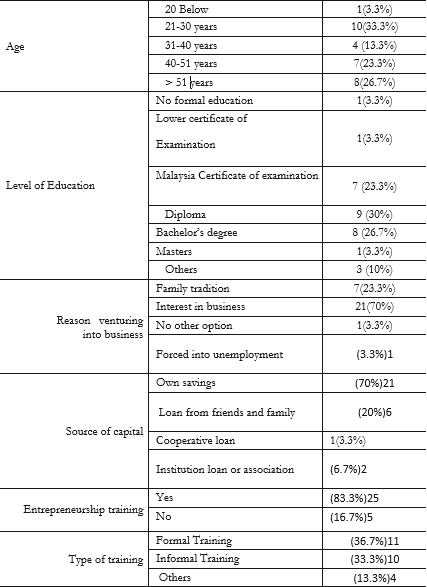
Table 1.
Respondents Profile
Majority (25 respondents) of the respondents had attended entrepreneurship training. The training includes formal training (organized by government agencies), informal training (acquired through mentoring from family members and friends, as well as personal experience). Seventy percent of the women entrepreneurs started their business using their own savings while a small number of them received the help from friends and families as well as organization such as the co-operatives, association and other institution. The reason for entering the business world is due to interest in business. The interest towards business accounts for 70% of the respondents and about 23.3% endeavor into business because of family tradition.
The challenges faced by the women entrepreneurs were assessed from four factors identified by Reynold (1991). They are environmental factor (factors such as lack of communication ability, high commitment for family, gender discrimination and bureaucracy), life course stage context (this is the self attributes which includes having enough information, self-confidence, skills in management and skills on entrepreneurship), economy (this factor relates to the financial ability, availability of financial help and financial skills) and lastly, social factor (these refers to having friends or family members, difficulty in having business link and lack of interest to communicate with peer entrepreneurs). The questions were adapted using 5 Likert scale, with scale 1 means most disagreeable and 5 means most agreeable. Table 2 illustrates the findings of the study on the challenges faced by the women entrepreneurs.
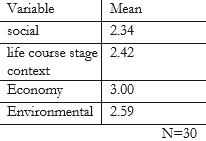
Table 2.
Mean value on the challenges faced by women entrepreneurs
As the questions were worded in a negative statement, the findings indicated that most of the women entrepreneurs believe that the social factors are not a hindrance in doing their business. They believe that they have the ability to communicate well, there is no gender discrimination and agencies are cooperating with them. In their experience with agencies there are no bureaucracy issues. The findings on the bureaucracy reflect the government’s initiatives to facilitate entrepreneurship by providing trainings as well as financial aid. This is also in line with in the initiatives from the Strategic Plan (2013-2017) of the Ministry of Women, Family, and Community Development (MITI Report, 2015).
The second challenges focus on their personal attributes. The questions were whether the respondents have adequate information to start their business, self-confidence, entrepreneurship skills and management skills. The result indicated that they believe they have the personal qualities as an entrepreneur. This is further evidence as they have undertaken some formal and informal training. These training are further enhanced with their experience in handling their own businesses. Besides with the adequate and appropriate training, it will help women to overcome any crisis during the business period. The on-going improvement in skills is crucial in ensuring the survival of women in this field (Ganesan, Dilbagh & Maheshwari, 2002).
The economic factor seemed to be a factor that may be a concern since the findings indicated that they neither agree nor disagree on having enough capital for their business, information on business financial assistance and entitlement on business to receive business financial assistance. They too seemed to be neutral in indicating if they have basic skills in economics and business.
The final factor on challenges was on social factors. These factors are the networking factors such as having mentors and linkages in the business world. The respondents agreed that they do have the connection and relationship with others in their line of business. This includes as having friend and family members to relate too as well as successful business mentors. Leskinen (2011) study shows that through a social network a female entrepreneur will become more successful in business. This is because the social network is seen as a process that could generate their motivation, consistency, responsibility and ability to work as a team. This situation indirectly could create new channels and other business opportunities. The relationships will be built on the interactions that occur between entrepreneurs. Through this interaction, knowledge can be shared especially in terms of competence, skills, strategies and beliefs.
Analysis of the four main factors that may have an effect on businesses showed that the economy factor may be a challenge. The responses from the women entrepreneurs are not reflecting whether they are assured on the financial side of the business. This may be due to the fact that most of them ventured into business using their own savings, therefore not requiring financial aid. Another explanation to this might be as opined by Mauchi, Mutengezanwa and Damiyano (2014) that women often venture into entrepreneurship with little resources and they are more likely to go into industries such as retail or personality services where the cost of entry is low.
Prior believes that women entrepreneurs face constraint in capital, limited access to formal education and training programmes, networking and access to information seemed not to be the case in Malaysia. The policies and government initiatives to encourage entrepreneurship has benefited the women entrepreneurs. They are becoming more apparent as contributors to the economy of the country.
Among the latest government initiatives as stated earlier by initiated a DanaNita Scheme which focuses on the training and financing aspects as well as the launched of the Bumiputera startup scheme (SUPERB) by Bumiputera Economy Council (BEC), in the grant form that created by the government to help bumiputera entrepreneurs who wanted to start a business. This initiative demonstrates the government’s determination in helping entrepreneurs to improve the economic standards especially for bumiputera women.
In the process of building their businesses, the women entrepreneurs were able to provide employment opportunities to others and help flourish the economy of the country. Their businesses are in line with the social entrepreneurship concept especially in creating social value to the community and benefited the country’s development. In an effort to empower women, the investment towards their development, especially in entrepreneurship is something that is very significant.
Recognition from the various business institutions towards the ability of women for example have indirectly inspired other women to participate (Kelly, Moen & Tranby, 2011). In accordance with the criteria that every woman is homogenous, every woman actually has their own unique angle to produce a business. Majority of the respondents ventured into business because they like it. The type of businesses ventured range from trade, production, services and handy crafts.
Majority of the women entrepreneurs (80%) employs less than 5 employees as they are in the micro business. About 16.7% of the businesses employ about five to 29 employees and 3.3% employs more than 75 employees. Table 3 illustrates the type of businesses and the number of employees in the businesses of the women entrepreneurs.
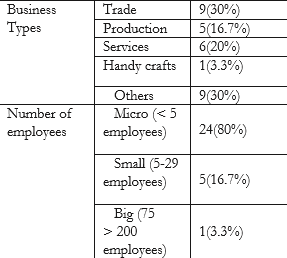
Table 3.
Types of business and number of employees
The challenges faced by the women entrepreneurs come from the inner self, the relationship between the entrepreneurs and the environment which consists of the other peer entrepreneurs and the system. The strength and determination of the women entrepreneur helps them to overcome their internal challenge and the system in the environment as in the government’s strategies and policies further drive the entrepreneurial spirit to fly high to embrace success.
Conclusions
Over the years the landscape of the women entrepreneurs seemed to have change. The once known as the minority group with many constraints to move and contribute to the economy are now hand in hand working with the men counterpart in flourishing the country’s socio-economy sector. The long drawn policies by any agencies in Malaysia are now proving to work and the country can be proud to set the benchmark in breaking the walls into the business world for the women.
Acknowledgment
This study is funded by the Fundamental Research Grant Scheme (FRGS) with the reference number 600-IRMI/ FRGS 5/3(0043/2016), awarded by the Ministry of Higher Learning Malaysia and Universiti Teknologi MARA.
Special thanks to our research assistances, Nur Khalida Pabli and Nur Amirah Syifa’ Azli for their contribution in completing this paper.
REFERENCIAS
Abu-Saifan S. (2012). Social Entrepreneurship: Definition and Boundaries. Technology Innovation Management Review. February: 22-27. Online search dated August 1 2018. https://timreview.ca/sites/default/files/ article_PDF/Saifan_TIMReview_February2012_0.pdf
Che Mohd Zulkifli C. O. & Nurdiana M. N. A. (2015). Factors affecting the success of Bumiputera Enterprises (SMEs) in Malaysia. International Journal of Management Science and Business Administration, Vol. 1 No.9, pp.40-45
Fong C.O. (1990). Small and medium industries in Malaysia: economic efficiency and entrepreneurship. The Developing Economies. Vol. 28 No. 2, pp.152-179.
Ganesan, Dilbagh & Maheshwari (2002). Women entrepreneurs: Problem and prospects. The Journal of Entrepreneurship. Vol. 11 No. 1, pp.75-93
Hirschman C. (2016). Gender, the status of women and family structure in Malaysia. Malaysian Journal of Economic Studies, Vol. 53 No.1, pp.33-50
Hirschman & Akbar (1980). Women’s Labour Force Participation and Socioeconomic Development: The Case of Peninsular Malaysia, 1957-1970. Journal of Southeast Asian Studies. Vol. Xl No. 1, pp. 30-49
Jensen P.H. (2017). Cause and effects of female labour force participation in local welfare systems. Journal European Societies, Vol. 19 No. 2, pp.121-137
Kelly, Moen, & Tranby (2011). Changing workplaces to reduce work-family conflict: Schedule control in a whitecollar organization. American Sociological Review, Vol. 76 No. 2, pp. 265–290
Leskinen R. (2011). Success in the female entrepreneurial networking process. Journal Annals of Innovation and entrepreneurship. Vol.2 No. 1.
Mauchi, F.N., Mutengezanwa, M. and Damiyano, D. (2014), “Challenges faced by women entrepreneurs: A case study of Mashonaland Central Province”, International Journal of Development and Sustainability, Vol. 3 No. 3, pp. 466- 480.
Othman & Othman (2015). A literal review on work discrimination among women employees. Asian Social Sciences, Vol. 11 No. 4, pp.26-32
Pathak & Sanjeev (2017). Challenges faced by women entrepreneurs in rural India: The case of Avika. The International Journal of entrepreneurship & innovation. Vol. 18 No. 1, pp. 65-72
Pérez-Pérez & Hernández (2016). Explanatory factors of female entrepreneurship and limiting elements. Suma de negocios. Vol. 7 No. 15, pp.25-31.
Reynolds P.D. (1991). Sociology and entrepreneurship: concepts and contributions. Entrepreneurship Theory and Practise. Vol. 16 No. 2, pp. 47-70
Shane & Venkataraman (2000). The promise of entrepreneurship as a field of research. Academy of Management Review, Vol. 25 No. 1, pp 217.
Shepherd & Patzelt (2011). The New Field of Sustainable Entrepreneurship: Studying Entrepreneurial Action Linking “What Is to Be Sustained” With “What Is to Be Developed”. Entrepreneurship Theory and Practice, Vol. 35 No. 1, pp. 137–163.
Syahida & Amran (2008). The development of entrepreneurship in Malaysia: State-led initiatives. Asian Journal of Technology Innovation, Vol. 16 No 1, pp.101-116
Third Malaysia Plan 1976-1980, (1976). Kuala Lumpur, Government Printers
Venkataraman, S. (1997). The distinctive domain of entrepreneurship research. Advances in Entrepreneurship, Firm emergence, and Growth,. Vol. 3, pp. 119-138.
Wendy & Siong (2014). Towards strengthening the development of women entrepreneurship in Malaysia. Gender in Management: An International Journal, Vol. 29 No. 7, pp.432-453.
Zainuddin & Others (2017). The 21st century challenges among women entrepreneurs: Revisiting the literature. Advanced Science Letters, Vol. 23 No. 8, pp. 7845-7848. DOI: 10.1166/asl.2017.9591