SUR-SUR
Career opportunities preferences among BSBA HRDM students
Preferencias de oportunidades de carrera entre estudiantes de BSBA HRDM
Career opportunities preferences among BSBA HRDM students
RELIGACIÓN. Revista de Ciencias Sociales y Humanidades, vol. 4, núm. 15, Esp., pp. 266-273, 2019
Centro de Investigaciones en Ciencias Sociales y Humanidades

Esta obra está bajo una Licencia Creative Commons Atribución-NoComercial-SinDerivar 4.0 Internacional.
Recepción: 18 Enero 2019
Aprobación: 02 Mayo 2019
Abstract: This study aimed to assess the Career Opportunities Preferences among BSBA HRDM students after Graduation. A total of one hundred thirty-seven. Second year students compose of sixty one. First year students, thirty-eight. Third year students who are taking up Bachelor of Science in Business Administration major in human Resource Development Management participated in the study. They were asked about their preferences in terms of Nature of Work, types of Business Organization, Environments, Compensation, Other Benefits, Safety and Health, and Career Development. Descriptive Survey Method was used through pretested questionnaires made by the researchers. Descriptive statistics particularly the frequency and weighted mean were used. The data was presented in a tabular form. The interview approach was used to check the data gathered in the questionnaire check list. The results of this study can facilitate the manner in which students taking up BSBA HRDM can assess their interest in the final analysis; such move would lead to first, second and third year students the enhancement of students to their career opportunities after graduation.
Keywords: Digital Tools, Teaching, Learning.
Resumen: Este estudio tuvo como objetivo evaluar las Preferencias de Oportunidades de Carrera entre los estudiantes de BSBA HRDM después de la Graduación. Un total de ciento treinta y siete. Los estudiantes de segundo año componen de sesenta y uno. Alumnos de primer año, treinta y ocho. Participaron en el estudio los estudiantes de tercer año que están cursando la licenciatura en administración de empresas con especialización en administración de recursos humanos. Se les preguntó sobre sus preferencias en cuanto a la naturaleza del trabajo, los tipos de organización empresarial, entornos, compensación, otros beneficios, seguridad y salud, y desarrollo profesional. El método de encuesta descriptiva se utilizó a través de cuestionarios probados previamente hechos por los investigadores. Se utilizaron estadísticas descriptivas, en particular la frecuencia y la media ponderada. Los datos fueron presentados en forma tabular. El enfoque de la entrevista se utilizó para verificar los datos recopilados en la lista de verificación del cuestionario. Los resultados de este estudio pueden facilitar la manera en que los estudiantes que toman BSBA HRDM pueden evaluar su interés en el análisis final; tal movimiento llevaría a los estudiantes de primer, segundo y tercer año a mejorar los estudiantes en sus oportunidades profesionales después de la graduación.
Palabras clave: Herramientas Digitales, Enseñanza, Aprendizaje.
Resumo: Este estudo objetivou avaliar as Preferências de Oportunidades de Carreira entre alunos do BSBA de RHDM após a graduação. Um total de cento e trinta e sete. Os alunos do segundo ano compõem sessenta e um. Alunos do primeiro ano, trinta e oito. Alunos do terceiro ano que estão tomando Bacharel em Ciências em Administração de Empresas major em Gestão de Desenvolvimento de Recursos Humanos participaram do estudo. Eles foram questionados sobre suas preferências em termos de Natureza do Trabalho, tipos de Organização de Negócios, Ambientes, Compensação, Outros Benefícios, Segurança e Saúde e Desenvolvimento de Carreira. O método descritivo survey foi utilizado por meio de questionários pré-testados pelos pesquisadores. Estatísticas descritivas particularmente a freqüência e média ponderada foram utilizados. Os dados foram apresentados em forma de tabela. A abordagem da entrevista foi utilizada para verificar os dados coletados na lista de verificação do questionário. Os resultados deste estudo podem facilitar a maneira pela qual os estudantes que assumem o BSDM podem avaliar seu interesse na análise final; tal movimento levaria a estudantes de primeiro, segundo e terceiro ano a melhoria dos alunos para suas oportunidades de carreira após a graduação.
Palavras-chave: Ferramentas Digitais, Ensino, Aprendizagem.
Introduction
With the growing complexity of the business environment, characterized both by competition and collaboration among businesses, social and political upheavals, and rapid change due to the scientific and technological developments, it should not only have the discipline and technical skills, but also an understanding of management from a holistic rather than a fragmented, highly specialized perspective. Career opportunity is one of the dreams of every student who are studying at college specially those who are taking up Bachelor of Science in Business Administration major in Human Resource Development Management. Formal education could not be replaced by non-formal education.
Furthermore, there is an analysis of career patterns according to Miller and Form (1951): the succession of jobs in every individual and the sequence of work periods over the course of several years. College students are faced with the need to choose an academic major at the same time to develop career goals for the future (Guerra & Braungart-
Ricker, 1999)
Business administration teaches general business practices and principles in the industry. The degree is broad enough to allow individual students to tailor their education to their interest through course electives and concentration; it also creates solid foundation for a variety of career fields. Career in human resources involves helping an organization manage its people (Bogardus, n.d).
Bachelor of Science in Business Administration is a course where students will take genial business courses providing combination of business theory and applied business as well as advanced courses for specific concentrations. There are both possible positive and negative impacts to business administration students that need to be taken into reflection when an organization decides to use these methods. The HR Department is involved in strategic planning, employment practices monitoring, staff recruiting, benefits management and safety thus, proper training of BSBA-HRDM students to develop their technical manual and managerial skills will be useful whom they will apply for a job in their preferred company or position.
This study, “Career opportunities preferences among Bachelor of Science in Business Administration major in Human Resource Development Management students after graduation” analyzed and assessed the suitability value of information relevant to a career services or career information unit and opportunities.
Statement of the Problem
The study assessed the career opportunities preferences among BSBA HRDM students after graduation. The studies specifically seek to answer the following:
1. What is the demographic profile in term of?
1.1 Age
1.2 Gender
1.3 Year level?
2. What are the preferences of HRDM students in terms of?
2.1 Nature of work;
2.2 Types of Business Organization;
2.3 Environment;
2.4 Compensation;
2.5 Other Benefits; and
2.6 Career Development?
Methodology
The descriptive survey method of the research was utilized in this study using questionnaire as the main instrument in gathering data of the study. This method is a fact finding investigation for BSBA HRDM students, based on the present condition when study was conducted.
The subject and respondents of the study were composed of first year to third year students of Surigao del Sur State University-Cantilan Campus who are taking up Bachelor of Science in Business Administration Major in Human Resources Development Management.
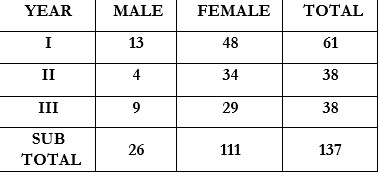
Table 1.
Respondent Distribution
Research Instrument
The instrument used in data gathering was questionnaire. The questionnaire was developed accurately by the researchers in a way that the respondents may understand the questionnaire. Part 1 was about the personal information of the BSBA HRDM students of Surigao del Sur State University-Cantilan-Campus. The Second part included the preferences of human Resource Development Management students in terms of Nature of work, Type of business organization, Environment, Compensation, Other Benefits and Career Development.
Data Gathering Procedure
The researcher sent a letter of request signed by the instructor and by the adviser asking permission from the participants before they distributed the questionnaires to learn more about Career Opportunities Preference among BSBA HRDM students after graduation.
Results and Discussions
This section presents, the results and discussions of the data gathered from the study based on the survey.
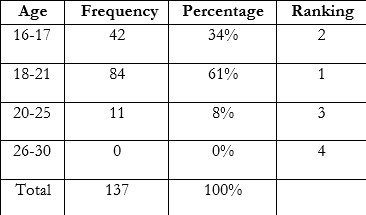
Table 2.
Demographic profile of the respondents
The table shows the demographic profile of the respondents in term of age. It is shown that majority of the respondents belong in the 18-21 age group. Moreover, move of the respondents belong in the 26-30 age group.
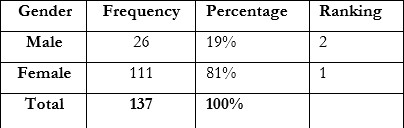
Table 3.
Gender
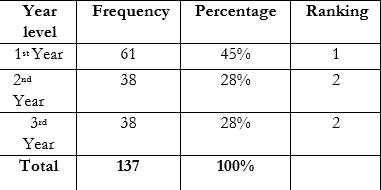
Table 4.
Year level
The table shows that 61 or 45% of the respondents are first year while the remaining year levels both have 38 or 28%.
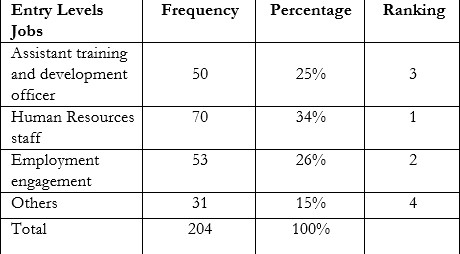
Table 5.
Preferences of HRDM students: Nature of Work
The table shows that 70 or 34% of the respondents prefer to work as a Human Resource staff. Meanwhile 31 or 15% or the respondents have other preferences. Human Resources staff is office personnel at the HR department of a company or a recruitment agency doing clerical work such as documents and records filling.
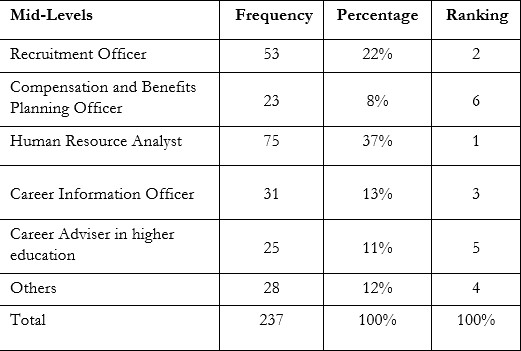
Table 6.
Mid- levels
The table shows 75 or 37 of the respondents prefer to work As a Human Resource Analyst while only 23 or 8% of the respondents prefer to work as compensation and benefits planning officer. A Human Resource Analyst is responsible for the company’s HR database management including the time generation of reports and employee contract information.
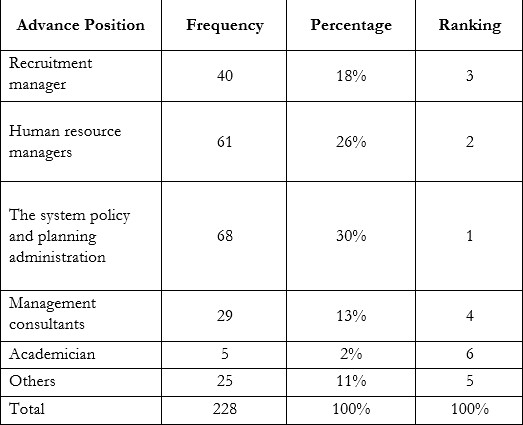
Table 7.
Advance position
The table shows the nature of work in Advance Position. It reveals that 68 or 30% of the respondents prefer to work in the Systems Policy and Planning Administration . On the other hand, only 5 or 2% of the respondents prefer to work as academician. The HR Systems Policy and Administration executes company department strategies and operational plans, previous periodic performance reports and performance appraisal reviews.
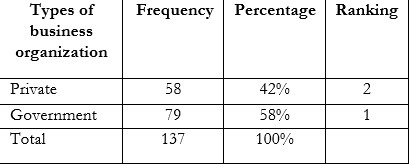
Table 8.
Types of Business Organization
The table depicts that 79 or 58% of the respondents prefer government type of business organization. Meanwhile, 58 or 42% of the respondents prefer the private type of business organization.
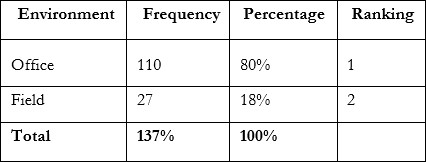
Table 9.
Environment
It can be gleaned that there are 110 or 80% who prefers the office environment while 27 or 18% prefer the field environment. James Stephenson defined an office as “part of business enterprise which is devoted to the direction and co-ordination of its various activities”.
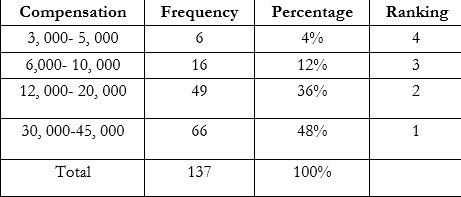
Table 10.
Compensation
The table shows that 66 or 48% of the respondents want a high compensation ranging from 30,000- 45, 000. On the other hand, 6 or 4% of the respondents prefer a compensation of 3, 000-5, 000.
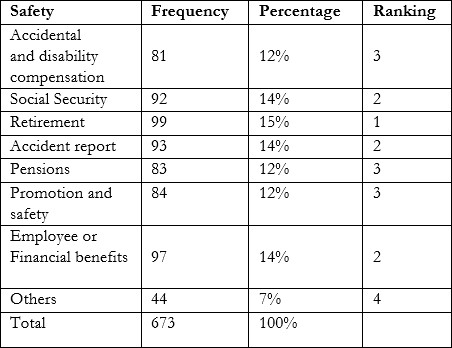
Table 11.
Others Benefits: Safety
The table shows that 99 or 15% of the respondents who prefer retirement. Unlike 44 or 7% of the respondents who prefer others safety.
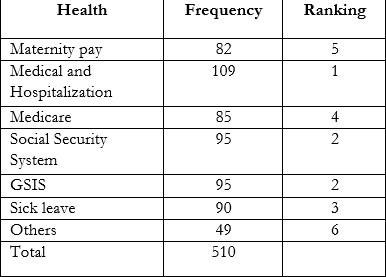
Table 12.
Others Benefits: Health
The table shows that 109 frequencies of the respondents prefer medical and hospitalization. On the other 49 frequency of the respondents prefer other benefits of health.

Table 13.
career development
Likert Scale
4.21-5.0- Excellent
3.41-4.2- Very satisfactory
2.61-3.4- Satisfactory
1.81-2.6- Fair
1.0-1.8- poor
The table shows that among the career developments only the special Seminars got a satisfactory result with a weighted mean of .16
Conclusions
Based on the findings, the following conclusions were made:
Majority of the respondents liked the middle-level position when it comes to the nature of work. Moreover, most of the respondents want to belong in the public type of business organization and work in the office than in the fields. In terms of compensation, the majority of the respondents liked thirty to forty five thousand, and in terms of other benefits, most of the respondents prefer safety benefits over health benefits.
Recommendations
In the light of the conclusion drawn from the study. The following recommendations were made:
1. Students/Respondents should be encourage to promote the importance of career opportunities whether they are young male or female.
2. The Guidance Office should assist students to learn more things about topics that relate to their course to make them motivate to become productive in the future. This can be done by giving the students opportunities to grow and improve themselves.
3. A further study should be made to determine the level the personal and skills of the students.
REFERENCIAS
W. Bruce Walls, et. al, M. C. & Meckling, W. H. (1988),“Career Decision Making”. Laurence Erlbaum Associates Publishers, Hillside New Jersey London
Duanne Brown, et. al, (2002),“Career Choice and Development” 4th edition, Jossey Bass A Company. Copyright 2002 by John Wiley and Sons, Inc.
Miller and Form, et. al, M. C. & Meckling, W. H. (1951),“Career Decision Making. Laurence Erlbaum Associates Publishers, Hillside New Jersey London
Suzanna Rose, et. al, “Women’s Career: Pathways and Pitfalls Praeger Publishers1988
Perron, Kristine M, et. al, (2002),“Role Model Influence on the Career Decidedness of College Students” College Students Journal Volume 36 No. March 2002
Guerra & Braungart-Ricker, (1999) “Role Model Influence on the Career Decidedness of College Students” College Students Journal Volume 36 No. March 2002
http://www.courses.com.ph/bsba-bachelor -of-science-in-business-administration-major-in-human-resource development-management-philippines/
https://www.facebook.com/HumanRDevtNDMU/.../1421460468066754
https://prezi.com/xuf8bgk0e3re/human -resource-development-management/
http://www.payscale.com/research/US/Degree=Bachelor_og_Business_Administration_%28BBA%29_Human_ Resources_Management_%28HRM%29/Salary
Public Sector_investorwords, Web, INC. 2016