GENERAL
A comparative study on the implementation stage of corporate integrity in the Malaysian public sectors
Un estudio comparativo sobre la etapa de implementación de la integridad corporativa en los sectores públicos de Malasia
A comparative study on the implementation stage of corporate integrity in the Malaysian public sectors
RELIGACIÓN. Revista de Ciencias Sociales y Humanidades, vol. 4, núm. 16, pp. 123-129, 2019
Centro de Investigaciones en Ciencias Sociales y Humanidades

Esta obra está bajo una Licencia Creative Commons Atribución-NoComercial-SinDerivar 4.0 Internacional.
Recepción: 26 Febrero 2019
Aprobación: 30 Mayo 2019
Abstract: Nowadays, corruption and fraud are being covered in news continuously. Starting in 2004, the fifth Malaysian Prime Minister, Tun Abdullah Badawi had launched a National Integrity Plan (NIP) to fight corruption and behold the nobility of integrity among civil servants. Malaysian Institute of Integrity (IIM) was then established, and IIM together with a few Malaysian university academicians developed a tool called Corporate Integrity Assessment Questionnaire (CIAQ) to measure the level of integrity in an organization adopted from a global Ethics and Integrity Benchmark previously introduced by Joan Elise Dubinsky from The United State of America. CIAQ consists of 12 Dimensions, in which each dimension has its own descriptors making a total of 214 questions pertaining to the level of integrity in the organization. In total, 179 respondents from Public Sector A (PSA) and 151 respondents in Public Sector B (PSB) take part in this assessment by completing and returning the questionnaires. All responses received have been screened for missing data, outliers, withdrawal from normality and other fitting checks for irregularity. Both public sectors have shown that their overall scores are slightly above 50% in which 56% for PSA and 53% for PSB. These results indicate that they are beginning to implement ethics and integrity mechanisms in their organization to maintain the highest levels of transparency, integrity, and professionalism
Keywords: corporate integrity, integrity assessment tool, public sector.
Resumen: Hoy en día, la corrupción y el fraude están siendo cubiertos en las noticias continuamente. A partir de 2004, el quinto Primer Ministro de Malasia, Tun Abdullah Badawi, lanzó un Plan Nacional de Integridad (NIP) para combatir la corrupción y contemplar la nobleza de integridad entre los funcionarios públicos. El Instituto de Integridad de Malasia (IIM) se estableció luego, e IIM, junto con algunos académicos universitarios de Malasia, desarrolló una herramienta llamada Cuestionario de Evaluación de la Integridad Corporativa (CIAQ) para medir el nivel de integridad en una organización adoptada de un Punto de Referencia de Ética e Integridad global introducido previamente por Joan Elise Dubinsky de los Estados Unidos de América. CIAQ consta de 12 Dimensiones, en las que cada dimensión tiene sus propios descriptores, lo que hace un total de 214 preguntas relacionadas con el nivel de integridad en la organización. En total, 179 encuestados del Sector Público A (PSA) y 151 encuestados en el Sector Público B (PSB) participan en esta evaluación completando y devolviendo los cuestionarios. Todas las respuestas recibidas se han evaluado en busca de datos faltantes, valores atípicos, retiro de la normalidad y otras comprobaciones de ajuste de irregularidades. Ambos sectores públicos han demostrado que sus puntajes generales están ligeramente por encima del 50%, de los cuales el 56% para PSA y el 53% para PSB. Estos resultados indican que están comenzando a implementar mecanismos de ética e integridad en su organización para mantener los niveles más altos de transparencia, integridad y profesionalismo.
Palabras clave: integridad corporativa, herramienta de evaluación de integridad, sector público.
INTRODUCTION
With increasing corruption cases in Malaysia, integrity has become a threat not only in individuals but also in organizations. Integrity should be taught from a young age and professional experts with PhD and Masters are needed to deal with integrity issue as mentioned by Datuk Akhbar Satar, the President of Transparency International (TI) Malaysia. Among 1,902 arrests being made in 2015 for graft offences, 55% of them involves with the youth. He added that in order to solve corruption matters, integrity issues needed to be looked into seriously by the Malaysian government (Avineshwaran, 2017). The introduction of new mechanisms such as National Integrity Plan (NIP), Malaysian Institute of Integrity (IIM), Malaysian Anti-Corruption Commission (MACC) and Anti-Corruption Academy have added to the list of institutions designed to tackle problems and enhance integrity.
National Integrity Plan (NIP) was introduced in April 2004 with the aims at building a united, just, democratic, liberal and progressive society. The main objective is to institutionalize a fully moral and ethical society whose citizens are strong in religious and spiritual values and permeated with the highest ethical standards (National Integrity Plan, 2008). This plan was introduced to mitigate corruption, misconducts and misuse of power thus improve the efficiency and effectiveness of the public system and overcome organizational red tape (Rosli, Aziz, Mohd, & Said, 2015). This is important since Malaysia has been ranked 55th in the world with the score of 49/100 in Corruption Perceptions Index (CPI) 2016 as announced by Transparency International (TI) which based in Germany (Corruption Perception Index, 2017). Therefore, a drastic measure needs to be taken so that the problem can be contained. Hence, besides good governance, corporate ethics and integrity system should be established systematically in order to fight for corruption.
NIP has been introduced to fulfill the fourth challenge of Vision 2020, after which Corporate Integrity becomes one of the important mechanisms to develop a concrete foundation for country’s future and forthcoming economic prosperity (Rosli et al., 2015). However, despite having aggressive exertion from the government against corruption, ethics and integrity issues are still widespread and it is one of the important causes in organizational failure. Therefore, government had introduced Government Transformation Program (TGP) 1.0 and 2.0 to enhance corporate ethics and integrity among corporations to have good governance practices (Sajari, Haron, & Ismail, 2016).
LITERATURE REVIEW
In general, integrity can be defined as good personality, for instance, honorable, honesty, righteousness and incorruption. Ssonko (2010) interpreted integrity as a virtue term and also in the context of accountability. When integrity is used as virtue term, its refers to a quality of one’s person. In the context of accountability, it serves as a measure of willingness to adjust value system so as to maintain or improve its consistency when an estimated result appears different with perceived outcome. Integrity also can be referred as the actions of being honest and sustained a strong moral principle in which the organization holds consistency in uprightness in conducting or running a business (Said, Omar, Zakaria, & Yahya, 2015).
Malaysian Public Sector includes the Federal and State Governments, Statutory Bodies, and Local Authorities. As for the last twenty years, there have been major changes and innovations being introduced into civil sector in order to deliver better services towards the public. Hence, the commitment of civil servants plays a vital role to make sure that the implementations of government policies are well-executed and delivered to the public (Ismail, Ngah, Hassan, Abdullah, & Salleh, 2011).
The government is aware that public sector became the most important instrument in management and administration, delivery services, and national development. Therefore, ethical practices and integrity are reflected in all undertakings. A Special Cabinet on Government Management Integrity, with the core business in integrity of government management, was created to strengthen governance of public sector. The core values which should be internalize and put into practice are honesty, trustworthiness, wisdom, fairness, transparency and more (Lee, Mat Zin, & Ahmad Badawi, 2014).
Public Servant Pledge was created to officially indicate that public servant are aware and agreed to execute their roles ethically. The pledge is a part of The Public Officers (Conduct and Discipline) Regulations 1993 that act as a contract between government and public servants (Lokman & Talib, 2007). The document consists of 1) Regulations pertaining to codes of conduct; 2) Responsibilities and duties in relation to disciplinary control and supervision; 3) Disciplinary procedures and codes of conduct; 4) Punishments imposed on breach of code of conduct; and lastly 5) Provisions on related miscellaneous matters (Public Services Commission of Malaysia, 2017).
CORPORATE INTEGRITY
It is important for a country to have a society that has moral and integrity in order to achieve high income economy status as well as to maintain and sustain economy. By implementing corporate integrity, Malaysia can achieve high income economy (Lee et al., 2014). Corporate integrity can be expressed as what an organization does or does not do when no one is looking which can bring to violation of the company policies and procedures so that ones can achieve personal or corporate gain.
A study by Ismail et al., (2011) stated that civil perception on integrity is important as it need to be clear and rules must be followed. Furthermore, integrity is all about observance of competency values, commitment to address and eliminate corruption, increasing the efficiency and effectiveness of the organization of either private or public as well as family units. There are still civil servants that are unclear and uncertain about the meaning of integrity in public sector. Those with younger age are less knowledgeable on the rule and procedure which led them being unsure about integrity.
Malaysian government has invested in lots of programs and budget to ensure Malaysia statutory bodies have implemented corporate integrity system. Therefore, it is important to check the level of corporate integrity system implemented in an organization (Said et al., 2015). After the level of integrity is measured, action should be taken so that proper improvement could be done.
Besides that, Malaysia had also launched a Corporate Integrity Pledge (CIP) with the intention to get Chambers of Commerce to commit and encourage their members to fight against corruption. This is one of the initiatives to fight corruption under the 6 National Key Result Areas (NKRA) under the Government Transformation Plan (GTP) (Companies Commission of Malaysia, 2005). In conjunction with that, a checklist was designed by IIM and it was developed based on the Anti-Bribery Checklist which released by Transparency International in 2009. It establishes a baseline prior to signing the CIP.
It also helps administrations to assess their existing integrity system, including policies, implementation procedures, and monitoring and review systems (Companies Commission of Malaysia, 2014).
CORPORATE INTEGRITY ASSESSMENT QUESTIONNAIRE (CIAQ)
CIAQ is a tool which is introduced and developed by Malaysian Institute of Integrity (IIM) together with a few Malaysian academicians adopted from global Ethics and Integrity Benchmark in late 2010 to facilitate organizations to evaluate and measure their progress in creating a formal and transparent commitment toward ethics and integrity in the workplace.
This assessment can be used by both public and private sectors to benchmark their initiatives in promoting integrity in workplace because it can helps alleviate corruption. It was originally established as consulting tool to helps corporations and organizations set up their Corporate integrity System, but the scale of the original tool have been refined and improved measure was included to assess the current practices of ethics and integrity (Omar, 2015).
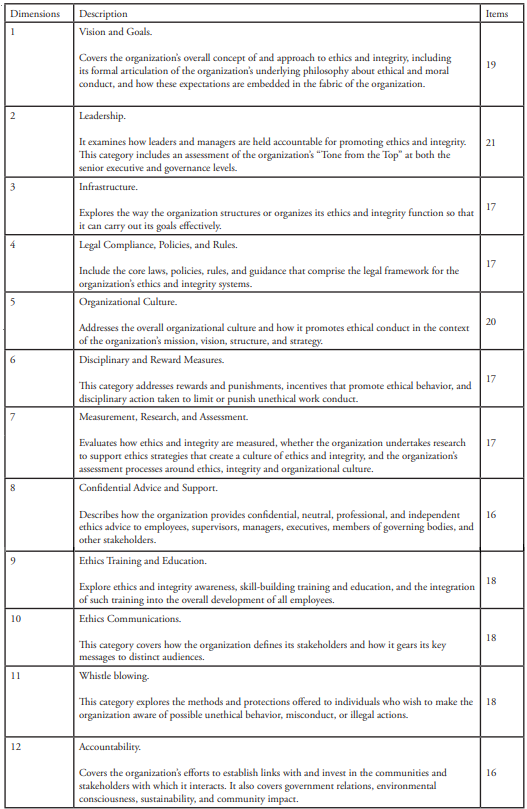
CIAQ consists of 12 Dimensions in which each dimension has its own descriptors making a total of 214 questions. This assessment was done after they signed their pledge with MACC. Table 1 shows the measurement of the variables for the CIAQ.
METHODOLOGY
This paper is about a quantitative study to assess the level of corporate integrity by two public companies using CIAQ. The 12 dimensions as mention in Table 1 reflect the level of integrity in the organization after being compared with Global Ethics and Integrity Benchmark (GEIB).
The benchmarks are divided into five levels progresses towards the best practices in each category. The 0% level indicates that an organization that has not yet begun to focus on this specific ethics consideration. The 25% level shows that the organization has compliance mindset and shows symbolic action only, 50% level means that they show progress in starting a programmatic thrust. For 75% level, it indicates that ethics and integrity has systematically been implemented. Finally, 100% level indicates the best-practices level. The 25% through 100% levels show where an organization progressively might be situated as it improves in that category, and finally reaching the 100%, or best-practice level (Dubinsky & Richter, 2008).
The questionnaires are distributed among employees in various branches and departments of the selected public companies which will be noted as Public Sector A (PSA) and Public Sector B (PSB). Section 1 captures the demographic profile of respondents. Sections 2 to 13 obtain responses from the respondents on the twelve dimensions of corporate integrity system. Table 1 describes the twelve dimensions of corporate integrity system and number of questions asked for each dimension. Respondents were asked to rate their responses using a 5-point scale: 0 = Not Sure, 1 = Strongly Disagree, 2 = Disagree, 3 = Agree and 4 = Strongly Agree. In the analysis section, the Scales of 3 and 4 are combined as “At least agree” and the scales of 1 and 2 are combined as “At least disagree”. If there are unanswered items by the participants, the questionnaire set will be remove. The result was then run in Microsoft Excel simulation.
RESULTS AND DISCUSSION
In total, 179 respondents from PSA and 151 respondents in PSB took part in this assessment by returning fully completed questionnaires. All responses received have been screened for missing data, outliers, withdrawal from normality and other fitting checks for irregularity. The results of this screening have revealed no major problem with the collected data.Table 2. Overall Progress Summary of Integrity Assessment Tool
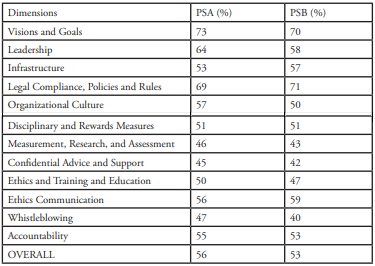
Table 2 summarizes the score obtained by each companies for each dimensions. Both companies show that their overall scores are slightly above 50 per cent which are 56% for PSA, while PSB is 53%. These indicate that they are beginning to start ethics and integrity mechanisms in their company to maintain highest levels of transparency, integrity and professionalism. These number also meant that 56% respondents from PSA at least agree that their company have a proper integrity system. As for PSB, they score 53% which is slightly lower than PSA.
The result revealed an interesting finding for dimension One (Vision and Goals) which have scored the highest for both companies (PSA= 73%; PSB=70%). These show that they have systematically implemented ethics and integrity at work place. From the findings, it was revealed that PSA have the lowest score (45%) for Dimension Eight which is Confidential Advice and Support. For this dimension, it assesses how the organization provides confidential, neutral, professional, and independent ethics advice to employees, supervisors, managers, executives, members of governing bodies, and other stakeholders. These show that PSA needs to provide private space for ethics advice and counselling, and make it confidential. They also need to provide confidential advices to employees or to seek ethic advice when there is an ethical issue.
PSB has lowest score (40%) for Dimension 11 which is Whistleblowing. This dimension explores the methods and protections offered to individuals who wish to make the organization aware of possible unethical behavior, misconduct, or illegal actions by the company. This may due to lack of information regarding the policies to whistleblowing. They could divulge to their employees about hotline or helpline services provided together with the guideline for every call reported. If there is retaliation for loss sustained, the company at least could compensate the victim and protect them. This could encourage other employees to whistle blow any unethical action.
Since, both companies just started to implants ethics and integrity in their organization, it is expected that the score obtained by both companies are lower than expected which was below 60%. PSA score 56% while PSB is 53%. Therefore, they can take action by getting a training from a professional in order to increase their integrity level and established a workplace that is free from corruption and fraud.
By measuring the Integrity Assessment, policymakers also could identify gaps and obstacles pertaining to corporate integrity within the company. With gaps clearly identified, they can devise the best strategies and policies to overcome them for instance, by attending workshops or seminars. They also could appoint chief integrity officer to lead ethics and integrity function, to report activities that have been done together with the results.
CONCLUSION
This study aims to assess the level of corporate integrity system in place of two companies in public sector. Based on this finding, the scored for each dimension can be used as a guideline to enhance its integrity performance by putting a proper mechanism thus reducing risk of corruption or fraud. It also can reflect a good reputation and gain trust among their employees and stakeholders.
This study is come with a limitation. The limitation is on the analysis system. Though the result can be analyze by using Microsoft Excel, but a deep analysis should be done by cross-reference with the demographic section. For further study, further analysis on corporate integrity with demographic section should be implement. Moreover, the analysis can be done by using a decision support system as to improve the analysis.
BIBLIOGRAPHIC REFERENCES
Avineshwaran, T. (2017, June 1). Integrity must be taught at a very young age , says expert. The Star. Retrieved from http://www.thestar.com.my/metro/community/2017/04/01/nurturing-moral- values-integrity-must-be-taught-at-a-very-young-age-says-expert/
Companies Commission of Malaysia. (2005). Corporate Integrity. Corporate Responsibility Management, 1, 39.
Companies Commission of Malaysia. (2014). From Pledge to Practice: A Guide to Implement the Corporate Integrity System, 1–48.
Corruption Perception Index. (2017). Corruption Perceptions Index 2016. Retrieved August 20, 2017, from https://www.transparency.org/news/feature/corruption_perceptions_index_2016
Dubinsky, J. E., & Richter, A. (2008). Global Ethics and Integrity Benchmarks.
Ismail, R., Ngah, N. E., Hassan, I., Abdullah, T., & Salleh, A. (2011). The Perception of Integrity of Three Public Agencies in Kuala Terengganu. World Applied Sciences Journal, 12(Special Issue), 60–63.
Lee, H.-A., Mat Zin, R., & Ahmad Badawi, A. (2014). Malaysian Development Experience : Lessons for Developing Countries. Institutions and Economies, 6(1), 65–81. Retrieved from https://www. whitehouse.gov/sites/default/files/omb/legislative/letters/data-breach-notification.pdf
Lokman, A., & Talib, A. T. (2007). An Overview on Malaysia ’ S Ethics Initiatives.
Omar, N. (2015). CORPORATE INTEGRITY AS AN ANTIDOTE TO CORRUPTION AND FOR SUSTAINING ORGANISATIONAL DEVELOPMENT : A RENEWED Corporate Integrity as an Antidote to Corruption and for Sustaining Organisational Development : A Renewed Role for Management Accountants. Malaysian Accounting Review, 14(December 2015), 1–25.
Public Services Commission of Malaysia. (2017). Series 1 – Public Services Codes of Conduct. Retrieved October 15, 2017, from http://www.spa.gov.my/en/siri1
Rosli, M. H., Aziz, M. A. bin A., Mohd, F., & Said, J. (2015). Integrity Systems in Malaysian Public Sector: An Empirical Finding. Procedia Economics and Finance, 28(October), 260–265. https:// doi.org/10.1016/S2212-5671(15)01109-0
Said, J., & Omar, N. (2014). Corporate Integrity System: Comparative Analysis of Two Giant Government Linked Companies. Procedia - Social and Behavioral Sciences, 145, 12–17. https:// doi.org/10.1016/j.sbspro.2014.06.006
Said, J., Omar, N., Zakaria, N. B., & Yahya, N. (2015). Corporate Integrity System Infrastructure : Empirical Findings from Statutory Body. International Conference on Islamic Economics, Governance and Social Enterprise, IConIGS 2015, (December).
Sajari, A., Haron, H., & Ismail, I. (2016). Role of Chief Integrity Officer in Malaysian Public Sector. The National Conference for Postgraduate Research, University Malaysia Pahang, 135–141.
Ssonko, D. K. W. (2010). Ethics, Accountability,Transparence, Integrity and Professionalism in Public Service: The Case Study of Uganda. Enhancing Professionalization of Human Resource Management in the Public Service in Africa, 18. Retrieved from http://unpan1.un.org/intradoc/ groups/public/documents/un-dpadm/unpan038789.pdf