GENERAL
Analysis of Pakistani learner’s argumentative essays: a multi-dimensional approach
Análisis de los ensayos argumentativos del alumno pakistaní: un enfoque multidimensional
Analysis of Pakistani learner’s argumentative essays: a multi-dimensional approach
RELIGACIÓN. Revista de Ciencias Sociales y Humanidades, vol. 4, núm. 19, pp. 122-131, 2019
Centro de Investigaciones en Ciencias Sociales y Humanidades

Esta obra está bajo una Licencia Creative Commons Atribución-NoComercial-SinDerivar 4.0 Internacional.
Recepción: 15 Agosto 2019
Aprobación: 25 Septiembre 2019
Abstract: The present study is a corpus based research using a statistical approach multi-dimensional analysis (MDA) by Biber to study linguistic patterns of learner language. MDA has gained much appreciation due to its objective and empirical nature. It not only systematically arranges common linguistic patterns but also elaborates the functional association of these patterns. The MDA is performed at two levels known as old MD and New MD. The present researchis only about second level (New MD). The results show that in Pakistani learners’ writing the prominent linguistic patterns are characteristically informational rather than argumentative. Instead of building arguments, learners are more interested in sharing information. Pakistani English has historical roots from pre-partitioned India, therefore, it has under gone through communal, traditional and dogmatic apexes. In the beginning, people started learning English as a second language that was inevitably entering in their social and cultural life.
Keywords: multidimensional analysis, New MD, argumentative essays, factor analysis.
Resumen: El presente estudio es una investigación basada en corpus que utiliza un enfoque estadístico de análisis multidimensional (MDA) de Biber para estudiar los patrones lingüísticos del lenguaje del alumno. MDA ha ganado mucha apreciación debido a su naturaleza objetiva y empírica. No solo organiza sistemáticamente patrones lingüísticos comunes, sino que también elabora la asociación funcional de estos patrones. El MDA se realiza en dos niveles conocidos como MD antiguo y MD nuevo. La presente investigación es solo sobre el segundo nivel (Nuevo MD). Los resultados muestran que en la escritura de los aprendices paquistaníes, los patrones lingüísticos prominentes son característicamente informativos más que argumentativos. En lugar de construir argumentos, los alumnos están más interesados en compartir información. El inglés paquistaní tiene raíces históricas de la India pre-dividida, por lo tanto, ha pasado por vértices comunales, tradicionales y dogmáticos. Al principio, la gente comenzó a aprender inglés como un segundo idioma que inevitablemente entraba en su vida social y cultural.
Palabras clave: análisis multidimensional, MD nuevo, ensayos argumentativos, análisis factorial.
Introduction
Pakistani English has attained the place of a distinct variety that is eminent from other non-native varieties. It has its unique linguistic structure, word choice and linguistic variations among various registers and sub registers. To study Pakistani English and its unique features most of the studies have been conducted e.g. Baumgartner 1987, 1993, Rehman, T., 1993, 2002, Mehboob 2004, Mehboob & Mehmood 2009, Shakir 2013 and Sajid 2015. The foci of all these researches,regardingPakistani learners’ English language, range fromlexical and phonological levels to the morphological and syntactic domains. Thus, efforts were made to make Pakistani English as an independent variety of English.This research is an extension in the previous storehouse of knowledge as it intends to elaborate regular features of Pakistani learners’ English.
The Academic language is an independent register with its own persistent flow of co-occurring linguistic features. The previous researches on Pakistani academic English either probed single linguistic item orone aspect of linguistic features. The focus of present study is not limited to a partial level rather it intends to focus all the consistent linguistic features that are the hallmark of Pakistani learners’ writing. For this multi-dimensional analysis (MD) methodology has been selected.
Biber is the pioneer of this approach who developed this comprehensive methodology to analyze register variation among various varieties of English and other languages with cross cultural perspective. It is a quantitative methodology that categorizes those salient co-occurring linguistic patterns which combine serve a communicative purpose in any register. These co-occurring patterns are named by Biber as underlying dimensions which share a common linguistic and communicative goal. The linguistic and functional content help to demonstrate what Biber calls dimensions.
The methodological approach of Biber is performed at two levels: old MD (or MD 88) and new factor dimensions or New MD. 88 MD is comprised of pre identical dimensions defined by Biber. These pre-identical dimensions of Biber possess five dimensions which retain67 linguistic items. The mean score of these dimensions helps to label the dimension by keeping in view its tilt towards any pre explained dimension like:‘involved vs. informational, narrative vs. non narrative concerns, the degree of referential elaboration, persuasive or argumentative focus and abstract vs. non abstract style of writing’ (Biber, 1988). MD 88 is performed only through software developed by Biber in his lab. The second layer is performed by further analysis through statistical factor solution. The factors are nomenclatured by keeping in mind the linguistic and functional roles performed by these dimensions. In present research, the second layer of MD has been performed. The notable six factors have been drawn and labeled by keeping in view their linguistic and functional contents.
Literature review
Pakistani English has historical roots from pre-partitioned India, therefore, it has under gone through communal, traditional and dogmatic apexes. In the beginning, people started learning English as a second language that was inevitably entering in their social and cultural life. To learn English became indispensable to grow and live stably in subcontinent. Later in 1947, the directcontact with natives ended and English started to develop at its own. Now, it has become a unique variety of South Asia and is used as official language in Pakistan.
The Researches conducted on Pakistani English (PE) have scrutinized it at two levels. One, such studies investigated its linguistic features discretely and these features were studied descriptively. These studies helped to establish the grounds PE as a separate varietylike Baumgartner (1996) explored unique style of PE by reporting its lexical and grammatical attributes. Talaat(1988) compared Pakistani English with British English and explored the lexical variety of Pakistani English. Mehboob (2009) investigated the grammatical features besides the phonemic elaboration of PE. But currently this trend has transformed into a more empirical and objective approach. Corpus based studies, largely known as empirical studies, have been adopted as a method to read linguistic features of Pakistani English. Mehmood (2009) and Mehmood(2009) conducted pioneer studies in this regard as both these authors have studied Pakistani English through a series of experiments and thus contributed to establish an independent variety. Such corpus-based studies have motivated the trend of determining linguistic features of Pakistani English by giving it functional variation. Corpus based approach transferred the concept of studying linguistic features into study of linguistic variation. It was Biber who for the very first time introduced the concept of register variation mainly in terms of English language by using MD approach. His study was inventory in nature covering the whole lexico-grammatical characteristics of English. He tried to identify the consistent patterns of linguistic features that vary from register to register.
Academic writing is a potent source to study language in use. Specifically, studies conducted on learner’s writing are more prominent in this regard. From semantic point of view, the choice of syntactic structure widely depends on the notion of meanings. The study conducted by Labove (1975) focused this idea by investigating the choice of get vs. be passives. He was of the view that selection of particular terms intended to bring particular semantic effect in special context. For example: he got arrested or he was arrested, though looked same but gave different semantic effects and also elucidated the context. MD analysis was used by Hardy and Rome (2013) who worked on lexico-grammatical features of higher-level students. In the same way, Egbert (2011) used MDA to study stylistic variation among texts. Abdulaziz (2018) used corpus of ICNAL to study learners’ English under MD approach and used Kashrus’ three circle model to support her arguments.
Research methodology
In the present research,ICLE corpus of 306 essayscontaining approximately 189407 words was used. The data was collected from students on 56 prompts which were argumentative in nature.The students were directed to compile an essay between 500 to 1000 words. After attaining the data, it was transformed into .txt files to make the data available electronically.
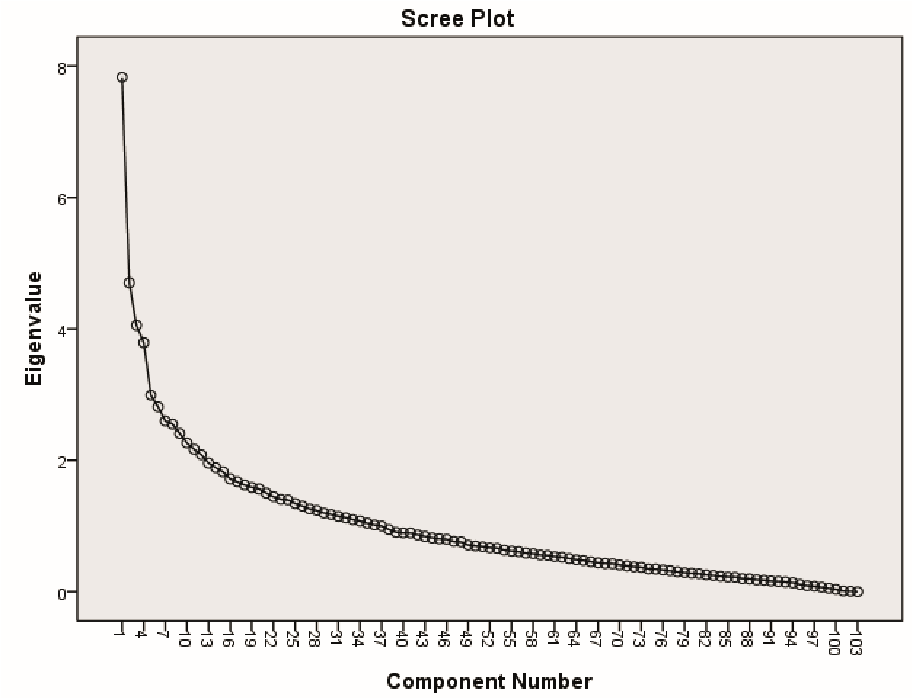
Then, it was tagged from Biber’s tagger from Arizona State University. The results show 185 linguistic features notable in Pakistani learners’ writing. After normalizing and standardizing, 96 features were selected keeping in mind the threshold point of selection i.e. ±0.35 proposed by Biber (1996). For the statistical analysis, SPSS package was adopted in which Principal Axis Factoring method was performed. Factorability of the sampling has been determined using KMO measure of sampling adequacy. Eigenvalues helped to decide the important loadings while Scree plot provided the image of ideal number of factors. A promax rotation was performed for the final factor solution.
1. Analyze -> dimension reduction àfactor….
a. Highlight all variables: move to variables :using the right arrow
b. Descriptive… -> check KMO and Bartlett’s test for sphericity
c. Extracting … -> method àselect principal component analysis factoring
d. Display -> check scree plot
e. Click ok
2. Look at KMO and Bartlett’s test
3. Analyze scree plot
Data Analysis and Discussion
Factor analysis is a statistical tool the broad purpose of which is to condense large data into small clusters. These clusters are formed by regrouping the data that is due to the shared variance of the variables. The statistical technique known factor solution is used to reduce large number of variables into small meaningfully arranged clusters which is mostly formed on the bases on shared function. Biber (1995) also considers factor analysis fundamental in conducting MD analysis where large number of linguistic variables are reduced into small meaningful sets which can be functionally interpreted. The extracted sets help to know the patterns and relationships of variables so that the groups may represent a common functional interpretation. Each of the extracted set is the linear combination of the parental set. Thus, the obtained results are based on the classification of the features of the texts from the corpus. The factors divide the features into two poles; one is positive, and the other is in negative values. The positive value means the existence of the feature in the particular text while the negative remains absent.
In extracting notable factors, eigenvalue is calculated which is important in representing a factor. Larger eigenvalue means the factors have more variance and eigenvalue 1.00 or higher is worth of analysis. Scree plot is another graph that exhibited eigenvalue. A scree plot is the pictorial representation of prominent factors in which the size of factor decreases as it proceeds further showing the descending order of features in each factor. The scree plot in present research displays 6 factors more important as they explainthe important factors. The curve of the scree plot gets straight showing the least variability.
To make factor derivation more clear, another process can be used to avail significant sets of features that is to focus the values or loadings of each featureon a specific factor. A correlation coefficient of a factor is availed from the measurement of a factor loading. This loading give two edge results one in positive and other is negative scores. Positive loadings mean the existence of feature while negative mean vice versa. This correlation coefficient helps to identify the features which correlate with the identified groups that may have complete correlation or otherwise. After all this process, a factor is formed possessing two sets of loadings both positive and negative features. Following table is the illustration of values attained through the above mentioned process.
Rotated Component Matrix
| Factor 1. | |||||
| PositiveComponent | Values | NegativeComponent | Values | ||
| vb_mental | .663 | Prep | -499 | ||
| private_vb | .568 | jj_attr | -.432 | ||
| vb_present | .464 | nn_premod | -.406 | ||
| att_vb_other | .455 | all_def_art | -.394 | ||
| Contract | .442 | nn_group | -.355 | ||
| coord_conj_cls | .414 | ||||
| pro_1 | .398 | ||||
| vb_progress | .366 | ||||
| likely_vb_other | .358 | ||||
| Factor 2 | |||||
| PositiveComponent | Values | NegativeComponent | Values | ||
| th_stange_all | .893 | No feature exists | |||
| th_vb_stance_all | .888 | ||||
| th_vb | .750 | ||||
| th_vb_comm | .677 | ||||
| vb_comm | .463 | ||||
| th_vb_fact | .461 | ||||
| th_vb_likely | .460 | ||||
| vb_public | .426 | ||||
| th_nn_stance_all | .414 | ||||
| Factor 3. | |||||
| PositiveComponent | Values | NegativeComponent | Values | ||
| pro_3 | .674 | nn_nom | -.433 | ||
| nn_human | .644 | vb_perfect | -.421 | ||
| jj_att_other | .582 | ||||
| jj_eval | .541 | ||||
| all_indef_art | .361 | ||||
| Factor 4. | |||||
| PositiveComponent | Values | NegativeComponent | Values | ||
| to_stance_all | .876 | ||||
| to_vb_stance_all | .837 | ||||
| Infinitive | .643 | ||||
| to_vb_effort | .615 | ||||
| to_vb_desire | .488 | ||||
| to_nn_stance_all | .413 | ||||
| vb_act | .377 | ||||
| Factor 5. | |||||
| PositiveComponent | Values | NegativeComponent | Values | ||
| nn_process | .435 | nn_proper | -516 | ||
| nn_stance_other | .430 | ||||
| det_nn_stance | .372 | ||||
Factor 1.
| Dimension | Loading | linguistic features | ||||
| Factor 1 | Positive | mental verb, private verb, verb present, mental attitudinal verb in other context, contract, coordination conjunctions clause, phrasal connector, pronoun 1,progressive verb, likely verb other | ||||
| Dimension | Loading | linguistic features | ||||
| Factor 1 | Negative | Preposition, attributive adjective, pre modifying noun, definite article, noun group | ||||
Statistically, first factor should be the most potent and leading factor as it generally comprises of large number of features on its side. In present research, the first dimension in factor analysis possesses features of factor 1 which has 15 features as a whole with 11 and 4 for positive and negative loadings respectively.Although the distribution of features has functional approach, here in present research all the linguistic features specifically with positive values are prominent as compared to negative ones. The functional interpretation of positive features bears interesting combination for example private verbs in the results possess the highest scores which, according to Biber, express intellectual state. The use of mental verbs is the expression of mental attitude of the speaker and combination of mental and private verbs gives clue to the personal thoughts, emotions and private attitude in an explicit manner (Biber,1995) and sometimes they may also refer to uncertainty and tentativeness as Finiginal(2012) observes. Operationalizing together, the mental verbs, factual verbs, factual adverbials and that clause with likelihood verbs refer to private stance with involved discourse. (Biber & Conrad 2009). Some linguists like Schifflin (1994) consider those discoursal features as important cohesive devices in the text or conversation which also function to provide information and extra details in the discourse.
Speaker’s personal involvement in the discourse is generally shown through the use pronouns. Personal prounouns specifically the first person is used to show involvement of the speaker ot author in discourse and this is the important feature of written language. The use of first person pronoun is always intentional by the writer as he deliberately uses personal pronouns so that he can mitigate the gap between reader and writer and this sometimes also helps to maintain claims or writer’s stance (Harwood, 2005). The second point of view that somehow seems opposite to this interpretation is given by Hyland (2005) who believes that the writer uses first person mainly to maintain his hegemony and control over the subject matter. In dimension if both personal pronouns (first and second) are combined it means the author is intentionally involving the reader and deliberately creating association with the addressee. Contractions refer to informal style of writing in which the writer uses the short surface form which also clues to writer or speaker’s personal stance.
Features like that clause controlled by likelihood verbs with coordinating conjunctions refer to uncertainty and tentativeness (Friginal, 2012) and co-occurrence of these features with mental verbs indicate more complex stance, as Biber and Conrad (2009) believe, which make it a cluster of features with more packed and crammed thoughts in involved discourse that also possesses personal point of view or stance.
In the other pole of dimension with negative values, features like prepositions and nouns are prominent. Together they indicate informational density (Biber, 1995). Although Biber believes that use of prepositional phrase is a marked feature of academic writing with single purpose to provide dense information. The prepositional phrases coupled with modifying nouns, attributive adjectives are regarded as informational features used to provide dense information. For example:
- I know many people myself who came back from foreign countries to Pakistan.
- I would like to share the brief information about these issues of censorship
- The same case is with me, I love Pakistan because it is my dear home land.
- I hope a time will come and Pakistan will become a real fort of Islam.
- We can say that in modern times media is more harmful than useful.
- We having the evil in us try to satisfy ourselves by doing wrong deeds.
- I’ll recommend that co-education should be promoted in Pakistan.
- The air of the county that I have breathed has kept me alive.
- I believe that women show better results in this regard.
The above examples show the interactive purpose of the writer with less informational content. This dimension thus may be taken in the line of previous literature of its kind and can be named as ‘interactive personal stance vs. abstract informational discourse’.
Factor 2
Factor 2 decreases in number of features and possess only those linguistic frequencies which hold positive values and on the opposite pole there is no feature at all.
| Dimension | Loading | linguistic features |
| Factor 2 | Positive | that complement clause and That compliment clause of verbs, of communicating verb, of public verb, of factive verb,of verb of likelihood, and of noun clause |
The notable feature of this dimension is clause constructions. Clauses are always used by the writer to share more information and such discourse is packed with information. Clauses controlled by activity verbs show action done by choice. As Biber marked them as verbs showing actions and events that are done deliberately by the author to indicate his choice and authority. Further, clause construction with factive verbs specifically progressive verbs refer to stance which is more focused and contextualized in terms. This also clues to the personal stance. Together with complementation, the use of public verbs shows the sharing of information with a more detached approach. This indirect sharing of information and findings is done deliberately by the writer to show an objective stance. For example:
- People rightly said that: “Nature is God.”
- Some said that people are much occupied with scientific facts and technological achievements.
- The nuclear bomb which is the invention of science had proved fatal for the people of Nagasaki, even the coming generation of the people
- Some people said that co-education is having a lot of advantages but its disadvantages are more.
- The prophet PBUH said “a person who has three daughters, educates them, gives them good manners will be with me in heaven.
- It may be used for giving scholarships to students and pensions to retired people.
- Some people detained to segregate them from the rest of the people so that they may not cause harm to anyone.
These examples possess author’s objective stance with a neutral diction. Thus, the suitable labeling for this dimension can be ‘contextualized factual information.’
| Dimension | Loading | linguistic features |
| Factor 3 | Positive | 3rd person pronoun, attributive adjective, attributive adjective evaluation, indefinite articles |
| Dimension | Loading | linguistic features |
| Factor 3 | Negative | Perfect verb, nominalizations |
In this third dimension there are 4 features on positive and 2 on the negative pole. The prominent features are 3rd person pronoun, attributive adjectives and adjectives of evaluation and indefinite article. The use of 3rd person pronoun is mostly considered to be marked for the general expression without focusing any particular person. It is a flexible approach through which author retains his neutrality without pointing any specific person. The evaluative adjectives are used to show judgmental approach of the author with an objective style. A number of linguists are of the view that evaluative adjectives are potentially common feature of academic writing which is purposefully adopted by the writer to show the importance of previously done researches (Auria, 2008 and Tutin, 2009).Evaluative adjectives together with third person pronoun show tendency of detached yet consciously built text to spotlight the ideas of others.
On negative pole features which tend to occur are nominalization and perfect tense. Nominalizations are known to be derived nouns indicating an informational focus. They clearly indicate a literate discourse purposefully designed to share information (Grieve, 2008). While perfect tense is frequently used in academic writing as Biber (1988) mark present perfect tense as a way to avoid temporal sequencing in providing information and On the other hand, use of past perfect tense places focus on the temporal sequencing even when they are used for informational purposes. Blankenship (1962) Marckworth and Baker (1947) Biber (1986) place perfect tense to be used as a tool to express actions that happened in the past but still those actions exercise their influence to the present situation. They have been associated with narrative techniques in academic writing. Feingenbaum (1978) Biber (1986) and Marckworth and Baker(1947) find it is a feature of narrative writing that past tense forms serve the purpose of narration of some event that happened in the past. For example:
- If he tries to get status then money is the most important part of good status.
- The people of Pakistan wear very simple dress like shalwarqameez as they think it most important traditional dress.
- She cannot give extra importance to any one
- Actually they are supposed to spend money formore important issues like hunger and health.
The examples show the objective approach of the author in sharing ideas and keeping himself in the background. Thus this factor can be labeled as ‘objective elaboration vs informational content’.
| Dimension | Loading | linguistic features |
| Factor 4 | Positive | To complement clause, to complement clause controlled by verb, infinitives, verb effort, verb desire, stance noun clause, activity verb |
Factor 4 is based on only positives features and we do not find negative features on the negative pole. It is prominent due to the features that Biber considers important in writing. Ochs (1979) describes Complementation as a relatively complex construction to a greater extent in planned than unplanned discourse. Winter (1982) notes that both verb and adjective compliment clauses divide the content into two clauses: one where speaker’s evaluation is shared through the first or mostly main clause while the subordinate clause possess information being shared. For Biber (1999) to provide information regarding the activities, desires, emotions and thoughts of the paticipant, the clause construction that is commonly used is to-clause controlled by verbs. He further says that the use of to-clause provides a cohesive link to the preceding discourse and emphasizes typical parallelism across sentences. Chafe (1982, 1985) is of the view that integration and sequence of information is usually achieved through the use of infinitives. Beaman (1984) finds infinitives as common feature of written than spoken narratives. Activity verbs are mostly used to show action and events that can be allied to choose. For example:
- I think it would be a much more accurate statement to say that the world is full of multiple deas
- I think we are still very barbarous, we in under, rape, steal do terrible things for money Thus, the labelling for this factor can be ‘elaborated personal stance’.
| Dimension | Loading | linguistic features |
| Factor 5 | Positive | process noun, stance noun in other context, determiner |
| Dimension | Loading | linguistic features |
| Factor 5 | Negative | Proper noun |
There are only four notable features in factor 5 and less than 4 in factor 6. In factor 5 process noun, stance noun in another context, determiner are on positive pole while proper noun is on negative pole. So according to Biber’s methodology these are not worth to be discussed.
Conclusion
Pakistani learners’ English holds its special position on the linguistic cline because of the distinctive linguistic features (Baumgartner, 1996). MDA systematically brings out these features through an empirical approach which helps to find out not only the prominent features but also the associated functions that are performed through these linguistic patterns. Instead of putting arguments, Pakistani learners’ argumentative writing is largely focused on sharing information. Even in putting arguments the writers do not try to take a clear stance instead they use indirect style. There is no proper introduction of the essays which may indicate the stance of the author or may guide the readers about what they are going to read next. Essays are focused on sharing information without synthesizing proper beginning, middle and conclusion. This confuses the reader about the purpose for which an essay is being written. Secondly, researches done in the field of academic writing, specifically in argumentative essays, suggest that students need special training in dealing with argumentative essays as such topics are more cognitive, complex , and interactive. Students perform well in narrative and descriptive essays as compared to argumentative topics. The learners should be exposed to more argumentative literature so that they may learn how to develop effective arguments (Crowhurst, 1990). Kachru (2009) was of the view that for developing a good argumentative essay the learners need special training, skill and a conscious effort at institutional settings like school, family and monarchy etc. MDA not only provides insight regarding prominent linguistic features of Pakistani learner’s argumentative writing but also gives functional interpretation which helps to identify areas where improvement is needed. Such approach also helps to know about those issues that can be addressed at syllabus designing and pedagogical levels.
Note: this paper is part of researcher’s Ph.D. dissertation.
REFERENCIAS
Abdulaziz, M (2017) A multidimensional analysis of PakistaniLearnerEnglish,Unpublished PhD dissertation. Government College University, Faisalabad.
Ahmad, S. (2015). Linguistic variation across press reportage in Pakistani Print Media: A multidimensional Analysis. Unpublished PhD dissertation. Government College University, Faisalabad.
Ahmad, S. & Mahmood, A. M. (2015). Comparing explicit features of Pakistani press reportage with British press reportage: A multidimensional analysis. Journal of Critical Inquiry: pp. 9-35.
Alvi, U. F., & Mahmood, M. A. (in press). A multidimensional analysis of Pakistani press editorials. The Dialogue.
Asghar, Z. M. (2013). A corpus-based study of preposition in Pakistani and British Englishes. Unpublished M. Phil Thesis. Government College University, Faisalabad. .
Auria (2008). Authority and invisibility: Authorial identity in academic Writing, Journal of Pragmatics, 34: pp. 109–112.
Barber, C. (1968). The flux of language. London: University of London.Baumgardner, R. J. (1990). The indigenization of English in Pakistan. English Today. 6(1): pp. 59-65.
Bartholomew, knott&Moustaki, (2011). Latent Variable Models and Factor Analysis: A Unified Approach, Wiley Series in Probability and Statistics.
Baumgardner, R. J. (1987). Utilizing Pakistani newspaper English to teach grammar. World Englishes, 6(3): pp. 241-252.
Baumgardner, R. J. (Ed.). (1996). South Asian English: Structure, use, and users. Urbana: University of Illions Press.
Begum, M. (2016). Linguistic Variation across Academic Writing of Pakistani University Students: A Multidimensional Analysis. Unpublished PhD dissertation. Government College University, Faisalabad.
Biber, D. (2008). Corpus-based analysis of discourse: Dimensions of variation in conversation. In V. Bhatia, J. Flowerdew & R. Jones (Eds.). Advances in discourse studies.. London: Routledge. pp. 100-114.
Biber, D. (2004b). Modal use across registers and time. In Anne Curzan and Kimberly Emmons (eds.), Studies in the history of the English language II: Unfolding conversations. Berlin: Mouton de Gruyter. pp. 189216.
Biber, D. (2009). Multidimensional approaches. In A. Ludeling& M. Kyto (Eds.), Corpus linguistics: an international handbook 2: pp. 822-855.
Biber, D. &Finegan, E. (1994). Multi-dimensional analysis of authors’ style: some case studies from eighteenth century. In D. Ross, D. Brink (Eds.). Research inhumanitiescomputing, III: pp. 3-17.
Biber, D. (1988). Variation across speech and writing. Cambridge: Cambridge University Press.
Biber, D., & Conrad, S. (2009). Register, genre and style. Cambridge: Cambridge University Press.
Biber, D., Conrad, S. &Rappen, R. (2002). Speaking and writing in the university: A multidimensional comparison. TESOL quarterly. 36(1). Pp. 9-48.
Biber, D. (1995) Dimensions of Register Variation: A cross-linguistic comparison. Cambridge University Press.
Biber, D. (1995). ‘On the role of computational, statistical, and interpretive techniques in multi-dimensional analysisof register variation’. Text 15/3: pp. 314-370.
Biber, D. (2004a). Conversation text types: A multi-dimensional analysis. In GéraldPurnelle, CédrickFairon, and Anne Dister (eds.), Le poids des mots: Proceedings of the 7th International Conference on the Statistical Analysis of Textual Data. Louvain: Presses universitaires de Louvain. Pp. 15-34
Biber, D. (2006). University language: A corpus based study of spoken and written registers. Amsterdam: John Benjamins
Biber, D. (2010). Corpus-based and corpus driven of language variation and use. In B. Heine & N. Narrog (Eds.). The oxford handbook of linguistic analysis. Oxford: Oxford university press. pp.159-191
Biber, D., Connor, U. and Upton, T. A. (2007). Discourse on the Move: Using Corpus Analysis to Describe Discourse Structure. Amsterdam: John Benjamins.
Biber, D., Johansson, S., Leech, G., Conrad, S. and Finegan, E. (1999). Longman grammar of spoken and written English. Harlow: Pearson Education Limited.
Chauhdary, B. A. (1995). Dimensions of English in Pakistan. Lahore: Polymer Publications.
Connor, U. & Upton, T. (2003). Linguistic dimensions of direct mail letters. In C. Mayer &Leistyna (Eds.), Corpus linguistics: language structure and language use. (pp 87-106). Amsterdam: Rodopi
Conrad, S. & Biber, D. (2001). Multi-dimensional methodology and the dimensions of register variation in English. In Conrad, S, & Biber, D. (eds.) Variation in English: multi-dimensional studies. Pearson: Harlow, UK. Pp. 13-42
Conrad, S., & Biber, D. (Eds.) (2001). Multi-dimensional studies of register variation in English. Harlow, England: Pearson Education.
Conrad, S. (1996a). Academic discourse in two disciplines: professional writing and student development in biology and history. Unpublished doctoral dissertation, Northern Arizona University.
Conrad, S. (1996b). Investigating academic texts with corpus-based techniques: an example from Biology. Linguistics and Education 8, pp. 299–326.
Conrad, S. (2001). Variation among disciplinary texts: a comparison of textbooks and journal articles in biology and history. In S. Conrad & D. Biber (Eds.), Variation in English: Multidimensional studies. Harlow: Pearson. pp. 94-107.
Conrad, S. & Biber, D (Eds.), Variation in English: Multidimensional studies Harlow: Pearson.
Crowhurst (1990). How many millions? The statistics of English today. English Today 1(1): pp. 7–9.
Friginal, E. (2012). The Discourse of Outsourced Call Centres: A Corpus-Based, Multi-Dimensional Analysis. Accessed 29 July, 2016, at: http://www.birmingham.ac.uk/documents/college-artslaw/corpus/conferencearchives/2007/24Paper.pdf.
Geisler, C. (2002). Investigating register variation in nineteenth century English: A multi-dimensional comparison. In R. Rappen, S. M. Fitzmaurice &D. Biber (Eds.), Using corpora to explore linguistic variation. Amsterdam:
Halliday M. A. K. (1988). On the language of physical science. In Ghadessy M. (Ed.), Registers of written English: Situational factors and linguistic features. Pinter: pp. 162-178
Harwood, N. (2005) We Do Not Seem to Have a Theory . . . The Theory I Present Here Attempts to Fill This Gap’: Inclusive and Exclusive Pronouns in Academic Writing. Applied Linguistics, 26(3): pp. 343–375.
Hussain, Z. (2015) multidimensional comparative analysis of PakistaniEnglish,Unpublished PhD dissertation. Government College University, Faisalabad.
Kachru, B. B. (2005). Asian Englishes: Beyond the canon. Hong Kong: Hong KongUniversity Press.
Kachru, Y. (2006). World Englishes in Asian Contexts. (Larry E. Smith Eds.) Hong Kong: Hong Kong University Press Kachru, Y. (2008). Contrastive rhetoric in world Englishes. English Today, 11(1): pp. 21-23.
Mahmood, R. (2009). A lexico-gramatical study of noun phrase in Pakistani English. Unpublished doctoral dissertation. Bahauddinzikriya university, Multan.
Mahmood, A. (2009). A corpus-based Analysis of Pakistani English. Unpublished doctoral dissertation. Bahauddinzikriya university, Multan.
Mahmood, M. A., Hassan, S., Mahmood, R. and Arif, N. (2012). A Comparative Study Ditransitive Verb Complementation Patterns in Pakistani and British Englishes. US-China foreign language 10(5): pp. 1159-1165.
Mahmood, R. and Shah. S.K. (2011). Culture-Specific Vocabulary: A Study of Urdu Nouns in Pakistani English, Komunikacijaikultura online: Godina II, broj 2: pp. 72-86.
Mansoor, S. Meraj, S, & Tahir, A. (Eds). (2004). Language policy, planning and practice: A South Asian perspective. Karachi: Aga Khan University and Oxford University Press.
Rahman, T. (1989). Pakistni English: the linguistics description of a non-native variety of English. MA dissertation, university of Strathclyde, Glasgow.
Rahman, T. (1990). Pakistani English: The linguistic description of a non-native variety of English. Islamabad: National Institute of Pakistan Studies.
Rahman, T. (2007). The Role of English in Pakistan With Special Reference to Tolerance and Militancy‘ in Language Policy, Culture, and Identity in Asian Contexts Tsui, Amy B.M &Tollefson, James W. (eds) London: Lawrence Erlbaum Associates, Mahwah, New Jersey London. pp. 219-239.
Rahman, T. (2012). English across South Asian. The Encyclopedia of Applied Linguistics.
Rahman, T. (2014; first published in 1990). Pakistani English. Islamabad: National Institute of Pakistan Studies. Quaide-Azam University.
Shakir, A. (2013). Linguistic variation across print advertisements in Pakistani media: A multidimensional analysis. Unpublished doctoral dissertation. International Islamic University, Islamabad.
Talaat, M. (1988). A study of lexical variations in Pakistani English: a view on language contact and change. M.Phil thesis, Department of linguistics. University of Nottingham.
Talaat, M. (2003). Pakistani English: a sociolinguistic variety. Journal of research 4, pp. 17-30.
Talaat, M. (2002). The Form and Functions of English in Pakistan. Unpublished Ph. D thesis. BahauddinZakariyaUniversity:Multan.
Trask , R.L. ( 1994). Language change. New York: Routledge.
Tutin, A. (2008). Evaluative adjectives in academic writing in the humanities and social sciences. Retrieved January 12, 2010 from http://w3ugrenoble3.fr/lidilem/lobo/file/evalative_adjectives 2008_tutin.pdf
Tutin, (2009). Gender-based variation in nineteenth century English letter writing. In C. Mayer &Leistyna (Eds.), Corpus linguistics: language structure and language use. Amsterdam: Rodopi. pp 87-106.
Uzair, M., Mahmood, A., & Mahmood, A. R. (2012). Role of Pakistani English Newspapers in Promoting Lexical innovations. International Journal of Physical and Social Sciences, 2(6): pp. 121-138.
Winter, L.(1982).Standard English and the Teaching of Literacy. Canadian Journal of Education/Revue canadienne de l’éducation, 15(4): pp. 334-347.
Información adicional
CITAR: Tabassum, R., Asim Mahmood, M., & Arif, M. (2019). Analysis of Pakistani learner’s argumentative essays: a multi-dimensional approach. Religación. Revista De Ciencias Sociales Y Humanidades, 4(19), 122-131. Retrieved from https://revista.religacion.com/index.php/religacion/article/view/443