Artículos
Electoral Accountability for the Economy in Latin America
Rendición de cuentas electoral por la economía en América Latina
Electoral Accountability for the Economy in Latin America
Política, vol. 53, no. 1, 2015
Universidad de Chile
Abstract: This article reviews the role that economic performance plays as incumbents look to maintain political support in Latin America. Survey data from 18 Latin America countries in 2014 show that citizen's perceptions of economic performance reflect macroeconomic outcomes, respondents’ own personal situations, and political considerations. Respondents hold politicians accountable for perceived sociotropic outcomes, with those who perceive that things have gone badly considering alternatives to the incumbent more than abstention or nullifying their vote. Finally, the electoral effect of economic performance varies systematically across countries, with economic volatility increasing its salience while political and economic factors that concentrate control of the economy in domestic actors and economic policy in the incumbent party facilitate attributing responsibility to the government. While perceived outcomes have their roots in a variety of national-level and personal factors, voters generally approach accountability for those outcomes in a sophisticated manner.
Keywords: electoral accountability, Latin America, issue salience, presidential approval, economic perceptions.
Resumen: Este artículo revisa el papel que tiene el desempeño económico sobre la intención de voto por el candidato oficialista en América Latina. Con datos de una encuesta de 18 países de América Latina en 2014, muestro que las percepciones que tienen los latinoamericanos del desempeño económico reflejan los resultados macroeconómicos, pero también las situaciones personales propias de los encuestados y consideraciones políticas. Los encuestados hacen responsable a los políticos por sus percepciones sociotrópicas. Aquellos que perciben que la situación ha empeorado consideran alternativas electorales distintas al oficialismo por sobre la posibilidad de abstenerse o anular su voto. Por último, el efecto electoral del desempeño económico varía sistemáticamente entre los países. La volatilidad económica incrementa su relevancia mientras que factores políticos y económicos que concentran el control de la economía en los actores nacionales facilitan la atribución de responsabilidad al gobierno. Los factores que concentran la política económica en el partido del presidente también facilitan la atribución de responsabilidad al gobierno. Si bien las percepciones de la economía tienen sus raíces en una variedad de factores tanto de nivel nacional como de nivel personal, los votantes en general se acercan a la rendición de cuentas para la economía de una manera sofisticada.
Palabras clave: Rendición de cuentas electoral, América latina, aprobación presidencial, percepciones económicas.
Introduction
This paper reviews what we know about how voters in the hemisphere hold politicians accountable for their management of the economy. I focus on four key questions in the accountability literature: how economic perceptions are formed, whether more attention is given to national economic outcomes or voters' own personal situations, whether the effect of the economy systematically varies across political contexts, and whether citizens who have decided to reject the incumbent in turn support one of the alternative parties or instead their frustrations lead them to consider the exit option from political participation.
Data from the 2014 AmericasBarometer survey illustrate that the connection between economics and political support for the ruling party in Latin America behaves in very similar ways to the patterns scholars have identified in other regions. Citizen perceptions of the economy reflect national economic outcomes like growth and inflation, respondents’ own personal economic situations and access to material resources, and their partisan predispositions. Support for the incumbent party is strongly associated with those economic perceptions, with evaluations of the national economy (sociotropic evaluations) having a stronger and more consistent impact than perceptions of the respondent’s personal financial situation do or perceptions of crime trends do. Opposition to the president when things are perceived as going badly can include abstention and casting a null vote, but the most consistent reaction to poor economic management in these data is to look for an alternative party that might generate better outcomes. Finally, the effect of economic performance systematically differs across countries, and voters are more likely to hold the president accountable for the economy when a volatile economy makes the economy the dominant issue on the agenda and when political and economic conditions make it easier to argue that economic fluctuations reflect choices made by the ruling party and not other political parties or global economic fluctuations.
We still have much to learn about these processes and about how campaigns themselves can shape public reactions to the economy, but there can be little debate that elections in Latin America function at least in part as referenda on whether the ruling party can successfully move the country towards economic prosperity and that voters display remarkable sophistication in weighing this choice.
1. What Economic Voting Theories Tell Us about Voter Behavior
The literature on economic voting relies on a simple assumption about how voters use elections: one purpose of elections is to hold politicians accountable for their performance in office and bad outcomes potentially demonstrate that the current administration has priorities that have led them to prioritize other issues than those deemed important by the electorate, has pursued ineffective policies, or does not possess the necessary skills and competencies to effectively manage the problems that the country faces. Thus politicians who oversee bad outcomes in office should lose support while those who oversaw good outcomes should be rewarded. In the context of elections, the expectation is that the state of the economy should be positively correlated with support for the ruling party.
Yet this simple model becomes complicated when you start examining its logic. One first issue is understanding what exactly politicians are being held accountable for. In particular, we cannot simply say that “voters hold politicians accountable for the economy” without qualifying which part of “the economy” we mean and, more importantly, understanding how citizens perceive and evaluate economic information. As Duch and Stevenson (2013:307) recently reminded us, “the relevant “economy” in this theoretical model is the economy that voters can and do observe ”, emphasis in original). Thus the question models of economic voting need to confront is how do voters perceive and experience economic fluctuations. The way in which aggregate statistics are reported, for example, affects the way in which they are perceived and voters respond ( Hetherington, 1996 ; Kayser and Leininger, forthcoming ). Individuals then need to consider which aggregate indicators they care most about and how to combine them ( Duch and Stevenson, 2013 ) 2013). Voters also may have access to different sources of economic information depending upon their access to technology, literacy levels, and the partisan leanings of their favorite sources. Voters may also incorporate their personal experiences into their assessments of the national climate as a heuristic, which means that perceptions will further differ within the electorate if the economy differentially affects different groups. Evaluations of the economy might also break down along partisan lines if individuals who are predisposed to support the incumbent might be more likely to perceive outcomes in a positive light or to get their information from partisan sources. The result is widespread evidence that individuals systematically differ in their perceptions of the economy (e.g. Kramer, 1983 ; Duch et al., 2000 ; DeBoef and Kellstedt, 2004 ; Evans and Anderson, 2006 ; Stevenson and Duch, 2013 ).
A related question is why voters making these calculations need to look at the national economy at all when they could instead vote based on their personal financial situation, holding governments accountable for personal economic hardships they experience. In the language of economic voting studies, voters can potentially vote egotropically and judge the economy based on their personal financial situation or vote sociotropically based on the state of the national economy. Most studies find sociotropic concerns receive more weight than egotropic concerns (e.g. Kinder and Kiewiet, 1979 , 1981 ; Lewis-Beck, 1988 ; Kinder et al. 1989 ). This does not mean that voters do not care about their personal finances. But it implies that voters recognize personal finances are also affected by one’s own efforts, qualifications, personalities, and circumstances in addition to the national economic climate ( Lau and Sears, 1981 ; Feldman, 1982 ) whereas the national economy is more likely to be directly affected by governments’ economic policies. Because the state of the national economy can be more directly attributed to the government than changes in personal finances can, it makes more sense to view the former as an indicator of government competence. 1
Yet we also cannot always assume that the economy can be reasonably used to measure incumbent performance and competence if voters cannot be sure of the incumbent’s role in and control over them. For example, if the president had to negotiate with other political actors to make economic policy then parceling out responsibility for what did or did not happen is difficult. As responsibility for policy outcomes becomes unclear, the rationality of awarding the blame or credit to any single political actor diminishes. Thus coalition governments ( Duch and Stevenson, 2013 ), fragmented legislatures ( Anderson, 2000 ), and divided government ( Powell and Whitten, 1993 ) are all expected to reduce the weight voters give to economic performance. On the other hand, voters may find it easy to attribute credit or blame to governments that have strong formal powers that make it easier to achieve their policy goals ( Rudolph, 2003 ; Carlin and Singh, 2015 ). Holding governments accountable for economic outcomes makes little sense in contexts where global economic trends are the major cause of domestic economic fluctuations ( Hellwig, 2014 ). Thus accountability for the economy is expected to be attenuated in countries that are the most fully integrated into the global economy.
Moreover, we need not expect that voters will always consider the economy to be the most important issue on the political agenda and if attention to the economy fades, so too does its likely economic impact ( Singer, 2011 ). It makes little sense to hold the government accountable for the economy if some other issue is more salient. Now, the high degree of importance that voters give to their own economic circumstances ensures that the national economic climate (with the opportunities it creates) will generally be something that voters value. But voter attention to the economy tends to fade in contexts where it has been stable while repeated booms and busts drive voters to focus on identifying politicians who can manage that volatility and deliver good economic performance ( Duch and Stevenson, 2008 ; Singer, 2013b ).
Finally, after the voter goes through the entire process of deciding how the economy is doing, weighing the incumbent’s responsibility for it, and deciding how to weight economic performance vis a vis other performance areas on which the incumbent could possibly be judged and decides whether or not he or she would like to support or reject the incumbent, the voter also needs to decide if there is an alternative to the incumbent that merits support. We know relatively little about how voters weigh partisan alternatives to the current government, although there is evidence from Latin America that those parties who have also managed the economy badly in the past are unlikely to be chosen as alternatives to the current government ( Benton, 2005 ). But voters who reject the government might also consider voicing their displeasure by abstaining or nullifying their vote ( Tillman, 2008 ; Weschle, 2014 ). Yet we know relatively little about how frequently these options are exercised.
2. What We Know about Economic Voting in Latin America
Extant studies show that Latin Americans consistently hold the ruling party accountable for economic outcomes on their watch. While studies differ in their reliance on aggregate or individual-level data, the specific indicator being looked at, and whether they are focused on voter choices in an electoral context or levels of government approval, an linkage between good economic performance and increased support for the president has been documented in Argentina (e.g. Gervasoni, 1998 ; Echegaray and Elordi, 2001 ; Canton and Jorrat, 2002 ; Remmer and Gélineau, 2003 ; Gélineau and Remmer, 2005 ; Echegaray, 2005 ), Brazil ( Meneguello, 1996 ; Carreirão, 1999 ; Spanakos and Renno, 2006a , 2006b ; Renno and Gramacho, 2010 ), Chile ( Panzer and Paredes, 1991 ; Morales Quiroga, 2008 ; Renno and Gramacho, 2010 ), Colombia ( Holmes and Gutiérrez de Piñeres, 2013 ), Costa Rica ( Seligson and Gomez Barrantes, 1989 ; Finkel et al., 1989 ; Cuzan and Bundrick, 1991 , 1997 ), El Salvador ( Cuzan and Bundrick, 1997 ), Honduras ( Cuzan and Bundrick, 1997 ), Mexico (e.g. Beltran, 2000 , 2003 ; Moreno, 2009 ; Buendia, 1996 , 2001 ; Magaloni, 1999 ; Poiré, 1999 ; Singer, 2009 ; Dominguez and McCann, 1995 ; Davis and Langley, 1995 ), Nicaragua ( Anderson et al., 2003 ), Peru ( Stokes, 1996 ; Carrion, 1999 ; Weyland, 2000 ; Morgan-Kelly, 2003 ; Arce, 2003 ; Arce and Carrion, 2010 ), Uruguay ( Luna, 2002 ; c.f. Echegaray, 2005 ), and Venezuela ( Weyland, 1998 , 2003 ). 2 Additional studies that pool election results from multiple countries in the hemisphere also show that incumbent support generally rises when the economy is strong ( Remmer, 1991 , 2003 ; Echegaray, 2005 ; Benton, 2005 ; Gélineau, 2007 ; Johnson and Schwindt-Bayer, 2009 ; Johnson and Ryu, 2010 ; Alcañiz and Hellwig, 2011 ; Singer, 2013a ; Singer and Carlin, 2013 ; Lewis-Beck and Ratto, 2013 ; Carlin, Love, Martiner-Gallardo 2015 ; Gelineau and Singer, 2015 ).
Yet when we move beyond the specific discussions of whether there is an association between economic performance and government support to the specific theoretical questions highlighted in the previous section, the evidence becomes scarcer. The area that has received the most attention is the question of whether the economy’s effect varies by context, with multiple studies showing that fragmented governments reduce the electoral effect of poor economic performance ( Echegaray, 2005 ; Gélineau, 2007 ; Johnson and Schwindt-Bayer, 2009 ; Gelineau and Singer, 2015 ; Carlin and Singh, forthcoming ). Trade exposure also reduces the weight voters place on economic performance ( Singer and Carlin, 2013 ; Gélineau and Singer 2015 ). We know less about the other questions. In a recent study, Singer and Carlin (2013) show that sociotropic considerations trump egotropic ones in all but the poorest of countries but that is a single study whose generalizability to other datasets is unknown. Finally, we know relatively little about how citizens form their evaluations of the national economy and whether weak economies lead to support for opposition parties or abstention.
Thus in this paper I use data from 2014 to look at the various steps of the accountability chain in Latin America. The goal is not to develop new theory but simply to highlight what we know about how this process works in Latin America. Each step of this process deserves further unpacking and theorizing, but the goal of this paper is to illustrate our current knowledge on this subject.
3. How did Latin Americans See the Economy in 2014?
I explore the political effect of economic perceptions using data from the most recent wave of the AmericasBarometer survey. The AmericasBarometer survey, conducted by the Latin American Public Opinion project at Vanderbilt University, relies on national probability samples of roughly 1500 respondents in each country and face-to-face interviews. Data are then entered using hand-held electronic systems (PDAs) to reduce data collection and processing errors and to facilitate switching between questionnaire translations in different native languages if needed. This survey was conducted in early 2014 in 25 western hemisphere countries; in the analyses that follow I restrict the sample to the 18 Spanish and Portuguese speaking countries of Latin America in order to hold the presidential regime constant and because estimates of the incumbent government’s ideology exist for these 18 cases and I can use those data to develop a measure of left-right proximity to the incumbent president to control for potential endogeneity in how respondents see the state of the economy.
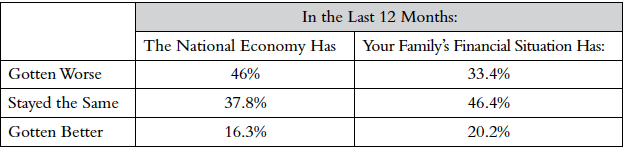
Respondents were asked to evaluate trends in the national economy as well as their personal economic circumstances, specifically whether they had gotten better, stayed the same, or gotten worse. Each variable is coded such that high values represent positive assessments of economic performance. In 2014 most Latin Americans tended to be pessimistic about economic outcomes ( Table 1 ). This was particularly true for assessments of the national economy: 46 percent of respondents in an average country thought the national economy had gotten worse while only 16 percent thought it had gotten better. Latin Americans tended to be slightly more positive about their personal economic situation, as 33 percent thought it had gotten worse while 20 percent thought it had gotten better. But in general Latin Americans were fairly pessimistic about the state of the economy.
Of course, behind these averages there is substantial variation in economic evaluations across the hemisphere as countries’ economies diverge ( Figure 1 ). 3 Respondents in Ecuador, Bolivia, and Chile had the most optimistic views of the national economy’s trend while those in Venezuela, Guatemala, and Argentina were the most negative on average. Average assessments of personal finances are highly correlated with evaluations of the national economy (the two sets of country level averages have a bivariate correlation of 0.83) but respondents in Brazil and Colombia were particularly more positive about their personal finances than one might expect given public views about the national economy.
These systematic differences across countries should be connected to real differences in economic outcomes. But there is also substantial variation within countries in how individuals perceive economic trends. We expect these differences to be a function of differences in the types of economic information individuals have access to, how the economy touches different groups, and also partisan rationalizations as individuals who are predisposed to support the incumbent might be more likely to perceive outcomes in a positive light.
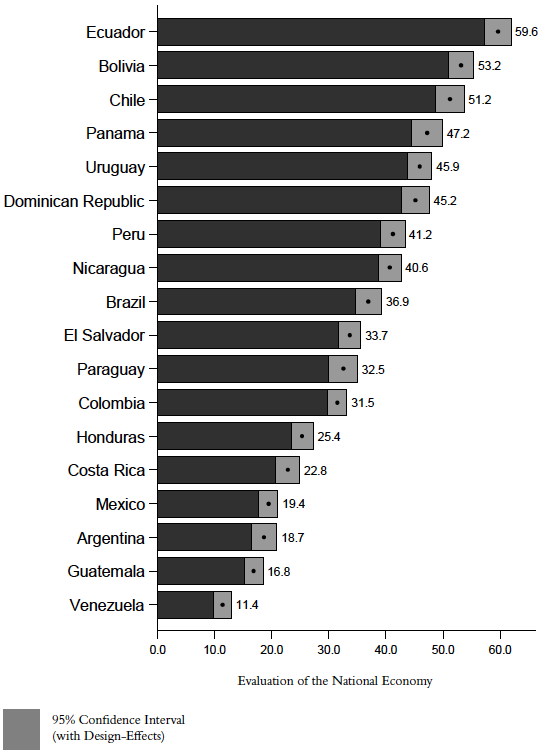
Figure 1
Economic Assessments by Country
Source: Americas Barometer, LAPOP, 2014; Version: Merged2014 v.0912

Source: Americas Barometer, LAPOP, 2014; Version: Merged2014 v0912
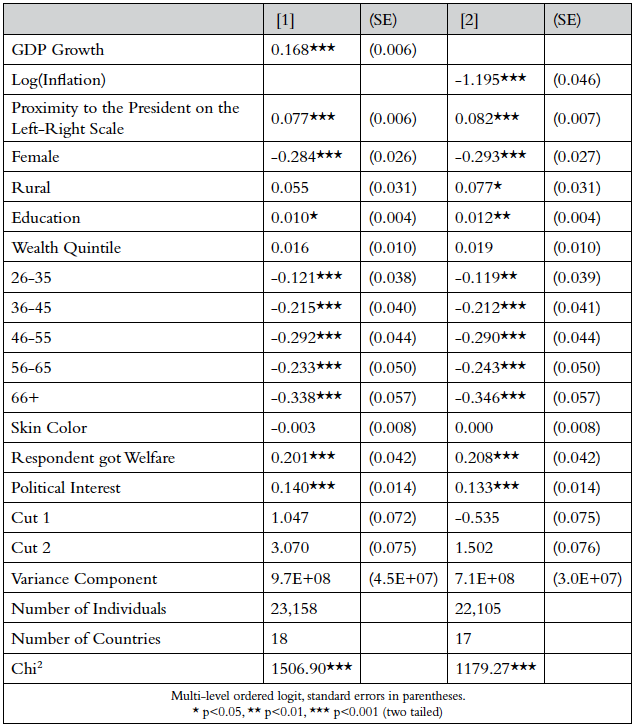
While studies of economic perceptions have been common in other regions, they remain relatively rare in the context of Latin America. The 2014 AmericasBarometer survey allows us to explore how these processes play themselves out in Latin America. In Table 2 , I model respondents’ evaluations of the national economy as a function of macroeconomic indicators, demographic factors, political predispositions to support the incumbent, and political interest. Studies of economic voting in Latin America have generally identified inflation and GDP growth as the variables that voters most heavily respond to, although recent elections have seemed to reflect the growth rate more than inflation as hyperinflation has faded ( Singer, 2013a ). Data for growth and inflation are drawn from the IMF’s World Economic Outlook database and the data for inflation are logged to reduce skew. Because the surveys were primarily taken in the second quarter of 2014, I take the weighted average of the 2013 and 2014 economic indicators to approximate the state of the economy at the time of the survey. 4 Due to limited degrees of freedom, I include growth and logged inflation separately in the models. 5 These variables are constant for all respondents in each survey year. Turning to individual-level measures, respondents who have fewer resources are expected to have more negative views of their personal finances and those personal experiences are also expected to spill over and affect evaluations of the national economy. The specific controls are for gender, income, urban/rural, age, and skin color. 6 I also include a dummy variable for whether or not the respondent received any welfare in the past year because these forms of social assistance might in turn make people optimistic about their finances as well as the national economy. I control for baseline levels of support for the incumbent by measuring the respondent’s proximity to the incumbent on the left-right scale where high values represent the respondent having a self-described left-right position that is very similar to the incumbent’s. 7 Finally, I control for political interest, scaled so that high values correspond a self-described high level of interest in politics. 8
The results of a hierarchical ordered logit modeling respondents’ evaluations of the national economy’s trend in the 12 months before the survey that takes into account clustering at the country-level and the limited degrees of freedom of the economic measures are in Table 2 . Respondents’ perceptions of the economy reflect economic trends in the country at the time of the survey: respondents in countries with high growth or with low inflation are more likely to report that the economy is improving. Differences of opinion within countries correspond to pre-existing political differences: individuals who place themselves on the left-right scale in a position similar to the president’s position are more likely to report that the economy is strong than are those who do not have an ideological predilection to support the incumbent. But they also reflect differences in respondent’s circumstances: educated and wealthy individuals tend to have more positive views of the economy as do men and younger respondents. Receiving welfare benefits from the government also tends to be associated with individuals having more positive views about the economy. Finally, the political interested also tend to be optimistic about the national economy.
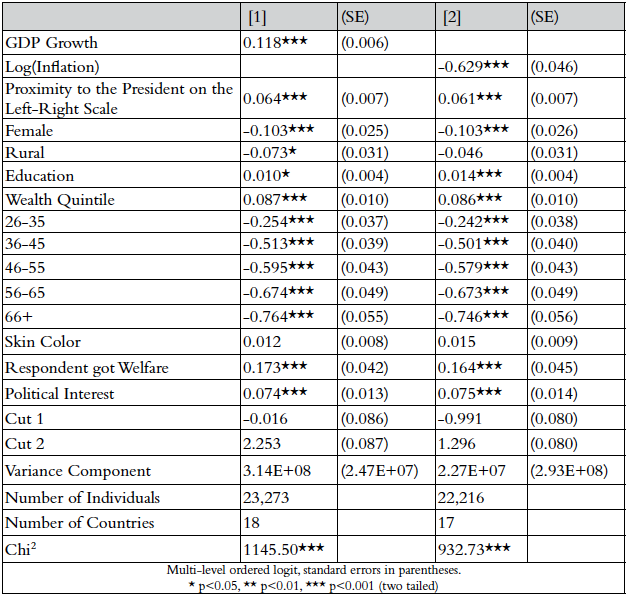
A similar set of patterns emerges when we look at how respondents evaluate their own finances ( Table 3 ): while groups systematically differ in how their finances are perceived and individuals who are close to the president on the left-right scale are more likely to report that they are doing well, individuals in countries where the economy is growing and where inflation is low are more likely to report that their household is better off now than it was a year ago.
In general, economic perceptions in Latin America behave as one would expect given the literature developed on other regions. Growth and inflation both seem to be salient in 2014, but respondents from prosperous economic circumstances and who are educated also tended to be more optimistic as are those who were receiving extra assistance from the government. Economic perceptions are also shaped by respondent’s own political predispositions. The expectation of the economic voting literature is that these evaluations of the economy’s performance should have political implications, with individuals who believe it is performing well being inclined to support the incumbent while those who are more pessimistic likely to reject the incumbent and either abstain, nullify their vote, or support an opposition party. It also suggests that on average sociotropic evaluations will have a stronger association with support for the incumbent than egotropic evaluations do. I test these basic propositions in the next section.
5. Perceptions of Economic Fluctuations Affect Attitudes toward the Incumbent Party
The main dependent variable is whether the respondent would support the incumbent in an election being held in the next few days after the survey. This question has been widely used to model how support for the incumbent shifts between elections (e.g. Duch and Stevenson, 2008 ; Singer and Carlin 2013 ) and we should see that intended support for the incumbent is a function of outcomes under his or her watch.
If the next presidential elections were being held this week, what would you do? (1) Wouldn’t vote, (2) Would vote for the incumbent candidate or party. (3) Would vote for a candidate or party different from the current administration, (4) Would go to vote but would leave the ballot blank or would purposely cancel my vote.
Theories of economic accountability have generally focused on the question of whether or not individuals are more likely to support the incumbent in good times than they are in bad. But several studies have reminded us that rejection of the incumbent may take the form of supporting an opposition party, abstaining, or casting a null vote ( Tillman, 2008 ; Weschle, 2014 ). Theories of accountability do not provide any insights about what citizens who have retrospectively rejected the incumbent will subsequently do as they choose between these alternatives. But in the models that follow we treat this variable as a nominal variable and model it using multinomial logit to evaluate how economic performance correlates with each of these alternatives in the Americas. Across the 18 countries in this sample, 36 percent of respondents intended to support the incumbent if an election were held today while 38 percent of respondents intended to support an opposition party, 16 percent said they would abstain, and 10 percent said they would cast a null vote.
As I model the association between economic perceptions and government support, I control for other factors that are also likely to affect citizens’ electoral choices. For example, the 2014 AmericasBarometer found that crime was just as likely to be mentioned as the most important issue facing respondents’ countries as economics was, thus we might expect that governments who cannot reduce crime will also be held accountable for that failing. Thus I control for respondents’ evaluations of whether crime is increasing or decreasing in their neighborhood in the year before the survey, with high values representing improvements in fighting crime, and expect that it will be positively associated with support for the incumbent. 9 I control for baseline levels of support for the incumbent by measuring the respondent’s proximity to the incumbent on the left-right scale where high values represent the respondent having a self-described left-right position that is very similar to the incumbent’s. I control for various demographic factors that might predispose respondents to support the ruling party in their country (gender, income, urban/rural, age, skin color, and religiosity). I estimate the demographic variables with slopes that allow certain groups to form part of the incumbent’s base in one country and oppose him in another (e.g. poor, nonreligious, or darker skinned voters are more likely to support left-leaning incumbents in Latin America than they are to support right-leaning incumbents; see Carlin, Singer, and Zechmeister 2015 ) by interacting them with dummy variables for each country. 10 I thus do not present the estimated coefficients for the demographic variables in the text that follows because the effect of a variable on average is meaningless unless we believe that some groups are simply naturally inclined to support the incumbent. Country-fixed effects then control for other omitted country-specific factors and clustering in the standard errors, but also mean that the results that follow explain differences in government support within countries but not across them. The baseline is supporting the incumbent president’s party so negative signs mean that the respondent is less likely to support the alternative to the incumbent in each column instead of supporting the president.
The results in Table 4 are consistent with the traditional economic voting hypothesis. On average, individuals in the hemisphere who believe the economy is improving are more likely to support the incumbent than they are to vote for the opposition, announce an intention to abstain, or consider nullifying their vote. This is true for both sociotropic and egotropic perceptions. Yet if we consider the predicted marginal effect of changing a respondent’s evaluations of these two economic factors from their minimum to the maximum while holding the other perception measure and all other variables constant, evaluations of the national economy have a substantially larger effect. For example, for a respondent that has the average value on all the other variables on the model thinks that the economy is doing poorly, the predicted probability that this person intends to support the incumbent party is 0.28. 11 If that same person believes the national economy is improving, that predicted probability becomes 0.54, and increase of 0.28. In contrast, the predicted effect of changing a respondent’s evaluation of their personal finances from their minimum to their maximum is to increase the predicted probability of supporting the president’s party by 0.11. While both personal finances and the national economy play a role in anchoring government support in Latin America and governments appear to be held accountable for their successes and failings at to generate both national prosperity and for those benefits trickling down to individual households, the national economy tends to have a larger effect.
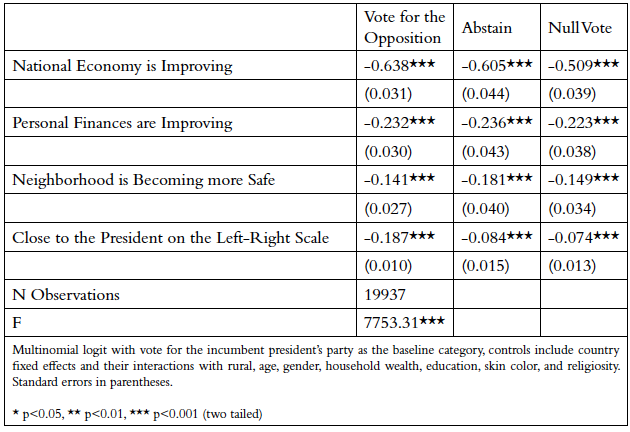
Individuals who think that the economy is good are likely to support the president. Those who think that it is doing badly have multiple options to express their dissent. The most common one is to support an alternative candidate: as perceptions of the economy go from their most positive to their most negative, the predicted probability of supporting an opposition candidate increases by 0.23. In contrast, the predicted probability on average of announcing an intention to abstain increases by 0.05 and intentions to cast a null vote increase by less than 0.01. Thus in an average respondent’s mind, the most common response to seeing that things are going badly under the current administration is to look for an alternative instead of withdrawing from the political debate. Yet those relative findings should be interpreted with care because the 2014 Americas Barometer is not an election survey and the choice set of alternatives to the president is not specified and, in some countries with volatile party systems, might not be known and so we might expect economic dissatisfaction become a larger driver of abstention or null votes as the election approaches and respondents actually have to identify an alternative to the current administration.
The predicted marginal effect of sociotropic economic is substantial. To illustrate the political impact of economic perceptions, consider that the predicted effect of changing a respondent’s self-placement on the left right scale from being as far away from the president as possible to having the exact same position as the president is to increase the predicted probability of supporting the president by 0.30, essentially the same change as the total predicted marginal effect of sociotropic evaluations. Or contrast this effect with the effect of believing that violence in the respondent’s neighborhood has gotten better in the 12 months before the survey, which as it changes from its most negative to the most positive is predicted to increase support for the president by 0.067. While crime is growing in salience in the hemisphere and its political effect may be higher than this average in some countries, voters seem to weight it less than they do economic performance on average.
The data in Table 4 model variations within countries but do not explain differences in leader support across them. So the degree to which overall levels of government support are affected by government perceptions is an open question. Yet we can use the 2014 AmericasBarometer to show that differences in economic perceptions also correlate with support for the president’s party across them as well. Ecuador had the largest share of respondents in Figure 1 who believed that the national economy was doing well, and it is not surprising that 59 percent of respondents in the 2014 AmericasBarometer said they would vote for the president’s party if an election were held that week, a proportion that is tied for the highest in the hemisphere ( Figure 2 ). The correlation between economic perceptions and vote choice is not perfect as factors specific to the country and its party system also affect the base of support for the president; support for the ruling party in Peru is low despite respondents in that country having an average evaluation of the economy that is right about the hemisphere average while respondents in Venezuela, the country with the most negative evaluations of the economy in 2014, were more willing to continue supporting the incumbent regime than one might expect given those economic perceptions. Yet in general, there is a significant, bivariate correlation (r=0.67) between perceived economic performance and average levels of support for the president’s party. 12 As individuals hold the incumbent party accountable for the perceived state of the national economy, this has an impact on their aggregate levels of support within the electorate.
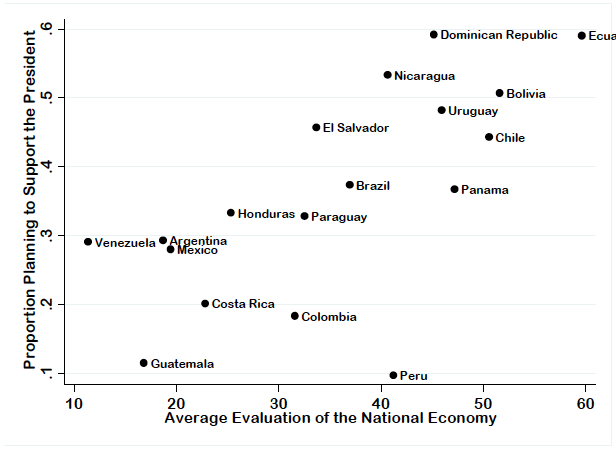
Figure 2
Aggregate Economic Perceptions and Average Levels of Support for the Ruling Party Across Countries, 2014
The Degree of Economic Voting Varies Substantially across Countries
The results in Table 4 confirm that perceptions of economic performance are an important source of incumbent support in the region. Yet the extant literature on economic voting globally (see Anderson, 2007 for a review) and on Latin America in particular (e.g. Echegaray, 2005 ; Gelineau, 2007 ; Singer and Carlin, 2013 ; Gelineau and Singer, 2015 ) suggests that economic performance should have a larger political effect in some countries than in others. The economy’s salience is not a constant and thus we should not expect voters to always make it the issue on which incumbents are judged. Moreover, in some cases it is difficult to tell whether the economy actually reflects political choices made the governing party or some other actor.
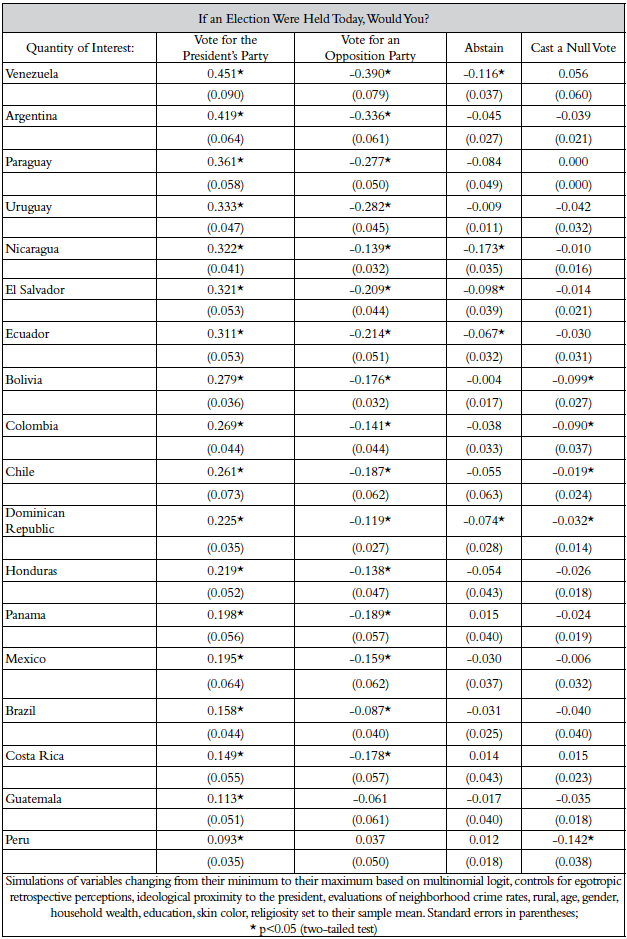
Thus in Table 5 , I return to the 2014 AmericasBarometer survey and again model what respondents say they would do if an election were held today as a function of perceived government performance, left-right proximity to the government, and demographics but this time I estimate the model separately for each country. 13 The complete results of the 18 multinomial logit models are available on the author’s website. In Table 5 , I illustrate the key findings with regards to sociotropic retrospective perceptions. Specifically, I present the estimated change in the predicted probabilities of a respondent in each country voting for the incumbent, voting for the opposition, abstaining, or planning to cast a null vote as their economic evaluations change from negative to positive when all other variables are set to their mean value using a similar methodology as I used for the predicted probabilities in the previous section. Countries are then sorted from the largest predicted economic vote to the smallest.
The first key finding from Table 5 is that economic perceptions have a statistically significant association with evaluations of the incumbent in every Latin American country. Individuals who said the economy was better than it was a year ago are more likely to say they would vote for the incumbent if an election were held today than are those who said the economy remained the same or that it had gotten worse. Economic voting is thus a consistent feature of electoral discourse and political accountability in the region.
But while the economy consistently has an effect, that effect is not constant across countries. Instead, economic perceptions have a stronger association with support for the incumbent in some contexts than others. The estimated marginal effect of economic perceptions is nearly four times larger in Venezuela or in Argentina, for example, than it is in Peru or Guatemala. Not all incumbents are being held accountable for their economic management in the same way (the ranking of countries by economic voting in 2014 differs somewhat from Gélineau and Singer’s (2015) ranking of countries by the size of their economic vote from 1995-2012. While these data agree with theirs that Venezuela, and Uruguay tend to have a large economic vote and Brazil and Costa Rica do not, historically the Dominican Republic and Peru have had a large economic vote while Paraguay and Ecuador have not. The shifts in Ecuador and Paraguay may reflect the increased consolidation of those party systems the —and the recent history of extreme economic swings in Paraguay— while Peru has seen its party system become particularly volatile in recent years. But the contrast between these two sets of data should be a reminder that while the structural variables discussed below do anchor the average level of economic voting that we see in any given context, there is still quite a bit of unexplained variance and/or noise in that relationship).
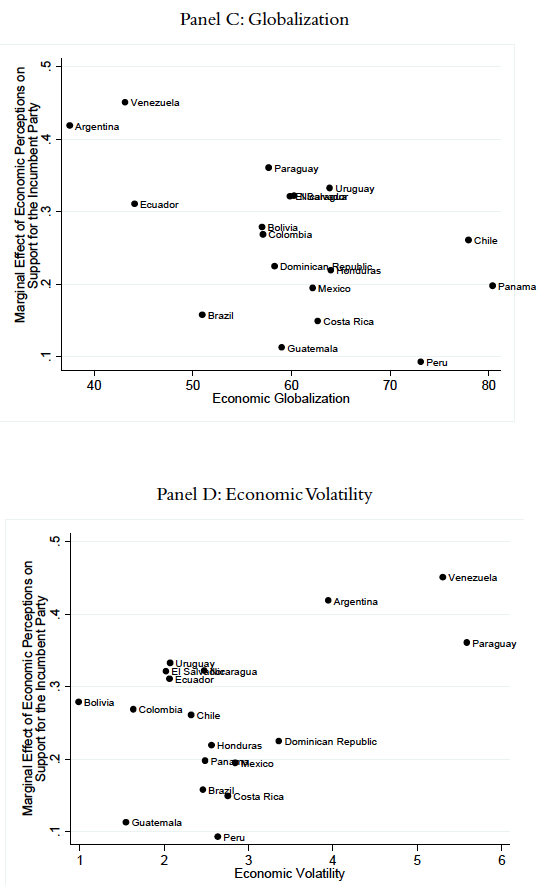
Recent studies have shown that levels of economic voting in Latin America systematically differ with levels of government political control, economic integration with the global economy, and economic volatility ( Singer and Carlin, 2013 , Gélineau and Singer, 2015 ; Carlin and Singh, 2015 ). A similar pattern emerges in the 2014 AmericasBarometer survey. Figure 3 plots the estimated marginal effect of economic perceptions on support for the president’s party as a function of the effective number of parties in the legislature (panel a), 14 the strength of the president’s legislative powers (panel b), 15 the degree of economic integration whereby high values represent more exposure to the global economy (panel c), 16 and the degree of economic volatility 17 in the country in the decade prior to the survey (panel d). Voters do seem to discount for the degree of political control the incumbent had at the time of the survey: while there are exceptions, the estimated presidential vote generally becomes attenuated as electoral fragmentation forces negotiation between political actors to achieve a legislative majority. The estimated economic vote also tends to be smaller in countries that are closely tied to the global economic system. Countries that have a recent past of economic volatility also tend to have a larger economic vote, although there are notable exceptions. The least consistent bivariate correlation is between presidential powers and accountability for economic management, although the two cases that combine high legislative powers with low levels of economic voting either have very fragmented legislatures (Brazil) or fairly high levels of global economic integration (Peru).
Thus as we look at countries like Argentina and Venezuela where economic voting in 2014 was strong, we see that they combine relatively low levels of economic globalization, high levels of economic volatility, and low to moderate levels of legislative fragmentation. With only 18 country-cases, there is limited power to engage in multi-variable analyses, but in regression analyses of the estimated marginal effect of sociotropic perceptions being changed from their minimum to their maximum on predicted support for the president all four variables have the expected sign and all but presidential powers are statistically different from 0 at the p<0.10 level or higher ( Table 6 ). Thus voters in Latin America do not respond randomly to economic fluctuations nor do they uniformly hold the president accountable for economic fluctuations-instead they focus more on the economy when it has a recent history of being difficult to manage and they at least partially take into account the degree to which the incumbent executive had the sufficient political and economic control to have economic outcomes reflect their policy initiatives and competencies.
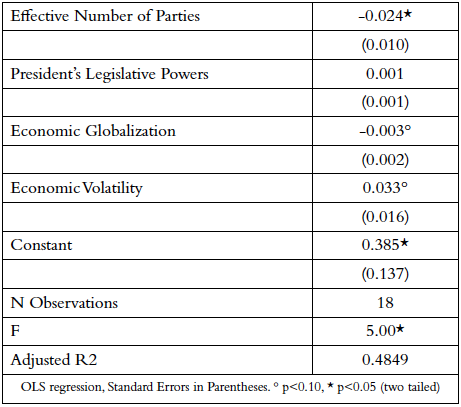
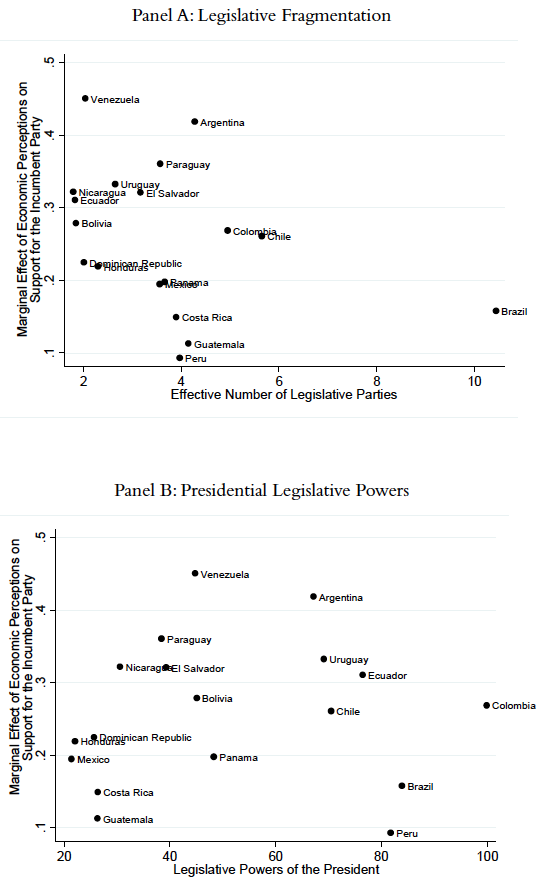
Figure 3
Variations in the Estimated Economic Vote across Contexts
The second key finding from Table 5 is that just as in the pooled model, in most cases the dominant response to believing the economy is bad is to support an alternative opposition candidate. Yet that is not uniformly the case. In Bolivia, Brazil, Colombia, Guatemala, and particularly Peru at least 25 percent of planned rejection of the incumbent if an election were held today occurs through increasing the probability of casting a null vote. In the Dominican Republic, Honduras, and particularly Nicaragua, the 2014 AmericasBarometer predicts that at least 25 percent of the change in predicted support for the incumbent as economic perceptions deteriorate occur as voters reject the incumbent but decide instead to abstain. Thus the specific form that voters’ reject of the incumbent takes does also seem to vary systematically.
There is very little cross-national work done on why anti-incumbent voters choose an opposition candidate instead of abstaining or nullifying their ballot and the existing studies find contrasting empirical results. Tillman (2008) , for example, finds that abstention emerges as the likely alternative to voting for the incumbent when the economy is bad in fragmented party systems where both the government and opposition share some responsibility for economic outcomes. Yet Weschle (2014) finds that abstention emerges as the likely response to a bad economy in unfragmented party systems where supporters of the ruling party are unwilling to switch their vote to their party’s chief rival. In analyses not reported here, I do not find any significant (p<0.10, two tailed) correlation between relative share of economic voting that occurs via abstention or null noting and the degree of legislative fragmentation or the degree to which the nation’s economy is globalized. There is some evidence in this very small sample that in volatile economic settings believing the economy is bad leads to respondents being more likely to support one of the incumbent’s rival parties instead of abstaining or casting a null ballot, but I have no theory as to why that would be the case. Understanding the choice of what voters do after they have decided to reject the incumbent is a large hole in the literature and something that scholars who are interested in the entirety of the accountability process need to pay greater attention to and develop theories about.
Conclusion
The economic voter that emerges from Latin America in 2014 is one who conforms neatly to theoretical expectations about how accountability should work. Perceptions of how the economy is doing incorporate both macroeconomic outcomes and voters’ own personal situations and partisan predispositions, which reminds us that the nature of government performance in inherently contested and is somewhat malleable in the political arena. Yet after the voter reaches a conclusion about how the national economy is going, it corresponds closely to support for the government or, in most cases, as willingness to consider an alternative. Moreover, voters appear to be considering the degree to which government actors can reasonably be held accountable for economic outcomes, thus emphasizing national economic performance over personal finances when the two diverge and giving greater weight to the economy when the president’s party is strong and international influence on the economy is constrained. Finally, the salience of the economy waxes and wanes across contexts as voters decide whether this is the most pressing political issue. Thus as voters actually hold governments accountable for their performance as it has been perceived, much of the accountability process that emerges is rational and reasonable and even sophisticated.
Yet as we look at these dynamics, a major hole in the literature on conditional economic voting in Latin America emerges in that the factors that affect the economy’s salience and attributions of responsibility for it are all structural and contextual. Yet we should also expect that political actors have an incentive to shape these processes. Campaigns should have incentives to raise the salience of performance issues on which their candidate has a perceived advantage (or their opponent has a perceived disadvantage) ( Anderson et al., 2004 ; Druckman and Holmes, 2004 ; Vavreck, 2009 ). Assessments of responsibility should also be affected by campaigns that have incentives to try to shape voter assessments of who is responsible for policy successes and who is to blame for failures and by media coverage of those issues ( Iyengar, 1994 ; Hellwig and Coffey, 2011 ).
These questions have received relatively little systematic attention outside of Latin America and even less inside of it. Two studies on Mexico ( Moreno, 2009 ; Hart, 2013 ) show that over the course of the 2006 presidential campaign, citizens brought their political attitudes into line with their assessments of the economy and that this was particularly true in areas where campaign communications highlighted the state of the economy and candidates’ proposals for strengthening it. A similar dynamic has played out in recent Brazilian elections ( Porto, 2007 ; Nunes and Meira, 2012 ). Thus there is evidence that candidates can affect the economy’s salience. But we do not know how general this phenomenon is and whether these campaign effects function in a region where access to media is uneven and where campaigns often do not explicitly highlight issues. We also do not know when candidates can shift the debate over who is responsible for economic outcomes and, in particular, while we know that voters can be persuaded to blame international financial institutions ( Alcaniz and Hellwig, 2011 ), we don’t know how politicians might be able to systematically shift blame these global actors.
Media actors are also largely missing from the models in this paper and from the larger literature on economic voting. Media coverage should affect citizen assessments of the economy as voters do not observe the national economy in total but instead have to respond to how it is covered in the press if they are going to base their opinion on anything beyond their personal experience and local area (e.g. Hetherington, 1996 ; Stevenson and Duch, 2013 ). Media coverage also should also effect the economy’s salience as they choose to cover it or other issues and political actors attempt to shape this process as well (e.g. Edwards et al., 1995 ; Kleinnijenhuis and Rietberg, 1995 ; Kelleher and Wolak, 2006 ). While we know that media effects are large in Latin America (e.g. Lawson and McCann 2004 ), there are few studies that look at how media priming shapes accountability in Latin America and how that effect varies across contexts and very little data (that I am aware of) about how the media in these countries covers the economy
Thus as the literature on economic voting continues to evolve in Latin America, we will continue to think about these basic steps in the accountability process and how they vary across voters and contexts. Yet greater attention can be taken to look at the inputs to this process on the political side and also on how the options available to voters shapes their ultimate choice between alternatives to the government.
References
Alcañiz, Isabela and Timothy Hellwig (2011) “Who’s to blame? The distribution of responsibility in developing democracies” British Journal of Political Science. vol 41, no 2, pp. 389-411.
Anderson, Christopher J. (2000). “Economic voting and political context: A comparative perspective” Electoral Studies. Vol. 19, no 6-7, pp. 151-70.
Anderson, Chrstopher (2007). “The end of economic voting? Contingency dilemmas and the limits of democratic accountability” Annual Review of Political Science. vol. 10, pp. 271-296.
Anderson, Christopher J., Silvia M. Mendes, Yuliya V. Tverdova (2004). “Endogenous economic voting: evidence from the 1997 British election” Electoral Studies. vol. 23, no 4, pp. 683-708.
Anderson, Leslie A., Michael S. Lewis-Beck, and Mary Stegmaier (2003). “Post-socialist democratization: A comparative political economy model of the vote for Hungary and Nicaragua.” Electoral Studies. vol. 22, no 3, pp. 469-84.
Arce, Moises and Julio Carrion (2010). “Presidential support in a context of crisis and recovery in Peru, 1985-2008” Journal of Politics in Latin America. vol. 2, no 1, pp. 31-51.
Arce, Moises (2003). “Political violence and presidential approval in Peru” The Journal of Politics. vol. 65, no 2, pp. 572–583.
Beltrán, Ulises (2003). “Venciendo la incertidumbre: El voto retrospectivo en la elección presidencial de julio de 2000 en México” Política y Gobierno. vol. 10, no 2, pp. 325-58.
Beltrán, Ulises (2000). “Factores de ponderación del voto retrospectivo” Política y Gobierno. vol. 7, no 2, pp. 425-42.
Benton, Allyson L. (2005). “Dissatisfied Democrats or Retrospective Voters?” Comparative Political Studies. vol. 38, no 4, pp. 417-42.
Buendía, Jorge (1996). “Economic Reform, Public Opinion, and Presidential Approval in Mexico, 1988-1993” Comparative Political Studies. vol. 29, no 5, pp. 566-91.
Buendía, Jorge (2001). “Economic reforms and political support in Mexico, 1988-1997”, In Susan Stokes (editor). Public Support for Market Reforms in New Democracies. New York: Cambridge University Press.
Canton, Dario and Jose Raul Jorrat (2002). “Economic evaluations, partisanship, and social bases of presidential voting in Argentina, 1995 and 1999” International Journal of Public Opinion Research. vol. 14, no 4, pp. 413-427.
Carlin, Ryan and Singh, Shane. (2015). "Executive Power and Economic Accountability". The Journal of Politics, vol. 77, n° 4, pp. 1031-1044.
Carlin, Ryan E., Gregory J. Love, Cecilia Martiner-Gallardo (2015). “Cushioning the fall: Scandals, economic conditions, and executive approval” Political Behavior. vol. 37, no 1, pp. 109-130.
Carlin, Ryan E., Matthew M. Singer, and Elizabeth J. Zechmeister (2015). The Latin American Voter: Pursuing Accountability and Representation in Challenging Contexts. Ann Arbor, MI: University of Michigan Press.
Carreirão, Yan de Souza. (1999). "Avaliacao do governo e voto economico". Lua Nova: Revista de Cultura Politica. n°48, pp. 213-33.
Carrión, Julio F. (1999). “Fujimori’s popularity in ordinary times, 1993-1997”, In Fernando Tuesta (editor). El Juego Político. Fujimori, La Oposición y las Reglas. Lima: Fundación Friedrich Ebert.
Córdova, Abby (2009). “Measuring relative wealth using household asset indicators and principal component analysis (PCA)” Insights Series. No 6. Nashville: Latin American Public Opinion Project, Vanderbilt University.
Cuzan, Alfred G. and Charles Bundrick (1991). “Economic and political effects on presidential popularity in Costa Rica” The Journal of Developing Societies. vol. 7, no 2, pp. 269-77.
Cuzan, Alfred G. and Charles Bundrick (1997). “Presidential popularity in Central America: Parallels with the United States” Political Research Quarterly. vol. 50, no 4, pp. 833-49.
Davis, Charles L, and Ronald E. Langley (1995). “Presidential popularity in a context of economic crisis and political change: The case of Mexico” Studies in Comparative International Development. vol.30, n°3, pp 24-48.
DeBoef, Suzanna, and Paul M. Kellstedt (2004). “The political (and economic) origins of consumer confidence” American Journal of Political Science. vol. 48, no 4, pp. 633-49.
Dominguez, Jorge, and James A. McCann (1995). “Shaping Mexico’s electoral arena: The construction of partisan cleavages in the 1988 and 1991 national elections” American Political Science Review. vol. 89, n°1, pp. 34-48.
Dreher, Axel, Noel Gaston and Pim Martens (2008). Measuring Globalisation-Gauging its Consequences. New York: Springer.
Druckman, James N. and Justin Holmes (2004). “Does presidential rhetoric matter? Priming and presidential approval” Presidential Studies Quarterly. vol. 34, no 4, pp. 755-78.
Duch, Raymond M. and Randy Stevenson (2008). Voting in Context: How Political and Economic Institutions Condition the Economic Vote. New York: Cambridge University Press.
Dutch, Raymond M., Harvey D. Palmer, and Christopher J. Anderson (2000). “Heterogeneity in perceptions of national economic conditions” American Journal of Political Science. Vol. vol. 44, n°4, pp. 635-652
Echegaray, Fabian, and Carlos Elordi (2001). “Public opinion, presidential popularity and economic reform in Argentina, 1989-1995” In Susan Stokes (Editor). Public Support for Market Reforms in New Democracies. New York: Cambridge University Press. pp. 187-214.
Echegaray, Fabian (2005). Economic Crises and Electoral Responses in Latin America. New York: University Press of America.
Edwards III, George C., William Mitchell and Reed Welch (1995). “Explaining presidential approval: The significance of issue salience” American Journal of Political Science. vol. 39, No 1, pp. 108-134.
Evans, Geoffrey and Christopher J. Anderson (2006). “The political conditioning of economic perceptions” Journal of Politics. vol. 68, no 1, pp. 194-207.
Feldman, Stanley (1982). “Economic self-interest and political behavior” American Journal of Political Science. vol. 26, n°3, pp. 446-466
Finkel, Steven E., Edward N. Muller, and Mitchell A. Seligson (1989). “Economic crisis, incumbent performance and regime support: A comparison of longitudinal data from West Germany and Costa Rica” British Journal of Political Science. vol. 19, n°3, pp. 329-351.
Gary King, Michael Tomz, and Jason Wittenberg (2000). “Making the most of statistical analyses: Improving interpretation and presentation” American Journal of Political Science.
Gélineau, Francois and Karen Remmer (2005). “Political decentralization and electoral accountability: The Argentine experience 1983-2001” British Journal of Political Science. vol. 36, no 1, pp. 133-57.
Gélineau, Francois, and Matthew M. Singer (2015). “The economy and incumbent support in Latin America”, In Ryan E. Carlin, Matthew M. Singer, and Elizabeth J. Zechmeister (editors). The Latin American Voter: Pursuing Representation and Accountability in Challenging Contexts. Ann Arbor: University of Michigan Press.
Gélineau, François (2007). “Presidents, political context, and economic accountability: Evidence from Latin America” Political Research Quarterly. vol. 60, no 3, pp. 415-428.
Gervasoni, Carlos (1998). “El impacto de las reformas económicas en la coalición electoral justicialista (1989—1995)” Boletín de la Sociedad Argentina de Análisis Político. vol. 4, n°6, pp. 67-101.
Gomez, Brad T. and J. Matthew Wilson (2005). “Cognitive heterogeneity and economic voting: A comparative analysis of four democratic electorates” American Journal of Political Science. vol. 50, no 1, pp. 127-45.
Hart, Austin (2013). “Can candidates activate or deactivate the economic vote? Evidence from two Mexican elections” Journal of Politics. vol. 75, no 4, pp. 1051-63.
Hellwig, Timothy and Eva Coffey (2011). “Public opinion, party messages, and responsibility for the financial crisis in Britain” Electoral Studies. vol. 30, no 3, pp. 417-26.
Hellwig, Timothy (2014). Globalization and Mass Politics: Retaining the Room to Maneuver. New York: Cambridge University Press.
Hetherington, Mark (1996). “The media’s role in forming voters’ national economic evaluations in 1992” American Journal of Political Science. vol. 40, no 2, pp. 372-95.
Holmes, Jennifer S. and Sheila Amin Gutiérrez de Piñeres (2013). “Security and economic voting: Support for incumbent parties in Colombian presidential elections” Democratization. vol. 20, no 6, pp. 1117-1143.
Iyengar, Shanto (1994). Is Anyone Responsible? How Television Frames Political Issues. Chicago, University of Chicago Press.
Johnson, Gregg and Sooh-Rhee Ryu (2010). “Repudiating or rewarding neoliberalism? How broken campaign promises condition economic voting in Latin America” Latin American Politics and Society. vol. 52, no 4, pp. 1-24.
Johnson, Gregg, and Leslie A. Schwindt-Bayer (2009). “Economic accountability in Central America” Journal of Politics in Latin America. vol. 1, no 3, pp. 33-56.
Kayser, M. A., & Leininger, A. (2015). "Vintage errors: do real-time economic data improve election forecasts?" Research & Politics vol. 2, n°3, pp. 1-11
Kelleher, Christine, and Jennifer Wolak (2006). “Priming presidential approval: The conditionality of issue effects” Political Behavior. vol. 28, no 1, pp. 193-210.
Kinder, Donald R. and D. Roderick Kiewiet (1979). “Economic discontent and political behavior: The role of personal grievances and collective economic judgments in congressional voting” American Journal of Political Science. vol. 23, n°3, pp. 495-527
Kinder, Donald R. and D. Roderick Kiewiet (1981). “Sociotropic politics: The American case” British Journal of Political Science. vol. 11, n°2, pp 129-161.
Kinder, Donald R., Gordon S. Adams, and Paul W. Gronke (1989). “Economics and politics in the 1984 American presidential election” American Journal of Political Science. vol. 33, no 2, pp. 491-515.
Kleinnijenhuis, Jan and Ewald Rietberg (1995). “Parties, media, the public and the economy: Patterns of societal agenda-setting” European Journal of Political Science Research. Vol. 28, no 1, pp. 95-118.
Kramer, Gerald H. (1983). “The ecological fallacy revisited: Aggregate- versus individuallevel findings on economics and elections, and sociotropic voting” The American Political Science Review. vol. 77, n°1, pp. 92-111.
Laakso, Markku and Rein Taagepera (1979). “Effective number of parties: A measure with application to West Europe” Comparative Political Studies. vol. 12, no 1, pp. 3-27.
Lau, Richard R. and David O. Sears (1981). “Cognitive links between economic grievances and political responses” Political Behavior. vol. 4, no 3, pp. 279-302.
Lawson, Chappell and James A. McCann (2004). “Television news, Mexico’s 2000 elections and media effects in emerging democracies” British Journal of Political Science. vol. 35, no 1, pp. 1-30.
Lewis-Beck, Michael S. (1988). Economics and Elections. The Major Western Democracies. Ann Arbor: University of Michigan Press.
Lewis-Beck, Michael S. and Maria Celeste Ratto (2013). “Economic voting in Latin America: A general model” Electoral Studies. vol. 32, no 3, pp. 489-93.
Luna, Juan P. (2002). “Pesimismo estructural o voto económico? Sobre la racionalidad agregada del electorado uruguayo” Revista Uruguaya de Ciencia Política. vol. 13, no 1, pp. 123-152.
Magaloni, Beatriz. 1999. “Is the PRI Fading? Economic performance, electoral accountability and voting behavior in the 1994 and 1997 elections”, in Jorge I. Domínguez and Alejandro Poiré (editors). Toward Mexico’s Democratization. Parties, Campaigns, Elections and Public Opinion. New York: Routledge.
Meneguello, Rachel (1996). “Electoral behaviour in Brazil: The 1994 presidential elections” Social Science Journal. vol. 147, n°4, pp. 627-641.
Morales, Mauricio (2008). “La primera mujer presidenta de Chile: ¿Qué explicó el triunfo de Michelle Bachelet en las elecciones de 2005-2006?” Latin American Research Review. vol. 43, no 1, pp. 7-32
Moreno, Alejandro (2009). “The activation of economic voting in the 2006 campaign”, In Jorge Dominguez, Alejandro Moreno, Chappell H. Lawson (editors). Consolidating Mexico’s Democracy: The 2006 Presidential Campaign in Comparative Perspective. Baltimore: John Hopkins University Press.
Morgan Kelly, Jana (2003). “Counting on the past or investing in the future? Economic and political accountability in Fujimori’s Peru” The Journal of Politics. vol. 65, no 3, pp. 864–880.
Negretto, Gabriel (2009). “Political parties and institutional design: Explaining constitutional choice in Latin America” British Journal of Political Science. vol. 39, no 1, pp. 117-39.
Nunes, Felipe and João Francisco Meira (n.d.). “Does the message really matter? Economy and poll rates in the 2010 Brazilian presidential election.” Working Paper. http://felipenunes.bol.ucla.edu/message.pdf
Panzer, John and Paredes, Ricardo D. (1991). “The role of economic issues in elections: The case of the 1988 Chilean presidential referendum” Public Choice. vol. 71, no 1-2, pp. 51-59.
Poiré, Alejandro (1999). “Retrospective voting, partisanship, and loyalty in presidential elections: 1994 and 1997”, In Jorge I. Domínguez and Alejandro Poiré (editors). Toward Mexico’s Democratization. Parties, Campaigns, Elections and Public Opinion. New York: Routledge.
Porto, Mauro P. (2007). “Framing controversies: Television and the 2002 presidential election in Brazil” Political Communication. vol. 24, no 1, pp. 19-36.
Powell, G. Bingham, and Guy D. Whitten (1993). “A cross-national analysis of economic voting: Taking account of the political context” American Journal of Political Science. vvol. 37, n°2, pp. 391-414
Remmer, Karen L. (1991). “The political impact of economic crisis in Latin America in the 1980s” American Political Science Review. vol. 85, no 4, pp. 777-800.
Remmer, Karen L. 2003. “Elections and economics in contemporary Latin America”, in Carol Wise and Riordan Roett (editors). Post-Reform Politics in Latin America: Competition, Transition, Collapse. Washington, D.C.: Brookings Institution.
Remmer, Karen L. and François Gélineau (2003). “Subnational electoral choice: Economic and referendum voting in Argentina, 1983-1999” Comparative Political Studies, vol. 36, n°7, pp.801-821.
Renno, Lucio and Wladimir Gramacho (2010). “Let’s blame everyone: Executive and legislative evaluations of economic performance in Brazil and Chile” Journal of Politics in Latin America. vol. 2, no 1, pp. 53-78.
Rudolph, Thomas J. (2003). “Institutional context and the assignment of political responsibility” The Journal of Politics. vol. 65, no 1, pp. 190–215.
Seligson, Mitchell A. and Miguel Gomez Barrantes (1989). “Ordinary elections in extraordinary times: The political economy of voting in Costa Rica”, In John A Booth and Mitchell A Seligson (editors). Elections and Democracy in Central America. Chapel Hill: University of North Carolina Press.
Singer, Matthew M. (2009). “Defendamos lo que hemos logrado: El voto económico en México durante la elección presidencial del 2006” Política y Gobierno. vol. especial, n°1pp. 199-236.
Singer, Matthew M. (2011). “Who says “it’s the economy?” Cross-national and crossindividual variation in the salience of economic performance” Comparative Political Studies. vol. 44, no 3, pp. 284-312.
Singer, Matthew M. (2013a). “Economic voting in an era of (non)crisis: Economic voting in Latin America 1982-2010” Comparative Politics. vol. 45, no 2, pp. 169-85.
Singer, Matthew M. (2013b). “Should nervous workers make incumbents worry about their own job prospects?: Evidence from developing countries” The European Journal of Political Research. vol. 52, no 2, pp. 143-63.
Singer, Matthew M. and Ryan E. Carlin (2013). “Context counts: The election cycle, development, and the nature of economic voting” The Journal of Politics. vol. 75, no 3, pp. 730-42.
Spanakos, Anthony P., and Lucio Renno (2006a). “Elections and economic turbulence in Brazil: Candidates, voters and investors. Latin America Politics and Society. vol 48, no 4, pp. 1-26.
Spanakos, Anthony P., and Lucio Renno (2006b). “Macroeconomia, mercado financeiro e intenção de voto para presidente: As eleições brasileiras de 1994, 1998 e 2002” DadosRevista De Ciências Sociais. vol. 49, no 1, pp. 11-40.
Stevenson, Randolph T. and Raymond Duch (2013). “The meaning and use of subjective perceptions in studies of economic voting” Electoral Studies. vol. 32, n°2, pp. 305–320
Stokes, Susan C. (1996). “Economic reform and public opinion in Peru, 1990-1995” Comparative Political Studies. vol. 44, no 5, pp. 544-565.
Telles, Edward (2014). Pigmentocracies: Ethnicity, Race, and Color in Latin America. Chapel Hill: University of North Carolina Press.
Tillman, Erik R. (2008). “Economic judgments, party choice, and voter abstention in crossnational perspective” Comparative Political Studies. vol. 41, no 9, pp. 1290-1309.
Vavrek, Lynn (2009). The Message Matters: The Economy and Presidential Campaigns. Princeton: Princeton University Press.
Weschle, Simon (2014). “Two types of economic voting: How economic conditions jointly affect vote choice and turnout” Electoral Studies. vol. 34, pp. 39-53.
Weyland, Kurt (1998). “Peasants or bankers in Venezuela? Presidential popularity and economic reform approval, 1989-1993” Political Research Quarterly. vol. 51 n°2, pp. 341-362
Weyland, Kurt (2000). “A paradox of success? Determinants of political support for president Fujimori” International Studies Quarterly. vol. 44, no 3, pp. 481-502.
Weyland, Kurt. (2003). “Economic voting reconsidered: Crisis and charisma in the election of Hugo Chávez” Comparative Political Studies. vol. 36, no , pp. 822-848.
Wiesehomeier, Nina and Kenneth Benoit (2009). “Presidents, parties and policy competition” Journal of Politics. vol. 71, no 4, pp. 1435-1447.
Footnote