Articles
Sword and Buckler in Masorah Figurata: Traces of Early Illuminated Fight Books in the Micrography of Bible, Paris, BnF, MS héb. 9
Sword and Buckler in Masorah Figurata: Traces of Early Illuminated Fight Books in the Micrography of Bible, Paris, BnF, MS héb. 9
Acta Periodica Duellatorum, vol. 9, núm. 1, pp. 1-32, 2021
Universität Bern

Esta obra está bajo una Licencia Creative Commons Atribución 4.0 Internacional.
Abstract: Two manuscripts produced in early fourteenth-century German lands reflect similar iconography of the fighting with sword and buckler; one is the well- known fencing manual, Leeds, Royal Armouries, MS I. 33, produced ca. 1320, and the other is a Hebrew manuscript of the Bible, Paris, Bibliothèque nationale de France MS héb. 9, made in 1304, which will be the focus of this article. I demonstrate that the masorah figurata iconography was adapted from German Fechtbücher (fencing manuals), which are books of instructions, usually with illustrations, that detail the fencing arts. The sword and buckler combination was used by unarmoured combatants in civilian settings and ordinary foot soldiers. Given the background of the 1298 riots known as the Rindfleisch massacres, the choice to portray the micrography figures as common combatants might well reflect the often-imminent danger that Jews faced from their bourgeois Christian neighbours.
Keywords: Bible, Fechtbuch, fencing, fight book, Hebrew, History, iconography, manuscript studies, martial arts studies, Masorah Figurata, micrography, Middle Ages, Ms. I.33, Jewish-Christian Polemic, sword and buckler.
Two manuscripts produced in early fourteenth-century German lands reflect similar iconography of the fighting with sword and buckler; one is the well-known fencing manual, Leeds, Royal Armouries, MS I. 33, produced ca. 1320 (henceforth MS I.33), and the other is a Hebrew manuscript of the Bible, made in 1304, which will be the focus of this article.1 Four figures with sword and buckler are portrayed as masorah figurata (figurative Masorah) on the lower margins of the opening page of Hebrew Bible, Paris, Bibliothèque nationale de France MS héb. 9, fols 104v-105r (figs 1-2).2 Warriors, especially knights, both Jewish and Christian, are portrayed in Hebrew manuscripts from German Lands (Ashkenaz) in miniatures and micrography.3 However, the appearance of sword and buckler fighters in Hebrew manuscripts that predate MS I.33 has received little scholarly attention, and to the best of my knowledge, there is no study on the scenes discussed here from Paris, héb. 9.4 Thus, the novelty of this essay is both in a study of an under-researched topic and in introducing early examples of sword and buckler iconography in Hebrew manuscripts.
The micrography figures in the lower margins are all wearing gloves with long cuffs, holding swords and bucklers, and have their outer garments rolled up to their waists and tucked into their belts so as to free their legs, and we can thus see the positions of their legs. As is well known to anyone who engages in martial arts, especially fencing, the leg position is crucial to maintaining balance, and here, despite the artistic limitations, the posture is quite realistic. Beyond the knowledge of how to handle a sword, what I wish to demonstrate in this article is that the iconography was adapted from German Fechtbücher (fencing manuals), which are books of instructions, usually with illustrations, detailing the fencing arts.5 First, I relate to the realia of Jews bearing arms and Jewish fencing masters.
Afterward I discuss the iconography of the fighting figures; subsequently, after examining the texts that make up the micrography, I reach a broader conclusion regarding the reason the patron commissioned this work and the meaning of the scene. This preliminary research intends to demonstrate how Hebrew illuminated manuscripts can shed more light on the study of fight book iconography.
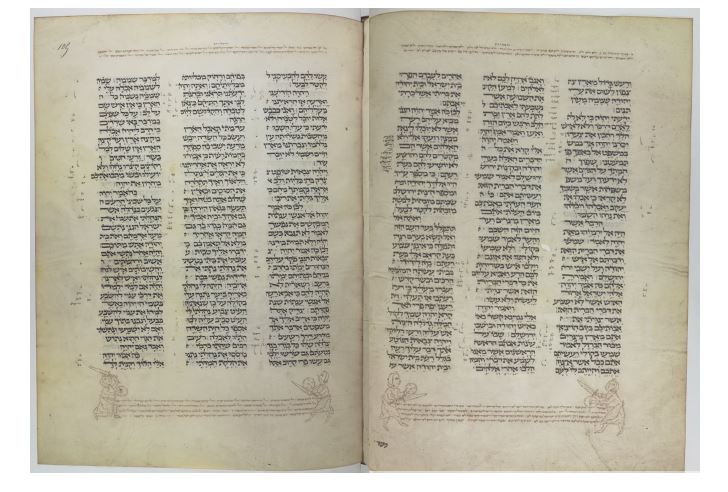
Figure 1:
Paris, Bibliothèque nationale de France héb. 9, fols 104v–105r, Germany 1304.
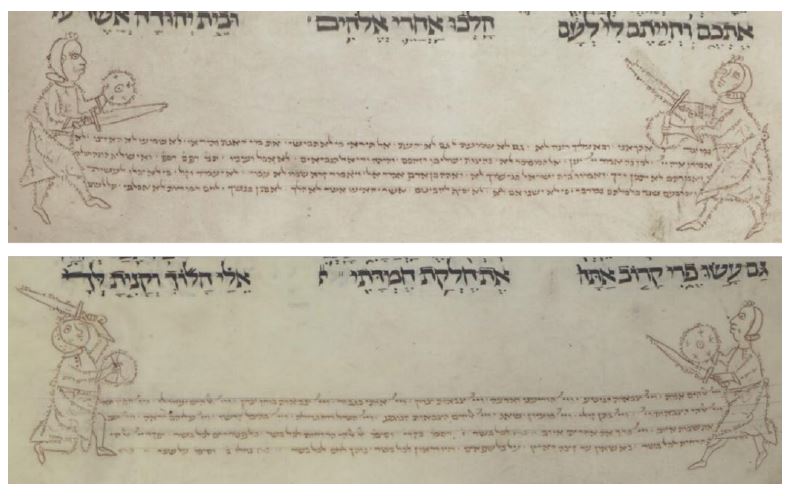
Figure 2:
Detail. Paris, BnF, MS héb. 9, fols 104v–105r
This three-volume Bible is replete with micrography, sometimes in floral or geometric motifs and sometimes images of beasts, hybrids, or human figures, some of the last identified as Jews by their hats, drawn in an iconography familiar from other Ashkenazi Bibles and mahzorim (prayer books). As not every page features micrography, when we find it, we should ask whether it was merely a decorative motif or had a particular meaning for the patron.6 At the end of the third volume, BnF, MS héb. 10, fol. 85v, the masorator (the person copying the Masorah text), Shneor b″r Ḥayyim, wrote that he copied twenty- four books (of the Hebrew Bible) for Rabbi Yaakov beRabbi Yitzḥak and finished on 22nd Tamuz 5064 (26 June, 1304).7 Nowadays, the folios measure 445–446 Í 320–325 mm, but based on this colophon page, the original dimensions must have been 500 Í 346 mm. The text is written in three columns, which also feature an Aramaic translation of the Pentateuch.8 The micrography that decorates the initial words of the opening of each of the biblical books and the masorah magna in the margins of the pages account for the entire artistic plan. As I show further on, the specific iconography of fighting figures with swords and bucklers, which is found in several different manuscripts, was a deliberate choice and reading the image together with the juxtaposed text conveys a social and religious message that goes beyond the biblical text itself.
This Bible manuscript has been described in a few studies, mainly catalogues, but to the best of my knowledge there has never been a thorough analysis of the textual and artistic content. Following Gabrielle Sed-Rajna and Malachi Beit-Arié, in an article devoted to several manuscripts, Dalia-Ruth Halperin discusses the symmetry in portraying decorative motifs as an aid to the binder so that he was able to maintain the correct order of the quires.9 I intend to further elaborate on the role of the micrography and especially the figurative images in providing a message to the viewer through an in-depth study of the micrography texts and images. As earlier studies of this manuscript do not include analyses of either the micrography-forming texts or the images found in the Bible’s margins, my challenge is to provide a comprehensive description of these elements. I also elaborate on the role of the figurative images as a visual accent on the message of the text in connection with contemporary history, especially the four fighting figures on fols 104v– 105r. Let us first begin with a short introduction on the study of Ashkenazi Bibles’ micrography.
The in-tandem study of texts and images in the micrography of Ashkenazi Bibles has received increased attention in recent years. The most cutting-edge research is presently being conducted by a group headed by Hanna Liss, which is working on the ‘Corpus Masoreticum: The Inculturation of the Masorah into Jewish Law and Lore from the 11th to the 13th Centuries: Digital Acquisition of a Forgotten Domain of Knowledge’, and will continue to do so through 2023. These scholars are exploring both the philological and artistic aspects of the Masorah and are in the process of adding an important digital humanities tool by building an accessible online database of their findings.10 It should be noted that MS. héb. 8-9-10 is not part of this project. Important methodological issues regarding Masoretic Bibles and micrography are found in recently published books by Jordan S. Penkower, David Stern, and Yosef Ofer.11
Apart from the studies of Leila Avrin, Joseph Guttmann, and Ursula and Kurt Schubert in the early 1980s, it seems that this scholarly field came to life only at the beginning of the new millennium, especially with the work of Dalia-Ruth Halperin on the fourteenth- century Catalan Mahzor.12 Recent years have also seen an ongoing interest in Ashkenazi Masoretic Bibles, as is evident in the appearance of a monograph by Élodie Attia on the micrography of MS Vatican Library, Vat. ebr. 14, copied in Rouen in 1239, and in the work of Clemens Liedtke, Hanna Liss, and Kay Joe Petzold, who have been compiling a digital edition of the complete masorah figurata in Vat. ebr. 14.13 As shown by Petzold in connection with Vat. Ebr. 14, masorah figurata occasionally feature quotations from commentary literature and midrashim that go far beyond the usual commentaries on the biblical text or even refer to different Bible commentaries, and some of the artistic motifs reflected in the micrography decoration can only be understood by reference to those texts.14
Rahel Fronda has published several articles on micrography in Ashkenazi Bibles in which she discusses the decorative program of the Erfurt Bible 2, Berlin, Staatsbibliothek Preussischer Kulturbesitz MS Or. fol. 1212, produced in the late thirteenth century, and compares it to Bible, Paris, BnF MS héb. 5-6. On the basis of similar micrographic ornamentation, one of her earlier articles suggests that the Sofer Bible, London, the David Sofer Collection, MS 1, executed in Ashkenaz in 1264, MSS Berlin, Staatsbibliothek Preussischer Kulturbesitz Or. Vols. 1–4, and the Oxford Pentateuch, Oxford, Bodleian Library MS. Canonici Or. 137, copied ca. 1300, were likely produced in the same Jewish scribal workshop, possibly in the vicinity of Würzburg.16 Clearly, then, studying a manuscript on its own is not enough, as comparing it to other manuscripts is more productive. Annette Weber discusses the meaning of the initial word micrography decorations in Ashkenazi Bibles, mostly in the Erfurt Bible 1, Berlin, Staatsbibliothek Preussischer Kulturbesitz MS Or. fol. 1211, produced in 1343, and Erfurt Bible 2 in relation to esoteric concepts found in the writings of Rabbi Judah the Pious and Rabbi Eleazar of Worms.17
In my recent book I discussed the connection between esoteric texts from Ashkenaz and the micrography of knights in Masoretic Ashkenazi Bibles. In a Bible, London, British Library MS Or. 2091, fol. 203r, produced in the second half of the thirteenth century, we find the four creatures of Ezekiel’s vision, with the human figure portrayed as a knight in full armor. This depiction can be explained by the tradition of Jacob’s image engraved upon the Throne, as the knight may illustrate the verse ’avir Ya’akov’, meaning Jacob’s guardian knight or Jacob the Knight. The association between the topos and the phrase was first noted in the thirteenth century by Rabbi Eleazar of Worms. In my work on the Erfurt Bible 2, I focused on two scenes, the first from the opening of the Book of Ezekiel and the second from the Book of Proverbs. I related them to the writings of Ḥaside Ashkenaz (German Pietists) and Rabbi Neḥemiah ben Shlomo Troestlin, the Prophet from Erfurt, who was active in the first third of the thirteenth century. Hence, the military aspects introduced in Ashkenazi texts are noticeable in the micrography of Bibles, where knights are displayed.18
When Jews were actually permitted to carry weapons, the arms indicated a high social status.19 Beyond its avowed purpose of self-defence, some Jewish Sages considered bearing a sword a mark of that status. Rabbi Eliezer’s (first–second century) rationale, as noted in Mishnah Shabbat 6:4, was that a man is allowed to carry a sword on the Sabbath because it is conceptually equivalent to a woman wearing jewelry, which is permitted; however, others among the Sages perceived the sword as signifying values that were diametrically opposed to the idea of the Sabbath, which is supposed to be a time of peace. Mainstream halakhah (Jewish law) followed this contrary judgment and Rabbi Eliezer’s opinion did not prevail during his day. However, later medieval halakhic literature relied upon his ruling and referred to the sword as an ornament or jewelry. An extensive discussion in Or Zarua, the halakhic compendium by R. Isaac Ben Moses of Vienna (ca. 1180–1250), notes that Jews used to go out on Friday nights with swords and shields, apparently to demonstrate to their high social status or to signify that they were free men (Or Zarua II, 13).20 Isaac Joseph Lifshitz explored the Jewish approach to the aesthetics of warfare along with the concept of beauty in medieval Ashkenazi texts.21 Although we might find the existence of Jewish knights an unlikely phenomenon, historians have discussed the subject as well as evidence that points to the fact that there actually were Jewish armed fighting men. Eyal Levinson, Markus J. Wenninger, and Israel Yuval have studied historical documents that relate to Jewish warriors and have identified occasional instances that featured Jewish knights, primarily in the German lands.22
It seems as though there was also some Jewish participation in the production of Fechtbücher.23 Even though the books mentioned below are dated later than the manuscript under discussion, they are clearly based on earlier traditions and reflect some likely Jewish involvement in their development. Fencing masters came primarily from the burgher classes.24 The genre of fight books flourished primarily in German-speaking lands in the late Middle Ages and in some ninety extant manuscripts, out of the thirty-six German fencing masters mentioned by name, three of them are described as Jews. Codex Lew attributed to ‛Lew the Jew’ (Jude Lew), Augsburg, Universitätsbibliothek, Cod. I.6.4°.3, ca. 1460 Bavaria (seven more manuscripts of instruction manuals have been attributed to Lew), where among other masters’ writings (including the foremost master Johannes Liechtenauer), we have Lew the Jew’s teaching on fencing in harness and on horseback.25 According to Daniel Jaquet, ‛the collection of teachings compiled by Lew the Jew is one of the main keys to understanding the lineage of the different teachings, according to the different known sources at hand for the German corpus’.26 According to Jaquet and Dierk Hagedorn, this manual was copied from the work of Master Ott, a baptised Jew, who is mentioned, for example, in the manuscripts of Paulus Kal (ca. 1420s–after 1485), which lists the principal contemporary fencing masters; among those manuscripts, the one known as München, Bayerische Staatsbibliothek, MS Cgm 1507, fol. 2v refers to ‛Master Ott, the Jew, who was the wrestler of the lords of Austria’.27
Another Jew mentioned in the German fight books is Andres the Jew (Andres Juden), a fourteenth- or fifteenth-century German longsword fencing master, who is alluded to in the Pol Hausbuch, a manuscript dated ca. 1389, now held in Nuremberg, Germanisches Nationalmuseum, MS 3227a, fol. 37r. He is mentioned after an elaborate discussion on the techniques of the famous Fellowship of Liechtenauer (Geselschaft Liechtenauers), which included seventeen fencing masters who followed the methods of the German master Johannes Liechtenauer.28 According to Eric Burkart, the heading on fol. 43r marks an explicit departure from the teachings of Master Liechtenauer, which is clear from the sentence ‛Here begin the teachings of the other masters, Hanko the priest Döbringer, Andre the Jew, Jost von der Nyssen, Niclas Prewß, etc’.29 These manuscripts are among the most important ones in the Fechtbücher genre and it is of great interest to find prominent allusions to a Jewish presence in these books. Fencing masters were probably of a high social status, so any Jewish member of this martial arts group probably took great pride in his skills and social rank.30
Beyond the interest in finding references to Jews as fencing masters in the Middle Ages, the fact that they were positioned so prominently is significant, as it allows us to assume that the images found in Hebrew illuminated manuscripts are not so farfetched in terms of ‛Jewish knights’. It may be that the patrons of some of the manuscripts that feature images of knights in a positive context belonged not only to an intellectual elite, but were also martial arts masters of rank who were glorifying their knowledge and skills.
According to Timothy Dawson, since fight books were generally commissioned by warrior aristocrats, it is likely that the artists were encouraged to a render a strong element of realism, so close attention to the details portrayed is fruitful.31 Jens Peter Kleinau offers methodological aspects that go beyond the scope of the iconography of fencing books and posits a new approach toward understanding the connection between image and text of pragmatic literature and image.32 He looks at this genre from a different perspective than the one generally engaged for illuminated books.33 Most Fechtbücher include images followed by brief instructions, and each image illustrates a martial arts technique.34 In connection with dueling postures he notes:
In the illustrations of the manuscripts from the 13th to the early 16th century we find typical poses of sword fighters that stand out of the mass as they were repeated over and over again: (a) the sword is raised high over the head symbolizing a mighty strike; (b) the sword is lifted over the right shoulder or the back for beheading as a symbol for punishing; and (c) the sword is in a death stabbing thrust to a person at the ground by a reversed grip (thumb is near to the pommel). The artists of the Fight Books used the same semiotic language as in the illustrations. … The combination of sword and buckler enters the complete corpus of illuminated manuscripts in a wide range in the first quarter of the 14th century. The combination became widely distributed in manuscripts in Europe. The images were exact reflections of the guard poses of the respective fencing book(s) of which one survived.35
In the image under discussion in Paris, héb. 9, the sword is held in the same way and, furthermore, the clothes are identical to those shown in MS I.33. As I noted earlier, all four figures are wearing gloves with long cuffs, holding swords and bucklers, and have their outer garments rolled up to their waists and tucked into their belts so as to free their legs, so we can see the positions of their legs. MS I.33, written in Latin with German terms, describes a system of combat in both text and illuminations that used a sword and buckler. The combatants are described as a priest and a student and the fact that the manuscript depicts a secular clergyman suggests that it might have been produced in a cathedral school.36 The book begins with a discussion of seven basic fighting guards, which are referred to alternately throughout the manuscript (there are some missing pages): under the arm, on the right shoulder, on the left, to the head, to the right side, to the breast, and the final one, the longpoint, where the point of the sword is extended straight out toward the opponent. Both manuscripts (Paris, héb. 9 and MS I.33), which were produced in early the fourteenth-century German lands, reflect similar iconography of the fighting postures as well as of the gloves and garments, as can be seen even in the details of the flared gloves, and the line and round decorations along the edge of the cuff. I should note that sometimes in Hebrew illuminated manuscripts, the iconography is reversed from left to right in a mirror view, so a certain known guard may be flipped in Paris héb. 9. Thus we can assume that they were copied from similar sources, perhaps model books for fighting.37 Of course, one principal difference is that in Paris, héb. 9 the illustrations do not depict close combat, as the figures are separated by the four lines of Masoretic Text.38
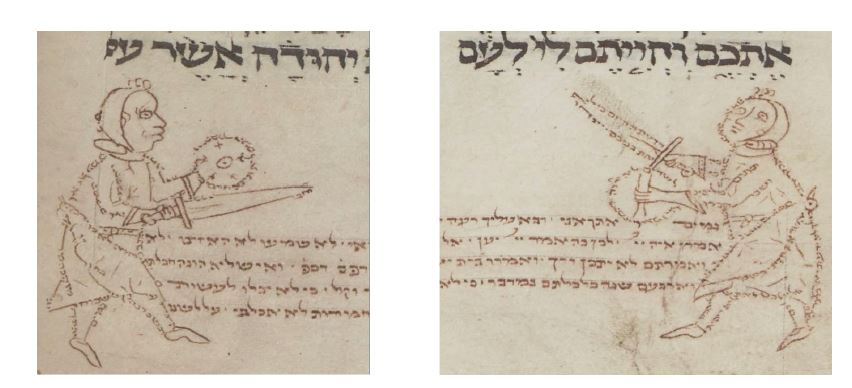
Figure 3:
Detail. Paris, BnF, MS héb. 9, fol. 104v.
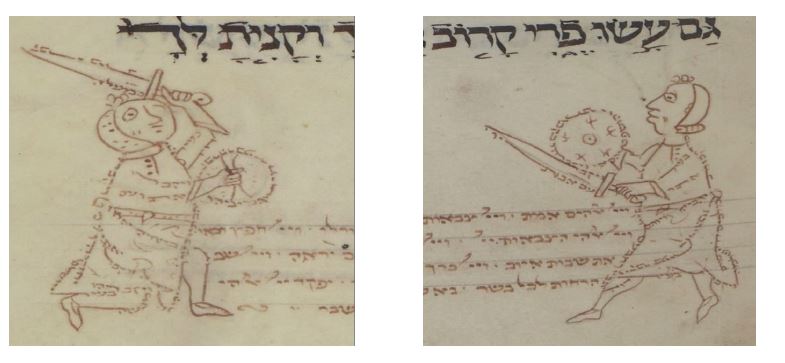
Figure 4:
Detail. Paris, BnF, MS héb. 9, fol. 105r.
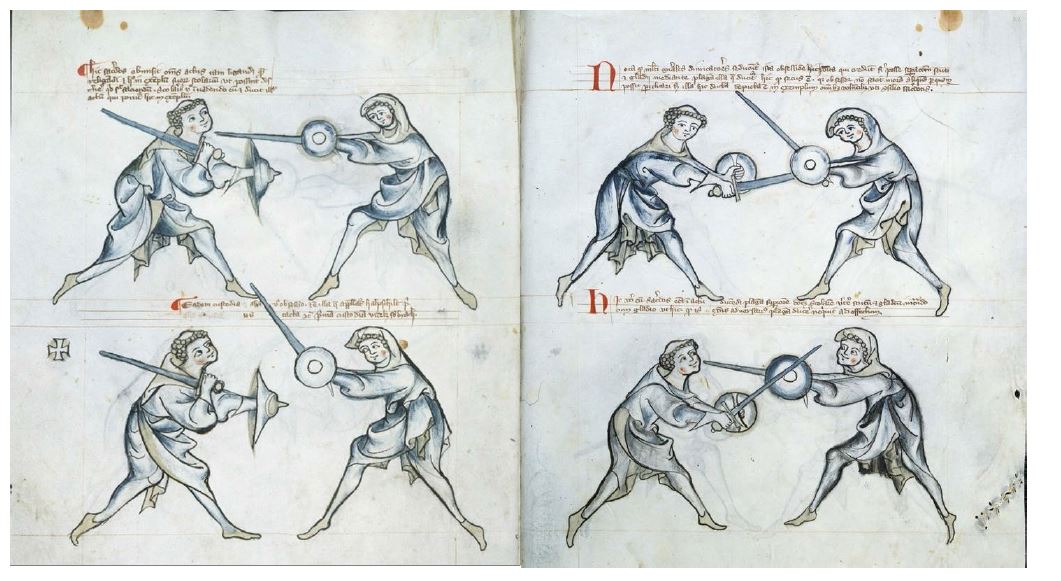
Figure 5:
Leeds, Royal Armouries, MS I. 33, fols. 10v-11r, Germany ca. 1320.
The same position of the legs is found in both manuscripts and this posture can also be seen in the well-known Codex Manesse, Heidelberg Universitätsbibliothek, Cod. Pal. Germ 848, fols 190v, 204r (figs. 6, 7), produced in Zurich, ca. 1300–1340.39 It is especially noticeable in the way that the figures’ knees are bent on fol. 204v (fig. 7). Interestingly enough, there is another colophon in Paris, BnF, MS héb. 10, fol. 85v, which was written in 1414 by Tuvia ben Shmuel, who bought the Bible in Zurich, thus bringing us a bit closer to Codex Manesse or more precisely to Zurich. We find similar iconography rendered at the same time and place as the Codex Manesse in the Siddur/SeMaQ, Vienna, ÖNB, Cod. Hebr. 75, fols 1v, 214v, produced in Lake Constance, ca. 1322, and in the Tripartite Mahzor, London, BL. MS Add. 22413, fol. 131r, Lake Constance, ca. 1322.40 Although MS I.33 is the earliest manual, according to Cinato, the oldest identified illustrations showing the same positions that are shown in the images in MS. I.33 are dated to ca. 1280, but, we do have some earlier literary references to swords and bucklers.41 He also notes that it is possible that the work on MS I.33 began earlier than 1304 since the Codex Manesse, produced in ca. 1304, has a depiction of Johann von Riggenberg (1291–1350) on fol. 190v, and his posture is probably based on the image in MS I.33.42
However, similar iconography does not necessarily mean that one was copied from the other, but rather that a common prototype copy or other fencing manuals might have been circulating in the first quarter of the fourteenth century; this is likely as we find comparable iconography in a Hebrew manuscript from around the same time and place. Evidence of an earlier iconographical model can be found in a Jewish prayer book known as the Michael Mahzor, Oxford, Bodleian Library, MS. Mich. 617, produced in the German lands (probably Franconia) in 1258 (figs 7,8).43 On fol. 4r the initial word of the liturgical poem El Mitnase features an unusual upside-down scene (fig. 8). When inverted, the panel portrays a hunt scene, with two warriors wearing great helms, one kneeling and drawing his bow and the other holding a sword and buckler. On fol. 11r we find two more fighting figures with swords and bucklers illuminating the liturgical poem Zakhor.44 As far as we know, there are no extant Christian fight books dated earlier than MS I.33, but Jewish illuminated manuscripts may shed more light on earlier references to fighting with a sword and buckler, which might enable us to trace models that later developed into the iconography of the known Fechtbücher.45
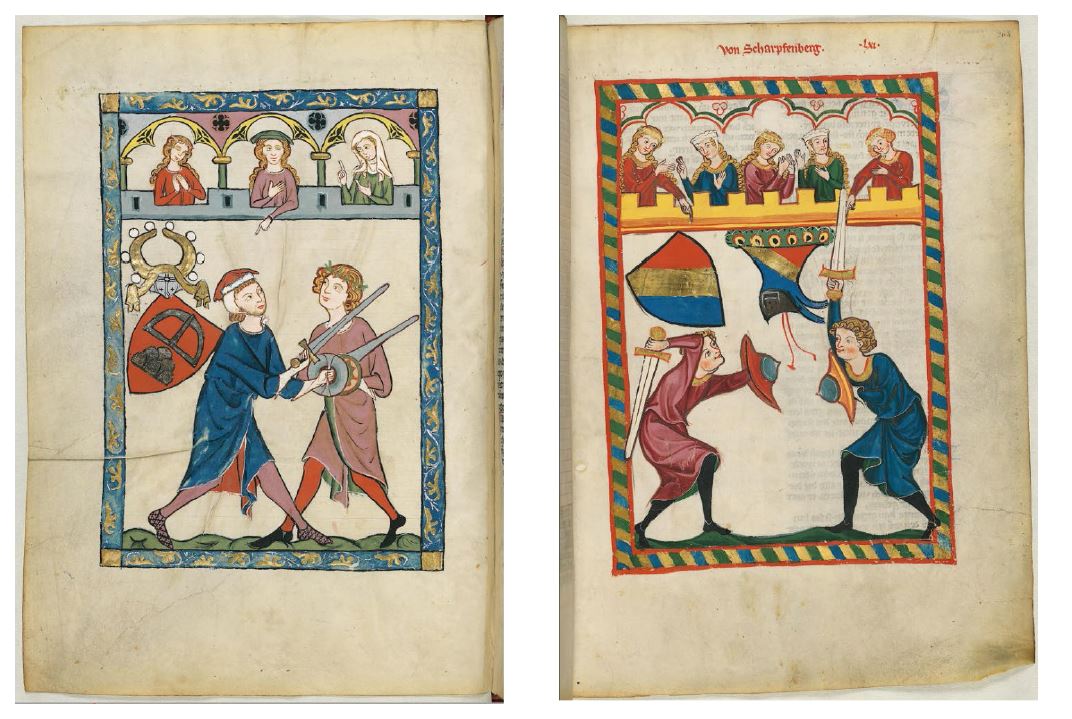
Figure 6:
Codex Manesse, Heidelberg Universitätsbibliothek, Cod. Pal. Germ 848, fols. 190v, 204r, Zurich, ca. 1300–1340.
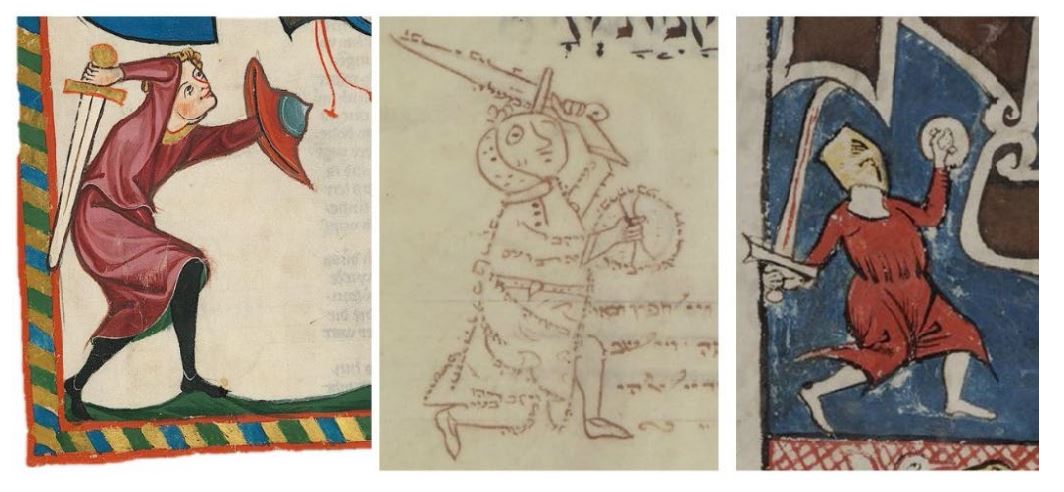
Figure 7:
Detail. Codex Manesse, fol. 204r; Detail. BnF, MS héb. 9, fol. 105r; Detail. Michael Mahzor, MS Mich. 617, fol. 4v.
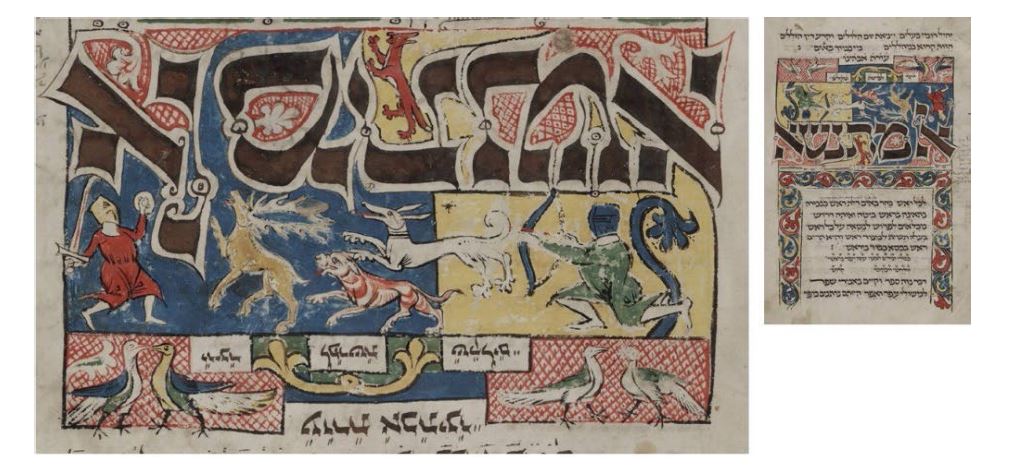
Figure 8:
Inverted page: Michael Mahzor, Oxford, Bodleian Library, MS Mich. 617, fol. 4v. Germany 1258.
I move now to a discussion of the micrography-forming verses. The text on fols 104v– 105r is from Jeremiah 10.22–13.1. The masorah magna (upper Masorah), as well as the masorah parva (between columns of text) on fol. 104v matches the MS Halle Okhla we- Okhla list #165 on the letter lamed; however, I could not find the upper Masorah on fol. 105v nor the lower Masorah, that is, the text in the micrography and between the figures, in any of the Okhla we-Okhla lists, so we can probably assume that it was compiled by the masorator and not copied from a list, at least not one that has survived.46 The text between the figures is based on verses mainly from the Prophets. On fol. 104v the immediate connection is the word ‛no’ (לא ):
When you pass through water, I will be with you (Isaiah 43.2). Evil is coming upon you. Which you will not (Isaiah 47.11). You had never heard, you had never known (Isaiah 48.8). Fear not, you shall not be shamed (Isaiah 54.4). Whom do you dread and fear (Isaiah 57.11) had never been heard or noted (Isaiah 64.3); never asked themselves, “Where is the LORD?” (Jeremiah 2.8). Assuredly, thus said the LORD: Because (Jeremiah 23.38). Shall not return to what he sold (Ezekiel 7.13). Throw their silver into the streets, and their gold (Ezekiel 7.19). My hand will be against the prophets (Ezekiel 13.9). he has not eaten [on the mountains or raised] his eyes (Ezekiel 18.16). he has not wronged anyone; he has not seized a pledge (Ezekiel 18.17). Yet you say, “The way [of the Lord] is unfair.” (Ezekiel 18.25). Yet the House of Israel say (Ezekiel 18.29). Your fellow countrymen say, [“The way of the Lord] is unfair.” (Ezekiel 33.17). Now, O mortal, say to (Ezekiel 33.10). Then He said, “Name him Lo[-ammi].” (Hosea 1.9). shall not hold his ground, And the fleet-footed (Amos 2.15). For I cannot do (Genesis 19.22). Forty years You sustained them in the wilderness (Nehemiah 9.21). For they cannot sleep unless (Proverbs 4.16); has turned away from them (Job 4.16). Happy is the man who has not (Psalms 1.1), who has never lent money at interest (Psalms 15.5). I ate no tasty food (Daniel 10.3); whose tongue is not given (Psalms 15.3).47
Further, on fol. 105r the words are ‛and the Lord’ (ʼויי):
But the LORD is truly God (Jeremiah 10.10). The LORD of Hosts, who planted (Jeremiah 11.17). The LORD informed me, and I knew (Jeremiah 11.18). O LORD of Hosts, O [just] Judge (Jeremiah 11.20). But the LORD is with me like a mighty warrior (Jeremiah 20.11). O LORD of Hosts, You who test the righteous (Jeremiah 20.12). But the Lord GOD will help me (Isaiah 50.7). But the LORD chose to crush him (Isaiah 53.10). Yet the LORD, the God of Hosts, [Must be invoked as] “LORD.” (Hosea 12.6). And the LORD roars aloud (Joel 2.11). And the LORD will roar from Zion (Joel 4.16). It is my Lord the GOD of Hosts. At whose touch (Amos 9.5). But the LORD cast a mighty wind (Job 1.4). And the LORD will manifest Himself to them (Zechariah 9.14). The LORD restored Job’s fortunes (Job 42.10). Thus the LORD blessed the latter years of Job’s life (Job 42.12). No flesh (Jeremiah 12.12). O God, Source of the breath of all flesh (Numbers 16.22). The first issue of the womb of every being (Numbers 18.15). Let the LORD, source of the breath of all flesh, appoint someone (Numbers 27.16). Tumult has reached the ends of the earth (Jeremiah 25.31). Upon all the bare heights (Jeremiah 12.12). They shall be a horror to all flesh (Isaiah 66.24). reaped thorns (Jeremiah 12.13). not concerned (Amos 6.6).48
The relationships between the verses are quite reasonable, as the words are connected by one word following another in a chain of similar words (or words written in the same manner, even if their meanings are different), even if the word is part of the verse but not copied in the folio. For example, תראי is the Hebrew word for both looking and fearing, but it has different meaning in each verse: ‛you had never heard, you had never known (Isaiah 48.8). Fear not, you shall not be shamed’ (Isaiah 54.4). Another example can be seen in the use of verses from the same chapter: ‛yet you say, “The way [of the Lord] is unfair”ʼ (Ezekiel 18.25), and immediately after, the appearance of a verse from the same chapter, but with the repeating words omitted: ‛yet the House of Israel say [“The way of the Lord is unfair.”]’ (Ezekiel 18.29).
Since the import of the image is related not only to the copied words, but also to the relevant complete verse (or even the chapter), I reproduce the micrography-forming verses in their entirety and mark the words used for the masorah figurata in bold (the original Hebrew text is in the footnotes). Not all the words composing the image are based on Jeremiah 10–13 but most of them were taken from there. The following verse is connected to the main text of Jeremiah 11.22: ‛assuredly, thus said the LORD of Hosts: “I am going to deal with them: the young men shall die by the sword, their boys and girls shall die by famine”’. I suggest that the choice of particular verses for the micrography was intended to relate not only to the words of Jeremiah, but also to the meaning of the opening page with its focus on the sword and the danger that the prophecy warns against.
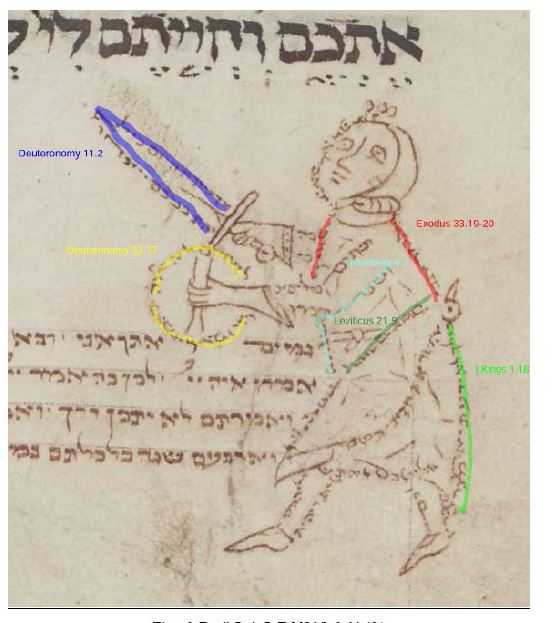
Figure 9:
Detail. Paris, BnF, MS héb. 9, fol. 104v.
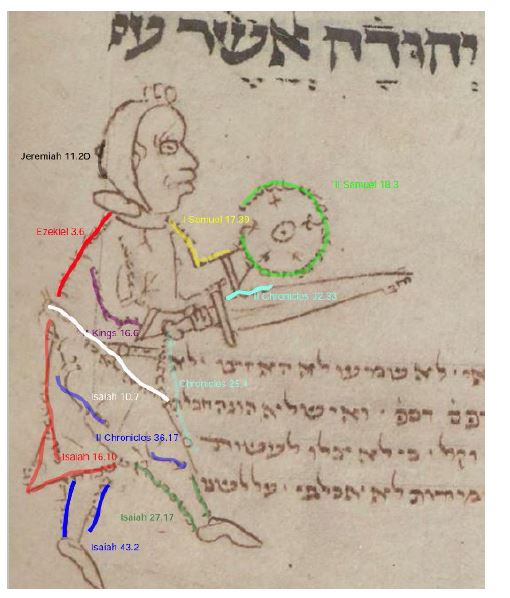
Figure 10:
Detail. Paris, BnF, MS héb. 9, fol. 104v.
On fol. 140v (fig. 9), the sword in the hand of the figure on the right is based on Deuteronomy 11.2: ‛take thought this day that it was not your children, who neither experienced nor witnessed the lesson of the LORD your God – His majesty, His mighty hand, His outstretched arm’.49 The buckler is based on Deuteronomy 32.17; 25: ‛they sacrificed to demons, no-gods, Gods they had never known, new ones, who came but lately, who stirred not your fathers’ fears. … The sword shall deal death without, As shall the terror within, to youth and maiden alike, the suckling as well as the aged’.50 The neck is based on Exodus 33.19-20: ‛and He answered, “I will make all My goodness pass before you, and I will proclaim before you the name LORD, and the grace that I grant and the compassion that I show”. But, He said, ”you cannot see My face, for man may not see Me and liveʼ”.51The abdomen is based on Numbers 6.3: ‛he shall abstain from wine and any other intoxicant; he shall not drink vinegar of wine or of any other intoxicant, neither shall he drink anything in which grapes have been steeped, nor eat grapes fresh or dried’.52 The garments’ folds are based on Leviticus 21.5: ‛they shall not shave smooth any part of their heads, or cut the side-growth of their beards, or make gashes in their flesh’.53The back is based on Kings I 1.18: ‛yet now Adonijah has become king, and you, my lord the king, know nothing about it’.54
For the figure on the left (fig. 10), the coif contains only one word from Jeremiah 11.20:‛O LORD of Hosts, O just Judge, Who tests the thoughts and the mind, let me see Your retribution upon them, for I lay my case before You’.55 The lower part of the garment is based on II Chronicles 36.17: ‛He therefore brought the king of the Chaldeans upon them, who killed their youths by the sword in their sanctuary; he did not spare youth, maiden, elder, or graybeard, but delivered all into his hands’.56 The lower garment and the right leg are based on Isaiah 27.17: ‛when its crown is withered, they break; women come and make fires with them. For they are a people without understanding; that is why their Maker will show them no mercy, their Creator will deny them grace’.57 The left leg is based on Isaiah 43.2: ‛when you pass through water, I will be with you; through streams, they shall not overwhelm you. When you walk through fire, you shall not be scorched; through flame, it shall not burn you’.58
The abdomen of the figure on the left is based on II Chronicles 25.4, which is also used for the figures on fol. 105: ‛but he did not put their children to death for [he acted] in accordance with what is written in the Teaching, in the Book of Moses, where the LORD commanded, “Parents shall not die for children, nor shall children die for parents, but every person shall die only for his own crime”’.59 The margins and lower part of the garment are based on Isaiah 16.10: ‛rejoicing and gladness are gone from the farmland; in the vineyards no shouting or cheering is heard. No more does the treader tread wine in the presses. The shouts have been silenced’.60 The upper back of the garment is based on Ezekiel 3.6: ‛not to the many peoples of unintelligible speech and difficult language, whose talk you cannot understand. If I sent you to them, they would listen to you’.61
The garment’s folds are based on Isaiah 10.7: ‛but he has evil plans, his mind harbors evil designs; for he means to destroy, to wipe out nations, not a few’.62 The right arm is based on II Kings 14.6: ‛but he did not put to death the children of the assassins, in accordance with what is written in the Book of the Teaching of Moses, where the LORD commanded, “Parents shall not be put to death for children, nor children be put to death for parents; a person shall be put to death only for his own crime”ʼ.63 The left arm (holding the shield) is based on I Samuel 17.39: ‛David girded his sword over his garment. Then he tried to walk; but he was not used to it. And David said to Saul, “I cannot walk in these, for I am not used to them”. So David took them off’.64 The sword includes two words: the upper one, ‛tombs’, is associated with the verses used to design the figures on fol. 105r based on II Chronicles 32.33.
The appearance of the word on the top of the swords suggests an attempt at a correction, as the ink is thicker there and perhaps it was meant to be ‛his sword’ (חרבו) but the resh was replaced with a heth so it reads ‛his length’ (.(רחבו The buckler is based on II Samuel 18.3: ‛but the troops replied, “No! For if some of us flee, the rest will not be concerned about us; even if half of us should die, the others will not be concerned about us. But you are worth ten thousand of us. Therefore, it is better for you to support us from the town”ʼ.65
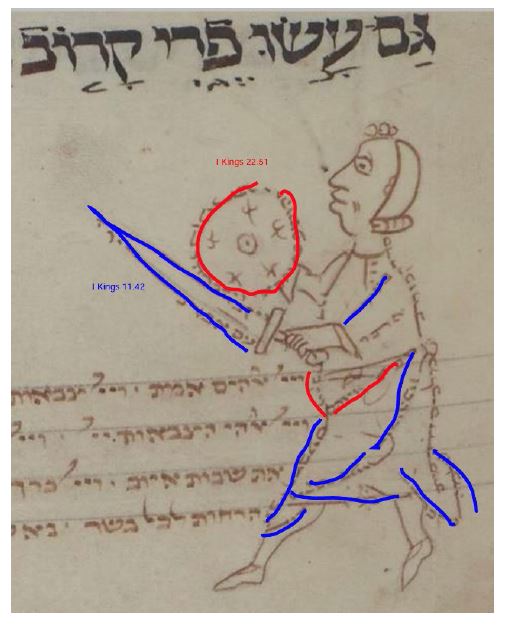
Figure 11:
Detail. BnF, MS héb. 9, fol. 105r.
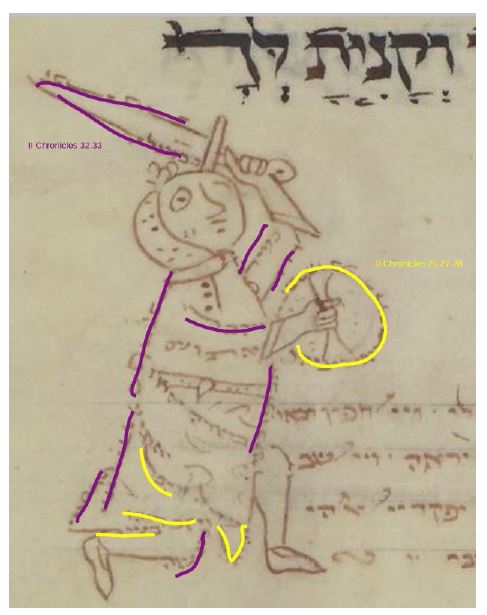
Figure 12:
Detail. BnF, MS héb. 9, fol. 105r.
The text of the masorah figurata on fol. 105r (fig. 11) is based on Jeremiah 12:12: ‛spoilers have come upon all the bare heights of the wilderness. For a sword of the LORD devours from one end of the land to the other; no flesh is safe’.66 The phrase that dominates the chosen Masorah is the ‛sword of the LORD’. The figure on the right is based on I Kings 11.42: ‛Solomon slept with his fathers and was buried in the city of his father David; and his son Rehoboam succeeded him as king’.67 It is also based on I Kings 22.51: ‛Jehoshaphat slept with his fathers and was buried with his fathers in the city of his father David, and his son Jehoram succeeded him as king’.68
The figure on the left (fig. 12) is based on II Chronicles 32.33: ‛Hezekiah slept with his fathers and was buried on the upper part of the tombs of the sons of David. When he died, all the people of Judah and the inhabitants of Jerusalem accorded him much honor. Manasseh, his son, succeeded him’.69 The buckler is based on II Chronicles 25.27–28: ‛from the time that Amaziah turned from following the LORD, a conspiracy was formed against him in Jerusalem, and he fled to Lachish; but they sent men after him to Lachish and they put him to death there. They brought his body back on horses and buried him with his fathers in the city of Judah’.70
In this manuscript, the masorah figurata in the Book of Jeremiah are imaged in clothes that are not typically identified with any group or religion, unlike those on fols 111v–112r, which are wearing Jewish hats, and are thus specifically identified as Jewish.71 As the texts imply, the figures with the swords were supposed to evoke fear in the hearts of the viewers, as they might have represented the inhabitants of the non-Jewish urban space; in other words, the imagery might point to the Jews’ fear of their Christian neighbors.
David Stern deals with the issue of the close relationship between the Christian illuminated manuscripts and Hebrew illuminated Bibles, especially in France and Germany. He contends that when discussing Hebrew manuscripts:
[T]here is no question that they mirror Christian book art of the period. Rather than viewing them as mere “borrowings,” however, it might be more correct to characterize them, along with the other material features of the Ashkenazic Bible, as deliberate appropriations of gentile culture on the part of Jewish scribes, that is to say, active efforts to Judaize the imagery of their surrounding gentile culture.72
Thus, if our manuscript seems to follow the Christian artistic preference in book illumination, it is likely that it was done that way to enhance the viewer’s fear and sense of danger. In the words of Hans Robert Jauss:
The historical essence of the work of art lies not only in its representational or expressive function but also in its influence … literature and art only obtain a history that has the character of a process when the succession of works is mediated not only through the production subject but also through the consuming subject.73
We should take into account the message that the Book of Jeremiah conveyed to readers/viewers in the context of contemporary Jewish-Christian relations in the German lands.
The sword and buckler were used by unarmoured combatants in civilian settings and ordinary foot soldiers and were carried for self-defence. Thus, the figures in the micrography were deliberately portrayed as commoners, rather than as aristocratic or knightly warriors.74 As early as 1189, we find restrictions on walking the streets of London with a sword, buckler, or other arms unless ‛he be a substantial person of good reputation or other respectable person of note’. Moreover, according to the tax registry, at the end of the thirteenth century, there was a fencing school in Paris. In the Liber Albus, a thirteenth-century book of common law:
It is also forbidden that any person shall be so daring as to be found going or wandering about the streets of the City after curfew … with sword or buckler, or with other arms for doing mischief whereof evil suspicion may arise, or in any other manner; unless it be some great lord or other substantial person of good reputation, or a person of their household, who from them shall have warranty, and who is going from one to another with a light to guide him.75
Therefore, the choice to portray non-aristocratic warriors and not even knights but common combatants might suggest the often imminent danger the Jews faced from their bourgeois neighbors. The manuscript was produced six years after the 1298 riots known as the Rindfleisch massacres, so we may find in this micrography an echo of the pogrom’s outcome, especially as the text of Jeremiah and the micrography-forming verses tell of severe judgment and harsh prophecy; the emphasis is on the sword that brings death.76 As the masorator also created the image, even though someone else might have designed it, we see a tight link between the text and the image it forms. A thorough examination of the texts and the images in this Bible could bring us closer to understanding the message behind the artistic program and lead to further implications in connection with Jewish-Christian relations in early fourteenth-century Germany.
BIBLIOGRAPHY
Primary sources
Berlin, Staatsbibliothek Preussischer Kulturbesitz, MS Or. fol. 1211 (Erfurt Bible 1, Erfurt, 1343) <https://www.nli.org.il/he/manuscripts/NNL_ALEPH000175262/NLI#$FL36489992> [accessed 28 May 2021]
Berlin, Staatsbibliothek Preussischer Kulturbesitz, MS Or. fol. 1212 (Erfurt Bible 2, Erfurt, thirteenth century) <https://web.nli.org.il/sites/NLIS/he/ManuScript/Pages/Item.aspx?ItemID=PNX_MANUSCRIPTS990001752630205171&SearchTxt=erfurt%201212> [accessed 28 May 2021]
Berlin, Staatsbibliothek Preussischer Kulturbesitz, MS Or. Vols. 1–4 (Hebrew Bible, Germany, thirteenth century)
Copenhagen, Det Kongelige Bibliotek, MS Thott.290.2º (Hans Talhoffer, Talhoffer Fechtbuch, 1459) <https://wiktenauer.com/wiki/Index:Talhoffer_Fechtbuch_(MS_Thott.290.2%C2%BA)> [accessed 28 May 2021]
Heidelberg, Universitätbibliothek, Cod. Pal. Germ. 848 (Codex Manesse, 1300-40) [accessed 3 November 2020]
Leeds, Royal Armouries, Fecht 01 (olim MS I.33) (Anonymous, Liber de Arte Dimicatoria, late thirteenth century) [accessed 3 November 2020]
London, British Library, MS add. 11639 (London Miscellany, Northern France, ca. 1280) [accessed 28 May 2021]
London, British Library, MS Add. 22413 (Tripartite Mahzor, Lake Constance, ca. 1322) [accessed 28 May 2021]
London, British Library, Add MS 47682 (Holkham Bible, England c. 1327-35) [accessed 28 May 2021]
London, the David Sofer Collection, MS 1(Sofer Bible, Germany, 1264)
London, British Library, MS Or. 2091 (Hebrew Bible, Germany, thirteenth century) [accessed 28 May 2021]
Milan, Ambrosiana, B. 32 Inf. (Ambrosian Bible, Germany, 1236-38)
München, Bayerische Staatsbibliothek, MS Cod. hebr. 235 (The Yiddish Bellifortis, Southern Germany, around 1500) [accessed 28 May 2021]
Oxford, Bodleian Library, MS. Mich. 617 (Michael Mahzor, Franconia, 1258) [accessed 3 November 2020]
Oxford, Bodleian Library MS. Canonici Or. 137 (Oxford Pentateuch, Germany, ca. 1300) [accessed 28 May 2021]
Paris, BnF, MS héb. 5-6 (Hebrew bible, Germany, 1295) [accessed 28 May 2021]
Paris, BnF, MS héb. 8-9-10 (Hebrew bible, Germany, 1304) [accessed 3 November 2020]
Vatican Library, Vat. ebr. 14 (Hebrew Bible, Rouen, 1239) [accessed 28 May 2021]
Vienna, ÖNB, Cod. Hebr. 75 (Siddur/SeMaQ, Lake Constance, ca. 1322) <https://web.nli.org.il/sites/NLI/Hebrew/digitallibrary/pages/viewer.aspx?&presentorid=MANUSCRIPTS&docid=PNX_MANUSCRIPTS990001692590205171-1#|FL22126584 > [accessed 28 May 2021]
Secondary literature
Achnitz, Wolfgang and Frank Fürbeth, Deutsches Literatur-Lexikon Das Mittelalter. Band 6, Das wissensvermittelnde Schrifttum bis zum Ausgang des 14. Jahrhunderts (Berlin and Boston: de Gruyter, 2014)
Alexander, John, Medieval Illuminators and their Methods of Work (New Haven: Yale University Press, 1992)
Assaf, Lilach, ‛Names, Identifications, and Social Change Naming Practices and the (Re-) Shaping of Identities and Relationships within German Jewish Communities in the Late Middle Ages’ (unpublished doctoral thesis, University of Konstanz, 2016)
Avrin, Leila, ‛Micrography as Art’, Bibliotheca Orientalis, 43 (1981), 377–88
Avrin, Leila, Scribes, Script, and Books: The Book Arts from Antiquity to the Renaissance (Chicago: American Library Association; London: British Library Chicago, 1991)
Attia, Élodie, The Masorah of Elijah ha-Naqdan: An Edition of Ashkenazic Micrographical Notes (Berlin and Boston: de Gruyter, 2015)
Barco, Javier del, Bibliothèque nationale de France: Hébreu 1 à 32: Manuscrits de la Bible hébraïque (Turnhout: Brepols, 2011)
Berthold, Cornelius, ‛Marginalised Fighting: Depictions of Sword & Buckler Fencers in 13th and 14th Century Manuscript Miniatures from Europe’ (Unpublished Paper).
Bodemer, Heidemarie, ‛Das Fechtbuch: Untersuchungen zur Entwicklungsgeschichte der bildkünstlerischen Darstellung der Fechtkunst in den Fechtbüchern des mediterranen und westeuropäischen Raumes vom Mittelalter bis Ende des 18. Jahrhunderts’ (unpublished doctoral thesis, University of Stuttgart, 2008)
Boffa, Sergio, Les manuels de combat (Fechtbücher et Ringbücher) (Turnhout: Brepols, 2014)
Burkart, Eric, ‛The Autograph of an Erudite Martial Artist: A Close Reading of Nuremberg, Germanisches Nationalmuseum, Hs. 3227a’, in Late Medieval and Early Modern Fight Books Transmission and Tradition of Martial Arts in Europe (14th–17th Centuries), ed. by Daniel Jaquet, Karin Verelst, and Timothy Dawson (Leiden: Brill, 2016), pp. 451-80
Cassen, Flora, Marking the Jews in Renaissance Italy: Politics, Religion and the Power of Symbols (Cambridge: Cambridge University Press, 2017)
Cinato, Franck, ‛Development, Diffusion and Reception of the “Buckler Play”: A Case Study of a Fighting Art in the Makingʼ, in Late Medieval and Early Modern Fight Books Transmission and Tradition of Martial Arts in Europe (14th–17th Centuries), ed. by Daniel Jaquet, Karin Verelst, and Timothy Dawson (Leiden: Brill, 2016), pp. 481-546
Cinato, Franck and André Surprenant, ‛L’escrime à la bocle comme méthode d’autodéfense selon le Liber de Arte dimicatoria’, in L'art du combat chevaleresque: le maniement des armes à travers les traités de combat (XIVe - XVIe siècles), ed. by Daniel Jaquet (Neuchâtel: Éditions Alphil-Presses universitaires suisses, 2013), pp. 81-89
Cinato, Franck and André Surprenant, Le livre de l’art du combat: Liber de arte dimicatoria (Paris: CNRS Éditions, 2015)
Codex Manesse: Die Große Heidelberger Liederhandschrift, Kommentar zum Faksimile des Cod. Pal. Germ. 848 der Univeritätsbibliothek Heidelberg, ed. Walter Koschorreck and Wilfried Werner (Frankfurt am Main: Insel Verlag, 1981)
Dawson, Timothy, ‛Before the Fight Books: Identifying Sources of Martial Techniques in Antique and Medieval Art’, in Late Medieval and Early Modern Fight Books Transmission and Tradition of Martial Arts in Europe (14th–17th Centuries), ed. by Daniel Jaquet, Karin Verelst, and Timothy Dawson (Leiden: Brill, 2016), pp. 31-46
Díaz Esteban, Fernando, Sefer ʹOklah wĕ-ʹOklah: Colección de listas de palabras destinadas a conservar la integridad del texto hebreo de la Biblia entre los judios de la Edad Media (Madrid: Consejo Superior de Investigaciones Científicas, 1975)
Edge, David and John Miles Paddock, Arms & Armor of the Medieval Knight: An Illustrated History of Weaponry in the Middle Ages (New York: Crescent Books, 1996)
Forgeng, Jeffrey L., The Medieval Art of Swordsmanship Royal Armouries MS I.33 (Leeds: Royal Armouries, 2018)
Frensdorff, Salomon, Das Buch Ochlah W’ochlah (Massora) (Hannover: Hahn’sche Hofbuchhandlung, 1864)
Fronda, Rahel, ‛Attributing of Three Ashkenazi Bibles with Micrographic Images’, Ars Judaica, 9 (2013), 45–56
Fronda, Rahel, ‛Micrographic Illustrations in a Group of Thirteenth Century Hebrew Bibles from Germany’, in Hebräische Schrift zwischen Juden-und Christentum in Mittelalter und früher Neuzeit: Beiträge zur 45. Internationalen Hebräischlehrerkonferenz (IÖKH) vom 8. bis 10. Mai 2015 in Erfurt. (Kleine Untersuchungen zur Sprache des Alten Testaments und seiner Umwelt 21), ed. by Peter Stein (Kamen: Hartmut Spenner, 2016), pp. 37–73
Garel, Michel, ‛Un ornement propre aux manuscrits hébreux médiévaux: la micrographie’, Bulletin de la Bibliothèque nationale, III (1978), 158–66
Garel, Michel, D'une main forte: Manuscrits hebreux des collections francaises (Paris: Seuil, 1992)
Grayzel, Solomon, The Church and the Jews in the XIIIth Century (New York: Jewish Theological Seminary of America, 1966)
Gutmann, Joseph, ‛Masorah Figurata: The Origins and Development of a Jewish Art Form’, in Sacred Images: Studies in Jewish Art from Antiquity to the Middle Ages, ed. by Joseph Gutmann (Northampton: Variorum Reprints, 1989), pp. 49–62
Hagedorn, Dierk, ‛German Fechtbücher from the Middle Ages to the Renaissance’, in Late Medieval and Early Modern Fight Books Transmission and Tradition of Martial Arts in Europe (14th–17th Centuries), ed. by Daniel Jaquet, Karin Verelst, and Timothy Dawson (Leiden: Brill, 2016), pp. 247-79
Halperin, Dalia-Ruth, ‛Decorated Masorah on the openings between quires in Masoretic Bible manuscripts’, Journal of Jewish Studies, 65 (2014), 323-48
Halperin, Dalia-Ruth, Illuminating in Micrography: The Catalan Micrography Mahzor–MS Hebrew 8o 6527 in the National Library of Israel (Leiden: Brill, 2013)
Halperin, Dalia-Ruth, ‛Micrography’, Encyclopedia of the Bible and Its Reception 18 (2020), p. 1179
Hils, Hans-Peter, Meister Johannes Liechtenauers Kunst des Langen Schwertes (Frankfurt am Main: Lang, 1985)
Isaac Ben Moses of Vienna, Complete Or Zarua, (Hebrew) ed. Shalom Y Ḳlain and Avraham Marinberg, (Or Etzion: Merkaz Shapira, 2001-2013)
Jaquet Daniel, ‛European Fight Books 1305-1630: Classification, Typology and Comparison’, Acta Periodica Duellatorum, 8 (2020), 5-24
Jaquet Daniel, ‛The Collection of Lew the Jew in the Lineage of German Fight Books Corpus’, Acta Periodica Duellatorum, 5 (2017), 151-62
Jaquet, Daniel, and Bartlomiej Walczak, ‛Lignitzer, Hundsfeld or Lew? The Question of Authorship of Popular Medieval Fighting Instructions’, Acta Periodica Duellatorum, 3 (2014), 105-48
Jauss, Hans Robert, Toward an Aesthetic of Reception (Minneapolis: University of Minnesota Press, 1982)
Jude Lew: Das Fechtbuch, ed. and trans. by Dierk Hagedorn (Herne: VS-Books Torsten Verhülsdonk, 2017)
Kleinau, Jens Peter, ‛Visualised Motion: Iconography of Medieval and Renaissance Fencing Books’, in Late Medieval and Early Modern Fight Books Transmission and Tradition of Martial Arts in Europe (14th–17th Centuries), ed. by Daniel Jaquet, Karin Verelst, and Timothy Dawson (Leiden: Brill, 2016), pp. 88-116
Levinson, Eyal ‛“Those Who Grow their Forelocks and Wear the Clothes of a Knight”: Young Jewish Men in Medieval Germany, between Rabbinical Masculinity and Chivalric Masculinity’, (in Hebrew) Chidushim, 21 (2019), 14-46
Liepe, Lena Eva, ‛The Study of the Iconography and Iconology of Medieval Art: A Historiographic Survey’, in The Locus of Meaning in Medieval Art: Iconography, Iconology, and Interpreting the Visual Imagery of the Middle Ages, ed. by Lena Eva Liepe (Kalamazoo: Medieval Institute Publications, Western Michigan University, 2019), pp. 16–45
Lifshitz, Joseph Isaac, ‛War and Aesthetics in Jewish Law’, in War and Peace in Jewish Tradition: From the Biblical World to the Present, ed. by Yigal Levin and Amnon Shapira (New York: Routledge, 2012), pp. 103-15
Lipton, Sara, Dark Mirror: The Medieval Origins of Anti-Semitic Iconography (New York: Henry Holt Metropolitan Books, and Company, 2014)
Liss, Hanna, ‛Introduction: Editorial State of the Art of the Masoretic Corpus and Research Desiderata’, in Philology and Aesthetics: Figurative Masorah in Western European Manuscripts, ed. Hanna Liss and Jonas Leipziger (Frankfurt, New York and Oxford: Peter Lang, 2021), pp. 3-39
Liss, Hanna, and Kay Joe Petzold, ʻDie Erforschung der westeuropäischen Bibeltexttradition als Aufgabe der Jüdischen Studienʼ, in Judaistik im Wandel: Ein halbes Jahrhundert Forschung und Lehre über das Judentum in Deutschland Herausgegeben, ed. by Andreas Lehnardt (Berlin and Boston: De Gruyter, 2017), pp. 189–210
Lotter, Friedrich, ‘Die Judenverfolgung des “König Rintfleisch in Franken um 1298”’, Zeitschrift für historische Forschung, 15 (1988), 385–422
Magin, Christine, ‛Armed Jews in Legal Sources from The High and Late Middle Ages’, Jewish Studies, 41 (2002), 67-81
Miller, Matthias, Karin Zimmermann, and Pamela Kalning, Die Codices Palatini germanici in der Universitätsbibliothek Heidelberg (Cod. Pal. germ. 671-848) (Wiesbaden: Harrassowitz Verlag, 2016), pp. 705-727
Neubauer, Adolf, Catalogue of the Hebrew Manuscripts in the Bodleian Library and in the College Libraries of Oxford(Oxford, 1886–1906)
Norman, Vesey, The Medieval Soldier (Havertown: Pen and Sword, 2010)
Ofer, Yosef, The Masora on Scriptures and Its Methods (Berlin and Boston: de Gruyter, 2019)
Offenberg, Sara, ‛Animal Attraction: Hidden Polemics in Illustrations of Biblical Animals in the Michael Mahzor’, Interfaces: A Journal of Medieval European Literatures, 5 (2018), 129-153 [accessed 4 November 2020]
Offenberg, Sara, Illuminated Piety: Pietistic Texts and Images in the North French Hebrew Miscellany (Los Angeles: Cherub Press, 2013)
Offenberg, Sara, Up in Arms: Images of Knights and the Divine Chariot in Esoteric Ashkenazi Manuscripts of the Middle Ages (Los Angeles: Cherub Press, 2019)
Ognibeni, Bruno, Sefer ‘Oklah we ‘oklah: edizione del ms. Halle, Universitätsbibliothek , 2 Y b 4 10, ff. 68–124 held in Madrid in the Instituto de Filología del CSIC Departamento de Filología Bíblica y de Oriente Antiguo (Fribourg: Université de Fribourg, 1995)
Patton, Pamela A., and Henry D. Schilb, ‛Introduction’, in The Lives and Afterlives of Medieval Iconography, ed. by Pamela A. Patton and Henry D. Schilb (University Park: The Pennsylvania State University Press, 2020), pp. 1–8
Penkower, Jordan S., Masorah and Text Criticism in the Early Modern Mediterranean: Moses Ibn Zabara and Menahem de Lonzano (Jerusalem: Magnes Press, 2014)
Petzold, Kay Joe, ‛Rashi in the Masorah: The Figurative Masorah in Ashkenazi Manuscripts as Parshanut’, in Philology and Aesthetics: Figurative Masorah in Western European Manuscripts, ed. by Hanna Liss and Jonas Leipziger (Frankfurt, New York, and Oxford: Lang, 2021), pp. 203–24
Riley, Henry Thomas, Liber Albus: The White Book of the City of London (London: Richard Griffin, 1862)
Rubin, Miri, Gentile Tales: The Narrative Assault on Late Medieval Jews (New Haven: Yale University Press, 1999)
Scheller, Robert W., Exemplum: Model-Book Drawings and the Practice of Artistic Transmission in the Middle Ages (ca. 900–ca. 1470), trans. by Michael Hoyle (Amsterdam: Amsterdam University Press, 1995)
Schiendorfer, Max, and Karl Bartsch, Die Schweizer Minnesänger. Nach der Ausgabe von Karl Bartsch neu bearbeitet und herausgegeben (Tübingen: Tübingen:Niemeyer, 1990), pp. 139-47
Schubert, Ursula and Kurt Schubert, Jüdische Buchkunst (Graz: Akademische Druck- und Verlagsanstalt, 1983)
Seemann, Sebastian, ‛The Okhla Lists in MS Berlin Or. Fol. 1213 (Erfurt 3)’, in: Philology and Aesthetics: Figurative Masorah in Western European Manuscripts, ed. by Hanna Liss and Jonas Leipziger (Frankfurt, New York, and Oxford: Peter Lang, 2021), pp. 275–99
Sed-Rajna, Gabrielle, Les manuscrits Hébreux enluminés des Bibliothèques de France (Paris: Peeters, 1994), pp. 187-91
Sefer Hasidim, ed. by Jehuda Wistinetzki (Frankfurt am Main: M.A. Wahrmann, 1924)
Shalev-Eyni, Sarit, Jews among Christians: Hebrew Book Illumination from Lake Constance (London: Harvey Miller, 2010)
Shatzmiller, Joseph, ‛Fromme Juden und christlich-höfische Ideale im Mittelalter’, Arye-Maimon-Vortrag an der Universität Trier, 7 November 2007 (Trier: Trier Universität, 2008), 9–29
Sirat, Colette, and Malachi Beit-Arié, Manuscrits medievaux en caracteres Hebraiques portant des indications de date jusqu’a 1540 (Paris and Jerusalem: Centre National de la Recherche Scientifique and Israel Academy of Sciences and Humanities, 1972–86)
Soloveitchik, Haym, ‛Catastrophe and Halakhic Creativity: Ashkenaz—1096, 1242, 1306 and 1298’, Jewish History, 12 (1998), 71–85
Stern, David, ‛The Hebrew Bible in Europe in the Middle Ages: A Preliminary Typology’, Jewish Studies: An Internet Journal, 11 (2012), 1–88
Stern, David, The Jewish Bible: A Material History (Seattle: University of Washington Press, 2018)
Talhoffer, Hans, Fight Earnestly: Fight-Book from 1459 by Hans Talhoffer, ed. and trans. by Jeffrey Hull (2007) 361–62 [accessed 6 August 2020]
Talhoffer, Hans, Medieval Combat in Colour: Hans Talhoffer’s Illustrated Manual of Sword Fghting and Close-Quarter Combat from 1467, ed. by Dierk Hagedorn and Mark Rector (Barnsley: Greenhill Books, 2018)
Tlusty, Ann B., The Martial Ethic in Early Modern Germany: Civic Duty and the Right of Arms (New York: Palgrave Macmillan, 2011)
Under the Influence: The Concept of Influence and the Study of Illuminated Manuscripts, ed. by John Lowden and Alixe Bovey (Turnhout: Brepols, 2007)
Verelst, Karin, Timothy Dawson, and Daniel Jaquet, ‛Introduction’, in Late Medieval and Early Modern Fight Books Transmission and Tradition of Martial Arts in Europe (14th–17th Centuries), ed. by Daniel Jaquet, Karin Verelst, and Timothy Dawson (Leiden: Brill, 2016), pp. 7-27
Wayno, Jeffrey M., ‛Rethinking the Fourth Lateran Council of 1215’, Speculum, 93 (2018), 611–37
Weber, Annette, ‛The Masoret Is a Fence to the Torah: Monumental Letters and Micrography in Medieval Ashkenazi Bibles’, Ars Judaica, 11 (2015), 7–30
Wenninger, Markus J., ‛Von jüdischen Rittern und anderen waffentragenden Juden im mittelalterlichen Deutschland’, Aschkenas, 13 (2003), 35-82
Yuval, Israel Jacob, ‛A German-Jewish Autobiography of the Fourteenth Century’, Binah, 3 (1994), 79-99
Yuval, Israel Jacob, ‘Rabbinical Perspectives on the Bearing of Weapons by the Jews’, Jewish Studies, 41 (2002), 51-55
Notes