Special Issue
LEARNING TO BE FREED Affective Multimodalities in Third Space
LEARNING TO BE FREED Affective Multimodalities in Third Space
Tsantsa, vol. 27, pp. 58-77, 2022
Universität Bern

Esta obra está bajo una Licencia Creative Commons Atribución-NoComercial 4.0 Internacional.
Abstract: This paper delves into the life stories of three unaccompanied asylum seeking youth residing at a state care shelter in Istanbul in 2015 and 2016. Through its intervention, the research follows an engaged anthropological approach to reveal the hidden aspects of the youth’s emotional and intellectual worlds. The in-depth life stories shared here illuminate Homi Bhabha’s Third Space Theory (1994) and are amplified by a methodological approach we call affective multimodalities. As we seek to understand the various ways the youths navigate survival and learning to be freed from institutional categories, we explore a few concepts of Third Space Theory: extraterrestrial territories, paradoxical worlds, afterliferebirth, and a displaced angle of vision. Through the practice of a collaborative radio show and photography elicitations, the youth were asked to share their dreams as they were encouraged to realize their potentials. During this co-creative approach, one of the youth even became a co-author of this paper. The ethnographic insights produced through this approach allows us to explore the third space theory with a poetical reflection through words and images.
Keywords: freedom, third space, affective multimodalities, engaged anthropology, asylum seekers, Turkey.
Introduction: Locating the shelter in third space
Our research is located at a fluctuating space of peace, harmony, and conflict at a shelter for unaccompanied asylum seeking youth (Çocuk ve Gençlik Destek Merkezi, here after listed as ÇOGEM) in the Yeldegirmeni Neighbourhood in Istanbul, Turkey.1 This paper asks how life unfolds for unaccompanied asylum-seeking youth as a site of both encounters and contradictions. It explores the kinds of space which the youth move through, in defining and transforming their lives from barriers to enacting new possibilities and beginnings.
Field work included four months within the shelter and subsequently following youths’ lives for another six months with on and off visits to the neighbouring area and to the city.2
A radio program was proposed to the Ministry as a social and emotional support activity. This proved to be a significant point of entry into the structures, everyday practices, and performances of the unaccompanied asylum seeking youth.3 Its realization in 2015 also overlapped with the largest movement of unaccompanied asylum-seeking youth towards Europe. As the project progressed, Turkey had begun to draft the EU & Turkey deal application processes. This took place in the context of violence and trauma resulting from critical events that happened only months apart in 2015–2016: the EU-Turkey deal, the attempted Turkish coup d’état, and the subsequent state of emergency (Strasser and Tibet 2019)
Eighteen staff members worked in the shelter; two social workers, a psychologist, a Turkish language teacher, a sports teacher, two gatekeepers, four housekeepers, two cooks, and four clerks. Approximately sixty minors resided in the shelter at the time of our fieldwork. Numbers would sometimes go up to ninety over night, with the arrival of large Afghan groups which were frequent at that time. Many youth at ÇOGEM had tried to cross the Mediterranean Sea to Europe several times and failed. During the peak of the Mediterranean Sea crossings in 2015, minors themselves often interpreted for new minors arriving at the shelter. Their efforts helped define the avenues of access for migrant youth. In doing so, they also shaped our primary research questions which this paper addresses by sharing their life stories. How did those who arrived, departed, and those who stayed collide and engage with each other? What kind of spaces did they create in defining and transforming their lives from barriers they face to enacting new possibilities and beginnings? How did they learn to be freed from institutional categories they constantly found themselves in, whilst strategizing for their survival?
In this paper we understand ÇOGEM as a distinct liminal space , which may be considered what Homi K. Bhabha calls a third space (1994). Bhabha calls on his interlocutors to create a third space defined by processes of dissent, dialogue, conversation, strategy, and craft. Through the use of deconstructive politics, he locates each subject in a position of differentiality, where meaning is neither isolated to the discursive space of the one, nor in the counter-discursive space of the other. Rather a third space emerges (Chakrabarti 2012, 25).
r-discursive space of the other. Rather a third space emerges (Chakrabarti 2012, 25). Bhabha’s most recent work, furthermore, addresses the problematics of agency with the poetics of translation of migrant experiences (Sahay 1996, 227). Bhabha builds on the work of Fanon, contemporary postcolonial poetry, the fiction of Salman Rushdie and Toni Morrison (Sahay 1996, 227).
The poetics of translation and the migrant experience is particularly clear through Abdi Deeq’s photographic lens. Aged 17 at the time of fieldwork, he became a key person not only in translating from Somali language, but also played a major role in informing and inspiring our ethnographic and theoretical engagement. Abdi’s work illustrates the third space illuminating youthful contemporary refugee experiences through three transformative migration trajectories of Abbas, Ramen, and Abdi himself.
Transformative third space
Youth often spoke about their migration journeys as transformative. Yet, what do their life stories tell us about what transformation means? Abbas Karimi’s story of transformation and stance towards life illustrate what Bhabha calls an after-life, a re-birth (Bhabha 1994, 13). Abbas Karimi was an armless teenager from Afghanistan, who has since then become a Paralympic swimming champion after resettling in the US. His story of migration and transformation sheds light on the influence of will power, mind power, and resilience in translating and deconstructing what both disability and refuge means.
Bhabha’s concepts of paradoxical worlds and extraterrestrial territories (Bhabha 1994, 13) is explored through Ramen’s life story, a talented Iranian teen, who dreamed of becoming a famous football player, but now makes a living as a facilitator within smuggling networks for other migrants. Paradoxical worlds invite discussions between hospitality and hostility and the right to neighborliness.
A central feature of the third space created with Abdi Deeq is the issue of representation and the co-creation of a new ethics of seeing evoking what Bhabha calls a displaced angle of vision (Bhabha 1994, 36). With Abdi Deeq’s contribution, we go beyond the illustration and reflection of Bhabha’s Third Space Theory. Our understanding of engaged anthropology, is to be not only a reflexive and critical science, but to be an active engagement that positions itself and creates/ transforms the social world we inhabit. We see Abdi Deeq’s contribution as an attempt to create a Third Space as his images explore identity, belonging, and place making through the liminal spaces of refuge and migration. We consider Abdi’s artwork as a transformative and liberating tool; created in the shelter, it carries the third space into the world as a counter-narrative to the mainstream media discourses on asylum seeking youth
Accordingly, this paper seeks to create space for the emerging new meanings created by asylum-seeking youth.4We argue that the various multimodalities of engaged youth participatory action research can contribute to the making of a third space that goes beyond the discursive space and scene of the other.
Arrivals, departures, and translators
Minors who stayed in the shelter for longer periods watched those who were arriving and departing, just as we would. Among them, only a few were attending high school. While they were planning their upcoming migration journeys, they had to cope with the everyday tasks of schooling. They were experiencing a great deal of anxiety; forced to reflect on their situation, they were constantly reminded of their previous failed attempts of crossing the Mediterranean that took them to the brink of death. We became aware that those with whom we spoke were the ones who had survived.
Over the following months, we learnt that many of the minors who left the centres failed with their attempts to reach Europe and returned to ÇOGEM. They were either pushed back, deported, or detained in removal centres. After spending every penny on facilitators, many returned with no savings left, and found themselves broke. Remaining under state protection was understood to be a shield against possible deportations. This period was often referred to by the asylum-seeking youth on their way to Europe as “time loss”, “waste of time”, “being stuck”, “waiting zone”, “a station”, “a temporary stop”, “being in transit”, and “a twist of fate”. Nonetheless, in instances of hostile or “bad” behavior, state care protection was not always a fully preventive mechanism against deportations and involuntary repatriations from the country. Being in such a shelter required extraordinary strength in coping with chronic uncertainty and precarity, as well as the added burden of a particular expectation of “good behavior”. The shelter was a paradox; while it was a place to pass time and avoid deportation, it also served as a deportation centre
Within the permanent upheaval of arrival, departure, and staying, the act of translation – in its literal sense – provided a mutual understanding and enabled a grounded space to make sense out of all that was occurring. It was thus more than just a tool for communication and survival. The importance of translation, its full meaning and how it informed our way to engage with theory became clearer during our fieldwork.
Abdi Deeq – co-author of this paper – was the only Somali translator in the shelter. He spoke five languages: Somali, Arabic, Farsi, Turkish, and English. This made him not only competent in receiving Afghans, but also a key person for Syrians, Palestinians, and Iraqis. His inherent interest in getting to know the differences among cultures and his contentment in living amidst diversity made him the most acclaimed and well-equipped keyholder and gatekeeper to this amazingly vivid world of migrating youth. Abdi Deeq’s photo elicitations (Harper 2002) were an important tool for our research.5 His work evokes the story of ÇOGEM and its inhabitants, and complements the radio programs, where we featured the life stories of the youth (Tibet 2018a).
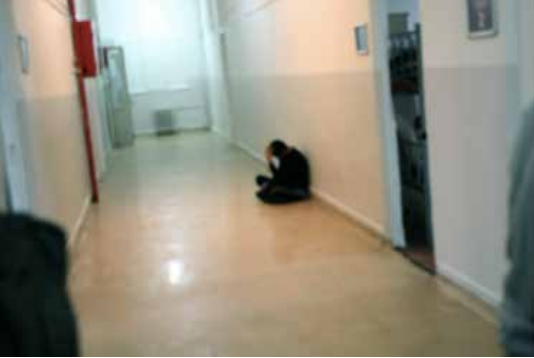
Deeq’s photograph “Lost in translation” is a good introduction to the importance and relevance of translation. Adbi describes the situation captured by the photograph a year later as he elicitates and voices:
Lost in Translation
Some boys arrive on their own, with no friends or relatives, solely on their own. Once there was a Sri Lankan aged 14, he cried non-stop for ten days; he was not able to communicate with anyone. He was Tamil and no one spoke his language here and also no one spoke it in Turkey, it was extremely difficult for him. I tried my best to use Google Translator or something to understand why he was here and what was going on with him. He suffered immensely, he was lost. (Abdi Deeq, October 2015, Istanbul)
Being lost in translation was a common experience for those who arrived in a new country and did not speak any language other than their own, though being lost was much more than a problem of language. It was the result of the many breakdowns the youth had to endure during migration. The loss of family ties, being subjected to systematic violence, imprisonment, and in some cases even to torture. Many youth were not able to communicate with words and expressed their feelings through their bodies. Some of them described it as if they became distanced from their very own being. One informant expressed this experience “as if my soul has migrated from my body” (Afghan minor, 15).
Affective multimodalities: Beyond categories
During their migration trajectories, the asylum-seeking youth are categorized in many different ways by the various actors in the field: as a legal definition, a humanitarian category, a group “at risk”, or “becoming a risk” (Malkki 2010, 63). However, the voices of the youth themselves are often lacking. Through a co-creative epistemological positioning on knowledge production in the field of engaged anthropology today, we critically engage with postcolonial discourse on how hierarchical categories of analysis can risk contributing to boundaries between “us”, as scholars, and “them”, as migrants (Brubacker 2013, Anderson 2013). The methodological approach, which we termed affective multimodalities, amplifies the voices of the youth in an affective tone as it recognizes and sees them in their full humanity and in their potential of becoming whom they dream to become.
In our workshops, we considered and encouraged the youth to be active learners with agency to overcome hostile encounters and paradoxical categorizations. In doing so, we switched from one medium to the other. The instant switchability comes with the requirement of having to improvize according to different needs and situations in the rapidly changing dynamics of their environment and psyche. This flexibility underscores what muldimodality is and can be, allowing an effortless and dialogical meeting of a diverse range of talents, needs, and inclinations. While some of the youth were more into performances via music sharings and singing, or into one-to-one or duo conversations at radio programs, some were more comfortable sharing their stories through silent modes of meaning creations via photography and its elicitations. Our efforts switched among all sorts of visual, aural, tactile media, platforms, collaborative sites, films, photographs, dialogue, social media, website creation, videography, kinesis, and practice, as that is what multimodality encapsulates (Collins, Durington, and Gill 2017)
Hence, multimodality is not only about being liberating and reflective in the way we create media artifacts together but is also hidden and contained in the political aspects of co-authoring and co-publishing academic papers together with research participants (Tibet and Deeq 2019). Through these acts of transcending hierarchies, we attempt to equalize the flow of political power by addressing and visibilizing the invisibilized.6
Paradoxical worlds and extra-terrestrial territories
In one of the radio programs, Abdi asked everyone what ideas they might have if they were to make a film about freedom. Ramen, aged 17 from Iran, answered that he would like to imagine a world where there were no borders and where countries stopped destroying each other. The world he portrayed was that of an eternal place in which passports were no longer needed. He then added that the refugee problem was the result of big ambitious politics of international forces.
Ramen was a talented goalkeeper and dreamt of becoming a professional football player. Although his formal education was continually interrupted by the pressure of being the sole breadwinner of his family, he worked, played football, and studied at the same time. After two failed attempts in crossing the Mediterranean, Ramen left high school (an Iranian school in Istanbul) in 2017. During his time in Istanbul, he found himself entering the world of facilitators of smuggling. He contributed to organizing the escape of hundreds of Iranians and Afghan people from Turkey to Europe. It was a stressful, yet profitable job that allowed him not only to save some money for his next attempt to escape to Europe, but also to put aside some money for his family left behind. Caught in his indecision among the many routes he could take, Ramen nonetheless challenged the current border-controlling regime. From another perspective, by transgressing and even “recreating” borders, Ramen consolidated his own kind of power even if borders as an obstacle greatly limited his own potential in the world (Spyrou and Christou 2014, 5)
After another failed attempt to cross the sea, we learnt that Ramen had been detained in İzmir for the third time. We tried reaching out to him through his girl-friend in Istanbul. At that time, we did not know that he worked as a facilitator within smuggling networks, or in his own words, as a smuggler.
She asked for help telling me that Ramen risked deportation. Kept for three weeks in detention, pressured by the police to sign his own deportation papers, a lawyer ultimately managed to get him out
Meeting him in a café beside the sea in Kadiköy, a district in Istanbul, after his release, we spent hours talking about his experience of detention and other pivotal, life-changing events. Ramen wanted me to know his life story. “Elif sister, you really care for us and I want you to write my story into your book. Let the world know about us, how we become who we are, why and for what reason, I want them to know”, he said.
After speaking about how he was detained various times and the hunger strikes he has taken part in, Ramen asked: “The end of this story is death isn’t it? The end is to die? But I am not afraid. I will try, you know I live on the edge (he laughs), but no, don’t worry I won’t die”
Later on one of the radio shows, while talking about the idea of freedom and migration, we came back to Ramen’s image of migration as running away from a bad world towards a better world where one could be treated as a human who could live with dignity. Together, we tried to understand what was meant by these two different worlds. It is also necessary to realize that “the thread of translation is actually produced as a third space between these worlds”, of which [Bhabha asks] “how to read the paradoxical predicament that at once proposes a right and proscribes its freedom?” (Bhabha, recorded lecture at CUNY, 2016) At this moment of dissent that is the essence of political argument and action, Bhabha, refering to Kant, claims that the construction of a paradoxical world puts together two separate worlds; hospitality and sovereignty (Bhabha, recorded lecture at CUNY, 2016). Bhabha borrows, revises, and reinterprets the term “paradoxical communities” from Julia Kristeva (1991). He contributes to the discussion of the alienation of consciousness and the estrangement of spirit. In these multicultural and transnational times, this discussion is devoted to the recognition of minorities, the representation of rights, and the intersubjective ethics of dignity and respect (Bhabha 2011, 2). If according to Ramen there are two worlds, a bad world and a good world, the bad one is described as a destructive world that is perpetually under conflict, from which the minors are running away. In Ramen’s words, the good world is described as where minors are hoping to be received as humans. It is a place where humans can live with dignity but are unfortunately received with hostility: a world that is imagined to be a hospitable one but is found to be a sovereign one, as the youth speak of how they have no rights to education and work, as they lack access to sufficient social services and often times receive hostile treatment by state authorities (the police, teachers, and social workers). In addition, Ramen also acknowledges a parallel world to the imagined good world, where citizens live and experience peace and prosperity. In this case, there are three worlds. In between these worlds are the extraterrestrial territories, which Bhabha frames as somewhere not inside the nation, and also not entirely outside the nation “but a space where a whole range of forms of illegality and forms of untimeliness are being practiced” (Bhabha 2011, 2). Ramen sheds light on this space through his life story, and further summarizes his journey:
My youth is spent in the islands of Turkey and the mountains of Iran, I did not get what it means to be oung. I spent my time either in detention sites, in the sea trying not to get drowned, or in the mountains trying not to get shot.
“Paradoxical communities are caught in a historical temporality of partial and double identifications that exist side by side in ethical and political life and they contribute to the problem of recognition as an ethics of neighborliness and hospitality”, Bhabha (2011, 2) writes. He asks what it mean to locate the authority of recognition, or the endowment of dignity, in the act of enunciation? We join him in finding out some more answers and life views to his enquiry within the youth’s own testimonees.
Afterlife and re-birth: An embryonic emergence
As part of our ritual of dining together after each radio show, co-authors Deeq and Tibet sat together with some of the youth for hours. During one of our dinners, we listened to Abbas’s story, at times crying and at times laughing as he tells us how he decided to come to Turkey and all that he has gone through in his life. Over the following weeks, Abbas shared his story in the radio program once again. In dialogue with Abdi Deeq and other participants, he told us how he overcame difficulties and boundaries, how he learned to survive on his own, and deal with feelings of loss, separation, and trust, the experience of losing social connections and finding new ones.
Abbas was born without both arms. Not ready to accept his disability as a fate, he told us how he loved to swim from an early age. His interest in swimming emerged through his trips to the mountains and lakes in Afghanistan and periodic visits to swimming pools. He mentioned how proud he felt the day he was recognized by a coach in Afghanistan, who discovered his potential and encouraged him to compete for championships. Abbas learned to improve his swimming skills. However, in order to pursue his dream, he needed to leave Afghanistan and try his luck elsewhere
Swimming gave him ambition and a goal in life. It gave him the desire to change his life and to combat the hardship, discrimination, and challenges he faced in life. Abbas mentioned his dream of becoming a professional swimmer and competing in the United States. He hoped to enhance and improve his talent more than he did in Turkey, where sportsmen are not supported very well, as he claimed. Once again, to pursue his dreams further, Abbas needed to leave Turkey and continue his migration trajectory. For Abbas, “the way to achieve dreams, comes from will power, courage, and self-esteem”, as he used to phrase it
Today, Abbas lives in Portland, Oregon, where he was resettled by the UNHCR.7 He won two gold medals at the U.S. (Indianapolis) Para Swimming World Series. He became the first Afghan to qualify for the 2017 World Para Swimming Championships in Mexico and took second place. The first-place finisher was his friend and biggest competitor from Turkey, who became Turkey’s first Paralympics swimming champion.
Abbas’s story illustrates the characteristics of how third space involves “the afterlife”. Abbas discussed the idea of crossing borders and boundaries that turn into new possibilities on the radio show. He used to express himself with images, videos, and photography elicitations to illustrate how he utilizes his disability to gain access to Paralympic swimming competitions, throughout his migration journey from Afghanistan to Iran, to Turkey and eventually to the United States. He shared his story on social media, on Facebook, Instagram, and YouTube, which attracted the attention of a U.S. veteran who became his sponsor and enabled his resettlement with the UNHCR
Showing us a photograph of him posing in the shape of an embryo inside the swimming pool where he practiced for Paralympic swimming competitions in Turkey, he was talking of the afterlife as a rebirth: “When I am out of the water I hate myself. I can’t stay away from water. It is as if I am born once again in water. This is also a way of staying alive. This is the way I survive: I swim.” For Abbas, staying alive has been the result of his new life, which started by being born again in the water, a space where he is not disabled, and where he is liberated as a promising, determined, and young refugee athlete
Although Bhabha argues for afterlife in terms of translation within his distinction between what is meant and the way of meaning it, he claims that translation raises a new version of the original, what he calls the “afterlife” (Bhabha, recorded lecture at CUNY 2016). He doesn’t mean that the afterlife happens at the end of translation, but rather something that is interstitial, happening in the middle of which he describes as a “rebirth.” For Bhabha, translation is a construction, like the making of history; it is temporal and is built up of metaphors, like an embryo, an echo, a fragment, or a single spot. An embryonic emergence comes out of a displacement of vision and as a nuance of the afterlife (Bhabha, recorded lecture at CUNY 2016)
Abbas’ reflections on the afterlife and the portrait of him as the embryo illustrates Bhabha’s metaphor. He used the image of the embryo, even though he was unaware of Bhabha’s conceptualization. Abbas’ becoming and building up of his own self, through the act of living a life that requires constant translation, locates and informs Bhabha’s theory. Abbas talked about how he will transform his status and being in the world; he spoke of how he rejects being called a refugee and how he does not accept anything as disability.
I have fear inside of me; I should end it. The Americans are too fast. But I will prove who I am to the world, I will prove what I came for. And today is the day for the disabled people who are celebrating it, but they are wrong because there is no such thing as disability, there are only those humans who disable people. There is no such thing as a refugee; I reject to be called this term because I am a champion. And I will be a world champion one day.
Bhabha speaks of the connection to the world as a right that every person has by virtue of their common possession of the surface of the earth (Bhabha 1994) and so does Abbas:
Well this world belongs to us, you know, and that is for we need to have some connection with this world. If we are made from this world it will be important; if we turn our back to the world then what would it mean? Nothing will happen, we therefore should always have a relationship with the world. It is humanity that connects us with the world. When I was in Afghanistan I always told myself that I should go abroad and see the world, and when I arrived in Turkey I realized that it is not the top of the world, I need to climb higher to see the world
By rejecting disconnection from the world, Abbas pushes back against the colonization of his mind. Abbas’s constant redefinition of his own self, of what he is capable of achieving and becoming, challenges limited notions of what it means to be human in this world, especially in contexts of relative or absolute powerlessness. In Abbas’ case, resistance to that powerlessness, articulated as will power and resilience, is a political act of rediscovery. In doing so, he creates his own ontologies through ideological creativity and bodily movement through the practice of sport.
Exactly a year after our radio conversations, Abbas became the first Afghan refugee to take part in the Paralympics competition. He gave an inspiring talk at the UNHCR in Geneva Switzerland (below), and became a member of a newly initiated UNHCR Youth Congress. On his second visit to Geneva in 2018, Abbas and – Tibet, one of the co-authors – met near his hotel. He told Tibet that despite being so successful in the Olympics he was still not receiving much support, and he still does not have a sponsor because he is not yet a US citizen. He said: “I literally swim to survive. And the more they make me angry the more I want to show them what I am capable of achieving”. In recent competitions during 2019, Abbas came in second place at the Paralympic swimming championship. Today, he leads the World Refugee Team consisting of six other team members from Syria, Afghanistan, and Burundi; altogether they represent 82 million displaced people worldwide.8 The City Commissionaires of the City of Fort Lauderdale, Florida, declared July 20, 2021, as Abbas Karimi day in recognition of his outstanding accomplishments in the face of adversity and for representing the city in the 2020 Paralympics in Tokyo, Japan, which took place in 2021 (postponed due to Covid-19 lockdowns)9
To understand how afterlife is built on new possibilities emerging from a life in translation, one can look at some fundamental aspects and survival strategies in the learning that factors into Abbas’s own transformation. It is interesting to note that Abbas’s story of transformation starts by overcoming fear, and continues in his work to free his own mind over time as he constantly deconstructs notions of refuge and disability. Abbas translates his disability into the world and creates new meanings out of it. He continuously changes the meaning and concept of disability along his migration journey from Kabul to Tebriz to Istanbul to Portland, becoming an internationally acclaimed, world-renowned young athlete and record breaking world champion.
A displaced angle of vision: The beyond and in between
Meanwhile, Deeq conveyed his own visual language, creating a series in blue and white to reflect the colours of the Somali flag and the orange to highlight the urgency of the Syrian flight
As Bhabha was inspired by post-modern art when developing his Third Space Theory, he looks carefully at how certain artists create metaphors for interstitial spaces in society (1994). We bring his lens of what he calls a displaced angle of vision to interpret the artwork of Abdi Deeq, who creates his photography from such spaces of beyond and in-betweenness
In his introduction to The Location of Culture (Bhabha 1994, 13–28) Bhabha describes existence today as living on the borderlines of the present. Instead of seeing people’s characteristics as limited to their ethnic heritage, Bhabha suggests that “we must move into the beyond to understand this difference that is also subjected to change and modification through experience” (Bhabha 1994, 13–28, 303–338).
According to Bhabha, it is imperative to think beyond narratives of original and initial subjectivities, and instead to focus on those moments or processes that are produced in the articulation of cultural differences (Bhabha, recorded lecture at CUNY 2016). These in-between spaces provide the terrain for elaborating strategies of – singular and communal – selfhood. The beyond is neither a new horizon, nor a leaving behind of the past. Beginnings and endings may be the sustaining myths of the middle years; but in the fin de siècle, we find ourselves in a moment of transit where space and time cross to produce complex figures of difference and identity, past and present, inside and outside, inclusion and exclusion (Bhabha, recorded lecture at CUNY 2016).
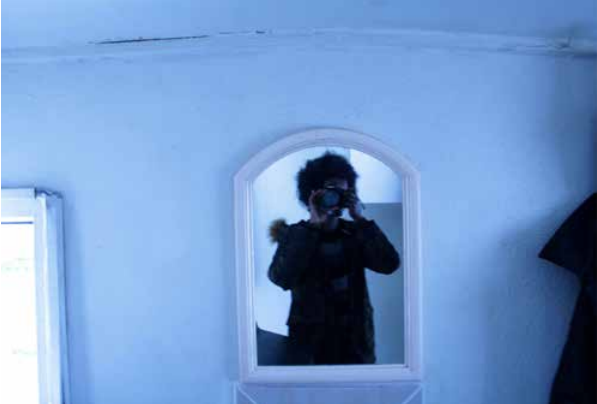
In a poignant moment in one of the Deeq’s photographs, he looks from the mirror and the mirror of his camera to the beyond. The intervention of the beyond establishes a boundary: a bridge, where presencing begins because it captures something of the estranging sense of the relocation of the home and the world – the unhomeliness – that is the condition of extra-territorial and cross-cultural initiations (Bhabha 1994, 13). While Abdi’s choice of blue for his photographs is representing the immobility and the longevity of the matter, the only warm coloured photograph is the portrait of his Syrian friend and that is to highlight the urgency of the Syrian exodus and challenges faced by the Syrian children, says Abdi. The muteness that Abdi highlights in this photograph in bright orange neon colour is to stress the unspeakability of war and to highlight the pathology war creates that is experienced in great silence. However, as witnesses of the incredible resistance and the fight for freedom given by the Syrian unaccompanied minors whom were transferred from the shelter to be detained in a refugee camp (Tibet 2017 , Tibet 2018b). Abdi recalls those moments as he talks of his Syrian brother as the son of the sun. Deeq questions and expresses his own affective portrayal in image and identity, as he changes our perceptions and recognitions. Within what Bhabha calls; “in his secret art of invisibleness” (Tibet 2017, Tibet 2018b) we are looking into the creative ways in which the migrant poet speaks.
Looking From the Mirror Beyond
I remember looking at myself in the hotel once. That day I will never forget, still not able to forget. After arriving in Istanbul as we went to the police, the UNHCR took us to the hotel for a night or two, before bringing us to the shelter. There I looked at myself in the mirror; all I could see was a completely destroyed person. I thought to myself, I lost my family, I lost my country, I lost my identity, and I am only 13. How can a man who has lost so much continue to live? That, I was able to find out much later. And I realized that, when looking at yourself each time, it is important to consider, from where are you looking? Ever since then, I have been looking at myself through the mirrors of the shelter, but this does not mean that I can only be seen from there; I should work hard to make it beyond the shelter and be seen elsewhere too. I would really like that to happen. After all, that is what is worth living for. (Abdi Deeq, January 2017, Istanbul)
A Fenced Playground
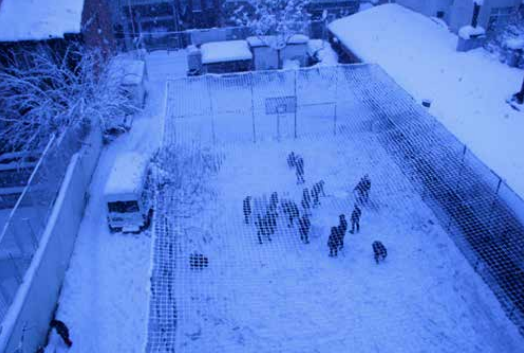
This shelter has taught me everything about life: what freedom meant, what justice meant, what was it all about, our pain and struggle. What did it mean to stay alive or die, as we have been always on the edge? What was the way to survive? We, the children of prison, nevertheless we never gave up on playing. Without play, life would have been unbearable. (Abdi Deeq, Januar 2017, Istanbul)
Waiting
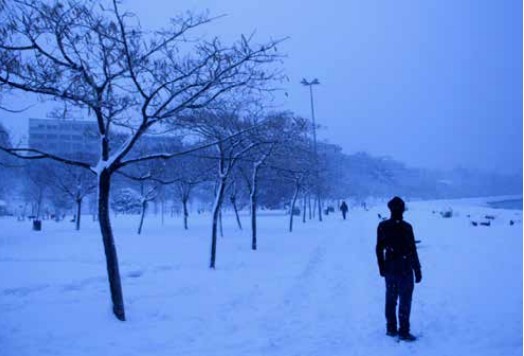
During winters we wait because the roads are closed. What I mean by the road is the migration routes to Europe. Some could be waiting while standing, sitting, or sleeping, but one needs to understand that the fundamental basics of migration is to know to wait. It is about patience. Those who hurry will lose, and those who wait too long will lose, too. One needs to find the perfect timing, and that is the mastery of migration: to know exactly when and how to take the road, but it is not so easy as you can imagine. And I don’t mean knowing in the logical sense, since there is nothing logical about getting on a boat towards Greece or hiding in a locked minivan towards Bulgaria. What I mean about knowing is derived 50% by senses, feelings, and acceptance of one’s reality, 50% about luck and faith . (Abdi Deeq, January 2017, Istanbul)
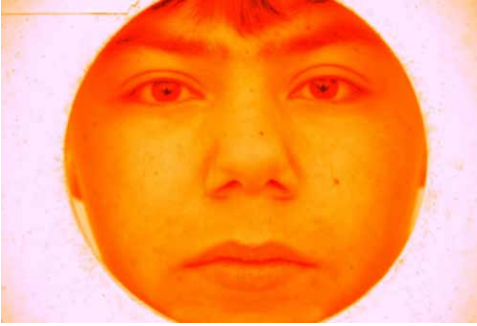
Mute is the Son of Sun
The portrait of my Syrian brother, who was trapped and enclosed in a prison in Syria and then in a refugee camp in Turkey, till he escaped. He was promised to see the sun, only if he knew he was the son of Sun. (Abdi Deeq, January 2016, Istanbul)
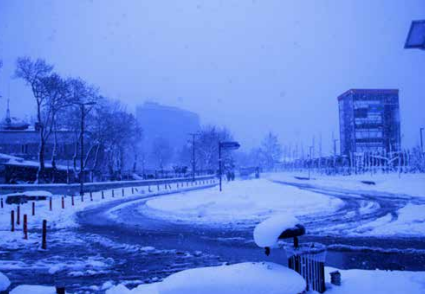
The loop
Once in a class, our teacher said, “every circle ends where they start”. My life is like that circle; it has a beginning and an end but somehow, I lost track of it. I am as if always turning around the same place, like a loop with no beginning and no end. (Abdi Deeq, January 2017, Istanbul)
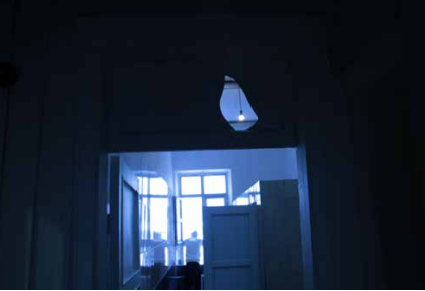
Learning to be Freed
Thinking of freedom, how can one be freed entirely? One needs an idea. With an idea, everything is then possible, yet if one becomes human by thinking, then one can also learn to be a free human too. At least we are free to think about freedom. (Abdi Deeq, January 2017, Istanbul)
Looking through a displaced angle of vision, Abdi Deeq’s photographs give us a hint on this stance too, as they provide us with a new way of seeing and looking at time in its temporality. The moral witness can strive for survival both in the future, in the present, and the past, since the migrating artist is caught in the interstitial spaces of being in between and beyond of all the borders of time and cultural differences. The role of photography is to “alter and enlarge our notions of what is worth looking at and what we have a right to observe, they are a grammar and even more importantly an ethics of seeing” (Sontag 1971, 3), which is seen in Deeq’s work. Hence, in his photography work, Deeq highlights “the plight of refugees in their loneliness, immobility, waiting, loops, preperations, faliures, blockages, mundaneness, death and survival in hope” (Tibet and Deeq 2019, 19). His art work as an autobiography of longing, loss, and displacement, comes as an act of translation like any other discursive or semiotic system, as a process and as a product influencing what is political (Bhabha, 1994).
The discursive present locates a transgressive agency that is also political and pushes beyond the binaries of positive, negative, good, or evil. Deeq’s photographic work erases binary oppositions; by applying the displaced angle of vision, Deeq as an artist creates metaphors for the interstitial spaces of his own journey. The binary oppositions of Black|White, and Self |Other are replaced by the blue and orange, the mobile and the immobile, in an effort to overcome them.
The emergence of third space is made possible through the constant act of translation. The translator becomes immune to events, as the translator also becomes the one who articulates and produces metaphors that are interpolative as seen in Abdi’s photography work and its elicitations. He makes visible the invisible and sayable the unsayable, simply by breaking the silence. By initiating an intercultural conversation and influencing the media discourse producing new metaphors of representation, it is the metaphors that produce hybrid realities-yoking together unlikely traditions of thought. Every act of translation becomes a representation and a reproduction. In this way, the process of translation gives rise to something different, something new and unrecognizable.
Conclusión
Instead of a conclusion, we ask how engaged anthropology can take on the challenge of freeing the study of humankind from the prevailing forces of global inequality and dehumanization. Bridging the theory of third space with the life histories of young migrants, this paper reveals not only the suffering and pain of young people in great despair, but shows that ÇOGEM is much more than a shelter: It is a site where dialogues and conversations, dreams and hopes are shared and realized, and where the asylum-seeking youth are actively building third spaces. Moving through paradoxical worlds, they search not only to make a living, but they are striving for political rights (beyond citizenship rights). With the hope to transform their lives under conflict, they envisage how to make new beginnings, where they can live prosperous and dignified lives, and share what they gain with those they have left behind.
These visions emerge in Ramen’s paradoxical and extra-terrestrial world, in Abbas’s afterlife and re-birth, and in Deeq’s visionary eye looking into the beyond
For the anthropologist, the idea of third spaces offers emancipatory ways of conducting research. It allows to discover new narrations, which leads to new discourses that are translated, interrogated, reallocated, and reinscribed during the migratory journey.
We have strived to locate this study firmly in the complex struggle for genuine transformation and freedom. In learning how to be freed from reification of their identity through the hegemonic border regime, we navigated and co-narrated the many courageous and creative ways young asylum seekers deploy, as they discover along their journeys, who they are yet to become.
References
Anderson, Bridget. 2013. Us and Them?: The Dangerous Politics of Immigration Control. Oxford: Oxford University Press.
Bhabha, Homi K. 2016. “Translation and Displacement” at CUNY. Lecture filmed on May 6, 2016, by GC Public Programs, the Critical Theory Certificate Program, the Center for the Humanities, the Writers’ Institute, the Ph.D. Program in Comparative Literature, the Ph.D. Program in Sociology, and the Advanced Research Collaborative. https://www.youtube.com/watch?v=TVQcdbSV6OI (accessed Dec 30, 2021).
Bhabha, Homi K. 2011. Our Neighbours, Ourselves: Contemporary Reflections on Survival. Berlin, New York: De Gruyter.
Bhabha, Homi K. 1994. The Location of Culture. London, UK: Routledge.
Brubacker, Rogers. 2013.“Categories of Analysis and Categories of Practice: A Note on the Study of Muslims in European Countries of Immigration.” Ethnic and Racial Studies 36, no.1: 1–8.
Chakrabarti, Sumit. 2012. “Moving Beyond Edward Said: Homi Bhabha and the Problem of Postcolonial Representation. International Studies.” Interdisciplinary Political and Cultural Journal 14, no.1: 5–21.
Collins, Gerald Samuel, Matthew Durington, and Harjant Gill. 2017. “Multimodal Anthropologies. Multimodality: An Invitation.” American Anthropologist 119, no.1: 142–153.
Harper, Douglas. 2002. “Talking about Pictures. A Case for Photo Elicitation.” Visual Studies 17, no. 1: 13–26.
Kristeva, Julia. 1991. Strangers to Ourselves. Translated by Leon Roudiez. New York, NY: Columbia University Press.
Malkki, Liisa. 2010.“Children, Humanity, and the Infantilization of Peace.” In In the Name of Humanity, edited by Ilana Feldman, and Miriam Ticktin, 58–85. Durham: Duke University Press.
Sahay, Amrohini J. 1996. “Book Review, The Location of Culture.” College Literature 23, no. 1, Johns Hopkins University Press: 227.
Sontag, Susan. 1971. On Photography. New York.
Strasser, Sabine, and Eda Elif Tibet. 2019. “The Border Event in the Everyday: Hope and Constraints Among the Young Migrants in Turkey.” JEMS: The Journal of Ethnic and Migration Studies 46 (Special Issue), no. 2: 354–371
Spyrou, Spyros, and Miranda Christou. 2014. Children and Borders. Basingstoke: Palgrave Macmillan.
Tibet, Eda Elif. 2018a. “Learning as Agency: Strategies of Survival Among the Somali Unaccompanied Asylum- Seeking Youth in Turkey.” In Handbook on Migration and Childhood,edited by Jacqueline Bhabha, Jyothi Kanics, Daniel Senovilla Hernández. Cheltenham: Edward Elgar Publishing House.
Tibet, Eda Elif. 2018b. “I am not a beggar; I am an Istanbullu: Seeking the right for a neighbourhood to being dragged into Streets” (In English and Turkish: Ben Dilenci Degilim, Istanbulluyum): Children and Spatial Justice by Beyond Istanbul (Special Issue), Turkey.
Tibet, Eda Elif. 2017. “Escaping Exclusion: Confused Moralities and the Syrian Unaccompanied Minors’ Search for Freedom in Turkey”, Movements Journal: Turkey’s Changing Migration Regime and Its Global and Regional Dynamics 3, no. 2: 193–210.
Tibet, Eda Elif, and Abdi Deeq. 2019. “De Novo: Photography as a Way of Finding Place in the World, Presenting Abdi Deeq’s Art-work.” (Also in French: “De Novo: La photographie comme une façon de trouver sa place au sein du monde”). Revue Jeunes et Mineurs en Mobilité 4: 18–36.
Notes