1. Introduction
The use of plastics by human beings has transformed their way of living. From products that have improved healthcare, food preservation and entertainment or are being used every day in packaging, electronics, and vehicles (Burgess et al., 2021; Li et al., 2022). While polymeric materials offer numerous technological advantages, their production and lifecycle contribute significantly to energy consumption and greenhouse gas emissions. In the USA, the polymer supply chain alone is responsible for the release of 104 megatonnes of carbon dioxide equivalent (CO2e) annually (Nicholson et al., 2021). The demand for single-use packaging from various sources -especially from plastic- has increased, and its inadequate disposal has led to post-consumer waste environmental, social, and economic problems. According to the Ellen MacArthur Foundation (Ellen MacArthur Foundation, 2017), global plastic packaging represents 26 % of total plastic consumption, however, 95 % of its value is lost.
According to Greenpeace (Greenpeace Colombia & Clínica Jurídica de Salud Pública y Medio Ambiente (MASP) de la Universidad de los Andes, 2019), 80 % of the world’s population live in large cities; areas with high rates of hyper-consumption, caused by the culture of disposing with greater relevance in the disposal of packaging and flexible single-use plastic containers.
The low re-use of flexible plastic waste has prompted some institutions to alert the problem. It is estimated that the production of plastics will double by 2035 and almost quadruple by 2050 (Mrowiec, 2018), increasing pollution by solid waste and by emissions of greenhouse gases (GHG).
The recycling of laminated flexible structures commonly used in food packaging is costly nowadays, resulting in considerable amounts of this flexible material going to landfills (Curtzwiler et al., 2019). Mechanical recycling could be an option for recovering flexible plastics by processing innovations (Bashirgonbadi et al., 2022), and chemical recycling is a good option for recycling laminated flexible films (Huang et al., 2023). The apparent consumption of plastics in Colombia for 2018 was 1 280 000 tons, of which 493 000 tons correspond to flexible plastics (extrusion process, Figure 1) (Acoplásticos, 2020). According to calculations based on the Sectorial Report of the Utilization Activity - 2018 of the Superintendencia de Servicios Públicos Domiciliarios, only 16 600 tons of flexible plastic waste are recovered in the country, this is 3.36 % of the total consumption (Superintendencia de Servicios Públicos Domiciliarios, 2019).
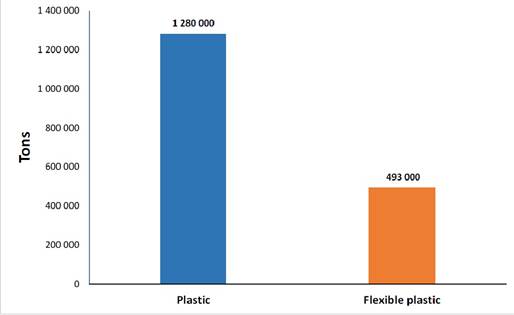 Figure 1
Plastic consumption in Colombia in 2018.
Figure 1
Plastic consumption in Colombia in 2018.
One primary obstacle hindering the valorization of recycled plastics is the persistently low rate of household plastic waste collection. This insufficient collection significantly reduces the availability of recyclable materials, thereby limiting the scale and economic viability of recycling operations (Burgess et al., 2021). The low collection of flexible plastics originated for multiple reasons, starting with an unsuitable design that does not allow recyclability and the generation of circular flows (Ellen MacArthur Foundation, 2017). Deficiencies in waste collection reverse logistics are due to: 1. Low prices and incentives for recyclers and consumers; 2. Lack of information on the location of collection centers; 3. Limited transportation infrastructure and few alliances with other companies; 4. Inefficiencies in the collection and recovery systems (Superintendencia de Servicios Públicos Domiciliarios, 2019); 5. Failures in communication to the consumers about recycling, consumption, and circularity issues that allow a correct separation at the source and maximum use of the waste (Cerantola, 2016); 6. The low regulations for waste disposal and the technical restrictions in flexible plastics recycling.
Due to the challenge of the use of flexible post-consumer packaging, in Colombia, the government issued the National Plan for the Sustainable Management of Single-use Plastics, looking to develop communications and citizen culture programs with the objective of increasing education in solid waste management and establishing the extended producer responsibility to the disposal of post-consumer products, through circular economy strategies to promote the recycling of plastics (Ministerio de Ambiente y Desarrollo Sostenible, 2021).
To generate and increase the value of flexible plastic materials, their wastes should be reintroduced into their own life cycle, being used as raw material in the creation of new containers and packaging materials, allowing “Cradle to Cradle” processes, developed by McDonough and Braungart, since they use the outputs (end of life of a product) as inputs and/or raw material for a new production process, avoiding the waste generation through a regenerative design (Ellen MacArthur Foundation, 2021).
Increasing recyclability requires the establishment of a robust flexible plastic value chain that actively engages key stakeholders, including governments, the plastics industry, universities, research institutions, brand owners, and consumers (Távora de Mello Soares et al., 2022). Enhancing plastic collection rates also necessitates significant investments in waste management infrastructure.
This study aims to encourage further exploration of solutions to one of the most pressing environmental challenges: the accumulation of plastic bags in ecosystems, particularly in marine environments, where they have severe adverse effects on biodiversity.
2. Methodology
The business model research, about flexible plastic in circular economy was made through the different databases in Colombia and worldwide (Asia, Europe, Africa, Oceania, and the Americas). A comprehensive literature review was conducted utilizing the databases of ScienceDirect® and Scopus®, as well as relevant web pages, to identify pertinent research published between the years 2016 and 2023. The models found were evaluated and qualified according to the criteria shown in Table 1, based on the methodology approved by the Universidad Pontificia Bolivariana (UPB).
Table 1
Qualification criteria for business models.

To define the guidelines that would be potentially applicable to flexible plastic circular economy business models in Colombia the selected models were studied under the following five sustainability aspects:
-
Level of eco-efficiency: Economic productivity/environmental cost.
-
Ecological sustainability: Environmental footprints.
-
Resource productivity: Recovered material per unit of flexible plastic waste.
-
Social Impact: Employment generation.
-
Technology Innovation: New technologies scope level.
Their impact on the sustainability aspects was classified at a qualitative rate: low, medium, high.
3. Results
3.1. Identification of business models in circular economy of flexible plastics
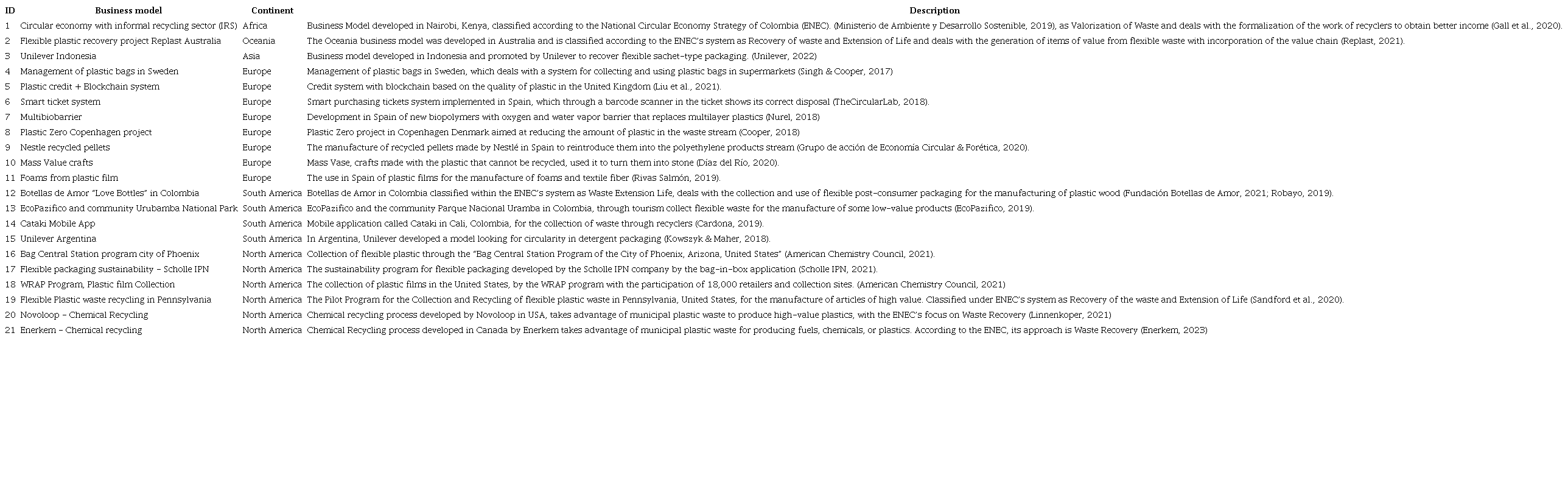
The bibliographic review made in Colombia and worldwide business models of the circular economy of flexible plastic, results in 21 models: (1) in Africa, (1) in Oceania, (1) in Asia, (8) in Europe, (10) in the Americas (Table 2).
Table 2
Selected business models.
3.1.1 Evaluation of business models of the circular economy of flexible plastics
Each business model described above was evaluated according to the criteria mentioned in the methodology. Six of them obtained the highest score among all the 21 business models, because of their exclusivity in the management of flexible waste, their impact on the three dimensions of sustainability, the increase in the value of plastic waste, the involvement of five or more interest groups and its high use of technology. The six selected models with the highest score are shown in Table 3, they scored over 90 % of the maximum grade.
3.1.1.1 Selection of flexible plastics business models
The six business models selected and described in Table 3 will be the benchmarks to be applied in Colombia. Their drivers and obstacles were identified to show the strengths and weaknesses for being implemented in Colombia and finally, their assessment based on five sustainability criteria shows the path for their use in the country.
Table 3
Evaluation of selected business models.
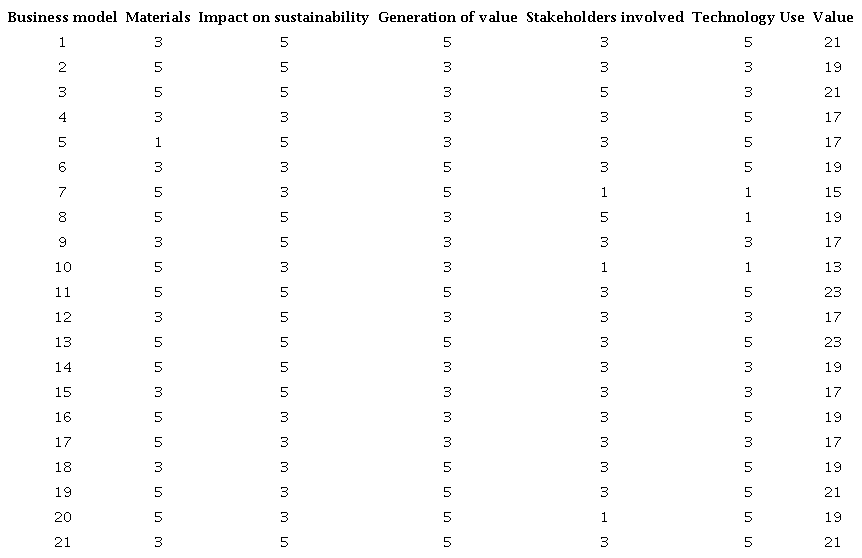
The six business models selected (highlighted in Table 3) are described below and will be the benchmarks to be applied in Colombia. Their drivers and obstacles were identified to show the strengths and weaknesses for being implemented in Colombia and finally, their assessment based on five sustainability criteria shows the path for their use in the country.
3.1.2 Circular economy of plastics with informal recyclers in Kenya
In low and middle-income countries, recycling activities are predominantly informal. The informal recycling sector (IRS) is characterized by social marginalization economic exploitation and the absence of formal employment, regulations, and taxes (Gall et al., 2020).
Business model
Green Africa (MGA) a company in Nairobi, Kenya, has implemented a business model together with the IRS, seeing them as facilitators of a circular economy (CE).
The basic idea is to abandon the traditional IRS value chain based on multiple intermediaries and replace it with a direct fair trade relationship between the individual recycler and the formal company. For this, proprietary commercial points were established where recyclers sell plastic waste to MGA. The commercial price is set at a rate of 19 Kenyan shillings (KSh) or 0.14 USD per kilogram of plastic, therefore it is not subject to market price volatility. That price is openly communicated and set in a way that is highly competitive with respect to that offered by other local buyers.
The company’s mobile application has a profile for each recycler where their productivity and reliability are recorded and analyzed. Recyclers who regularly trade with MGA are eligible for a loyalty program that awards a premium price in exchange for meeting monthly supply targets. In this way, and with the integration of other informal collectors such as scrap yard owners, the company maintains a relatively constant supply of waste, additionally, thanks to the interaction at commercial points, there is a certain degree of control over types and qualities of received materials, besides building trust, acceptance, and inclusion of the IRS (Gall et al., 2020).
Table 4
Informal recycling sector (IRS) model assessment.

3.1.3 Botellas de Amor, in Colombia
The recovery and recycling of flexible packaging in Colombia has not been enough to cope with the growing volume of the material and the concern about its environmental impacts. Faced with this problem, the Botellas de Amor non-profit Foundation aims to take advantage of flexible plastic waste by closing the cycle with the manufacture of plastic wood (RPL), which would be used to build houses and other types of furniture.
Business model
The process begins with the training of consumers in educational centers and collection points. The participants fill plastic bottles of Polyethylene Terephtalate (PET) with flexible post-consumer waste as tightly as possible, carrying them to the collection points and then to the processing plants in Medellín and Bogotá, where the plastic bottles “are broken to remove the content of flexible plastics. PET bottles are marketed with container manufacturing companies and the flexible packaging materials are mechanically bonded to later apply modifiers that reinforce their properties” (Rivas Salmón, 2019). The model also receives plastic surpluses from industry.
“The recycling model is designed so that the flexible post-consumer material is delivered in plastic bottles (PET) and not in loose bags, since the aim is to generate the least of gas emissions. For this reason, the collection points are designed or prepared to receive bottles” (Fundación Botellas de amor, 2021). The project does not force the bottles and the flexible material to be washed and dry, however, it emphasizes draining them well to eliminate the remains and improve their quality.
Table 5
Botellas de Amor model Assessment.

Among the sustainability aspects we found: 1. The level of eco-efficiency is medium, since RPL handles one of the most difficult wastes to recover flexible plastics, however, the RPL is not useful for high end constructions due to lack of standards and regulations 2. Ecological sustainability is low, because there is no control of emissions since the transport used for carrying the residues to the collection points and some of them may need washing, thus generating an increase in the water footprint. 3. Resource productivity on average since the flexible material for recycling depends solely on the management of separation and introduction of waste in PET bottles for the consumers. 4. Its social impact is medium, because some jobs are created in the plastic wood production and in the manufacturing of housing and recreation items destined for low-income communities. 5. Technological innovation is low, because they use traditional systems in the transformation of waste, however, they work in the design of buildings
3.1.4 Flexible plastic waste collection and recycling pilot program in Pennsylvania, United States
This pilot project was developed by the Materials Recovery for the Future (MRFF) organization, the Total Recycle company and the Pennsylvania Recycling Markets Center and the community of Birdsboro, Pennsylvania, a city near Philadelphia.
The pilot program object involved the community, with the support of Total Recycle staff through workshops, analyzing the collection of flexible plastics gaps, monitoring the collection and introducing new practices for separating the material, improving the quality of the post-consumer material and increasing its value (Sandford et al., 2020).
The results of the pilot project were:
- 1.
Capture of 90 % of the flexible plastic in the classification system of the recycling plant.
- 2.
Decrease the amount of paper that comes in the flexible waste stream to less than 15 %.
- 3.
Reduction in the number of employees in quality control of film waste at the recycling plant by 25 %.
- 4.
In the first year of operation, it was possible to demonstrate that by making a good selection of flexible plastic at the source, recycling companies accept the material from the containers that are on the curbsides, improving their possibility of sale (Sandford et al., 2020).
Table 6
MRFF model assessment.

because it increases economic productivity, uses resources better and reduces waste, 2. Its ecological sustainability is high because by the separation of waste in the source it increases the collection of flexible plastic, 3. Its social impact is medium because, although it involved the community, it decreased jobs in the recycling company, 4. Its impact on the productivity of resources is high because it generated the recovery of 2000 tons of plastic and 5. Its impact at the level of technological innovation is medium because it requires the implementation of an infrared equipment to increase the separation (Sandford et al., 2020).
3.1.5 Recovery of flexible plastic project Replast, Australia
Replast processes recycles plastic and produces sustainable, high quality and cost-competitive articles, using state-of-the-art equipment and robots. Its portfolio includes traffic dividers, terraces, trails, furniture for sports practices, parks, gardens, among others. They indicate that their products contain 98 % recycled material, (Replast, 2021).
Replast sources flexible plastic waste through the RedCycle program with partner companies for manufacturing aproducts that are to be used outdoors. The RedCycle program places clean and dry flexible plastic and bag collection containers in a supermarket chain with 830 locations in Australia (RedCycle, 2017).
The benefits of the project are the reduction of waste in sanitary landfills, the creation of local jobs and the manufacture of sustainable products.
Table 7
Replast model Assessment.

Within the guidelines of this business model, we found: 1. Its level of eco-efficiency is high because the final products contain 98 % recycled plastic, 2. Ecological sustainability is high due to its low carbon footprint, 3. Productivity of resources is high due to the use of state-of-the-art technology, 4. The social impact is high due to community involvement and job creation, and 5. Technological innovation is high due to the use of robots in the production process.
3.1.6 Novoloop© Chemical recycling, a plant to recover flexible material and convert it into high-value plastic material
Novoloop©, a Silicon Valley start-up company, produces high-performance products from the thermo-accelerated oxidative breakdown of post-consumer polyethylene waste. Through a chemical process, of accelerated thermo-oxidative decomposition of Polyethylene, they are solving one of the greatest environmental challenges as stated by its CEO Miranda Wang. The idea for Novoloop© arose because the founders of the company visited the waste management plants in America, and they realized that polyethylene and especially film were difficult to recycle once they were contaminated (Linnenkoper, 2021).
The patented process allows Novoloop© to use plastic bags, pallet wrappers, agricultural films, food packaging products and more to turn them into a higher value product such as running shoes. The chemical recycling process breaks the polyethylene chains into basic elements, this occurs at low temperature (less than 200 °C) and using a mechanism that recirculates an acidic solvent in the appropriate equipment for the chemical reaction, in this process greatest reduction of CO₂e is achieved, around 68 %. They produce materials, such as thermoplastic polyurethane, with up to 50 times the value of waste (Linnenkoper, 2021).
Chemical recycling offered by Novoloop© offers an alternative to mechanical recycling to solve the technical and economic disadvantages of mechanical recycling due to the difficulty of handling contaminants such as fats, inks, colorants, and fillers that are easily removed in chemical recycling. The Novoloop© process requires less energy than other chemical recycling processes (Karidis, 2020).
Table 8
Novoloop© model Assessment.

Within the guidelines of this business model, we found: 1. Its level of eco-efficiency is high due to the increase of up to 45 times the value of recycling, it allows offsetting the costs of processing; 2. Ecological sustainability is high because this model allows reducing the carbon footprint by 45 % versus polyurethane that is made with virgin resin and address the problem of products that are difficult to recycle mechanically; 3. The productivity of resources is low because the initial conversion rate is low due to the size of the plant pilot; 4. The social impact is high due to the generation of current and potential jobs; 5. Technological innovation is high because it develops novel technology that transforms plastic waste through chemical reactions.
3.1.7 Enerkem©, generation of biofuels and chemical products
Enerkem© works on a revolutionary idea about the manufacture of biofuels and chemical products from non-renewable waste, its objectives are the generation of solutions to waste, the diversification of energy and the construction of a circular economy. It works with communities to reduce waste going to landfills and incinerators. Enerkem’s competitive advantage is Research and Development, which allows it to be at the forefront of the circular economy, generating more than 100 patents since 2000 when the company was established. Enerkem’s technology uses waste such as textiles, non-recyclable packaging plastics, wood waste, or dirty food containers (Enerkem, 2023).
Enerkem’s technology would allow the production of plastic resins such as Polyethylene from difficult-to-recycle plastic waste, household waste and construction materials, which would reduce one of the largest environmental problems in the world, generating a circular economy of plastics, increasing participation of recycled material in new containers and packaging (Grupo Axioma Group S.A.S, 2020). This technology will allow the construction of a plant in Spain that will convert 4 000 000 tons of waste into 220 000 annual tons of methanol and reduce 200 000 tons of CO2 (Repsol, 2021).
Table 9
Enerkem© model Assessment.
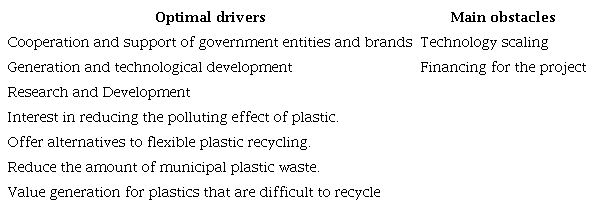
Within the guidelines of this business model, we found: 1. Its level of eco-efficiency is high because it gives value to municipal waste that goes to landfills and has no value; 2. Ecological sustainability is high because this model allows reducing the carbon footprint, for example in a project that will be carried out in Spain will reduce 200 000 tons / year of CO₂ eq. The productivity of resources is medium because it has a productivity of around 50 % of waste material such as methanol 4. The social impact is high due to the generation of current and potential jobs and 5. Technological innovation is high because they have developed around 100 patents.
Although there is not an established business model in Colombia to solve the problem of flexible plastic waste, it is necessary to implement actions such as those detailed below. However, it is important to clarify that one by itself does not fully solve the difficulties and uncertainties related to its collection and recovery, but a combination of these actions will allow its management in the long term.
5. Conclusions
The implementation of circular economy business models for flexible plastics in Colombia must prioritize methods oriented toward achieving long-term sustainable outcomes. The primary objective would be to address the challenges posed by flexible materials through cyclical processes that not only eliminate waste but also generate economic savings and enhance the value of residual materials.
In our research, we developed an innovative methodology classifying 21 worldwide different circular business models for flexible plastics based on the sustainability pillars: social, environmental, and economic, selecting the six more relevant through sustainability criteria such as Useful Materials, Impact on Sustainability, Value Generation, Stakeholders involved and Use of Technologies. One of the novelties of this methodology is the inclusion of interest groups due to their fundamental role in guaranteeing the sustainability of business models.
Our findings reveal no existing business model in Colombia-or globally-that fully addresses the complexities of flexible plastic recovery, particularly the challenges surrounding collection and reuse. Consequently, a synergistic approach, integrating elements from the aforementioned models, is essential to overcome the persistent issues of low recycling rates and limited value generation from post-consumer flexible plastic waste in Colombia.
As an outcome of this research, we propose guidelines for six business models focused on generating value from waste through mechanical recycling, developing infrastructure for flexible plastic waste collection, expanding the adoption of chemical recycling technologies, formalizing the recycling chain in Colombia, advancing technologies for the separation and classification of flexible plastic waste, fostering alliances among stakeholders in the value chain to promote the value of recycling, and creating mobile applications to engage consumers in the recycling process. These guidelines provide a comprehensive roadmap to address the challenge of increasing the utilization rate of flexible plastic waste in Colombia.
To establish effective circular economy business models for flexible plastics in Colombia, new methods and long-term development processes must be adopted. This includes identifying high-value applications through research and the development of innovative technologies for sorting, cleaning, and removing toxic substances. Furthermore, new reverse logistics systems must be created, emphasizing direct consumer participation and the formalization of informal recyclers. Establishing robust value chains with the involvement of all stakeholders is essential for achieving sustainable outcomes.
 Nicolas Ramiro Orrego-Bustamante; nicolas.orrego@esenttia.co
