Artículos
Determining elements of housing satisfaction in Mexico: analysis by estimating an Ordered Probit Model
Elementos determinantes de la satisfacción de la vivienda en México: análisis estimando un Modelo Probit Ordenado
 Naím Manríquez García naim.manriquez@gmail.com
Determining elements of housing satisfaction in Mexico: analysis by estimating an Ordered Probit Model
Vivienda y comunidades sustentables, no. 14, pp. 71-86, 2023
Universidad de Guadalajara
Received: 03 May 2023
Accepted: 19 July 2023
Abstract: This paper performs an analysis of the elements that determine housing satisfaction, as well as evaluates the probability that a household may be satisfied with it. For this purpose, an Ordered Probit Model was estimated. The data was collected from the National Housing Survey, 2020, carried out by the National Institute of Statistics and Geography in Mexico. In particular, this paper estimates the probability of satisfaction concerning specific variables to the housing and the environment. The main findings are households in lower socioeconomic levels are the most dissatisfied with their housing. When estimating the Ordered Probit Model, it is found that having a dining room, garage, water tank, and garden increases the probability of satisfaction, while suffering from humidity and subsidence decreases levels of satisfaction. Likewise, the presence of garbage and noise in the area decreases the probability of satisfaction. The relevance of taking these statistical approaches lies in the fact that they become a tool that facilitates the targeting of housing policy, allowing adequate management of programs and projects associated with improving the quality of life.
Keywords: Housing satisfaction, Ordered probit model, Adequate housing, Econometrics approach.
Resumen: Este trabajo realiza un análisis de los elementos que determinan la satisfacción de la vivienda, así como también evalúa la probabilidad de que un hogar pueda estar satisfecho con ella. Para ello se estimó un Modelo Probit Ordenado. Los datos fueron recolectados de la Encuesta Nacional de Vivienda, 2020 que realiza el Instituto Nacional de Estadística y Geografía en México. En particular, este trabajo estima la probabilidad de satisfacción con respecto a variables específicas a la vivienda y el medio ambiente. Los principales hallazgos son que los hogares de niveles socioeconómicos más bajos son los más insatisfechos con su vivienda. Al estimar el Modelo Probit Ordenado se encuentra que tener comedor, cochera, tanque de agua y jardín aumenta la probabilidad de satisfacción, mientras que sufrir humedad y hundimiento disminuye los niveles de satisfacción. De igual manera, la presencia de basura y ruido en el área disminuye la probabilidad de satisfacción. La relevancia de llevar estos abordajes estadisticos radica en que se transforman en una herramienta que facilita la focalización de política habitacional, permitiendo una gestión adecuada de los programas y proyectos asociados a mejorar la calidad de vida.
Palabras clave: Satisfacción con la vivienda, Modelo probit ordenado, Vivienda adecuada, Enfoque econométrico.
Introduction
The right to decent, adequate and decent housing has been recognized since 1948 in the Universal Declaration of Human Rights, in article 25, which states: every person has the right to an adequate standard of living that ensures for themselves and their family, health, well-being, and especially food, clothing, housing, medical care, and necessary social services.
Regarding the issue of housing, the United Nations (UN-Habitat, 2010). establishes seven basic elements to have adequate housing:
- 1. Legal security of tenure for housing. It means conditions that guarantee legal protection for its occupants against forced eviction, harassment, and other threats.
- 2. Availability of services, materials, facilities, and infrastructure. It refers to the provision of drinking water, adequate sanitary facilities, energy for cooking, heating, and lighting, food preservation, waste disposal, and emergency services.
- 3. Affordability. It means that the cost of housing must be such that all people can access it without endangering the enjoyment of other basic satisfactions.
- 4. Habitability of housing. It means the existence of structural and design elements that guarantee physical safety and protection for its occupants against environmental hazards and health threats, as well as sufficient habitable space and protection against cold, moisture, heat, and rain, among others.
- 5. Accessibility. It refers to the fact that the design and materiality of housing must consider the specific needs of disadvantaged and marginalized groups, particularly people with disabilities.
- 6. Location. It means that the location must offer access to employment opportunities, health services, schools, daycare centers, and other social services and facilities, and be located outside of risky or contaminated areas.
- 7. Cultural adaptation. It refers to the fact that the expression of the cultural identity of its occupants must be respected and taken into account.
For some authors (Kowaltowski et al, 2006; Ortiz, 2012; Hernández-Rejón, 2010; Córdova-Canela, 2021, Forrest et al, 2021), housing can be understood in two ways: as a commodity, which is recorded in the dynamics of supply and demand, and as a social and human right. Regarding the first, it means that housing is a high-cost finished product and is aimed at those who can pay for it, and concerning to housing as a social and human right, it means that it is fundamental for the adequate development of individuals.
In this sense, it can be said that housing plays a decisive role in people’s quality of life, and in most cases, leads to access to services today considered essential to achieve minimum levels of well-being. Having said the above, satisfaction with housing can become a parameter that makes it possible to quantify people’s quality of life. Measuring home satisfaction implies a subset of attributes, including the physical elements of the building and the necessary accessories for its habitability (water supply, electricity, etc.).
In this sense, the main objective of this research is to analyze the principal elements that determine housing satisfaction, as well as to calculate the probability that a home can be satisfied with it.
Based on the background and literature review, we can determine the following hypotheses.
-
Hypothesis 1: There is a positive correlation between socioeconomic level and satisfaction with housing, that is, as socioeconomic level increases, housing satisfaction also increases.
-
Hypothesis 2: There is a positive correlation between the size of the dwelling, and the level of satisfaction, meaning that as a dwelling has more space, satisfaction also increases.
-
Hypothesis 3: Experiencing issues such as cracks, subsidence and fissures decreases satisfaction with the home.
-
Hypothesis 4: Having amenities such as a garden, patio, and a good environment close to the home increases satisfaction with it.
The present is only an exercise to be taken as a reference regarding the subject. The relevance of taking these statistical approaches lies in the fact that they become a tool that facilitates the targeting of housing policy, allowing adequate management of programs and projects associated with improving the quality of life.
Materials and methods
The objective of this research is to estimate an econometric model that explains the probability of satisfaction with the dwelling as a function of the characteristics of the dwelling itself and its surrounding environment. Particularly, it seeks to validate the proposed hypotheses and visualize the issue of residential satisfaction in Mexico by socioeconomic level.
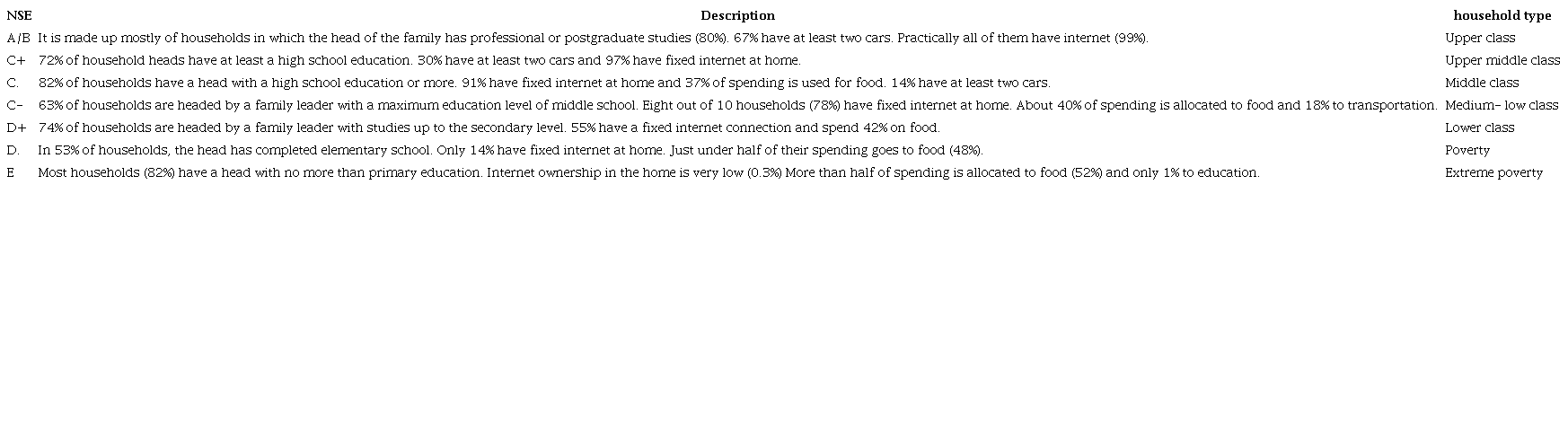
For the purposes of this research, the socio-economic levels index of the Mexican Association of Market Research Agencies (AMAI, 2022) is used as a reference. This index is based on a statistical model that allows Mexican households to be grouped and classified into seven levels according to their ability to meet the needs of their members. The index considers the following six household characteristics: educational level of the head of household, number of employed persons in the household, internet access, proportion of household expenses, and number of automobiles.
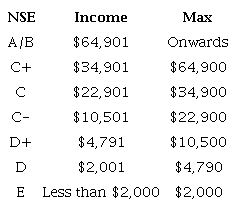
The classification of socioeconomic levels is presented in the following table, which is classified into letters from A/B to E, the latter being the lowest and equivalent to households in extreme poverty, which may earn up to $2000 Mexican pesos per month of work income.
Source: Own elaboration based on AMAI (2022)

DATABASE AND VARIABLES
The data used in this research comes from the 2020 National Housing Survey in Mexico (ENVI, 2020) conducted by the National Institute of Statistics and Geography. The purpose of this survey is to produce statistical information about the characteristics of housing in Mexico, which allows generating a comprehensive overview of the housing situation in the country, as well as the needs and demands of the population in this regard.
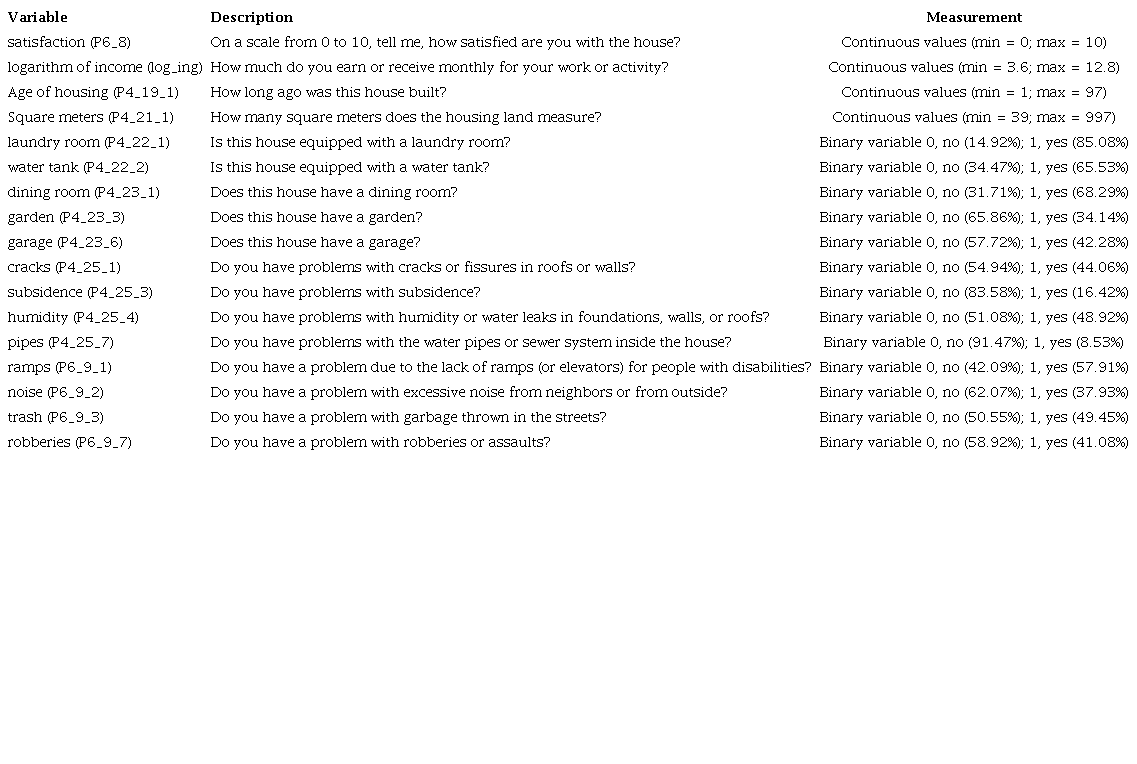
The model that we will use to estimate the probability of housing satisfaction is an Ordered Probit Model. The definition of the dependent variable used in the model is based on the following question: On a scale from 0 to 10, tell me, how satisfied are you with the house?
While the explanatory variables, based on which the probabilities of satisfaction are estimated are the following:
- 1. Variables in the immediate environment of the home. These variables refer to the exterior close to the home, that is, the conditions that each family faces during their day-today: problems with excessive noise from neighbors, garbage is thrown in the streets, lack of wheelchair ramps, robberies, and assaults.
- 2. Individual and internal variables to the dwelling. These variables are the ones that define the internal characteristics of the house, meters that measure the land of the house, household income, age of the unit, amenities (garden, garage, water tank, dining room), humidity problems, subsidence, cracks, and fissures.
The variables are briefly described below, and the nomenclature used for them is indicated.
-
Income (log_ing). This variable is included to capture the effect of income on housing satisfaction; Some authors such as Addo (2016), Alnsour and Hyasat (2016), Reategui (2018), Ibem et al (2019), Chang and Wong (2022), and Kshetrimayum et al (2020) have addressed the issue, finding that low-income households tend to be the least satisfied with their homes. This is logical in the sense that the poorest households, since they do not have enough income, do not have the economic capacity to pay for a home that meets certain characteristics that influence their satisfaction.
-
Square meters (P4_21_1). The use that is given to a house and the number of inhabitants end up defining the size of the house. In the first hypothesis, the size becomes important in the satisfaction of the dwelling, since it is expected that there will be less overcrowding and greater capacity for space distribution regarding the needs of each home. In the case of this variable, usually as the square meters of a home increase, its price also increases (Zhang and Hudson, 2018; Poeta et al, 2019; Urrea and Cardenas, 2019; Duan et al, 2021), so it is expected that the households with lower incomes tend to have smaller dwellings and are therefore more dissatisfied with the size.
-
Garden (P4_23_3), garage (P4_23_6), dining room (P4_23_1), laundry room (P4_22_1). The internal characteristics of the house are other kinds of satisfaction measures, in the case of the garden, it can provide a series of ecosystem benefits that affect well-being and satisfaction, such as improving air quality, reducing noise that comes from the street to inside the house, protects the house from ultraviolet rays and lowers the ambient temperature (Dunnet and Qasim, 2000; Lampert et al, 2021; Andini et al, 2021; White et al, 2019). In the case of the garage, it allows for safe parking and space, which can be used for various uses. On the other hand, the function of the dining room is essential for a key meeting point for the members of the household, meaning, the dining room is the space for family gatherings, around the table not only food, is consumed, but also conversations and important decisions are made (Amerio et al, 2020).
-
Cracks (P4_25_1), subsidence (P4_25_3), humidity (P4_25_4), pipes (P4_25_7). In the case of cracks, these can cause major problems, not just aesthetic or structural. In some cases, water can leak through them, causing moisture inside. Additionally, repairing them requires an extra cost to the home. As for humidity, it produces bacteria, which not only put the health of household members at risk but also end up ruining the aesthetics and structural quality of the house, since they manifest themselves through dark spots (Zhang and Yoshino, 2010; Hamehkasi, 2016).
Source: Own elaboration based on the ENVI 2020
Empirical analysis: ordered probit model
The econometric model that we propose explains the probability of housing satisfaction as a function of its characteristics and a set of variables related to the housing environment. In particular, we used an ordered response model, with a standard normal distribution, commonly known as the Ordered Probit Model. The estimation of marginal effects allows us to analyze the influence of variables on the probability of satisfaction.
Due to their characteristics, these types of models allow the following purposes:
- 1. Quantify the importance of the relationship between each of the covariates and the dependent variable.
- 2. Determine through the marginal effects, which variables carry more weight to increase or decrease the probability of an event or occurrence.
Following Cameron and Trivedi (2005), Munkin and Trivedi (2008) and Baltagi (2021) for this research we denote, the level of housing satisfaction, which is an unobservable continuous random variable, same that dependent on the immediate environment conditions of the housing and its characteristics, this can be expressed as:
where:
household housing satisfaction i.
row vector (1 xk) containing the set of explanatory variables that influence housing satisfaction.
column vector (kx1) of parameters associated to the explanatory variables.
residual
In the case of the model, the variable increases from unknown thresholds according to the ordering of the alternatives. It can be defined as follows:
For a model with m alternatives y , then:
F is a cumulative distribution function ( cdf ) of ei. The β are obtained through maximum likelihood and their sign identifies the direction of the impact.
Marginal effects
Once the model parameters have been estimated, it is convenient and interesting to analyze the marginal effects, which indicate the impact of each explanatory variable on the probability that a household is satisfied with its home. In other words, how does the partial change of any of the explanatory variables affect the probability of satisfaction.
To quantify the marginal effects, the following equation is used:
In other words, the marginal effect indicates the effect that a one-unit change in explanatory variable has on the probability of different discrete outcomes. More detailed interpretations and derivations of marginal effects can be found in prior work (Greene 2005; and Wang and Kockelman 2005).
Descriptive statistics and empirical analysis
In this section, some of the descriptive statistics regarding housing satisfaction are presented. One of the facts to highlight is that the mean satisfaction level is 8.2, which may indicate a moderate level of satisfaction. Table 5 shows the frequency of responses from the survey participants, noticing that 86 percent fall within the 7-10 range of satisfaction level.

Source: Own elaboration based on the ENVI 2020
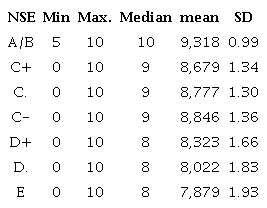
Table 6 shows the level of satisfaction with the home by socioeconomic level. When analyzing it in terms of socioeconomic level, it was found that the least satisfied groups are levels D and E, that is, those who are in poverty. These results are consistent with studies conducted by Hernández-Rejón (2010) and Souza (2010), which argue that dominant groups (upper and upper-middle classes) usually choose the best places for settlement, leaving lower classes in peripheral and vulnerable areas - suburbs with multiple requirements, forgotten and lagging behind urban development (where even land prices are lower) - thus, they are the groups that inhabit these areas with low levels of housing satisfaction and quality of life.
Source: self made. Note. SD standard deviation.
Housing related issues
Having a home not only means having a roof to live in, but it is a place that requires maintenance, and addressing problems that are difficult to solve (cracks, fissures, humidity, subsidence, among others) and, sometimes, are impossible to repair, being resolved only temporarily. Among the main structural problems analyzed in this research are moisture, cracks or fissures, and subsidence.
Humidity
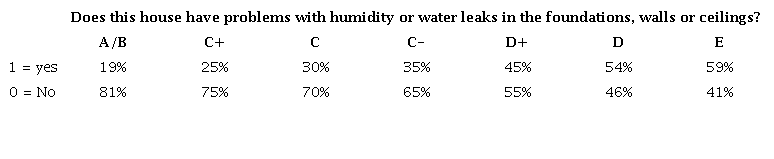
According to data from the National Housing Survey (2020) of the National Institute of Statistics and Geography, the biggest structural problem that occurs in homes nationwide is humidity or water leaks at 44.2%, followed by cracks and fissures at 40.8. %. In the case of humidity, Martínez et al (2005) mention that it causes health problems or discomfort in people, damages and injuries in the house, favors the development of pathological processes such as efflorescence on walls and floors, generates the appearance of germs that contaminate the environment, corrosion and rotting of metallic and wooden elements, respectively, and the reduction of thermal insulation.
Exploring the data from our analysis, Table 7 shows the percentage of homes that declared having at least problems with moisture in foundations, walls, and ceilings. Once again, the socioeconomic levels with the greatest humidity problems are D and E, although the humidity problem is present in all homes, eliminating, reducing and controlling the formation of damp and subsequent mold on walls and ceilings, it requires preventive and corrective maintenance, which are usually of high-cost that the poorest households cannot afford.
Source: Own elaboration based on ENVI 2020.
Cracks
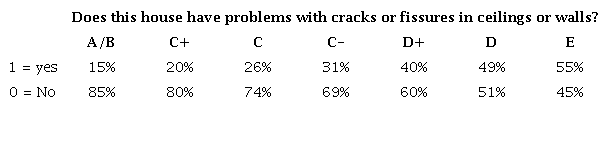
Among other problems that can be generated inside homes are cracks or fissures. These refer to cracks that appear on the surface of the concrete of the house, they are mainly due to incorrect consolidation, finishing, curing procedures, and sometimes to over-vibration (Méndez et al, 2012). In the case of analyzed data, problems such as cracks or fractures, as in the case of humidity, are concentrated in socioeconomic levels D+, D, and E, leading to a possible reality of housing precariousness in the poorest households, being these the most vulnerable.

Source: Own elaboration based on ENVI 2020.
Source: Own elaboration based on ENVI 2020.
Pipelines
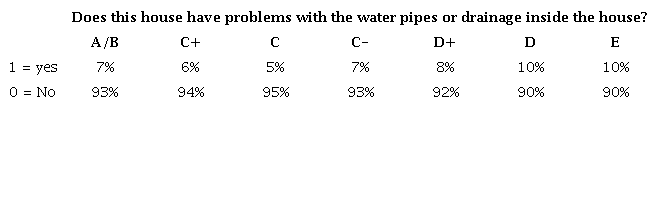
Pipes are a complex system of conduits that serve the purpose of transporting water to homes. Each component plays a specific role in the system, and in most cases, problems arise due to the wear of its materials or the presence of deteriorated facilities.
Source: Own elaboration based on ENVI 2020.
In the case of pipe problems, this was not a serious problem for the homes under study, at least in all socioeconomic levels, 90% stated that they did not have a problem with the pipes inside their home.
Ground subsidence
The subsidences are generally caused by the construction of buildings in unsuitable places. These can cause disasters as severe as those caused by earthquakes and floods, putting the quality of life and integrity of the people who inhabit the house at risk.

Source: Own elaboration based on ENVI 2020.
In this matter of land subsidence, the most affected houses are those of levels D+, D, and E, that is, homes in conditions of low class and poverty, as mentioned above, homes in this socioeconomic range are characterized by being located on the urban periphery, far from any center of activity, with little accessible to urban equipment and poor quality soil.
Environmental problems outside the home
Among other problems that can affect the satisfaction and quality of life of people who inhabit a home are those related to their immediate surroundings, particularly negative externalities such as noise, problems with trash on the streets, theft, and assaults.
Noise
Noise, often called noise pollution, is considered by the majority of the population as a factor that mainly affects people’s quality of life. In particular, this is linked to the affectation on hearing sensitivity, affecting the development of aspects such as concentration, rest, and communication and even causing stress in people (Gidlöf-Gunnarsson and Öhrström, 2007; Kroesen et al, 2010; Firdaus, 2010; Merino et al, 2019).
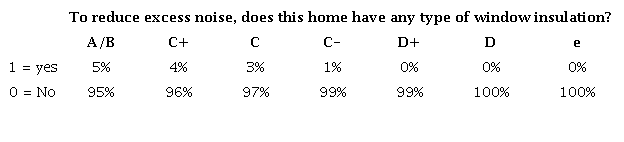
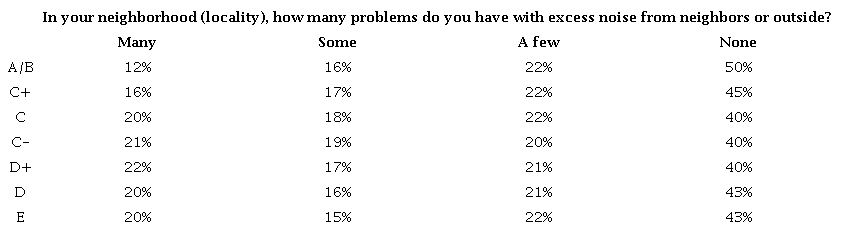
Regarding whether homes have any kind of wall or window insulation to reduce excess noise, we noticed that very few households have it. However, when contrasting with the question of whether households in their district or neighborhood (locality) have problems with excess noise from neighbors or the outside, households that reported having that problem to a greater extent were found in the lower class and poverty.

Source: Own elaboration based on ENVI 2020.
Source: Own elaboration based on ENVI 2020.
Households that reported having some or a lot of noise problems caused by neighbors were located at middle and low socioeconomic levels, while 72% of households in the high socioeconomic level mentioned having little or no problems. This may reflect a social reality where high socioeconomic levels tend to live in exclusive neighborhoods where excess noise is not allowed or where large gatherings that can generate noise and discomfort among neighbors are prohibited.
Source: Own elaboration based on ENVI 2020.
Robberies
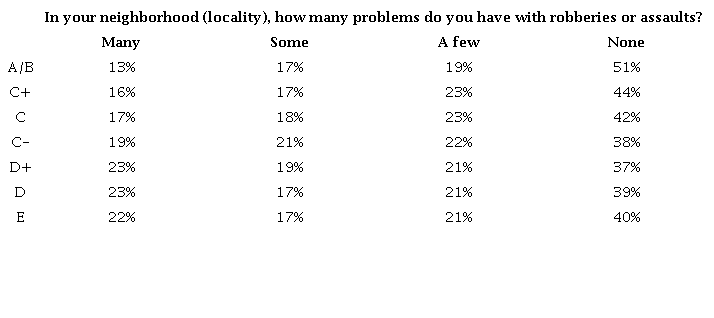
The effect of living in an insecure context has consequences in society such as decreased life satisfaction and the erosion of social capital and happiness. In addition, the perception of insecurity violates people’s quality of life, as they stop carrying out daily activities such as going out at night, carrying cash, restricting minor children from going out, not carrying debit or credit cards, taking taxis, visit relatives or friends (Romero, 2014; Reid et al, 2020; Piroozfar et al, 2019), likewise, the perception of insecurity has negative effects on well-being, especially negative subjective well-being (Charles-Leija et al, 2019; Janssen et al, 2021) because this type of well-being rises with the increase in the perception of insecurity.
In the case of analyzed households, regarding the question of whether in their locality or neighborhood, they have robbery or assault problems, again the households in the lower-class levels and a situation of poverty are the ones who experience this type of problem. Analyzing more thoroughly, the places where these types of homes are located, in many cases, are areas where the maintenance and lighting of public spaces (such as parks or avenues) are absent, and therefore, there is a greater probability that there is a crime and go unnoticed.
Source: Own elaboration based on ENVI 2020.
Trash
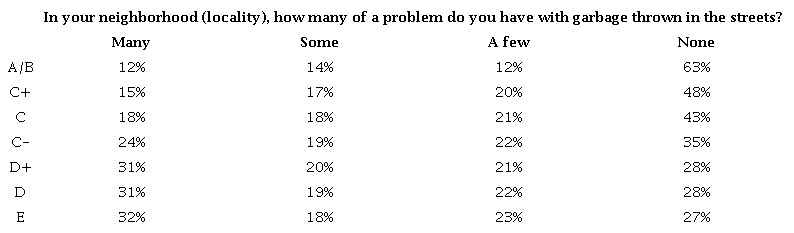
Waste exposure is a problem that affects human health, likewise, inadequate storage or disposal of waste creates favorable environments for the reproduction of rodents and insects (flies, cockroaches), many of which act as vectors in disease transmission. In the case of the question: how many problems do you have with garbage thrown in the streets? The socioeconomic levels that have this very marked problem are those located in the lower middle class and poverty situation, generally, these population groups do not have a regular home collection, and the waste produced is deposited in the surroundings, which generates a deteriorated environment.
Source: Own elaboration based on ENVI 2020.
Results of the econometric model
To carry out the statistical analysis, the RStudio (2020) programming language has been used in its latest version. The results estimation of the Ordered Probit Model is presented in Table 17, in which it can be observed that the coefficients associated with the factors of the immediate environment are statistically significant, and therefore they are variables that do have an influence -according to the evidence - on the probabilities of housing satisfaction. On the other hand, the coefficients associated with the internal variables were statistically significant except for whether or not there was a laundry room.
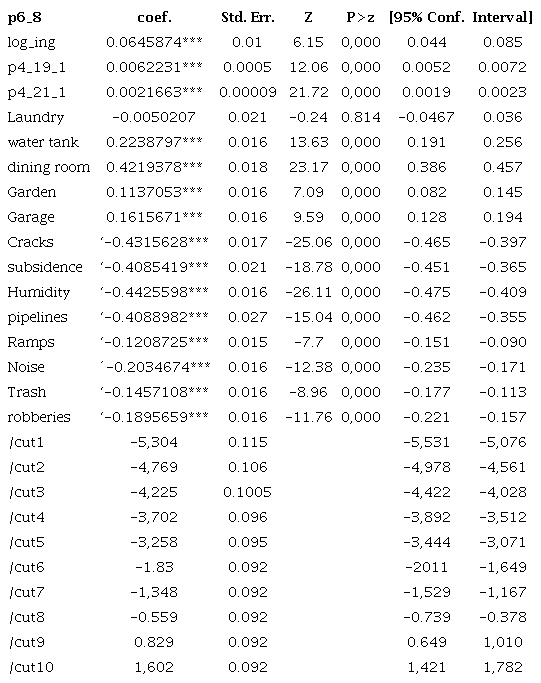
Own elaboration based on the ENVI, 2020. Note: (*), (**), (***indicates significant coefficients at 10%, 5%, and 1% respectively.
The direction and magnitude in which these variables influence the probabilities of mobility can be analyzed in greater detail in the context of the estimation of marginal effects that are presented in the following subsection.
Estimation of marginal effects
As we have mentioned, an important part of this research consists of estimating the marginal effects. To measure the impact of each explanatory variable on the probability that a household is satisfied with their home. The results of the estimation of the marginal effects are shown in Table 17.
The first thing we can notice in these results is that practically all the marginal effects are statistically significant. Now, considering that analyzing the direction and magnitude of these average marginal effects is very important to understand the evidence against or in favor of some of the hypotheses proposed by the theoretical review, we proceed to carry out this analysis in more detail.
-
Marginal effects of immediate environment variables: We can say that having problems with excessive noise from neighbors or the exterior decreases the probability of satisfaction by 4.09 percentage points. On the other hand, having problems with garbage thrown in the streets decreases satisfaction with the housing by 2.9 percentage points.
-
Marginal effects of internal housing variables: It is stated that having a garden in the home increases the probability of satisfaction by 2.28 percentage points, while the dining room does so by 8.4 percentage points. Problems with humidity or water leakage in foundations, walls, or roofs, decrease the probability of satisfaction by 8.2 percentage points, while cracks decrease by 8.6 percentage points and problems with water or sewer system inside the house by 8.2 percentage points.
Findings
The present investigation was the first econometric effort to measure residential satisfaction, where each variable analyzed showed its particularities, however, to expose some of the main findings in a very synthetic way, the following is mentioned:
The problem of excessive noise around the home decreases the probability of home satisfaction by 4.09 percentage points, retaking the data, we find that this situation occurs particularly with low-income homes, however, few homes reported having protection to inhibit noise outside the house.
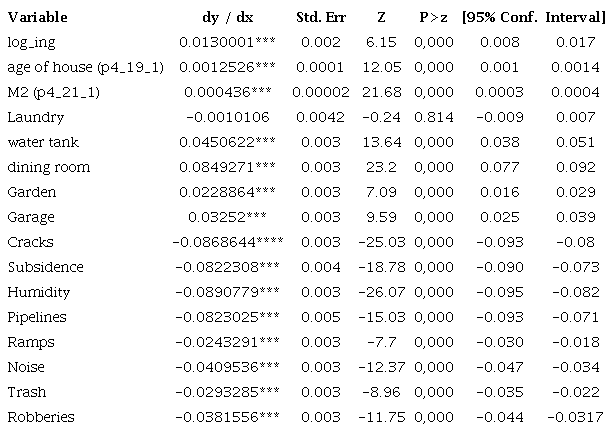
Having a garden at home increases satisfaction by 2.8 percentage points. Having a garden provides a fresh atmosphere at home, as well as being an amenity, it allows one to relax and reduce stress. This result is similar to what has been mentioned by Ruiz (2012). The garden is an element that provides ecosystem services to homes and is a determinant of comfort.
Having humidity problems decreases satisfaction by 8.2 percentage points, we consider that the intensity of this impact may be because its consequences are more visible in the home since it generates the appearance of germs and bacteria, it is also noticeable on the walls.
The problem of subsidence in housing decreases the probability of satisfaction by 8.2 percentage points.
As income increases, the probability of satisfaction increases by 1.3 percentage points. On the other hand, the variables of house antiquity and square meters did not have a significant impact on the satisfaction of the dwelling.
These are some of the findings obtained, however, it should be noted that this research only focuses on the internal factors of the home and its immediate environment, social factors (related to households), and macro issues (social conditions and cultural, political, local, national) are not contemplated.
Conclusions
This research tried to highlight some variables and relationships that should be considered when analyzing satisfaction with housing. The contributions of this study also demonstrate the conditions in which some of the households in Mexico live, particularly those with lower incomes, which present a series of structural problems in their homes, referring to them as inadequate housing, mainly due to lack of functionality, insecurity of construction systems and materials.
The importance that housing represents as one of the country’s priority problems is that some indicators of the sustainable development objectives depend on it, particularly objective 3, which guarantees a healthy life and promote well-being for all at all ages. For this purpose, homes with adequate facilities contribute directly to the reduction of diseases and the physical and mental well-being of their occupants. Similarly, it contributes to objective 11, which aims to make cities more inclusive, safe, and resilient. Adequate housing helps ensure access for all people to suitable, safe, and affordable housing and basic services and improves slums.
Finally, it is necessary to reflect that housing is much more than a simple built space. In addition, it entails the intervention of many actors, among them, public institutions of the federal, state, and municipal government: investors, developers, builders, material suppliers, and associations. Actually, in Mexico, the challenge is to guarantee decent and adequate housing and improve the quality of life of all people. To achieve this, it is necessary: first, to measure the current needs and, second, to promote public policy strategies in housing matters. All this, ensures people-centered approach.
Likewise, strategies for the implementation of an Official Standard on habitability in housing and cultural adaptation must be carried out. Taking into consideration the particular needs of each territory and integrating environmental variables. Having this Official Standard can help not only the country but also serve as an example for other countries to implement actions on adequate housing, mainly in Latin American countries where thousands of people live in poverty.
Declaration of conflicting interests
The author(s) declared no potential conflicts of interest with respect to the research, authorship, and/or publication of this article.
References:
Addo, I. A. (2016). Assessing residential satisfaction among low income households in multi-habited dwellings in selected low income communities in Accra. Urban Studies, 53(4), 631-650. https://doi:10.1177/0042098015571055
Alnsour, J. A., & Hyasat, A. S. (2016). Residential satisfaction with low income housing in Jordan: Salt city as a case study. Jordan Journal of Economic Sciences, 3(1), 31-44.
Amerio, A., Brambilla, A., Morganti, A., Aguglia, A., Bianchi, D., Santi, F & Capolongo, S. (2020). COVID-19 lockdown: housing built environment’s effects on mental health. International journal of environmental research and public health, 17(16), 5973. DOI: 10.3390/ijerph17165973.
Andini, M., Dewi, O. C., & Marwati, A. (2021). Urban Farming During the Pandemic and Its Effect on Everyday Life. International Journal of Built Environment and Scientific Research, 5(1), 51-62. https://doi:10.24853/ijbesr.5.1.51-62
Asociación Mexicana de Agencias de Inteligencia de Mercado y Opinión. (2022). Nivel Socioeconómico AMAI 2022. Consulted on February 2, 2023 at: Consulted on February 2, 2023 at: https://amai.org/descargas/Nota_Metodologico_NSE_2022_v5.pdf
Baltagi, B. H. (2021). Limited Dependent Variables and Discrete Choice Modelling. In Oxford Research Encyclopedia of Economics and Finance.
Cameron y Trivedi. (2005). Micro econometrics Methods and Applications. United States of America: Cambridge University Press.
Chan, S. M., & Wong, H. (2022). Housing and subjective well-being in Hong Kong: A structural equation model. Applied Research in Quality of Life, 17(3), 1745-1766 https://doi:10.1007/s11482-021-10000-4
Charles‐Leija, H., Aboites, G., & Llamas, I. (2019). Violence in the Household and Happiness in Mexico. Australian Economic Review, 52(2), 200-211. https://doi:10.1111/1467-8462.12298
Córdova Canela, F. (2021). Participación social en el desarrollo de estrategias para mitigar la problemática de la vivienda abandonada. Academia XXII, 12(23), 82-107. https://doi:10.22201/fa.2007252Xp.2021.23.80161
Duan, J., Tian, G., Yang, L., & Zhou, T. (2021). Addressing the macroeconomic and hedonic determinants of housing prices in Beijing Metropolitan Area, China. Habitat International, 113, 102374. https://doi:10.1016/j.habitatint.2021.102374
Dunnett, N., & Qasim, M. (2000). Perceived benefits to human well-being of urban gardens. HortTechnology, 10(1), 40-45. https://doi:10.21273/HORTTECH.10.1.40
Firdaus, G., & Ahmad, A. (2010). Noise pollution and human health: a case study of municipal corporation of Delhi. Indoor and built environment, 19(6), 648-656. https://doi:10.1177/1420326X10370532
Forrest, R., Murie, A., & Williams, P. (2021). Home ownership: Differentiation and fragmentation. Routledge.
Gidlöf-Gunnarsson, A., & Öhrström, E. (2007). Noise and well-being in urban residential environments: The potential role of perceived availability to nearby green areas. Landscape and urban planning, 83(2-3), 115-126. https://doi:10.1016/j.landurbplan.2007.03.003
Greene W (2005) Econometric analysis. Upper Saddle River, NJ, Prentice-Hall.
Hamehkasi, M. (2016). Effects of low humidity on comfort, health, and indoor environmental quality: literature review.
Hernández-Rejón, Elda Margarita. (2010). El problema de la vivienda marginal en México. El caso de los asentamientos humanos periféricos en el sur de Tamaulipas, México. Universitat de Barcelona.
Ibem, E. O., Ayo-Vaughan, E. A., Oluwunmi, A. O., & Alagbe, O. A. (2019). Residential satisfaction among low-income earners in government-subsidized housing estates in Ogun State, Nigeria. In Urban Forum (Vol. 30, No. 1, pp. 75-96). Springer Netherlands. https://doi:10.1007/s12132-018-9337-4
Instituto Nacional de Estadística y Geografía e Informática. (2020). Encuesta Nacional de Vivienda ENVI 2020. Consulted on February 5, 2023 at: Consulted on February 5, 2023 at: https://www.inegi.org.mx/programas/envi/2020/
Janssen, H. J., Oberwittler, D., & Koeber, G. (2021). Victimization and its consequences for well-being: A between-and within-person analysis. Journal of Quantitative Criminology, 37(1), 101-140. https://doi:10.1007/s10940-019-09445-6.
Kowaltowski, D. C., da Silva, V. G., Pina, S. A., Labaki, L. C., Ruschel, R. C., & de Carvalho Moreira, D. (2006). Quality of life and sustainability issues as seen by the population of low-income housing in the region of Campinas, Brazil. Habitat international, 30(4), 1100-1114. https://doi:10.1016/j.habitatint.2006.04.003
Kroesen, M., Molin, E. J., Miedema, H. M., Vos, H., Janssen, S. A., & Van Wee, B. (2010). Estimation of the effects of aircraft noise on residential satisfaction. Transportation research part D: Transport and environment, 15(3), 144-153. https://doi:10.1016/j.trd.2009.12.005
Kshetrimayum, B., Bardhan, R., & Kubota, T. (2020). Factors affecting residential satisfaction in slum rehabilitation housing in Mumbai. Sustainability, 12(6), 2344. https://doi.org/10.3390/su12062344
Lampert, T., Costa, J., Santos, O., Sousa, J., Ribeiro, T., & Freire, E. (2021). Evidence on the contribution of community gardens to promote physical and mental health and well-being of non-institutionalized individuals: A systematic review. PLoS One, 16(8), e0255621. https://doi:10.1371/journal.pone.0255621.
Martínez, Patricia., Sarmiento, P., y Urquieta, W. (2005). Evaluación de la humedad por condensación dentro de viviendas sociales. Revista INVI, 20(55). https://doi:10.5354/0718-8358.2005.62167
Méndez, T. A., León, B. A., y González, R. M. B. (2012). Características físicas de la vivienda popular en la periferia urbana de Tuxtla Gutiérrez, Chiapas, México. Quehacer Científico en Chiapas, (4), 4-13.
Merino, M. A. O., Andrade, R. J. C., Guagua, E. A. C., Aguiar, C. A., & Salazar, S. A. C. (2019). Acoustic pollution and its incidence in population health along Alejo Lascano Avenue in Jipijapa city-Ecuador. Dominio de las Ciencias, 5(1), 538-559. https://doi.org/10.23857/dc.v5i1.876
Munkin, M. K., & Trivedi, P. K. (2008). Bayesian analysis of the ordered probit model with endogenous selection. Journal of Econometrics, 143(2), 334-348.
ONU Hábitat (2010). El derecho a una vivienda adecuada. Folleto Informativo núm. 21/ Rev. 1. Ginebra: Oficina del Alto Comisionado de las Naciones Unidas para los Derechos Humanos/ONU-Hábitat. Available at: https://bit.ly/2O9AZn9.
Ortiz, E. (2012). Producción social de la vivienda y el hábitat. Bases conceptuales y correlación con los procesos habitacionales. Hábitat International Coalition, México: Oficina Regional para América Latina.
Piroozfar, P., Farr, E, Aboagye-Nimo, E, Osei-Berchie, J. (2019). Crime prevention in urban spaces through environmental design: A critical UK perspective. Cities, 95, 102411.
Poeta, S., Gerhardt, T., & Stumpf Gonzalez, M. (2019). Análisis de precios hedónicos de viviendas. Revista ingeniería de construcción, 34(2), 215-220.
Reátegui, A. (2018). Determinantes de la satisfacción familiar con la vivienda en segmentos de bajos ingresos: El rol del subsidio del Estado. Barcelona, España: Universidad Ramón Llull.
Reid, I. D., Appleby-Arnold, S., Brockdorff, N., Jakovljev, I., & Zdravkovi‐, S. (2020). Developing a model of perceptions of security and insecurity in the context of crime. Psychiatry, psychology and law, 27(4), 620-636. https://doi:10.1080/13218719.2020.1742235
Romero, D. (2014). Insecurity or perception of insecurity? Urban crime and dissatisfaction with life: Evidence from the case of Bogotá. Peace Economics, Peace Science and Public Policy, 20(1), 169-208. https://doi:10.1515/peps-20130057
RStudio Team (2020). RStudio: Integrated Development for R. RStudio, PBC, Boston, MA URL http://www.rstudio.com/.
Ruiz E. (2012). El jardín como elemento integrador del hombre en la metrópoli. Arte, Individuo y Sociedad, 24(1),147-157. https://doi:10.5209/rev_ARIS.2012.v24.n1.38049
Sousa G, Eduardo. (2010). De la ciudad a la metrópoli. Una interpretación teórica del fenómeno expansivo ligado a la vivienda, a la vulnerabilidad y a la pobreza: el caso del área metropolitana de Monterrey, Nuevo León, México. Revista INVI, 25(69), 19-101. https://doi:10.4067/S0718-83582010000200002
United Nations General Assembly (1948). The Universal Declaration of Human Rights (UDHR). New York: United Nations General Assembly.
Urrea Zora, M. A., y Cárdenas Mazo, N. (2019). Un modelo espacial de precios hedónicos y calidad de vecindario: una aplicación para Medellín, Colombia (Tesis de Licenciatura, Universidad EAFIT)
Wang X, Kockelman K (2005) Occupant injury severity using a heteroscedastic ordered logit model: Distinguishing the effects of vehicle weight and type. Transportation Research Record 1908: 195-204.
White, M. P., Alcock, I., Grellier, J., Wheeler, B. W., Hartig, T., Warber, S. L., ... & Fleming, L. E. (2019). Spending at least 120 minutes a week in nature is associated with good health and wellbeing. Scientific reports, 9(1), 1-11.
Zhang, F., Zhang, C., & Hudson, J. (2018). Housing conditions and life satisfaction in urban China. Cities, 81, 35-44. https://doi:10.1016/j.cities.2018.03.012
Zhang, H., & Yoshino, H. (2010). Analysis of indoor humidity environment in Chinese residential buildings. Building and Environment, 45(10), 2132-2140. https://doi:10.1016/j.buildenv.2010.03.011